
I believe the title of my first election day-oriented post, “I Care Not How. Only If.” , was accurate when it appeared in 2014, but it certainly would not be now. I backed off from my sincerely held “every vote’s a good vote” stance in 2018 by changing the title to the embarrassingly unsatisfying “I Care Less About How You Vote Than If”. Here’s hoping I can stand behind and be comfortable with this new title for a while.
We fought a war to get this country going, then gave every land-owning white male above the age of twenty-one the right to vote. A little more than fourscore years later, we fought a war with ourselves that cleared the way for non-whites to vote. Several decades of loud, disruptive, and sometimes dangerous behavior brought the granting of that same right to non-males a half-century later, and another half-century saw the voting age lowered to eighteen after a decade or so of protests and demonstrations.
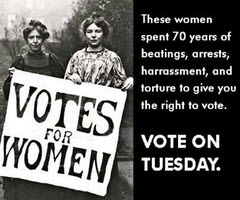
Of course, putting something in a constitution does not automatically make it a practice throughout the land, and I am painfully aware that resistance followed each of those changes and that efforts to make voting extremely difficult for “the other side” are ongoing today. I don’t want to ignore partisan obstructions and system flaws, but neither do I want to get hung up on them. I meant my first paragraph to be a reminder that a hell of a lot of effort, property, and lives have gone into providing an opportunity to vote to a hell of a lot of people. Far too many of those opportunities go unused.
My 2014 election post was triggered almost entirely by the USA’s abysmal record on voter participation. Subsequent posts have suggested that we might be getting better, but that’s not holding up. A smaller percentage of eligible voters participated in the 2024 presidential election than the one previous — 64% vs. 66%. Same with the 2022 and 2018 midterms — 46% vs. 50%. In the 2024 version of this post, I noted that the real problem appeared to be registration rather than voting. The gap between the number registered and the number voting is much smaller than the gap between the voting-age population and those registered. I’ve not found updated numbers for all that, but there are solid indications that the situation has not changed. This post goes up too late to include “Register” in the checklist in the title. The things in that list can all be practiced right up to the point you mark your ballot. “Question” and “Think” are clearly the most important, and they apply to everything that you “Read” or “Listen” to. Maybe they apply to campaign ads more than anything else. The purpose of campaign ads is not to inform or even misinform, although it sometimes seems like it. Their purpose is to persuade. Question them. Think about them.
I first posted the core of this article in 2014. In the original title, I claimed to not care how anyone votes. That was never entirely true, of course. I have my favorite candidates and issues. I’ll be disappointed in anyone who votes differently than I do, but not nearly as disappointed as I’ll be in anyone who doesn’t vote at all. I’m reminded of parents working on getting their kids to clean their plates with lines like, “There are hungry children in China who would love to have your green beans.” I’m not sure what the demand for leftover beans is in Beijing these days, but I’m pretty sure some folks there would like to have our access to ballots and voting booths.