A Capitol Encampment

I have already taken advantage of two Ohio Goes to the Movies events, and I doubt those will be the last. But Ohio is doing a lot more than showing movies to mark the semiquincentennial of the signing of the United States Declaration of Independence. One of the many events organized by America 250 – Ohio was something called American Revolution in the Ohio Country, which took place Wednesday on the grounds of the state capitol in Columbus. Ohio was not a charter member of the USA, but we did join up fairly early on. Plus Fort Laurens near Bolivar, OH, was built and occupied during the American Revolution, and the Battle of Picawey, near Springfield, OH, is considered part of that war. Wednesday’s encampment did not attempt to recreate any specific event, but to offer a glimpse at life in the 1770s.

It was a few minutes past the 10:00 start time when I reached the plaza on the west side of the Capitol. I’d parked a couple of blocks to the east, and this was what I saw when the gathering first came into view. I sensed at once that I was late. I heard but did not see cannons or muskets firing, and may have missed some sort of opening ceremony.

Shortly after I reached the open space beyond the tents, the men who, I assume, had been making the booms I heard closed ranks and marched away. I would get to hear and see these fellows and others do a lot more booming before the day was over, but for now, a shot of them passing by was all I got.

But I did get to see the day’s first performance from Heritage Fife and Drums in its entirety. They started at the far side of the plaza lawn, then marched up to the crowd, where their leader enthusiastically introduced each song.

More music followed. This music was recorded and played through speakers so these energetic folks could dance to it. The second picture is of a quadrille (4 couples, 8 people), which Americans in the next century turned into square dancing with cowboy boots and no French accent.

Having read that there would be “samples of food from the revolutionary time”, I anticipated things unfamiliar and bizarre, but the most bizarre thing about the offerings was that stuff that I thought quite modern was being served in the 18th century. When I mentioned my surprise, the lady tending to the “Mini Beef in Crust”, which I picked as one of my two samples, told me that “Swedish Ham Meatballs” had been served at Mount Vernon, and that “Shrimp & Grits”, my other sample, had been popular in the Carolinas back in the day.

Inside one of the tents, a fellow explained 18th-century maps and mapmaking. There were also displays of more common items of the period.

While I was listening to the fifers & drummers, watching the dancers, and sampling the samples, the soldiers had been relaxing and answering questions from the curious. Now they lined up and began marching back to the open lawn. It was about to get noisy.

After marching to the far side of the lawn, both the militia and the uniformed regulars fired several volleys. (Note that the day this is being posted, April 19, 2026, is the 251st anniversary of men dressed and armed much like those in the first photo confronting British troops at Lexington and Concord.) Then the regulars begin moving toward the crowd. Half the group marched several paces ahead of the others and fired. They would then reload while the other half advanced and fired. Then, after crossing much of the lawn in this fashion, they all lowered their bayonets and charged,

Following that bayonet charge, the reenactors marched back to the tents for a bit of a break, but eventually returned to roll out the big guns. Here‘s a better look at the thin white object tucked into the hat of the fellow standing in the center of the third photo. I spotted him smoking the pipe just moments after watching another reenactor semi-stealthily puffing on a cigarette. I approached and commented about how much better the pipe looked. Yes, he agreed, he tried to appear accurate, and, yes, it was clay, and yes, he had made it himself.

Of course, any smoke produced by hand-made clay pipes or machine-rolled cigarettes was nothing to that produced by the battery of 3-pound cannons. Perhaps this, too, is part of trying to appear accurate.


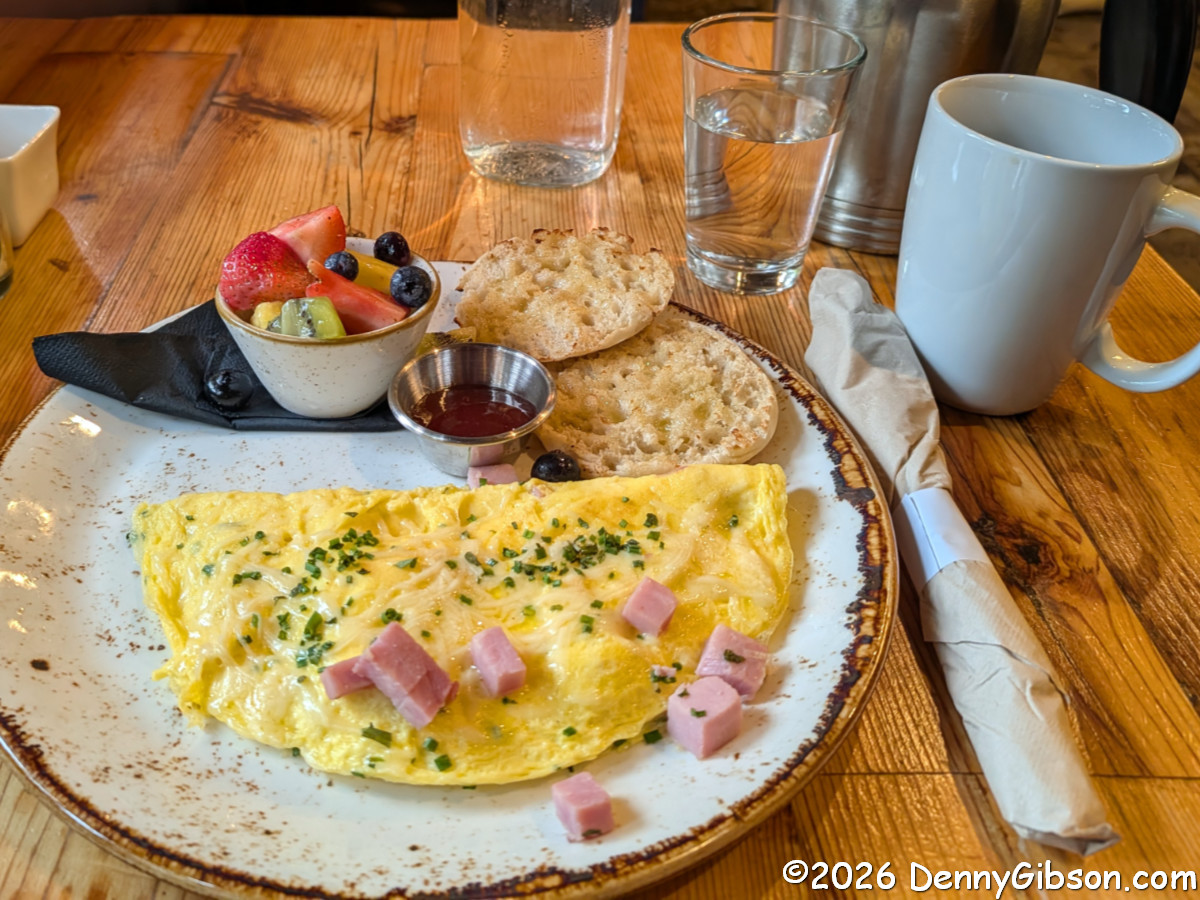
Those samples of delicacies from 250 years ago were not the first things I had to eat on Wednesday. In the not-too-distant past, from a source I can’t remember, I’d heard of a great-sounding breakfast spot in Columbus named Katalina’s. I may or may not have known that Katalina’s had appeared on Diners, Drive-Ins and Dives. In any case, I had not seen the episode. If I had, I would have known that it was recorded at Katarina’s Too. I went to the original on Pennsylvania Ave. There is now a Katarina’s Tres also. I’ll try to keep an open mind, but I can’t imagine that either of the others is anywhere near as cool as the original.

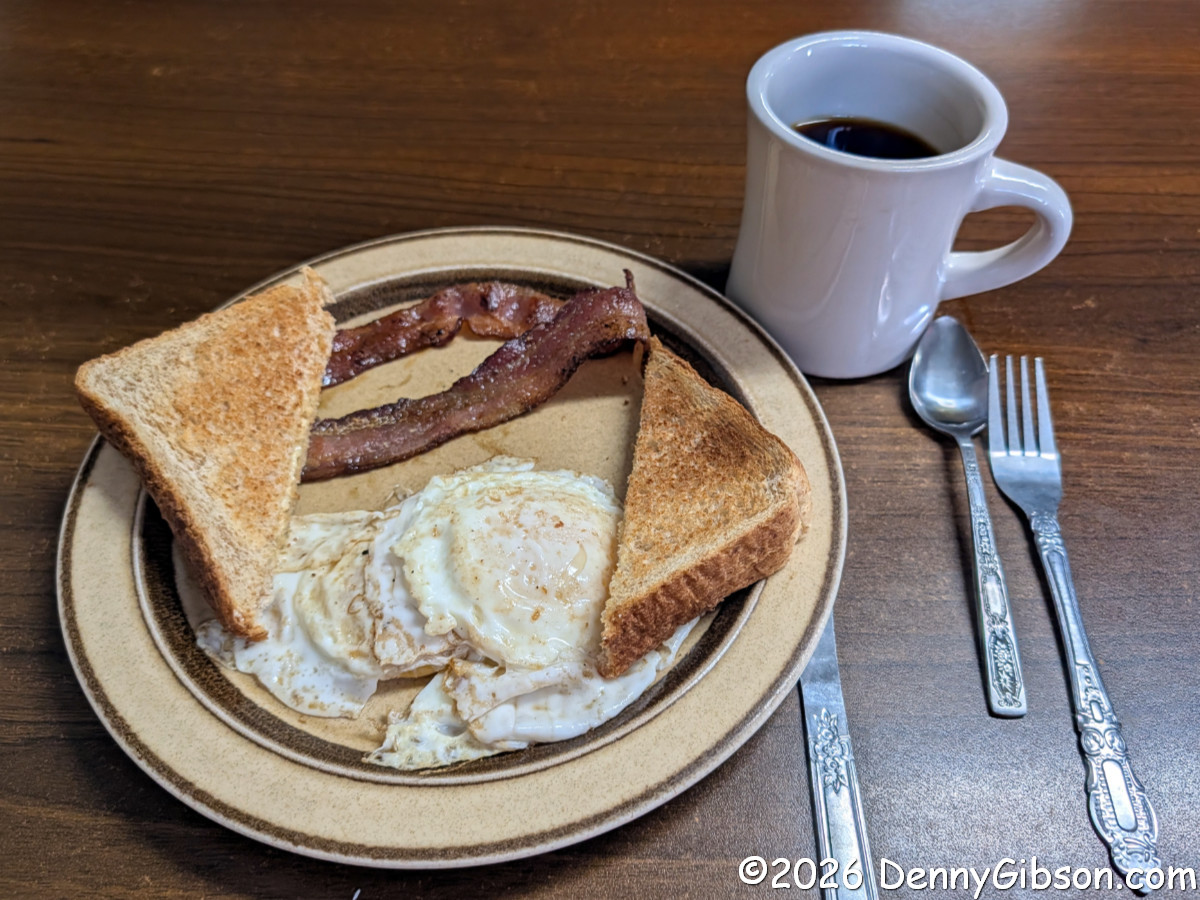
Another thing I could have learned from the D, D and D episode was how to eat the signature and absolutely delicious Pancake Balls. I briefly considered pouring the real Maple syrup on the Nutella-filled balls like I would on a flat pancake, but decided that probably wouldn’t work. I proceeded to tear pieces from the balls with fingers and fork, and dip the impaled pieces into the syrup. I’ve now seen the video and know that holding a ball in your fingers, dipping it into the syrup, then taking a bite, is what the cool kids do. Next time, I’ll be cool, too. I was already cool enough to use my fingers to eat the best bacon I’ve ever met.

Movie Review
Janice Meredith
E. Mason Hopper

Like February’s showing of The Wizard of Oz in Wilmington, this showing of Janice Meredith was part of Ohio Goes to the Movies. And like my review of that event, this post is not really a review of the movie, but of the overall experience. On the other hand, since I’m quite certain that readers are nowhere near as familiar with Janice Meredith as they are with that Oz movie, and because it is pretty impressive, I’ll not ignore the film completely.

The venue for the showing was the Arcanum Opera House, built in 1889. Arcanum is a small town not far from Greenville, where actor Walter Law spent his formative years before moving to Dayton. Law appears in Janice Meredith, which is the connection to Ohio that led to its inclusion in the Ohio Goes to the Movies schedule.

The building served its original purpose until 1928, then played a variety of roles before being put to use housing Arcanum’s village offices. When the village government planned to construct a new building for their offices and move out, the opera house was in serious danger. The construction did happen, and the opera house was vacated in 2020, but a group was formed in 2019 to save it. The Arcanum Preservation Society has plans to restore the building and has made some serious progress in that direction.

Walter Law appeared in more than 40 movies during his career. His earliest film work was with Fox Film in New Jersey. He moved to Hollywood in 1920 and continued his career there. He most often appeared in supporting roles, and that is the case here. Law plays General Charles Lee, one of General Washington’s subordinates. That was essentially the entire description of his character I had on Friday, and I did not spot any reasonable candidates during the opera house screening. Although the quality isn’t nearly as good as what we saw on Friday, the movie is available on YouTube, so, armed with a somewhat better description of the character, I made a serious attempt to find him by picking out and studying scenes with Washington. No luck. I know he’s in there somewhere, but I can’t tell you where. I can tell you where that basket on the left side of the picture ended up. I was there with friends Terry and Sue. Everyone was given numbered tickets when we arrived, and Sue’s number won her a nice movie-watching kit.

Prior to Friday, about all I knew of the film was that it was a romance set during the American Revolution. Just before Friday’s showing, I learned it was “a little longer than most silent films”, and later learned that meant 11 reels or 140 minutes. But it wasn’t just its length that set the movie apart. It was a true epic with scenes of big battles and social gatherings, and extended shots tracking galloping horses, including Paul Revere’s. There is notable comic relief aided by W.C. Fields’ first motion picture appearance. Following the battle at Lexington, three of the wounded — or maybe ghosts of those killed — arise and form the trio of Archibald Willard’s Spirit of ’76 and march toward the camera while subsequent battles appear below them.

By the film’s end, I could not help but think this was the Gone with the Wind of the silent era. Like the Civil War epic released just fifteen years later, Janice Meredith features the beautiful daughter of a wealthy landowner, in love with an unconventional fellow whom her father definitely does not approve of, all while the war rages around her. It’s not entirely the same, though. When Janice Meredith ends, its protagonists are about to be married rather than separated, and this time the rebels win.

Not My Father’s Library

Nor is it my son’s library. The following generation will certainly benefit from Hamilton County’s Building the Next Generation Library project, but it is the one after that which seems poised to take advantage of the full range of library advances being made by the project. For a guy who once saw weekly bookmobile visits and encyclopedia yearbooks as state-of-the-art information access, what I saw Saturday at Symmes Township Branch Reopening was pretty mind-boggling.

The Symmes Township Branch is the one closest to where I live. It was closed and demolished about a year and a half ago so that a new building could be constructed on the site. During that period, this storefront was rented to provide physical access to the branch. Even though the temporary location was even closer to me than the permanent one, I was never inside. To be honest, I haven’t visited the library all that often, but I sure do appreciate it being there.

This is the new library building. I believe it is bigger than the old one, and they seem to have added quite a bit of parking, too. Maybe they bought more land. I’m not at all up on the details. When I arrived around noon, the parking lot was nearly full, but there were a few open spots, and people were coming and going regularly, which kept it in a steady state. Apparently, that had not always been the case because quite a few cars were parked at the nearby school with people walking over the grassy area between the school and library.

Here are some indicators that this is not a normal day at the library. Although it was not all that loud, Richard Goering was playing live. Additional entertainment was scheduled throughout the day. And refreshments were available in one of the side rooms. There was also a table filled with snacks, but the room was filled with people, so I skipped more photos. As I sipped some lemonade, I commented to a staff member that this blew a big hole in the “no food or drink” rule, and she replied, “Oh, we dropped that a long time ago. We trust people.”

I was familiar with the MakerSpace concept from the main library in downtown Cincinnati and knew that MakerSpaces had been established at a few of the branches. Now my branch has one. A MakerSpace contains various creative tools that patrons can use for just the cost of materials. These pictures show a photo printer, 3-D printer, flatbed scanner, and vinyl printer.

The place was really crowded, which made me reluctant to take many pictures inside, especially since children made up a major portion of the crowd. But I did grab one picture to show that lots of digital media is available in addition to rows of old-fashioned books with paper pages. And how about the cool outdoor reading room? The other exterior photo is an attempt to offer a glimpse of the children’s play area without actually showing the children

I think this Next Generation Library is going to be a hit — even for some whose generation is decidedly previous.

A Sudsy Season of the Fish

I suspect that Lenten fish fries are perceived as having a bigger presence on this blog than is actually the case. And the perceived presence of church fish fries may be off even more. The first “season of the fish” post was in 2014, and it was nine years before the second one came along. I ate fish at quite a few churches between the two, and before the first one, but that 2014 Must Be the Season of the Fish post was the only one completely focused on religious organization fundraisers. It was in the middle of 2023’s Another Season of the Fish that I decided to focus on anything but.

The “season of” posts have appeared in years when I managed a Lenten-related meal on all seven qualifying Fridays. Apparently, that is something I’ve targeted more in recent years, as this is the fourth consecutive such post. In 2014, I indicated I’d started getting serious about fish fries three years prior, and mentioned that it was “a nice break from eating at establishments practicing commercialism full time.” That is something I’ve kept in mind even after moving away from churches. Since then, I’ve targeted American Legion posts, VFWs, and similar organizations. But not this year.

On Ash Wednesday, the first day of Lent, local beer aficionado, The Gnarly Gnome, published a blog post that really caught my attention. That post, Cincinnati Brewery Lent Specials, 2026, listed local breweries with Lenten specials, and that made sense to this old brewery hunter. So this year, I embraced rather than avoided “establishments practicing commercialism full time” — as long as they are makers of beer.

On the first Friday of Lent, I was in Kentucky for something totally unrelated and decided to hit a brewery on that side of the river. Alexandria Brewing Company‘s offering was fried cod on a Cubano roll. The $19.95 price was a rather sobering indicator of what inflation hath wrought. It was quite good, but I eventually decided that there was just too much bread and stripped off the Cabano and downed the last half with a fork. Live Fast, On High oatmeal stout washed it all down nicely.

Week two found me in Greenville, OH, so I stopped at the northernmost candidate on the way home. The $12.00 fish and fries at Lebanon Brewing Company was good, but the Most Best Barrel Aged Coconut Stout was great.

Seventy degrees and sunny was a perfect setting for a drive to the west side of town and the $15 fish basket at 13 Below Brewery. Bock season and Lent always overlap, and I’m sure that the evening’s Bockfest Parade benefited from the glorious weather. Sadly, I missed the parade, but I did not miss out on 13 Below’s Fluss Bock.

Despite it being sunny and not terribly below seventy degrees, plans for the evening ruled out a drive across town, so I chose nearby Cartridge Brewing for this week’s fishy meal. As it turns out, Cartridge has no menu items specifically for Lent, but the always available $22 fish & chips met my requirements. As you can see, it arrived while plenty of my Covert Schwarzbier remained.

Bocce Brewing Company is a nano brewery operating inside an Italian restaurant. I imagine that what is now called the brewery’s taproom was once the restaurant’s bar. Nano brewery offerings are often limited to just one or two varieties, but Bocce seems to always have a half-dozen or so beers available on tap, and I have been impressed with the ones I’ve tried. This time it was 120 Golden Lager, barely visible in the corner of the meal photo. In the center of that photo is the first seafood lasagna I have ever consumed, and it (Four-cheese lasagna with shrimp, cod and crab in a lobster sauce topped with shrimp $21) was delicious.

I went off the Gnome’s list this week. Although there is a brewery slightly closer to my home, I think of The Common Beer Company as my neighborhood beer maker. It’s a true mom & pop operation and a hotbed of friendliness. There is no kitchen or full-time food partner, but they do frequently host food trucks, and when I found out that Cousins Maine Lobster would be there on the final official Friday of Lent, I knew that would work. On one hand, $25.95 makes that a pretty pricey sandwich, but on the other, there is an awful lot of lobster stuffed into that roll. A glass of Dunkellfagus completed the meal.

Lent technically ends on Good Friday, but many of the non-commercial fundraising fish-frying folk keep their operations going, and I have always included it in my “Season of…” posts, and I wasn’t going to let a little roadtripping interfere with that. This week, I had no choice but to go off list since I was not even in the Cincinnati area. It took some online searching and some off-route driving, but I did find a brewery with fish in Cedar Rapids, Iowa. At the Third Base Brewery, I washed down the $13.99 fish and chips with Tilted Kilt Red Ale.


Not only is today Easter, but it is also the end of my 79th year of existence. Easter and my birthday last coincided in 2015, and I noted, after the fact, that it would happen again in 2026. I then forgot it until late February, when my daughter pointed it out and spared me another last-minute surprise. I also celebrated my 6th birthday on Easter and might celebrate my 90th and 101st on the big holiday as well. Of course, any celebration of those two future events will likely be fairly subdued.

Fool’s Errand

The name comes from April Fools-A-Palooza in Lucas, KS, being the first thing in the trip plan with a firm date and location. Things have been added, both before and after April Fool’s Day, and it’s entirely possible that I’ll surprise myself with itinerary additions before it is over. The first day’s journal, which reaches Kansas City, KS, has been posted.

This entry lets blog-only subscribers know about the trip and provides a place for comments. The journal is here.

Warbirds Revisited

I first visited the Tri-State Warbird Museum in the pre-blog days of 2010, when this website used things called odments to deal with non-trip topics. The oddment for that 2010 visit, which is here, attracted a couple of visitors recently, and that prompted me to reread it myself. The first paragraph mentions that both the Warbird Museum and another museum visited the same day, the Railway Museum of Greater Cincinnati, were open only on Wednesdays and Saturdays. That stuck with me so that when I was looking for something to do on a Wednesday, the Warbirds naturally came to mind.

Nearly all the airplanes on display are from World War II, including this unlikely-looking pair. Flying the Boeing-Stearman bi-wing was relatively simple. It was the first airborne step for many new military pilots. The Piper L-4H Grasshopper was the military version of the extremely popular Cub. Its ability to fly low and slow made it very useful in training, observation, medical evacuation, and more.

These three probably more closely match your idea of WWII fighting aircraft. Like the Stearman, the bright yellow North American AT-6D was a trainer, but it was used for more advanced maneuvers, such as aircraft landings. The twin-engined Beechcraft TC-45H Expeditor was originally designed as a civilian craft but was adopted by the military as a versatile transport plane. North American P-51 Mustangs were very effective as bomber escorts and served in every theater of WWII.

This North American TB-25N Mitchell might be the museum’s biggest star. It is my biggest memory, in any case. That could be because about two years after my 2010 museum visit, I saw this and 19 other B-25s in flight at the Doolittle Raiders 70th reunion. The sight of all those big planes was pretty impressive, and the sound was incredible.

ADDENDUM 27-Aug-2014: I somehow failed to mention how friendly and helpful the volunteers at the museum were, but I now get a second chance. As I originally put this post together, I noticed that the nose art on the B-25 had changed since my 2010 visit, and I reached out to the museum via email to see why. I now recall being told that a couple of the museum’s planes had appeared in movies and TV shows, but I had not paid much attention. As I quickly learned, the B-25 name change came from a movie role with another local star. The story is here.

A couple of the museum’s planes were not at home Wednesday, but every plane that was there was capable of flying except one. This Goodman Corsair is in the process of being restored, with some assembly required before it leaves the hangar.

On the way back to the museum’s front door, I climbed to the balcony to get an overhead shot then snapped one of the flight simulator area on the way down.

This isn’t a warbird, but it is the sort of vehicle my Dad piloted during the war. He was a courier. Every time I see a Jeep from that era, I think of one of the few stories he ever told of those days. During the Battle of the Bulge, snow covered the ground, which was where most soldiers slept. He considered himself lucky to have his Jeep to sleep in. He could even lie down on his side between the seats, “but I had to stand up to turn over.”

Book Review
The Last Ride of the Pony Express
Will Grant

I have read and reviewed more than a few books about modern retracings of historic routes, including some I was personally responsible for. Almost all of them involved automobiles, with the result that those doing the retracing typically traveled significantly faster than the route’s original users. For the original travelers on the route that Will Grant followed in 2019, speed was far and away the main consideration. Relay riders moved mail over the nearly 2,000-mile-long route in ten days. Grant’s main consideration was safety. About 75 horses were ridden to near exhaustion in each Pony Express run. Grant’s safety and the success of his ride depended on two horses covering the entire distance. Will, Chicken Fry, and Badger got to know each other quite well during the 142 days they spent together during The Last Ride of the Pony Express.

I’ve been to the stable-turned-museum where Grant and all of those Pony Express riders began their journies west, and I have crossed the Missouri River at Saint Joseph, but it somehow never registered with me just how close that stable was to the riverbank. The stable and the river are less than half a mile apart. When I finally realized that, my first thought was to question why the Pony Express did not just place its eastern terminus on the other side of the river. It was a dumb question that I almost instantly answered. The Missouri River marked the border of the United States in 1860. St. Joseph was on the frontier. Pony Express riders began their westward dash with a ferry ride. Will Grant began his unhurried retrace with a police escort over a bridge.

Grant was very familiar with horses from a lifetime of riding, and I suspect he was more familiar than most with the history of the Pony Express and the geography of the American West. But he became a lot more familiar with these subjects as he prepared for his ride, and he shares that knowledge throughout the book. He also shares what I see as a sense of awe at the logistics of managing the hundreds of horses and men involved in the Pony Express. Many of us see only a galloping horse and rider when thinking of the Pony Express. Some may also think of brave station masters. Grant thinks and writes about all the men, and probably a few women, responsible for a constant supply of water, hay, and other necessities to those isolated stations, for the speedy breaking of horses to be ridden, and for all the other behind-the-scenes details of keeping an operation this big and spread out functioning.

The lack of that widespread support organization might be just as big a difference between Grant’s ride and those of 1860 as the speed of travel. Grant had the benefit of modern resources, including a sometimes-connected cell phone, and numerous generous routeside residents provided meals, showers, and places to camp. But he was basically self-contained and, despite several invitations, never slept in someone’s home. Surroundings ranged from too much civilization to essentially none at all. The severe isolation of parts of the trail is illustrated by Grant arranging for six caches of water and hay to be placed along the route through the Great Salt Lake Desert to make up for the lack of staffed and provisioned Pony Express stations.

The routeside residents also provide conversation. Sometimes history is explored, and sometimes the topic is something very current. Some subjects, like corporate ranches, wind farms, and wild mustangs, have the potential to become political, but Grant somehow manages to avoid that. Not only in his real-life conversations but in his informative writings. He’s really good at sharing facts, and maybe even describing a couple of viewpoints, without letting his own opinion distort them. In fact, most opinions held by others are reported with any rough edge they might have had removed.

I enjoyed encountering place names I recognized. Just as parts of the Pony Express route followed paths marked earlier by wagon wheels, feet, and hooves, some of it would later be followed by the tires of automobiles. Saint Joseph, MO, where it started, is where the Jefferson Highway and the Pikes Peak Ocean to Ocean Highway crossed. I recognized one of Grant’s camping spots, Hollenberg Station, from having stopped there while driving the PPOO. Farther west, the Lincoln Highway has led me to Dugway, Fish Springs, and other Pony Express-connected places that Grant mentions.

At Willow Spring Station in Callao, UT, another place the Lincoln Highway has taken me, Grant pauses for a day to rest himself and the horses. The last of his arranged caches lies between Callao and the stateline and beyond that, Nevada and California. There was still a long way to go, but the big desert was essentially behind him, and the day of rest may have prompted a look back. “No one, I thought, knows the ride of a Pony Express rider, but I’d come pretty close. My time in the desert, free from the distractions of population or vegetation or paved roads, had revealed what no book had conveyed, what I could not fully articulate, but what I knew was a past informant to our current psyche.”

On September 22, 2019, 142 days after crossing that bridge in Saint Joseph, Will Grant rode Chicken Fry up to the Pony Express statue in Sacramento with Badger in tow. The three had surely traveled more than the 1,966 miles said to comprise the actual Pony Express route. I’m still not sure whether I think the Pony Express was insane or brilliant. Crossing a 1,400-mile-wide gap in our country on horseback once in ten days is an impressive accomplishment. Establishing a system to do that in both directions twice a week is incredibly so. It is commonly estimated that something like 500 horses were used. Grant’s not buying it. He thinks a number between 1,500 and 2,000 is more believable.

I doubt I have ever spent much more than an hour on horseback at any one time, and I certainly don’t intend to try it now. I gained a slight sense of what multiple days in the saddle might be like without risking snakebites, saddle sores, or wild mustang attacks, and that’s close enough for me.

The Last Ride of the Pony Express: My 2,000-mile Horseback Journey into the Old West, Will Grant, Little, Brown and Company (June 6, 2023), 6.3 x 9.55 inches, 336 pages, ISBN ‎ 978-0316422314
Available through Amazon.

Returning to the Scene

In the days of my youth, Greenville, OH, had two movie theaters. I’m sure there were differences between the two, but I recall them as interchangeable. I know that I saw new movies like The Vikings and Ben Hur at these theaters, but I can’t remember which. I do remember that I saw Gone with the Wind at the State Theater when it was re-released for the centennial of the Civil War in 1961. I also remember that the Wayne Theater was where I saw Bambi. Oh boy, do I remember.

The 1942 animated feature has been re-released multiple times. One of those was in 1957, when the Wayne Theater must have looked pretty much the same as it does in the 1956 photo above. Our parents dropped my sister and me off at the theater with admission money and probably an extra dime for a pop. I was ten; my sister was seven. As hard as it is for some to believe, there really was a time and a place where this was not considered child endangerment. As everyone now knows, Bambi’s mom meets her end fairly early in the movie. That brought my sister to tears. Unable to stop the crying, I eventually headed to the lobby with her. In time, the crying stopped, but Sis had no desire to watch any more of that horrible movie. I, on the other hand, seeing no reason for me to miss out on the big screen entertainment, returned to my seat. At movie’s end, I hastened to the lobby, where, despite assurances she would wait, my sister was nowhere to be seen. She had tired of waiting inside and was standing just outside the theater when Mom and Dad arrived to pick us up. I don’t recall any particular punishment for abandoning my sister in the lobby, but I sure got a lecture.

My attendance at both Greenville theaters dropped to zero once I moved to Cincinnati. The State Theater closed in 1980 and was demolished a few years later. The Wayne Theater divided itself into two screening areas and soldiered on. I made it back inside the Wayne in 2006 when I happened to be in Greenville on the weekend that Cars was released. I had been anticipating the movie, and saw it for the first time at the Saturday matinee. This was still the era of 35mm film. Partway through the showing, the film or projector temporarily malfunctioned, and the house lights were turned on. Kids made up most of the crowd, and they immediately turned to the projectionist and began pointing and laughing. Just like the good old days.

In 2014, the Wayne Theater and three other movie houses owned by Alan Teicher closed. The Wayne found new owners, and there was initially hope for a quick reopening. The need to convert to digital projection was part of the reason for the closure, but additional issues and expenses were soon discovered. The new owners eventually threw in the towel.

Things were looking rather grim for the Wayne when Mike Jones and his family stepped up to save it. Mike and wife, Sherri, have saved other pieces of Greenville history, including St Clair Manor, the home of Henry St. Clair. Mike took on the theater about the time that the COVID pandemic hit. It and related problems, such as supply chain disruptions, interfered with the project, but a complete renovation of the theater was completed in 2023.

In November of 2023, there was a big-time grand opening with Hollywood premier-style searchlights and other major hoopla. I wasn’t there, although I really wanted to be. I had every intention of checking out the resurrected theater ASAP. Within weeks, I thought. Worst case, within a couple of months. After just about two years and four months, I finally made it.

In early 2025, the theater began hosting Senior Movie Days with bargain prices and older movies. Many of the first-run features filling the theater’s normal schedule did not appeal all that much to this old man, and there were scheduling problems with the few that did. It seemed possible that the “classic” nature of Senior Movie Day movies would better match my tastes. They did, but it still took nearly a year for things to click. On Wednesday, a long-time friend, his wife, and an aunt of mine joined a theater-filling crowd of similarly aged folk to watch Casablanca on the big screen.

The renovated theater definitely lived up to all of the good things I’d heard. The concession stand is first class, although none of our group took advantage of it. The lobby is fresh and inviting, with a large copy of the photo at the top of this post prominently displayed. Because I got our tickets and I did not understand the layout, we found ourselves in the front row. Not to worry, as the comfortable recliners positioned us for a proper view even from there. Of all the movie joints, in all the towns, in all the world, I’m glad we walked into this one.


The year 1920 is cast into the front of the theater. I have read that it opened on April 18, 1921. While poking around the internet, I stumbled upon this photo from the Wayne’s first decade. But the photo is only part of the reason I’ve tacked this paragraph onto the end of the post. I also learned that the Wayne Theater had an American Fotoplayer when it opened. I followed that tangent to a number of videos of Fotoplayers being played, and believe you deserve to see one. Check out Stars and Stripes Forever. Not every silent movie was accompanied by a prim schoolmarm on an upright piano.

Musical Review
Wizard of Oz
Loveland Stage Company

Loveland’s got talent! That’s the phrase that came to mind to lead off this review as I left the Loveland Stage Company theater on Friday. I put it aside when I realized it was exactly how I started the review of my first visit to the theater in 2023 (Company). But it did not stay there, and in the end, being repetitive didn’t seem so bad. The amount of talent this community theater group brings together is awesome. You, I told myself, can say that again.

This is a happy time for the Wizard of Oz and me. I’ve seen the 1939 movie on TV screens numerous times, then last month, I saw it in a theater for only the second time (The Wizard of Oz). Before this month ends, I hope to visit the Oz Museum in Wamego, KS. It seems a near-perfect time for me to see the story presented live on stage for the first time ever.

Many versions of the story exist. The Loveland Stage Company’s production is based on the classic 1939 movie. Almost every difference is because a theater stage is not the same as a Hollywood sound stage. There are no horses of any color, nor is there a sty filled with pigs for Dorothy to fall into. The stage backdrop is a screen that provides views of the really big stuff. These include the tornado, Dorothy’s flight to Oz (yes, there’s a bike and a boat), the field of poppies, and even (pay attention) the Wizard flying off in his balloon. One big thing that is not a projected image, even though it was in the movie, is the Wizard. Here he is free-standing and majestic. The stage design, on what I assume is a limited budget, is truly impressive.

Most, but not all, of the differences between the movie and the stage are pragmatic omissions. There is at least one example of something in the stage production that was not in the movie. It’s a scene featuring the song Jitterbug. Although it was filmed in 1939, it did not make the final cut. The official video has been lost, but you can catch a glimpse of the scene here, even though I’m sure you’ll like the LSC version better.

Every bit of music, including the Jitterbug, comes from a ten (or maybe fourteen) piece orchestra behind that rear stage screen. The uncertainty comes from the difference between a list and individual biographies in the program. I could not count them live, of course, because they are hidden. They sound great and are a key part of the production. An awful lot of the talent behind this article’s first sentence is hidden. Check out the program to identify that hidden talent.

Of course, that program also identifies the unhidden talent. The cast of The Wizard of Oz is comprised of ten players in named roles plus a sixteen-member ensemble. Quite a few ensemble members fill individual speaking roles at various points. Loveland’s talent clearly runs deep.

Dorothy, Scarecrow, Tin Man, and Lion are played by Kelly Johnson, Derek Harper, Matt Truesdell, and Derek Foster, respectively. These four handle much of the singing and dancing, but the ensemble definitely carries its share of the load. Olivia Munro appears as Glinda, and Ginny Johnson is the Wicked Witch of the West. Jim Tobergta plays the Wizard and contributed tremendously to set design and construction. Toto is brought to life, marionette fashion, by Jonah Human. Human is probably on stage as much as any character, yet manages to be nearly invisible most of the time. There are several instances where his facial expression adds to the on-stage action; none where it detracts.

Six performances remain: Friday and Saturday evenings plus Sunday matinees for the next two weeks. At the moment, none are completely sold out, but they are all getting close. If you make it, see if you think Ginny Johnson might be channelling Margaret Hamilton in the delivery of a few of her lines, and maybe a couple of laughs, too. I did.

Drawing Board at ASM

Sketches are big in Cincinnati right now. Last month, I looked over some sketches by Rembrandt at the Taft. Yesterday, I looked over some sketches by various sign designers at the American Sign Museum. I missed Thursday’s opening reception for the ASM’s Back to the Drawing Board: The Art of the Sign Sketch 1925-1975 exhibit, but made it to Saturday’s tour by ASM founder Tod Swormstedt. The introduction placard speaks of the difference in how commercial art and fine art are perceived and invites folks to “consider what counts as art”. Early in the tour, Tod shared his oft-repeated observation that “The difference between fine art and commercial art is the number of zeros in the price.”

The exhibit is placed in what I believe is the museum’s largest event space. It marks the first use of the large movable panels made for just this purpose. The area’s walls have been used for previous exhibits, but the wheeled panels provide significantly more wall space while allowing the area to be easily cleared for dining, and dancing, and such.

Most of the sketches are placed in chronological sequence on the movable panels. A fixed wall displays a timeline of significant world events, along with examples of sign designs from the identified periods. marked times. Some of the noted events, such as the 1965 Highway Beautification Act, had a sizable direct effect on advertising and signs.

Among the things Tod pointed out as he led us through the exhibit was the start of using black backgrounds to better illustrate the impact of lighted signs and the increasing use of backgrounds and buildings rather than just the sign by itself.

Items on the exhibit’s last panel, as well as many of the previous items, can hardly be described as sketches. Some of the older sketches had truly been salvaged from trash cans and dumpsters. Some items in this photo were borrowed from collections displayed in homes and on office walls. The exhibit provides some real insight into the design and marketing of signs, but doesn’t help at all — Tod’s “zeros” comment notwithstanding — in distinguishing fine art and commercial art.


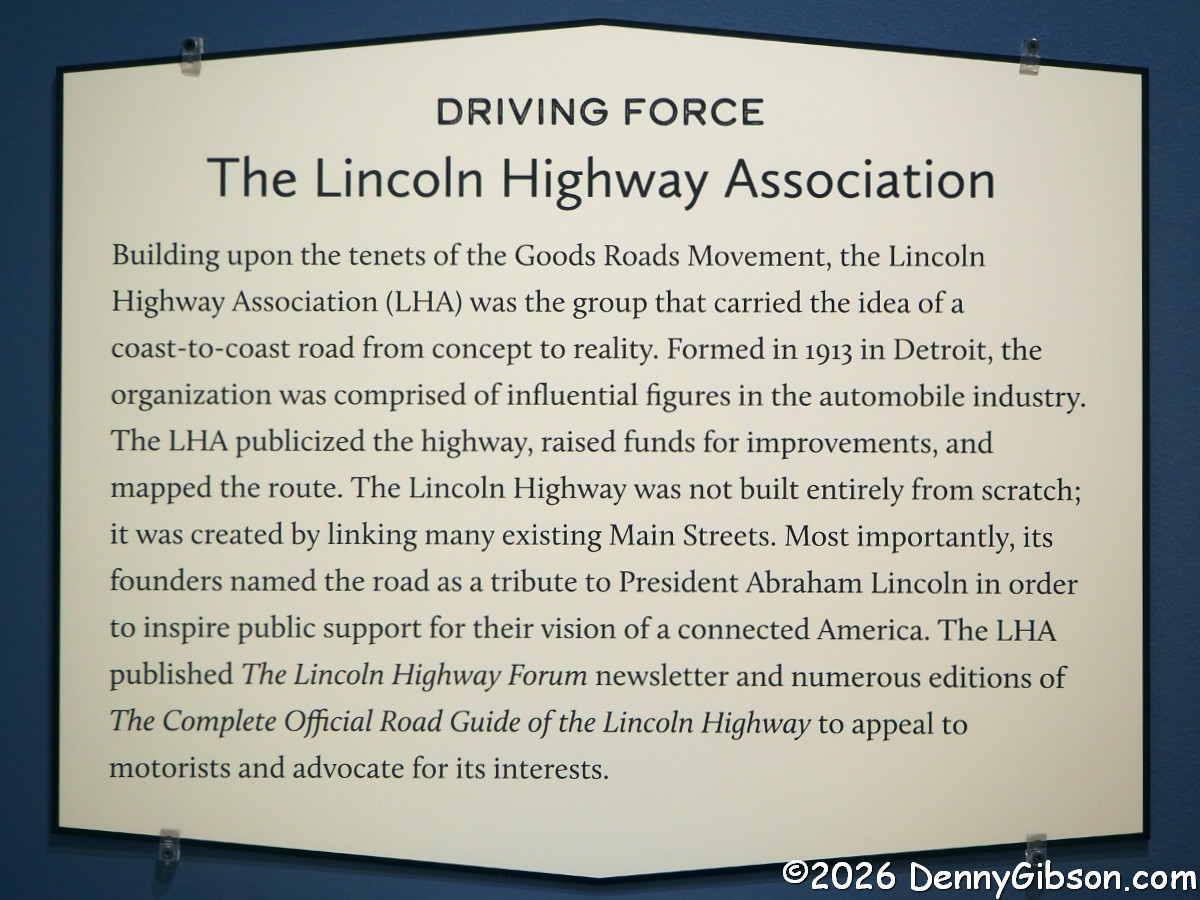
This picture has nothing at all to do with the Back to the Drawing Board exhibit. It is a detail from the billboard reproduction advertising the Lincoln automobile in the background of the last exhibit-related photo that might interest my named-auto-trail-loving friends.