
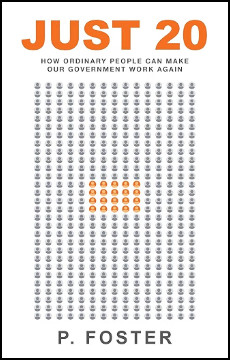
It was election day. I’d voted just about sunup, then ate breakfast by dawn’s early light. A doctor’s appointment and a pause that refreshed followed, and I was on my way home when WVXU’s Cincinnati Edition with Lucy May came on the radio. I’m an occasional, not regular, listener, and I’ve probably heard more evening repeats than live noontime broadcasts, but the show’s guest that day quickly snagged my attention. It was a retired local constitutional attorney talking about her recently published book. I was home and the radio off before the interview ended, but I had heard enough to prompt an online visit to the local library and the downloading of an electronic copy of Just 20: How Ordinary People Can Make Our Government Work Again. It is only 146 pages long and written in plain easy to understand English. I read it over the next couple of days. I have also now listened to that full Cincinnati Edition interview. It’s here.
The thing that author Patricia Foster said that grabbed my interest the most was that the rule giving the Speaker of the House nearly absolute control over what bills the House works on is not in the Constitution or any law. It is in the Rules Package that is voted on by the full House every two years when a new congress is formed. Said another way, one of the first things a newly elected or reelected Representative does is hand over their authority to introduce legislation to be discussed and voted on to somebody else.
I believe I knew at some level that it had not always been that way, but I forgot, if I ever knew, how it happened. Foster knows and recounts the steps that did it. The books first two chapters are essentially history. Chapter 1, “What Congress Was Meant to Be”, does what its title promises. It explains the founders’ careful design of a government with three equal branches: one to legislate, one to interpret, and one to execute. The second chapter, “Who Killed Congress”, identifies those steps I mentioned that brought us to the current situation where Congress does nothing that doesn’t benefit the team that that one guy belongs to. Those steps are interesting and informative. They are summed up in a single sentence near the chapter’s end, “Congress slowly rewrote itself into dysfunction.”
I’m guessing that we all have favorite examples of congress triggered frustration. One of mine is when a single individual prevented a Supreme Court appointee even being considered and gloated about it being a win for his team. More recently, another stopped a bipartisan immigration reform bill from seeing the light of day so the problem could continue to be touted as an issue by his team. The team in both of those examples is the same and easily identified, but I have no doubt that equally frustrating examples involving the other team are easy to find.
Those frustrations are not the result of something I favored being defeated by congress. They are the result of one person deciding something would not benefit their team then suppressing that something. They are the result of disruptions in the four steps that Foster repeatedly identifies as the basic original job description for congress: Propose, Debate, Amend, Vote.
As you probably know, I simply won’t waste energy reviewing something I don’t enjoy. If I hint at recommending something, it’s generally because I think you will enjoy it, too. I’m strongly recommending that you read this book and/or listen to the Lucy May interview partly because I think most of you would enjoy it, but also because I think you may benefit from it and in turn you might benefit the world. Foster doesn’t just describe the dysfunctional congress, she describes some steps to initiate repairs. They basically involve attempting to convince your representative to try to hang onto the power he has on day one of a new congress. In suggesting this, she reminds us that each representative is beholden to approximately just 0.2 percent of the population making them our most intimate contact with the Federal government. I obviously missed out on making the suggestion to my congressman while I still had my vote in my hand, but I made it anyway.
In support of the ideas in her book, Foster maintains a website and a Facebook page. Check ’em out.
Just 20: How Ordinary People Can Make Our Government Work Again, Patricia Foster, Gatekeeper Press (August 21, 2026), 8.5 x 5.5 inches, 146 pages, ISBN 978-1662976988
Available through Amazon.