
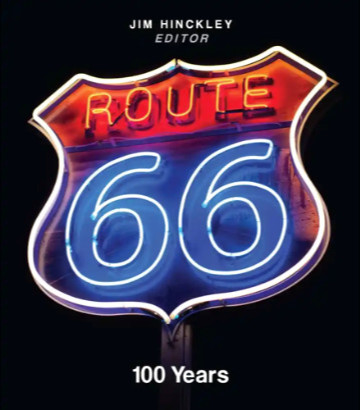
 That title may look familiar. If so, one reason might be the similarly named Route 66: The First 100 Years, reviewed here back in June. The world-famous highway will turn a hundred years old on November 11, 2026, and I suspect we will see several more books (and movies and parties and blog posts) with the numbers 66 and 100 in their titles over the next year or two. I will not be purchasing and reviewing every one of those books. One reason I have invested in this pair is that I knew the quality would be good, and one reason for that is I personally know every one of the contributors to both books on one level or another. I sure hope you won’t hold that against them.
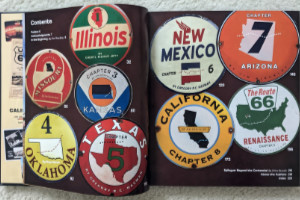 Route 66: 100 Years is an anthology edited by Jim Hinckley of Jim Hinckley’s America. There is a chapter for each of the eight states on the route, and Jim covers his home state of Arizona, plus neighboring California and the state with the fewest miles of Sixty-Six, Kansas. He also supplies the introduction and epilogue. Talented writers Cheryl Eichar Jett, Joe Sonderman, Rhys Martin, and Gregory R.C. Hasman each cover their states of residence (Illinois, Missouri, Oklahoma, and New Mexico, respectively), and Greg also writes about Texas, where he lived while attending college.
 Like the beginning pages of many books about historic highways, the introduction includes tales of how the early automobile roads followed native trails, animal migration paths, and train tracks. And it talks about the impact that the popularity of bicycles had on the desire for and development of roads outside of cities toward the end of the 19th century. What makes it a little different from most similar writings is that it provides some details about organizations and specific events during road development during this era of pedal-powered transportation.
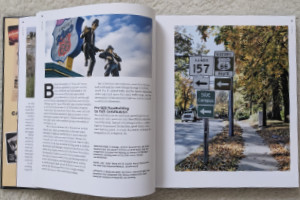 The state chapters appear in geographic sequence, east to west, which is the direction most people travel the route. Together, they provide a sort of combination travel guide and history lesson. I’m not talking about a travel guide with turn-by-turn directions, motel phone numbers, and such. However, most towns along the route are mentioned — and US 66 was a great connector of small towns — along with numerous points of interest. There is usually some history given about each town and POI, and there is plenty of history about the route itself.
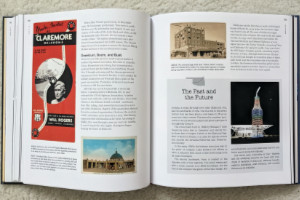 The book is definitely well-illustrated. I don’t believe there is a single page, besides the index and authors’ bios, without at least one image. These include modern and period photographs, postcards, advertising brochures, and other items. Joe Sonderman supplied some of those postcards and brochures, as did big-time collectors Mike Ward and Steve Rider. I was extremely pleased to see a photo from the collection of the late Laurel Kane included. Many of the modern photos were taken by Jim Hinckley and his wife, Judy. I saw no photos from either Rhys Martin or Greg Hasman, although I know both are excellent photographers. I did see photos from Shutterstock, Alamy, and Getty. I thought both situations were curious, but the final product comes off well.
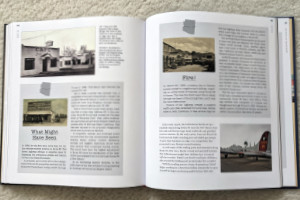 The quality of the book is quite good. Color and black-and-white images show nicely on the heavyweight glossy pages, and the layout serves them well. All have descriptive cut lines that include source credits. There are numerous sidebars, most with their own images, providing extra information outside of the main text flow.
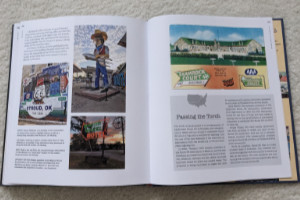 The individual states that carried US 66 account for eight chapters. The book has nine. Dries Bessels, a resident of the Netherlands, authored a chapter named “Renaissance”. Dries has guided multiple tours down the length of Route 66 and provides an outside-the-country view of the historic road. The “renaissance” he writes about is its emergence as a travel destination for both Americans and foreigners after being bypassed and decommissioned. America, essentially spared the devastation that WWII brought to Europe, was the land of dreams to post-war Europeans, and Route 66 was a tangible thing that rolled right through those dreams. Today, Route 66 is still regarded as a way to experience a diverse range of America.
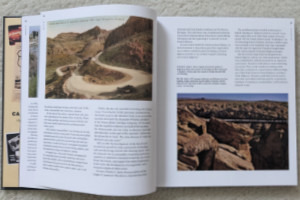
I once had a boss whose business ideas included the “rusty hinge” theory. We made machine controls, which were big metal cabinets packed with electronics. The theory was that, if you were showing a new product that still had a few bugs, a rusty hinge on the cabinet would so distract people that they would not notice any operational flaws. Fortunately, I knew about Route 66: 100 Years‘ “rusty hinge” before I saw it. In a chat about the book, Jim had mentioned that it opened with a picture not of Route 66 but of Monument Valley. The other side of the page, in my opinion, isn’t all that much better. It’s a picture of the Second Amendment Cowboy, a Muffler Man-style statue that is close to, but not quite on, Historic Route 66. A plaque at the statue’s base contains a manipulated quote incorrectly attributed to George Washington. Controversial, I think, at best. I assume these photos were included by a less-than-well-informed publisher. I have saved mention of these “rusty hinges” to the end of my review, but I can’t just ignore them. I think being aware of them is a good thing. They were clearly not intentionally put there to distract you from other flaws, but they could easily distract you from some really good writing and interesting information on the pages beyond. Don’t let them.
Route 66: 100 Years, Jim Hinckley (editor), Cheryl Eichar Jett. Joe Sonderman, Rhys Martin, Gregory R. C. Hasman, Dries Bessels (authors), Motorbooks (November 4, 2025), 9.5 x 10.88 inches, 224 pages, ISBN 978-0760391488
Available through Amazon.
Pingback: Route 66: 44 Years | Denny G's Road Trips Blog