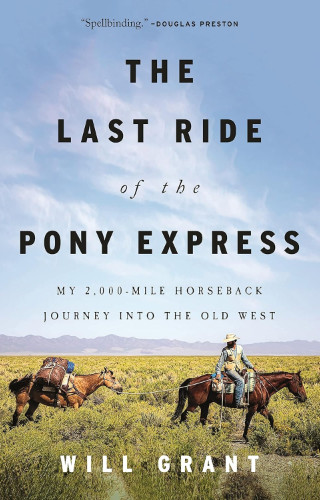
I have read and reviewed more than a few books about modern retracings of historic routes, including some I was personally responsible for. Almost all of them involved automobiles, with the result that those doing the retracing typically traveled significantly faster than the route’s original users. For the original travelers on the route that Will Grant followed in 2019, speed was far and away the main consideration. Relay riders moved mail over the nearly 2,000-mile-long route in ten days. Grant’s main consideration was safety. About 75 horses were ridden to near exhaustion in each Pony Express run. Grant’s safety and the success of his ride depended on two horses covering the entire distance. Will, Chicken Fry, and Badger got to know each other quite well during the 142 days they spent together during The Last Ride of the Pony Express.
I’ve been to the stable-turned-museum where Grant and all of those Pony Express riders began their journies west, and I have crossed the Missouri River at Saint Joseph, but it somehow never registered with me just how close that stable was to the riverbank. The stable and the river are less than half a mile apart. When I finally realized that, my first thought was to question why the Pony Express did not just place its eastern terminus on the other side of the river. It was a dumb question that I almost instantly answered. The Missouri River marked the border of the United States in 1860. St. Joseph was on the frontier. Pony Express riders began their westward dash with a ferry ride. Will Grant began his unhurried retrace with a police escort over a bridge.
Grant was very familiar with horses from a lifetime of riding, and I suspect he was more familiar than most with the history of the Pony Express and the geography of the American West. But he became a lot more familiar with these subjects as he prepared for his ride, and he shares that knowledge throughout the book. He also shares what I see as a sense of awe at the logistics of managing the hundreds of horses and men involved in the Pony Express. Many of us see only a galloping horse and rider when thinking of the Pony Express. Some may also think of brave station masters. Grant thinks and writes about all the men, and probably a few women, responsible for a constant supply of water, hay, and other necessities to those isolated stations, for the speedy breaking of horses to be ridden, and for all the other behind-the-scenes details of keeping an operation this big and spread out functioning.
The lack of that widespread support organization might be just as big a difference between Grant’s ride and those of 1860 as the speed of travel. Grant had the benefit of modern resources, including a sometimes-connected cell phone, and numerous generous routeside residents provided meals, showers, and places to camp. But he was basically self-contained and, despite several invitations, never slept in someone’s home. Surroundings ranged from too much civilization to essentially none at all. The severe isolation of parts of the trail is illustrated by Grant arranging for six caches of water and hay to be placed along the route through the Great Salt Lake Desert to make up for the lack of staffed and provisioned Pony Express stations.
The routeside residents also provide conversation. Sometimes history is explored, and sometimes the topic is something very current. Some subjects, like corporate ranches, wind farms, and wild mustangs, have the potential to become political, but Grant somehow manages to avoid that. Not only in his real-life conversations but in his informative writings. He’s really good at sharing facts, and maybe even describing a couple of viewpoints, without letting his own opinion distort them. In fact, most opinions held by others are reported with any rough edge they might have had removed.
I enjoyed encountering place names I recognized. Just as parts of the Pony Express route followed paths marked earlier by wagon wheels, feet, and hooves, some of it would later be followed by the tires of automobiles. Saint Joseph, MO, where it started, is where the Jefferson Highway and the Pikes Peak Ocean to Ocean Highway crossed. I recognized one of Grant’s camping spots, Hollenberg Station, from having stopped there while driving the PPOO. Farther west, the Lincoln Highway has led me to Dugway, Fish Springs, and other Pony Express-connected places that Grant mentions.
At Willow Spring Station in Callao, UT, another place the Lincoln Highway has taken me, Grant pauses for a day to rest himself and the horses. The last of his arranged caches lies between Callao and the stateline and beyond that, Nevada and California. There was still a long way to go, but the big desert was essentially behind him, and the day of rest may have prompted a look back. “No one, I thought, knows the ride of a Pony Express rider, but I’d come pretty close. My time in the desert, free from the distractions of population or vegetation or paved roads, had revealed what no book had conveyed, what I could not fully articulate, but what I knew was a past informant to our current psyche.”
On September 22, 2019, 142 days after crossing that bridge in Saint Joseph, Will Grant rode Chicken Fry up to the Pony Express statue in Sacramento with Badger in tow. The three had surely traveled more than the 1,966 miles said to comprise the actual Pony Express route. I’m still not sure whether I think the Pony Express was insane or brilliant. Crossing a 1,400-mile-wide gap in our country on horseback once in ten days is an impressive accomplishment. Establishing a system to do that in both directions twice a week is incredibly so. It is commonly estimated that something like 500 horses were used. Grant’s not buying it. He thinks a number between 1,500 and 2,000 is more believable.
I doubt I have ever spent much more than an hour on horseback at any one time, and I certainly don’t intend to try it now. I gained a slight sense of what multiple days in the saddle might be like without risking snakebites, saddle sores, or wild mustang attacks, and that’s close enough for me.
The Last Ride of the Pony Express: My 2,000-mile Horseback Journey into the Old West, Will Grant, Little, Brown and Company (June 6, 2023), 6.3 x 9.55 inches, 336 pages, ISBN 978-0316422314
Available through Amazon.
Pingback: Book Review Cities of Gold Douglas Preston | Denny G's Road Trips Blog