
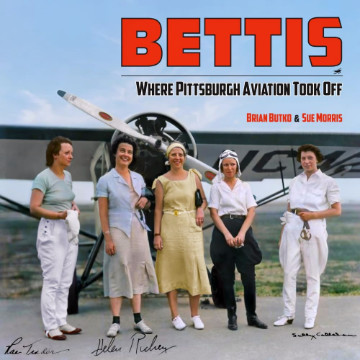
 I was aware of this book when it was published, and I was interested in reading it. But not so interested, it seems, to actually order it. My interest in the book came from a general interest in early aviation history that anyone growing up in the land of Wilbur and Orville, as I did, should come by naturally. The lack of urgency came from the fact that its proclaimed subject was an airport in another state. It was a nearby state, but it wasn’t my state. It took a visit by the authors to a nearer and more familiar airport to finally put a copy in my hands.
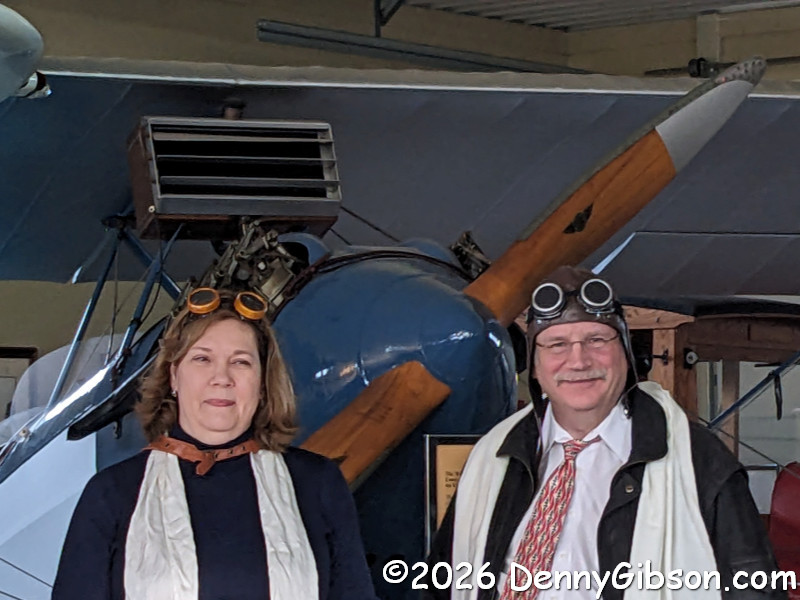 That nearer airport was WACO Field in Troy, OH. WACO airplanes were once manufactured in Troy, and I have attended a few of the annual fly-ins that take place there. The most recent for me was the 100th anniversary of the company’s 1923 move from Lorain, OH, to Troy. Morris and Butko were, as you can see, dressed appropriately. Brian is a friend. This was my first time meeting Sue. Both are from Pittsburgh and passionate about their city. When I first heard of the WACO event, I assumed it was simply to take advantage of a semi-close historic airfield. But even before the presentation began, I learned that there was a much more meaningful connection. More on that in a bit, but I will note that there is a hint in the photo on the left.
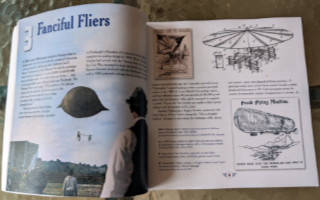 I really was not surprised that Morris and Butkos begin their story long before there were any such things as airports or even airplanes. They do it with a Pittsburgh twist, of course, and tell about early inventors and adventurers connected to the city. I got a chuckle from a quote they share about a 1897 flight by Professor Carl E. Myers and his skycycle. The skycycle appears to be a balloon with a seat and pedals suspended below it. As reported by The Pittsburgh Press, it did fly and eventually floated out of sight while “The professor, if he had any control over the skycycle, did not exercise it.”
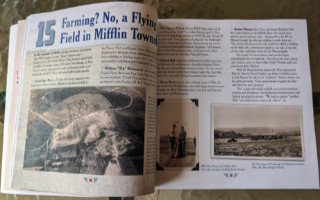 Of course, skycycles and other “Fanciful Fliers” fell out of favor once airplanes came along, and particularly after they were proven practical in World War I. Morris and Butko share the stories of several Pittsburghers involved in wartime aviation and the barnstorming that war-surplus aircraft gave rise to after the hostilities ended. It was a group of Pittsburgh barnstormers that gave birth to the airport that would be named Bettis Field in 1926. One of them, Clifford Ball, provided a slogan that would eventually be modified for a different field and some different dreams: “Build the nests and the birds will come.”
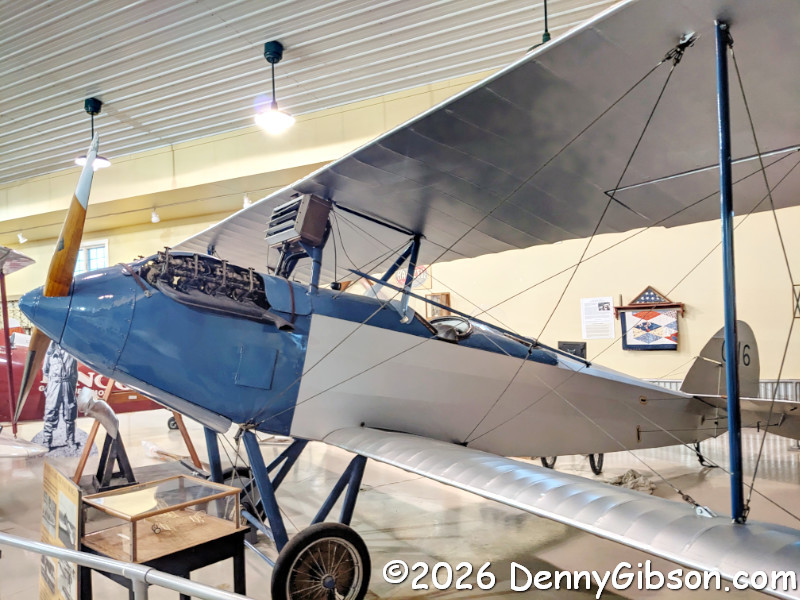
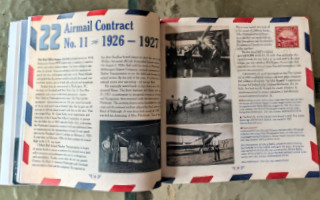 Also in 1926, Ball sold his interest in the airport to form Skyline Transportation to pursue a government airmail contract. He did get the contract and purchased three airplanes to service it. Here’s where that WACO connection mentioned earlier comes in. The three planes were WACOs named Miss Pittsburgh, Miss McKeesport, and Miss Youngstown. Miss Youngstown was destroyed in a wreck; Miss Pittsburgh hangs at the Pittsburgh Airport; and Miss McKeesport is in the WACO Museum, parked behind Sue and Brian in the photograph above. There is another view, sans authors, here.
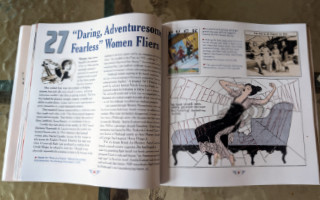 Morris and Butko have uncovered and included an impressive number of stories about people and events connected with Bettis Airfield. It was one of the stops on Charles Lindbergh’s tour following his cross-Atlantic flight, but the Spirit of Saint Louis had to be slid sideways into a hangar because its wings were wider than the door. Quite a few black pilots trained at Bettis, but for a period, had to go to another state to be licensed because the designated federal inspector simply refused to pass them. A fairly large number of female pilots, some of whom were rather famous, were associated with Bettis. Passengers were sometimes flown on airmail flights, sitting on bags of mail; then, in 1929, real passenger service — with seats — was added.
As you can probably tell, all of these stories are well illustrated with period photos and other images. Chapters are short, with an even number of pages (2 or 4), so that each one begins on a left-hand page. That’s something I’ve noted in other Butko books, although I don’t doubt that others do it too. The book is clearly focused on Pittsburgh, and Pittsburgh residents might get a little extra kick from some of the local references, but everyone can enjoy its entertaining look at early aviation. I’m sure glad I went to that Ohio airport to learn about one in Pennsylvania.
Bettis: Where Pittsburgh Aviation Took Off, Brian Butko and Sue Morris, Heinz History Center (December 1, 2024), 8.5 x 8.5 inches, 124 pages, ISBN 978-0936340326
Available through Amazon.