
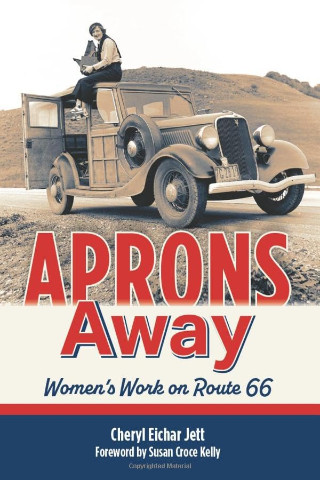
I’ve commented before that “Why another Route 66 book?” is something I sometimes ask. I more or less thought I would be asking that question about Aprons Away: Women’s Work on Route 66, but found it wasn’t really needed. This is not, in my opinion, “another Route 66 book”. It is a book about women who made meaningful contributions to the world and who happen to have a connection to the route. For some, that connection is lifelong and one that defines their contribution. For others, Route 66 is associated with a smaller—sometimes much smaller—portion of their accomplishments. You won’t learn all that much about Route 66 from this book. You will learn a lot about a bunch of women who left their mark on the world. Route 66 is not the subject of this book; it is only the filter for selecting the subjects.
Jett divided those subjects into ten chapters, starting with “Blueprints” and ending with “The Documentarians”. Each chapter begins with a brief introduction of each of the chapter’s subjects, including some hints as to what each of them accomplished. Not so brief, but not overly long, biographies follow. Most are only a page or two, but each one makes it clear just what made the woman stand out and what connected her to Route 66.
In interviews, Jett has said that the first stories in her collection about women and Route 66 were of women in “visible roles”. By that, she meant waitresses, motel operators, and others who were visible to travelers on the road. Neither of the categories I’ve mentioned, “Blueprints” and “The Documentarians”, is visible in that sense, but each contains someone quite visible to the world at large. The person whose biography begins the book, Mary Colter, is best known to fans of Route 66 as the architect of La Posada hotel in Winslow, AZ, but is highly visible to others for her wide-ranging design work on and off the route. Dorothea Lange, who appears on the cover of Aprons Away, is undoubtedly the documentarian in the book with the highest level of visibility. Her depression era photographs are some of the most recognized in the world.
“An Apron and a Coffee Pot”, “The Gas Station Girls”, “The Inn Keepers”, and “The Entrepreneurs” more closely match the “visible roles” Jett was referencing. Sometimes women waited tables, pumped gas, registered guests, or collected tickets for a business run by their husband or father, but not always. Lucille Hamons, Lillian Redman, and Ramona Lehman are names that nearly every fan of Route 66 will recognize for their major roles in customer-facing businesses along the route. The other categories, “Public Service”, “The Artists”, “World War II”, and “Design and Engineering” also have stars that are known to many who have traveled or studied the route.
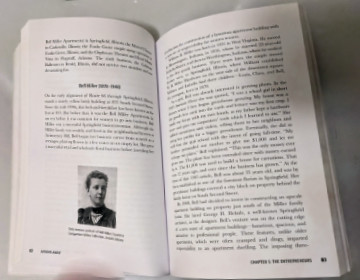
Of course, every one of those chapters has several sections on people much less famous than Lange or Colter or Redman, and that’s why we buy such books. In fact, I’m guessing that it’s pretty much why the book was written. I strongly suspect that Jett would have heard some complaints had she not included Colter and others of equal fame, but there are numerous places we can read about those folks. I did not count them, but understand there are more than eighty women profiled in Aprons Away. Every one of them deserves to be here, and their stories deserve to be told. Jett has uncovered some very interesting women and has done a nice job of sharing their collected stories. I was familiar with well under half, maybe no more than a quarter, before meeting them in this book. New knowledge is a good thing.
Aprons Away Women’s Work on Route 66, Cheryl Eichar Jett, Reedy Press (April 1, 2026), 6 x 9 inches, 224 pages, ISBN 978-1681066349
Available through Amazon.