Vintage Bikes and More

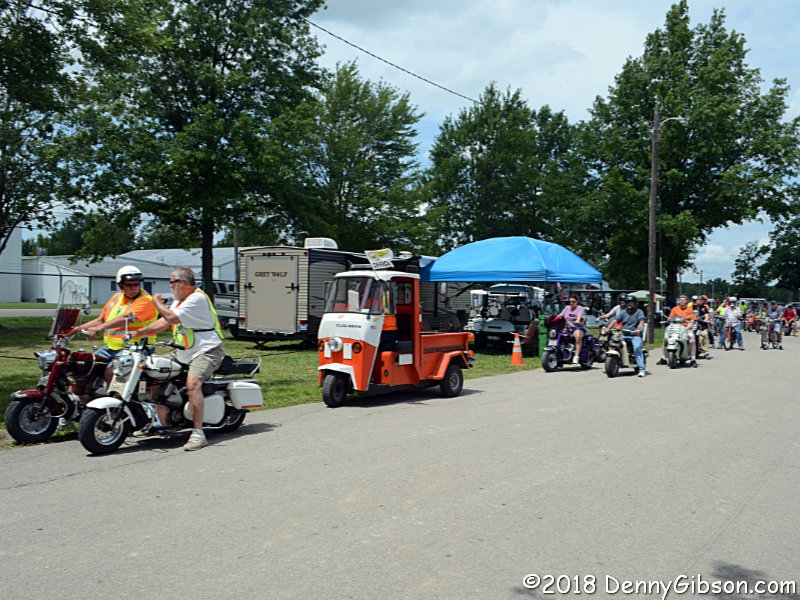
On Thursday, I was back at the Jay County Fairgrounds near Portland, Indiana. It’s a place I’ve been to a couple of times before for the Antique Engine & Tractor Show where my friend Terry displays his collection of Wheel Horses. In 2015, my friend Dale met me there. This time I was there for the National Vintage Motor Bike Club annual meet, and it was Dale who had the trailer full of gear. The picture at right shows vintage motor bikes all set to head out of the gate for a fairly slow cruise around the area.
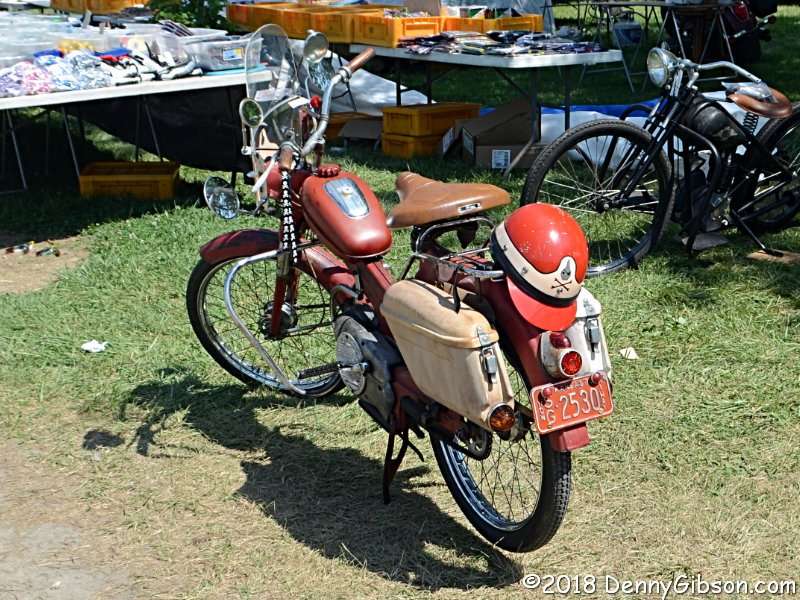
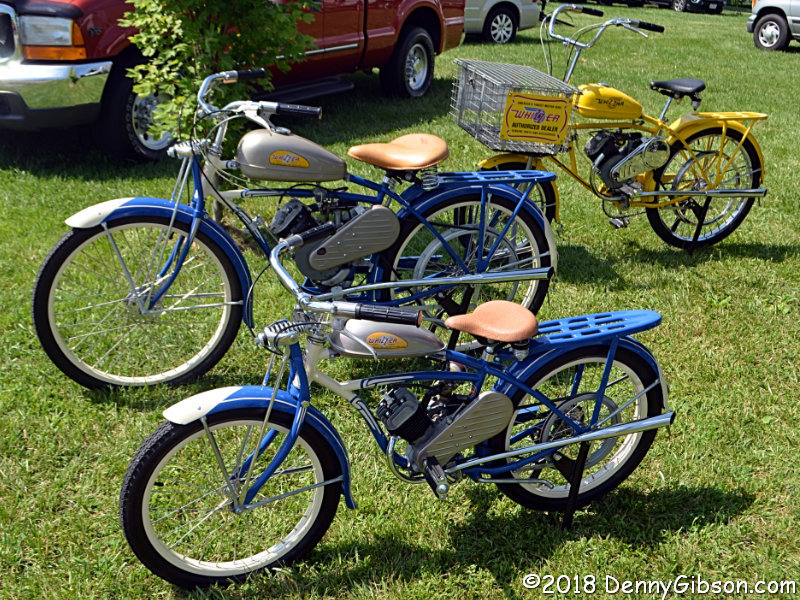
Dale and I were already nearly ten years into our lifelong friendship when we acquired our first motorized transportation. His was an Allstate Mo‑Ped; Mine was a Whizzer. I talk a bit about both vehicles here. I believe Dale’s Mo-Ped was actually much shinier that this example but it never had saddlebags or a windshield. I don’t think either of us knew what a helmet was in those days, either. My Whizzer never looked half as good as those in the picture. That’s a mighty nice looking scaled down replica, too.
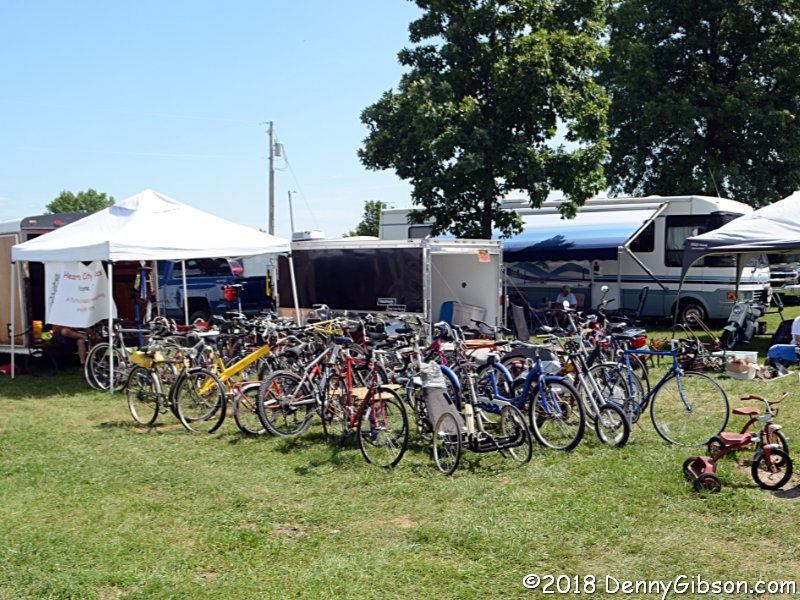
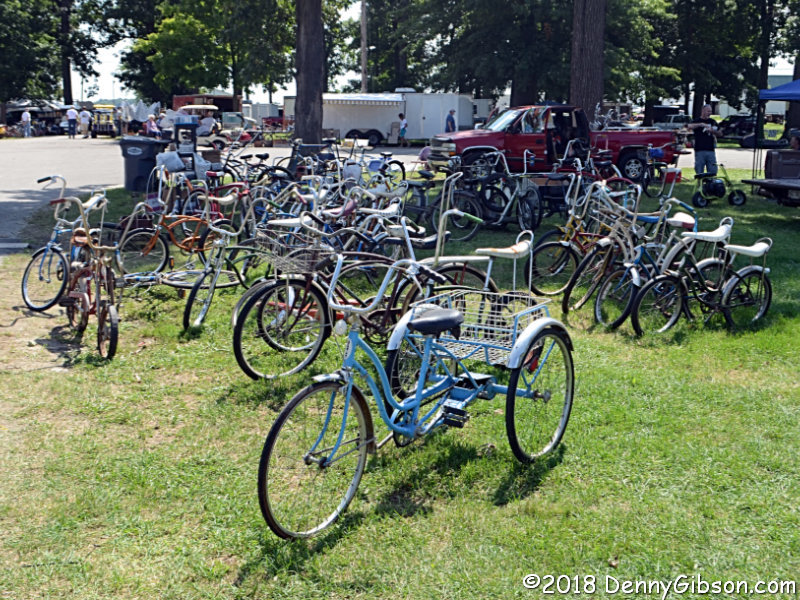
Despite the word “motor” in the event’s name, I’m guessing that nearly half of the bikes on the grounds were people-powered. That’s why Dale was there, and the collection in the last picture is the one he brought with him.
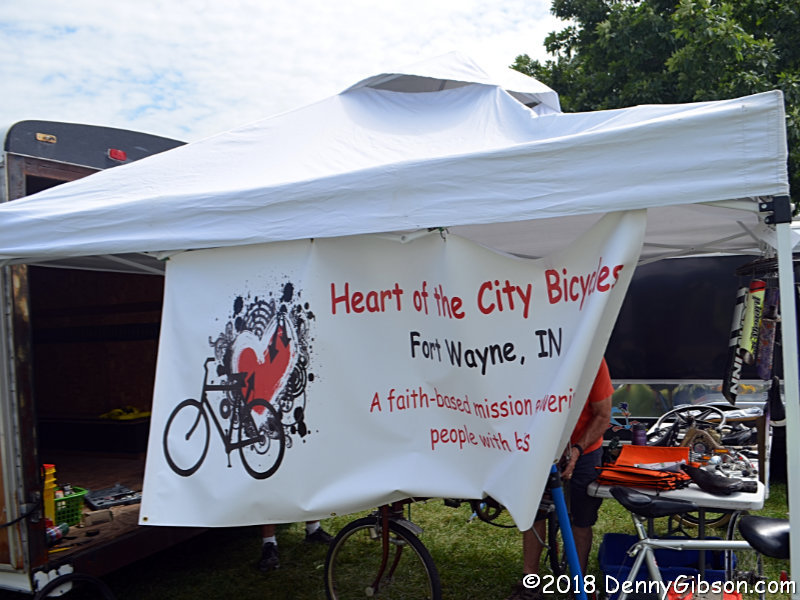
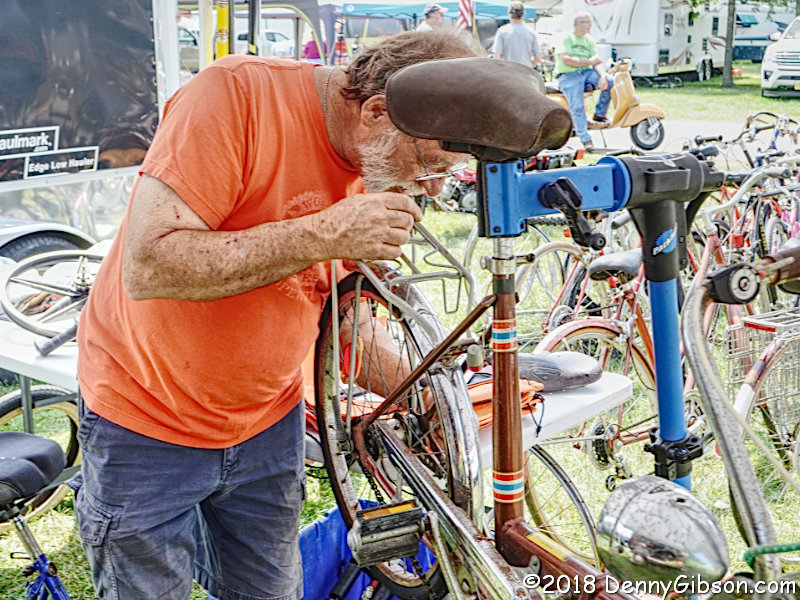
Here’s a little better view of the banner at the left of the previous picture. Heart of the City is the name of the bicycle ministry operated by Mission Church Fort Wayne. I stopped by their shop, where Dale and other volunteers repair and recondition bikes for the homeless and inner city’s needy, a few years ago. That’s Dale remounting a wheel after fixing a flat. Orley, another volunteer, was with Dale today but I failed to get a picture. All of the bicycles the two of them brought to the meet are for sale. They are a mixture of Dale’s personal “extras” and some that have been donated to the ministry but aren’t really appropriate for the earn-a-bike program.
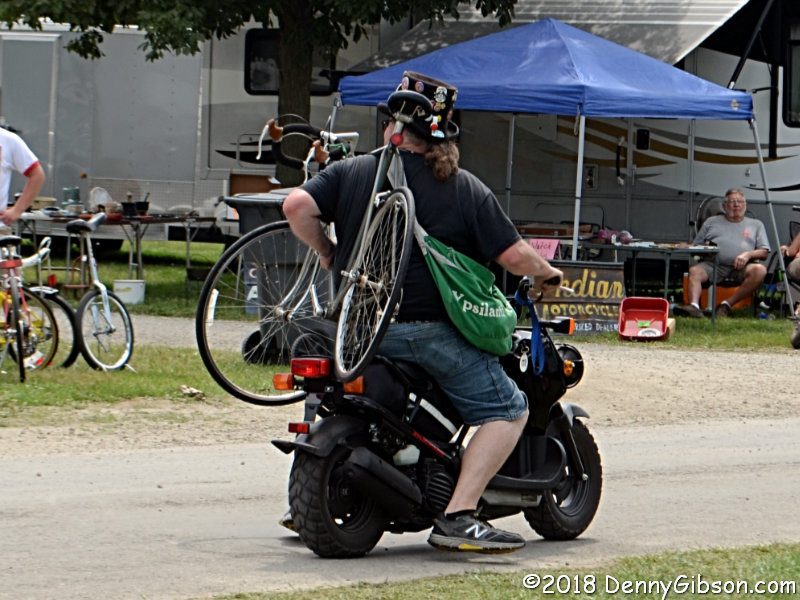
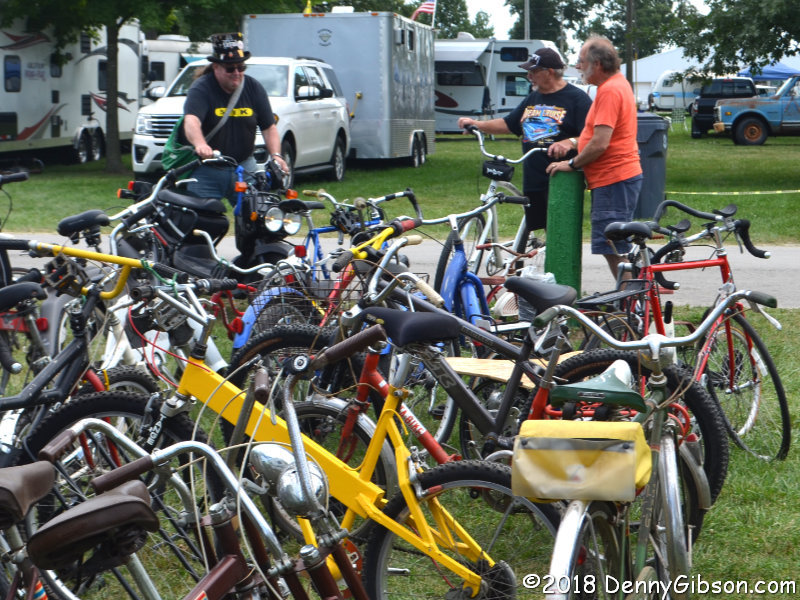
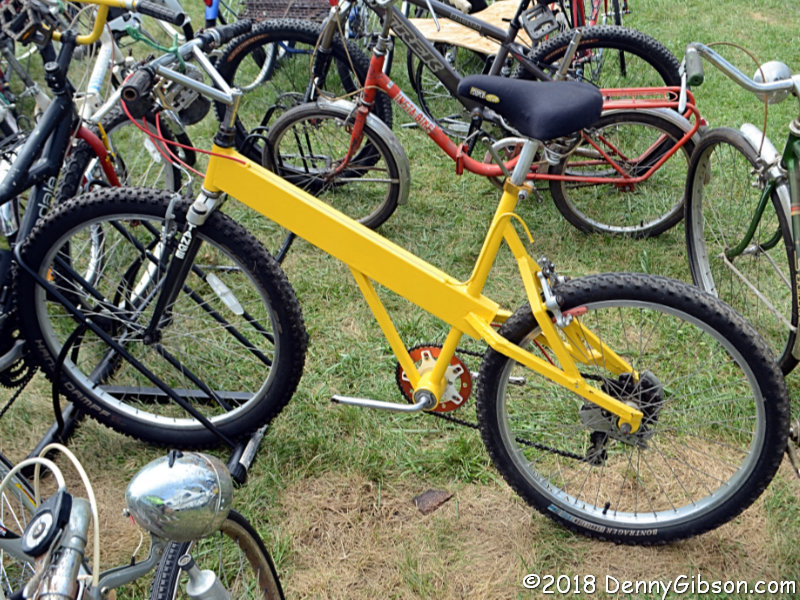
This was the first day of the event, and my theory is that most of the traffic was from other participants seeing what everybody else had to offer. Sales were not brisk, but neither were they non-existent. By far the most interesting of the few I witnessed, was this one. I’d noticed this fellow, or at least his hat, during a little walkabout Dale and I did. He is both a collector and an active supporter of some sort of earn-a-bike program in the Detroit area. Some people walked their purchases, and some held a “new” bike’s handlebars to tow it beside the bike they were riding. This guy just slung it over his back and putted away. All that was interesting, of course, but what I thought even more so was the conversation he and Dale had as they roamed among the bikes. With an often foreign vocabulary, they discussed who made what, when they made it, and why this was good and that was bad. I didn’t understand much but I sure did appreciate it. Incidentally, that yellow bike in the first picture is one that Dale fabricated following some Cannondale geometry. There’s a better view here.
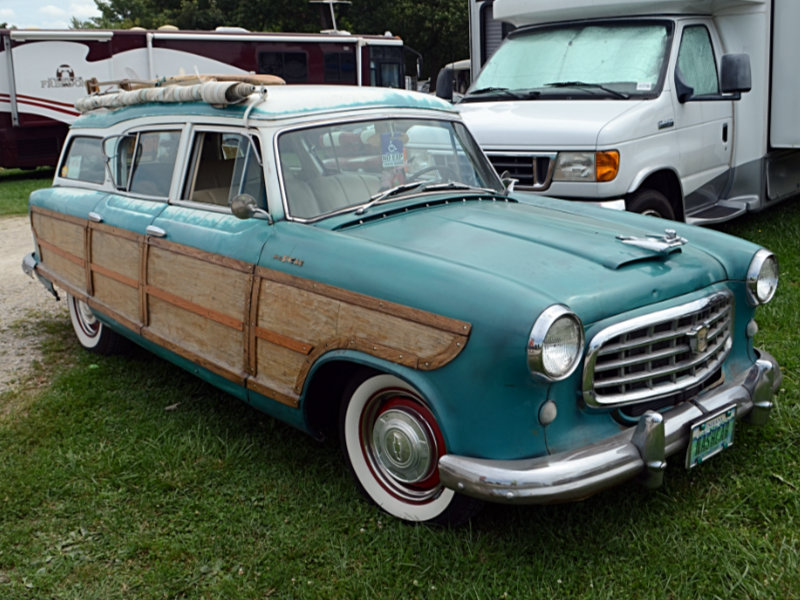
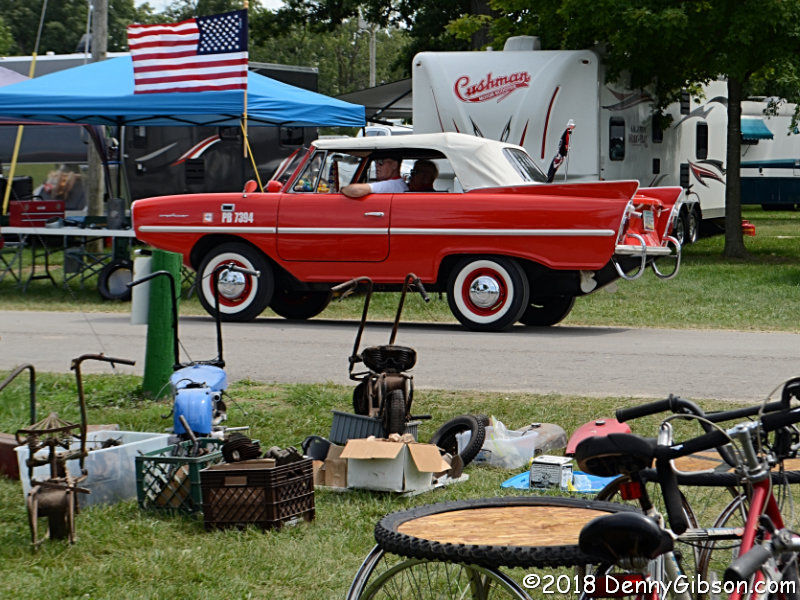
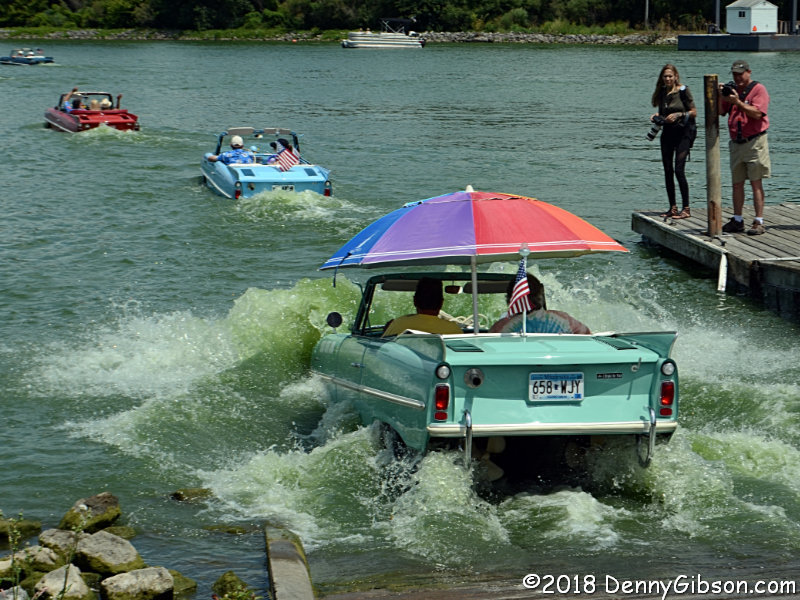
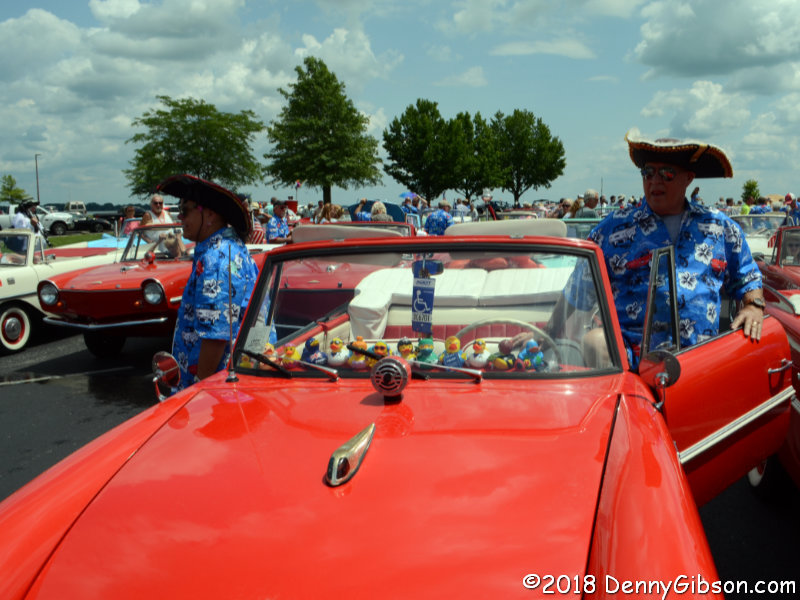
Not surprisingly, there were also a few interesting four wheeled vehicles around. We found the Nash woodie on our walkabout. The Amphicar drove by as we sat behind the bikes. As told below, I would see it again in a couple of days.
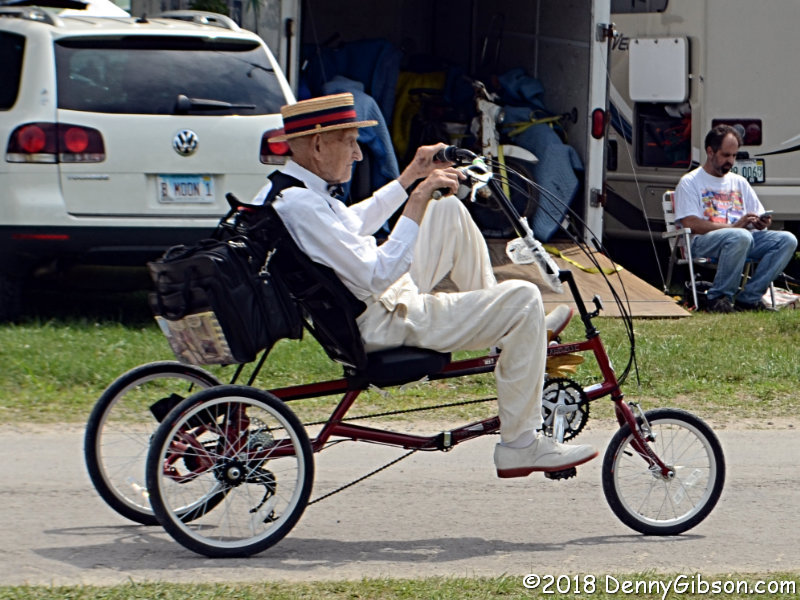
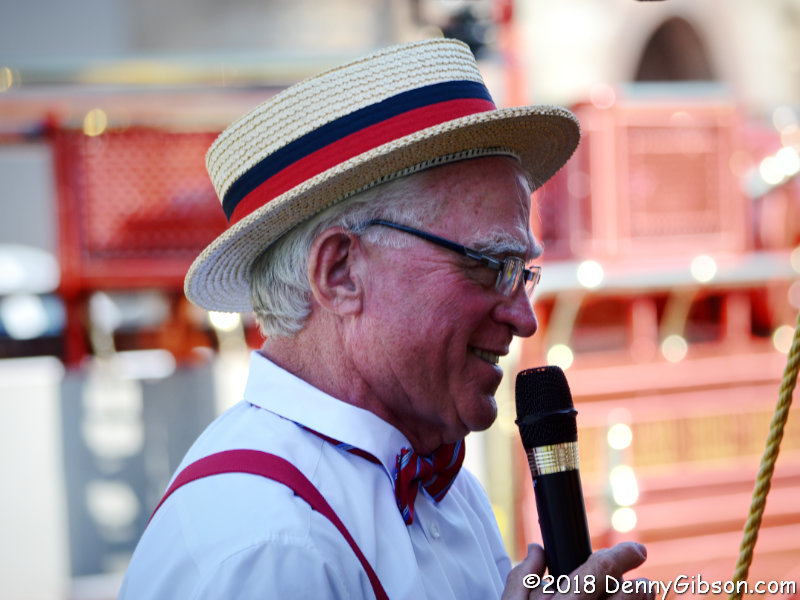
When this nattily dressed fellow pedaled by, Dale told me that he and his wife Marsha each own a trike like this. He didn’t tell me whether they dress in pure white and wear straw skimmers when they go out riding them but I’m guessing not.
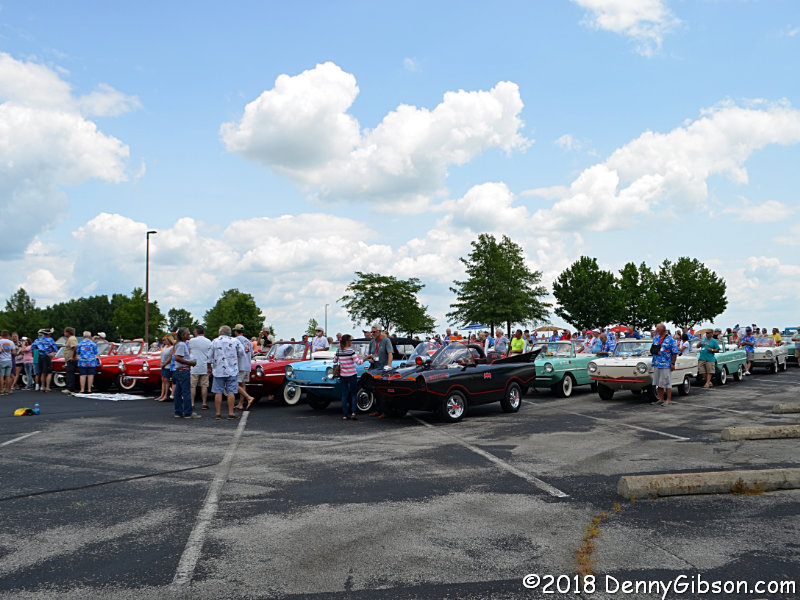


The red Amphicar that we saw in Portland, Indiana, is in the front row of this group of Amphicars in Celina, Ohio. On Saturday, during the annual Lake Festival, an attempt was made to break the Guinness Record for the Largest Gathering of Amphicars which stood, and disappointingly still stands, at 75. This group was slightly smaller at 72. I identified the car seen in Portland by its watercraft license number, and spoke briefly with its owners.
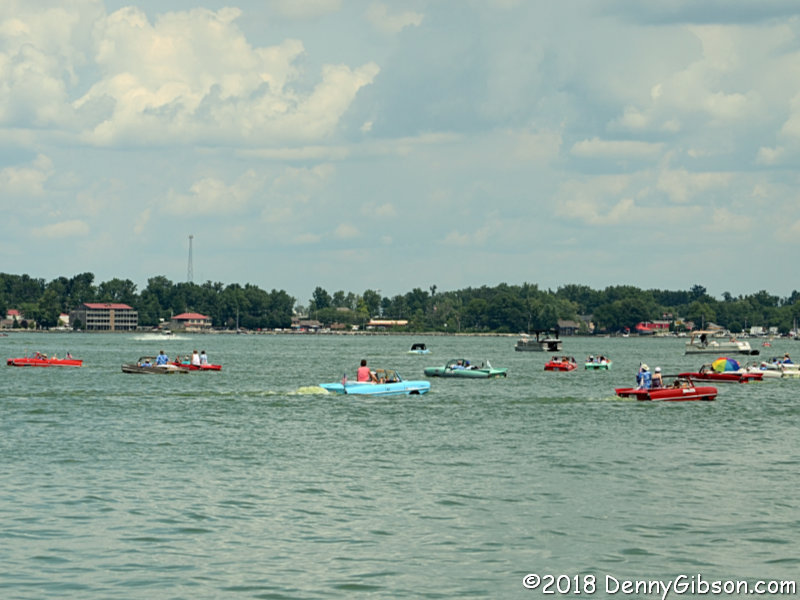
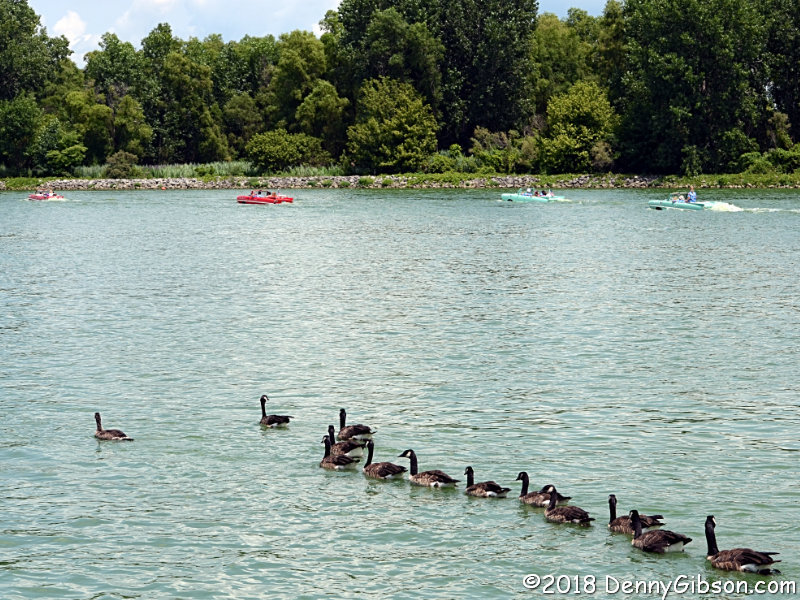
Nothing soothes the pain of a near miss on a world record like a splash in the lake, and many of the cars’ owners wasted little time in doing exactly that.  
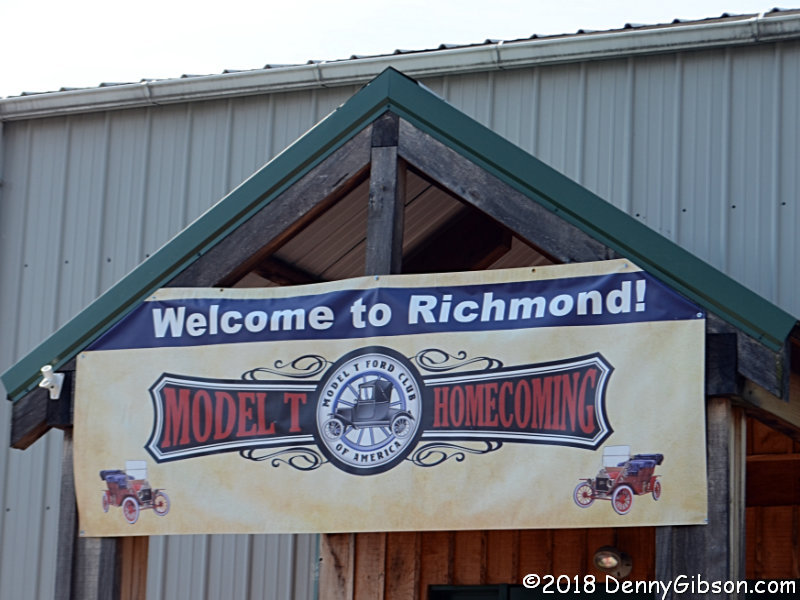
Ts at a Hundred and Ten

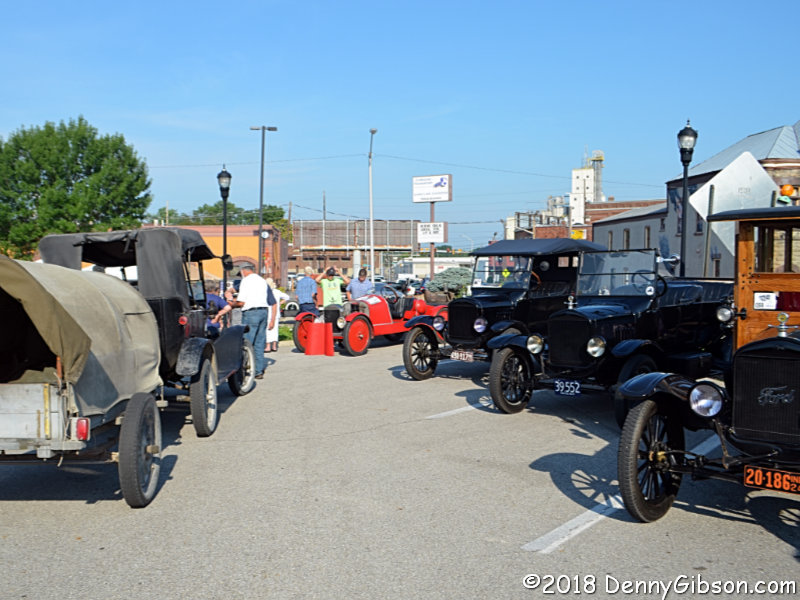
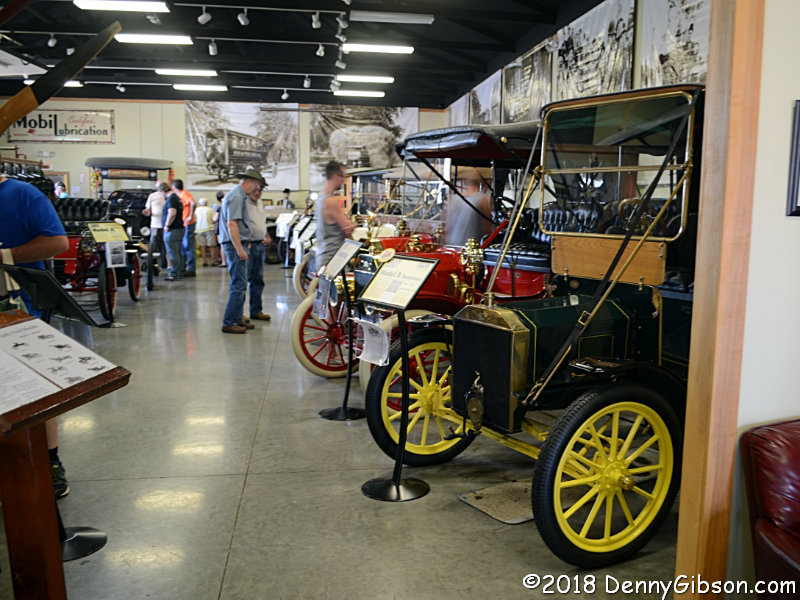
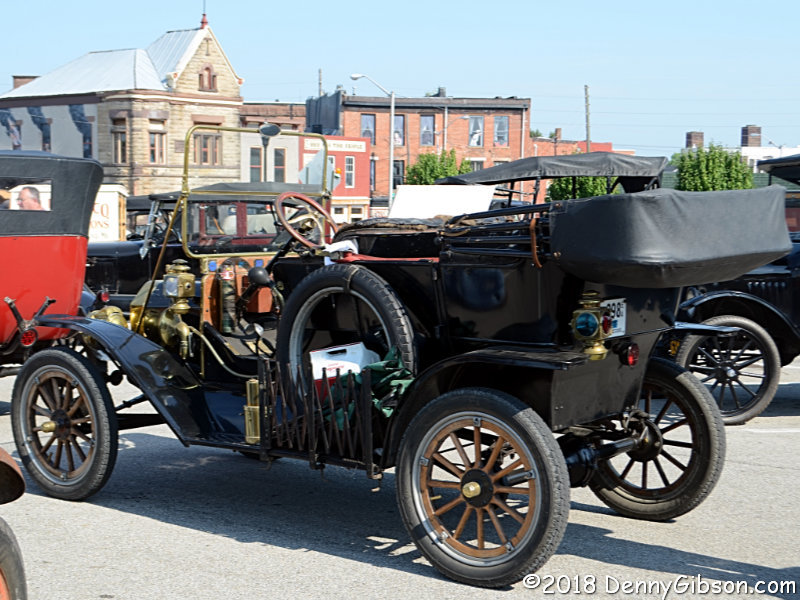
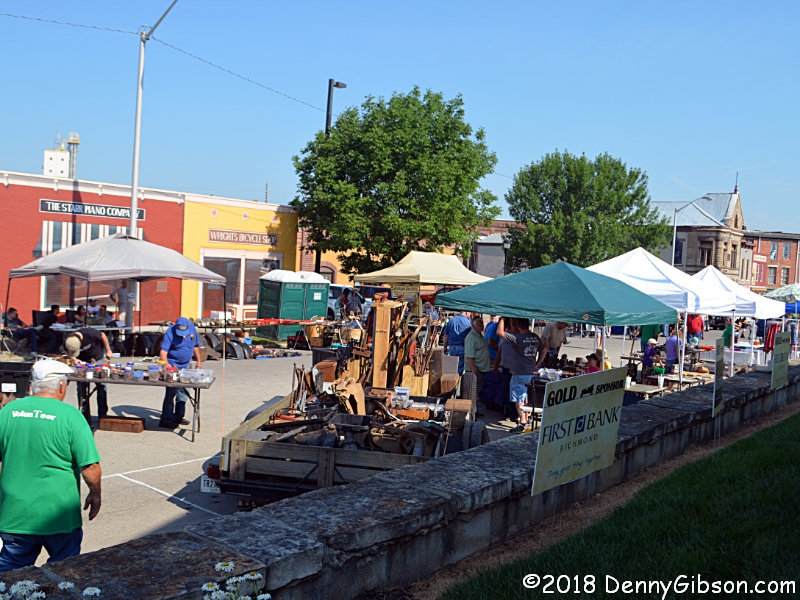
Richmond, Indiana, seems to have become the de facto Model T Capital of the World. The Model T Ford Club of America is headquartered there and operates a marvelous museum dedicated to Henry’s world changing creation. In 2008, when the T turned 100 years old, Richmond hosted a birthday party attended by approximately 1000 of the cars. I was there for one day. This year, with the T turning 110, Richmond had another party. It wasn’t nearly as big as the centennial bash but it was still a pretty big deal with about 100 Ford Model Ts showing up. Again, I was there for one day, Saturday.

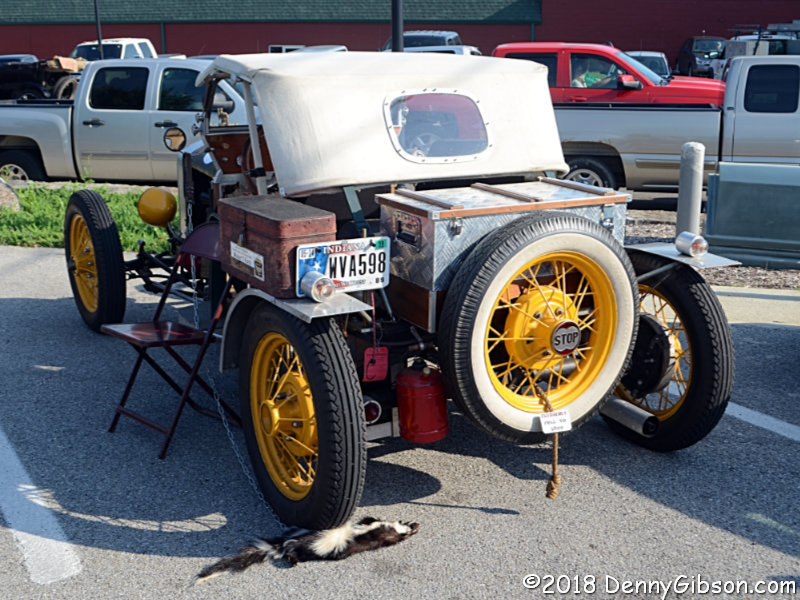
Some of those 100 or so visiting Model Ts were parked in the street but many were in the museum’s parking lot. It was a great day for looking the cars over but, because of their proximity to one another and the number of people sharing the space, getting good photos wasn’t so easy. A dead skunk emerging from beneath a rear tire does seem to provide a little extra space, however.

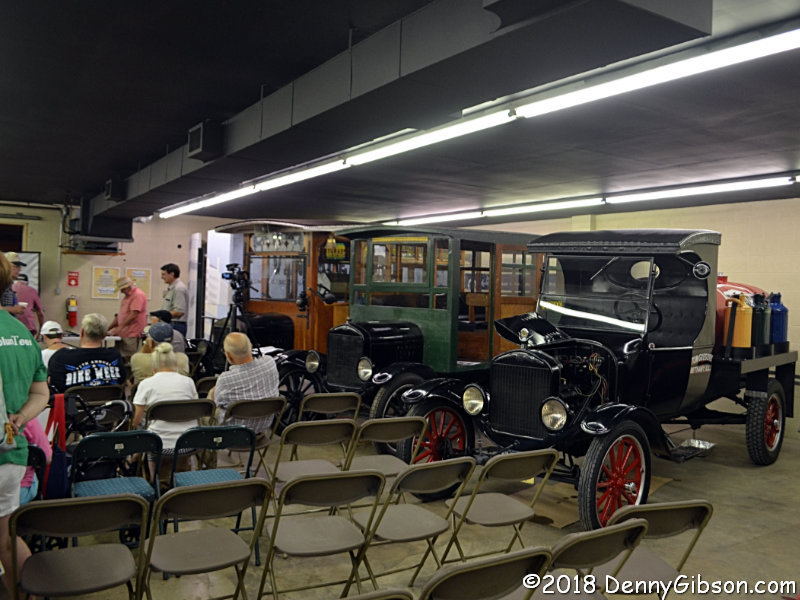
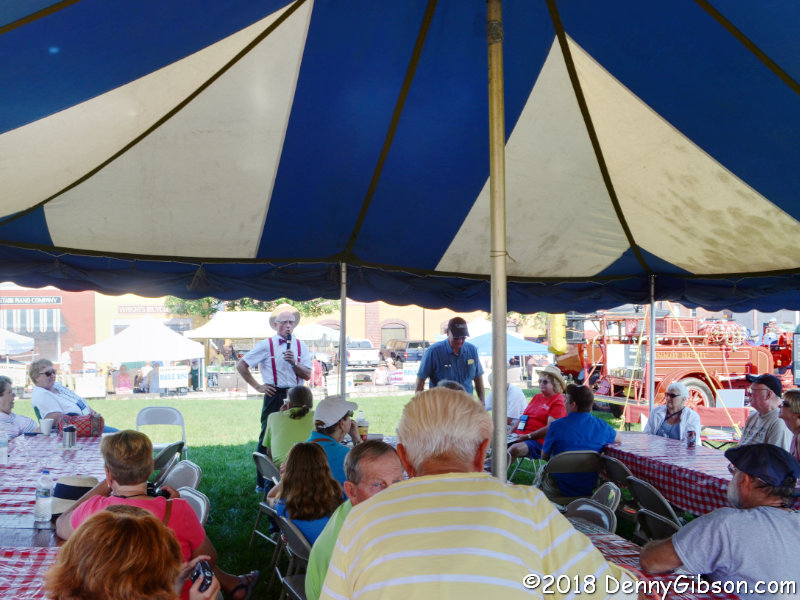
The museum was open and entirely free all day which really was great but the space and people issues seen outside were amplified inside. A chunk of normally open space in the annex was filled with a series of seminars.

I’ve visited the museum in the past when I was the only one there and I expect that will happen again. Today’s lack of “photo space” didn’t really bother me. The cars, in fact, were not the primary reason I was there. I’d first learned of this event last fall on a visit to the museum to see a car named the Silver Streak. In the 1930s and ’40s, a group of young women had used the Streak to travel the country. The car was on loan from its current owner, John Butte. I bought a copy of the book John had written about the car and was in Richmond today to get it signed and meet its author. John is in all three of these photos. The third includes his wife Carmen and the Silver Streak. A few pictures of the car accompanied my review of the book.

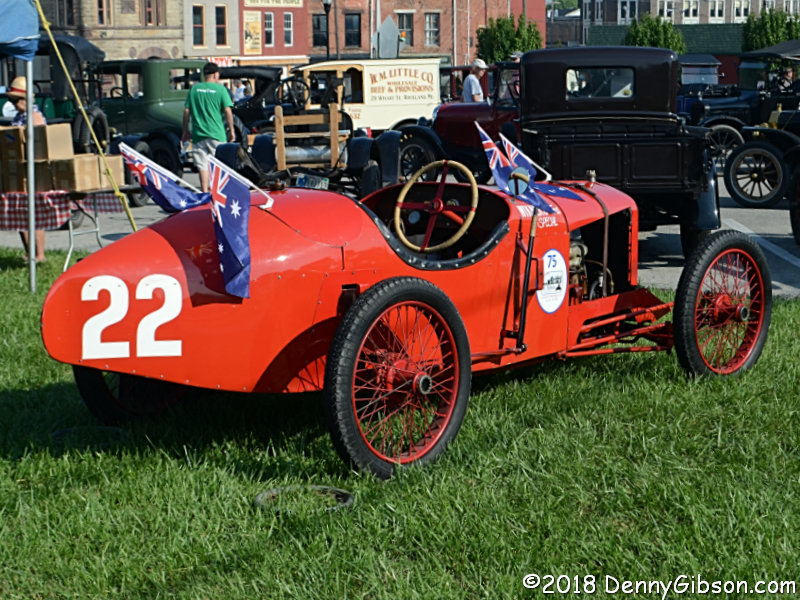
Doug Partington is the owner of another Model T with a great story guy. The Wikner Ford Special is the very first race car built in Australia. Doug bought the partially disassembled car when he was fourteen. Only after he’d had considerable fun and success racing the car did he learn of its unique history. The Wikner Ford Special will be on display at the museum for the next eighteen months. The Silver Streak will be leaving in August.

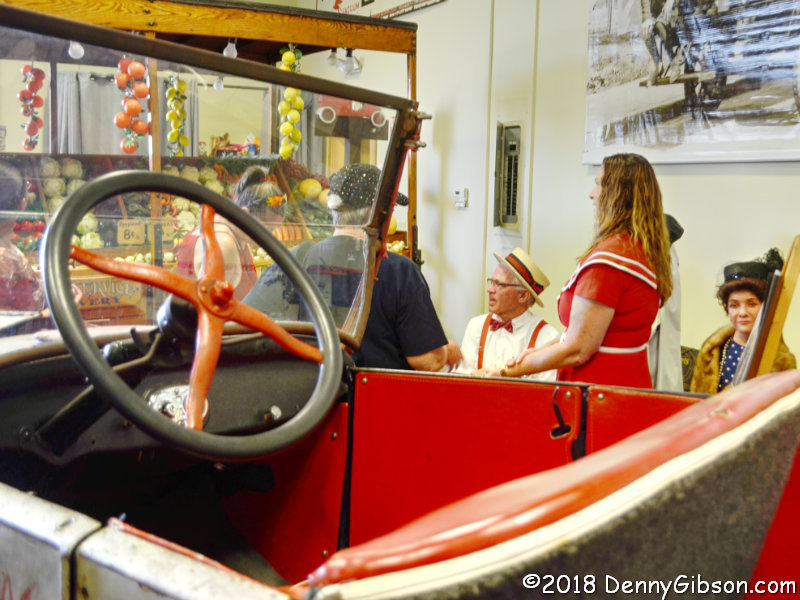
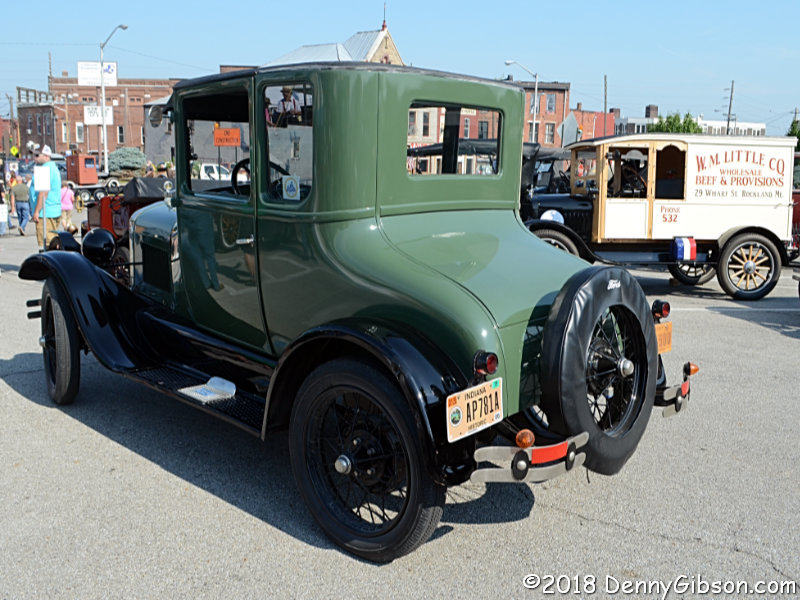
Among the many Model Ts on display was an open car much like the one my great grandparents drove to Florida in 1920 and a green coupe similar to one they subsequently owned which is currently in the possession of an uncle.

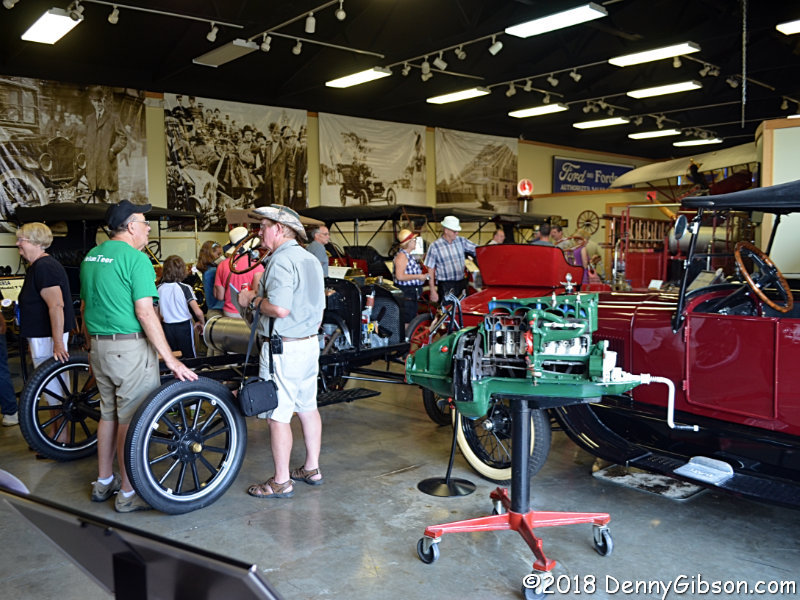
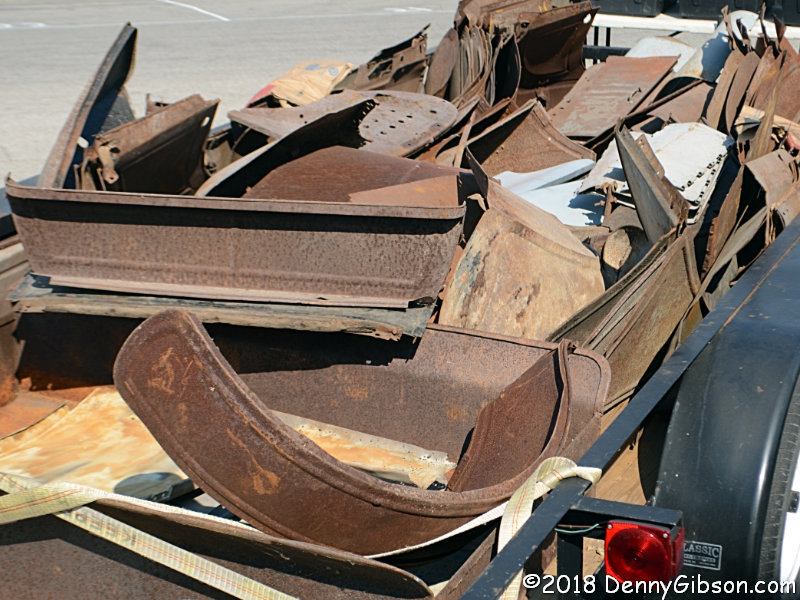
Of course the gathering was not limited to already complete and fully functioning automobiles. There were also plenty of pieces that just might be the key to another complete and fully functional Ford.

My Wheels — Chapter 32
1986 Ford Bronco II

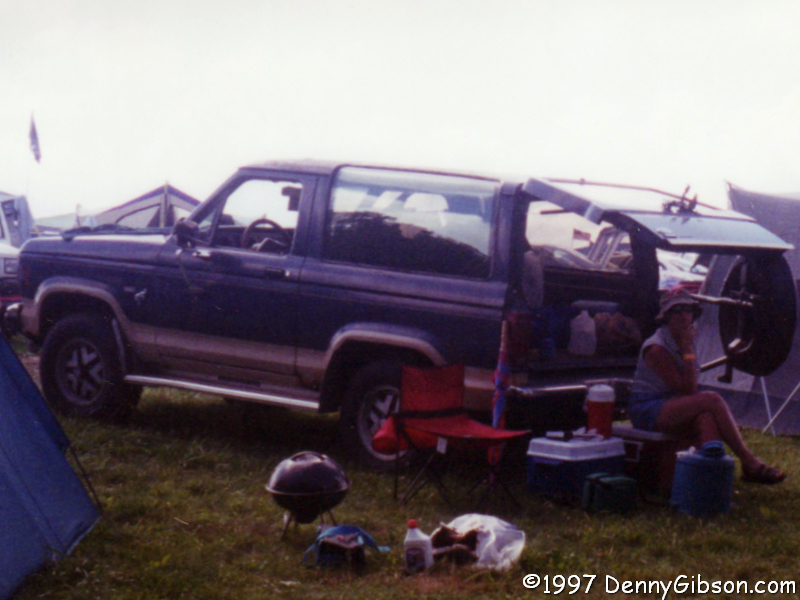
The Camaro was great fun to drive — mostly. On those fairly infrequent Cincinnati snow days, it was not. Well, maybe it was sometimes fun in a perverse slip-sliding-away sort of way, but it sure wasn’t relaxing. After one winter with it as my only vehicle, I went shopping for something a bit more winter friendly. The result was a very experienced V6 5-speed 1986 Eddie Bauer Edition Ford Bronco II.

The Eddie Bauer package included several amenities that made it a near luxury vehicle. It was instantly recognizable by the tan (regardless of base color) lower body trim. Seats and upholstery were special and a premium sound system and power windows and locks were included. My new acquisition had once been a rather prestigious ride. The operative word in that sentence is “been”.

The odometer showed a little more than 10,000 miles but no one would have even briefly thought that accurate. In those days of five digit odometers, this one had clearly passed through its full range at least once. The description that quickly developed was “Everything you absolutely need works. Anything you don’t absolutely need doesn’t”.

When I first got the car, the power door unlocks worked. The lock side of the option had already quit functioning but I could initially unlock both doors with the push of a button. That didn’t last long. Lights for the speedometer and some other gauges worked but other dashboard illumination, such as that for the radio, did not. The dark radio dial was hardly an issue since the premium audio had pretty much quit functioning before I ever saw it. It wasn’t entirely dead, though, and a friend who borrowed the car (It made a good loaner.) described turning it on and listening to a faint but clear broadcast with the volume cranked all the way up. The system’s full capabilities were miraculously restored, and the car filled with ear piercing music, by a bump in the road. It didn’t last long, and another bump soon silenced things completely.

In the photo, the rear door is kept from dropping onto Chris’ head by a wooden dowel as the struts had stopped doing their job long before. I was somewhat surprised and extremely grateful that the power windows fell on the “absolutely needed” side of the great divide. Since air conditioning was apparently not “absolutely needed”, and therefore not working, I appreciated being able to roll down the windows in the summer but it did make me nervous. Having them fail while open and a monsoon approaching seemed almost inevitable but it never happened.

The starter failed a couple of times but even there I was personally lucky. Not so Chris. For me, it failed on pavement within walking distance of home. For her, it happened on a narrow road bordered by snow and mud.

The Bronco was key to making the hundred mile drive to my parents in the winter and as Dad’s health deteriorated its reliability became a concern. I replaced it in 2003 and gave it to my daughter. She had another car but the Bronco’s four wheel drive helped her get to work when snow hit. She lived and worked in town so there was no risk of being stranded on an isolated country road. As I recall, she junked it after one winter.

My Previous Wheels: Chapter 31 — 1994 Chevrolet Camaro
My Next Wheels: Chapter 33 — 1998 Chevrolet Corvette

Some Subtle Stuff

A long time reader recently suggested I do a post on the various cars I’ve used on road trips. That’s not a bad idea and I’m thinking about it. This blog does have a series of posts on some of the hardware I’ve used in making and documenting the trips (My Gear) and another on the software (My Apps). There is also a series on vehicles I’ve owned (My Wheels). That series, however, is not just about cars used on documented road trips. In fact, not one vehicle from those trips has yet appeared. But it’s close. The series is just two chapters away from featuring the car used on my first documented trip in 1999. The 31 My Wheels chapters published so far have been spread over 65 months which suggests that it will be well over a year before the seven owned cars used in documented trips get their chapters. So maybe it makes sense to do a single post with a brief mention of each of the seven. Maybe not. That’s what I’m thinking about.

Regardless of whether or not I do a post on those road trip cars, that suggestion did lead directly to this post. Technically, it wasn’t the suggestion itself that triggered this post; It was the conversation that followed.

When I mentioned it, I learned that the fellow who suggested the car post wasn’t aware that the “Prev” and “Next” buttons on the journal’s daily pages usually reflect the car I’m driving on the trip. I wasn’t overly surprised; It’s rather subtle and has never been spelled out anywhere. But it reminded me of another long time feature that another long time reader had been unaware of until quite recently. This particular reader didn’t realize or had forgotten that a map is part of each trip journal. That’s really easy to understand on the multi-day trips since the map button appears on the trip cover page and not on the daily pages that are the subject of RSS entries and most email notifications. So here we go, with “Five Things You Might Not Know about DennyGibson.com”.

Prev & Next Buttons

All daily pages for multi-day trips have text links for the previous and next day with buttons made of left and right facing vehicles above them. That has been true from the very beginning. That first trip was made in a red Corvette convertible and that’s what formed the buttons. They were static on that first trip but started “popping” when the cursor hovered over them on the second multi-day trip and they had done that ever since.
It’s possible that the concept of the buttons exactly matching the car used on the trip wasn’t yet firmly established, but I think I just intentionally broke from it for the third and fourth multi-day trips. That third multi-day trip was a retrace of one my great-grandparents had made in a Model T. I couldn’t get a suitable picture of the car they actually drove but I did get one of a Model T they owned later and which an uncle owns now. The next trip requiring buttons involved a caravan of Corvettes of every year and I used a picture of the inaugural 1953 model. For the 2004 Tiger Cruise with my sailor son on the USS Enterprise, I used a silhouette of the aircraft carrier. For a couple of Amtrak trips, I used a picture of a toy train. For rental cars, I’ve mostly used generic sedans although I did use a red Jeep, which matched two of the three cars I rented, on the 2017 Hawaii trip. Other than that, those buttons have accurately shown the model and color of the car being driven if not the actual car.

Locator Maps

Although a locator map wasn’t initially part of a trip journal, I did start doing it fairly early on then retrofitted one to journals already posted. A small button shaped like the contiguous US accesses the maps. For multi-day trips, the button is at the top of the cover page next to the trip title. For single day trips, it’s next to the trip title on the only page there is. The general model is a map of the route “zoomed” to fill the available space sitting atop a map of the US with a red rectangle marking the area involved.

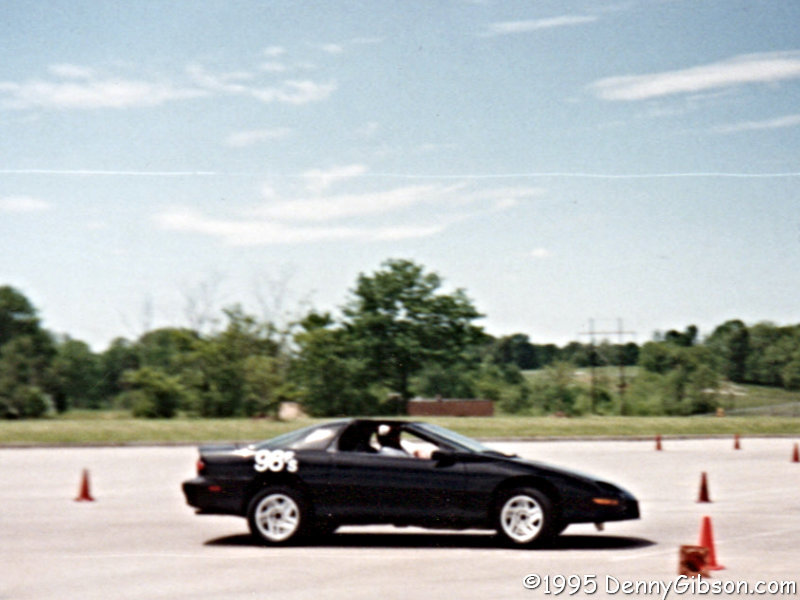
To date, DeLorme Street Atlas has been used to produce these maps. With Street Atlas no longer supported, how long that will continue is naturally in question. I do own the final (2015) version of Street Atlas and the resolution of locator maps is not at a level to be affected by minor undocumented changes in the real world. I expect locator maps to continue to be part of future journals although it’s quite possible the tools used to produce them, and therefore their appearance, will change.

The most recent journal has a second map button. For my full length drive of the Jefferson Highway, I imported my planned route to Google Maps and made it available. A big advantage of this over the static locator map images is the ability to zoom and otherwise interact with the map to see details as well as the high level overview. A big disadvantage is that it makes a feature of DennyGibson.com dependent on the functioning of another website. While this is something I try to avoid, it’s not the first. For example, the site search feature utilizes Google’s search capabilities. The Jefferson Highway map was shared with very little manual intervention so it’s possible, but not guaranteed, that I will continue the practice.

Trip Collage

The journals of all completed trips are available through either a list or a collage of photos. Both are accessed under “Done Deeds-All Trips”. I’m mentioning the collage here because it is a personal favorite and something I’ve received almost no feedback on. The collage consists of a single thumbnail from every completed trip. The images are displayed in chronological order and clicking on one leads to the associated journal. I’ve said that one of the reasons this website exists is to eventually feed me my own memories. The collage already does that to some degree which probably explains why I like it while others aren’t so impressed.

Random

A “Random” selection is also available under “Done Deeds-All Trips”. Clicking it presents a single picture from the collage which can be clicked to get to the associated journal. It’s useful when you are really really bored.

FAQ

A link to the Frequently Asked Questions page appears on the site’s home page so maybe it’s not all that subtle. But there are lots of other letters on that page so I’ll grab this chance to mention it. It’s a little like a larger version of this post with the obvious exception that everything in this post answered an unasked question while only part of the FAQ page does that.

My Wheels — Chapter 31
1994 Chevrolet Camaro

In the previous My Wheels chapter, I mentioned that the price of the Lumina was improved by the dealer’s need to “make room for the ’93s”. These included an all new fourth generation Camaro and I was instantly smitten by what I still consider one of the most attractive automotive shapes ever. The extremely clean wedge reminded me of futuristic dream cars my friends and I would sketch in the margins of our note books in high school. A new Pontiac Firebird naturally appeared at the same time and many were attracted to the performance oriented Trans Am model but not I. As was common with Pontiacs of the time, the Trans Am distinguished itself with various bits of cladding. There was also what I considered an awkward looking spoiler. In contrast, the Camaro’s simple blade-like spoiler was smoothly integrated into the body. I irritated some Trans Am admirers of my acquaintance by describing the car as “Camaro meets Mr. Potato Head”.

When, two years after buying the Lumina, the time came to “make room for the ’95s”, I was back to buy my third car from the same dealer. Ideally I’d have found a leftover green manual 6-speed Z-28 but I settled for a black 4-speed automatic. It was a Z-28, however, and a test drive of the 275 HP V8 told me that this would be a fun car even with the automatic transmission. It was also great looking. When clean and shining, this was one of the best looking cars I’ve had the pleasure of owning. But, as is well known, black cars are dust magnets and its clean and shining periods were usually rather short lived. This is — and I’m sure it will remain — the only black car I’ve ever owned.

As seen in the photo, I autocrossed this car quite a bit. It was much better suited to the job than the Z-34 Lumina and I did considerably better with it although I was never a real threat. I sure had a lot of fun, though.

Of course I still had some daughter chauffeuring responsibilities. The Camaro wasn’t as roomy as the Lumina but neither was it as confining as the Storm. Hauling two, and on occasion even three, flexible teenagers, was never much of a problem. Maybe the kids like the tasteful rumbling. I know I did.

My previous Wheels: Chapter 30 — 1992 Chevrolet Lumina
My Next Wheels: Chapter 32 — 1986 Ford Bronco II

My Wheels — Chapter 30
1992 Chevrolet Lumina

The Storm was fun to drive but was completely inadequate in terms of people hauling. As the 1992 model year came to an end, a bright red Chevrolet Lumina Z34 sitting unsold at the dealer where I’d bought the Geo caught my eye. Enough time had passed since the divorce to let my credit recover to the point I could buy it even though I still owed on the Storm and wasn’t trading it in. It became a graduation gift to my oldest son and he drove it to his new home in San Francisco.

I suspect there were several reasons why the Z34 was hanging around. One may have been price. The typical Lumina was a mid-sized reasonably-priced family-friendly car. The Z34 model not so much. As the performance model it carried a premium and having just two doors somewhat reduced its utility. The bright color and the manual transmission may have also eliminated a few perspective owners. While those things may have made it less desirable to some, they were — except for the price — the very things that attracted me. In the end, the need to “make room for the ’93s” made even the price kind of attractive.

The Chevy was an almost ideal vehicle for me at that time. It held four adults in tolerable comfort which made chauffeuring my daughter and a friend or two absolutely painless. I could even do the lunchtime driving for small groups of coworkers and that was something that had simply not been possible with the Storm. Plus it was fun.

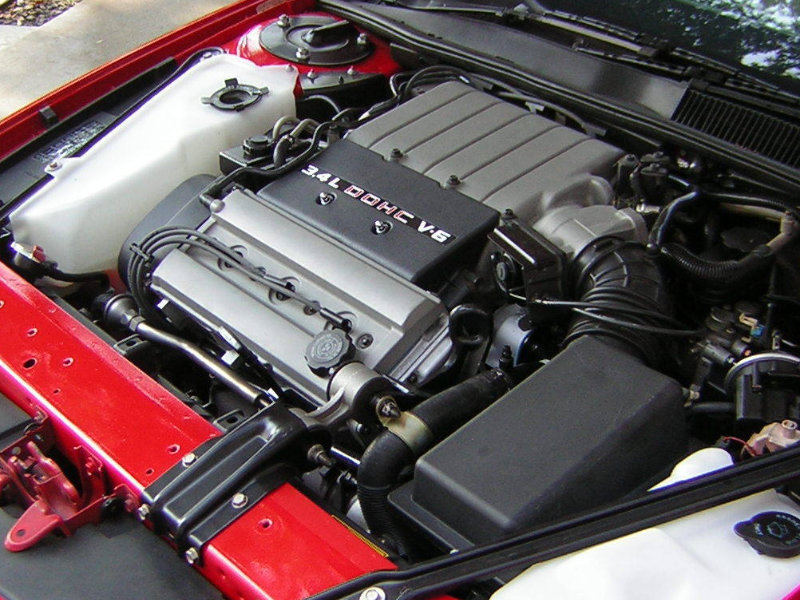
I’ve always liked shifting my own gears. That’s something I’d been reminded of with the Mazda as well as the Storm so the 5-speed manual was a big plus for me. The front wheel drive Storm didn’t handle quite as well as the rear drive Mazda but it was pretty good. The FWD Lumina was bigger than either of those so did not handle as well as either but it was a long way from bad. Plus it could go — and stop — quite well indeed. The 34 in the model designation came from its 3.4 liter V6 engine. With two overhead camshafts on each cylinder bank, this was a pretty exotic engine for General Motors. To this day, it remains the only car I’ve owned with just as many cams as wheels. Output was 210 HP. Four-wheel ABS discs did the stopping. I’ve since owned other cars with this brake setup but the Z34 was my first. I was impressed.

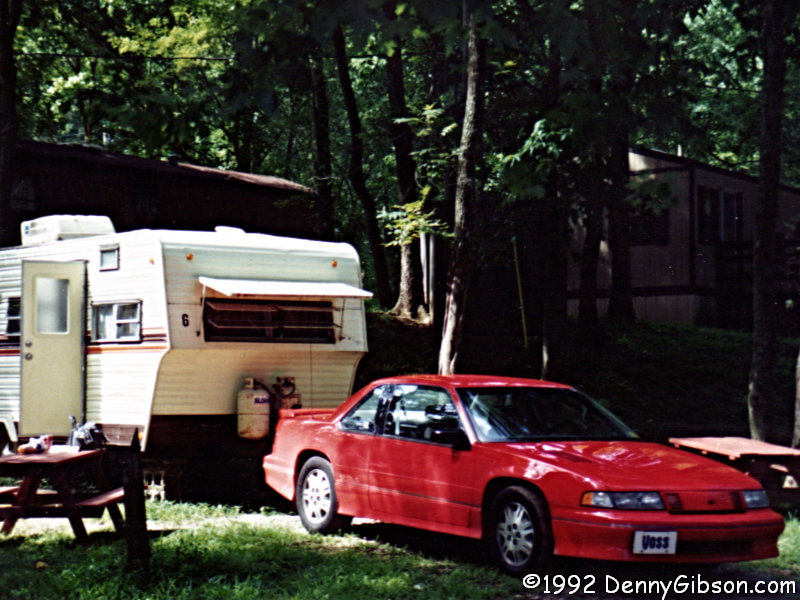
The picture at the top was taken after I’d had the car just a couple of days. I did not tow the camper there. It was one of several rental units in a Kentucky campground bordering the Ohio River. I took my daughter and one of her friends camping there almost as soon as I picked up the car. The trip included a visit to the Kentucky Horse Park where the girls  enjoyed some gentle horseback riding. I quit smoking.

It wasn’t exactly planned, but I had finally reached the point where I was mentally ready to quit. What tipped the scale was that smoking had just become too much of a hassle and the acquisition of a new not-yet-smoked-in car seemed a good occasion to go for it. I took no cigarettes on the trip but did take a pack of Between the Acts cigarette style cigars to use in dealing with major nicotine cravings. I essentially finished the first few I smoked but it wasn’t long before a couple of puffs would make me light-headed. I resorted to the little cigars a couple of time after we got home but I never finished the pack and I never smoked in the Lumina.

I did go racing in it though. Once. Kinda. This was the first car I went autocrossing in. Autocrossing (a.k.a. gymkhana) is a race against the clock on a course marked by orange cones. Some friends were into it and I decided to give it a try. A common arrangement is for half of the entrants to line the course as corner workers while the other half raced and then switch roles. I had never even seen an autocross but figured I’d get to watch for awhile before launch time. Nope. Not only was I in the first drivers (rather than workers) group, my slot was so early that I was in line and unable to see much of anything when the few cars in front of me made their runs. To no one’s surprise, I didn’t do well. It wasn’t horrible but it sure  wasn’t competitive. I did a little better on subsequent runs but not much. The FWD Lumina was not a particularly good autocross car and I had no idea what I was doing. I would be back, however  — in a different car.

My Previous Wheels: Chapter 29 — 1991 Geo Storm
My Next Wheels: Chapter 31 — 1994 Chevrolet Camaro

My Wheels — Chapter 29
1991 Geo Storm

In the previous My Wheels chapter, I mentioned that the motorcycle it featured passed through my hands sometime in the period around my second divorce. The same was true of the subject of the chapter before that. The Mazda, the Yamaha, and the wife all came and went while the leased Acura remained. Eventually, however, even it went away. In the fall of 1991, I found myself in need of a car with nothing to trade in and with credit not all that good in light of the recent divorce.

I’d enjoyed driving the Mazda and, with the family down to just me and my daughter, thought I’d go for something sporty. The Mitsubishi 3000GT had recently been introduced, and I really liked its looks. I picked out one I wanted, took it for a quite satisfying test drive, then quickly discovered the credit issue. I simply couldn’t afford the car.

The Isuzu-based Geo Storm had appeared at Chevrolet dealers about the same time. It was kinda sporty, kinda fun to drive, and a lot cheaper than the Mitsubishi. My credit was good enough for a blue Geo Storm GSI 5-speed coupe.

Even as I closed the deal, I considered it something of a stopgap. The Storm was a step down from the Acura I had been driving and, more importantly, from the Mitsubishi I wanted. I intended to move on just as soon as the smoke and ashes from the divorce cleared a little. I became more serious about doing that as I quickly realized how wrong I had been about my transportation needs.

Sure, there were now only two of us in the household I headed, but I hadn’t considered the fact that teenage girls hardly ever go anywhere alone. My chauffeuring duties weren’t all that heavy, but when I did need to deliver or retrieve my daughter, she was usually accompanied by a friend or two. The Storm could handle three teens and me for short distances, but that was its limit. In hindsight, I was better off realizing this for the price of a Geo rather than the Mitsubishi I’d targeted.

The worst of the impact of the divorce on my credit was over about as quickly as the marriage. I was able to upsize in less than a year. As a result, I really have no stories about the Storm. It did its job even when overloaded with teenagers, and I really had no problems with it at all. My problem-free experience made finding an article titled “Famously Unsafe: Geo Storm” a huge surprise.

I found the article (It’s here.) as I searched the internet to refresh my memory for this post. I dived into it expecting to learn of major flaws or failures that I had somehow miraculously avoided. Turns out that the car wasn’t particularly fragile or uncontrollable, but supposedly had a reputation I was unaware of. The only hard fact I saw to support this is, “The NHTSA actually rated the Storm as having the most aggressive drivers in its class.” In other words, the “unsafe” reputation came from the car having more than its share of owners who overdrove their and the car’s capabilities. The article ends by referencing the Storm’s “tendency to attract morons”. Nolo contendere.

My Previous Wheels: Chapter 28 — 1978? Yamaha 400
My Next Wheels: Chapter 30 1992 — Chevrolet Lumina

Trip Peek #62
Trip #51
2007 National Route 66 Festival

This picture is from my 2007 National Route 66 Festival trip. The festival was in Clinton, Oklahoma. It was the centennial year for the state of Oklahoma which was a factor in holding the festival there and it also meant there were other things going on. One of those was the opening of a time capsule in which a brand new 1957 Plymouth had been buried. This was a fly-and-drive trip and I arranged my flights to be in Tulsa for the Plymouth resurrection then cover a little Route 66 before the festival. The capsule had leaked and the Plymouth pretty much ruined but it was still a cool event. My time on Route 66 was enough to get me to my first overnight at the Blue Swallow in Tucumcari, New Mexico, and a look at two almost but not quite ready to open new businesses on the Route: Boothill Restaurant in Vega, Texas, and Pops in Arcadia, Oklahoma. Among the things making the festival itself memorable was the one and only appearance of Route 66 e-group founder Greg Laxton and the first of many appearances of the now legendary Road Crew.


Trip Peeks are short articles published when my world is too busy or too boring for a current events piece to be completed in time for the Sunday posting. In addition to a photo thumbnail from a completed road trip, each Peek includes a brief description of that photo plus links to the full sized photo and the associated trip journal.

My Wheels — Chapter 27
1985 Mazda RX7

Details of timing are lacking for both this and the following My Wheels chapter. I think I’ve got the sequence right but I’m not even entirely certain of that. The two are connected by more than a lack of precision in dates but I don’t expect this chapter to explain things very well. Hopefully I’ll be able to make things clearer in the next chapter when all the pieces have been identified.
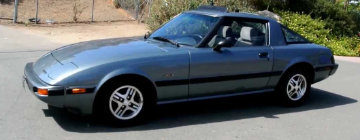
The subject of this chapter was my oldest son’s car. I cosigned the loan and he made all the payments on time and handled all other expenses, including insurance, right up until he needed it. At some point the financial load became a bit too much and he decided to sell it. No need to insure a car you’re going to sell. Right? As often happens, the decision to sell and the decision to drop insurance preceded the decision to stop driving and, pretty much on cue, there was an accident. It wasn’t a huge one and it was a single vehicle thing but it left him with something that could neither be driven or easily sold. What happened next was pretty much on cue, too. Dad the cosigner became sole owner of the undrivable, unsalable, uninsured, and unpaid for Mazda. That’s not the actual car in the photo but it’s a perfect match except for the sunroof.

I got the damage repaired and the car insured and I drove it for awhile. It was a rather a fun car to drive. The rotary engine seemed like it would accelerate — at least a little — forever. It was, however, a toy I really couldn’t afford at the time. As I said at the beginning, details of timing are lacking and some of the related details involve my second marriage and divorce. I know I had the car both before and after the short lived marriage but I’m understandably just not capable of fitting all the pieces together.

Either during or shortly after the marriage, my younger son bought the car. I’m fairly certain he did it for my benefit. He was in the Navy with no expenses. He also had no driver’s license. He hadn’t felt the need in high school and had entered the Navy on graduation. Plans were made for him to get his license then see a bunch of the country driving the Mazda to his assignment in San Diego. There was only time for one shot at a license and it was a miss. As I recall, the big dig was activating turn signals way too early but I’m guessing that a general nervousness contributed a lot. He flew to San Diego and the Mazda was parked in the garage to await his return.

Although he did eventually get his license (The Navy needed him to drive something.) he never took possession of the car. After a year or so he/I sold the car to a friend. I had let it sit idle for too long and it took some effort to get it running again. It became a daily driver for its new owner until a winter ice attack in traffic brought about its demise.

My Previous Wheels: Chapter 26 — 1986 Acura Legend
My Next Wheels: Chapter 28 — 1978? Yamaha 400

Trip Peek #61
Trip #70
Some Lincoln Highway

This picture is from my 2008 Some Lincoln Highway trip. It was one of those cost cutter things I often tacked onto the end of work assignments. This assignment was near Philadelphia, Pennsylvania, and the picture is of an abandoned bridge over Poquessing Creek northeast of the city. Built in 1805, it carried the early Lincoln Highway. It was where I started the personal part of the trip that would follow the Lincoln Highway west as far as Canton, Ohio. After visiting several roadside attractions along the way I spent the final day admiring classic cars at Canton’s Glenmoore Gathering. As I looked over the journal to prepare this entry, I couldn’t help but smile when I saw that the “66 the Hard Way” idea came from preliminary planning for this trip.


Trip Peeks are short articles published when my world is too busy or too boring for a current events piece to be completed in time for the Sunday posting. In addition to a photo thumbnail from a completed road trip, each Peek includes a brief description of that photo plus links to the full sized photo and the associated trip journal.