An Auto Park Turns Two

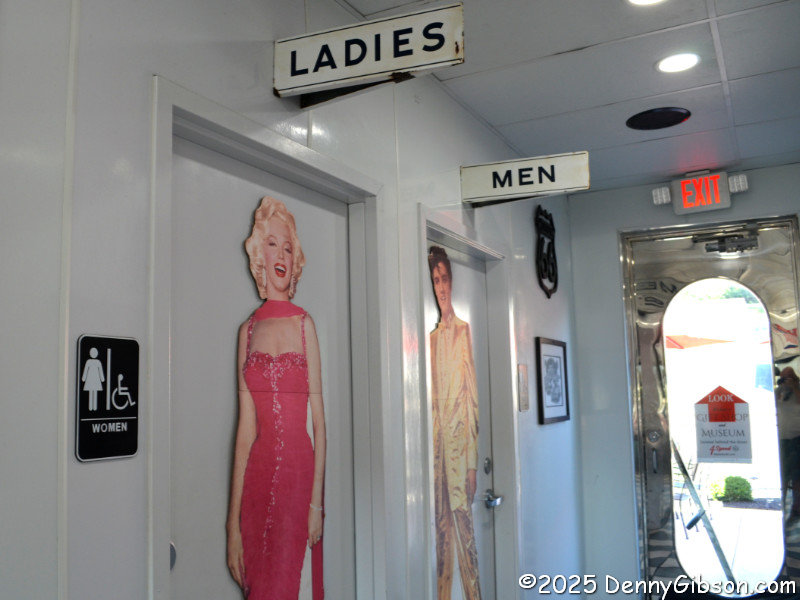
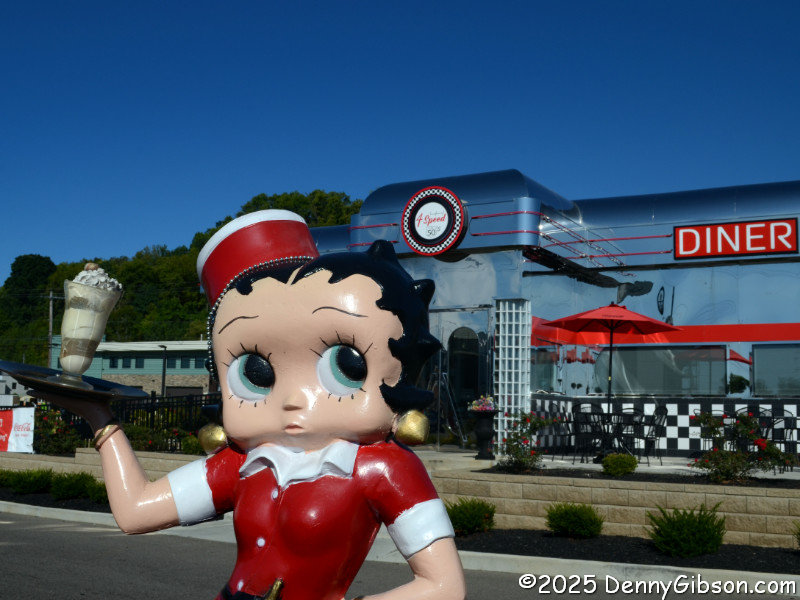
I’ve not been overly secretive about the fact that I’m generally not crazy about bright and shiny brand-new diners or diners of any vintage with a hard-core Marilyn & Elvis vibe. Just the “bright & shiny” thing is probably enough to explain why I’ve passed the 4 Speed on 50 Diner multiple times without stopping. Two Fridays ago, I was headed home from a spot a bit deeper into Indiana than Lawrenceburg with a stomach empty enough and a bladder full enough to pull me in. Inside was a staff so friendly and food so good that I was very glad I stopped. I sat at the counter and watched this burger prepared on the grill in front of me, then ate it. I swear it didn’t look that big on the menu. At some point, I asked the cook about the museum I’d seen signs for, and he pointed to a fellow he called one of the owners at the end of the counter. He explained that the museum contained some very interesting cars but had just closed for the day. Then he went on to tell me the diner’s second anniversary was being celebrated in just over a week with some special entertainment and the weekly Cars & Coffee.
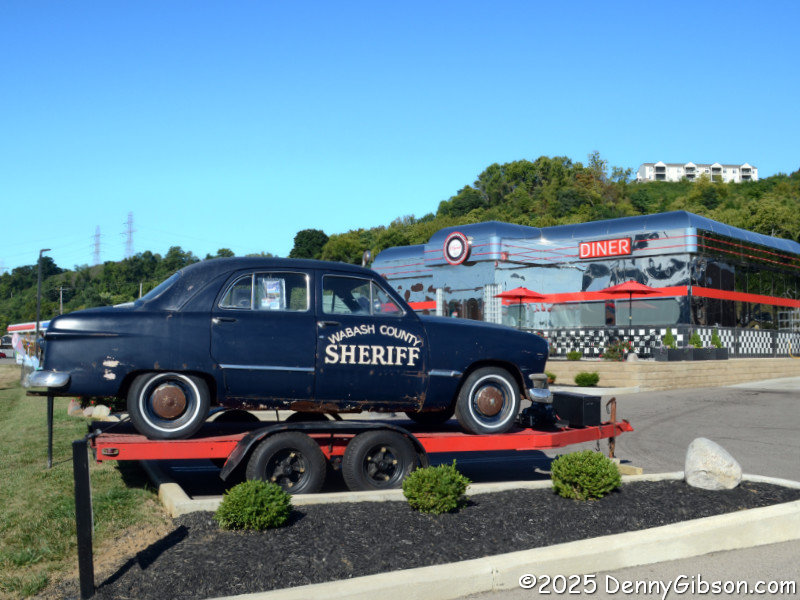
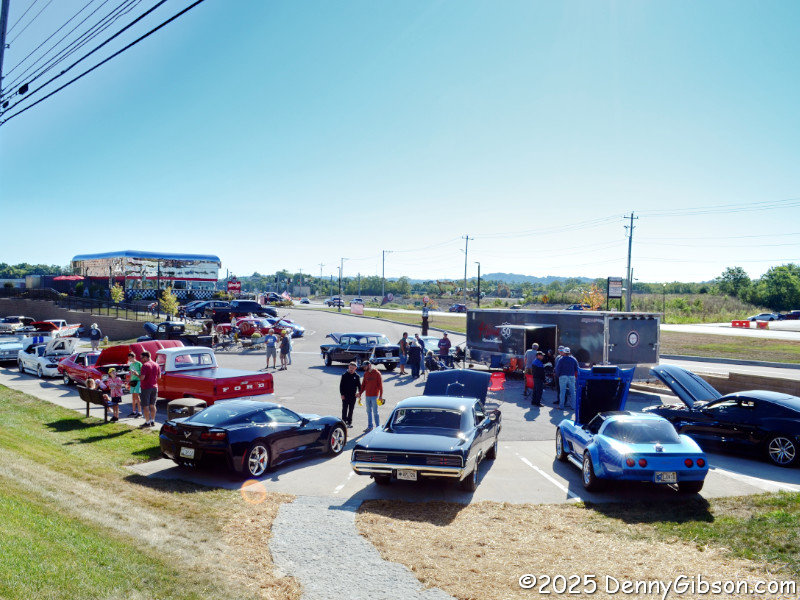
I decided that was a good activity for an absolutely beautiful Saturday, and headed over in time to catch a decent chunk of Cars & Coffee. The day’s entertainment highlight would be a renowned Elvis impersonator, but that was scheduled for the evening when I intended to be sitting quietly at home. I did get to see one of the event’s guest celebrities, however. This Ford appeared in the Movie Hoosiers. I confess to being one of the few people in the world and possibly the only male over 16 living within 60 miles of Milan, IN, carrying that shame. Yeah, I know. I will fix that someday. I promise.
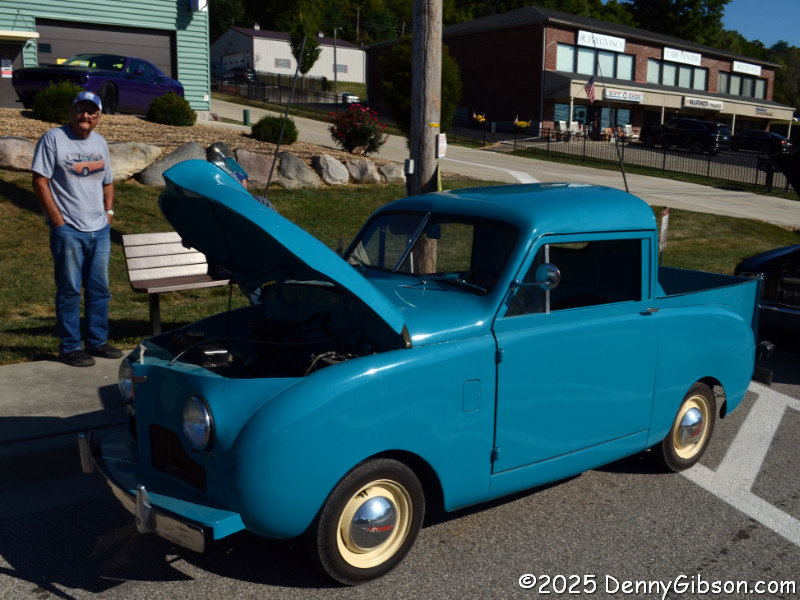
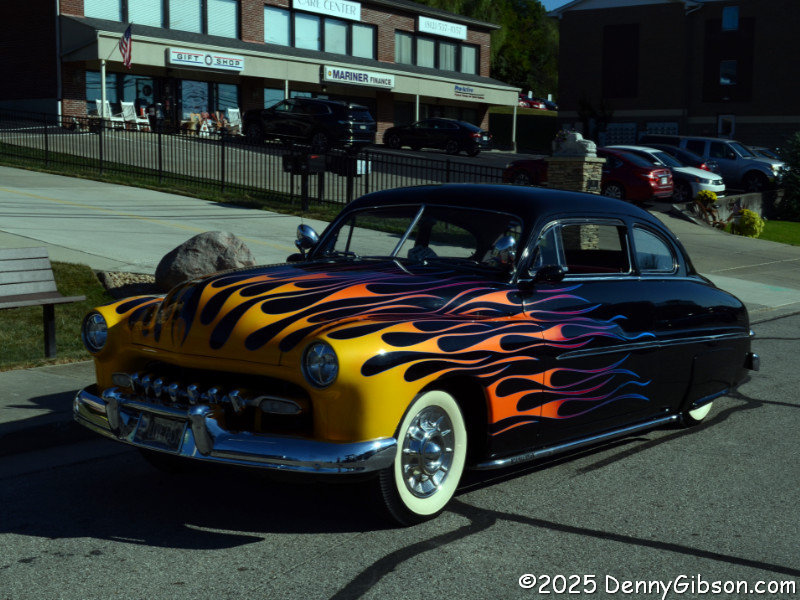
The setup here is sort of a car culture campus. A separate website, 4 Speed on 50 Auto Park, covers the non-diner part of the operation. The Hoosier car is displayed in front of the diner. Cars & Coffee makes use of a parking area between the diner and an associated gas station so that diner access is not affected. I’m guessing that might not remain the case once the Elvis crowd starts rolling in. There appeared to be a pretty decent turnout, and it certainly included some real classics.
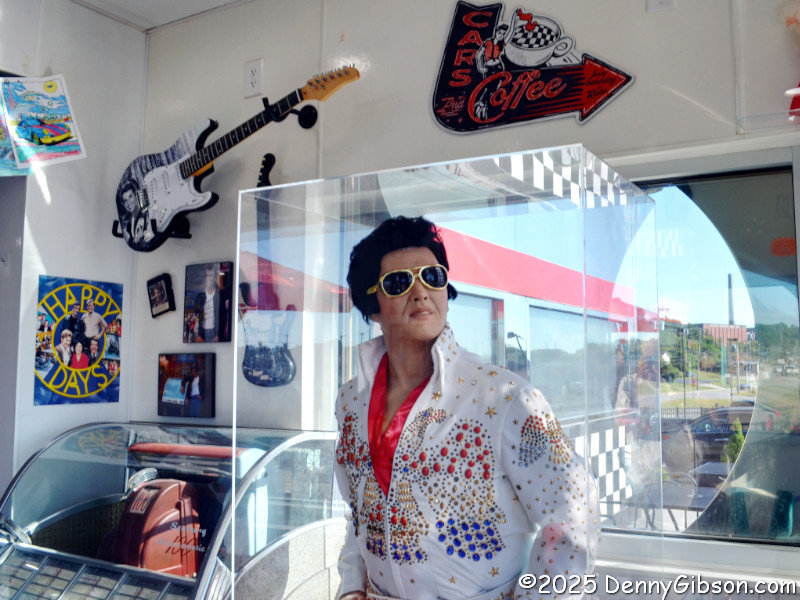
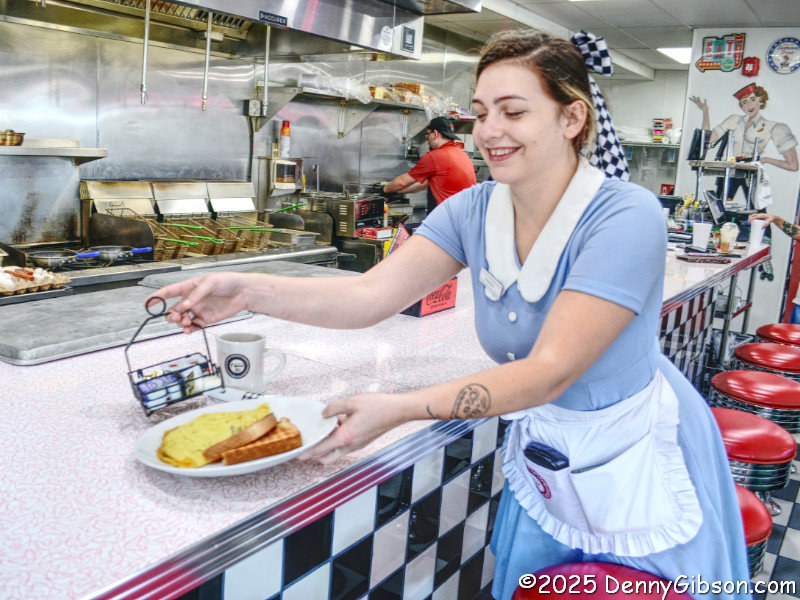
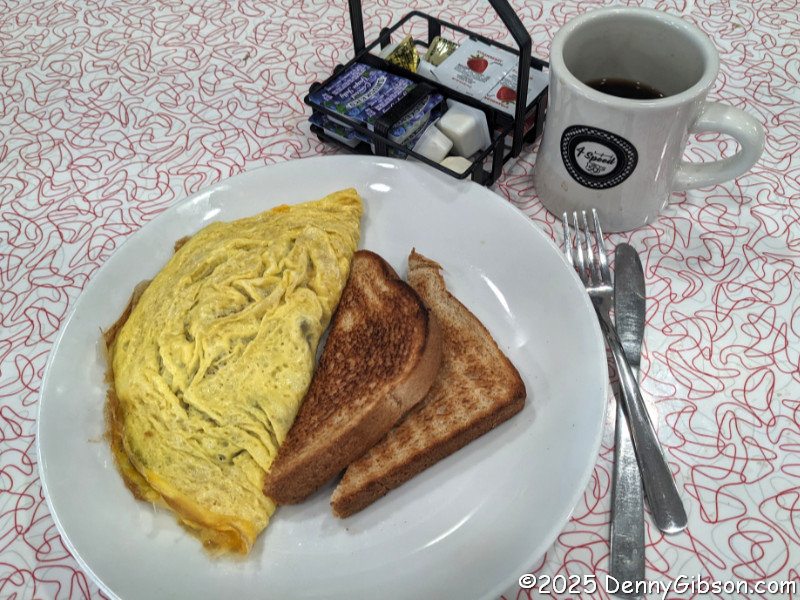
Once I had checked out all the cars, I went inside and don’t even pretend you’re surprised. There’s a real greeter with a real smile just out of frame to the left. I once again sat at the counter and watched as my meal was cooked. It was then delivered with a smile. This time it was a Local Omelet (goetta, onion, peppers, mushrooms, cheddar jack cheese). After eating, I carefully selected and then made use of one of the restrooms.
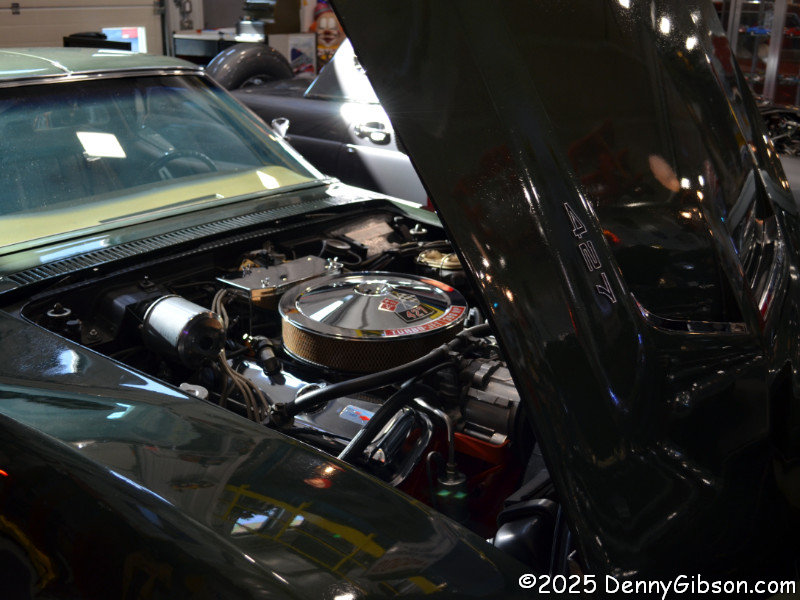
Now I was ready to visit that museum. When I purchased my ticket, the fellow I had spoken with the previous week was sitting nearby, and I made a comment about him being the owner. His dad was the actual owner, he now explained as he walked with me to the museum entrance. Both he and his dad were named Steve, and there was a third Steve who helped run the place I would probably encounter while I was there. Not long after he left, I was looking over a 1969 427 Corvette when three men entered, and I made some joke about one or two of them being Steve. I was off by one. One was the owner and creator of the complex, and one was the other Steve I’d just been told about. The third was a visiting friend who was also named Steve. So, minutes after learning the name of Steve the Younger, I met Steve the Elder, Steve the Other, and Steve the Visitor.
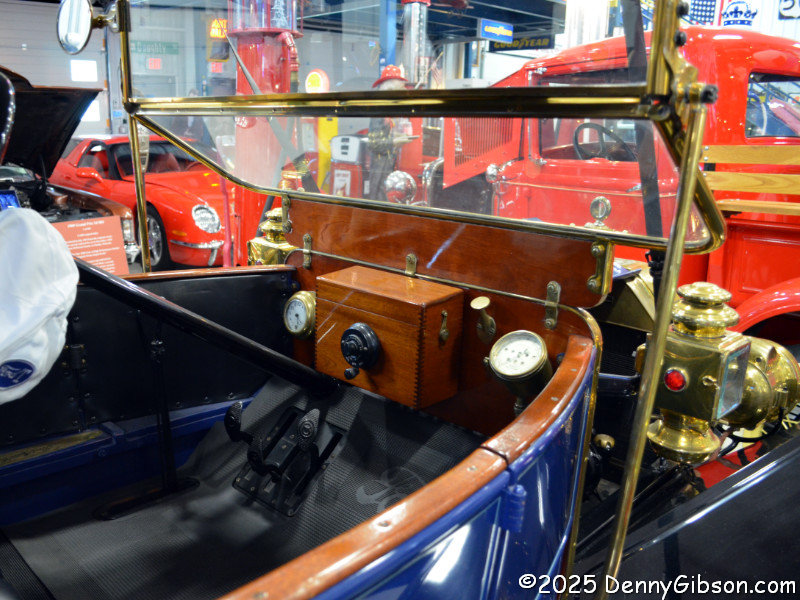
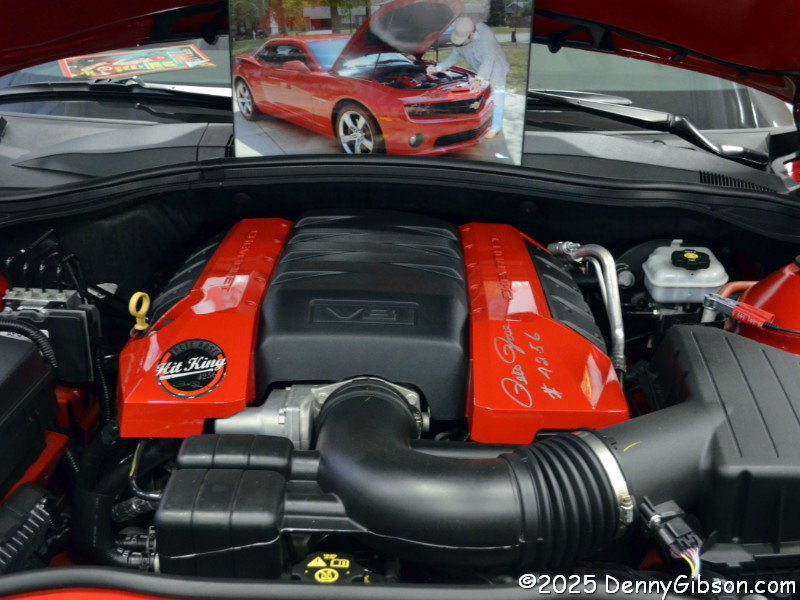
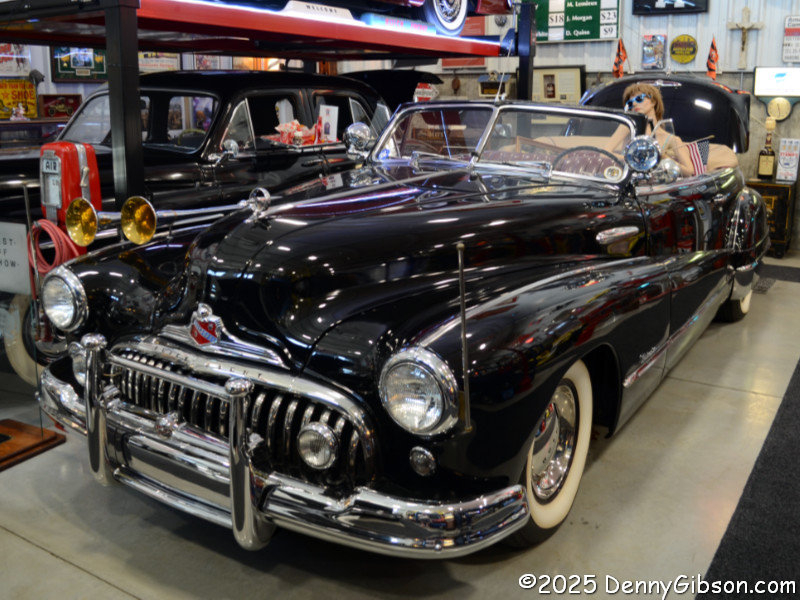
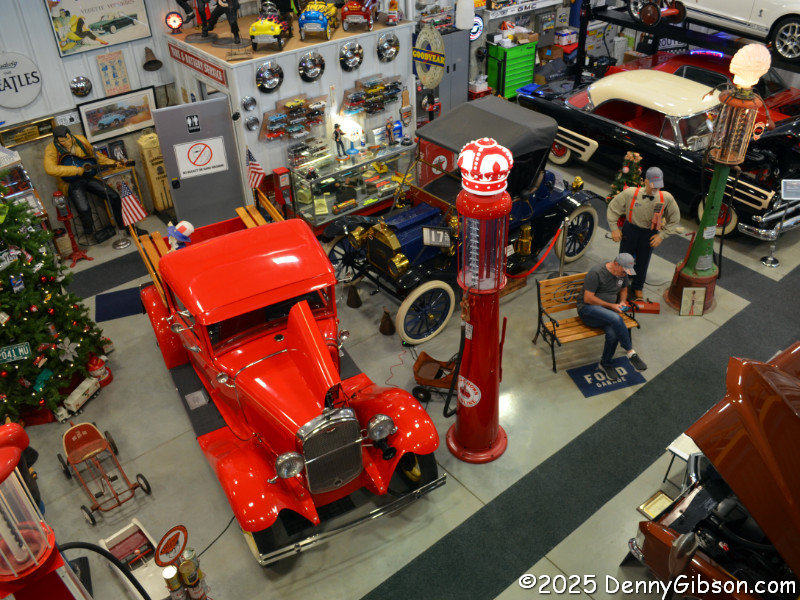
Steve TE has brought together a rather impressive collection of cars spanning a wide range of years and styles. Some are extremely rare, and many have remarkably low mileage. I believe the oldest car in the museum is the 1911 Brass Era Model T Ford. The 2010 Hit King Edition Camaro is one of just 27 made. Pete Rose signed the engine covers, and each car came with a spare, unsigned cover, in case the owner wanted to save the signature and actually use the car. The 1948 Buick parade car once belonged to the family that owned the land where the museum now stands. It had been sold before Steve TE bought the land, but he managed to track it down and have it restored.
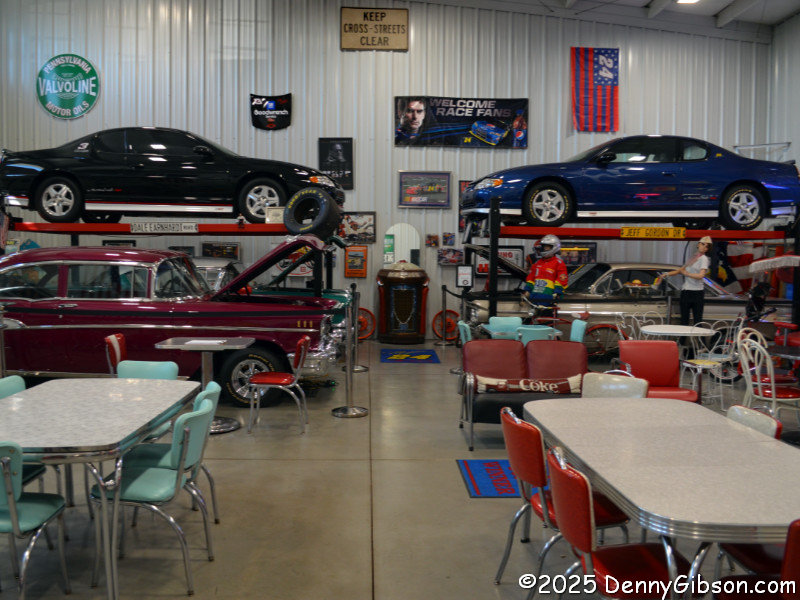
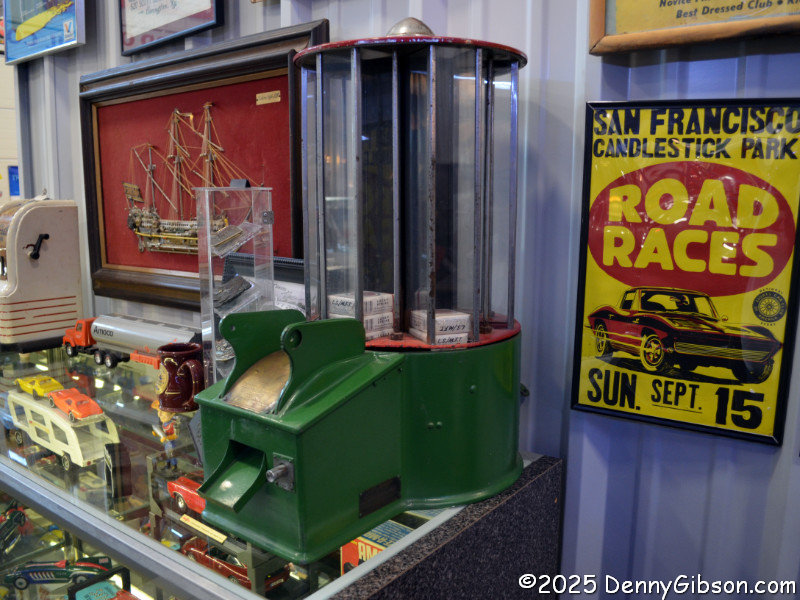
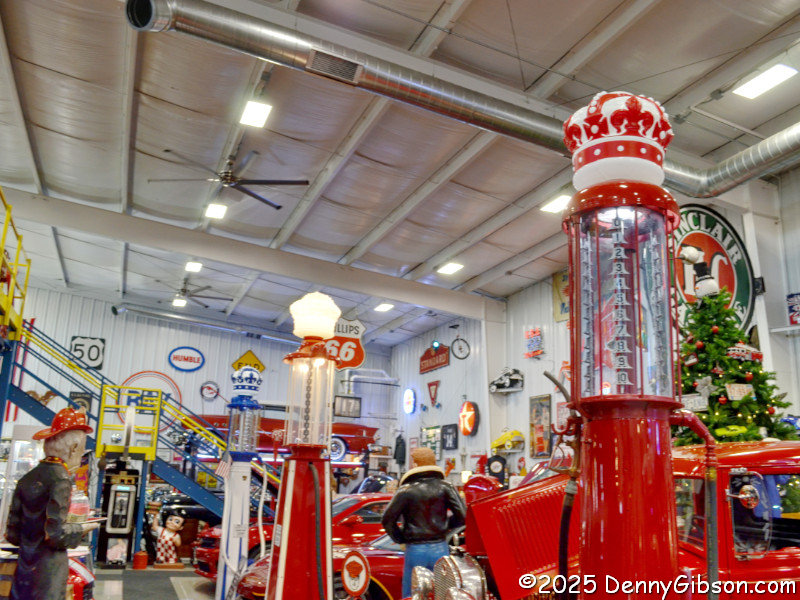
There’s really a lot more than cars here. Guys who put together car collections like this seem to naturally pick up lots of other things car-related, as well as some stuff that’s not really car-related at all. The cigarette vending machine served up a pack of smokes when a dime and a nickel were inserted simultaneously. Out of view are climate-controlled spaces similar to those seen here that are rented by individuals for car storage. And even the public space isn’t exactly all museum. A large section called The Hub can be rented for private events and has been the site of birthday and graduation parties, club meetings, and at least one wedding. Of course, parts of it do look pretty much like a museum.
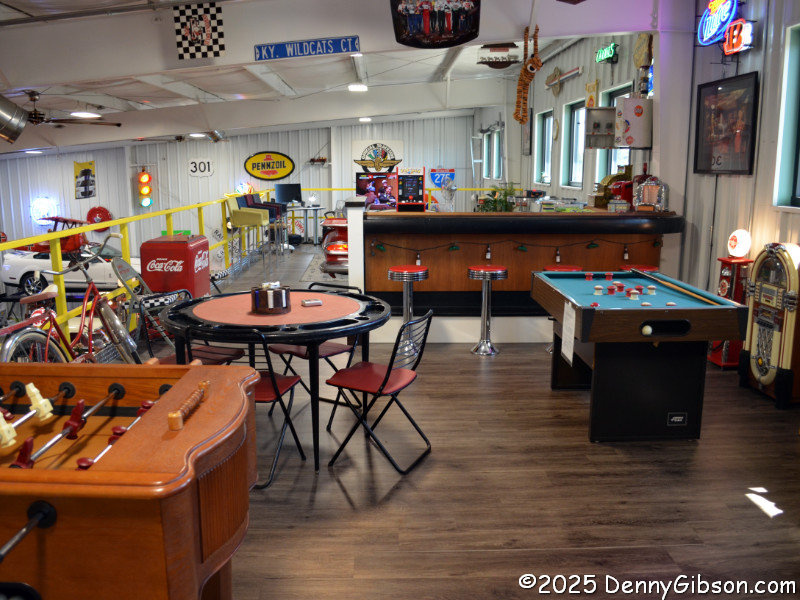
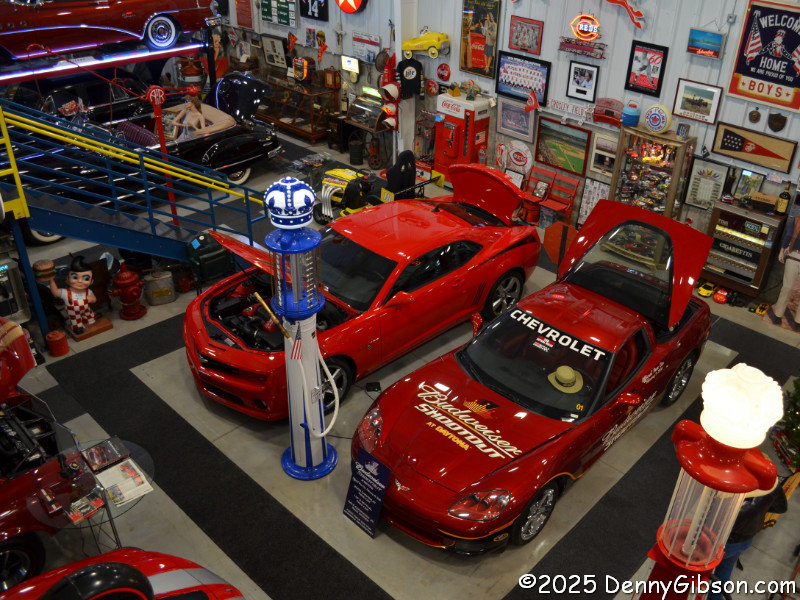
For a different view of some of the cars and maybe some fun and games, climb the stairs to the mezzanine. I did and snapped pictures that include the Hit King Camaro, the Brass Era T, and Steve TO waiting for me to come back down. He basically gave me a fully guided tour and answered every question I had, including some called down from the mezzanine.
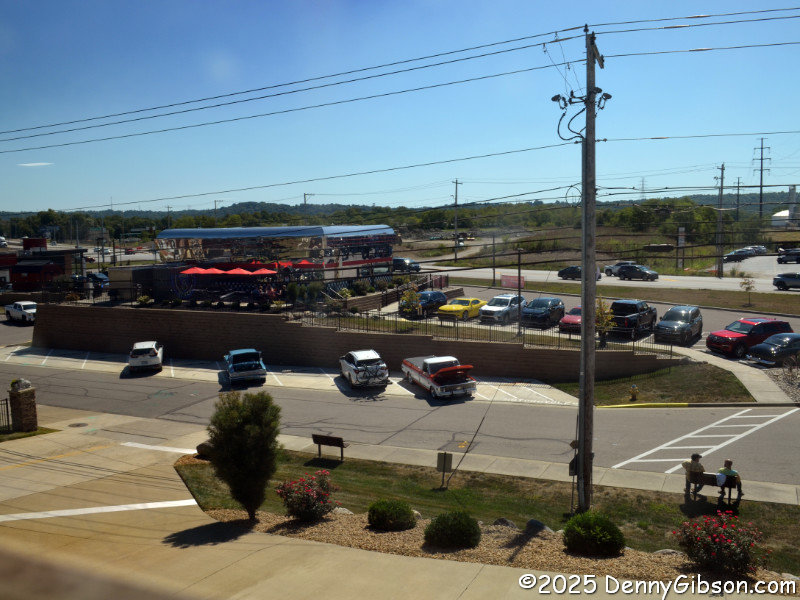
The mezzanine also provides a nice overlook of the diner and US-50 passing by. I’ve not suddenly become a fan of brand-new chrome-plated diners, and I’ll probably still cringe a little when I next find myself knee deep in Elvis & Marilyn paraphernalia, but Steve Caudill… I mean, Steve TE and his wife, Barbara, have created something pretty cool in Lawrenceburg, Indiana. The diner isn’t trying to pretend it’s something it’s not, and the museum’s impressive collection is very nicely presented. A miniature golf course is to be added to the complex in the near future. If the folks running that are as cheerful and competent as everyone I’ve met on my two visits, I might be tempted to pick up a putter for the first time in a few decades. Maybe not, though. I’m more likely to sip a milkshake while looking at cool cars and watching someone else count strokes.
Trip Peek #148
Trip #2
Packard Museum & Garage-mahal

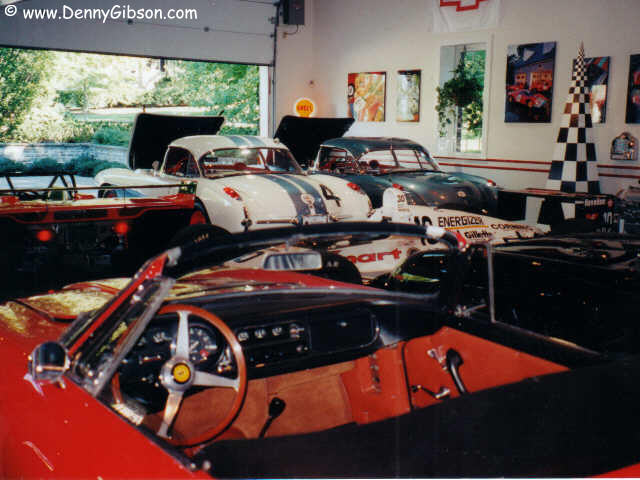
This picture is from my 2000 Packard Museum & Garage-mahal day trip. It was only the second trip documented here, and the first day trip. It wasn’t documented very well, as the idea of this as a permanent website had not yet taken root. It was an Eastgate Corvette Club outing with two museum visits separated by a lunch stop. First up was America’s Packard Museum in Dayton, OH. It’s in a former Packard dealership, and may have been going by the name of that dealership, Citizens Motorcar Company, at the time. The afternoon stop was at the home and garage of Cincinnati Microwave co-founder Jim Jaeger. I have subsequently re-visited both collections with my most recent visit to the Packard Museum documented here. Apparently, other visits to Jaeger’s garage went undocumented.


Trip Peeks are short articles published when my world is too busy or too boring for a current events piece to be completed in time for the Sunday posting. In addition to a photo thumbnail from a completed road trip, each Peek includes a brief description of that photo plus links to the full-sized photo and the associated trip journal.

Two for Four in Ohio

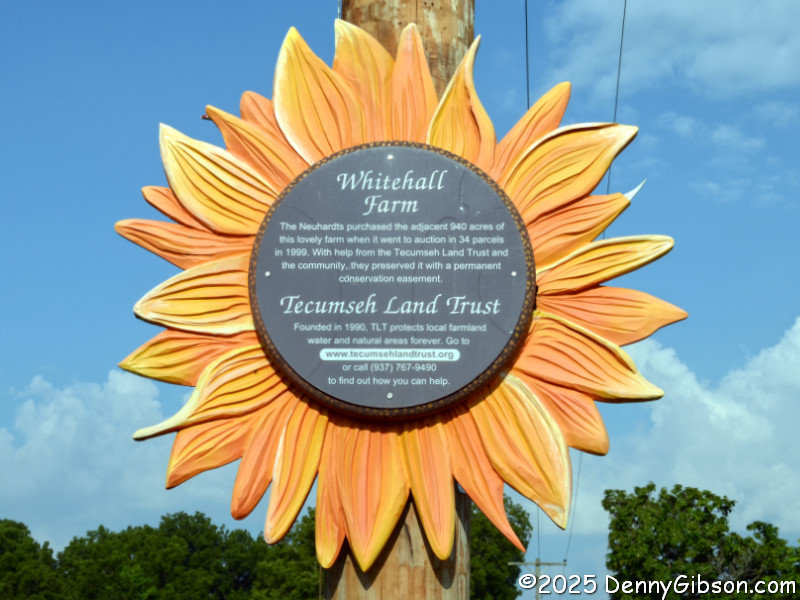
After my return visit to an outstanding Ohio museum last week, my thoughts rather naturally turned to other Ohio museums when considering activities for the mostly open following week. I settled on two I had never visited, then added a sunflower field and a nearly new member of the World’s Biggest club to create a four-stop Friday outing. Although I reached all four, only two can be counted as successful visits.

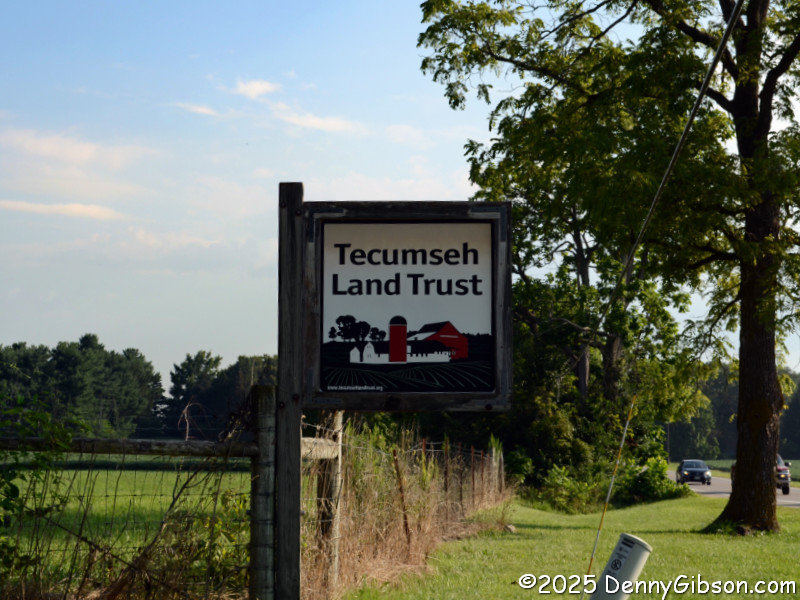
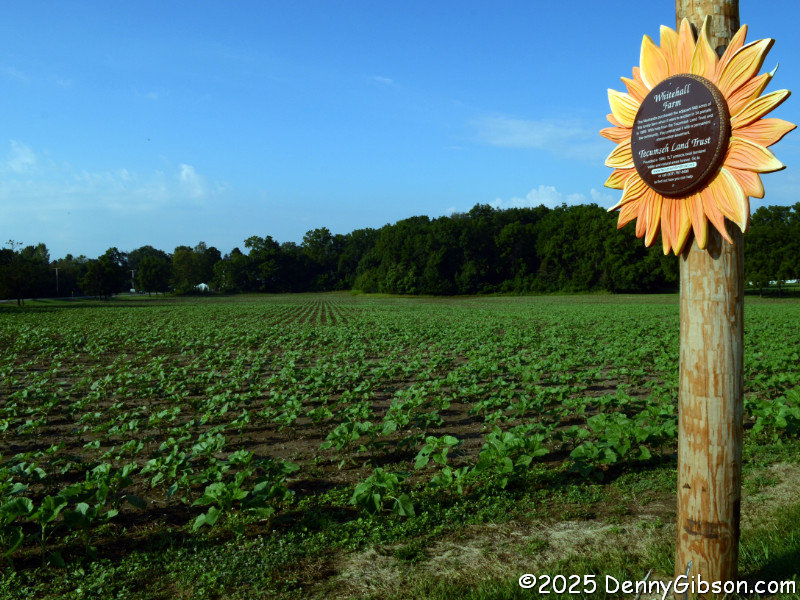
I actually knew there would be no blooming flowers at Tecumseh Land Trust before I left home. When I initially made my plans, I’d found some general information indicating that the field operated in August and September. A few days later, I learned that projected bloom dates for 2025 were near the end of September.

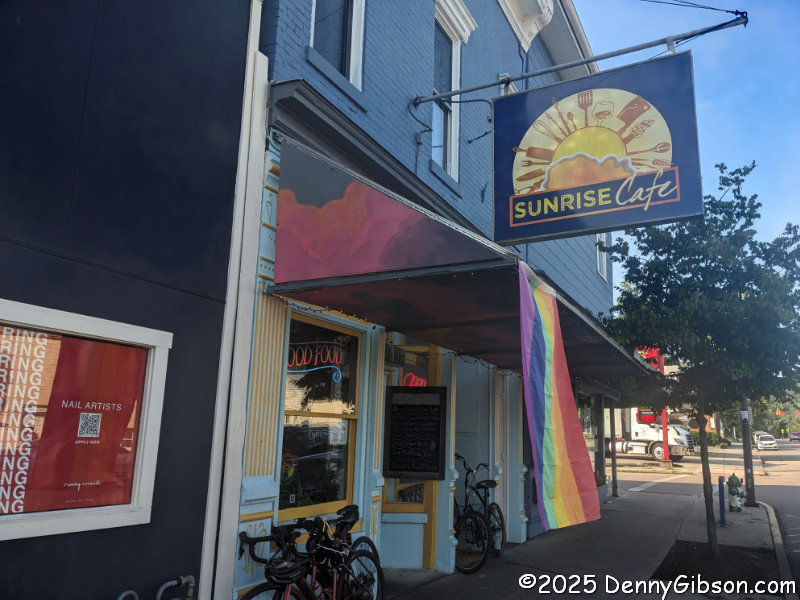
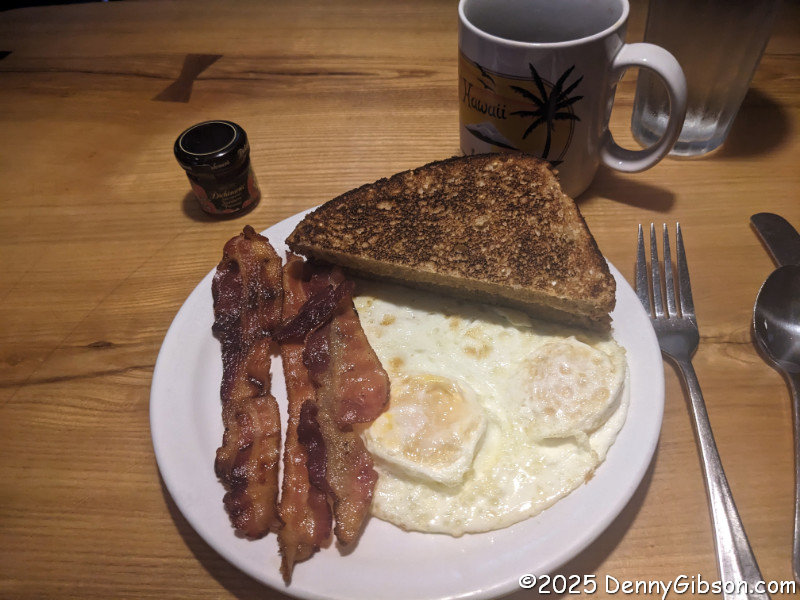
Of course, I considered dropping the field from my agenda, but my appetite was already aimed at one of my favorite restaurants in nearby Yellow Springs. So I stuck with the circuitous two-lane drive and breakfast at Sunrise Cafe rather than the direct but boring expressway route to my second stop. Maybe I’ll come back for a meal — with flowers — next month.

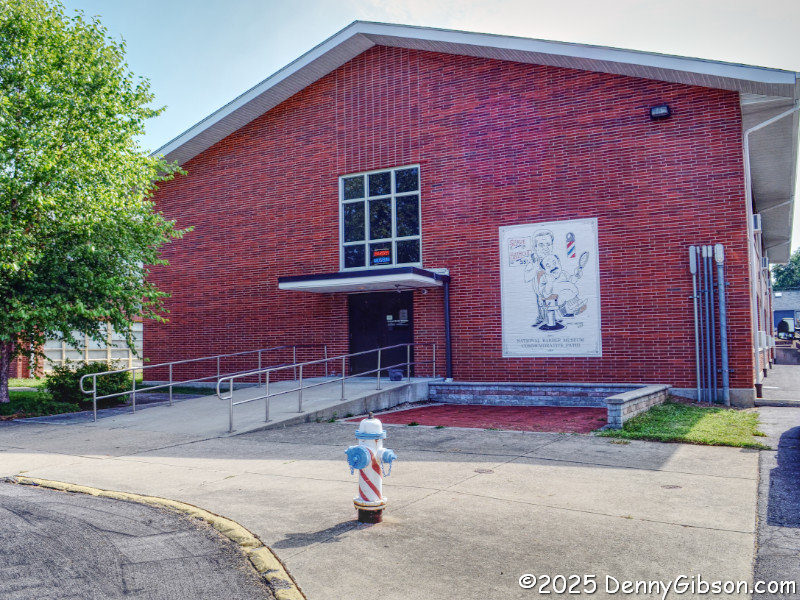
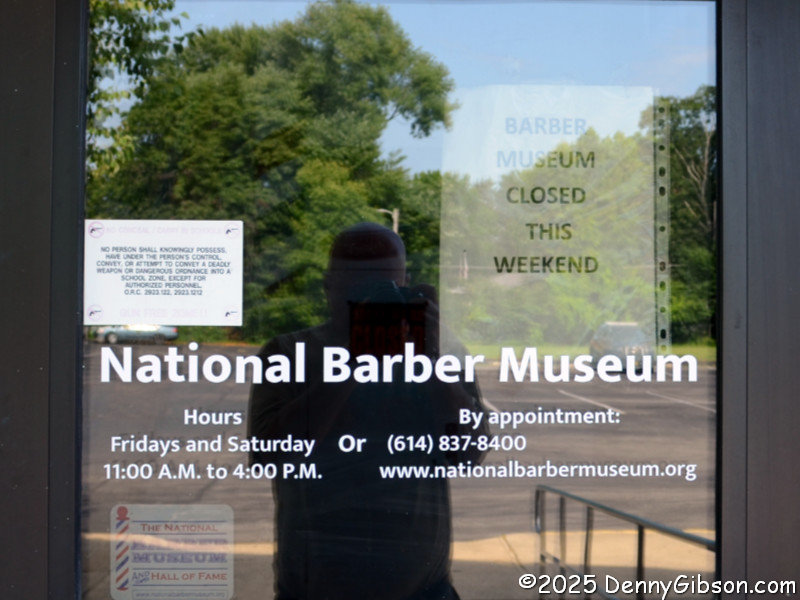
This was what the trip was more or less built around and what I anticipated being the trip’s highlight. Instead, it provided only an accidental selfie. I believe that when I first became aware of the National Barber Museum, all visits were by appointment only. At some point, regular hours on Fridays and Saturdays were added. I was disappointed when I saw the closed notice, but since I was there just a bit before the scheduled opening, I did what I probably should have done earlier. I called. I spoke, I assume, with museum director Mike Ippoliti, who explained that a lack of volunteers and his own recent foot surgery prevented normal operation at present. He expected regular hours to return in a few weeks. I wished Mike well in his recovery and headed to stop number three.

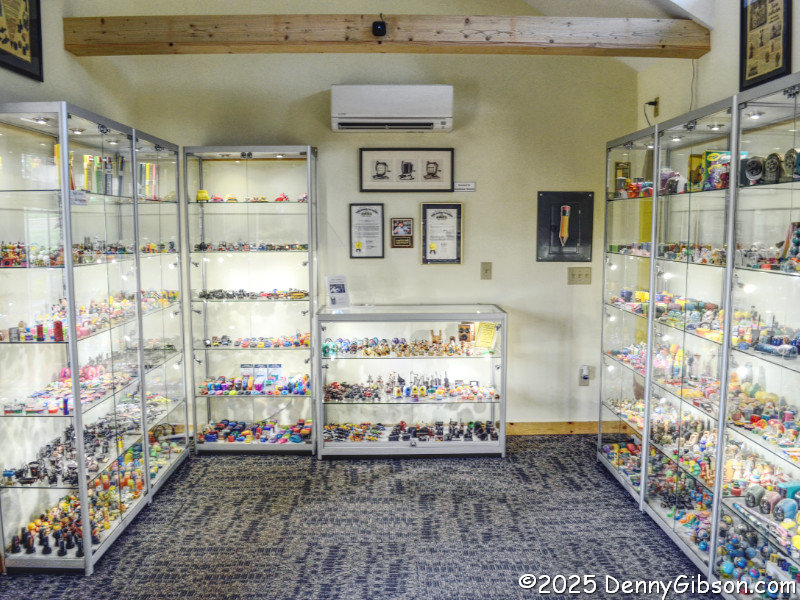
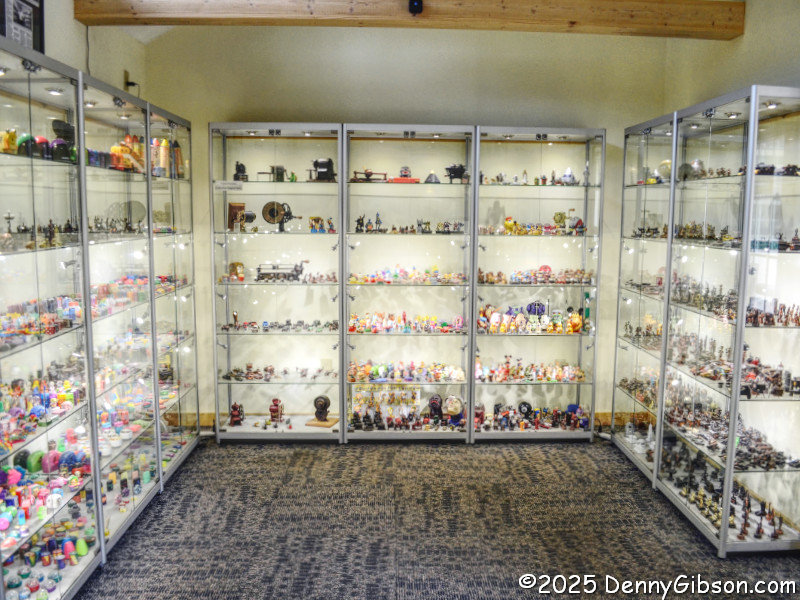
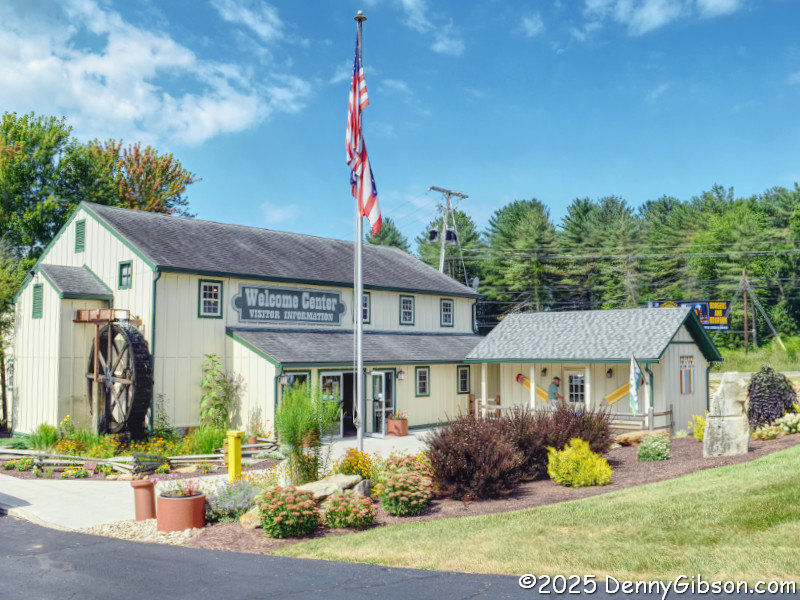
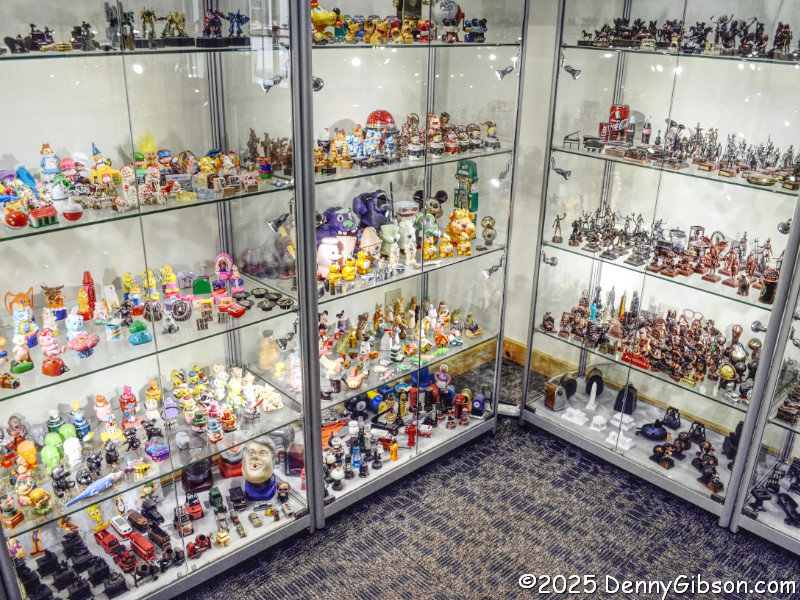
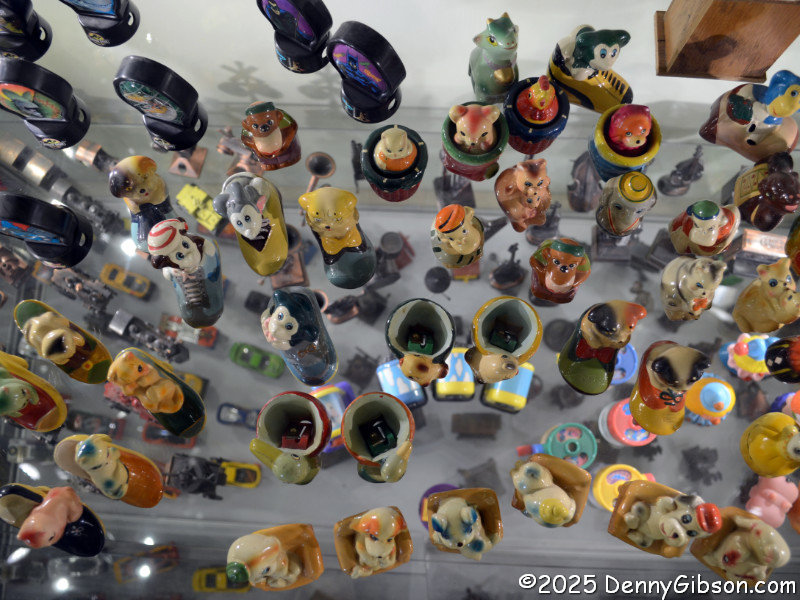
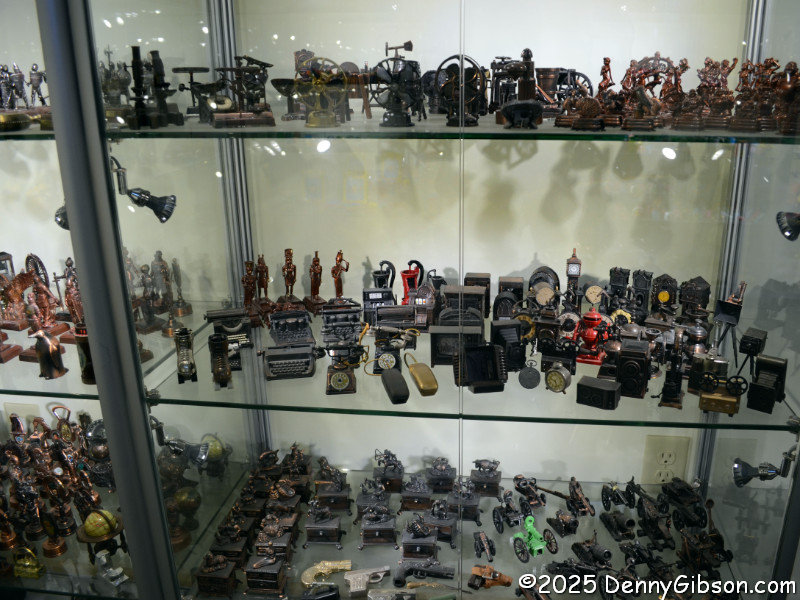
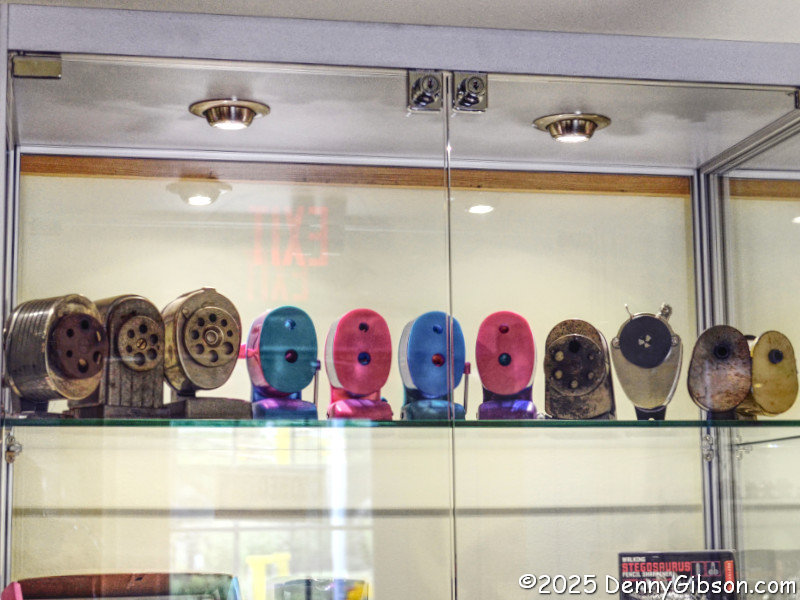
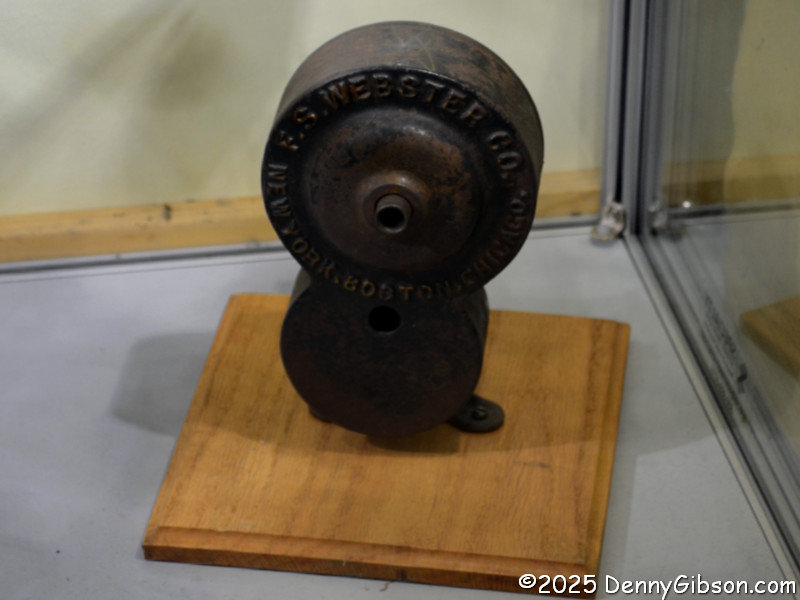
I missed the first two iterations of the Paul A. Johnson Pencil Sharpener Museum. The first iteration was assembled in a shed at Paul A. Johnson’s home. After Johnson’s death in 2010, the nearly 3,500 sharpeners and the shed housing them were moved to the Hocking Hills Regional Welcome Center near Logan, OH. In 2024, the deteriorating shed was replaced by the building on the right side of the first picture. By then, the collection had grown to somewhere around 5,000 sharpeners when the widow of Florida collector Frank Paredes donated all the sharpeners he had amassed to the museum.

The incredible collection includes sharpeners I remember from my school days, and some even older than that.

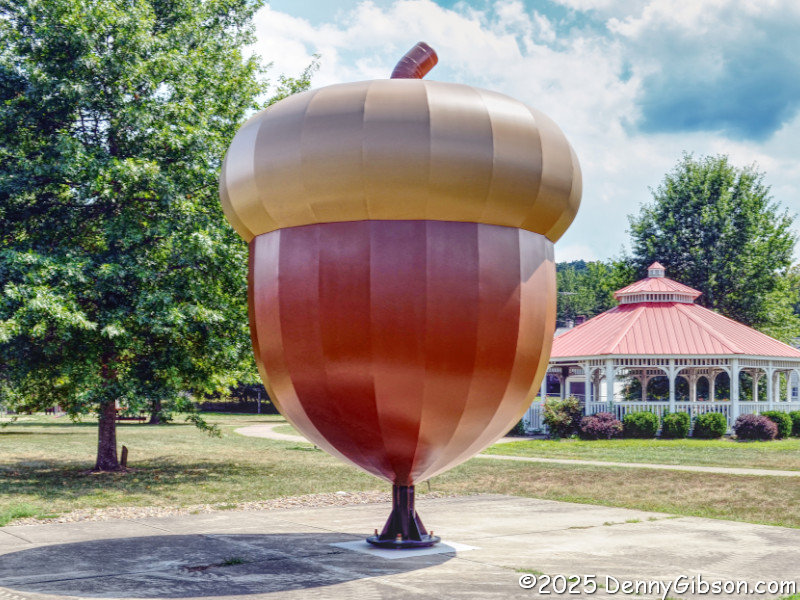
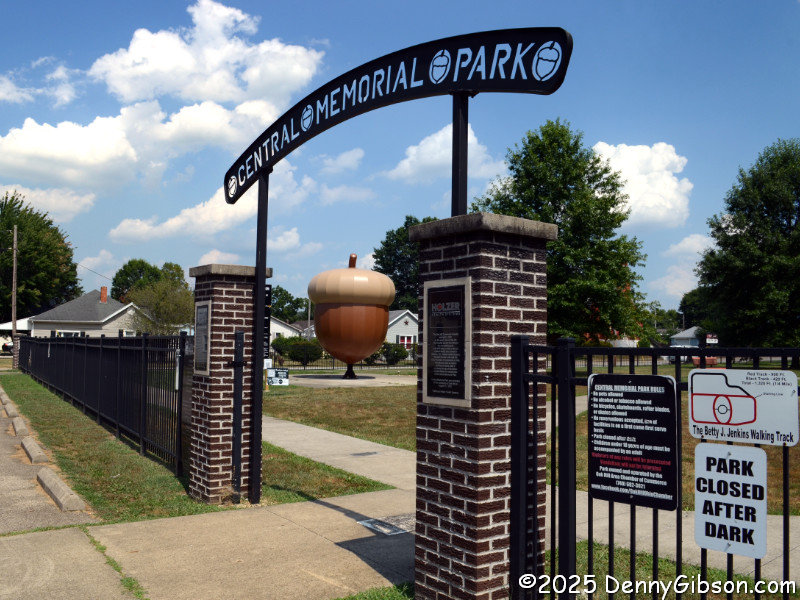
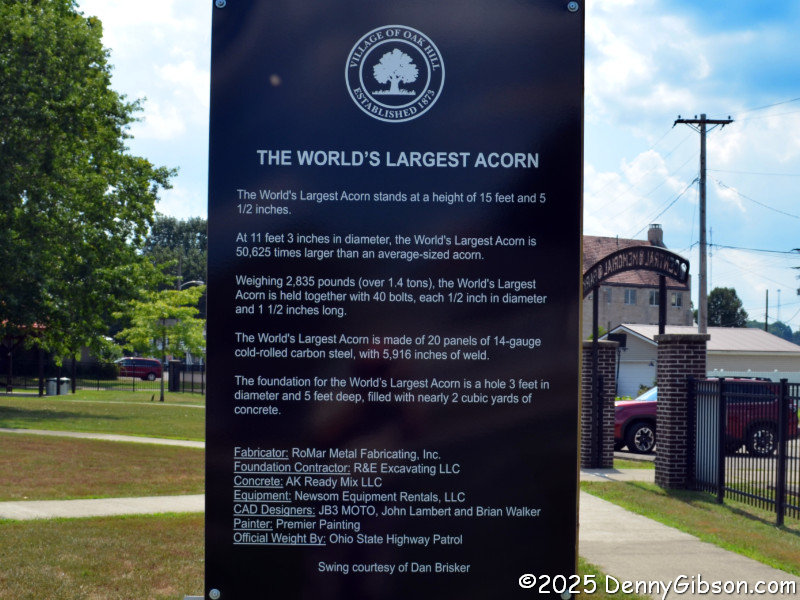
Just over two months before I got there, the town of Oak Hill, OH, erected this giant acorn and declared it the World’s Largest. As far as I know, Raleigh, NC, never claimed that the big nut dropped there on New Year’s Eve was the World’s Largest, but, having some experience with that particular acorn, I was curious about how they compared. It’s not really close. The Raleigh acorn is 10 feet tall, while the height of this one is 15 feet and 5 1/2 inches. That and other statistics are noted on a nearby sign. However, when I went looking for the dimensions of the Carolina nut, I learned that some folks in Silver Springs, MD, may have a legitimate challenge to Oak Hill’s claim. Take a look here. It doesn’t appear that the Guinness record trackers were involved in any of this, so where it all will lead is unclear.

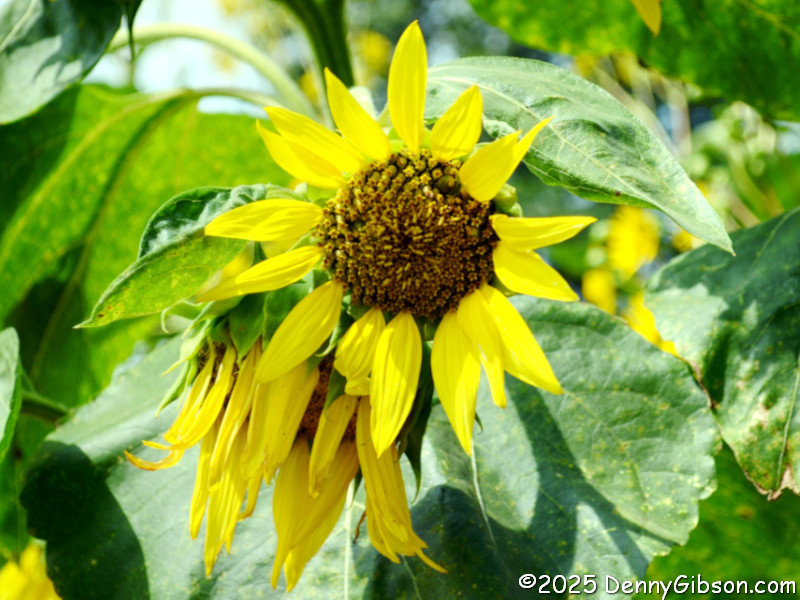
Sunflowers had yet to arrive at the Tehcumseh Land Trust, but I did find some standing tall in the Pioneer Garden at the Hocking Hills Regional Welcome Center, and that lets me end this post on a bright note with a bright bloom.

Book Review
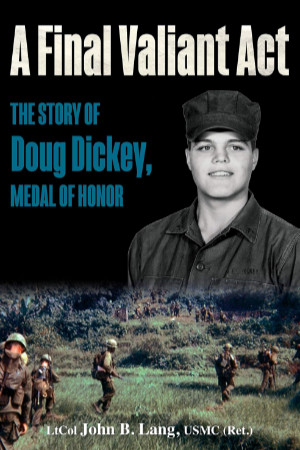
A Final Valiant Act
John B. Lang

This is the second book that I’m aware of about Medal of Honor recipient Doug Dickey. I was aware of the first one, Remembering Douglas Eugene Dickey, USMC, before its 2015 publication. I quickly bought it, but did not get my review written and posted until nearly a year later. Although A Final Valiant Act was published in 2020, I only became aware of it last fall when I spotted it in the Garst Museum gift shop. It then took me several months to get it read and reviewed. It shouldn’t have.
It’s a well-written, straightforward telling of the story. Doug enlisted in the Marines with four classmates as part of the Buddy Program, which assured they would stay together through boot camp. Lang met with the survivors of the group as he researched the story. He also spoke with members of Doug’s family and with many of the men he served with in Vietnam. These contacts provided lots of quotes and details. He also dug through military records and things like newspapers to produce a proper background for Doug’s Easter morning sacrifice. That background is so complete that the book’s dust cover calls Lang’s writing “the most detailed account of Operation Beacon Hill yet written.” I don’t doubt that, but the “detailed account” is so well woven into the flow of the story that it’s not something I would have guessed.

The book’s title comes from a phrase in Doug Dickey’s Congressional Medal of Honor citation. I suspect it is a phrase that appears in far too many award citations. In this case, it appears as part of the sentence, “Fully realizing the inevitable result of his actions, Private First Class Dickey, in a final valiant act, quickly and unhesitatingly threw himself upon the deadly grenade, absorbing with his own body the full and complete force of the explosion.” There’s more to the citation, of course, although that is the essence of it. It mentions that there was “a fierce battle” going on, that “a grenade landed in the midst of a group of Marines”, and that Doug’s actions “saved a number of his comrades from certain injury and possible death.” Lang describes that “fierce battle” and how it came to be. He puts names and personalities to the “group of Marines”, and he tells us what became of those “comrades” as they returned to their homes and eventually started having reunions. The first reunion was in Doug Dickey’s hometown, so that Doug’s parents were able to meet some of the men their son had saved. Some of the reunions that followed were held in the hometowns of other fallen comrades.

The book includes several maps and diagrams to help describe things like locations and organization hierarchies. There are even a few black and white pictures mixed in with the text. That’s nice, but they are on matte paper. What is even nicer is the section of twenty-two glossy pages containing higher quality images, many of which are in color.
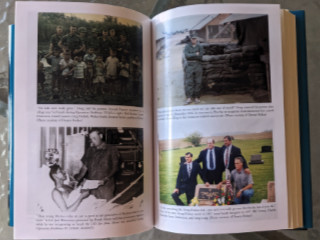
When I reviewed Remembering Douglas Eugene Dickey, USMC, I recommended it, but not for everybody because of it being very comprehensive and somewhat scholarly. I have no such caveats regarding A Final Valiant Act. There are fewer historic details and less auxiliary information, but nothing central to the story is missing, and it reads more like a novel.

As mentioned several times on this website, Doug Dickey was a classmate of mine. I have attended events that honored him and read much that has been written about him. Two things from this book that I’d not heard before stood out. The common belief was that Doug fell on top of a single grenade, and that is what the Medal of Honor citation describes. But years later, when witnesses were able to compare notes, it was determined that there was a second grenade that Doug pulled under his body after falling on the first one. I was also struck by the sentence that Lang ends his book with, and with which I’ll end this review. It’s something that Doug’s mother, Leona Dickey, said when talking about her oldest son. “The guy who threw the grenade — he would have loved him, if he could have just met him.”
A Final Valiant Act, LtCol John B. Lang, USMC (Ret.), Casemate (April 28, 2020), 6.25 x 1 x 9.5 inches, 296 pages, ISBN 978-1612007571
Available through Amazon.

Back to the Bikes

I have thought of revisiting the Bicycle Museum of America quite a few times in the more than two decades since my first visit. Sometimes it has been when I’m looking for a target for an interesting day trip, and sometimes it has been due to something more specific. The most recent specific event that triggered thoughts of the Ohio museum was my visit to the Cycle Through exhibit at the Cincinnati Art Museum. When I started getting serious about a trip to the bicycle museum, I naturally took a look at the journal for my 2002 visit and noted that I had driven a bit of OH-66 to get there, and that naturally reminded me that I had driven its full length a couple of years later on the first day of a two day trip. The museum visit journal is here. The journal for the OH-66 drive is here.

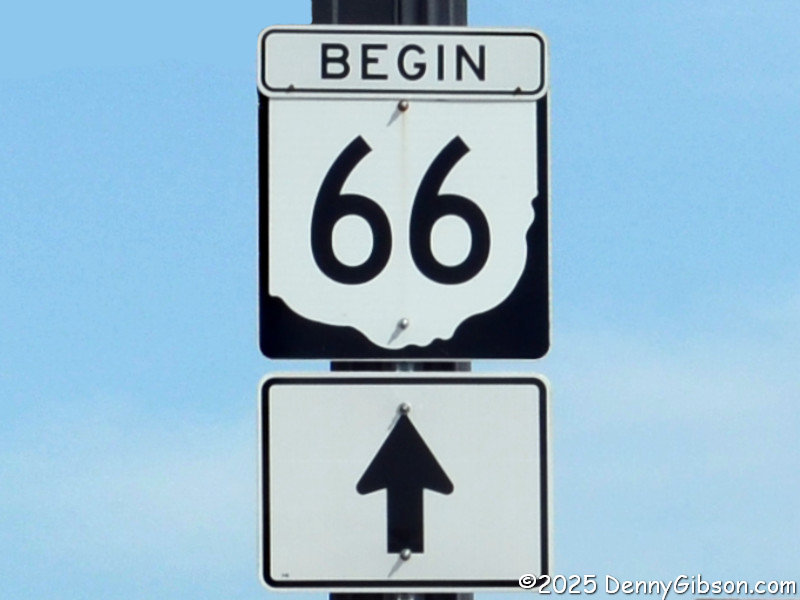
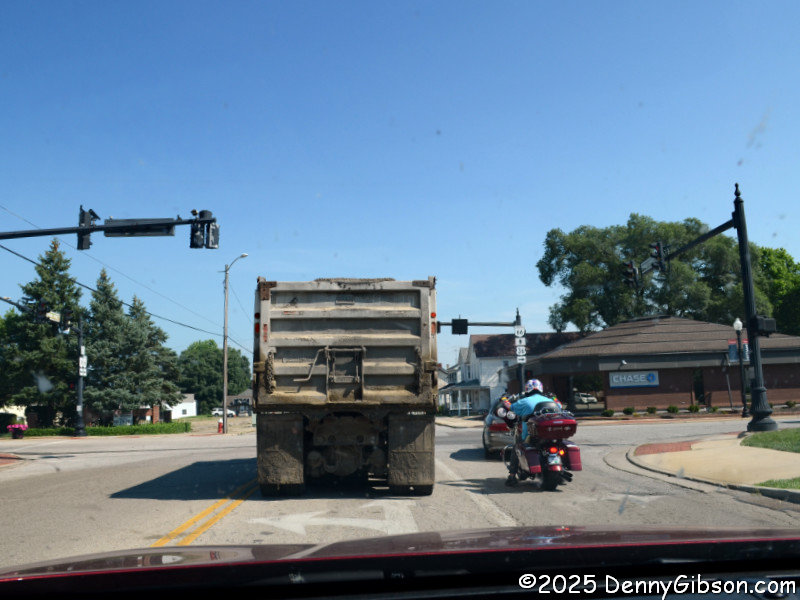
So, I headed to Piqua, OH, and the southern end of OH-66 at US-36. It has become a little fancier over the years and now sports a “BEGIN” tag. That the more famous Route 66 will reach its centennial next year is getting a lot of attention. The centennial of Ohio’s Route 66 was last year, but I missed it. I wished the route a belated 100th as I started my drive. Although I drove all of OH-66, the museum was the trip’s focus, and I did not make a lot of other stops.

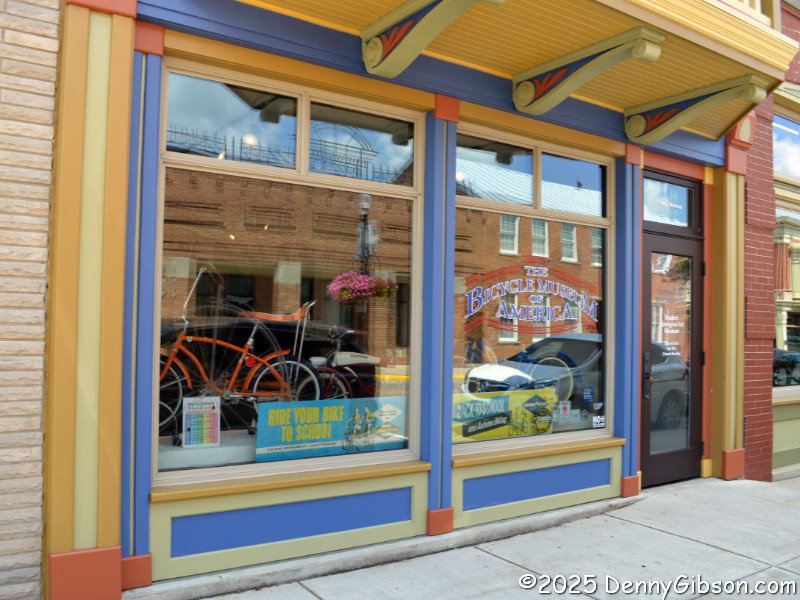
Cars parked on the street in front of the museum kept me from getting a clear picture of the building. It and other older nearby buildings housing restaurants and such are well maintained and picturesque, and make New Bremen quite an attractive town. The attendant, whose name I have absolutely no excuse for not asking, was extremely friendly and helpful. One of the things I learned while planning this trip was that the museum owned one of four surviving Schwinn bicycles from Pee-wee’s Big Adventure. I suspected that this might be the one I had recently seen in Cincinnati, and started to ask. I did not quite get my question fully formed before learning that not only was that customized DX Cruiser on loan from the museum, but so was every other bicycle in the display. I should have known that. The Cycle Thru! description on the Cincinnati Art Museum’s website notes that it is made up of “over 20 bicycles from The Bicycle Museum of America in New Bremen, Ohio”. Just one more thing I missed.

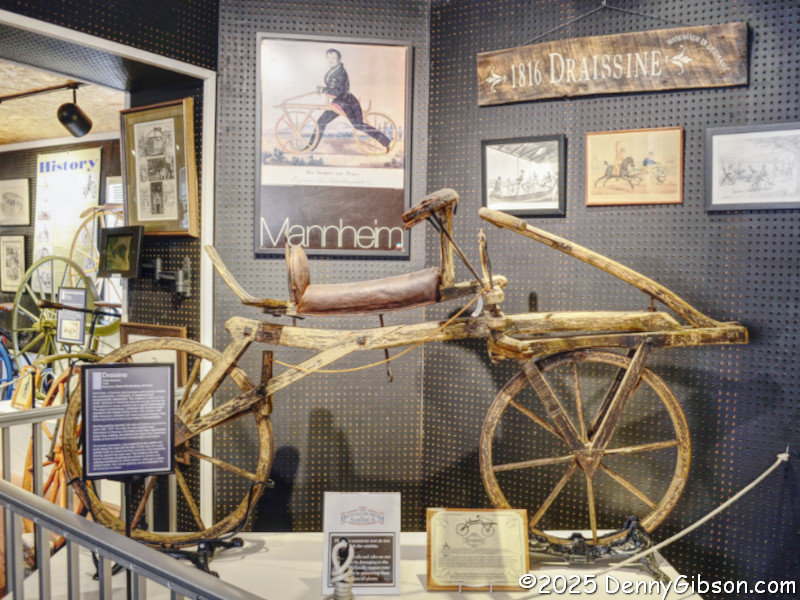
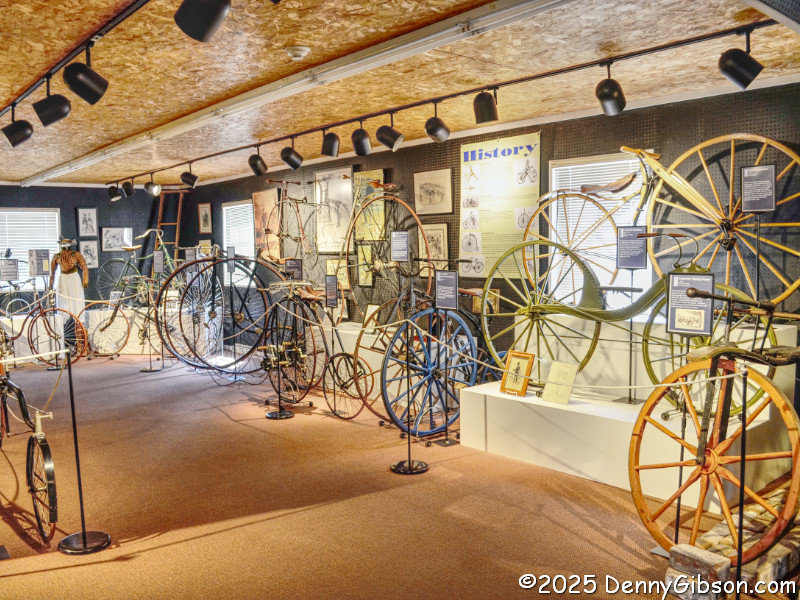
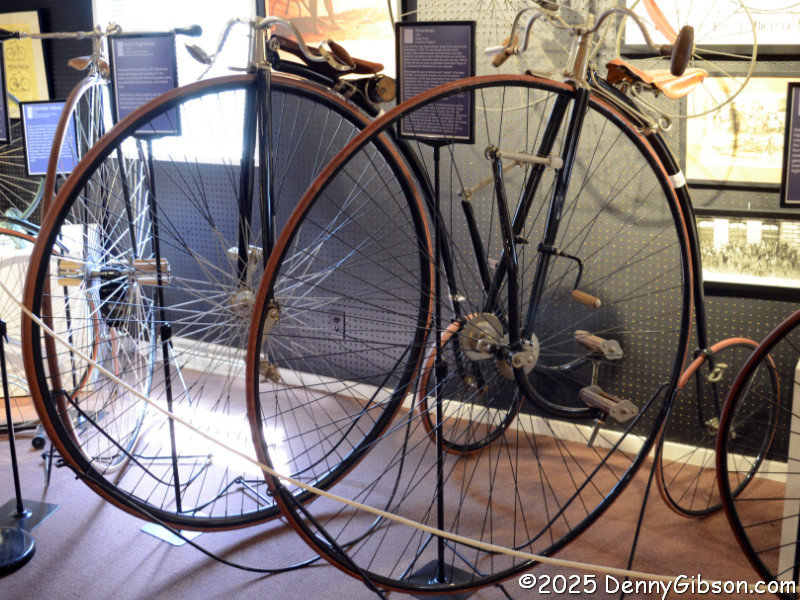
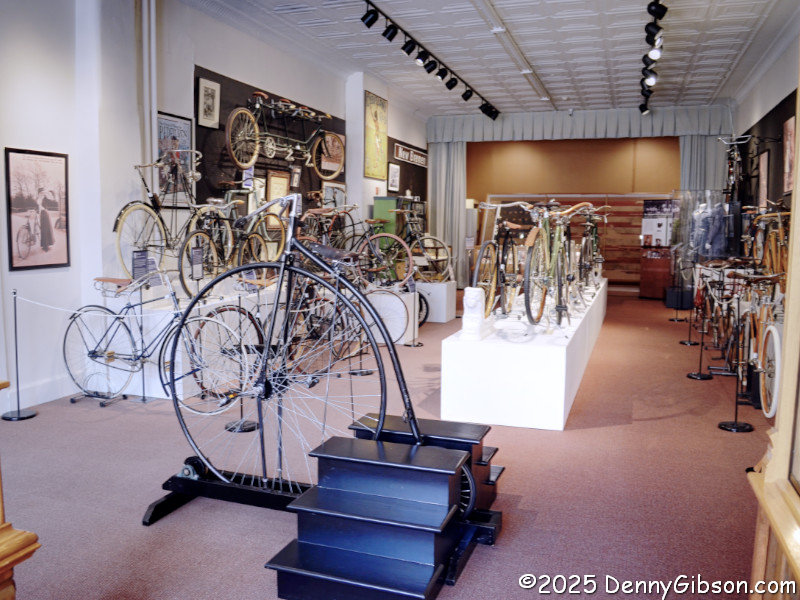
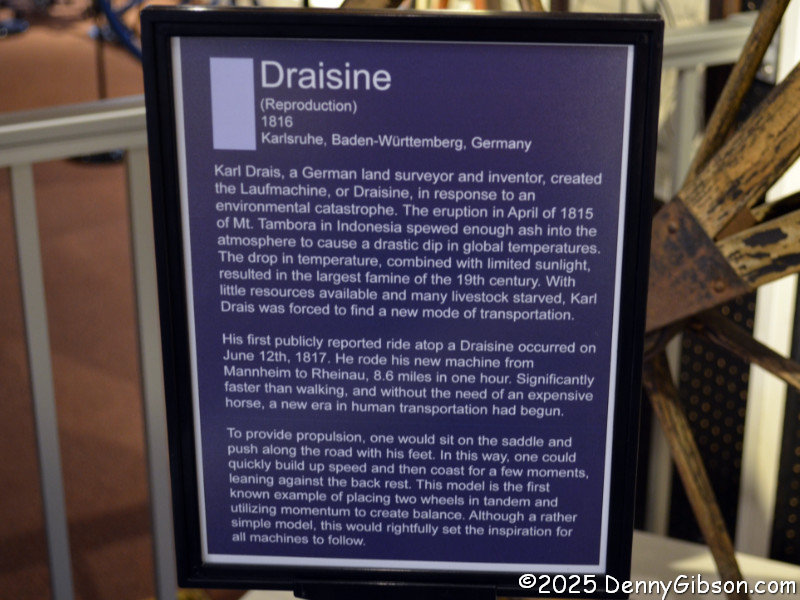
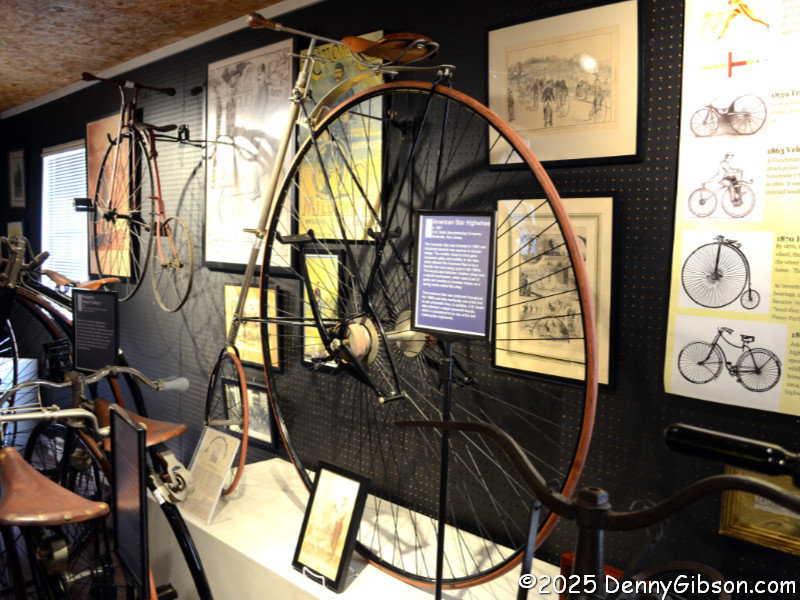
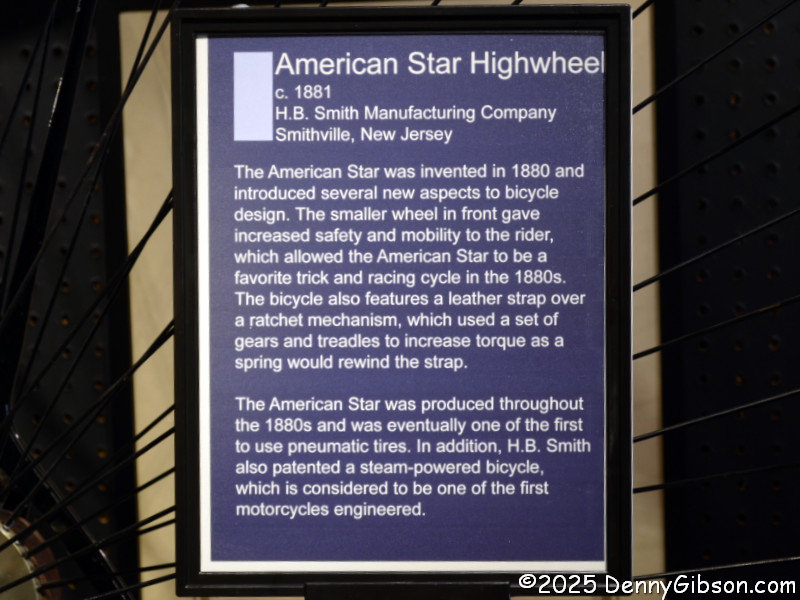
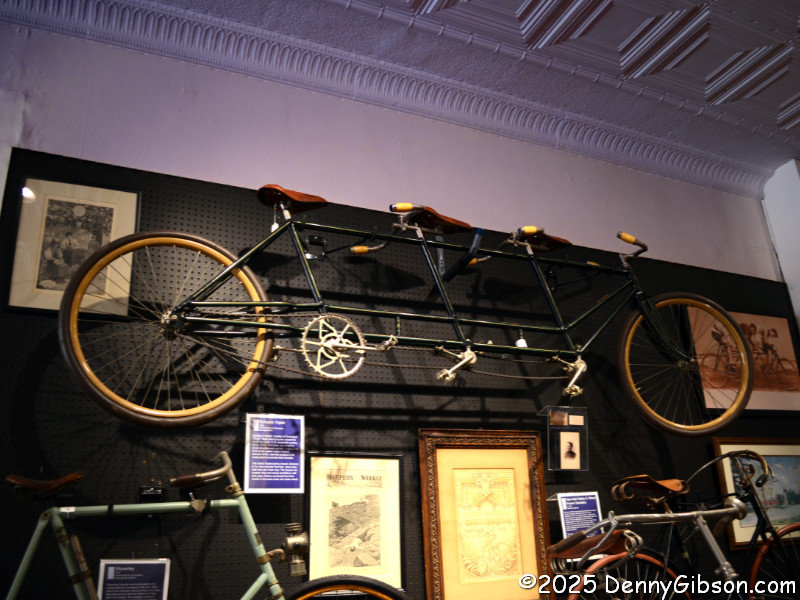
The museum contains a replica of an 1816 Draisine, which is the earliest known use of motion to balance on two tandem wheels. There are, of course, quite a few penny-farthings among the historic vehicles on display. When I first heard that name many years ago, I initially thought it had something to do with cost, but soon learned that it came from the idea that those big-wheeled bicycles looked like a large British penny coin paired with a small farthing coin. In the middle of all those historic bicycles is something that looks more like a farthing-penny. It’s an American Star Highwheel, which tried to make things a little safer by putting the little wheel in front. The H.B. Smith Manufacturing Company, makers of the American Star, also patented a steam-powered bicycle, and yes, I would like to see one of those.

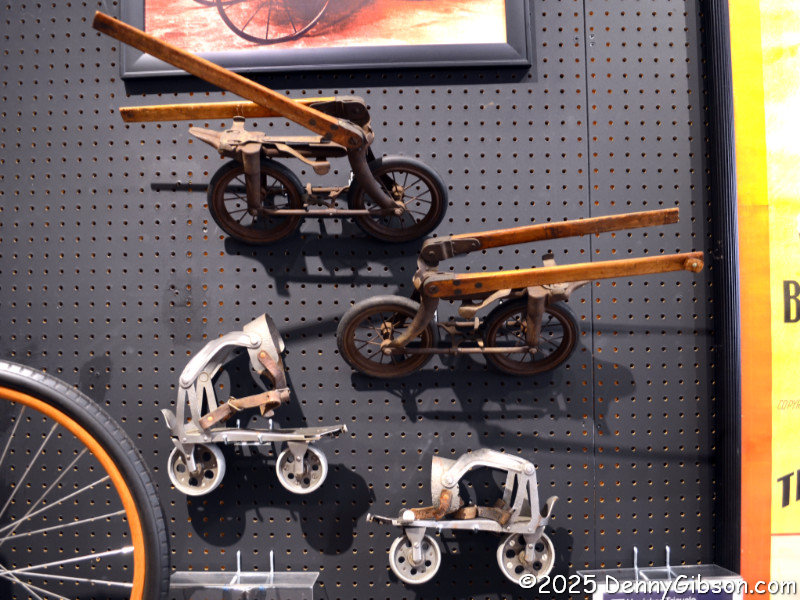
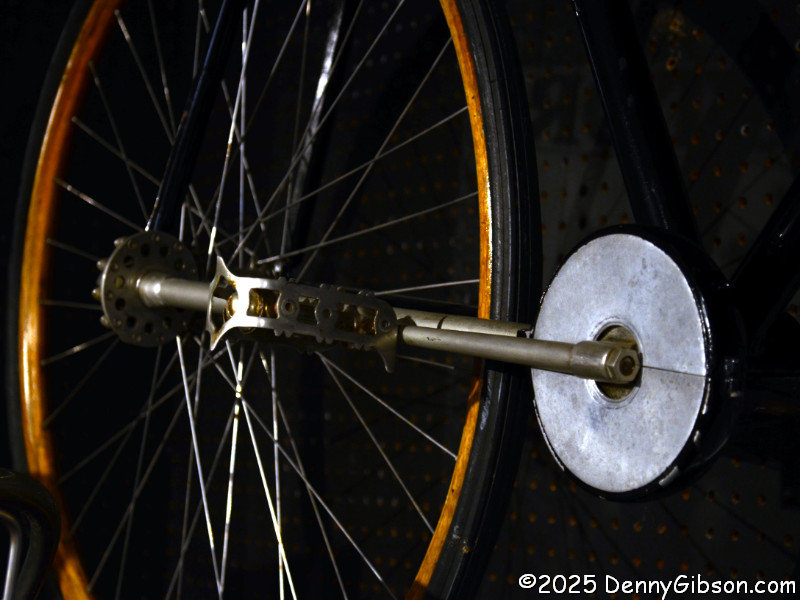
In fairly short order, inventors applied gears, chains, and straps to eliminate the need for a huge wheel to achieve a decent speed, and the penny-farthing became a thing of the past. In addition to those on display, the museum has one on rollers with “trainer steps” for anyone wanting to give it a try. Of course, inventors did not stop inventing. A different way to go riding with your friends can be seen on the wall behind the steps. Bicycles with driveshafts existed before the nineteenth century ended, and inline skates clearly aren’t as new as you might think.

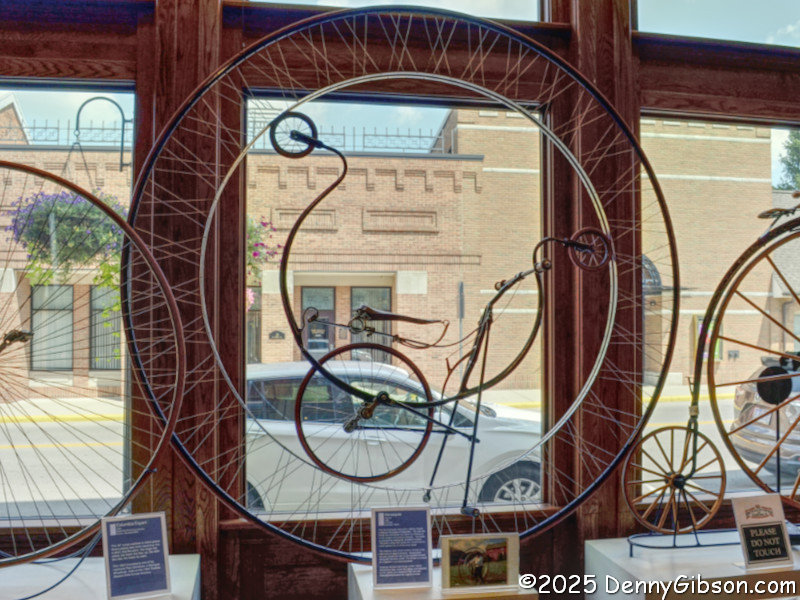
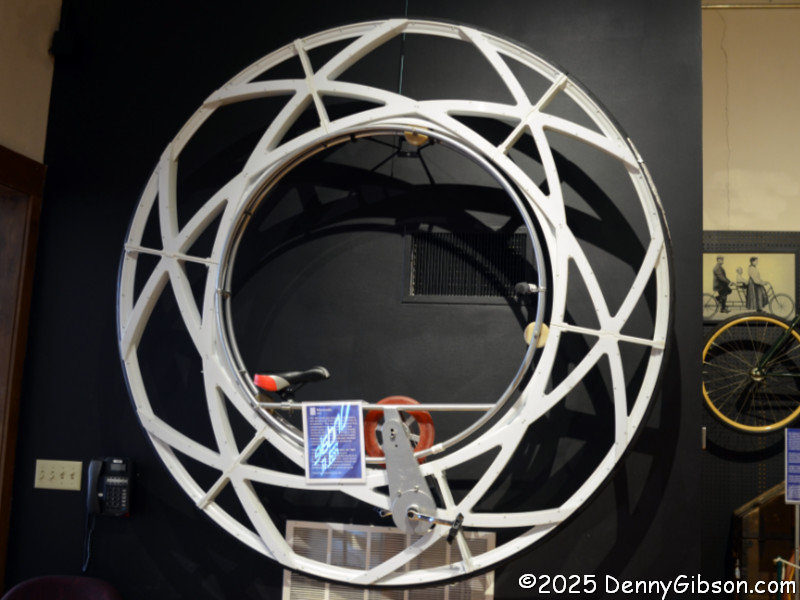
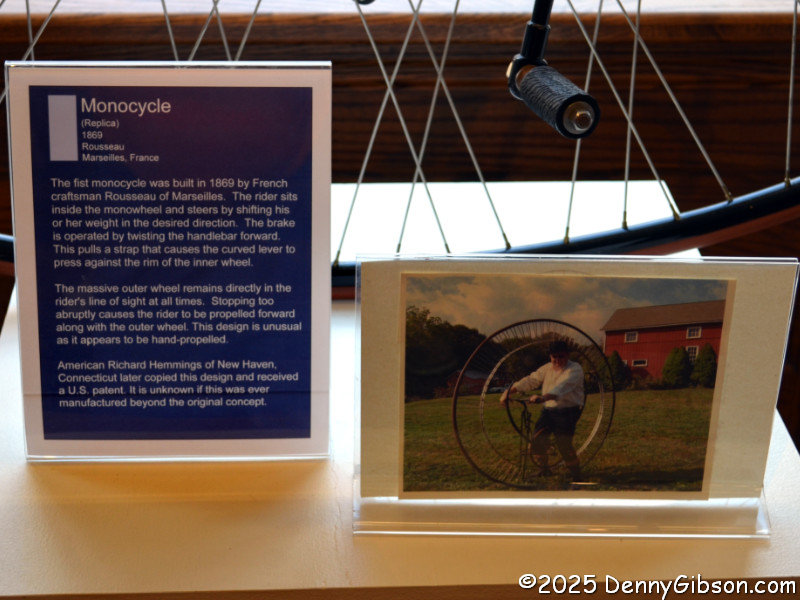
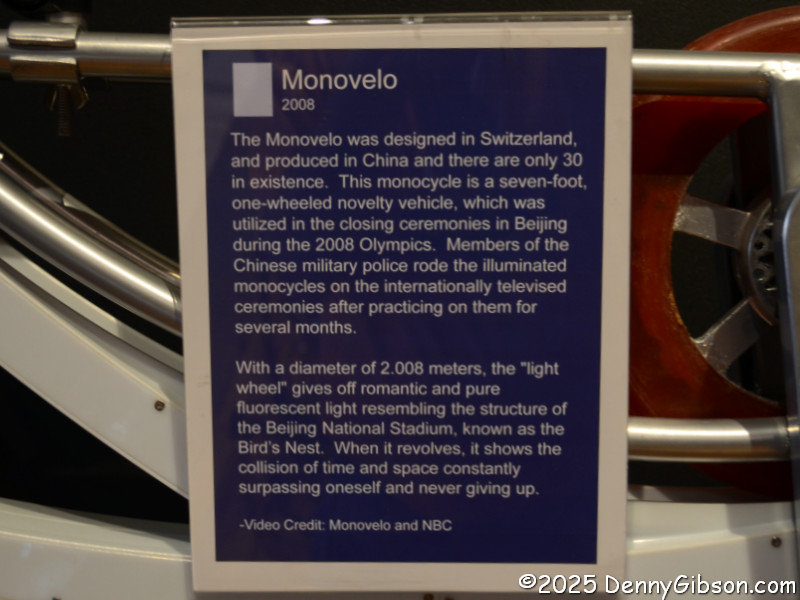
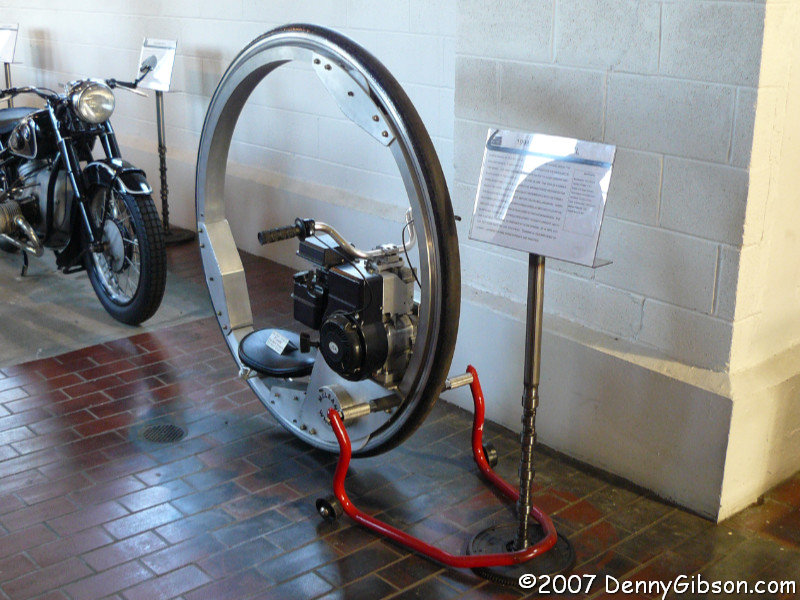
Backed by one of the museum’s windows is a replica of a monocycle from 1869. The museum also has one of just thirty existing Monovelos from 2008. Monocycles are just plain weird. Fitting between these two date-wise is a 1998 motorized version at the Lane Motor Museum in Nashville.

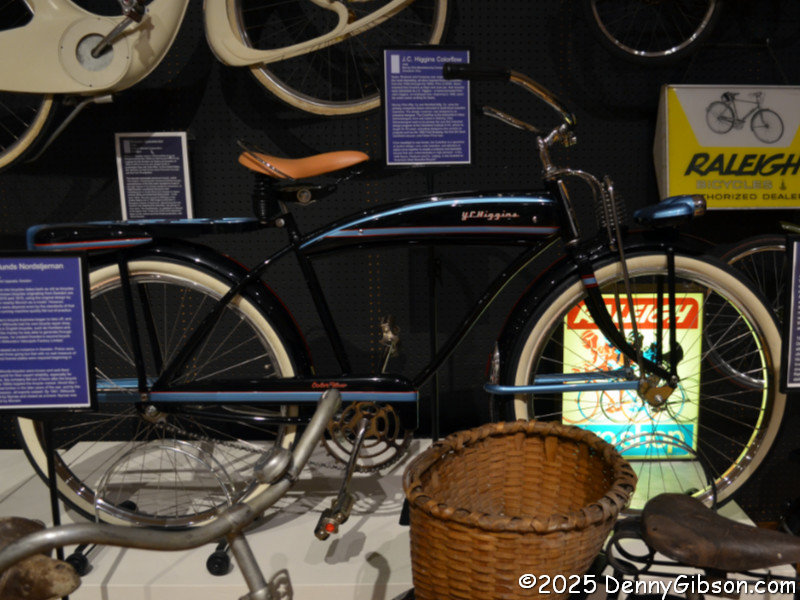
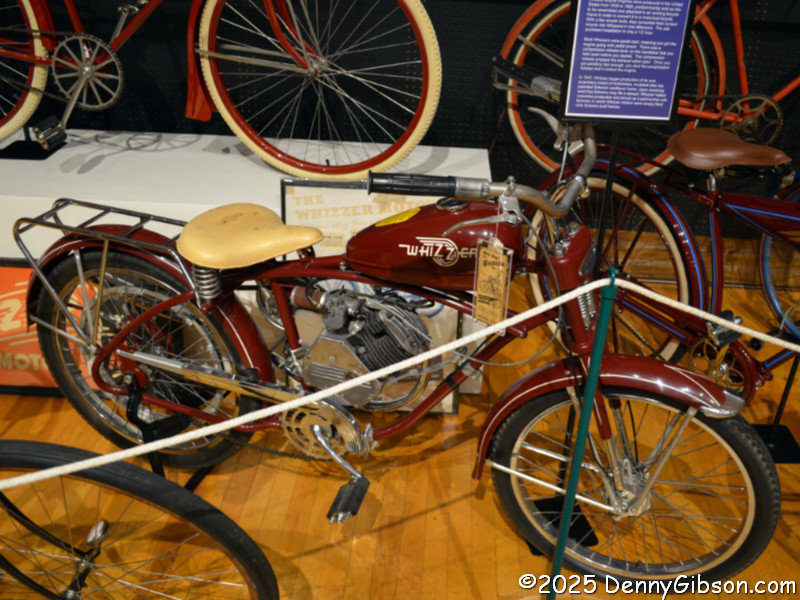
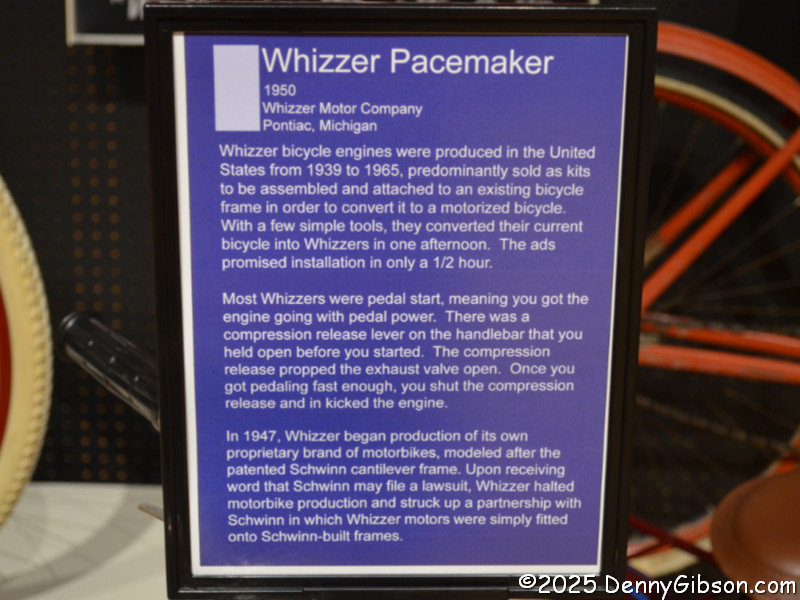
The museum has about 800 bicycles in its collection, so even with twenty on loan in Cincinnati, there is no problem keeping a couple hundred on display. The challenge is picking which ones that will be. That’s the same challenge I have picking which photos to post. I could go on and on, but I’m going to cut it off here with a pair I have at least a tiny personal connection to. My first motorized vehicle was a 1948 or ’49 Whizzer. The one pictured is a 1950. That’s a 1949 J.C. Higgins Colorflow in the other photo. My first new vehicle was a 1960 J.C. Higgins Flightmaster that is the subject of what I believe is the most popular post ever on this blog. The Flightliner post is here. A post on the Whizzer is here. Before leaving, I learned that the museum has a 1960 girl’s Flightliner in storage. Flightliner fans, keep your eyes peeled. It could come out someday.

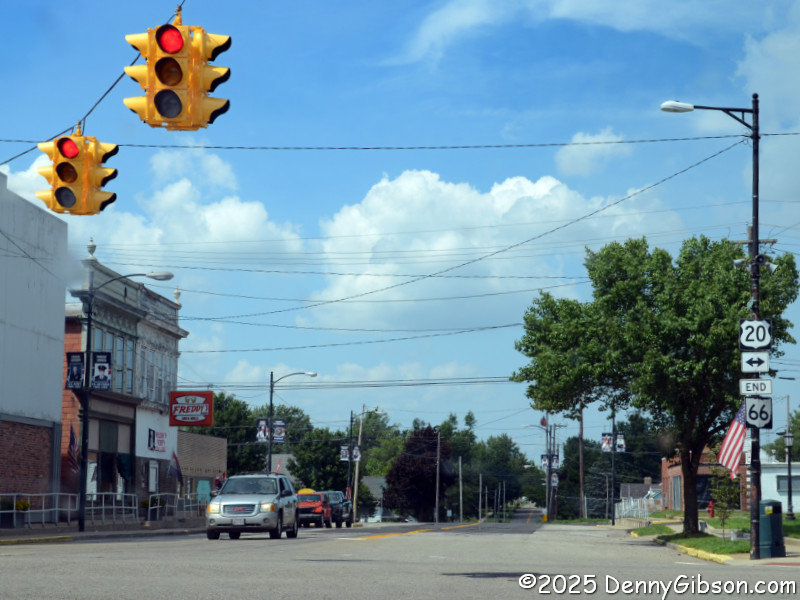
I did make a couple of stops beyond the museum, but they were related to my 2004 OH-66 drive rather than to OH-66 in general. Where the route ends at US-20 in Fayette, I was happy to see an “END” tag that was not there in 2004. I celebrated completing the route with a Budweiser in the same building where I celebrated in the same manner twenty-one years ago, but the name was now Freddy’s Place instead of Harry’s Tavern, and the Bud came in a can instead of a bottle.

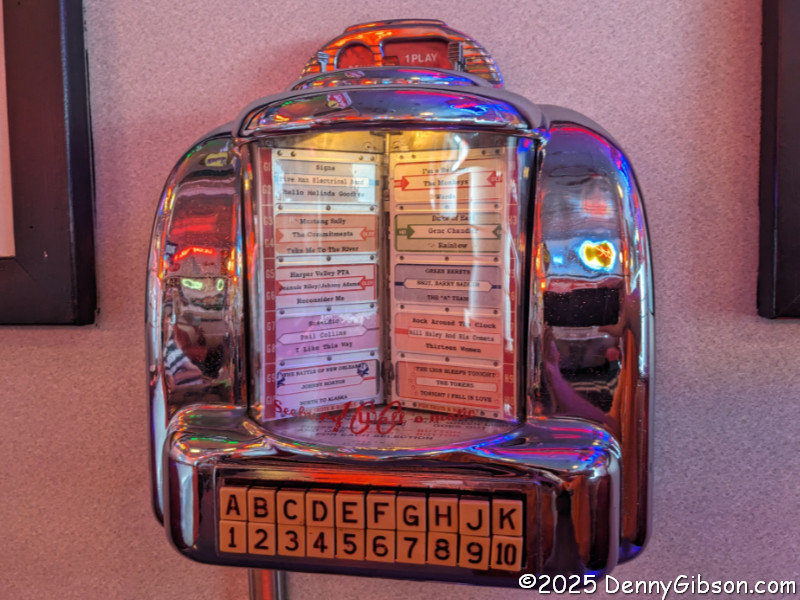
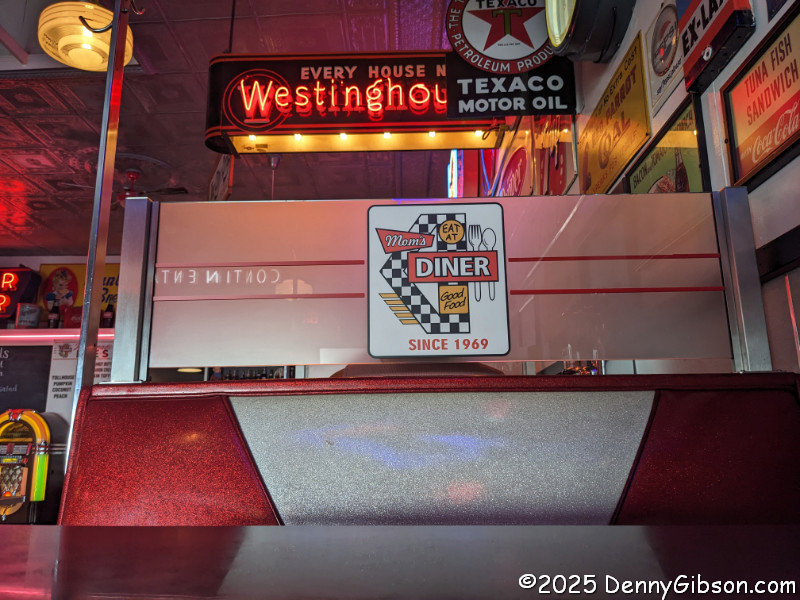
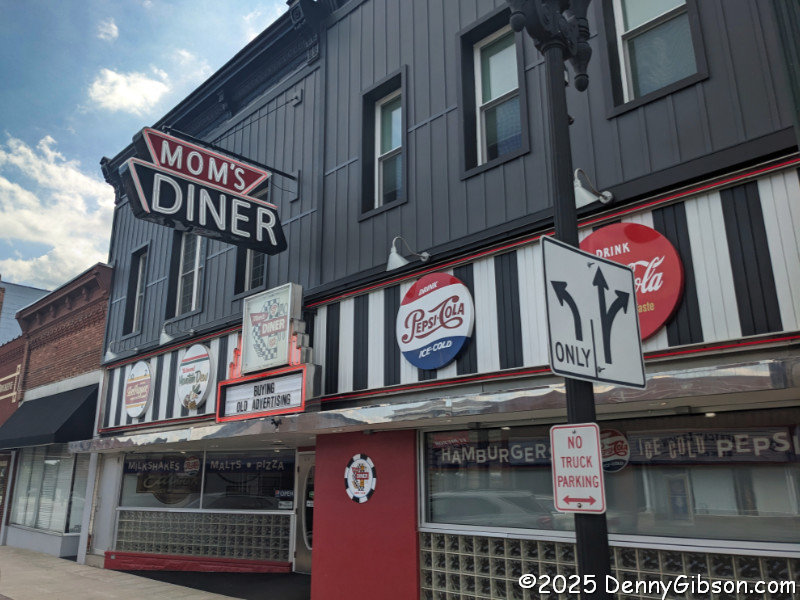
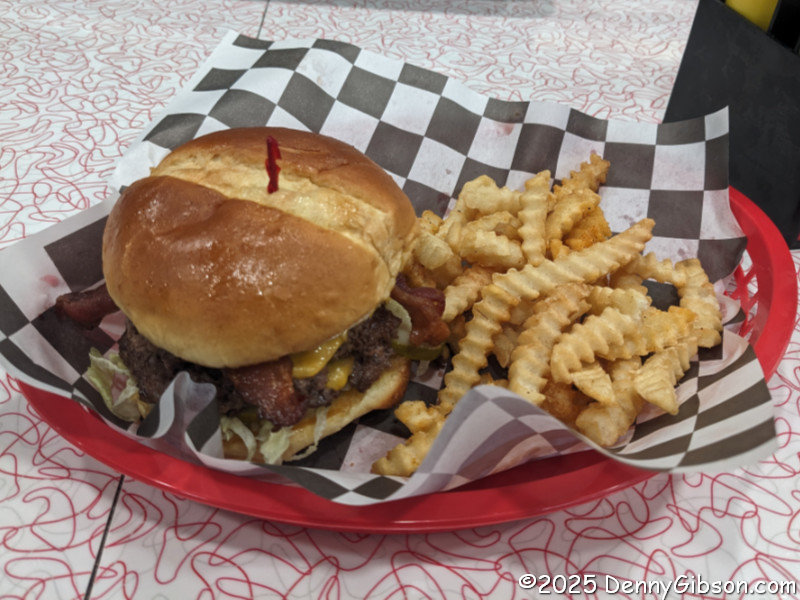
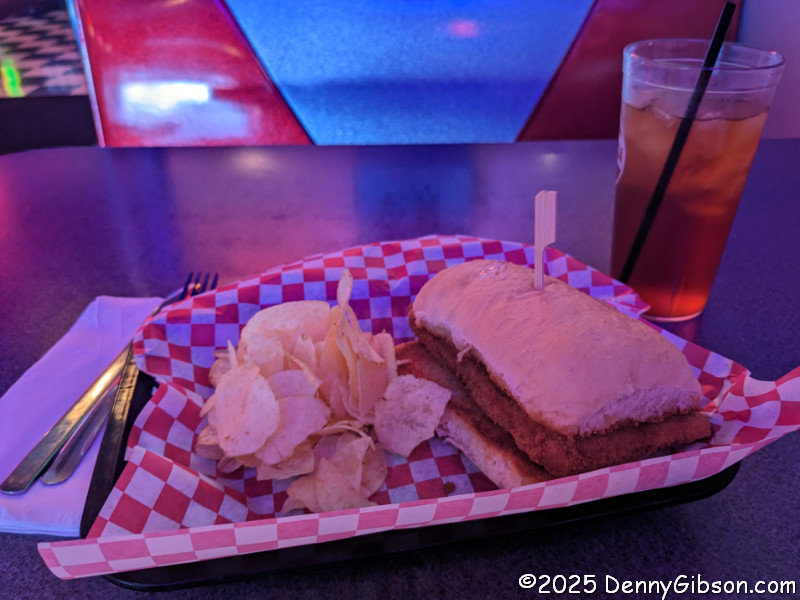
I also repeated my dinner stop in Archbold, where Mom’s Diner was not only still in business but had a new pseudo-neon sign hanging out front. With the exception of a few details, the inside looked essentially the same. I did not record what I ate in 2004, but today I had the fish sandwich special. The place was fairly busy when I arrived and just about full when I left. That not only kept me from taking many photos, but it also interfered with my jukebox playing. In ’04, I played “That’ll Be The Day”, but today it wasn’t an option. In ’04, I had the juke box all to myself, but that wasn’t at all the case today. By the time I settled on “Rock Around the Clock”, someone had beaten me to it. My quarter went for “Mack the Knife” by Louis Armstrong and His All Stars.

Trip Peek #147
Trip #145
Route 66 Miles of Possibility Conference

This picture is from my 2017 trip to the Route 66 Miles of Possibility Conference in Joliet, IL. This was the third MOPCon, and my second time attending. At the time, there were still questions about whether a pay-to-attend conference could succeed in a world accustomed to free festivals, but with the tenth annual MOPCon scheduled for October 2025, those questions appear to have been answered. By coincidence, the tenth MOPCon will be right where the third one was: Joliet. My 2017 guess that the idea of a pay-to-attend conference would find no takers outside of Illinois has so far proven correct.

I drove almost no Historic Route 66 getting to and from the conference. I took US-40 through Casey, IL, and checked out some of the World’s Largest things displayed there. Then it was north on US-45 for a meal at the original Burger King in Mattoon, IL. The drive home was mostly on US-35, which I picked up at its northern terminus near Michigan City, IN. In between was the conference with plenty of presentations and a Road Crew concert at the historic Rialto Theater.


Trip Peeks are short articles published when my world is too busy or too boring for a current events piece to be completed in time for the Sunday posting. In addition to a photo thumbnail from a completed road trip, each Peek includes a brief description of that photo plus links to the full-sized photo and the associated trip journal.