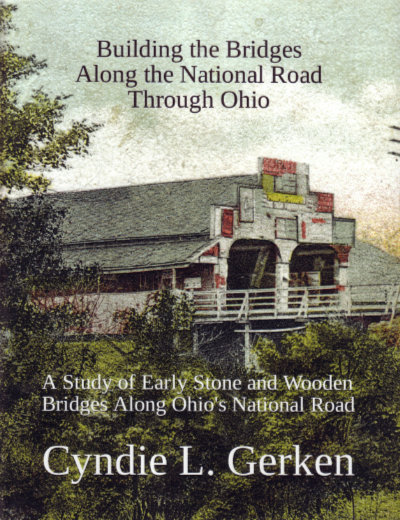
 Cyndie’s done it again. As I began to write this review of Cyndie L. Gerken’s fourth book on the National Road in Ohio, I revisited my reviews of the previous three thinking I might come up with a better opening line but everything I saw just reinforced my initial thought. Cyndie has indeed done it again.
The words “accurate” or “accuracy” appear in the opening paragraphs of all three along with words like “precision” and “thoroughness”, and all those words certainly fit once again. In my review of the third book, Headley Inn and Cliff Rock House, I noted that it differed from the previous two by focusing on a small stretch of roadside rather than all of the state. That difference struck me again as I read Building the Bridges Along the National Road Through Ohio but in a slightly different way. The “Along the National Road Through Ohio” in the title tells us that this is something of a “return to form” but it occurred to me that the set of four is just a bigger version of something going on within each of the individual books. There is no denying that reading lots of details about lots of very similar things can become repetitious. In Marking the Miles… and Taking the Tolls… and again in Building the Bridges…, Gerken often intersperses human-interest style stories among the facts and statistics to help fend off boredom. Thinking of Headley Inn and Cliff Rock House playing a similar role in the series, despite having its own sets of facts and statistics, brought a smile to my face. It might have had just as much value in that regard to the writer as to the reader.
 Although I certainly know better, I tend to instinctively think of big stone arches when I hear the phrase “National Road bridges”. One reason is that many of those stone bridges, some of them S-shaped, are still in existence. There were also many wooden bridges along the road but all were much shorter-lived. Building the Bridges… includes both. It identifies twenty-one covered wooden bridges built for the National Road in Ohio in addition to probably forty-some stone bridges. There were also well over a thousand stone culverts and one reason an accurate count of stone bridges is difficult to produce is that not everyone followed the same rules when distinguishing culverts and bridges. Span length was and is the distinguishing characteristic. Twelve feet, twenty feet, and no doubt some other numbers of feet were used to make the distinction and some reports did not distinguish the two at all.
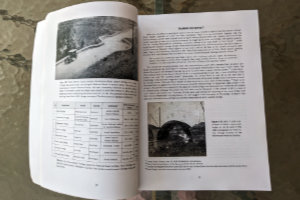
Gerken talks about culverts vs. bridges in the introduction along with many other topics related to the Ohio National Road bridges in general and some that simply concern all bridges in general. Building techniques are described as are bridge types and bridge components. Thanks to an annotated picture of one of the Blaine Bridge arches, I now know what a voussoir is although I’ve no idea how to pronounce it. (Voussoirs are the wedge-shaped stones that form an arch.)
A chapter titled “The Builders of Ohio’s National Road Bridges” follows the introduction. Its opening pages contain information about the road’s Superintendents, how the road was divided, what contracts looked like, and similar subjects. Then comes fifty+ entries on individual builders.
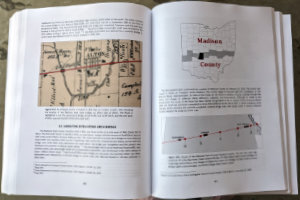 After telling us about as many of the bridge builders as she could identify, Gerken touches on some of the iconic National Road bridges east of Ohio, including the Wheeling Suspension Bridge, before beginning a county-by-county trek across the state. Each county chapter begins with a thumbnail of the county and the National Road through it. A map locating the National Road bridges in the county appears very early in each chapter. Sections on each of the bridges and some of the culverts in the county appear also in east-to-west sequence. Just as some bridges east of Ohio were touched upon preceding the border-to-border coverage, a few in Indiana follow it.
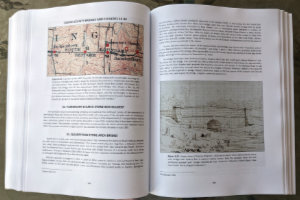 At a minimum, the location of each structure and what it crossed is given. The builder or builders are identified if known and, thanks to some pretty good sleuthing, many of them are. Beyond that, the information given for each bridge or culvert varies widely but it is a natural variation. For unnamed culverts over unnamed intermittent streams, location might be just about the only thing known. For major structures, lots of additional information might be included and usually supported by various graphics. Topographic maps are fairly common and there are lots of historic photographs and drawings. Plenty of modern photos also appear and if a structure is still standing there’s a good chance that the book contains a very modern picture of it taken by the author herself. Stories about events associated with happenings at or near a particular bridge can pop up anytime and are often fleshed out by reproducing contemporary reports.
The current status of each structure is always given if known. I’ve long been impressed with the number of National Road bridges still standing. Maybe I should be even more impressed after reading about all that failed and had to be replaced within a year or two of completion due to shoddy materials or workmanship. The number of contracts that had to be reissued after being abandoned by the initial winning bidder was also somewhat surprising. Building the first interstate was no simple task.
Ample anecdotes and news reports are mixed in with or printed beside all the facts and statistics. Some are funny and some are sad but almost all provide a glimpse into another time. I’ll share a piece of one that struck a chord with me. In her reminisces on the two-lane covered bridge over the South Fork of the Licking River, Minnie Moody describes a sound from another time.
What I liked was to go clattering through one lane of the bridge at the same time another vehicle was passing through on the other side of the center partition. Whang, bang, clickty-clack! With a roof over our heads the uproar was terrific.
I believe I have passed through a two-lane “double barrel” covered bridge but I’m not 100% certain. I am 100% certain that I’ve not done it in the presence of even one, let alone two, horse-drawn vehicles. I’m nearly 100% certain that I never will but thanks to Minnie — with the help of Cyndie — I have a pretty good idea of what it was like.
Yep. Cyndie has done it again. Building the Bridges… is quite clearly a valuable reference book for National Road fans but it’s something of a storybook, too. It has people in it along with the stones and lumber. The Ohio Genealogical Society hands out awards to several books each year. One of these is the Henry Howe Award which goes to a book on “Ohio state, county, or local history”. Each of Gerken’s previous three National Road books has won the award and I’ve a hunch this one will as well. Yeah, I think Cyndie’s going to do that again, too.
Building the Bridges Along the National Road Through Ohio: A Study of Early Stone and Wooden Bridges Along Ohio’s National Road, Cyndie L. Gerken, Independently Published (May 14, 2023), 8.5 x 11 inches, 521 pages, ISBN 979-8393147471
Available through Amazon.
 When I wrote about
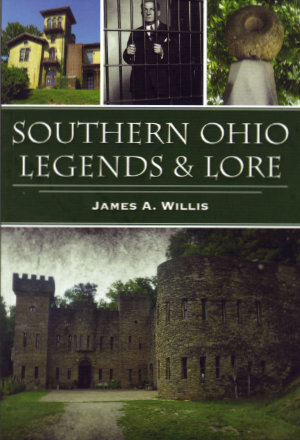
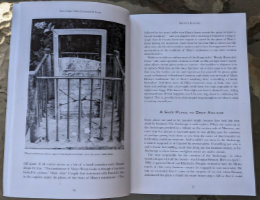 The stories are divided into six sections: “Ghostly Legends”, “Legendary Characters”, “Legendary Villians”, “Legendary Places”, “The Unexplained”, and “Legendary Events”. Having lived my entire life in southern Ohio, I was already at least somewhat familiar with most of them. There are exceptions including all four “Ghostly Legends”. It is the only section where every story is new to me and it is the only section dealing more or less directly with possibly supernatural phenomena. I’m thinking those two facts might very well be related. I’m also thinking that this is the right place to mention that Willis is the founder and director of the paranormal research group The Ghosts of Ohio. I find it somehow reassuring that this is also the only section where that comes into play and even here there is no straying from the “verifiable facts” approach.
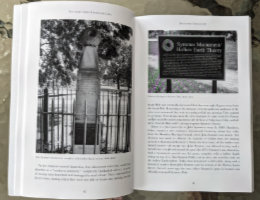 I don’t believe I learned anything new about any of the “Legendary Characters” but I appreciate the concise and complete descriptions. Willis’ reporting on John Symmes and his hollow earth theory is among the most even-handed and comprehensive I’ve read. Likewise, his tale of “Legendary Villian” George Remus where I did learn a few details for the first time.
 “Legendary Places” combines a place I had never heard of (Athens Pentagram) with three that I am quite familiar with. That somehow makes it my favorite section. One of the three familiar places, the Loveland Castle, was the subject of a blog post here
 For the second consecutive year, I’ve created a post specifically for my birthday. I didn’t expect to. I did it last year to note a milestone in age and a change in appearance. I’m doing it this year primarily to record some thoughts. I ended
  The day before John turned seventy-six, he commented about having that number of trombonists serenade him for his birthday. On the day. I shared a Youtube clip of The Music Man‘s signature song.



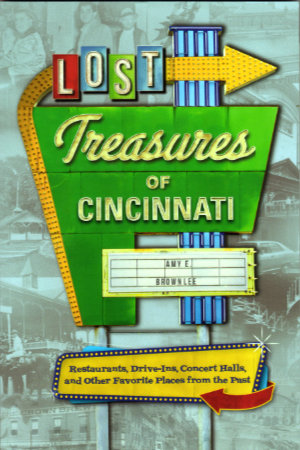 Amy E. Brownlee is a lifelong Cincinnatian. She naturally learned a lot about the city growing up here then used that knowledge and added much more during her ten years at Cincinnati Magazine. An awful lot of the treasures she writes about in Lost Treasures of Cincinnati were lost before she arrived but a rather frightening number have disappeared during her lifetime. Of course, an even larger number have disappeared during mine. Neither of us is responsible for that. I swear it’s coincidence pure and simple.
 The book opens with “Food and Drink” in Section 1 then covers “Entertainment” and “Retail” in the next two sections. The smallest section, “Media”, is followed by the largest, “Community”. Definitions for those section titles are not particularly rigid and the size of the “Community” section probably indicates that it is the least rigid of all. It is where things like churches and breweries, of which Cincinnati had more than a few, appear.
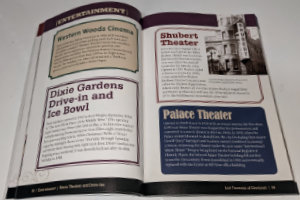 Most, but not quite all, of the breweries mentioned in the book were gone before I got here. Likewise with restaurants and attractions which together comprise the biggest part of things that have disappeared during my lifetime. I caught one show, Hair, at the Shubert (“Entertainment”) before it was torn down. I also saw one movie at the Albee (“Entertainment”) but I don’t remember what it was. I had one meal each at The Gourmet Room and the Maisonette (“Food and Drink”) before they closed. There are quite a few places in this book where I ate one or more meals or watched one or more movies, plays, games, or concerts. Encountering each of them on these pages prompted memories that went way beyond the single paragraph of text. Reading about places that were already gone when I came to Cincinnati didn’t prompt any memories, of course, but it did make me appreciate just how many treasures have been lost.
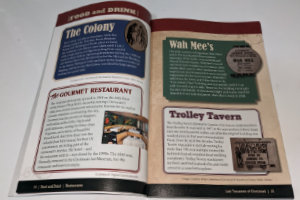 I really enjoyed reading Lost Treasures of Cincinnati cover-to-cover front-to-back but as I did, two other ways of reading the book came to mind. With its fairly short standalone essays, it seems like a natural fit for that popular personal reading room with the porcelain furniture. Its use as a reference book also seems rather natural. I don’t mean an every-last-detail reference book to use in conducting deep-dive research but a great place to answer questions like “What was the name of that boat-shaped restaurant?” or “What happened to our NBA team?”. The full index will help the book play that role.
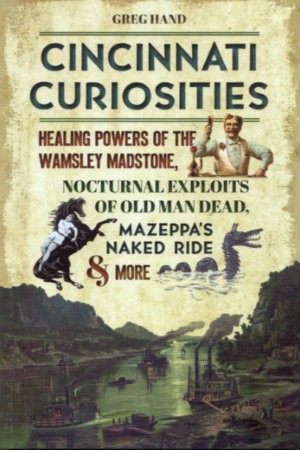 Greg Hand has been a man of letters — or at least a man of words — his entire adult life. He began as a newspaper reporter, moved up to editor, left to head up a university PR department, co-authored three books about the university while he was there, then retired. I was not even slightly aware of any of this as it was happening. I only became aware of Hand’s existence when I stumbled upon the blog he started post-retirement. His knowledge of local history and ability to dig up information to augment that knowledge was immediately apparent and I’ve been an ardent reader of that blog ever since that happy discovery. The blog’s name is Cincinnati Curiosities and it can be found
 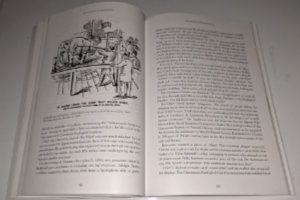 In fact, later in the book, Hand offers another very different capsulated view of the city. On December 12, 1890, he tells us, “The Palace Hotel had elephant steak on the menu because an elephant was executed by firing squad that morning at the Cincinnati Zoo. Hundreds of people watched. That pretty much summarizes Cincinnati in 1890.”
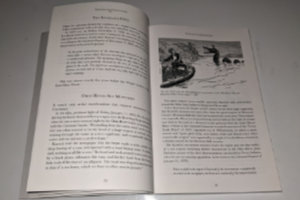 “The Sensational and the Senseless” is the fourth of ten chapters. Other chapters tell of monsters in the Ohio River (“The Old Weird Cincinnati”), Fanny Trollope’s visit during the “Porkoplis” period (“Tales From the Old City”), the possibility that striptease was invented in Cincinnati (“Freaks, Flesh, and Footlights”), and a large variety of other topics. The striptease claim is based on Millie De Leon’s orchestrated removal of several garters in 1901, and Hand cites the claim in suggesting that a Striptease Hall of Fame might be an “appropriate addition to our Over-the-Rhine neighborhood”.
 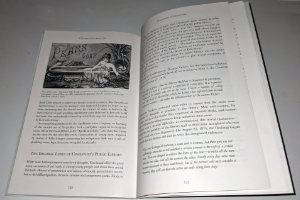 Hand’s usually light-hearted reports are often accompanied by contemporary illustrations. At left is a Pears Soap advertisement based on Lillie Langtry’s famous bath in Apollinaris water at Cincinnati’s Grand Hotel in 1883. It’s in the chapter titled “Nudity, Naughtness, and Negotiable Affection”, and if that doesn’t get you interested in the book I don’t know what will.