There hasn’t been a lot of requests/offers to do a guest post on this blog but there have been a few. Until the most recent, all were from sites with nothing but contrived and flimsy similarities. They resembled shotgun “link swap” requests more than anything and that, of course, made them easy to ignore. The latest request was different. It came from some fellow Ohioans who call themselves “weekend history buffs”. Their recently launched website looks promising and their initial round of blog posts involves something that’s been on my mind of late. Exactly one hundred years ago today, water started spilling into the streets of Dayton, Ohio, from stressed levees. The flood that followed is the topic of this post from the folks at HistoricNaturalDisasters.com.
ADDENDUM 27-Mar-2022: Obviously my ability to assess new websites leaves much to be desired. HistoricNaturalDisasters may have been promising but it was not delivering. It is now gone and probably has been for quite some time. This nine-year-old guest post may be the only remaining online evidence that it ever existed.
HistoricNaturalDisasters.com Guest Post
The week of March 21st through March 26th marks the 100 year anniversary of one of the greatest natural disasters to ever hit the United States. A series of storms caused flooding and even tornadoes that ravaged the Midwest and parts of New England during this week in 1913 and left hundreds dead and thousands homeless, and caused billions of dollars in damage. One of the cities hit the hardest by the storm’s fury was Dayton, Ohio.
Located along the Great Miami River bend, Dayton had been prone to major flooding events every decade or so since its establishment in 1796. What happened during the storm of 1913, however, was a flood the magnitude of which was unlike anything Dayton had ever seen. Starting on March 21, storms dumped between 8 and 11 inches of rain on the already oversaturated Great Miami River watershed causing all the rivers in the region to swell far beyond their normal banks. At approximately 6 AM on March 25th, the levees holding back the Great Miami River broke and water began to rush into the Dayton streets at speeds approaching 25 miles per hour.
The waters filled the city so rapidly that most of the residents were trapped in their homes and many were quickly forced to take refuge on their roofs as the waters filled the first and second floors of their homes. Many people were faced with essentially camping on their roofs for days on end as they waited for rescue, which proved nearly impossible for relief workers in boats due to the incredibly strong currents of the flood water. The currents were so forceful in fact that many homes and business were literally ripped from their foundations and carried away by the waters, disappearing from the Dayton streets forever.
Downtown Dayton was among the hardest hit areas, with flood waters reaching a high of 20 feet in some spots. Unfortunately, the destruction was just beginning, as fire took hold where the waters receded, fed by natural gas escaping from broken stoves and gas lines and pushed along by strong winds. An entire block of businesses and factories in downtown Dayton was burned down to the water line, with the fire department unable to get men and equipment close enough to help due to the depth of flood waters.
By the end of the flood, March 26th, the damage was widespread. 14 square miles of the Dayton were underwater, and more than 360 people were dead. Some 20,000 homes were completely destroyed, an estimated 65,000 people were left homeless, and all told, the city had suffered close to $100 million ($2 billion in today’s dollars) worth of damage. The cleanup effort took more than a year to complete and Dayton’s economy didn’t make it back to pre-flood levels until more than a decade after the disaster.
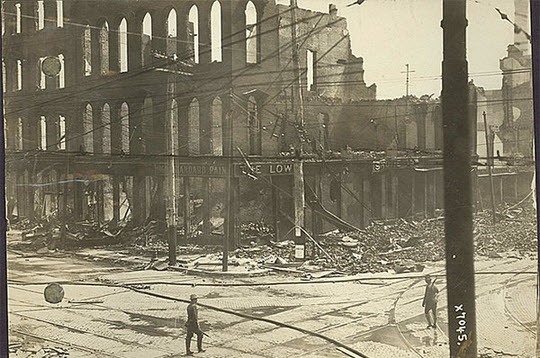
1913: The ruins of the Lowe Brothers Paint Store on the Southeast corner of East Third and Jefferson Street in Dayton
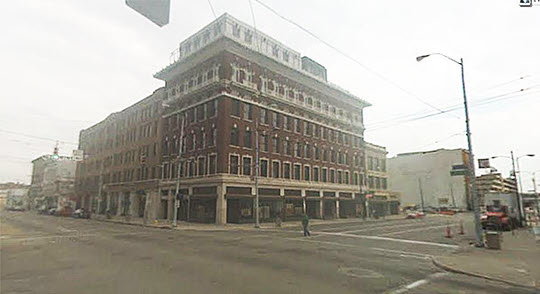
2013: The corner of East Third and Jefferson Streets as it appears today
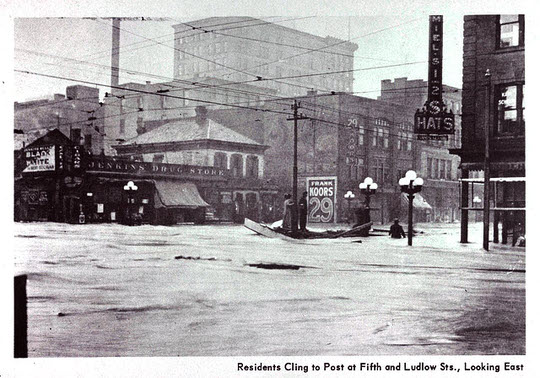
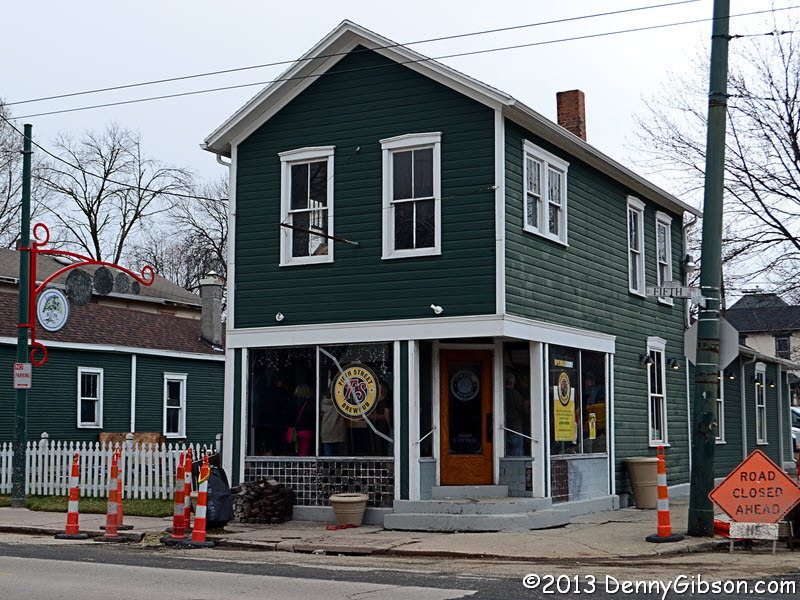
1913: Fifth and Ludlow Streets in downtown Dayton during the worst of the flooding
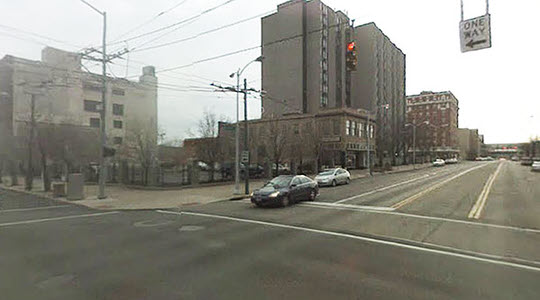
2013: Fifth and Ludlow Streets in downtown Dayton as it appears today
Thanks so much to Denny Gibson for letting us share a piece of this historical project on DennyGibson.com. We’re humbled by the interest in this project, and we really hope you enjoyed this snippet of history!
We’d also like to thank some of the great archives and archivists who have done so much work to preserve the amazing history of the 1913 flood, including the Dayton Metro Library and historian Trudy Bell. The amount of history compiled at these two websites is amazing. Lastly, thanks to Jason from InsuranceTown.com, who lent us some of the resources we used to help prepare content for the web and publish our blog and inspired our Mapping History Contest.
Don’t forget to check out HistoricNaturalDisasters.com for more images and for information on our Mapping History Contest – help us figure out the locations pictured in historic photos from 1913 and you could win $100!
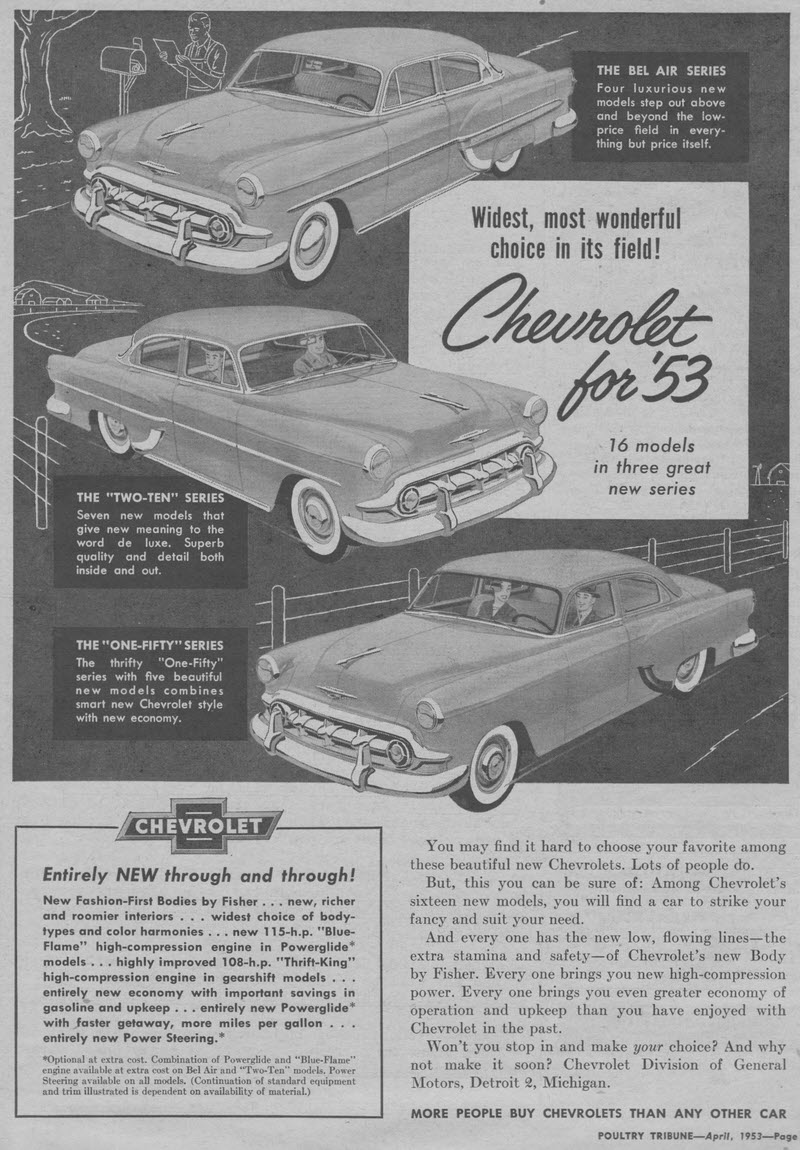
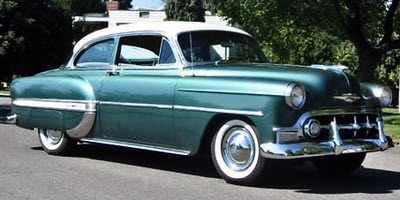 My car was a green and white Bel Air that looked a lot like the car at left. Exceptions were that mine was a 4-door and it never looked nearly that shiny while I owned it. Late in the summer I threw a rod and did my first engine swap with something out of a wreck. During the winter, the front got a little wrinkled when I was intentionally doing donuts in the snow and unintentionally found a guard rail in my path. When the rods in my junkyard engine started knocking in the spring, the Chevy was done.






 I’ve never seen Dirk Hamilton in person with a band. I’ve seen him twice with another guitarist and twice with no one else on stage period. Conversely, I’ve never listened to him without a band. OK, maybe “never” is a stretch but a bold print seldom sure isn’t. I own just about everything Dirk has released and it’s the rare track that doesn’t have at least a few top notch musicians backing him up. That’s not a bad thing. The tunes are served well by the added layers and the folks Dirk chooses to play with always add something to the mix. But listening to solo mono is kind of like a “being there” I can relate to.



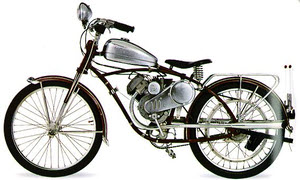 It was 1962, I was 15 years old, and I was going mobile. Fourteen and fifteen year old Ohioans can still ride two and three wheelers with “helper motors” but both vehicle and and rider require a license. Plus the motor must be under 50 CC and 1 HP and incapable of moving the rig faster than 20 MPH. Shish!
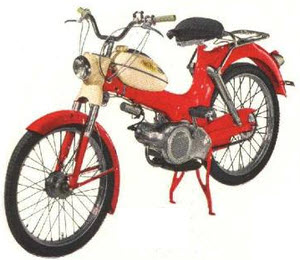 Dale’s moped had a capital ‘M’ — and a hyphen. It was a real Mo-Ped sold by Sears under the Allstate brand. They were made, apparently, by Puch in Austria. Our two mopeds did the same job but they sure had their differences. The Mo-Ped had a two-cycle 50cc motor with a two speed transmission and chain drive. Power from the Whizzer’s larger four-cycle reached the rear wheel through a belt. Belts and pullies slip; Chains and gears don’t. Compared to the Whizzer, the Mo-Ped was a jackrabbit off the line. The Whizzer would slowly lumber into motion usually helped by my feet on the ground or on the pedals. The Whizzer’s top end was well above the Mo-Ped’s so I’d usually whiz by, to show I could, before settling down for a side by side cruise. When first setting out, the Mo-Ped could be started on its stand with a little pedal pushing. The Whizzer could, in theory, be started by pedaling but it was a real chore. The method of choice was to start pushing it, release the clutch, (‘pop’ is not a word often associated with the Whizzer belt idler.), and jump on after the bike started but before it ran away.
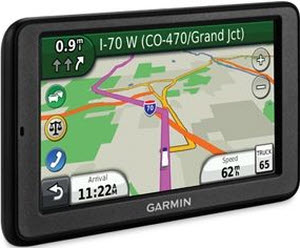 This product took me to within one U-turn of abandoning Garmin completely. It replaced a Garmin Quest which was, in my opinion and for my purposes, nearly perfect. I talk about that
  I am even less qualified to review DVDs than I am to review CDs and books. That won’t stop me of course. I just thought you should know. Going My Way is Chuck Land’s take on the story of Larry and Tim Goshorn’s musical adventures. Chuck Land is the guy behind