
Route 66: 44 Years

It’s probably not hard to guess that this post was triggered by two recent reviews of books with titles (Route 66: The First 100 Years & Route 66: 100 Years) that closely resemble the one above. Just like someone’s list of the best guitarists or best albums, those books could not possibly include everybody’s favorites. Reading them stirred up my own memories of the route, and when I finished, it was clear that some of the things and people that stood out in those memories had been omitted. I even briefly thought of pointing that out in the reviews, but quickly and wisely dropped the idea. Including everyone’s ideas of what was significant about a hundred years and more than 2,000 miles is even more challenging than naming everyone’s favorite album in a top 100 list. So, I started planning an entry about a few of the “omissions” on my mind and almost immediately realized that some context was required. Thus, this post.

I initially had 26 in this post’s title to account for the 26 years since my first full drive of Historic Route 66 in 1999. Then I remembered my one and only real-life encounter with a real live US 66. In 1981, my future ex-wife and I were headed toward Las Vegas on I-40 when we exited at Winslow, AZ, for breakfast. I knew almost nothing about Route 66, but recognized the name Winslow from the Eagles song. I even think that had something to do with picking the town for breakfast. I recall grabbing an Egg McMuffin, then driving through a bit of the town, and returning to I-40 on the west side. I believe that at least a tiny bit of that drive was on a still commissioned US 66. I always learn something while writing a blog post, and in writing this one, I learned that “Take It Easy” and the Egg McMuffin were both released in 1972.
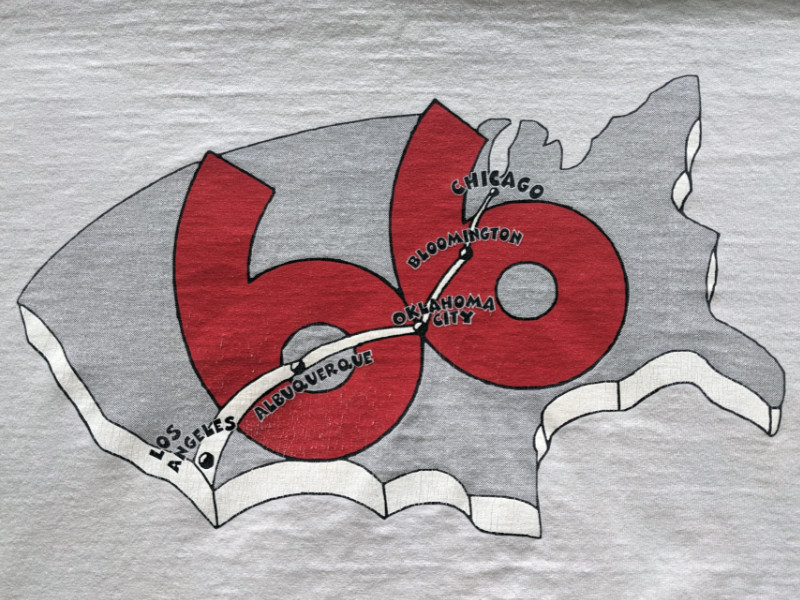
As we all know, the route ceased to officially exist a few years later. My next encounter with the route, and probably first encounter with the renaissance, was in 1998 when I attended the Bloomington Gold Corvette gathering in Bloomington, IL, with a friend. I imagine I was already thinking of driving the route when I bought this T-shirt. I still have it and even still wear it occasionally. I recently wore it at the Milles of Possibility conference, where it got a little attention because of the unusual set of cities marked on the back. Most Route 66 folks, including Bobby Troup, forget Bloomington.
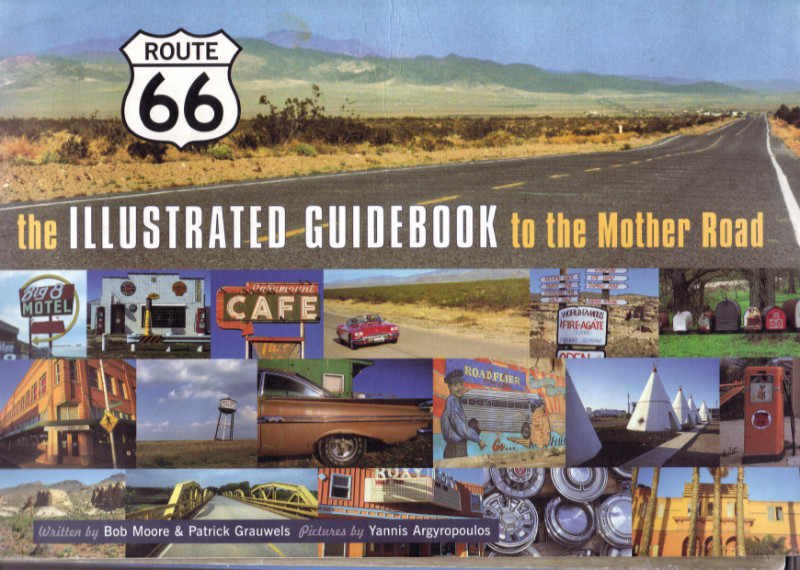
A more serious relationship with Sixty-Six began the next year when I made my first full-length drive. The book shown at right was my guide. It was a true mile-by-mile guide with accurate distances to turns, cities, and roadside attractions. Its ring binding (similar to EZ66) allowed it to be laid open in the car. Co-author Bob Moore was a key player in Route 66 Magazine. In 2003, he and Rich Cunningham published a two-volume Route 66 Guidebook and Atlas. I never met Bob, although I did stop by the magazine’s office and gift shop on that first trip. The journal for that trip is still available here.
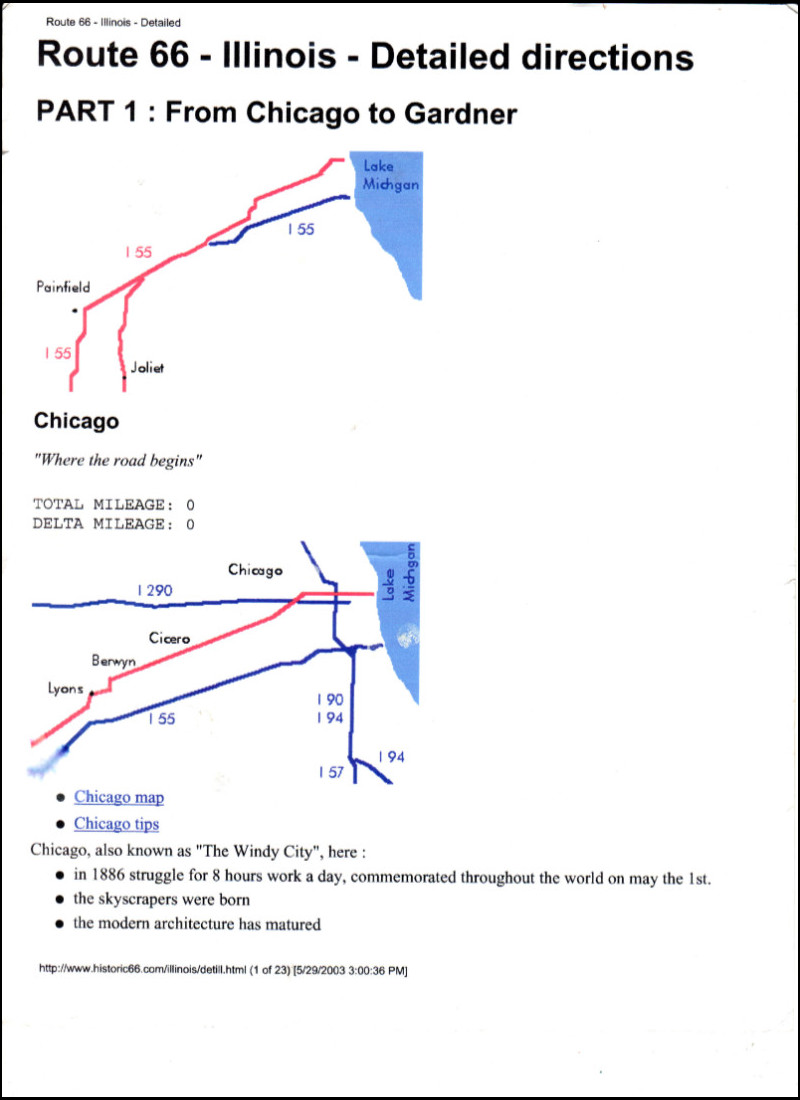
At left is a scan of the first page of the directions I followed on my second full-length trip in 2003. By then, I had discovered Historic66.com and gave my printer a workout by printing every page of the turn-by-turn directions at the site. What would become Historic66.com was started in 1994 by Belgian Swa Frantzen and his wife, Nadine Pelicaen. This was near the leading edge of the internet, and the website is generally accepted as the first dedicated to Route 66. Swa and Nadine turned the site over to Route 66 Navigation founders Marián Pavel and Jan Švrček in 2021. Details of this cyber-pioneering are told here.

I did meet Swa and Nadine several times, but since their retirement, they have pretty much cut out international travel. The last US visit that I am aware of was in 2018, when they were here partially to photograph the total solar eclipse of that year. I was alone in an open car on that 2003 trip. I kept the directions in the seat beside me with large spring clips at top and bottom. As I finished each page, I pulled it from the clips and crumpled it up behind the passenger seat to keep it from blowing away. At the next stop or at the end of the day, I would straighten them out and place them at the back of the stack. I still have them. The journal for the 2003 trip is here.
There has always been a GPS in my car, starting with the very first of my documented road trips. The earliest ones I used showed me my position on a map and the straight-line distance to cities and other places. They did not offer routing. I actually doubt that routing was even possible before the government dropped “selective availability”, which limited the accuracy of civilian receivers, in 2000. I acquired a unit capable of routing in 2006 and started plotting downloadable routes for my trips. This included some partial Route 66 outings using directions in a first-edition EZ66 Guide, which I’d bought from Jerry in 2005. For my third full-length trip in 2012, I used a store-bought route.

River Pilot began releasing Route 66 products for certain Garmin GPS models in 2010. I purchased his Ready2Go Tours app (reviewed here) in 2012, and used it for a Chicago to L.A. run later that year. I was quite happy with the product. It was available for purchase for several years, and GPS units could be rented with it pre-loaded. Incompatibility with new Garmin models basically doomed the product. That also seems to have doomed a line of pre-planned routes that were once available from MAD Maps for Garmin units. I had several email and telephone conversations with River that included comments about how we were part of a seemingly small subset of GPS users who understood the difference between being guided to a point and being guided along a route. He had some hope of developing products that would take advantage of the exploding availability of GPS in smartphones, but I don’t believe they were ever seriously pursued. MAD Maps’ similar intentions also went unrealized. To the best of my knowledge, Touch Media’s Route 66 Navigation (reviewed here) is the only successful use of a smartphone to truly follow a route.
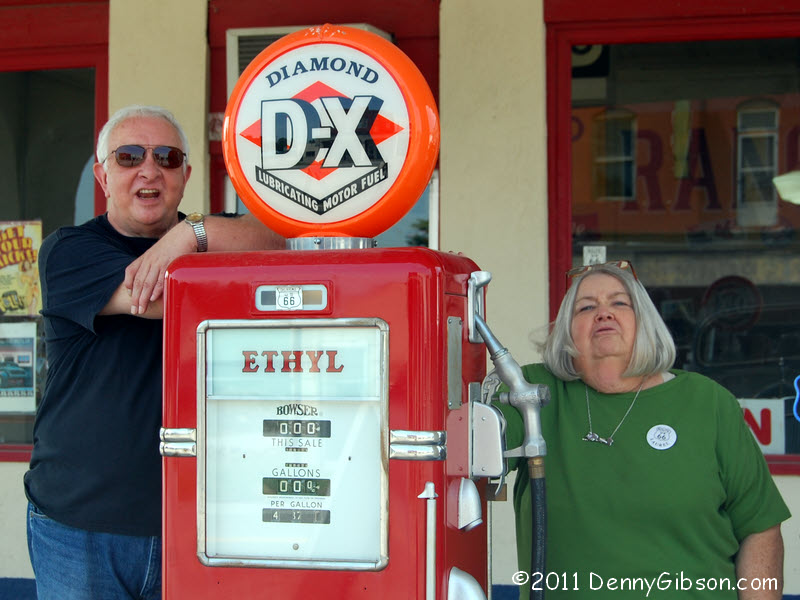
I’ve always liked this picture of Ron, Ethel, and Laurel. Laurel Kane operated a small museum and gift shop in Afton, OK, from sometime around 2000 until her death in 2016. Ron McCoy frequently rode along on Laurel’s eighty-mile commute from Tulsa to help with something at the station or to just keep her company. She might sell a few souvenirs while she was there, but that wasn’t really the point. She was there to greet the world travelers passing by and to tell them about her part of Route 66. I mentioned in the review of Route 66: 100 Years that it included a picture from her sizable collection of photos, postcards, and other memorabilia. She would have liked that. My “remembering’ post for Laurel is here.

For me, Bob, Swa, Nadine, River, and Laurel have played significant roles during my 45 (really 26) years on Route 66. I bet they are also big players in some others’ memories of the route, too. Egg McMuffins, maybe not.
Book Review
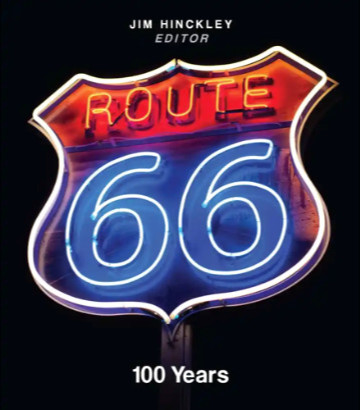
Route 66: 100 Years
Jim Hinckley, Editor

That title may look familiar. If so, one reason might be the similarly named Route 66: The First 100 Years, reviewed here back in June. The world-famous highway will turn a hundred years old on November 11, 2026, and I suspect we will see several more books (and movies and parties and blog posts) with the numbers 66 and 100 in their titles over the next year or two. I will not be purchasing and reviewing every one of those books. One reason I have invested in this pair is that I knew the quality would be good, and one reason for that is I personally know every one of the contributors to both books on one level or another. I sure hope you won’t hold that against them.
Route 66: 100 Years is an anthology edited by Jim Hinckley of Jim Hinckley’s America. There is a chapter for each of the eight states on the route, and Jim covers his home state of Arizona, plus neighboring California and the state with the fewest miles of Sixty-Six, Kansas. He also supplies the introduction and epilogue. Talented writers Cheryl Eichar Jett, Joe Sonderman, Rhys Martin, and Gregory R.C. Hasman each cover their states of residence (Illinois, Missouri, Oklahoma, and New Mexico, respectively), and Greg also writes about Texas, where he lived while attending college.
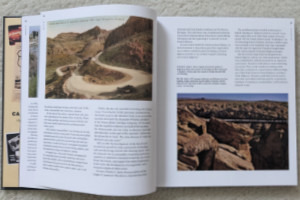
Like the beginning pages of many books about historic highways, the introduction includes tales of how the early automobile roads followed native trails, animal migration paths, and train tracks. And it talks about the impact that the popularity of bicycles had on the desire for and development of roads outside of cities toward the end of the 19th century. What makes it a little different from most similar writings is that it provides some details about organizations and specific events during road development during this era of pedal-powered transportation.
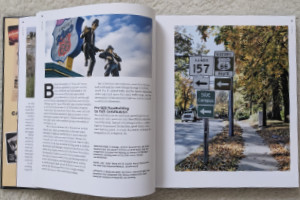
The state chapters appear in geographic sequence, east to west, which is the direction most people travel the route. Together, they provide a sort of combination travel guide and history lesson. I’m not talking about a travel guide with turn-by-turn directions, motel phone numbers, and such. However, most towns along the route are mentioned — and US 66 was a great connector of small towns — along with numerous points of interest. There is usually some history given about each town and POI, and there is plenty of history about the route itself.
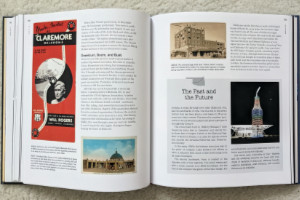
The book is definitely well-illustrated. I don’t believe there is a single page, besides the index and authors’ bios, without at least one image. These include modern and period photographs, postcards, advertising brochures, and other items. Joe Sonderman supplied some of those postcards and brochures, as did big-time collectors Mike Ward and Steve Rider. I was extremely pleased to see a photo from the collection of the late Laurel Kane included. Many of the modern photos were taken by Jim Hinckley and his wife, Judy. I saw no photos from either Rhys Martin or Greg Hasman, although I know both are excellent photographers. I did see photos from Shutterstock, Alamy, and Getty. I thought both situations were curious, but the final product comes off well.
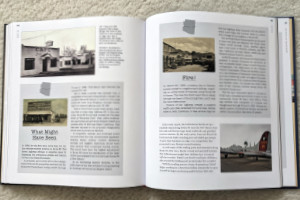
The quality of the book is quite good. Color and black-and-white images show nicely on the heavyweight glossy pages, and the layout serves them well. All have descriptive cut lines that include source credits. There are numerous sidebars, most with their own images, providing extra information outside of the main text flow.
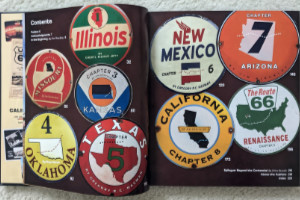
The individual states that carried US 66 account for eight chapters. The book has nine. Dries Bessels, a resident of the Netherlands, authored a chapter named “Renaissance”. Dries has guided multiple tours down the length of Route 66 and provides an outside-the-country view of the historic road. The “renaissance” he writes about is its emergence as a travel destination for both Americans and foreigners after being bypassed and decommissioned. America, essentially spared the devastation that WWII brought to Europe, was the land of dreams to post-war Europeans, and Route 66 was a tangible thing that rolled right through those dreams. Today, Route 66 is still regarded as a way to experience a diverse range of America.
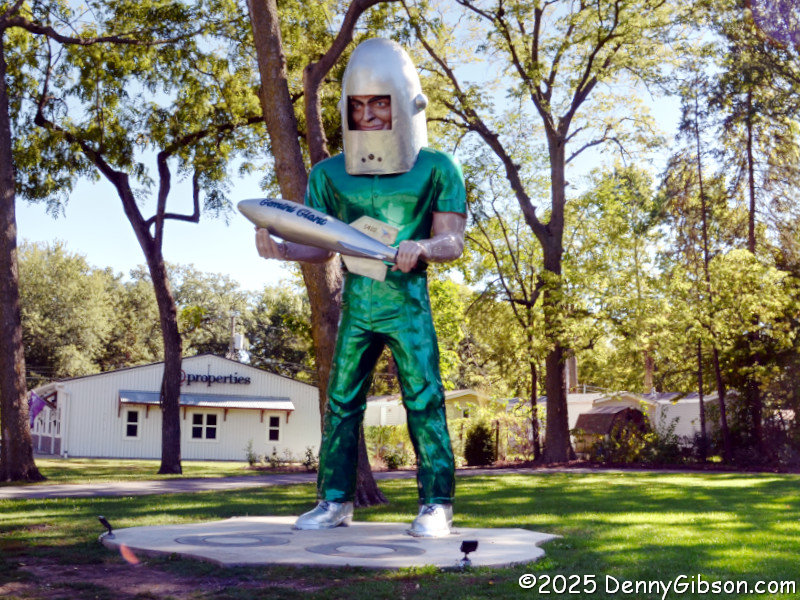
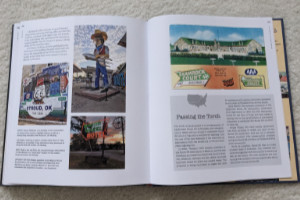
I once had a boss whose business ideas included the “rusty hinge” theory. We made machine controls, which were big metal cabinets packed with electronics. The theory was that, if you were showing a new product that still had a few bugs, a rusty hinge on the cabinet would so distract people that they would not notice any operational flaws. Fortunately, I knew about Route 66: 100 Years‘ “rusty hinge” before I saw it. In a chat about the book, Jim had mentioned that it opened with a picture not of Route 66 but of Monument Valley. The other side of the page, in my opinion, isn’t all that much better. It’s a picture of the Second Amendment Cowboy, a Muffler Man-style statue that is close to, but not quite on, Historic Route 66. A plaque at the statue’s base contains a manipulated quote incorrectly attributed to George Washington. Controversial, I think, at best. I assume these photos were included by a less-than-well-informed publisher. I have saved mention of these “rusty hinges” to the end of my review, but I can’t just ignore them. I think being aware of them is a good thing. They were clearly not intentionally put there to distract you from other flaws, but they could easily distract you from some really good writing and interesting information on the pages beyond. Don’t let them.

Route 66: 100 Years, Jim Hinckley (editor), Cheryl Eichar Jett. Joe Sonderman, Rhys Martin, Gregory R. C. Hasman, Dries Bessels (authors), Motorbooks (November 4, 2025), 9.5 x 10.88 inches, 224 pages, ISBN978-0760391488
Available through Amazon.

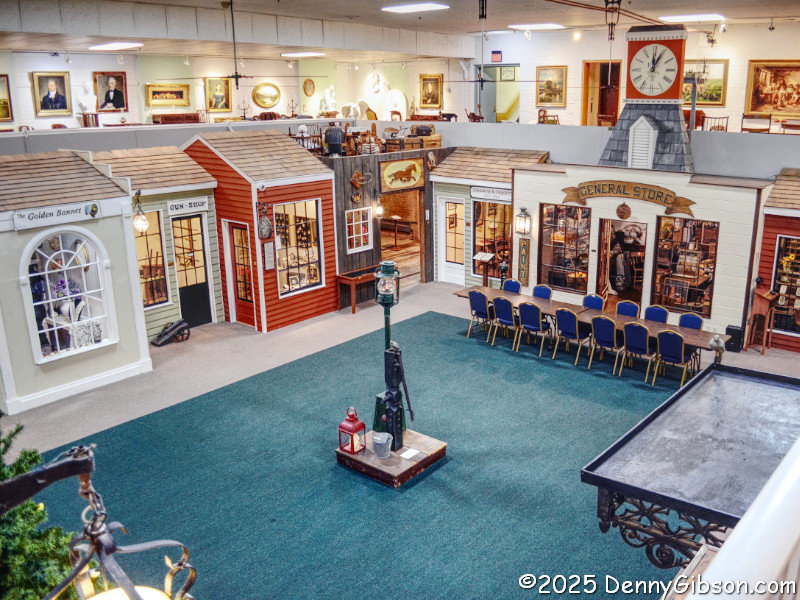
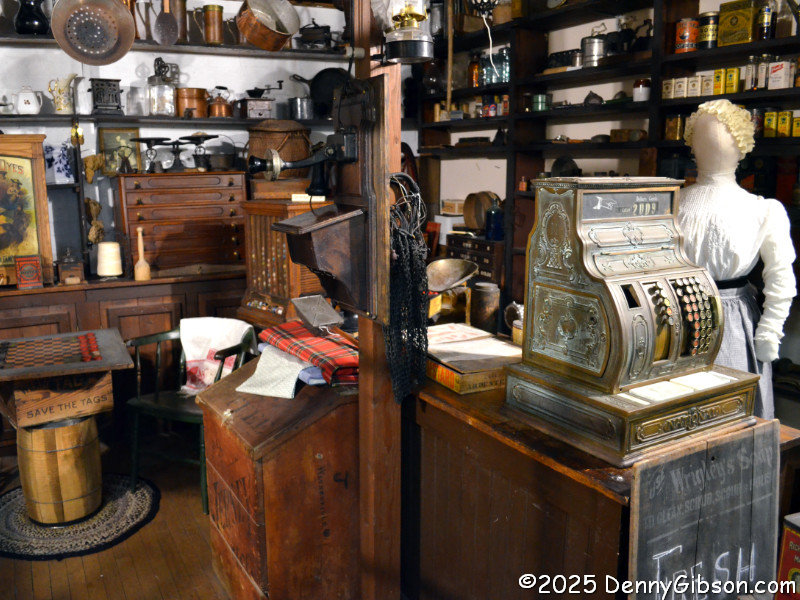
Harmon Museum
Lebanon, Ohio

It might be apparent that I occasionally use a museum visit to feed a post for an otherwise idle week. And I’m sure it’s no surprise that I find some of those targets through various online searches containing the word “museum.” Without giving it too much thought, I’ve filtered out of the results museums that are too close or too familiar. I recently asked myself why. Why was I refusing to document visits to places I knew were interesting simply because they were not new discoveries? I had no answer, which means I now have a few not-new-to-me candidates for future idle weeks. Here’s the first: Harmon Museum, just one county and a dozen miles from home.

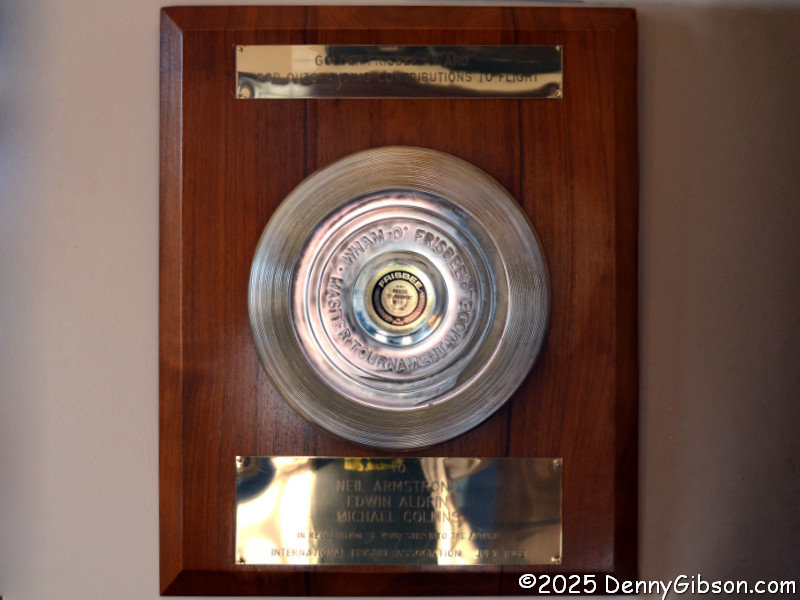
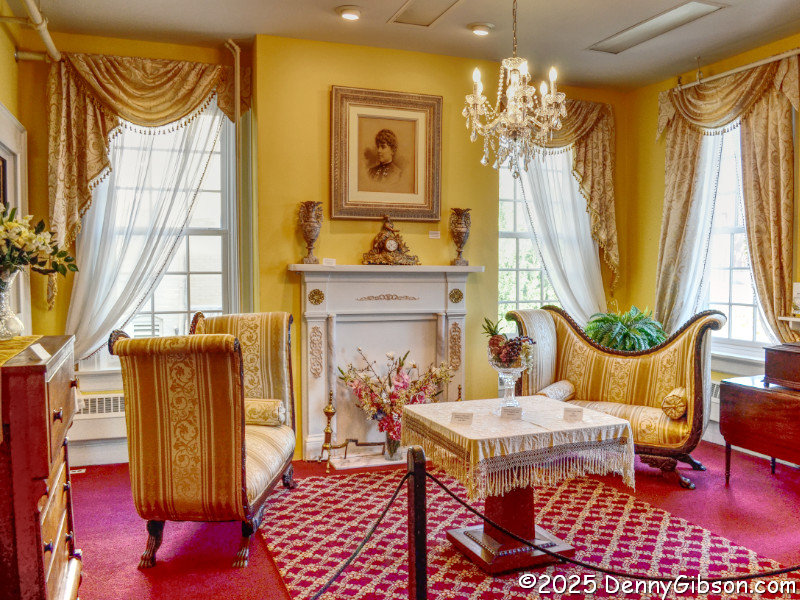
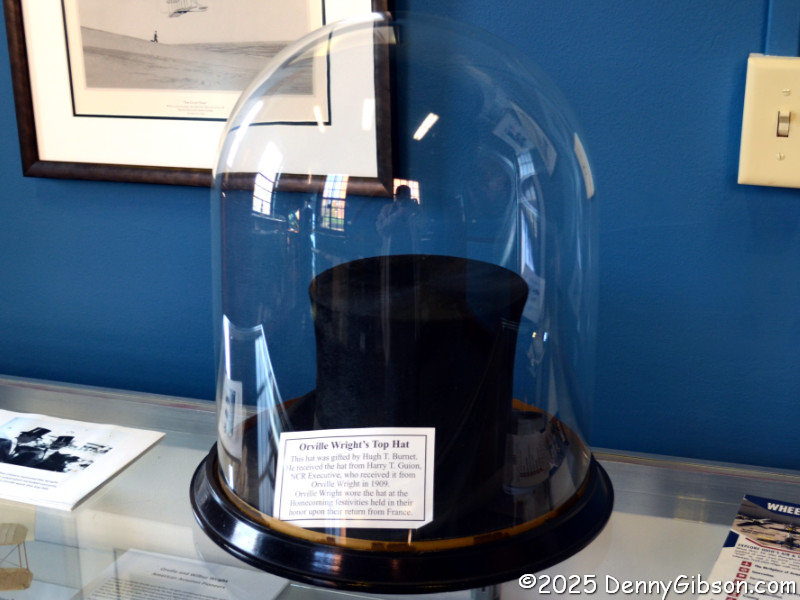
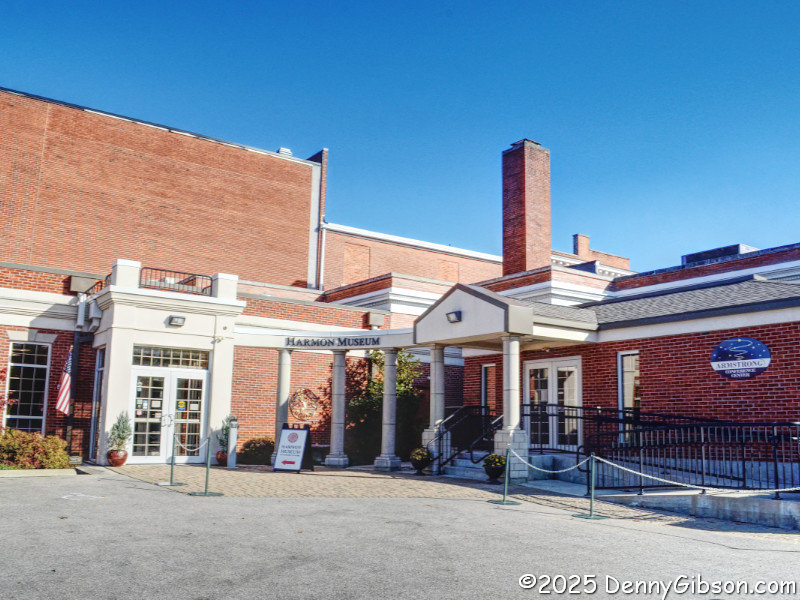
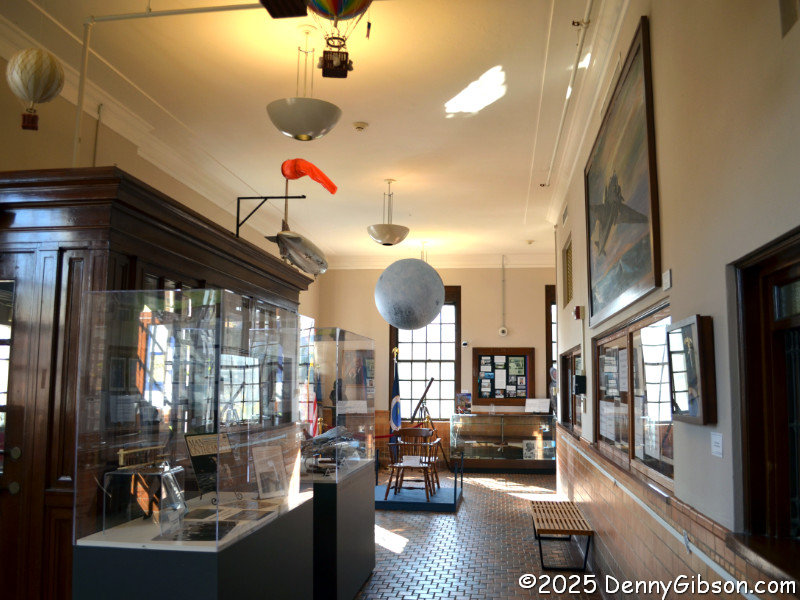
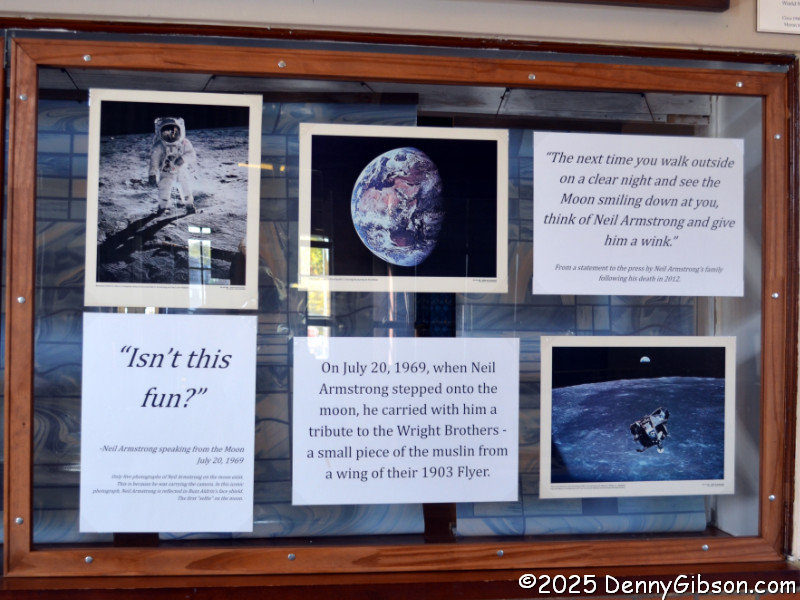
The first gallery inside the entrance is filled with art, and no photos of the wonderful paintings and sculptures on display are permitted. The art gallery leads to the Armstrong Conference Center, housed in the attached former post office. Two ladies were meeting at one of the tables, and I quickly apologized for interrupting. They weren’t the least bit annoyed and paused their discussion to make sure I crossed the open room to see the aeronautics exhibit at the front of the building. Neil Armstrong spent his final years in Lebanon, and most of the items, including the golden Frisbee for his “step into the future“, are related to his life. Non-Armstrong-related items include Orville Wright’s hat. I had a very nice chat with the ladies at the table as I passed them on the way back to the main museum. One said that if I were still in the museum when they finished, she would point out a few of her favorite things.

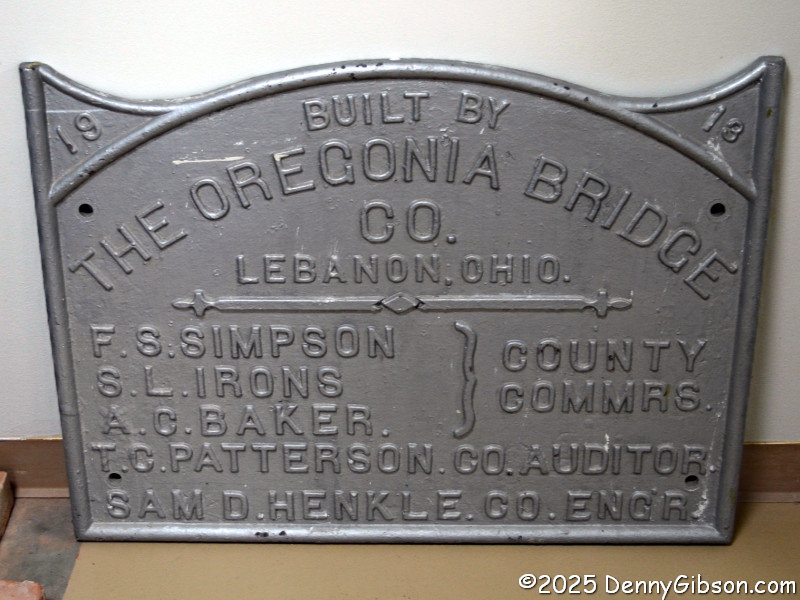
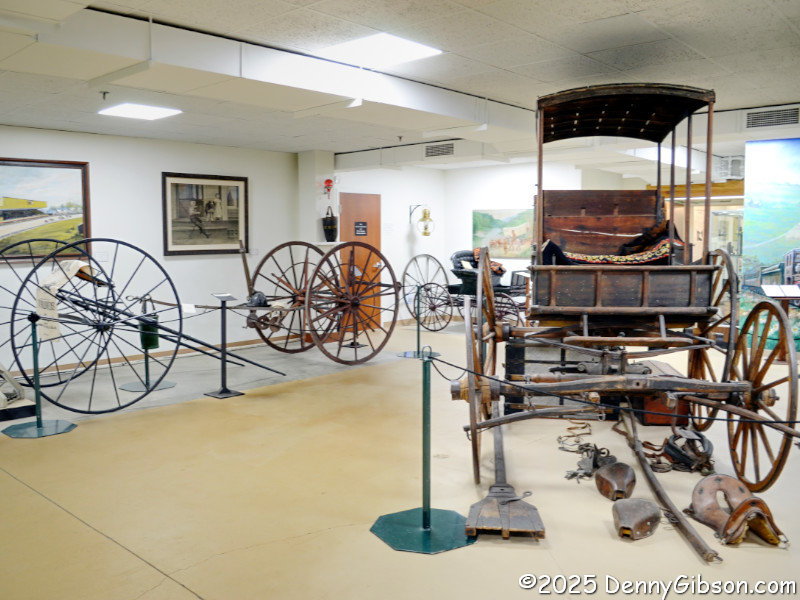
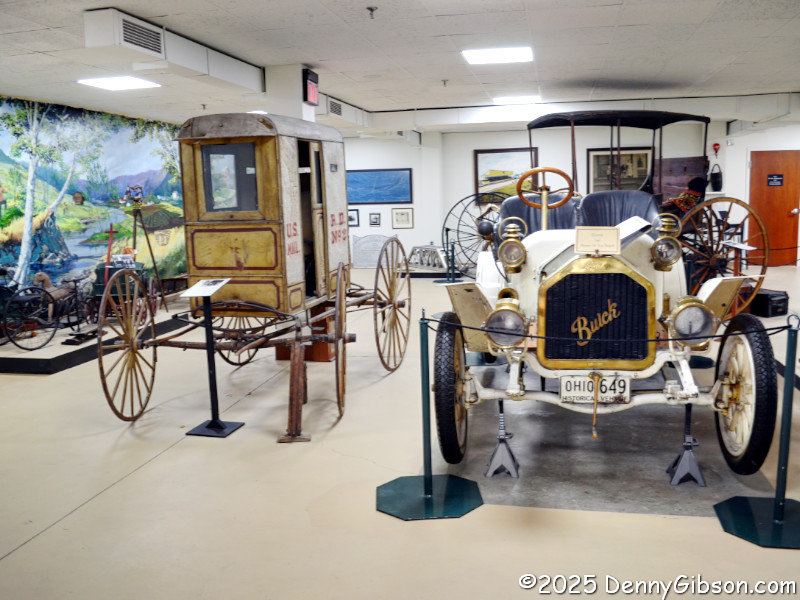
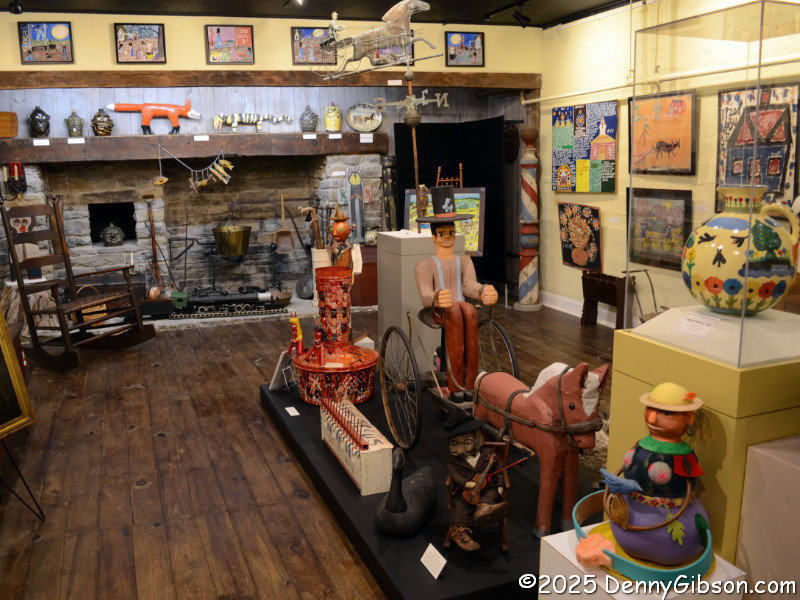
Back at the entrance to the main museum, I was greeted by a 1908 Buick Model D and an early U.S Mail wagon. Beyond them were some other early vehicles. I have seen quite a few signs like the one in the last photo in the wild, and I’m sure my road fan friends have too. The Oregonia Bridge Company was incorporated in 1896 in the small nearby town of Oregonia. Rapid growth prompted relocation to Lebanon in 1903.

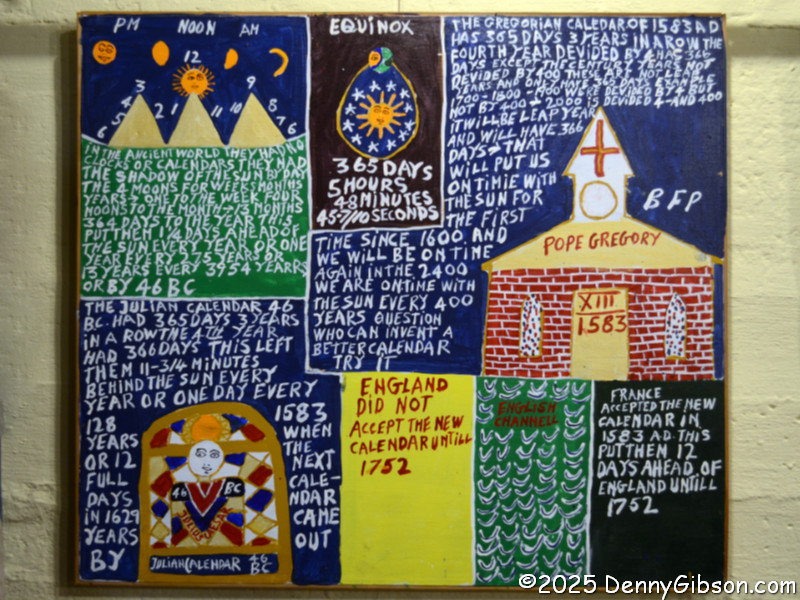
Next up was a room filled with some very impressive folk art. I found the painting in the far right corner, by Jimmy Lee Sudduth (1910-2007), particularly interesting. A few of this blog’s posts have touched on the difficulty of keeping our man-made calendars in sync with the cosmos, which is sort of the subject of the painting. As Mr. Sudduth notes, the sun and our calendar last matched up in 2000 and won’t do it again until 2400. Lucky to be alive to experience one such alignment, I guess.

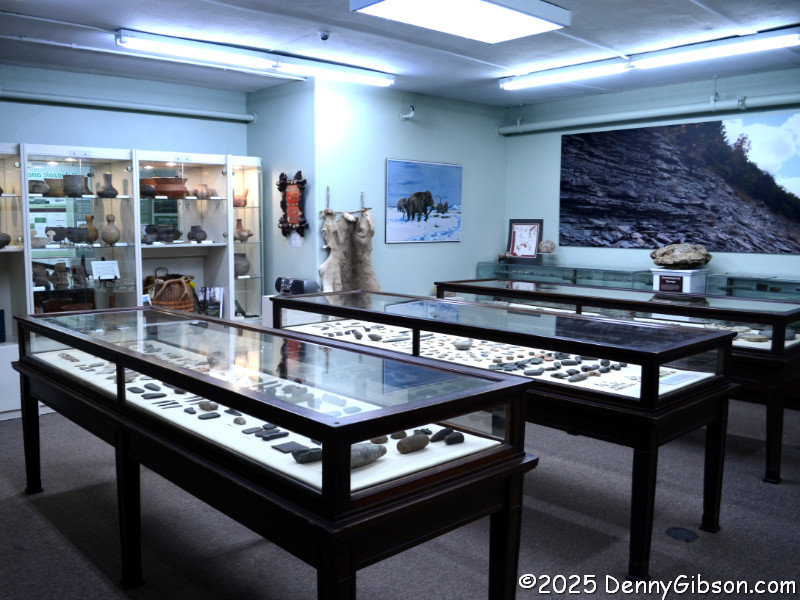
The adjacent room contained an impressive collection of locally found arrow and spear points, axe heads, and other prehistoric tools. It was here that Hope, the lady I met in the Armstrong Conference Center, caught up with me and told me that this was her favorite room in the building. She pointed out some items in the room and even demonstrated, short of a final launch, the workings of an atlatl.

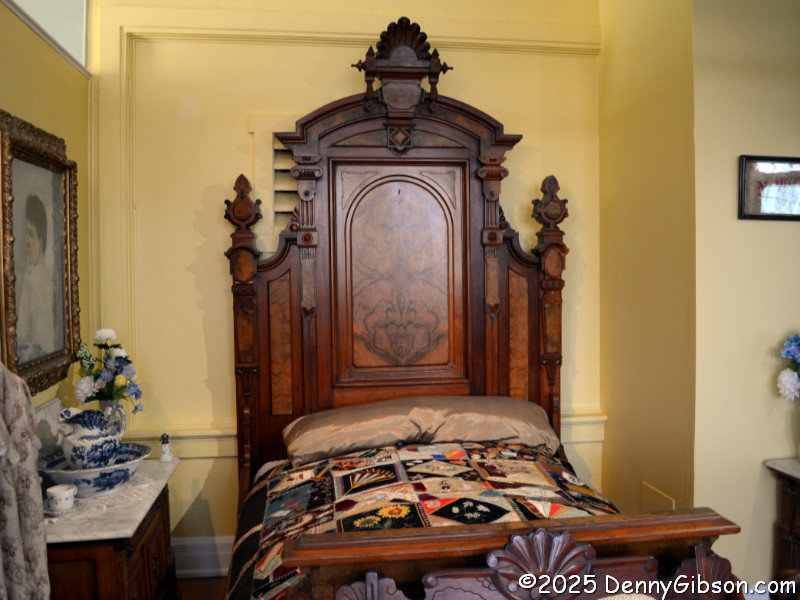
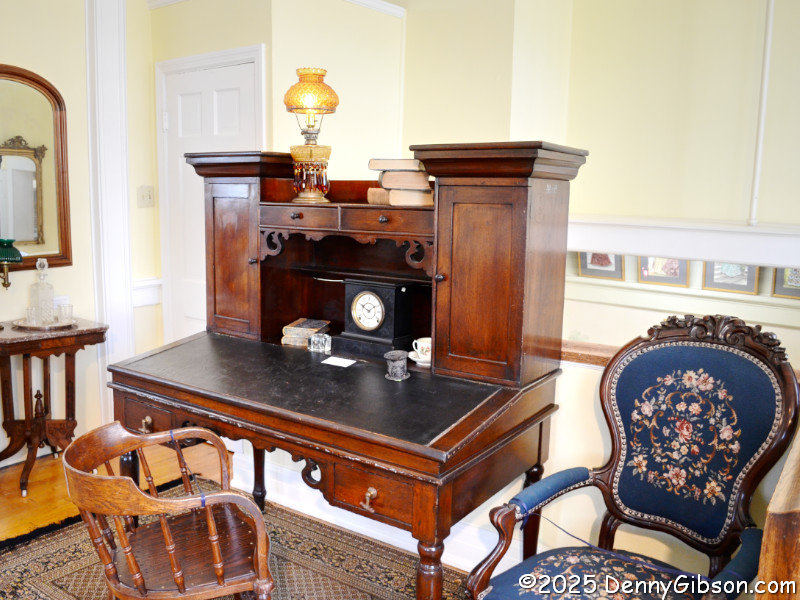
I was then treated to a guided “highlights tour” of the rest of the museum. As we moved upward through the exhibits, Hope called various items to my attention and shared some information about each one. This bed was a product of the Cincinnati Art-Carved Furniture Movement of the late 19th century. This was a rather major movement powered primarily by women, and something I previously knew absolutely nothing about. I guess this desk was not among Hope’s favorites, but it was among mine. Thomas Corwin was a Lebanon lawyer who had great success in politics. He served in both houses of the U.S. Congress and as the U.S. Secretary of the Treasury, along with several positions within Ohio, including governor. This desk is from his time as Ohio’s 15th governor (1840-1842).

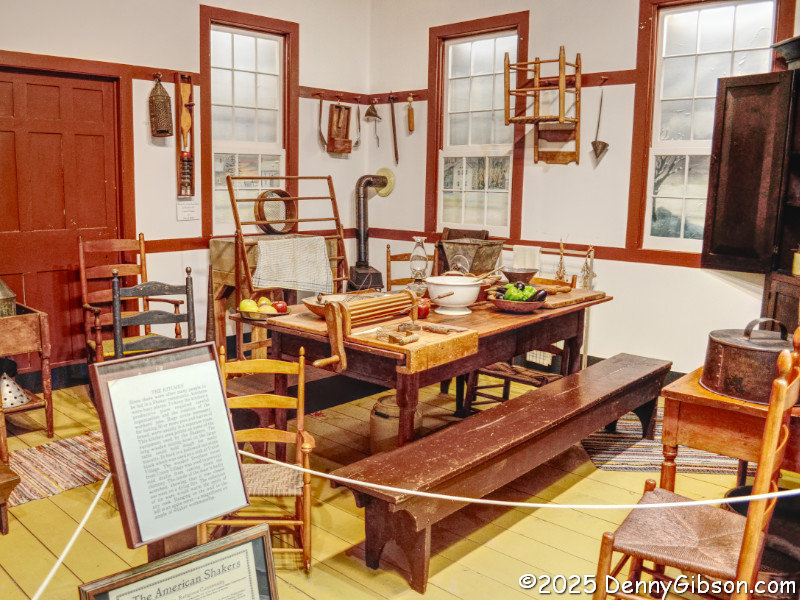
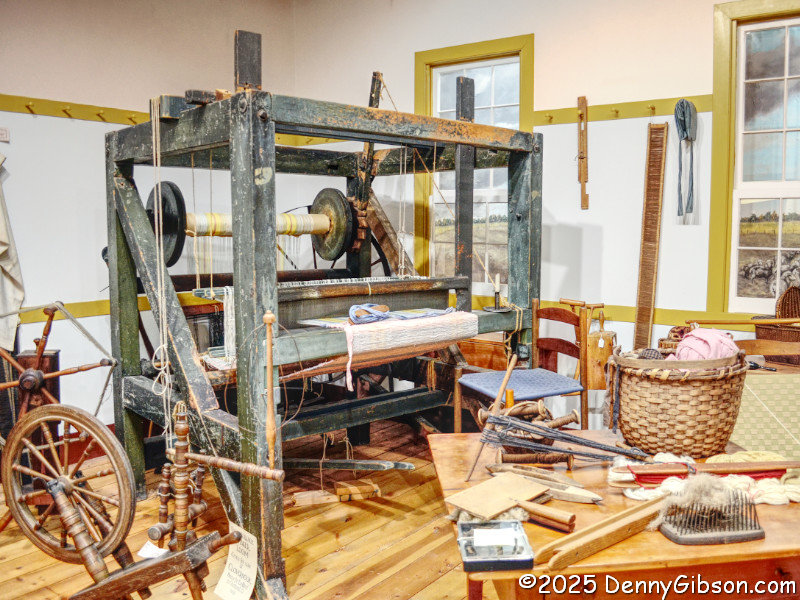
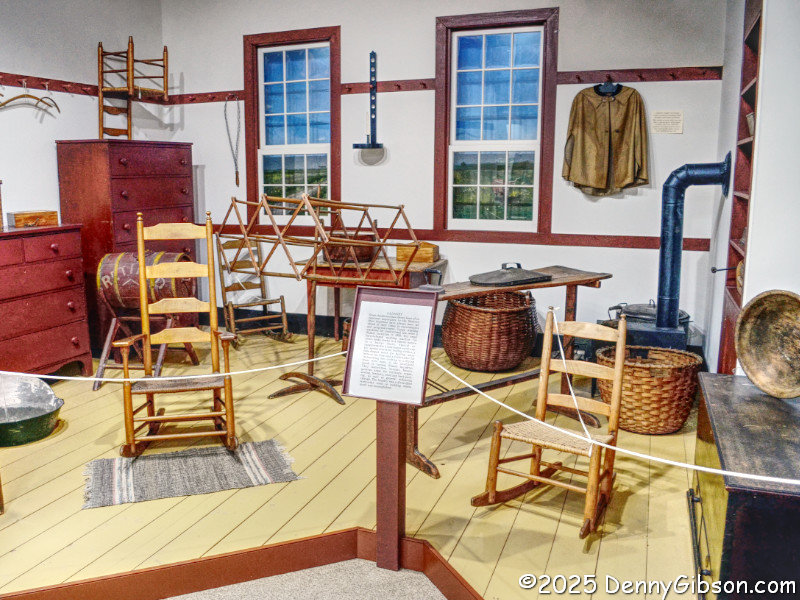
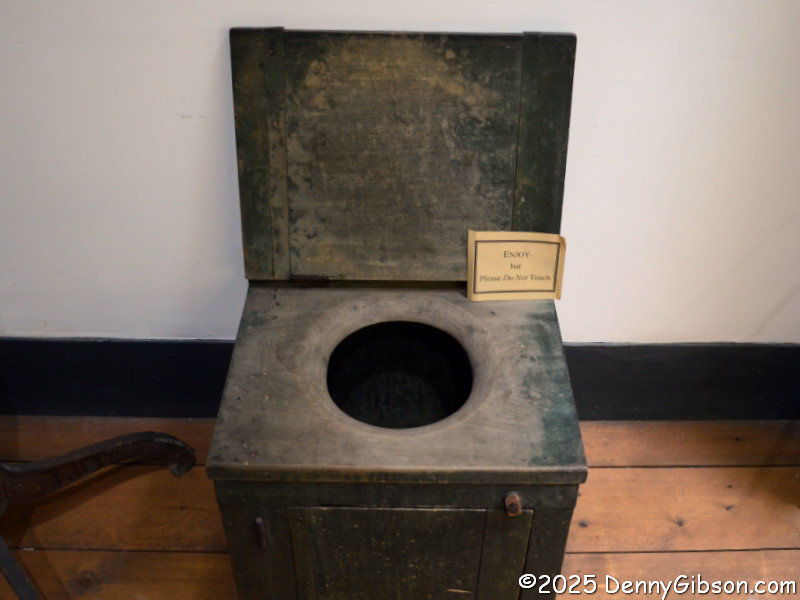
Following the “highlight tour”, I returned to Shaker Gallery on the top floor. In the early 19th century, a large colony of this communal religious group stood in nearby Turtlecreek Township, and the museum has many articles from there. Pictured are a laundry room, a textile room, and a kitchen. Curiously, one of the few items accompanied by instructions is one where they are probably not needed.

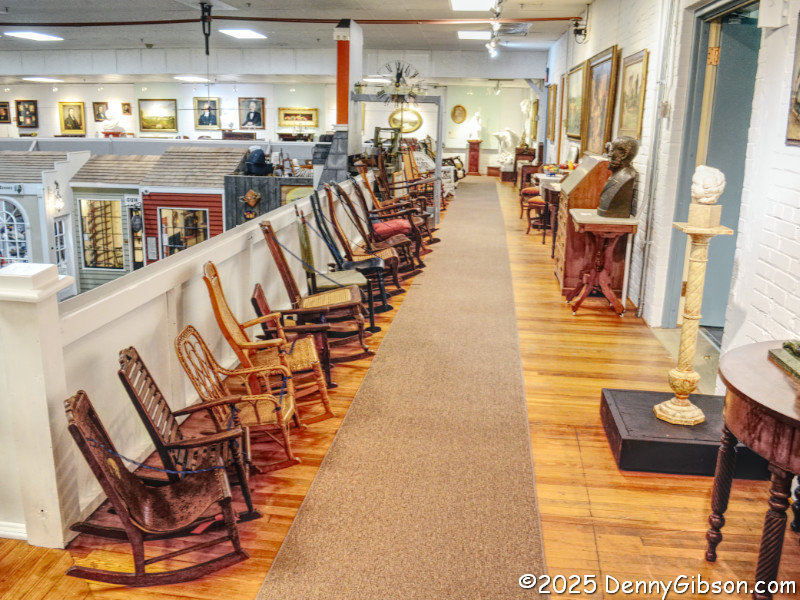
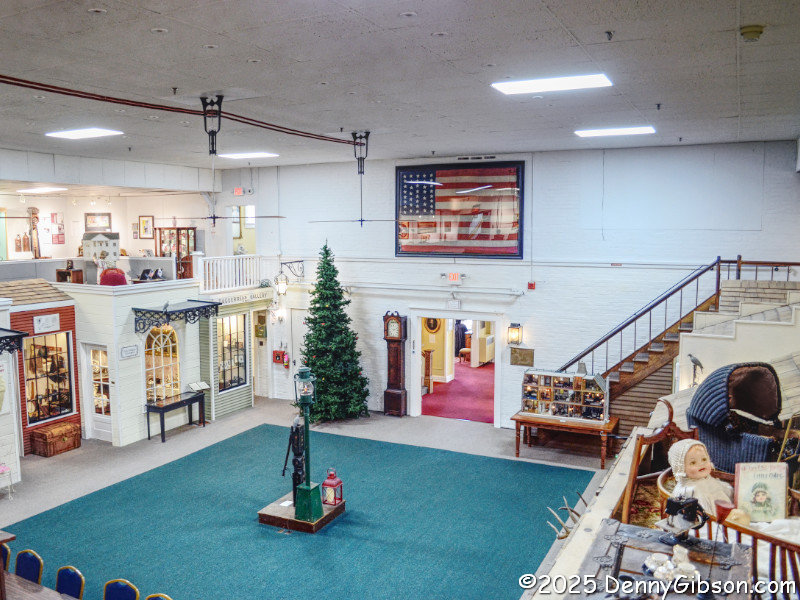
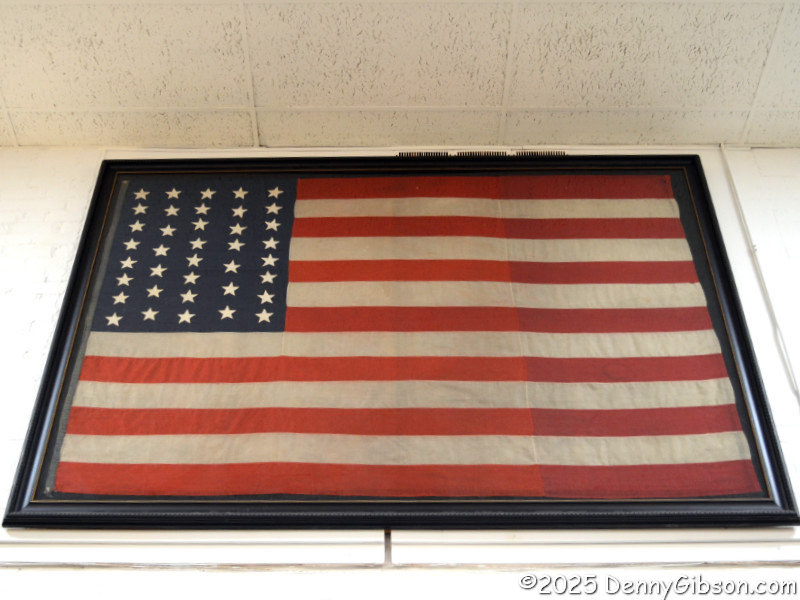
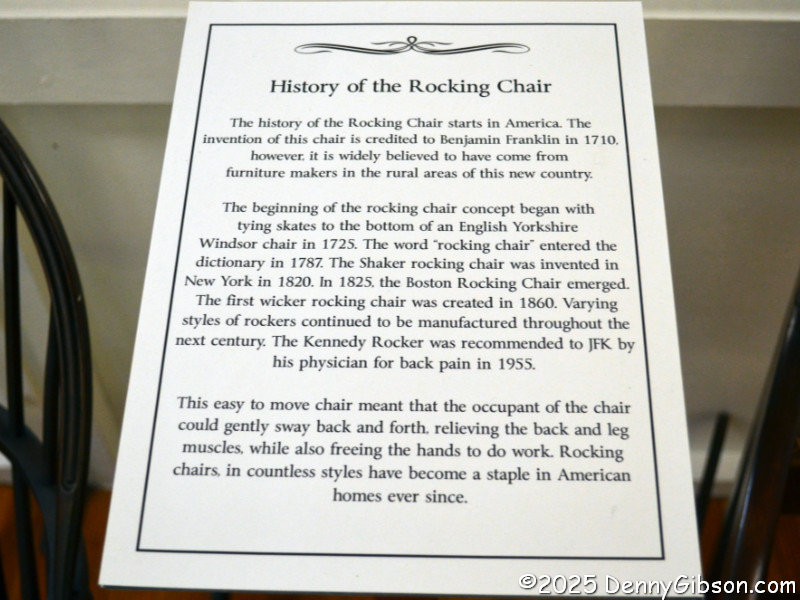
The building housing the museum was originally built as a gymnasium with a large space where basketball games and other athletic activities took place. Basketball hoops were once mounted where the clock and the 1876 38-star flag are now. The rocking chairs are among Hope’s favorites, and she commented that she thought this collection was one of the world’s largest when we passed it. According to this placard, rocking originated in America. I suppose it’s only natural that we eventually combined it with rolling.

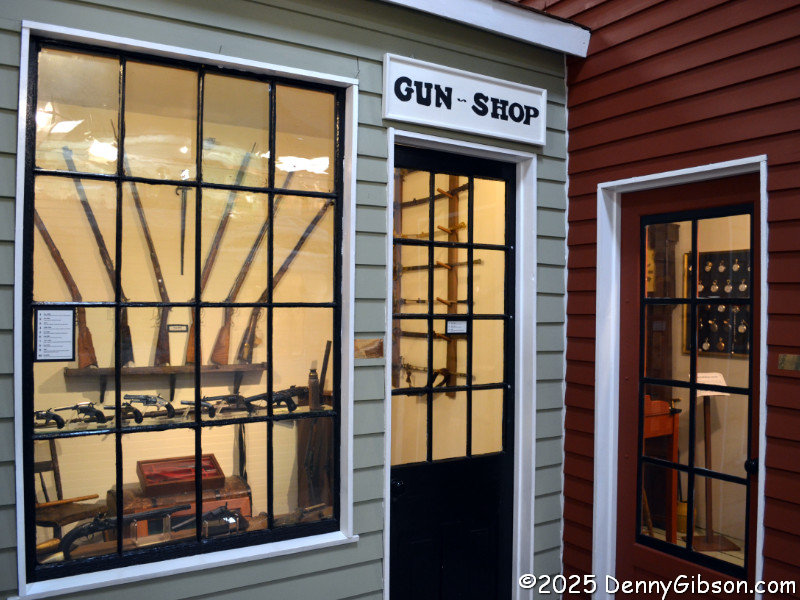
The space where basketball was once played is now surrounded by several shops, forming a sort of old-time town square.

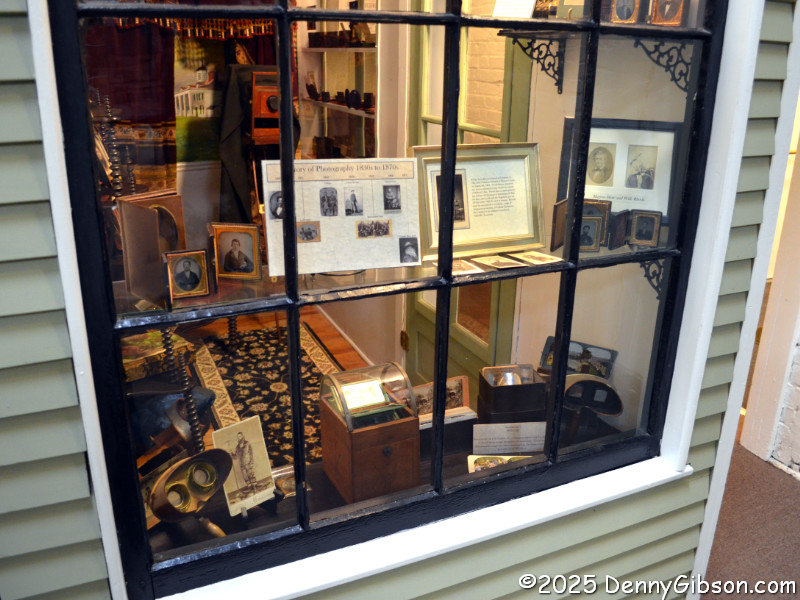
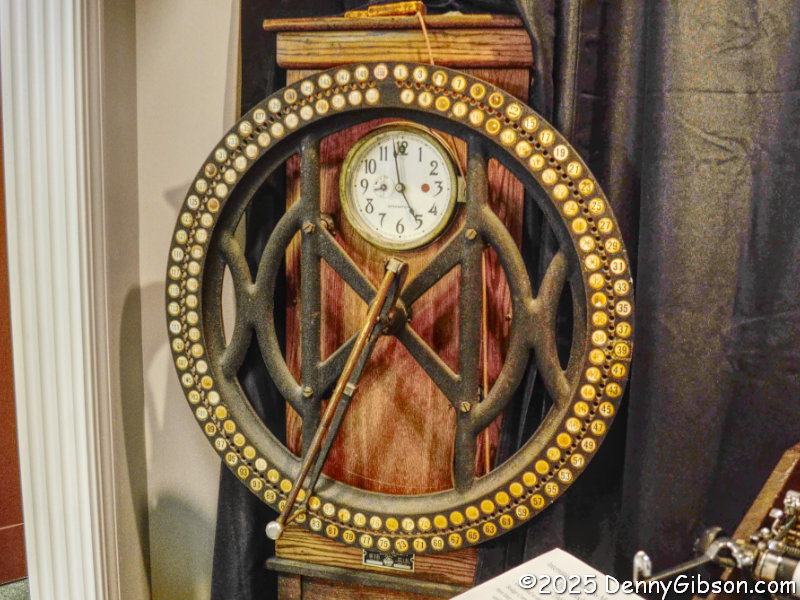
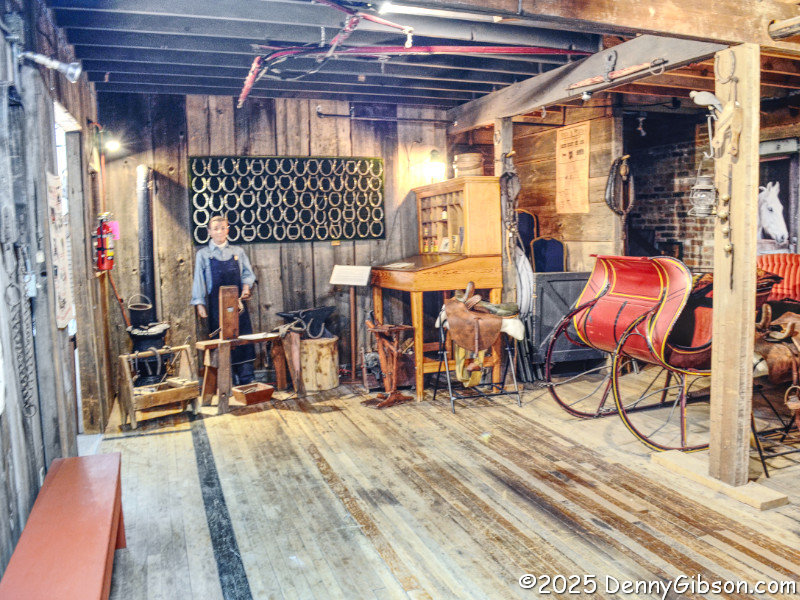
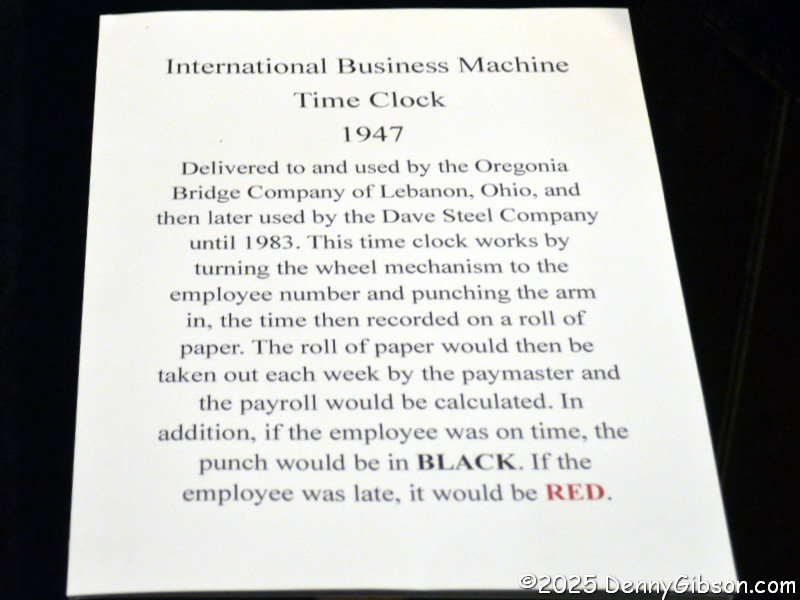
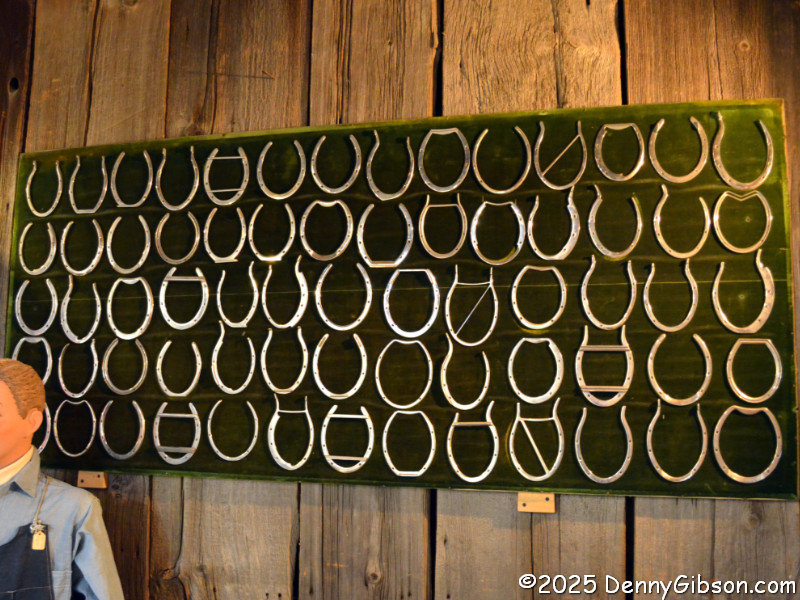
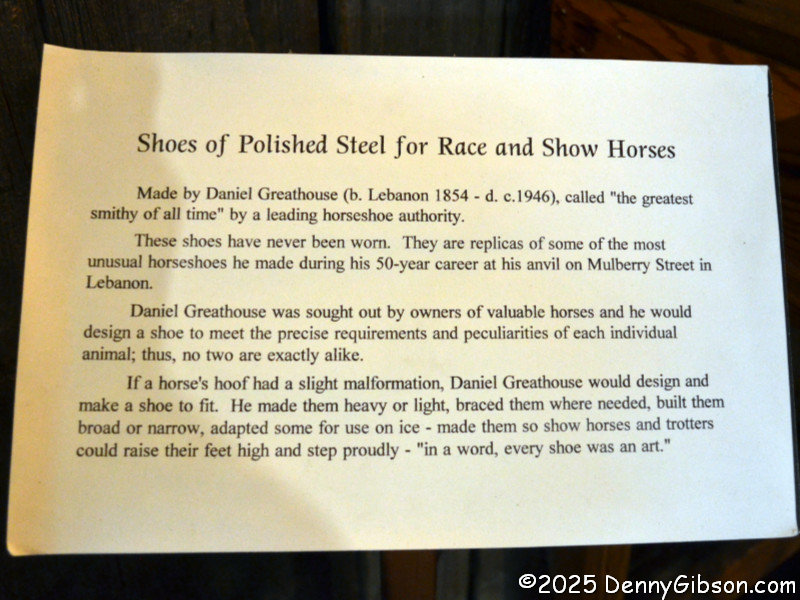
The museum is well organized, but there is no single correct path through it. That’s even more the case when you make a pass taking advantage of someone’s favorites before falling into your own meandering. There was very little coherent sequencing in the preceding photos, and there is even less from here on out. This is simply a trio of my own favorites. The IBM time clock was purchased in 1947 by the previously mentioned Oregonia Bridge Company. Read about it here. The most interesting thing for me in the blacksmith shop is the framed shoes on the wall. Read about them here. The furniture in the last photo came from the Glendower Historic Mansion. I learned today that the mansion was home to the first incarnation of the Warren County Historical Society Museum. Over the years, it was owned and administered by the WCHS and the Ohio History Connection. Most recently, the WCHS was the owner. It closed in 2022 and is now a private residence. I visited it during a period when OHC owned it.

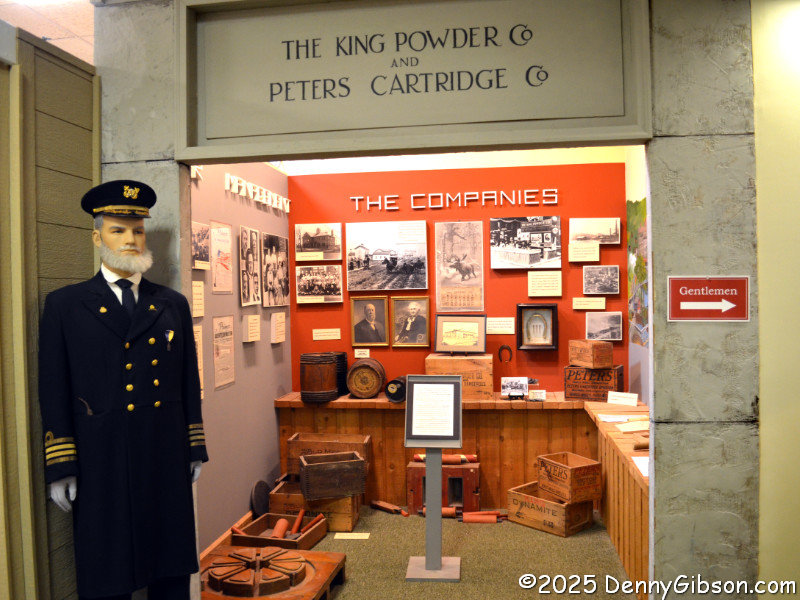
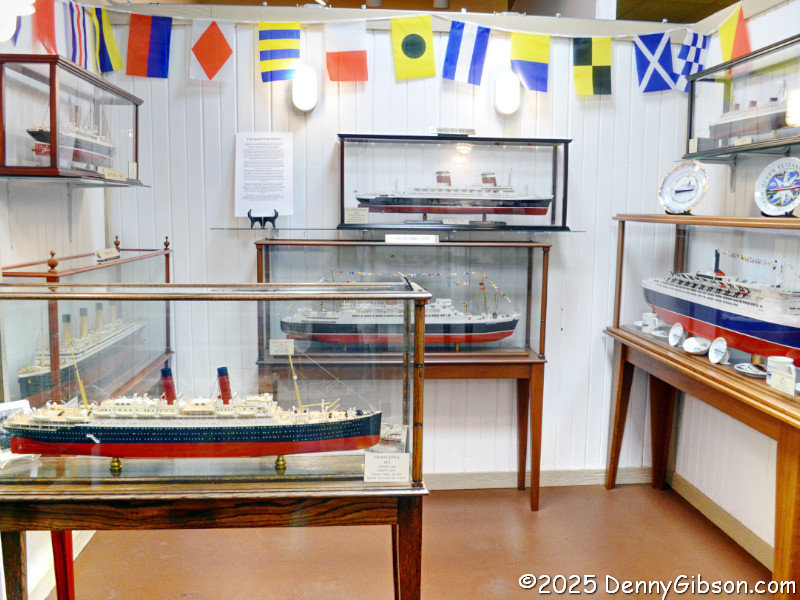
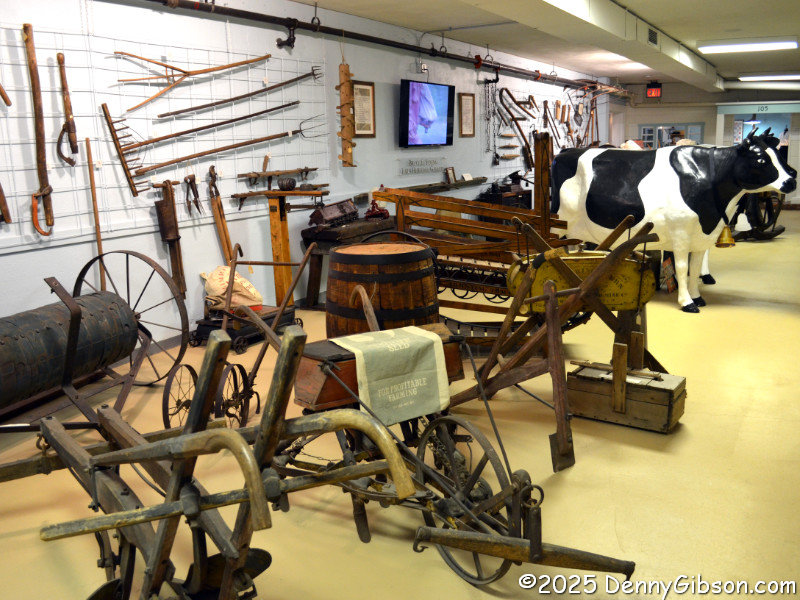
That there is a goodly amount of farming gear on display is not a surprise. That there is a collection of phenomenal ship models is. Finding a display about gunpowder and cartridge manufacturing might surprise some, but not anyone really familiar with the area.

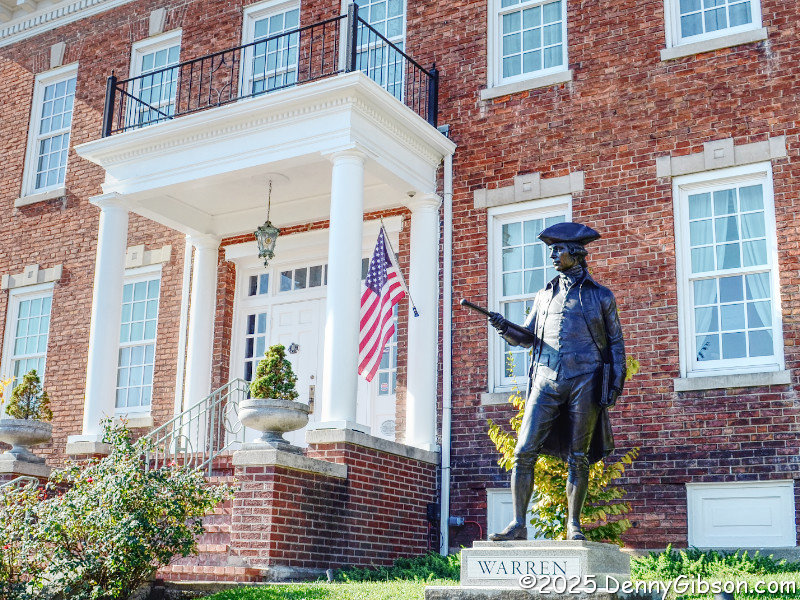
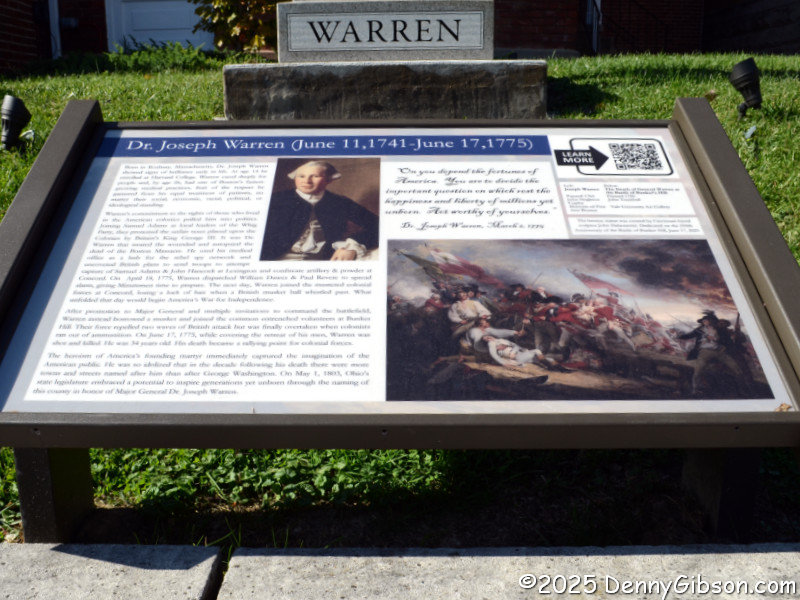
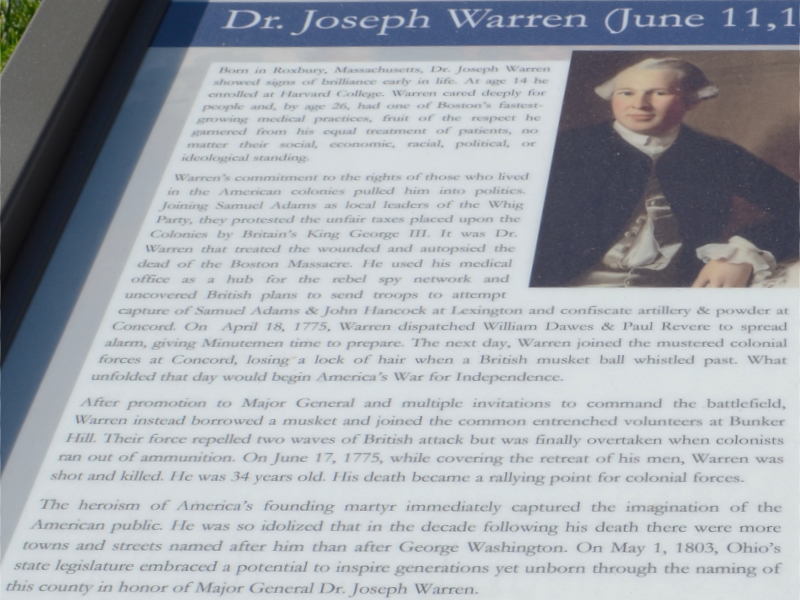
The entrance pictured at the top of this article is located at what might be considered the rear of the building, where it is conveniently near a parking lot. The front of the building faces Broadway, and that is where this statue of Warren County’s namesake, Dr. Joseph Warren, stands. The statue was dedicated just months ago on the 250th anniversary of Dr. Warren’s death at the Battle of Bunker Hill on June 17, 1775. A somewhat more readable version of the text on the sign is here. The QR code at the sign’s upper right leads here.

Movie Review
Frogman
Rotting Press, Feral Child Films

Frogman is a horror movie. I’m pretty sure the last horror movie that I paid to see in a theater was The Exorcist in 1973. I did that because I liked the book. I went to see Frogman because I liked the festival.
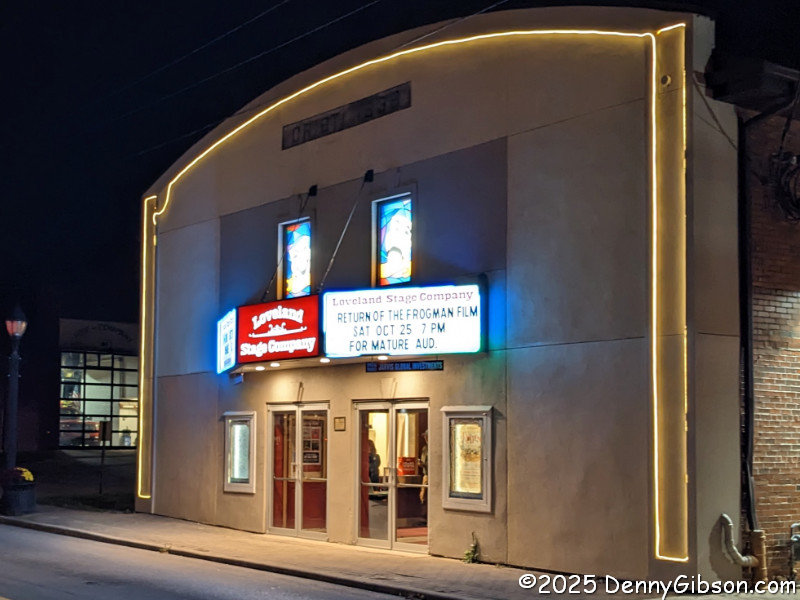
The legend of the Loveland Frog/Frogman can be traced to 1955. It got a little boost in 1972, but only recently has this creature of widely varied descriptions been seen as a crypid to embrace, promote, and maybe make some money off of. Perhaps the first example of the latter was the musical play Hot Damn! It’s the Loveland Frog in 2014. I missed it then and only became aware of it as the second attempt (AFAIK) to make something of the legend — the Frogman Festival — was taking shape. That first festival, which I attended, took place in 2023, with the fourth annual event set for March 2026.

Just over a year ago, Hot Damn! It’s the Loveland Frog was revived for a few performances in Loveland itself. I jumped at the chance to attend and reported on it here. About the same time, plans were announced for a city-connected Return of the Frogman Festival, which would take place that October and every leap year thereafter. I was out of town during that festival and may have been most disappointed by a missed opportunity to see the recently released Frogman movie. When I heard of plans for an October 2025 showing, I jumped again.

By the time I arrived at the Loveland Stage Company theater, I had read many of the reviews at IMDB and was prepared for a pretty bad movie. In hindsight, I think some of those negative reviews were well off the mark. To be clear, there are probably at least as many positive reviews as there are negative. It’s just that the negative ones had made more of an impression on me. After seeing the movie, I’m firmly in the “not as bad as expected” camp.

The audience no doubt had something to do with that. Of course, anything connected to the Loveland Frog is best experienced in Loveland. This crowd was there to have fun — several wore frog suits — not to be frightened. There are a few something-suddenly-jumps-at-you scenes, but they were, at least in this setting, pretty ineffective. I heard no gasps or screams. I did hear many laughs.

The Loveland of the movie is not the Loveland of the viewing. The movie was shot in Stillwater, MN, which isn’t all that much bigger than Loveland, OH (19,000 vs. 13,000), but somehow feels like it is, and the St. Croix River really is much bigger than the Little Miami. Some scenes in Fargo were shot in Stillwater, so there is that.

The Frogman of the movie may or may not be the Frogman of the legend. The frogish creature in the movie only appears in very brief glimpses and usually with less than optimal lighting and focus. My size appraisals range from about the size of a large cat to bigger than the biggest grizzly. In the novel The Exorcist, much of the supernatural goings on happened out of sight or were caught ever so briefly from the corner of one’s eye, leaving the reader to accept them or not. In the movie, that ambiguity got lost. There is no doubt that I, her on-screen mother, and everybody else in the theater saw Linda Blair’s head spin like a top. That, in my opinion, was a major shortcoming of the movie. Although the thing appearing in those on-screen Frogman glimpses might not exactly match any of the descriptions reported in real life, the quality of the glimpses is sort of similar. 

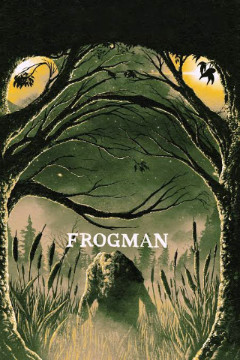
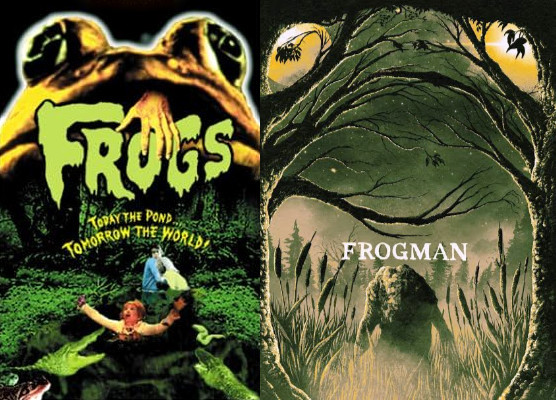
While writing this, I’ve learned that Frogman is available for streaming from several services, including my go-to freebie Tubi. I’m rather happy that I didn’t know that earlier, as I might have just watched it in my living room and missed the fun gathering at the theater. After being alerted to this by IMDB, I searched for it on Tubi and found it listed beside a 1972 movie named Frogs with Ray Milland and Sam Elliot. In my mind, I had already awarded the Frogman promotional artwork bonus points for its creative facial image formed by branches. After seeing that there’s a good chance it intentionally resembles that of the earlier film, I’m just going to double those points.


Subdued Hues

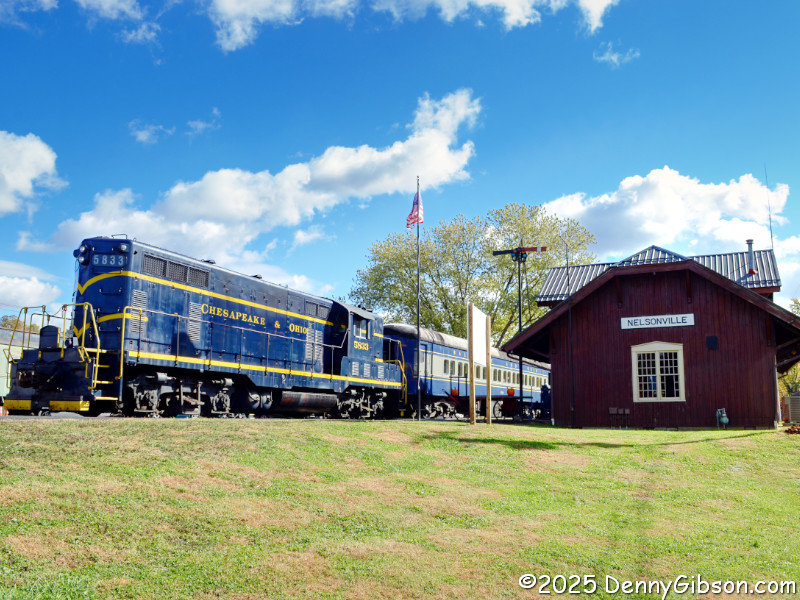
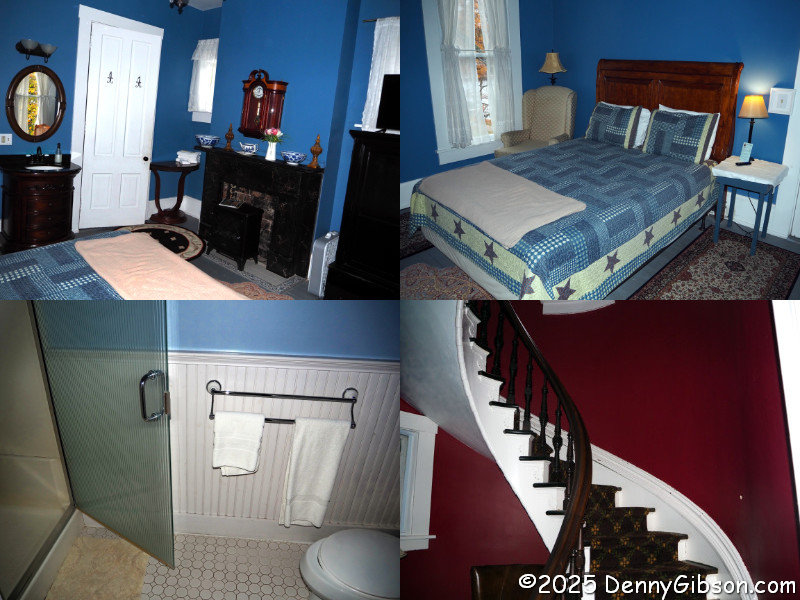
An advertisement for a steam train in Virginia caught my attention, and the autumn foliage outing it promoted sure looked inviting. However, I couldn’t make any of the train’s scheduled dates work for me. It did get me thinking about autumn rail excursions, though, and I found another steam-powered one that I could fit into my schedule. It was even closer in Ohio. However, it only ran on weekends, and weekend lodging in the area was either unavailable or unaffordable. When I saw that very affordable lodging could be had on Thursdays and that the same route followed by the steam locomotive on weekends was followed by a diesel on Fridays, I decided I could make do with a slightly shallower dive into history. I booked the B&B and the Friday afternoon train.

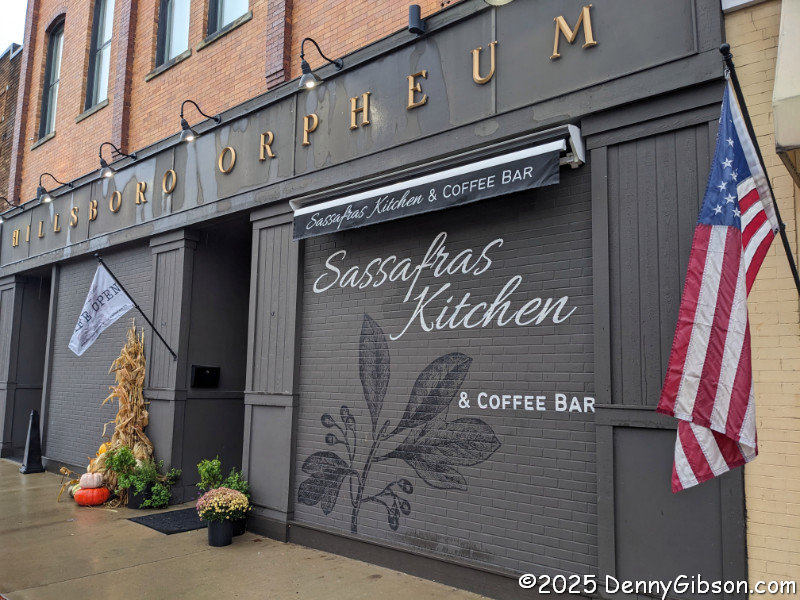
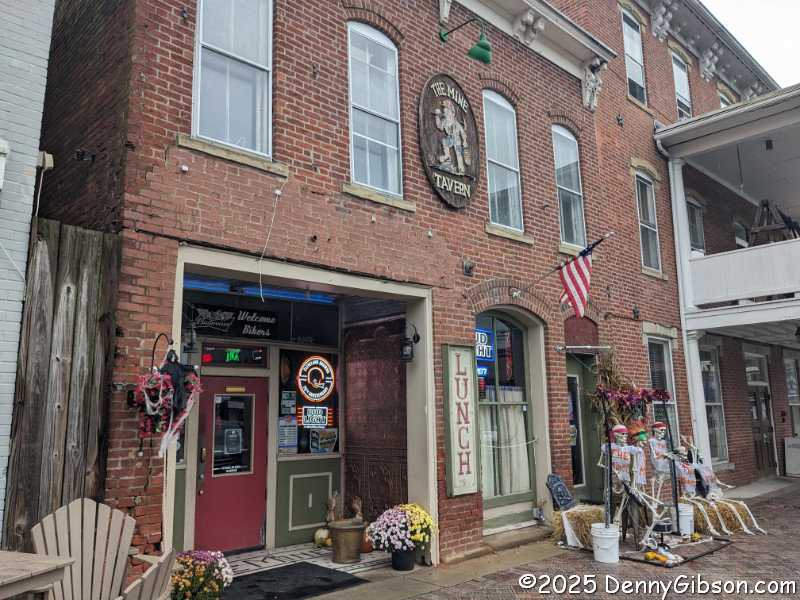
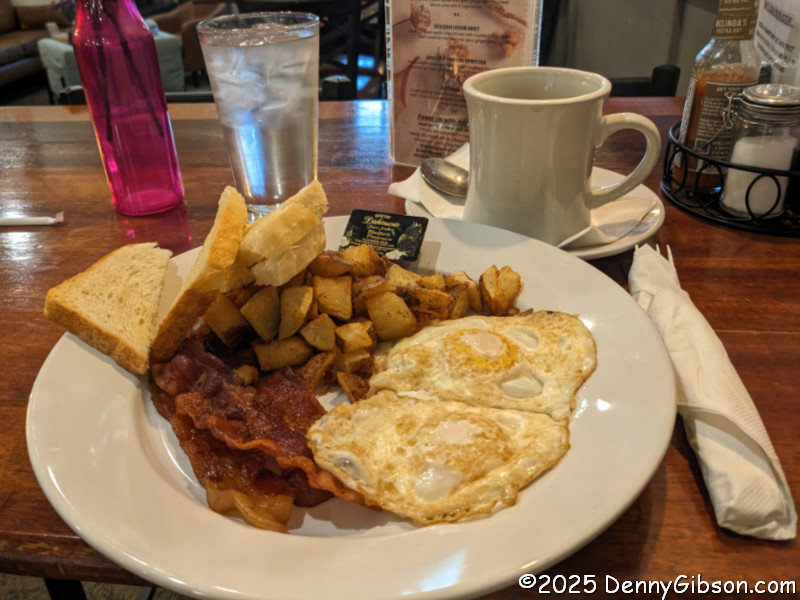
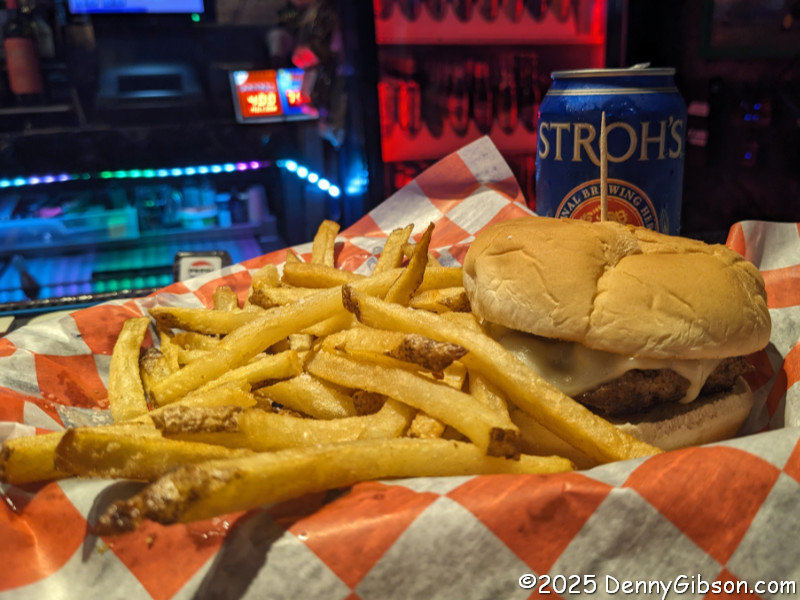
Rain entered the picture as the outing neared. It started on Wednesday and continued as I headed east on US-50 Thursday morning. I stopped for an excellent breakfast at Sassafras Kitchen & Coffee Bar in Hillsboro, and had a really good burger and some fantastic fries at The Mine Tavern in Nelsonville.

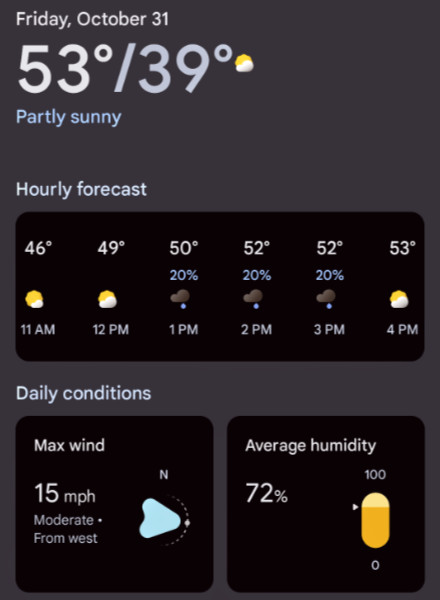
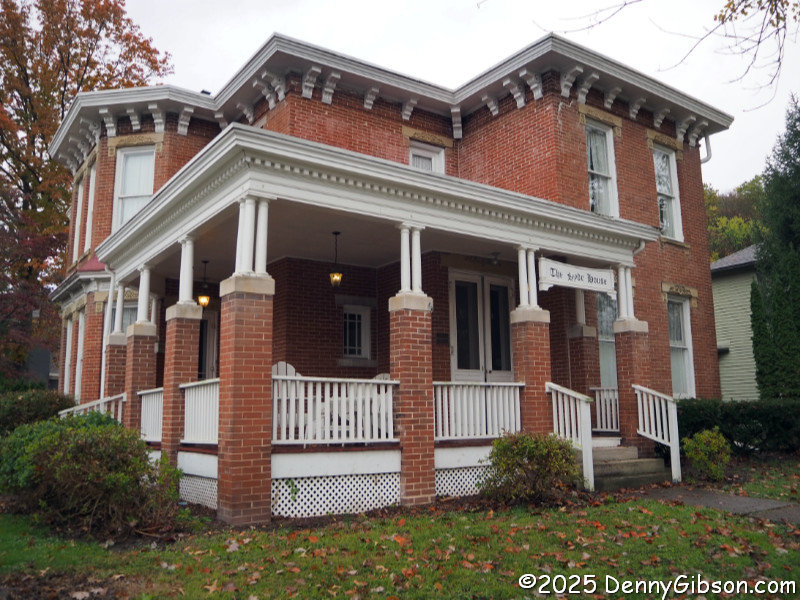
Nelsonville was my destination. I checked into the Tulip Room in the Hyde House, just a couple of blocks from the tavern and not much more than that from the train station. Recent weather predictions had shown the rain ending Thursday night, with Friday being completely dry. I checked one more time before falling asleep and noticed a slight change. My little train ride was scheduled to depart at 1:00 and last for two hours.

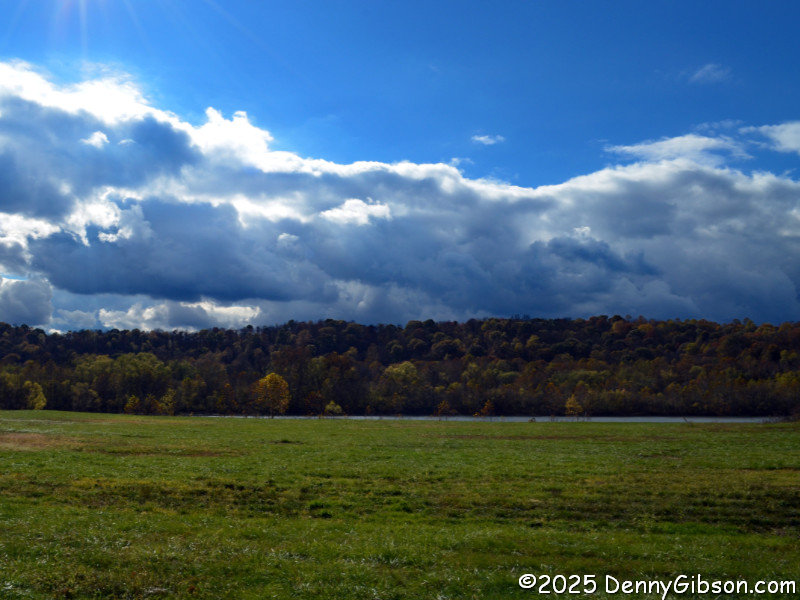
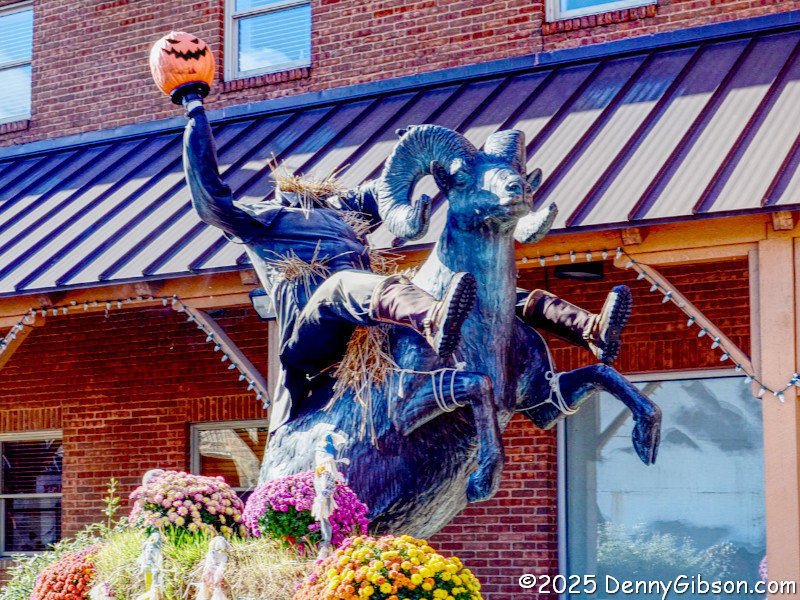
The Hocking Valley Scenic Railway station is right next to Rocky Boots headquarters and outlet. I arrived well before departure time and walked over to Rocky Boots to get the picture of the Headless Sheepman that opens this article. It was, after all, Halloween. Note that, although the sky is hardly cloudless, the sun is shining.

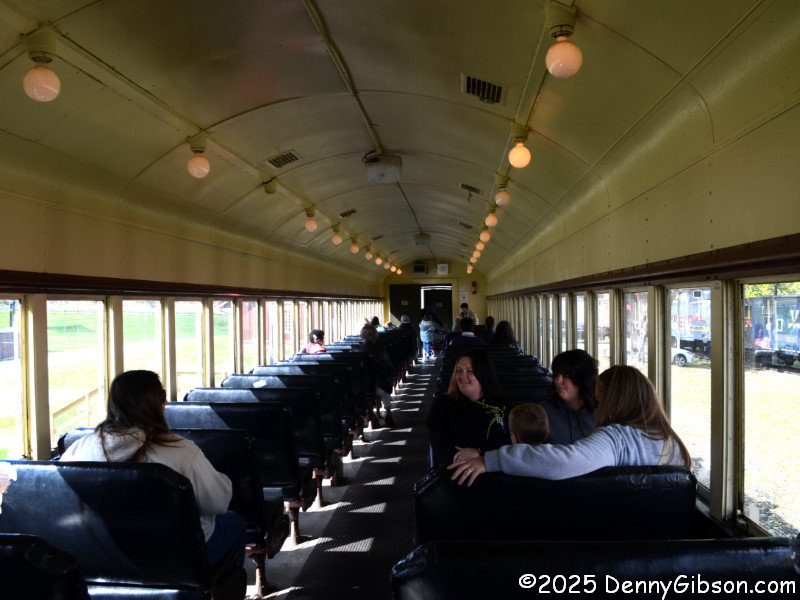
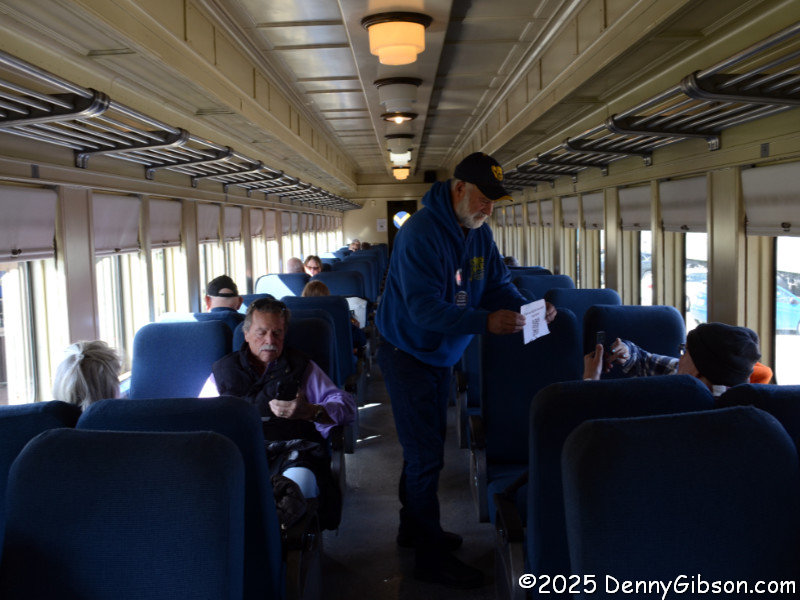
All four cars of the train would essentially be full by the time we pulled out, but I was on board early enough to grab photos of them nearly empty. The car with blue seats was built in 1939 for long-distance travel. It was once used on the Cincinnatian, which ran between Cincinnati and Detroit. The other three cars (I rode the middle one) were built in the 1920s and used by commuters in the Chicago area.

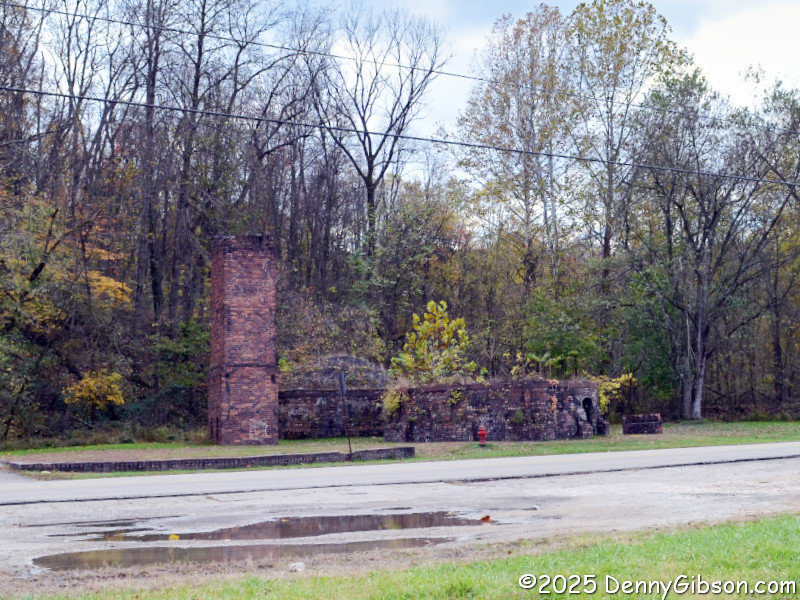
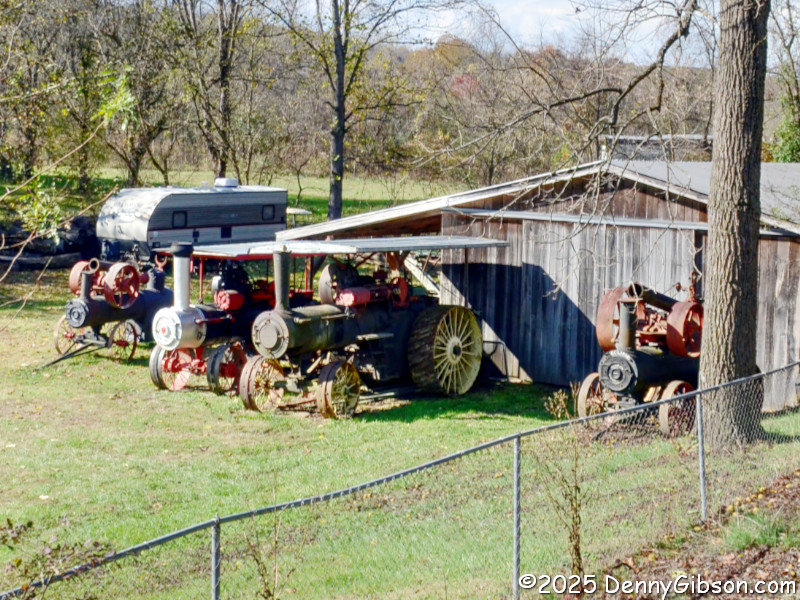
Early in the trip, we passed the remaining kilns of the Nelsonville Brick Company. In addition to plain paving bricks, the company made those very popular decorative star bricks. We were also treated to some nice views of the Hocking River. There was no shortage of front and back yards filled with cars in need of attention, but this was the only yard I saw filled with steam engines. Much classier, in my opinion.

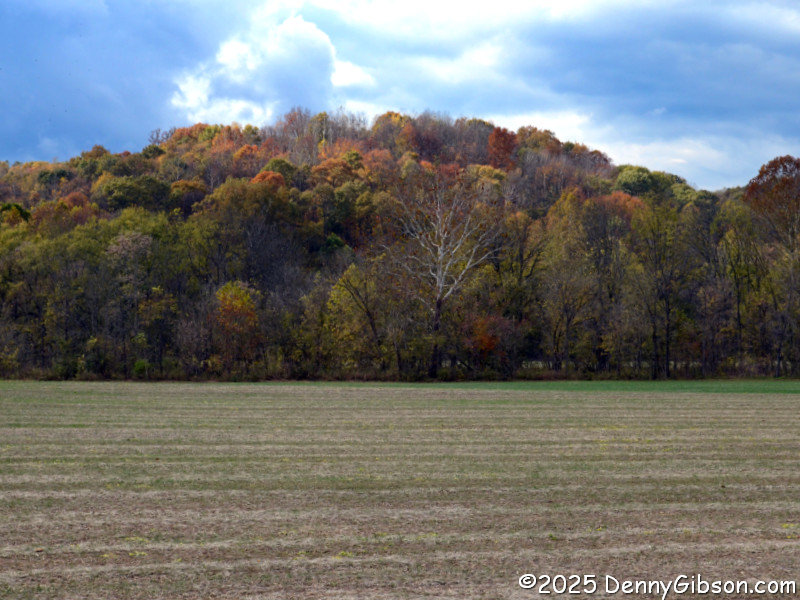
The excursion ran almost to Logan, with much of the route actually inside the Wayne National Forest. There were plenty of trees, and some rather scenic views here and there. Red and orange leaves, however, were few and far between.

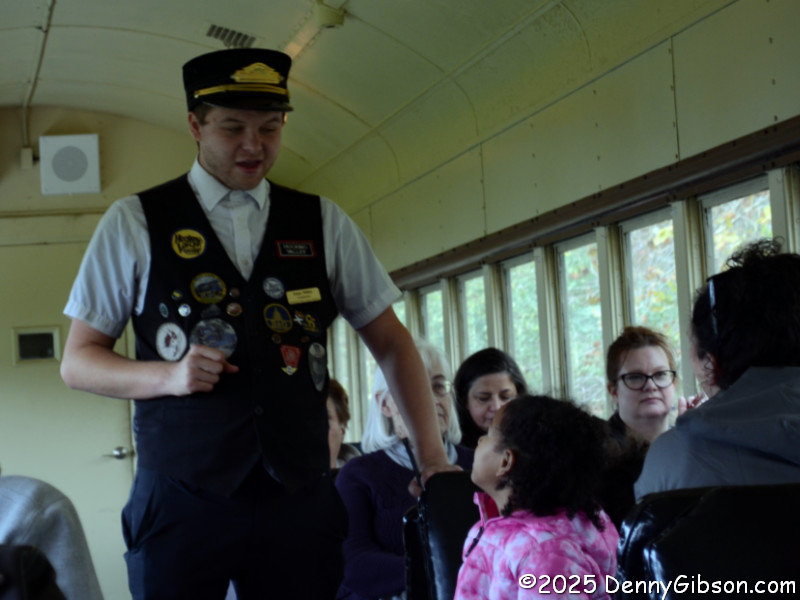
Railroad employees passed through the cars frequently, helping with windows, seats, and any other issues passengers might have. At the route’s end point, the locomotive moved from one end of the train to the other via a siding. The seats in the commuter cars had reversible backs, and quite a few riders flipped theirs, so they were facing forward as the cars were pulled “backward”. I was not among them.

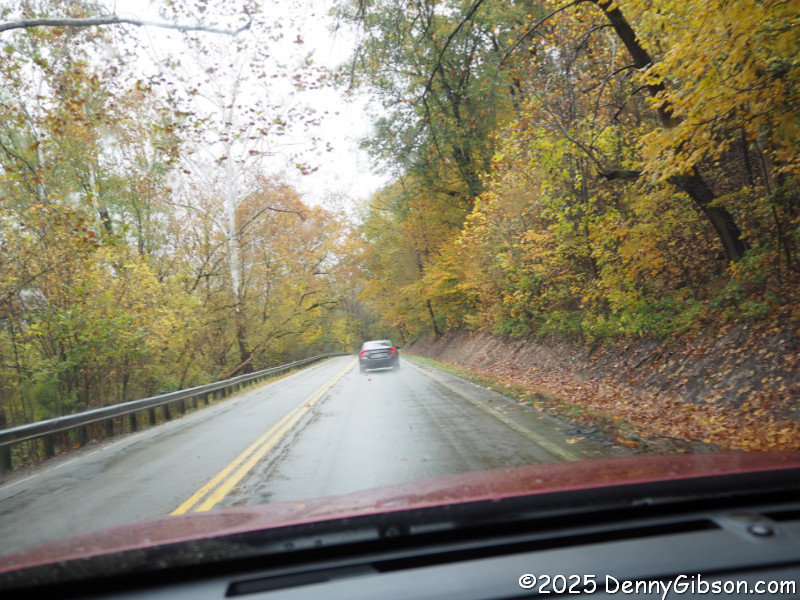
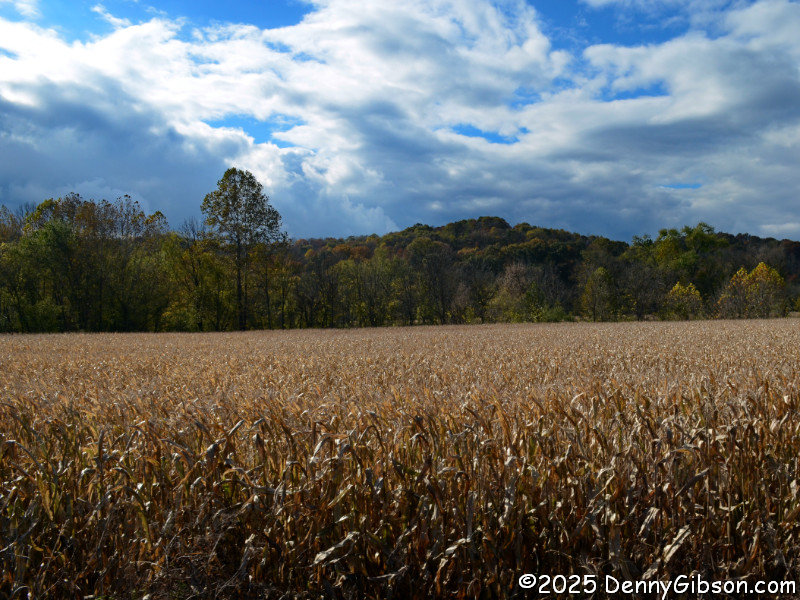
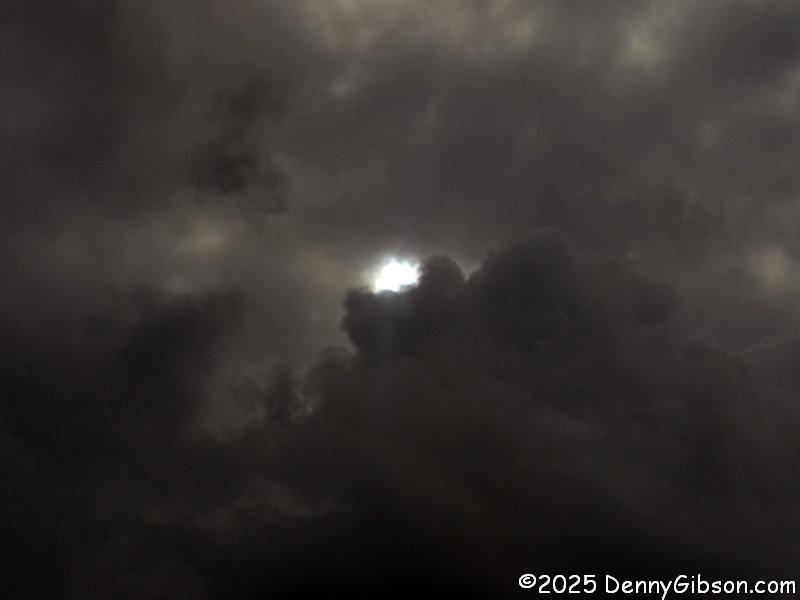
You may have noticed clouds gathering in some of the previous photographs. No rain fell during the ride or during the short time I was in Nelsonville after it ended. However, by the time we returned to the station, the sky looked like this. As we exited the train, I commented to a lady in line that there had not been much color in the trees along the way. “No,” she said, “not this year. It’s been too dry.” Maybe that’s the reason. I don’t know. If so, the dry spell appears to be over, but any rain now will just knock the leaves from the trees. It won’t make them colorful. 

Movie Review
Ohio: Wild at Heart
MacGillivray Freeman

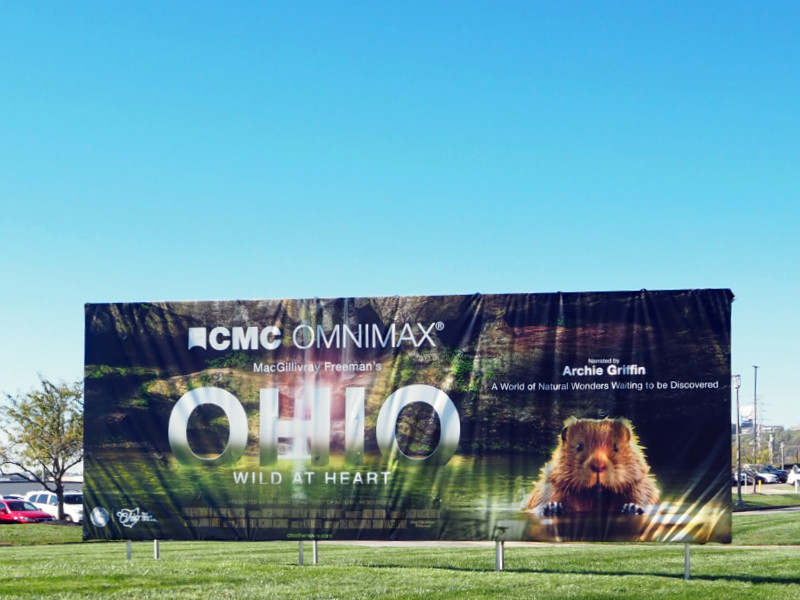
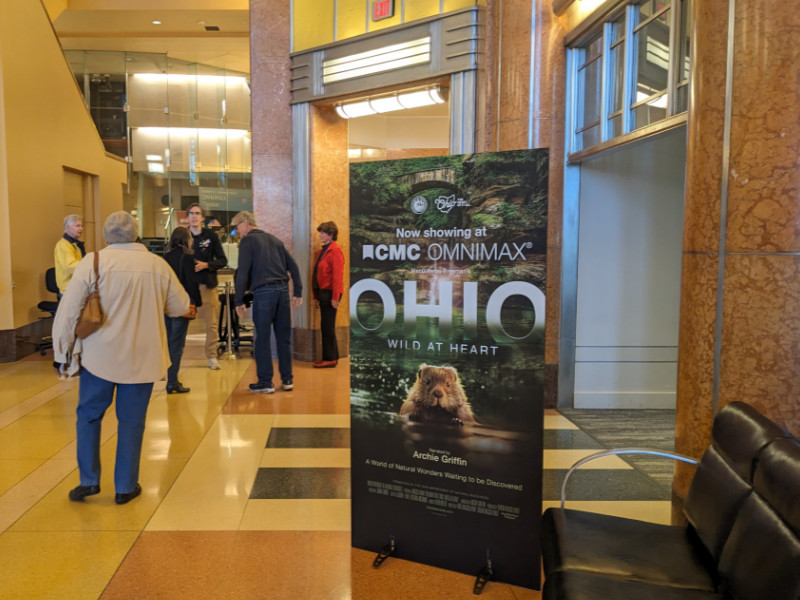
This just might be the ultimate selfie. It’s a big-screen movie ordered up by the Ohio Department of Natural Resources starring the natural resources of Ohio. Yeah, that selfie label is admittedly a real stretch — not only because it’s a 45-minute-long movie rather than an in-your-face snapshot, but also because it wasn’t the ODNR holding the camera. That was the talented folks at MacGillivray Freeman, makers of many outstanding features, including the subject of my first-ever movie review.

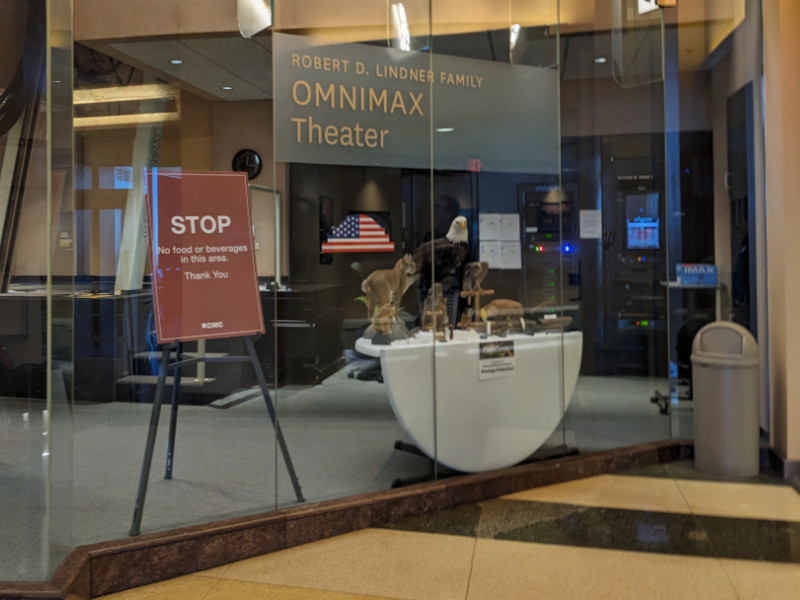
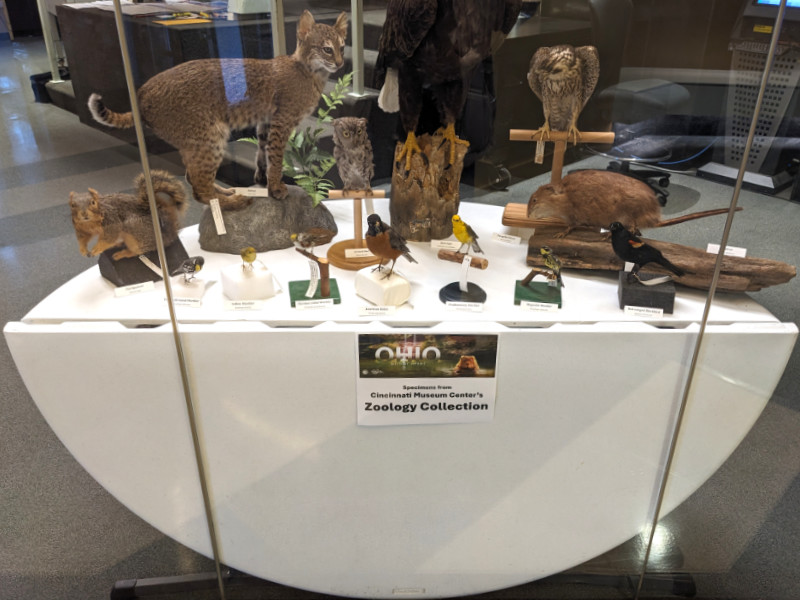
Of course, I watched Ohio: Wild at Heart at the Robert D. Lindner Family OMNIMAX® Theater in Cincinnati. I was there at its first screening on Friday. This is the third theater, after Toledo and Dayton, to add the movie to its schedule. It will soon be added by several others, as listed here.

The movie begins with the story of the recovery of the state’s bald eagle population from just four nesting pairs in 1979 to nearly 1000 nests today. The successful reintroduction of trumpeter swans to the state, with their removal from Ohio’s threatened species list just over a year ago, is a story told later in the movie. Other successful conservation projects, including major cleanups of the state’s waterways, are also documented. Governor DeWine, who was instrumental in getting the movie produced, emphasizes the word “education” when discussing it. He sees making Ohioans aware of what they have as an important mission. He has said, “If people love the rivers. If they love the lakes. If they love all the beauty of this state, they’re going to take care of it.”

MacGillivray Freeman does a wonderful job of capturing “all the beauty of this state” on the screen. There are gorgeous shots of swans on mirror-smooth lakes, and stunning aerial views of eagles in flight and in nests, of kayaks on rivers, and hikers, bikers, and dog sledders on trails. Yes, dog sledders! Before I saw this movie, this lifelong resident of the Buckeye state had no idea that dog sledding was a thing anywhere within its borders. That’s education.

There are people in the movie. Governor DeWine makes an appearance along with his wife Fran. There are enlightening conversations with folks enjoying all of the things I’ve mentioned, plus bird spotting, firefly watching, and much more. Narration is supplied by a true Ohio natural resource. Archie Griffin, the world’s only two-time Heisman Trophy winner, who was born in Ohio and played his high school, college, and professional football in the state, nails it.

The movie’s website highlights the quote “When we take care of nature, nature takes care of us.” I don’t know if I missed that exact line in the movie or if it’s a minor paraphrasing of a line I did hear and was impressed by enough to make a note of: “We make a commitment to restoring nature because nature restores us.” Both lines are insightful and worth repeating. I have no doubt that Ohio: Wild at Heart will do a fine job of making Ohioans aware of what we have, and I’ve a very strong hunch that it’s going to make a lot of other folks aware of it too.

Not Long Ago. Not Far Away.

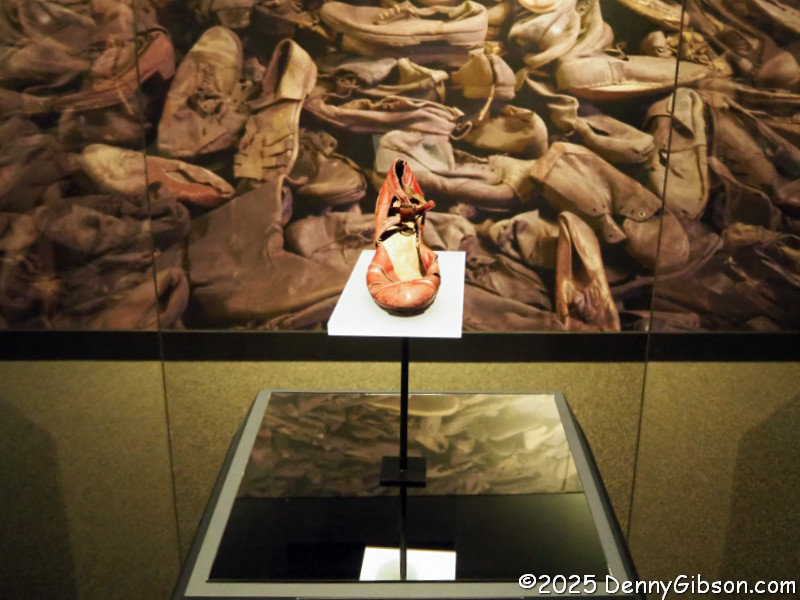
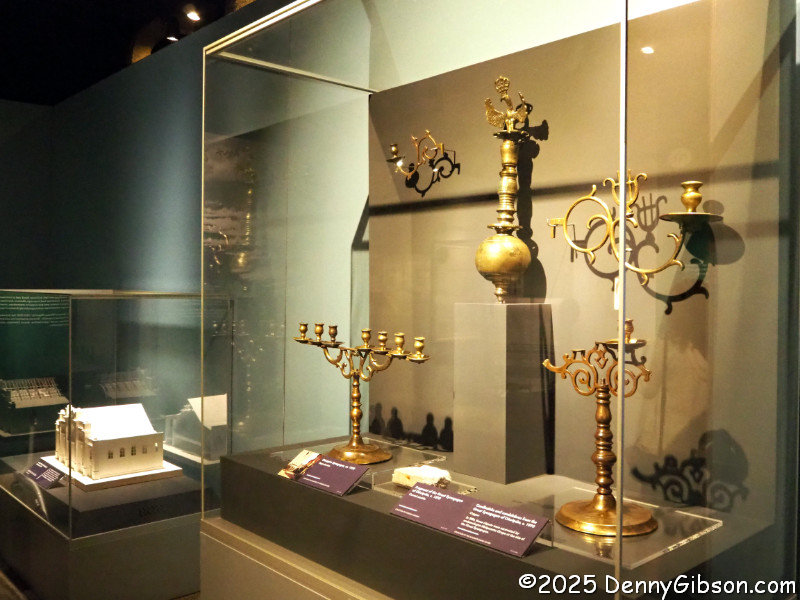
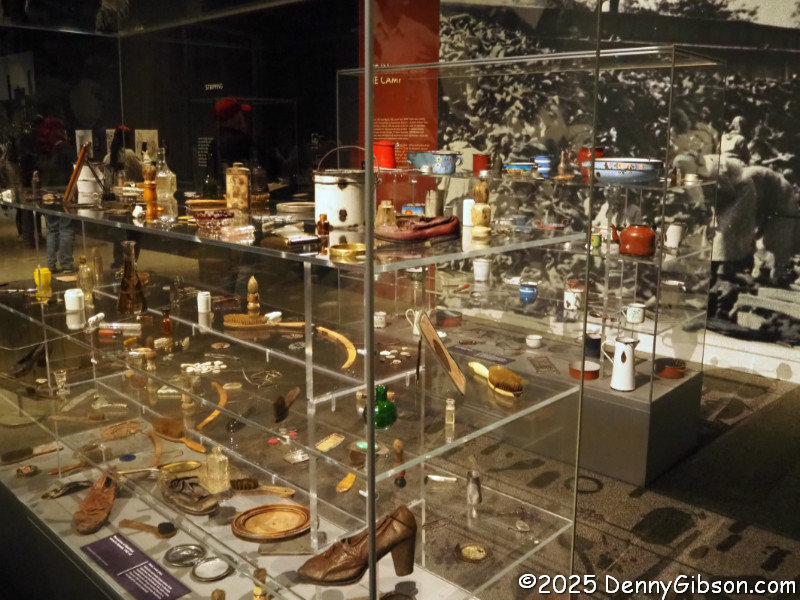
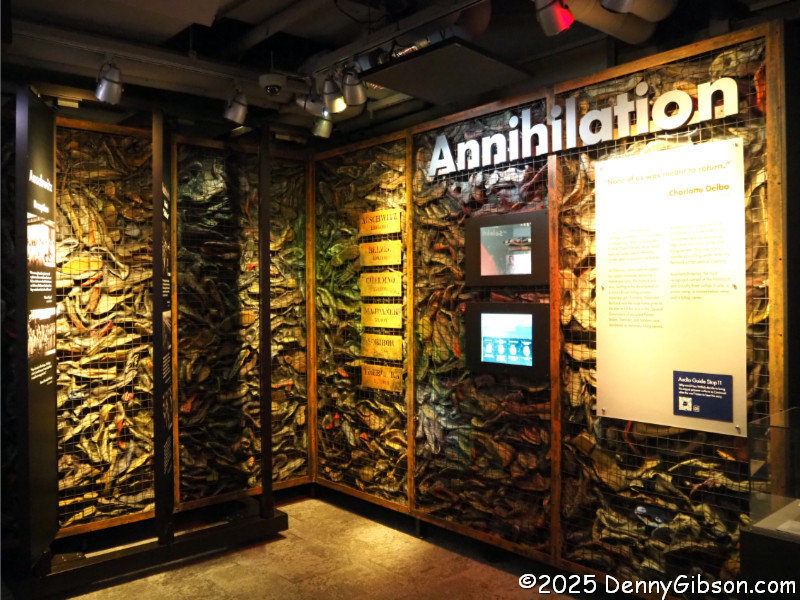
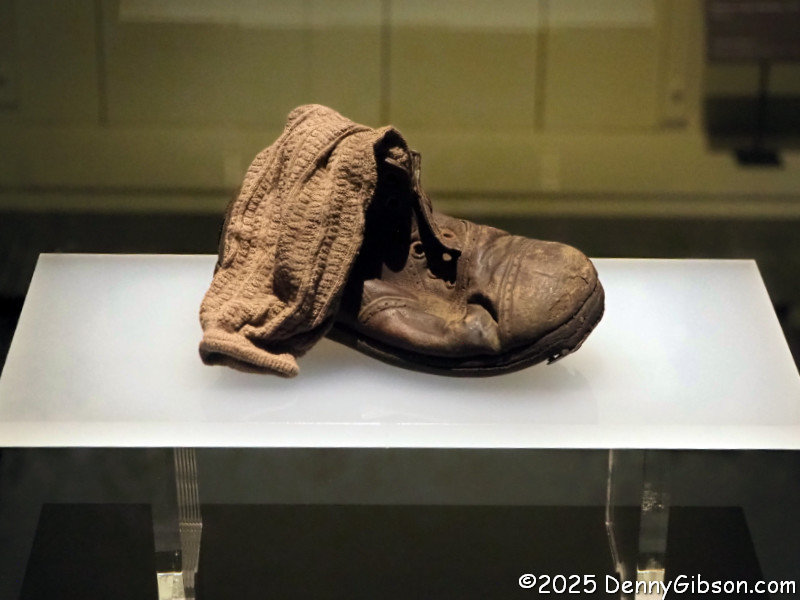
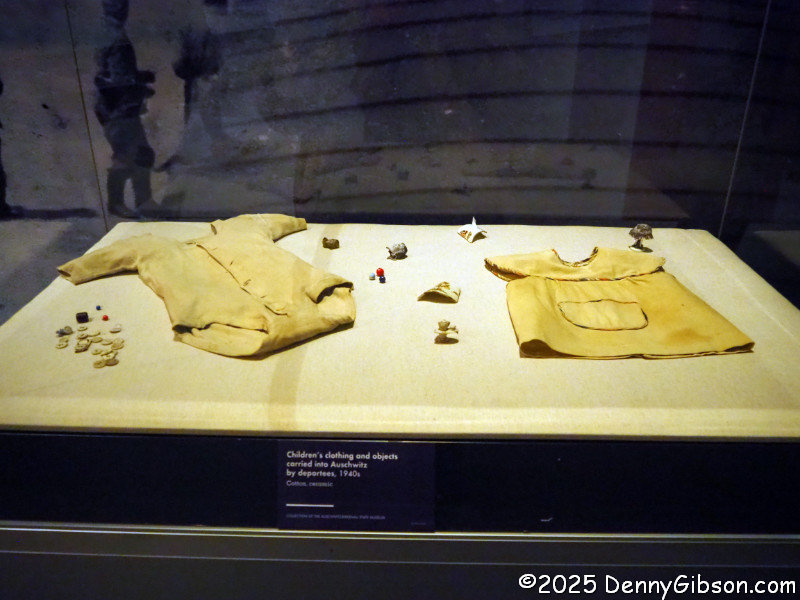
On Saturday, October 18, “Auschwitz. Not long ago. Not far away.” opened at the Cincinnati Museum Center. I attended on Wednesday. The red shoe pictured at right is one of the first items visitors see when they enter the exhibit. Photos of the shoe, backed by the image of countless other empty shoes, have been used to promote the display. The wall-filling image boggles the mind as the realization that the owners of all those shoes walked into Auschwitz but never walked out slowly forms. The mind nearly breaks realizing that the photo contains just a fraction of such shoes.

Having seen pictures of that red shoe, and knowing that this was “the largest collection of artifacts from Auschwitz outside of Europe”, I probably could have predicted the question that formed as I moved into the exhibit and listened to the included audio guide. It’s a question that most of us ask ourselves anytime we give much thought to the Holocaust. “How could this have happened?” we wonder. The exhibit doesn’t really explain it, but it does tell some of the history. It describes and displays artifacts from the small Polish village that would become home to the largest of the Nazi concentration and extermination camps.

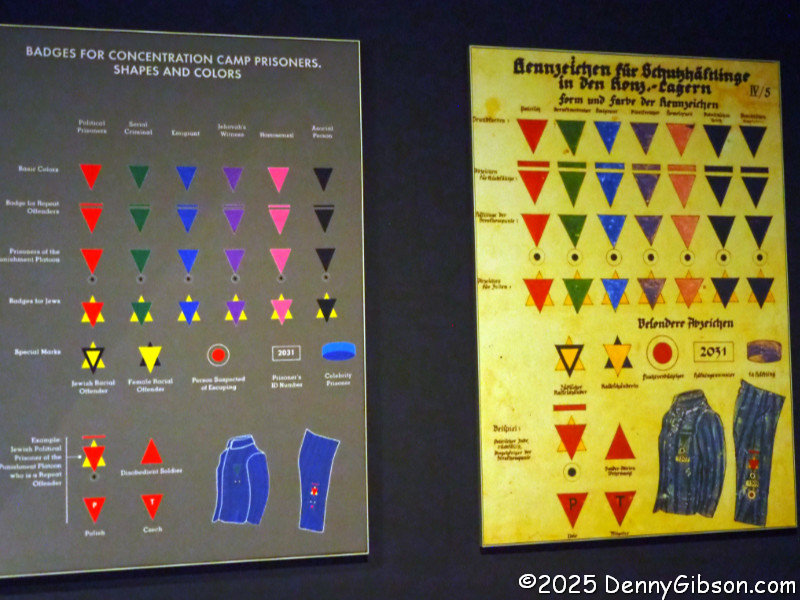
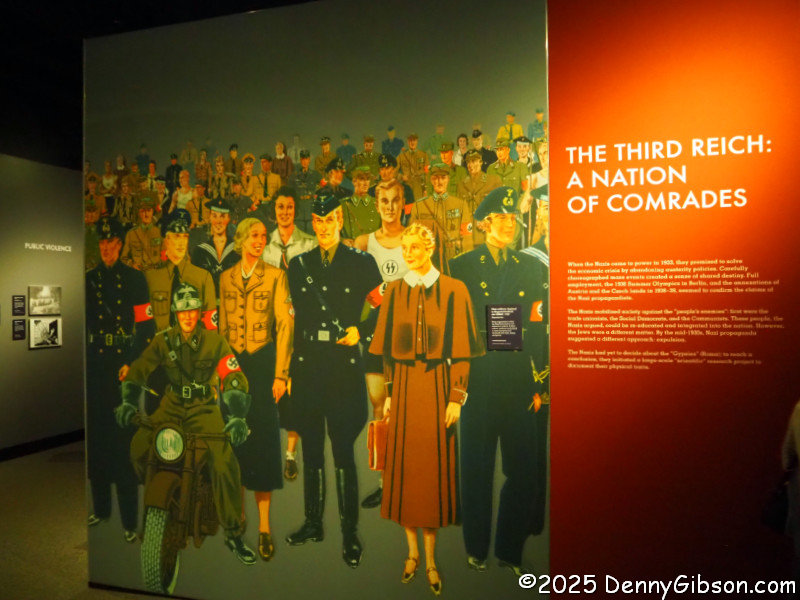
Establishing that the “other” was responsible for all of Germany’s problems was essential. The “other” was mostly, but not exclusively, Jews. Blacks, Roma, homosexuals, and people with disabilities were among those persecuted by the Nazis.
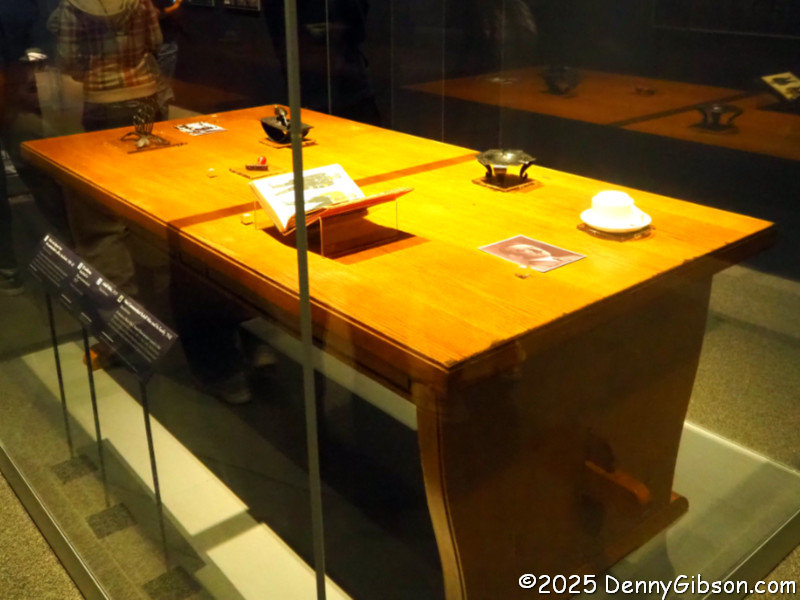
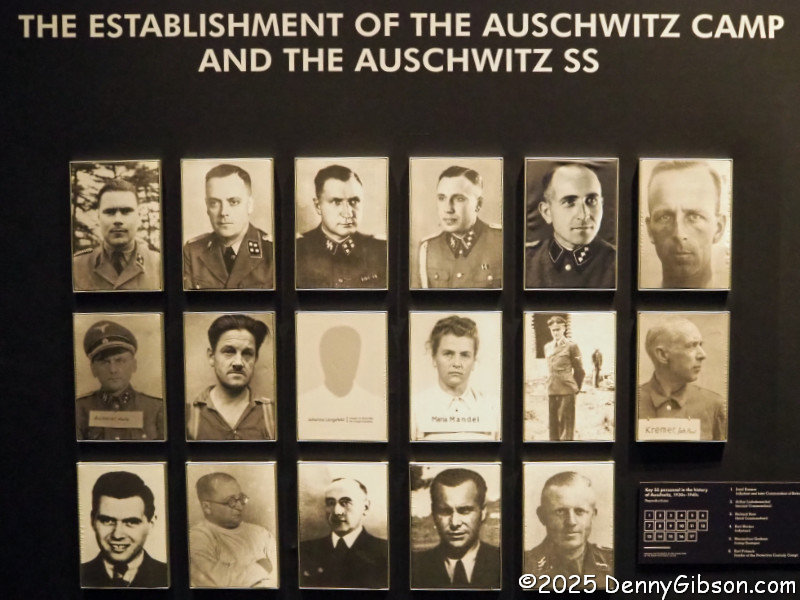
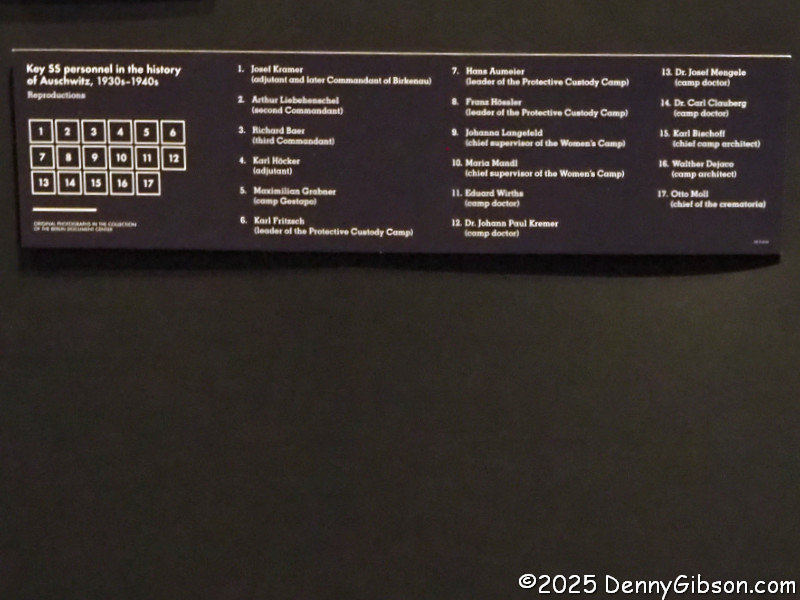
This is the desk of the camp commandant, Rudolf Höss. Photos of key Auschwitz personnel are displayed nearby with an identifying legend.

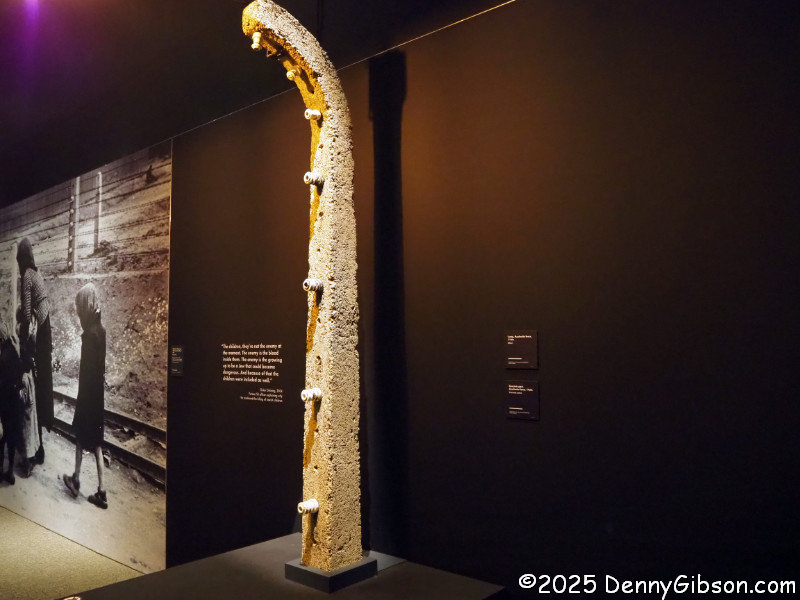
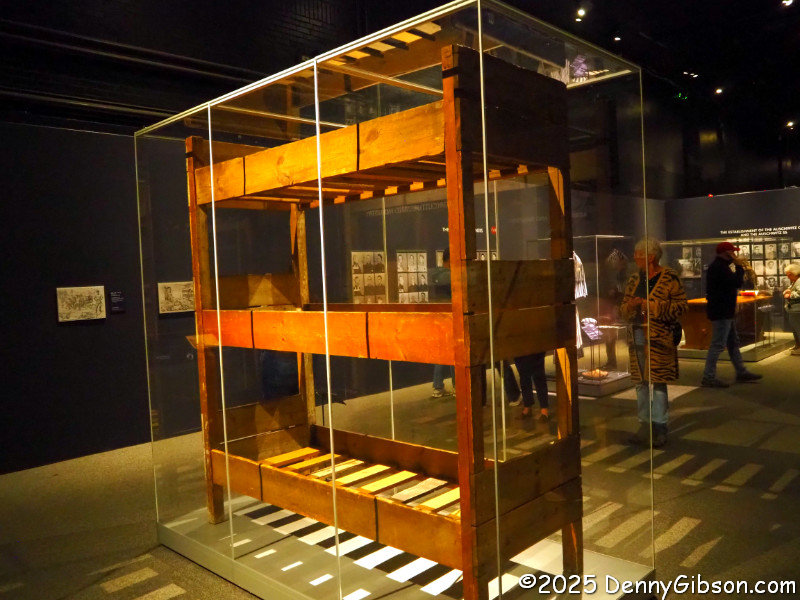
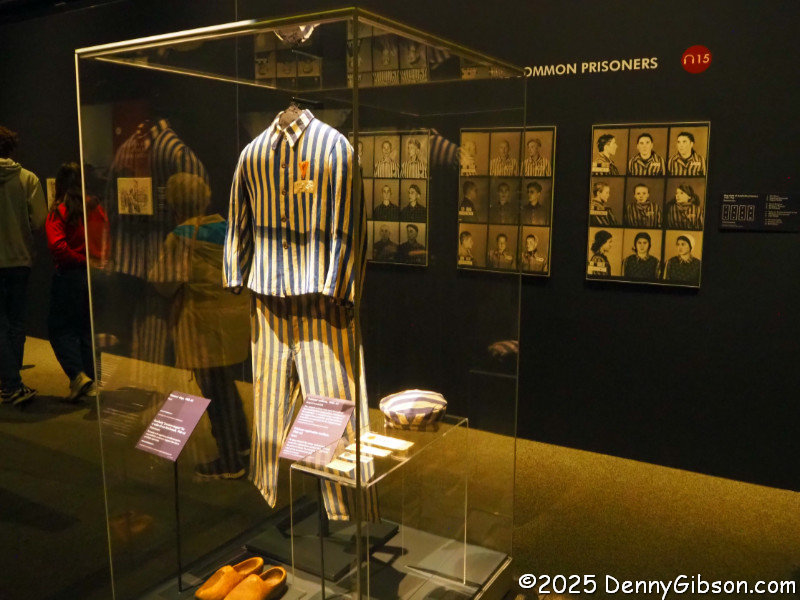
Roughly 80% of those arriving at Auschwitz were sent directly to the gas chambers. The other 20% became slaves, and not many survived the starvation, beatings, and forced labor. Many more than three people occupied the three-tiered bunks. The concrete post held barbed wire, as seen in the photo in the background.

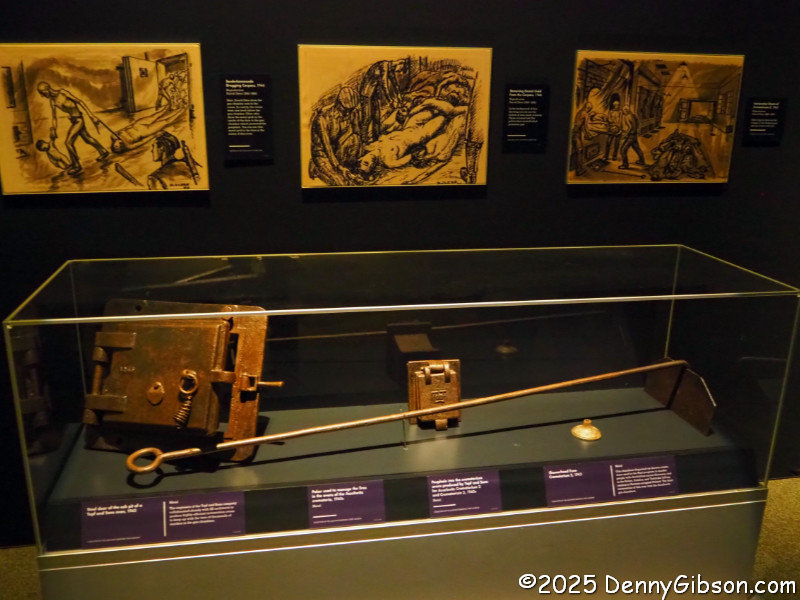
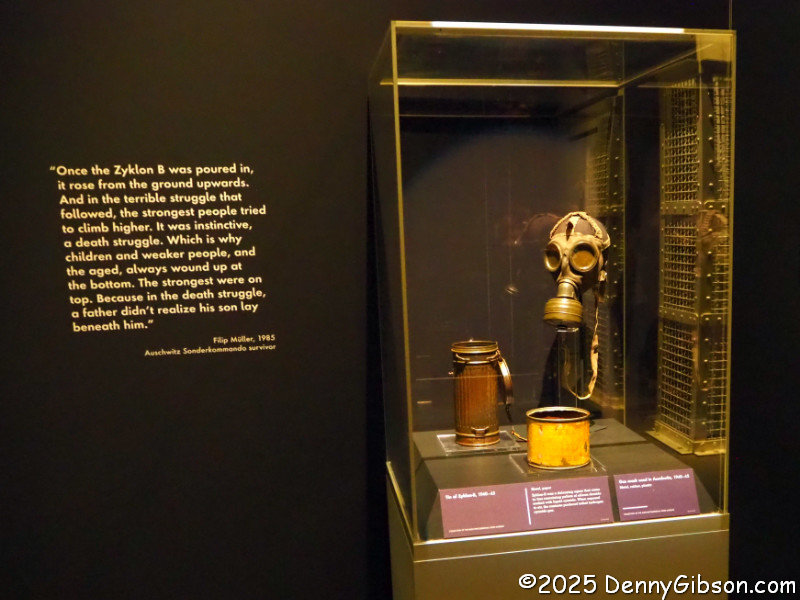
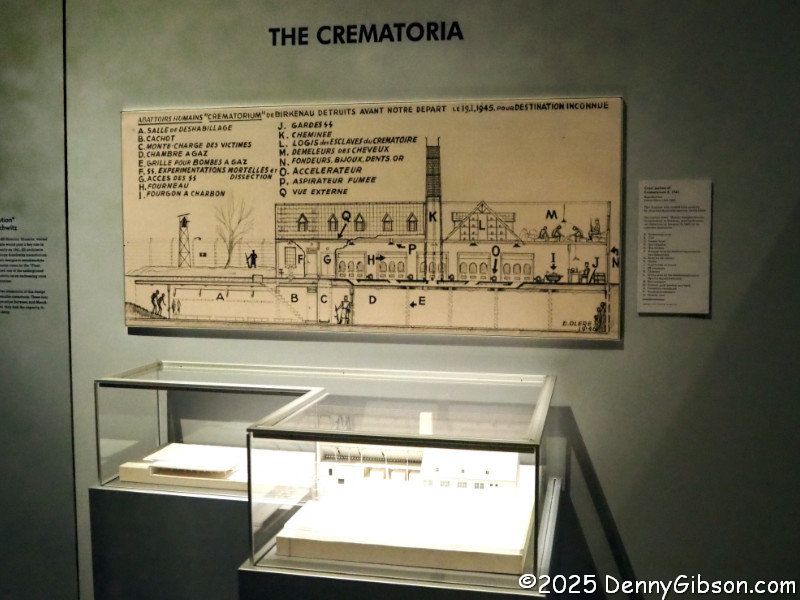
Some of the prisoners were “rented” to various privately held companies, but many were assigned tasks in the camp, such as removing bodies from the gas chambers or moving them through the crematorium. The first photo contains items from gas chambers and crematoriums. There is a “shower head” in the lower right corner. The gas mask in the second photo was worn by a soldier who dropped the Zyklon B once the chamber was sealed.

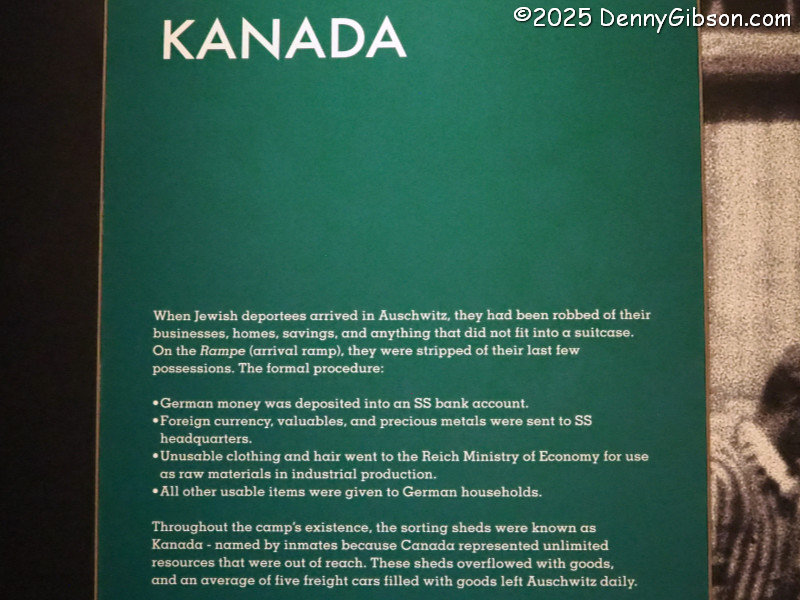
Other prisoners were forced to sort through the few possessions that actually made it to the camp. Prisoners referred to the sorting sheds as Kanada.

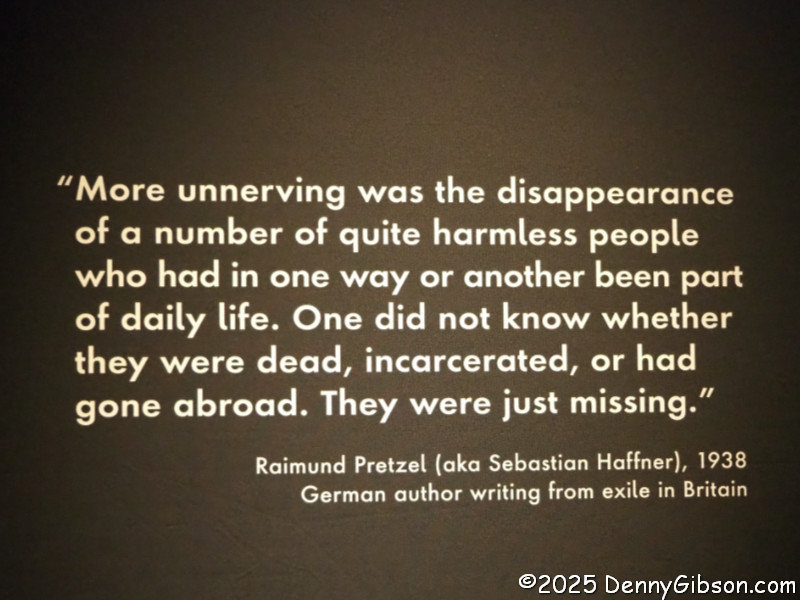
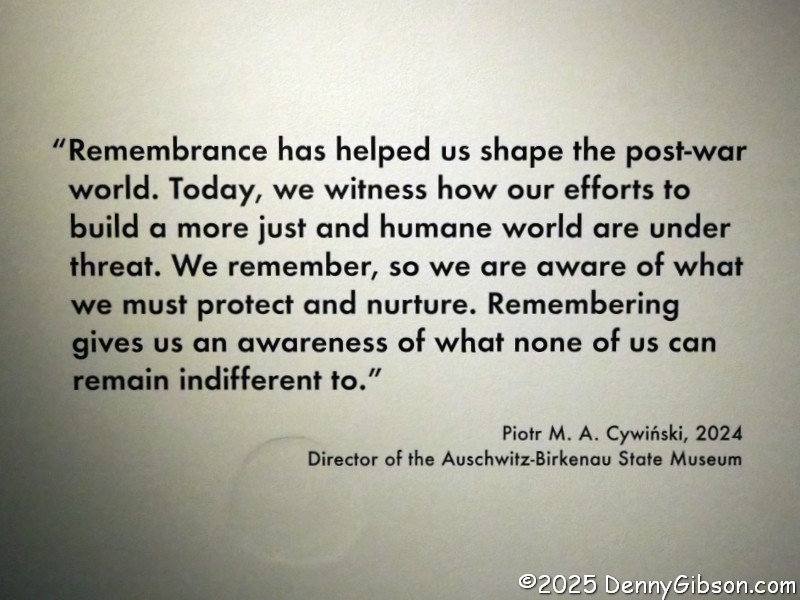
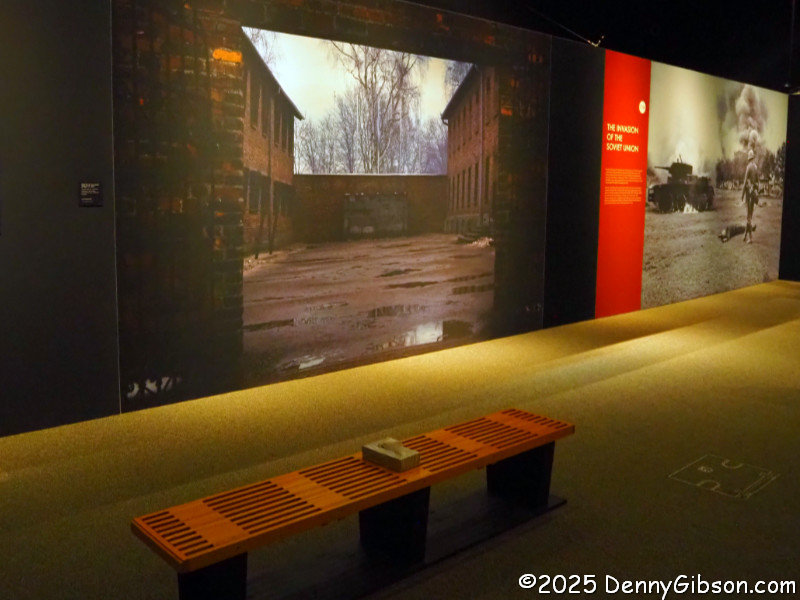
There were several benches placed throughout the exhibit. Many were positioned in front of screens showing videos of scenes related to the camps. All had a box of tissues placed at their center. There was no lack of tear-inducing images, artifacts, and stories in the exhibit. Nearly all of the items on display are from the Auschwitz-Birkenau State Museum. The last picture is of a quote from the director of that museum about remembrance. I immediately thought of Eisenhower’s 1945 command, “Get it all on record now. Get the films, get the witnesses, because somewhere down the track of history some bastard will get up and say this never happened.” He was right, of course. That quote on the wall notes that today “…our efforts to build a more just and humane world are under threat.” Nearer the beginning of this article, there is a photo of a quote about  “…the disappearance of a number of quite harmless people…” It’s from 1938 Germany during the Nazi rise to power. As I read it, it occurred to me that it could have easily come from certain Central or South American countries a few decades ago. Or it could have come from somewhere not even that far away or that long ago.

Auschwitz. Not long ago. Not far away.” runs through April 12, 2026.


The Holocaust and Humanities Center helped bring the Auschwitz exhibit to Cincinnati. Although a separate operation, it is housed in the Cincinnati Museum Center and throughout the exhibit’s run is offering discounted adult admission of $7.50 to anyone presenting an “Auschwitz. Not long ago. Not far away.” ticket. This rate is available year-round to seniors and military.

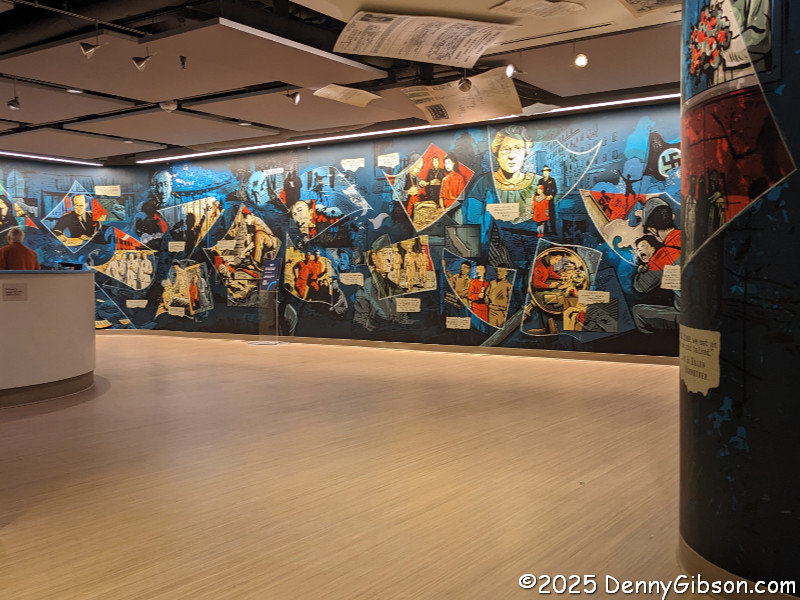
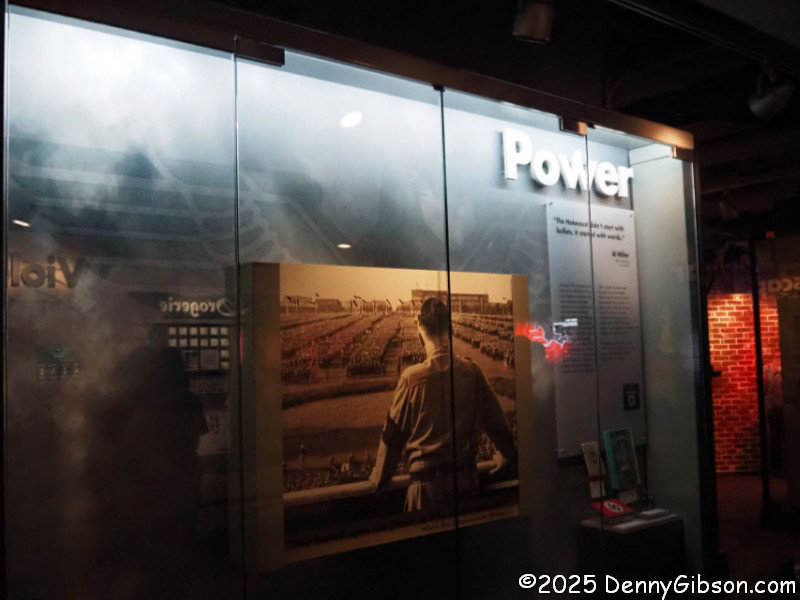
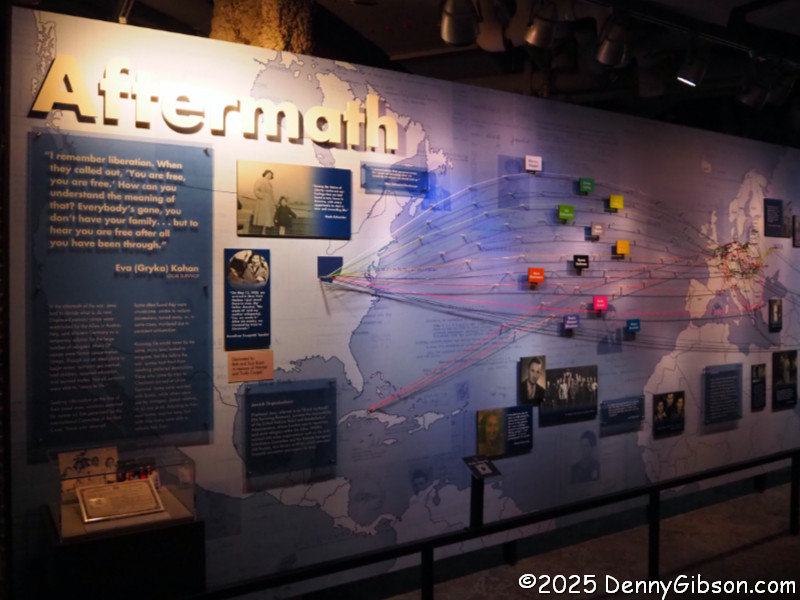
Naturally, there is overlap between the Auschwitz displays and those in the Holocaust Museum. A notable example is this molded wall of abandoned shoes that echoes the red shoe and large photo from Auschwitz. But there are also a lot of differences. The museum has many interactive displays, and the story it tells is broader than the one with a specific concentration camp at its center. In particular, the museum continues the story well beyond the liberation of the prisoners with reporting on the post-war trials and tales of recovery.

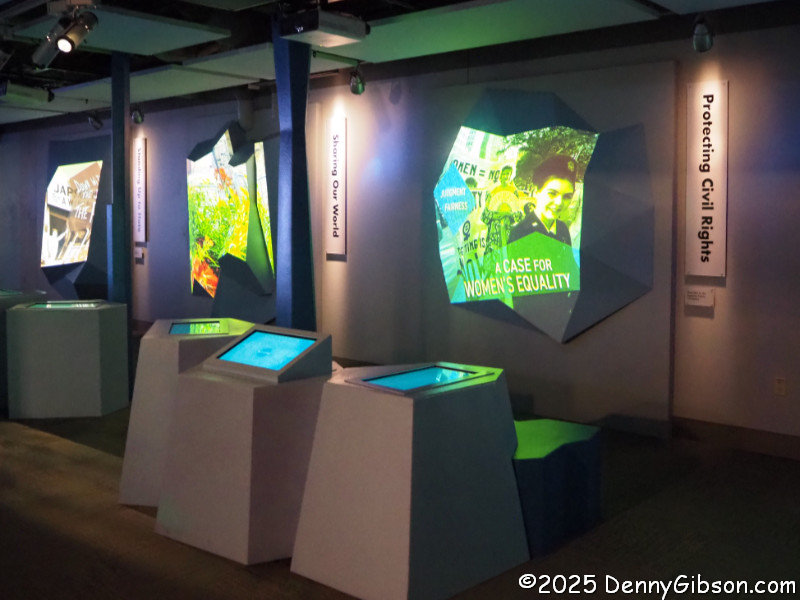
When I spoke with a friend about the Auschwitz exhibit, I encouraged a follow-on visit to the Holocaust Museum, and it wasn’t just because of the broader story. The Holocaust is humanity at its worst. Studying it and acknowledging it is important and necessary, but it is hardly uplifting. The museum offsets that just a little by presenting recent examples of bigotry being defeated and human rights being defended. Your mood probably won’t be exactly celebratory when you leave, but it very well might be hopeful.
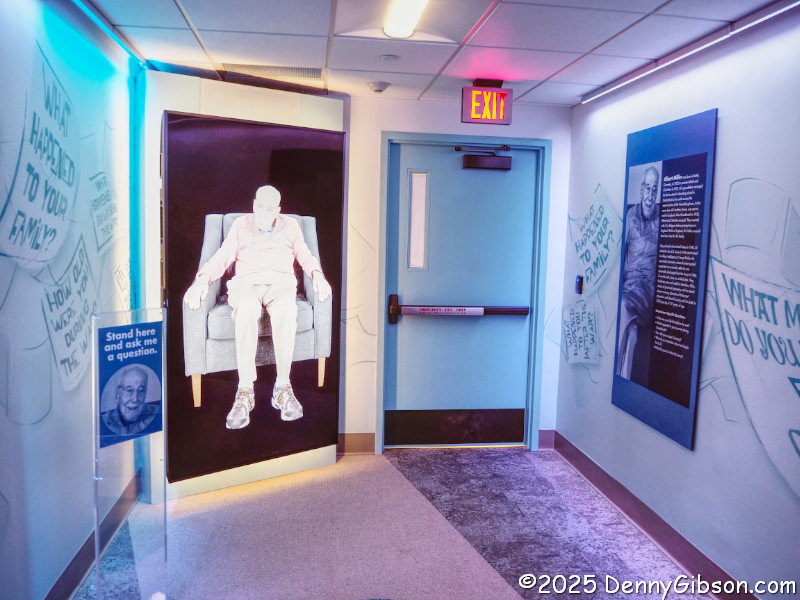
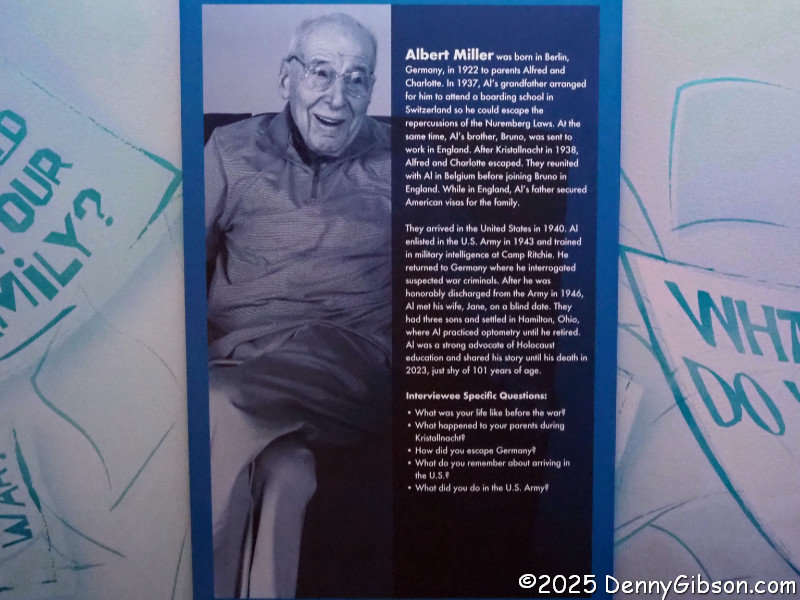
With every museum that exists, it is always possible to see something you’ve previously missed when you revisit. But sometimes that new discovery really is something new. That is the case with this recently installed interactive display featuring Albert Miller (1922-2023). Albert, who escaped Europe with his parents in 1940, then returned as a Nazi interrogator in 1943, tirelessly answers spoken questions about the life he lived.
I documented my first visit to the museum here

An Ohio Meeting

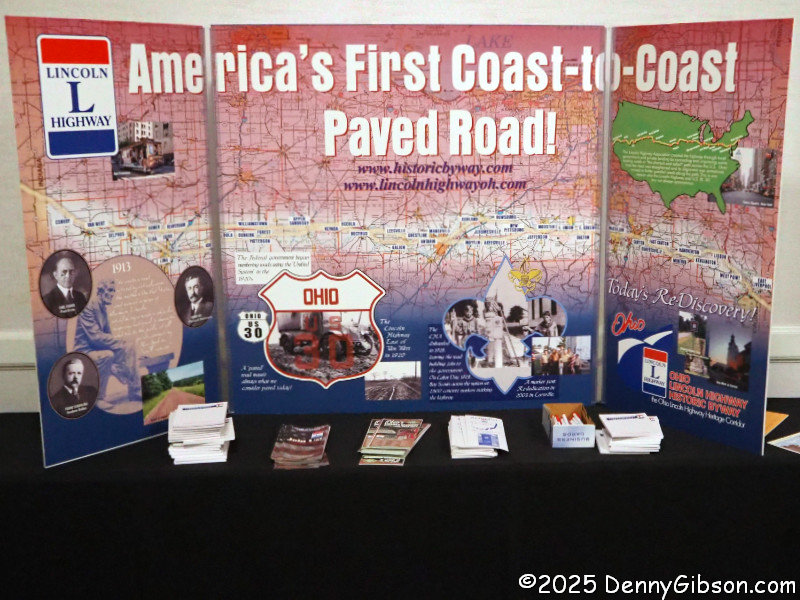
It has been a long time since I attended an Ohio Lincoln Highway League annual meeting. Longer, perhaps, than I realize, as I can find no evidence of attendance since 2014. There seems to almost always be a conflict in my schedule, but not this year. Canton, the meeting’s location, is a little too far away to make the round trip in a day. When I planned an overnight in a nearby town, I discovered that the path there passed quite close to a favorite brewery. With that, I thought my itinerary was set.

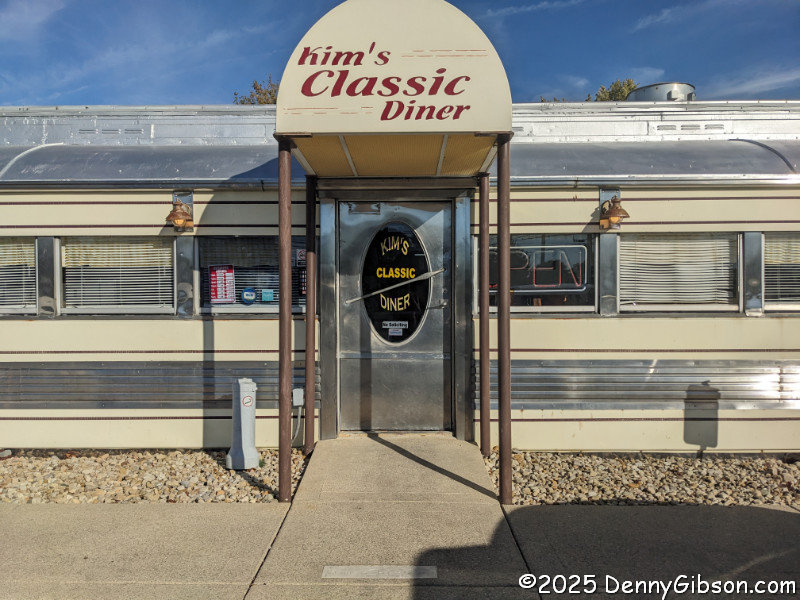
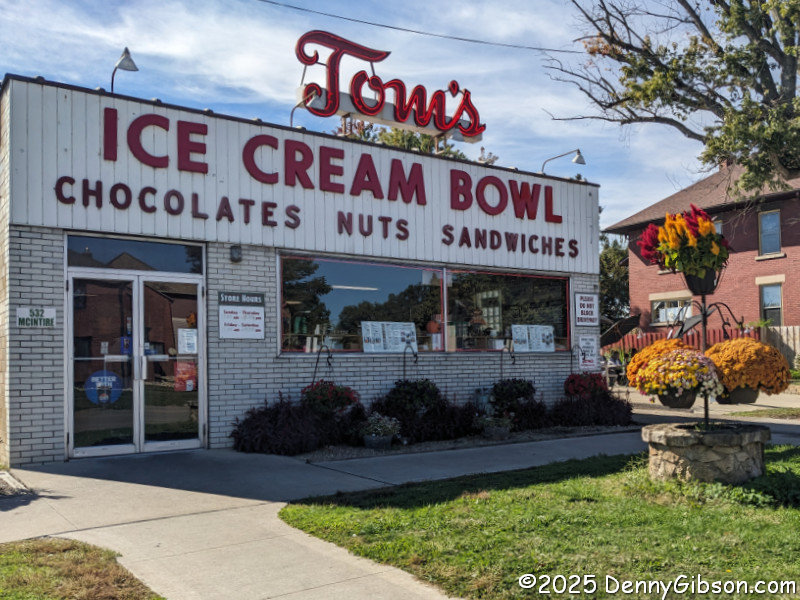
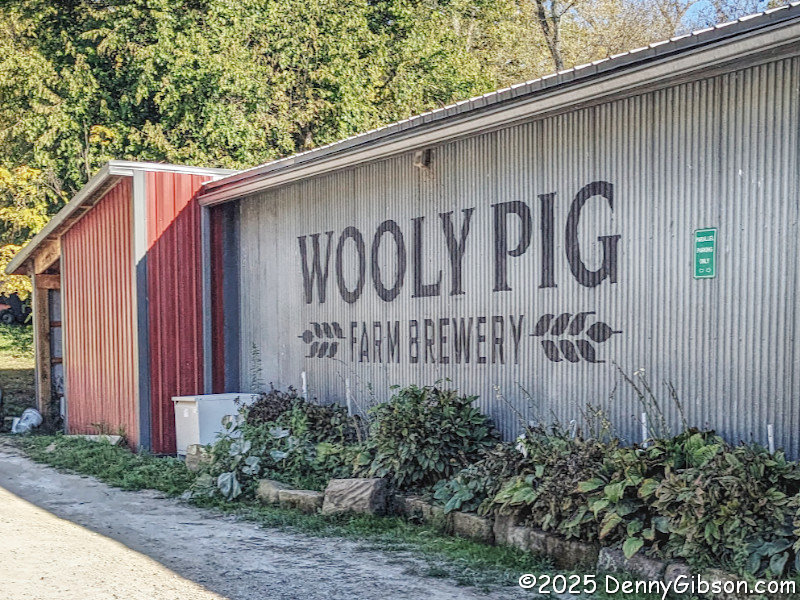
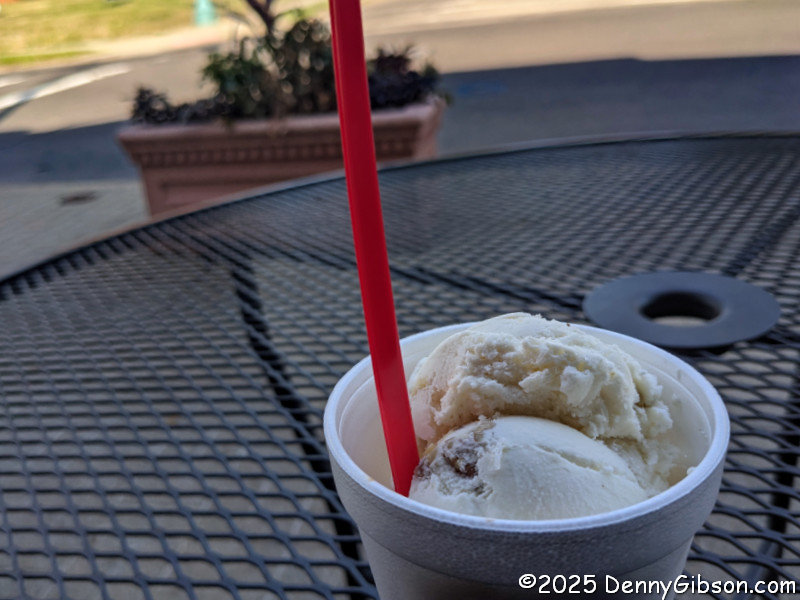
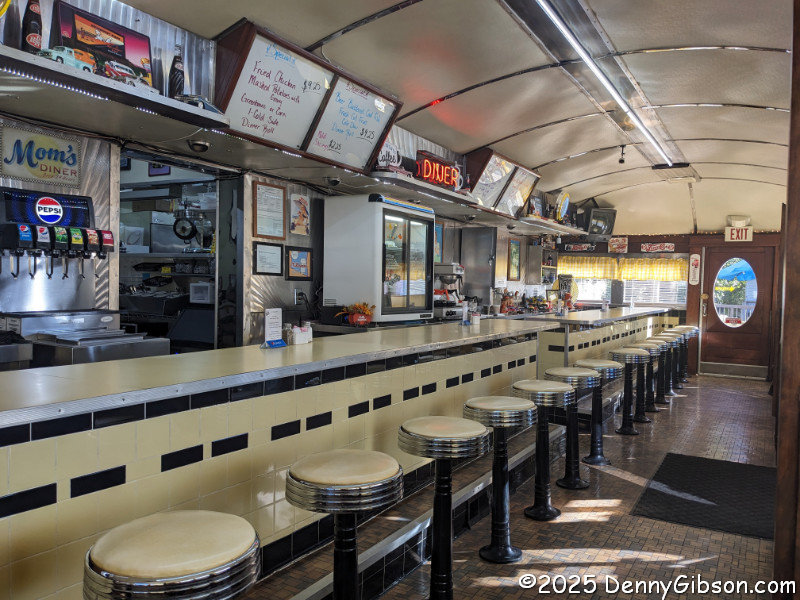
However, when I was ready to head out on Friday morning, I realized that there was no need to hurry on expressways, so I swapped I-71 for US-22. That allowed me to stop for breakfast at Kim’s Classic Diner in Sabina. I typically sit at the counter, but was in a booth today and was able to get a shot of an empty counter when the area was briefly empty. I stayed with US-22 to Zanesville, and that let me stop by Tom’s Ice Cream Bowl for some French Vanilla Cherry Chocolate Chunk, which disappeared before I could get a picture. I then headed to that favorite brewery, Wooly Pig Farm, on OH-93. OH-93 is quickly becoming one of my favorite wiggly roads.

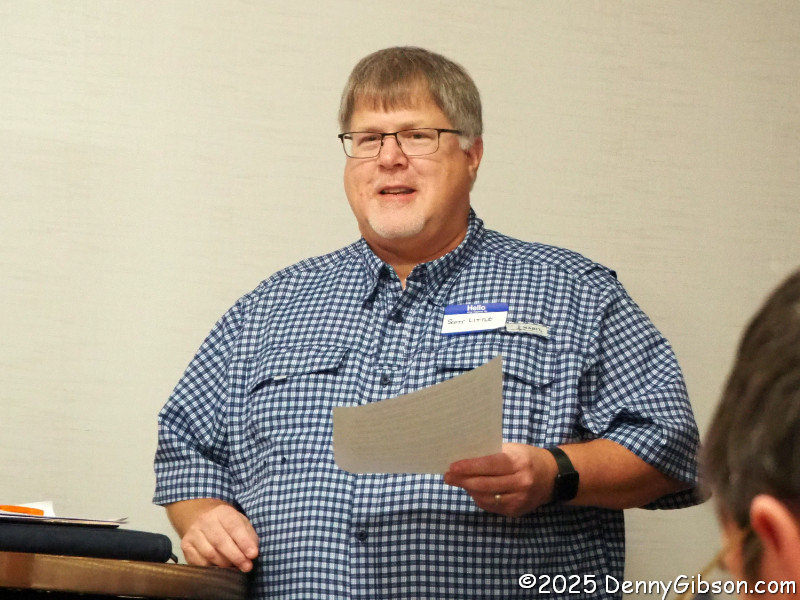
President Scott Little presided over the meeting. The league is comprised of three chapters, each of which has more or less monthly meetings throughout the year. This yearly meeting is the only one involving the entire state. Scott is also president of the Western Ohio Chapter and delivered the report of that chapter’s activities for the year.

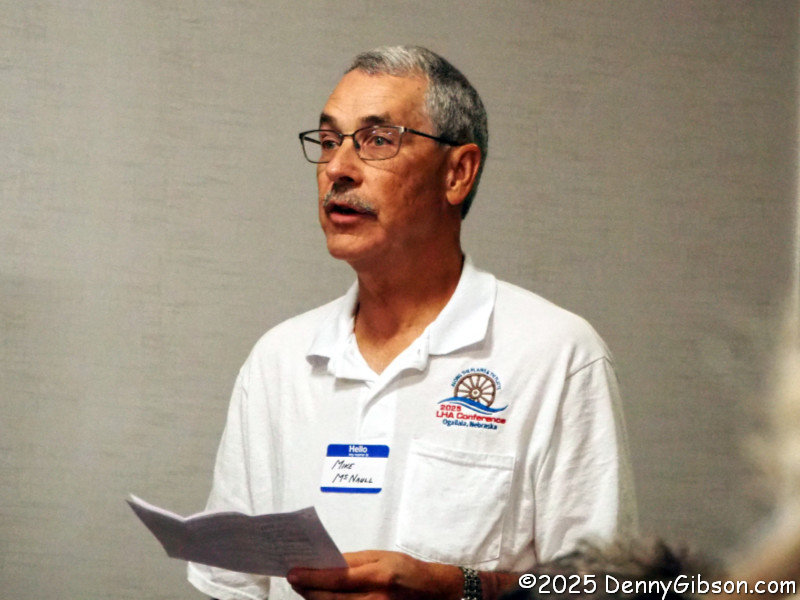
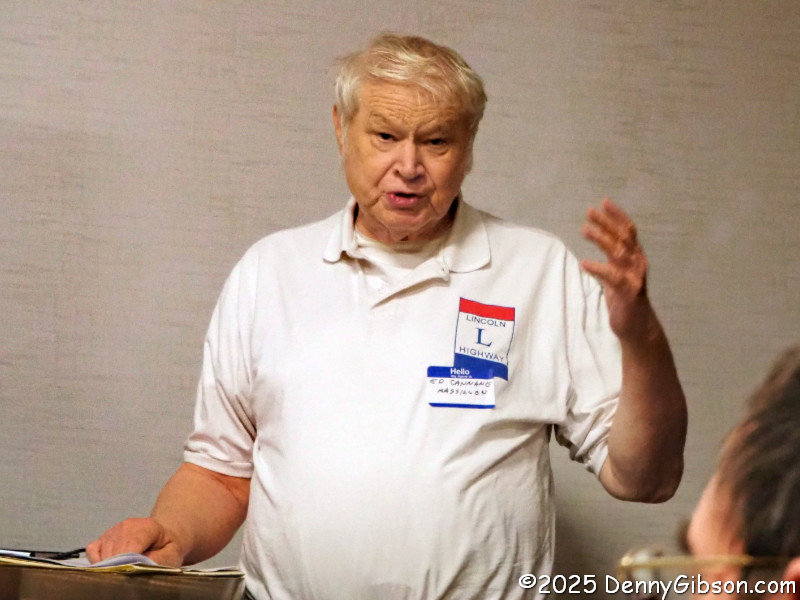
Mike McNaull, of the Mid-Ohio chapter, and Ed Cannane, of the Eastern Ohio Chapter, delivered reports of their chapter’s activities. All three chapters do some things for their members’ enjoyment and an awful lot to promote and maintain the Lincoln Highway in their areas.

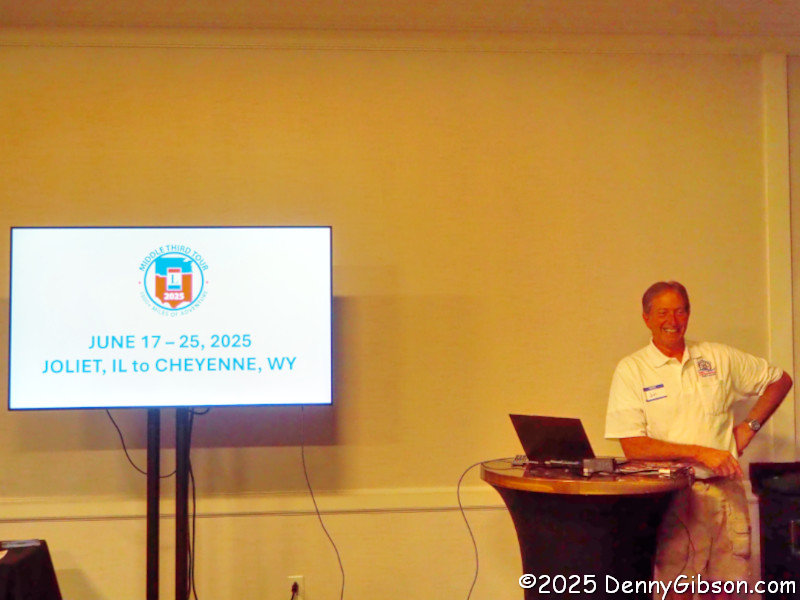
A presentation by someone from the National First Ladies Library and Museum, followed by a visit to the museum, had been planned, but the government shutdown scuttled that. Jim Cassler’s presentation on this summer’s tour of the Lincoln Highway’s middle third was a fine substitution. A tour of the eastern third happened in 2022, and the trilogy will be completed in 2028 during the centennial of the final 1928 realignment and the setting of the concrete markers.

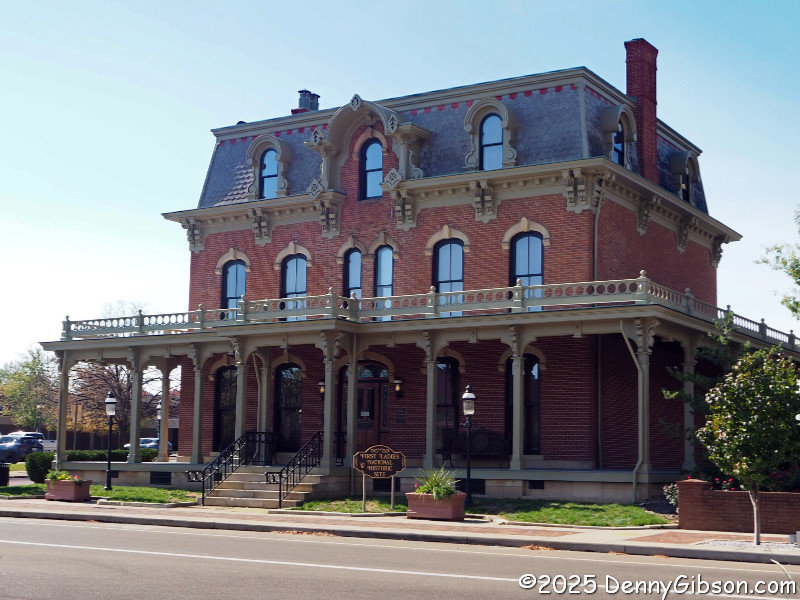
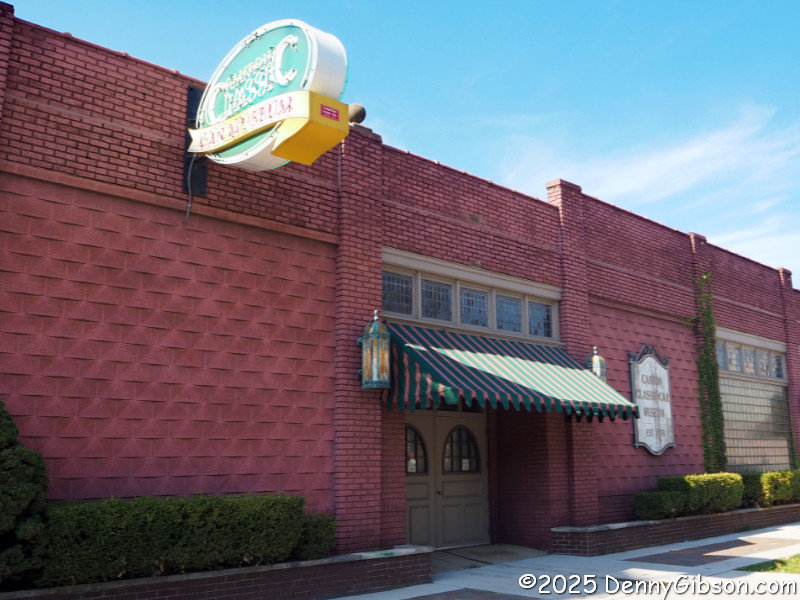
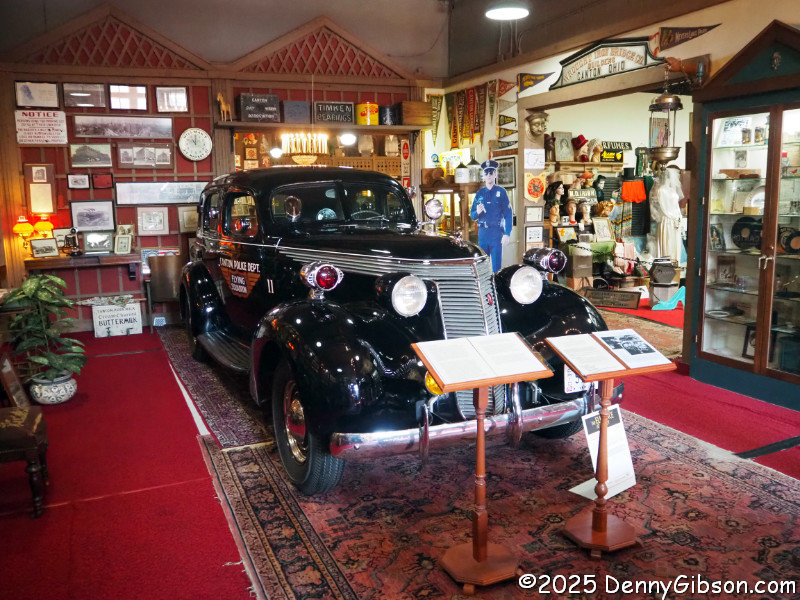
The Saxton McKinley House, home to the library portion of the not-to-be-visited-today National First Ladies Library and Museum, is directly across the street from the meeting site. A visit to the Canton Classic Car Museum, about a block away, would proceed as planned.

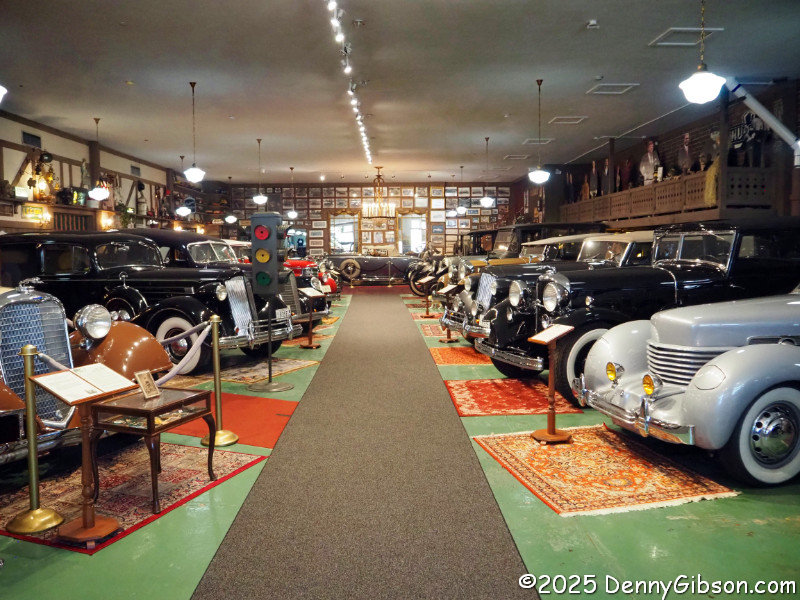
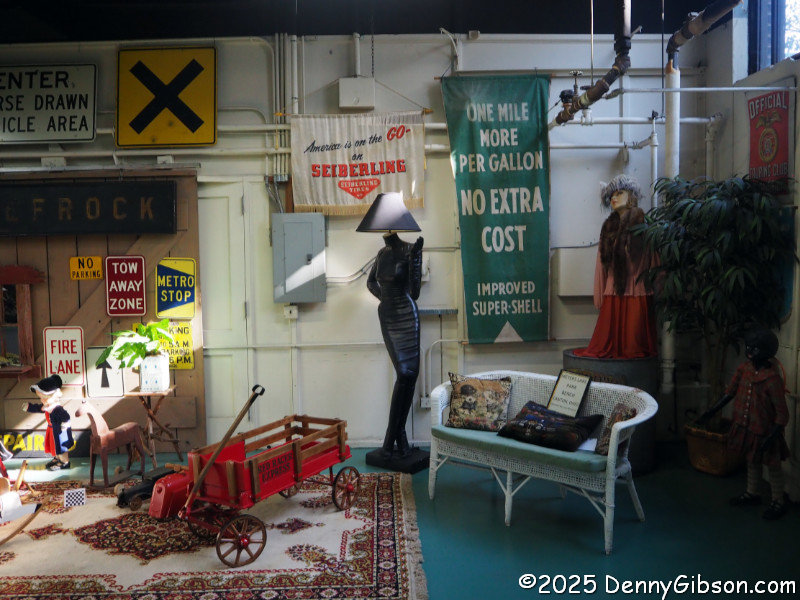
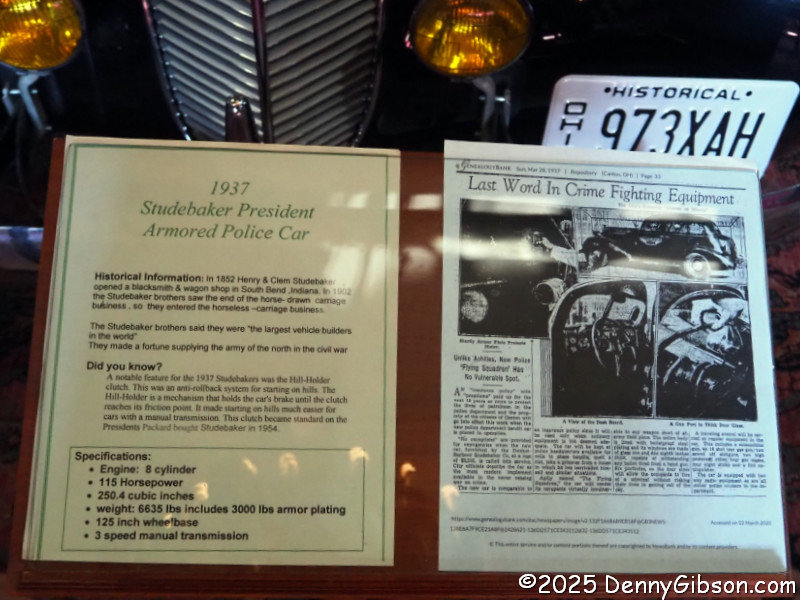
One of the museum’s prized possessions is a 1937 armored Studebaker. There are definitely plenty of really cool cars here, but there is more. If a fragile lamp with a single leg is a “major award”, what might this four-limbed illuminator be? 

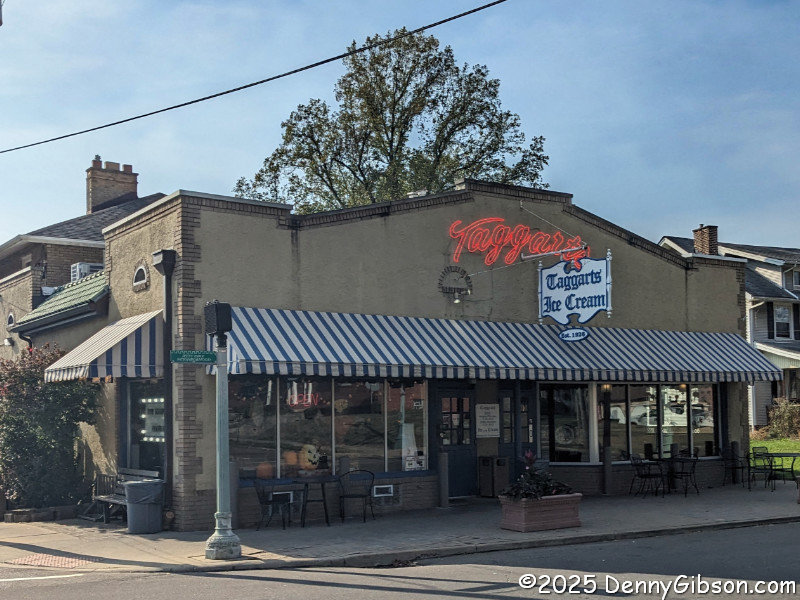
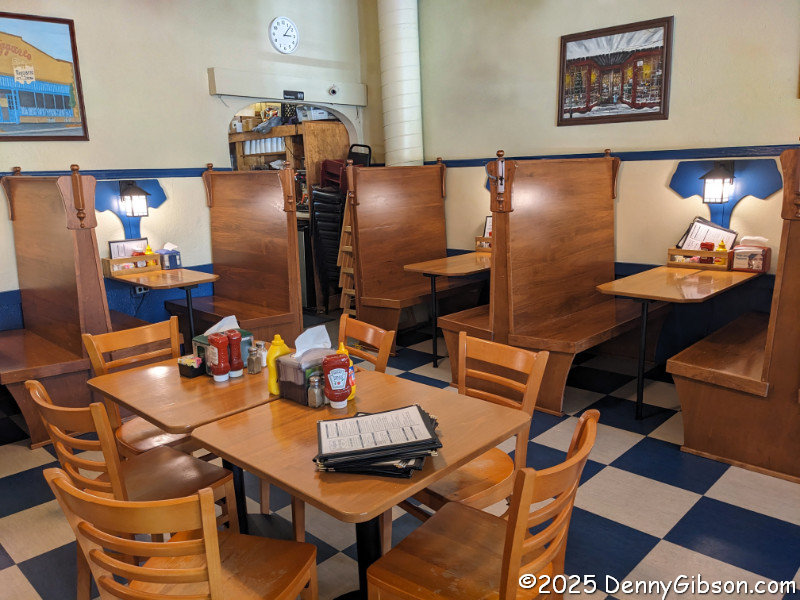
Possibly one reason I failed to photograph my ice cream at Tom’s was the conversation I had with a couple beside me. They were headed home to Kentucky after a vacation that included a stop for ice cream in Canton, which is where they learned of Tom’s. I reversed the story and stopped in Canton for ice cream at a place I’d learned of at Tom’s. The wooden booths at Taggart’s Ice Cream looked inviting, but I enjoyed my Black Walnut outside.

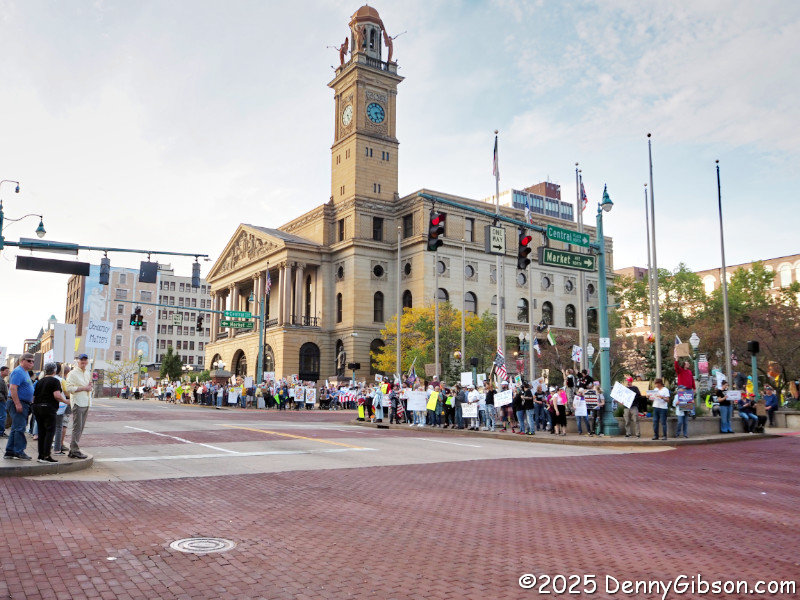
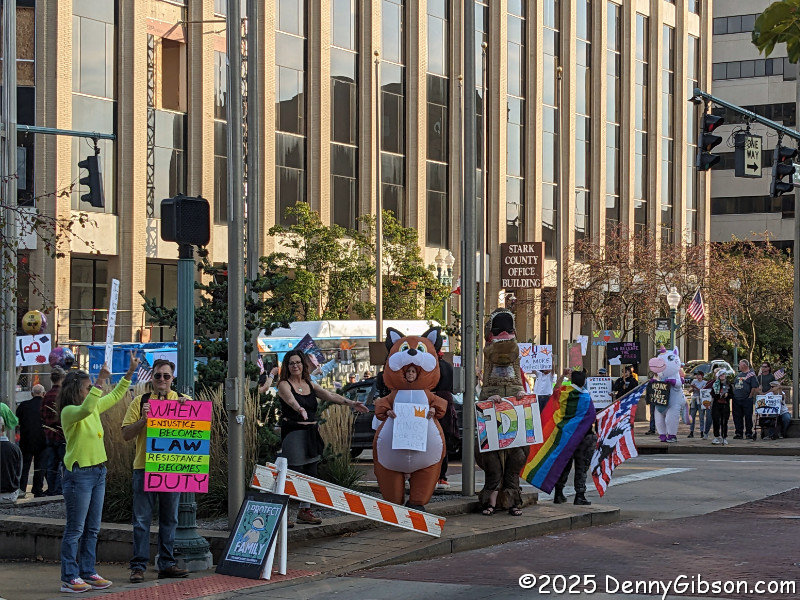
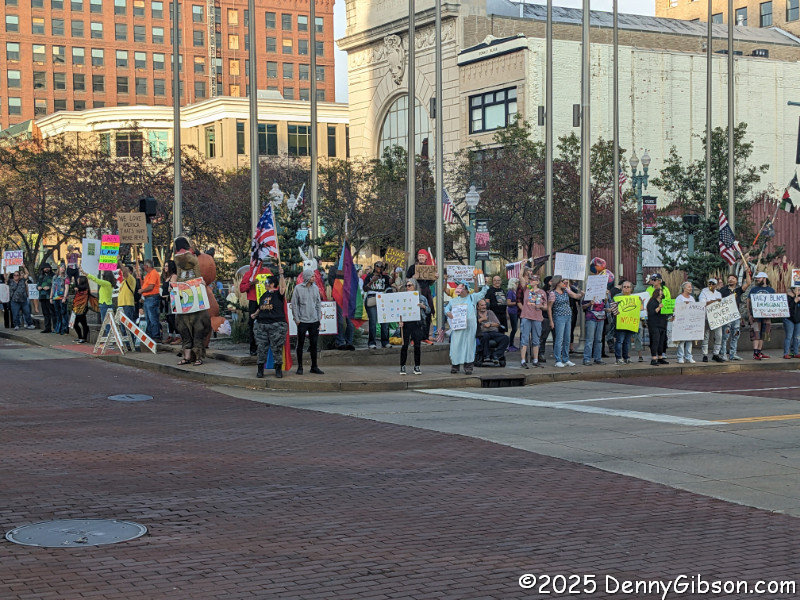
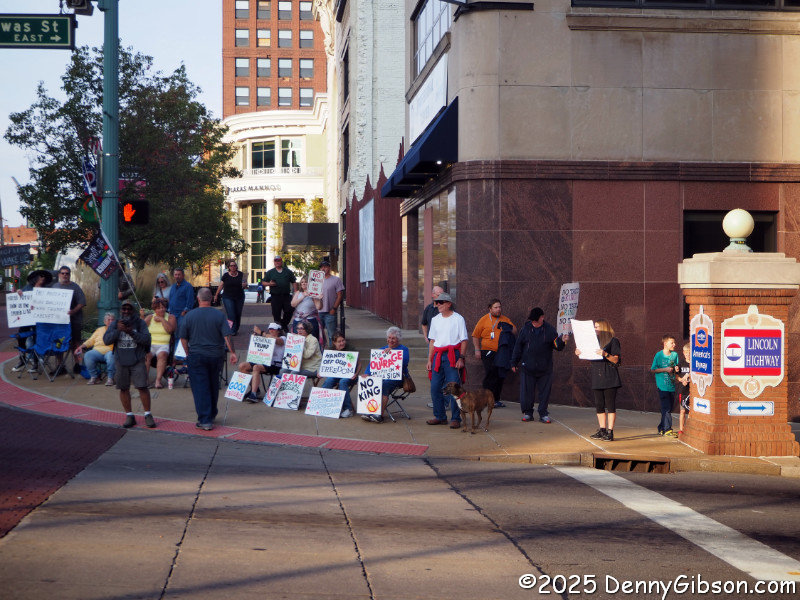
I was a little disappointed when I realized that the meeting date was the same as the planned nationwide No Kings protests. I would not be able to attend one in my home territory, but was pleasantly surprised to learn that the one in Canton would be taking place later than most, and I could possibly make it. A sizable crowd was already in place when I arrived about half an hour ahead of the scheduled 5:00 start, and it was still growing when I left for home about 5:30. A fellow I spoke with said this was already a bigger turnout than last time.

I’ll close with a reminder of why I was in Canton. I’m pretty sure Mr. Lincoln would be proud of the nation crossing highway with his name on it. I also think he would approve of the sentiments expressed in signs being held in demonstrations all across that same nation, though not necessarily of all of the language.

Trip Peek #149
Trip #167
Hiwassee Loop

This picture is from my 2022 Hiwassee Loop trip. Railroad loops allow elevation changes in less space than switchbacks and without the need to reverse direction. The Tennessee Valley Railroad‘s Hiwassee Loop was completed in 1890. Riding the train through the loop was the whole purpose of this trip, but I drove the Tail of the Dragon, the Cherohala Skyway, and a little Dixie Highway getting there, then some US-127 and more Dixie Highway getting home. It was a three-day trip with both overnights spent in historic digs.


Trip Peeks are short articles published when my world is too busy or too boring for a current events piece to be completed in time for the Sunday posting. In addition to a photo thumbnail from a completed road trip, each Peek includes a brief description of that photo plus links to the full-sized photo and the associated trip journal.

Route 66 Miles of Possibility 2025

I attended last year’s Miles of Possibility Conference in Edwardsville. It was my sixth documented trip of the year and was added to my schedule just days before it opened. This year is a little different. It’s my second trip of 2025, and I registered for the conference at the beginning of September. The tenth Miles of Possibility Conference is taking place in Joliet, IL, which is where the third one was held in 2017. The journal for the first day, which is basically the drive from home to Joliet, has been posted.

This entry lets blog-only subscribers know about the trip and provides a place for comments. The journal is here.