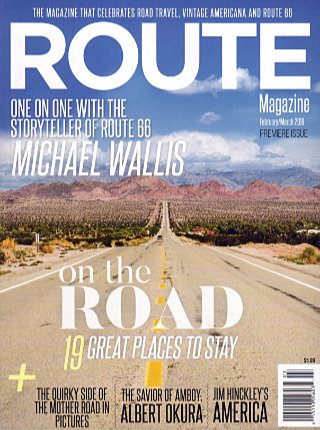
 The premier issue of ROUTE Magazine reached my neighborhood last week. Online chatter — from the publisher, some contributors, and quite a few anxious readers — had been building over the last few months. By the time I held a copy in my hands I’d seen the front cover and had a pretty good overview of the contents. Flipping casually through my purchase verified that this was a quality product with lots of photographs nicely reproduced on semi-gloss pages and plenty of inviting text. It also verified something that I was a little slow in realizing: ROUTE Magazine, or at least this issue, is 100% devoted to Route 66. Not that there’s anything wrong with that.
The name of author Michael Wallis occupies a prominent spot on the cover. Inside he is the subject of a far ranging interview. Wallis and Route 66 have been tightly tied together since his book, Route 66: The Mother Road, was published in 1990. On one hand, there’s an awful lot of “us too” in spotlighting him like this. On the other, there’s probably a fair amount of credibility to be gained from the interview.
An interview with restaurateur Albert Okura is also listed on the cover along with a set of photographs from David Schwartz and some reminiscing by Jim Hinckley. Okura founded the highly successful Juan Pollo chain and has put his own money into saving bits of Route 66 including the town of Amboy, California. The basic story is well known in the Route 66 community but the interview shines some light on the man behind the story. David Schwartz is an extremely talented photographer living in the no-where-near-Route-66 town of Cleveland, Ohio, who is rapidly getting a reputation for capturing his love for the road in his photos. Author Jim Hinckley is responsible for the best writing in this issue with his memories of six decades of personal experience with Route 66. Some were familiar but some — especially those of Ed’s Camp proprietor Ed Edgerton — were fresh and fun to read.
In addition, the magazine contains a few nuggets from Ron Warnick’s Route66News.com, a “Women on the Route” article, a piece on route-side lodging, and a short form interview with former Midpoint owner Fran Houser. “Women on the Route”, written by Katharine McLaughlin, talks about Katrina Parks’ documentary project and draws information from it. There are some historic mom-and-pops (e.g., Wagon Wheel, Boots) included in the lodgings article but there are also some fairly upscale boutique establishments that don’t often appear in Route 66 listings. The Fran Houser interview appears on the end page under a “Parting Shot” label so I suspect something similar will be a regular feature.
I mentioned that I was slow coming to the realization that this is essentially a Route 66 focused publication. Posts on the magazine’s Facebook page made in the lead-up to publication included at least one Lincoln Highway and one US-50 reference and they apparently caught my eye more than they should have. Looking a little closer, I now see that 90+% of the posts were Route 66 references and all of the magazine’s posts not on its own page were in Route 66 oriented groups. Again I say there’s nothing wrong with that. I’m personally a little less interested than I would have been otherwise but there seems to be significant interest from others and the first issue does look good.
Distribution is currently through Barnes and Noble stores although it appears that not every store is carrying the magazine. Of the two closest to me, one is and one isn’t. Subscription details are still being worked out but are to be available soon at the magazine’s website, www.routemagazine.us. That website is not yet operational making the aforementioned Facebook page (facebook.com/ROUTEMagazine) the place to check for status and news for the time being.
UPDATE 21-Feb-18: Only a few hours after this review was published, ROUTE Magazine announced on Facebook that the website at www.routemagazine.us had gone live. The site includes a page supporting subscriptions.
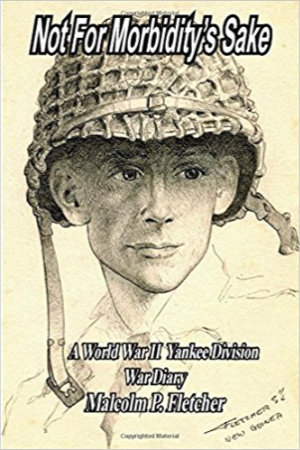 It’s a familiar story I’d never heard before. In no way is use of the word “familiar” meant to be dismissive. It’s just my way of acknowledging that many aspects of Malcolm Fletcher’s story are to be found in the stories of thousands of other World War II soldiers. Of course, each of those stories is also unique in ways both small and large. Large happenings that make Fletcher’s story unique include the actions that earned him a bronze star and the day he watched his brother get shot and captured. Getting coffee and doughnuts from the Red Cross in February and washing clothes and shaving in May are among the not-so-large pieces of the story that make it real. Numerous photographs, maps, and drawings — many by Fletcher himself — really fill things out.
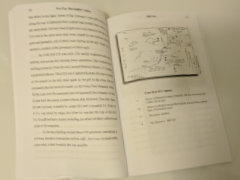 It’s a great story and well told, but there’s no denying that the mere fact that it is being shared plays a big role in setting this story apart from most of the others. The majority of those soldiers never told their story to anyone. A relative few did write it down or record it but not many saw an audience beyond family, friends, or a veterans organization. That Malcolm Fletcher wanted to share his story is obvious. He expanded his wartime notes and produced a “diary”. The title is his. Not For Morbidity’s Sake came from the fact that, as his son Michael says in the foreword, “…he took no pleasure in telling most of this story”. Malcolm Fletcher died in 1994, and Michael, with help from his brother Mark, made publication of the diary a reality. To a large degree, this meant editing their father’s writings, but they also augmented the story with information gathered from other family members, friends, and even some of the men who served with Malcolm.
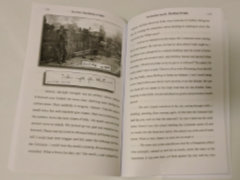 Those observations also fed some slightly philosophical thinking on the horrors of war and the brotherhood of man. He had personal experience with both. Whether the deeper of Fletcher’s thoughts came during his time in Europe or while he subsequently transcribed his notes in safety in the USA is unclear and unimportant. He was in the midst of battles where men destroyed each other with cannons, bombs, rifles, bayonets, and flame-throwers. He saw many and met a few French, Belgian, and German civilians whose world was ravaged beyond comprehension. And he was there at the end of the conflict, interacting with German and Russian soldiers to learn that “These Russies are just like us.”

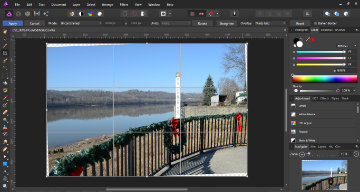 For me, up to speed isn’t all that fast. I’m basically a resize, rotate, and crop sort of guy. I was nearly at speed once those were mastered. I do, on occasion, dabble with tone a bit and do a little touch-up work. About as fancy as I ever get is the rare collage or the slightly less rare HDR. Accomplishing these with Affinity is quite different than with PhotoPlus but I eventually figured it out. I’m a long way from being a master of the software but I manage to do what I need.
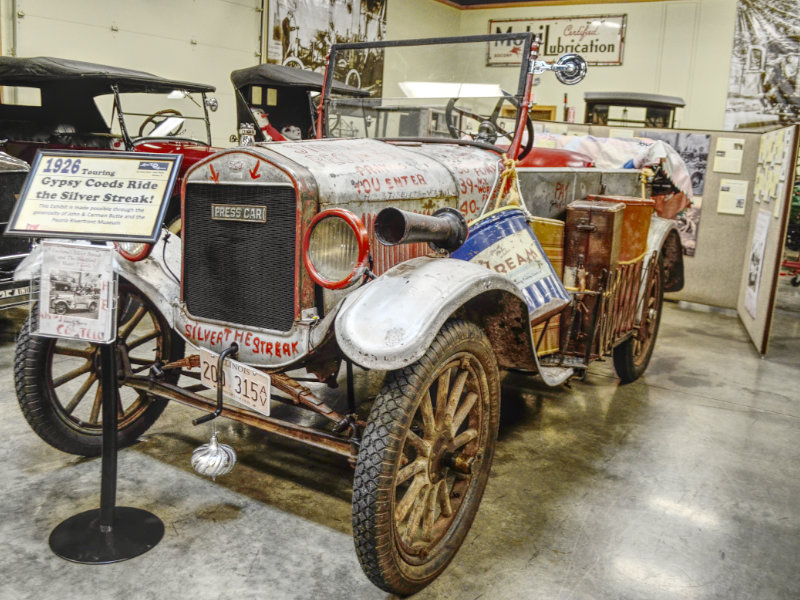
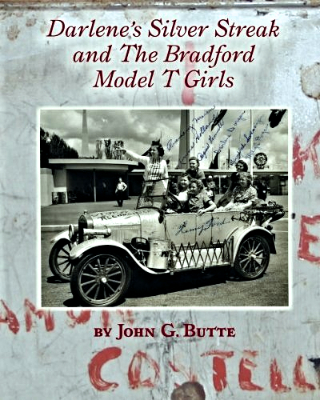 I first heard of Darlene Dorgan and her friends from a presentation on early female travelers at the Lincoln Highway Association in June. Then they were part of a similar presentation at a Route 66 conference in October. This book may have been mentioned in either or both of those presentations but, if so, it didn’t register. What finally got me interested in Darlene’s Silver Streak and The Bradford Model T Girls was when a blog I follow,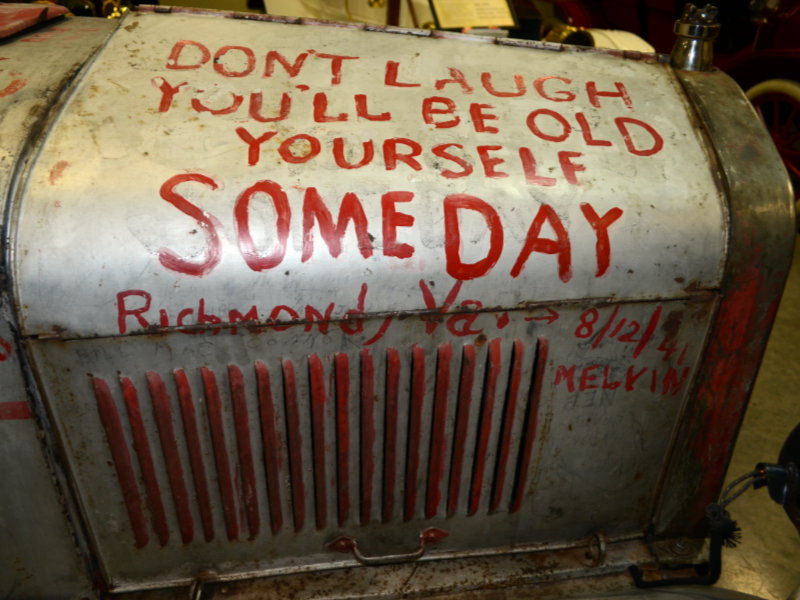
 Things are more or less back to normal after last year’s extra long (and extra exotic) Alaska trip boosted the days and pictures counts significantly. The number of blog posts was nudged upward by 2017 having 53 Sundays. The regular weekly posts were augmented with links for the nine road trips and eleven reviews. In a flip-flop from last year’s summary, two new-for-2017 blog posts made the top five while no new-for-2017 trip journal entries did. The Hawaii trip was closest at number ten.