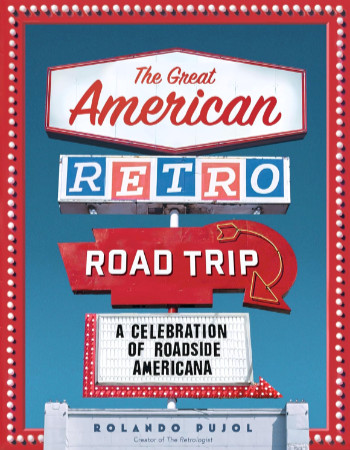
 There’s no road trip here. The Great American Road Trip is not a travelogue. Nor is it a guide for traveling to or through a particular place. It is a well-done, very inclusive, nicely illustrated catalog of stuff that people like me drive around the country to see.
The subtitle is more accurate. This book is indeed A Celebration of Roadside Americana, and that’s a celebration I’m always ready to put on my party hat for. It’s a celebration that Rolando Pujol is extremely well qualified to host. He is an award-winning print and TV journalist, and is the man behind The Retrologist website. Surprisingly, this appears to be his first book.
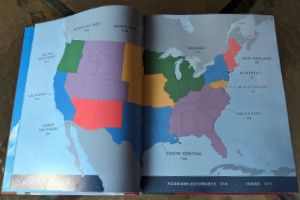
Pujol identifies seven categories of stuff people like me/us drive around the country to see, and has divided the country we drive around in into eleven regions. The chapters are the regions: Northeast, New England, Mid-Atlantic, Southeast, South Central, Midwest, Heartland, Desert Southwest, Mountain West, Pacific Northwest, and California. Sections in each of those chapters are devoted to the categories: Roadside Quirks, Roadside Eats, Mainstays of Main Street, On with the Show, The Inn Crowd, Sweet Stops, and Cheers! I bet most of you can come up with an example of something in each of the categories, even without a precise definition. Sidebars appear here and there to expand on or drill down on selected topics.
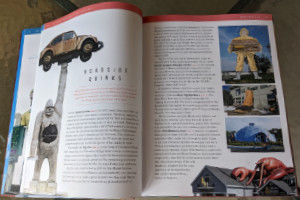
The book is jam-packed with bright color photos that range in size from small thumbnails, measuring only an inch or so on a side, to double-page spreads at the front of each chapter. Many are integrated into the book’s text layout. I believe that all photos were taken by the author.
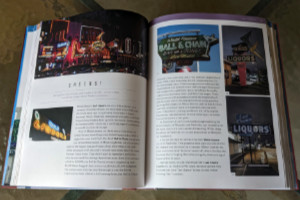
Every photo is identified in the text, and a few points of interest are described without an accompanying photo. Some attractions are covered in a single paragraph, but many get a lot more. The city and state are always provided, and more often than not, some interesting history about the building, the owners, or both is also included.
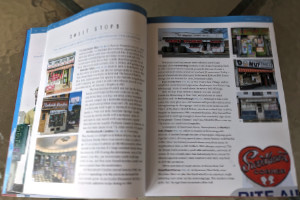
For the first time, I’m writing a book review without reading every word in the book. I did read every word from the beginning through the end of the Midwest chapter. That’s where my home is, and there are quite a few familiar items in that chapter. However, there is no storyline or itinerary to move the reader forward, and I found my page-turning motivation beginning to fade at that point. The pictures are great, and the nuggets are well-written and informative. I may finish it in some short spurts over the winter, and in all likelihood, I’ll give it a look when planning a trip to a specific area. I have not removed my bookmark.
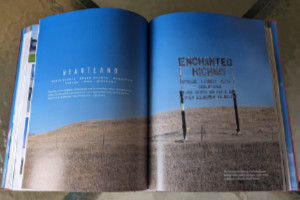
This is a good quality hardback publication with glossy pages that properly present the photos. It is fully indexed for help in finding specific points of interest. I ordered this book when it was announced that Pujol would be featured in the Society for Commercial Archeology’s August Zoom presentation. I thought I might get in some advance reading, but that didn’t quite work out. That presentation was recorded and, like other SCA Zoom presentations, has been made available for anyone to view. Learn more about The Great American Retro Road Trip straight from the Retrologist’s mouth here.
The Great American Retro Road Trip: A Celebration of Roadside Americana, Rolando Pujol, Artisan (June 24, 2025), 7.2 x 9.25 inches, 320 pages, ISBN 978-1648293719
Available through Amazon.








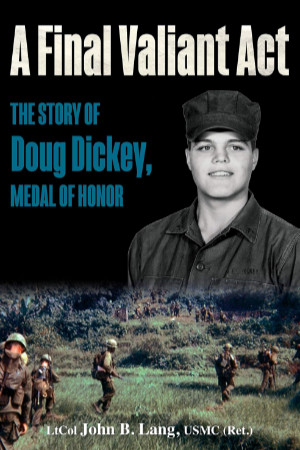 This is the second book that I’m aware of about Medal of Honor recipient Doug Dickey. I was aware of the first one,
 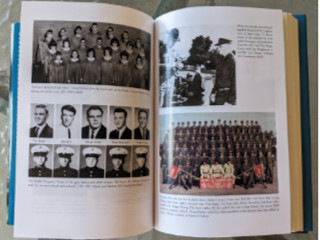 The book includes several maps and diagrams to help describe things like locations and organization hierarchies. There are even a few black and white pictures mixed in with the text. That’s nice, but they are on matte paper. What is even nicer is the section of twenty-two glossy pages containing higher quality images, many of which are in color.
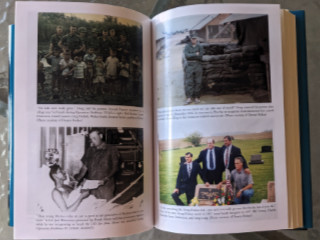 As mentioned several times on this website, Doug Dickey was a classmate of mine. I have attended events that honored him and read much that has been written about him. Two things from this book that I’d not heard before stood out. The common belief was that Doug fell on top of a single grenade, and that is what the Medal of Honor citation describes. But years later, when witnesses were able to compare notes, it was determined that there was a second grenade that Doug pulled under his body after falling on the first one. I was also struck by the sentence that Lang ends his book with, and with which I’ll end this review. It’s something that Doug’s mother, Leona Dickey, said when talking about her oldest son. “The guy who threw the grenade — he would have loved him, if he could have just met him.”