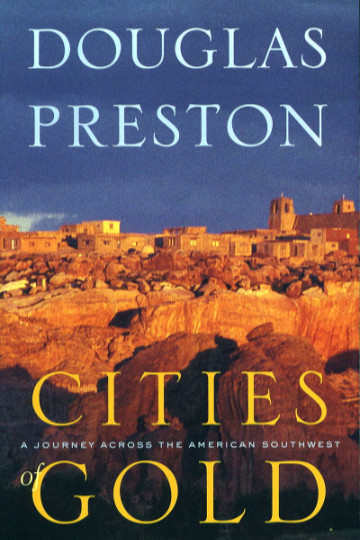
 When I published my review of The Last Ride of the Pony Express, a friend suggested another book I might like. That book was Cities of Gold, and he was right. I did enjoy the book, and it’s pretty obvious why the one book reminded him of the other. Both tell of journeys on horseback through the American West that attempt to follow a path once ridden by others. The stories, though certainly not identical, are similar. The authors could hardly be more different. Will Grant, who set out to retrace the route of the Pony Express, had been around horses most of his life. Douglas Preston, whose goal was to retrace the sixteenth-century travels of Coronado, was essentially a standard-issue city slicker from Boston, MA. If the mere existence of the book didn’t prove that he had survived, I would have really had my doubts as I read the opening pages.
But even before my doubts about Preston as a horseman started to form, I had decided I was probably going to like him as a writer. In “A Note to the Reader,” which precedes the actual start of the tale, Preston notes that it “is not a comprehensive history of the Southwest.” It is, he explains, “a narrow slice through the bedrock of time.” He might not (yet) know how to judge a horse or properly stay atop one all day every day, but he did have a way with words. For my purposes, that was definitely the more important ability of the two.
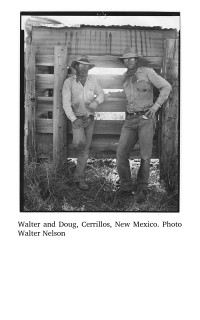
Preston, recognizing his own limitations, arranged for two others to accompany him on his big ride. He apparently was not as astute at recognizing limitations in others. A fellow hired as a wrangler, to handle the horses, had clearly oversold his experience and capabilities. He returned home after the trio had covered maybe a third of the total distance, and he didn’t contribute a whole lot while he was there. Preston was more familiar with the group’s third member, Walter. Walter turned out to be much more adept at packing the horses than the hired hand had ever been. He also seems to have been a better judge of capabilities than Preston. He had never been happy with the pretend wrangler, and when the pretender left, he commented, “This is more like it.” That was when, in his opinion, the real adventure began. Walter and Doug actually seemed to make a pretty good team whose relationship included a fair number of odd couple” style spats and recoveries, which doesn’t hurt the story at all.
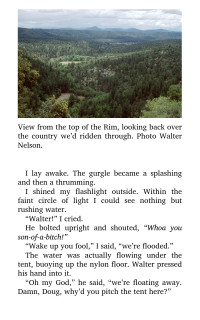
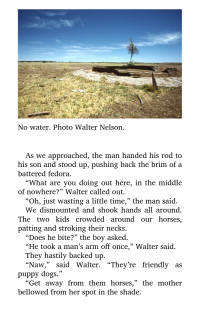
On the surface, this is a story about a couple of guys spending seventy days on horseback to travel a thousand miles. It would be a good story if that’s all there was. Its protagonists have to track down runaway horses, navigate through trackless desert, and keep an eye out for rattlesnakes. They nearly run out and desperately search for water on multiple occasions, while on another, they encounter so much water that their tent floats. Like any decent travel tale, this one is populated with interesting characters met along the way.
There is, of course, a lot more to it than a log of a long ride. The travels that Preston sets out to trace took place in 1540, and an awful lot of history occurred in the intervening four and a half centuries. Some of that history is shared through the interesting characters Doug and Walter meet. Ranchers, shepherds, and tribal members often have memories passed down through generations. Sometimes the sharing of history is triggered by a location. It might be something from 1540, involving Coronado’s initial contact with the people he encountered, or it might be something from more recent times, such as the days of cowboys, cattle, and outlaw gangs. Preston clearly researched his subject well, and he shares what he learned in an easily digested manner.
I came to this book because of another horseback travelogue, and since I read the two fairly close together, I find I can’t stop comparing them. There are the obvious differences between looking for a not well-documented path followed once 450 years previous and looking for a commercial path traveled repeatedly 150 years previous. But I was also struck by the differences between the two modern journeys separated by just thirty years. When Preston made his trek in 1989, there was no civilian use of the Internet or GPS, and cell phones were in their infancy. By the time Will Grant tackled the Pony Express route, all three of these technologies were well established, although Grant may have spent more time without a cell phone signal than with. I don’t say this to diminish the risks Grant faced. By traveling alone, things that might have been just a problem, perhaps even a really big problem, with a buddy along, could be fatal. I think I say it because it was often on my mind as I read Cities of Gold. I suspect it was often on my mind because those technologies play such a large role in my own travels.
Oddly enough, I didn’t think nearly as often about the much larger difference between the technology of the horse and the technology of the automobile. That might be because that difference is just too big to grasp easily. I did think about it once, however. As the riders approach Albuquerque, NM, Preston writes about how much of the world has been arranged to accommodate the automobile. That is a bit different than noting various individual changes brought on by cars. For the first time, I realized that accommodating cars is central to almost everything that humans do. Also, probably for the first time, I considered the question of whether the invention of the automobile was good or bad a legitimate one. That wasn’t the only time that Cities of Gold prompted me to think about something differently, and that, in my opinion, is a good thing.
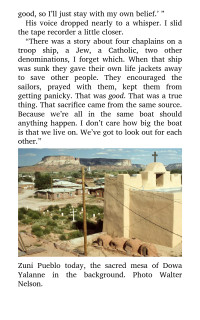
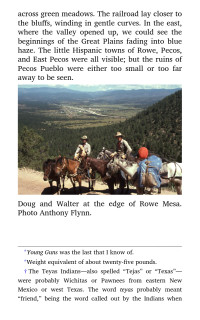
Walter, Preston’s traveling companion, was a photographer. He toted a goodly amount of gear, including an 8×10 Deardorff view camera. The majority of the photos in Cities of Gold are Walter’s, and I think they significantly enhance the story. The edition of the book that I read was also helped by Walter’s words. The adventure took place in 1989, and Cities of Gold was first published in 1992. I read an electronic version of the 25th-anniversary edition, which includes an Afterword by Walter. Two people rarely see everything the same way, and it is pretty obvious from the original book that Doug and Walter were top-grade examples of this. Walter’s contribution begins with a summary of the trip from his point of view, which leads to the sharing of two dozen memories that stuck with him for 28 years. If you intend to read this book, and I certainly think it is worthwhile, I do suggest going for a version with Walter’s Afterword included.
Although it has taken me decades to realize he existed, I guess my impression that Douglas Preston has “a way with words” was not wrong. I really enjoyed reading this book, and so, too, it seems, have many others. That it got a 25th anniversary edition is evidence of that. Further evidence of his “way with words” is that he has now written or co-written more than 40 books, including several that have appeared on the New York Times bestseller list. Cities of Gold was his second.
Cities of Gold: A Journey Across the American Southwest, Douglas Preston, UNM Press (March 1, 2019), 6 x 9.25 inches, 480 pages, ISBN 978-0826320865
Available through Amazon.

 This picture is from my 2024 trip to the Society for Commercial Archaeology Conference in Nashville, Tennessee. I intended to go as soon as it was announced, then waited too long, and it sold out too fast. So I made other plans, although I did put my name on the waiting list. I was surprised when it reached the top, but took advantage of it and changed my plans again. I have been to Nashville multiple times, so I was familiar with many of the points of interest we visited, including the pictured Broadway, a.k.a. “neon canyon”, and Lane Motor Museum. But there were plenty of new-to-me places, too. Among them were the Willie Nelson and Friends Museum and Marathon Village.