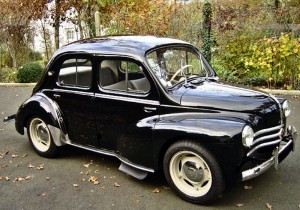
 Having that long white Chevy convertible on campus sure was cool but I knew it was a fleeting thing. A high school buddy would also be attending college in Cincinnati when I returned for my sophomore year and the two of us decided to share an apartment somewhere between our two schools. This meant I needed, or at least could justify, a car, but it wouldn’t be that lovely Impala. Reason number one, of course, was that I only owned half, and there was no way I could afford to buy out my sister. Another was that, even at a quarter a gallon, feeding that V8 was a challenge for a perpetually broke college student. Sis bought all of the Chevy, and I bought a semi-running 1961 Renault 4CV.
I bought it from a high school friend, and I really wish I could remember how he came by it. This is not the sort of vehicle high school kids in rural Ohio typically lusted after. I got it cheap because of the semi-running part. The rings were pretty much shot, and I doubted the small trunk would hold enough cans of oil to get me back to Cincinnati. I worked out a deal with a mechanic where I would do the grunt work, and he would handle the finer points of installing new rings for a greatly reduced price. By mid-summer, I had a fine running five-year-old imported sedan.
Fine running is, of course, relative, and so too, in some sense, is the five-year-old bit. Though this particular specimen was just five years old, the 4CV had been in production since 1947, with a design that started in 1941. The 4CV name comes from four taxable horsepower. Stateside, the earliest models were rated at 23 horsepower, so I guess one French horse equals 5.75 American horses. My car was from the final year of production and benefited from all fourteen years of improvements. It had 28 American horses. The engine and 3-speed transmission were in the rear. First gear was unsynchronized, and the floor-mounted shifter made the one in a VW Beetle feel like a Hurst. Incidentally, the three previous My Wheels 3-speeds, ’53 Chevy, ’54 Merc, and ’52 Ford were also unsynchronized in first as was standard at the time. Twenty-eight horsepower and Cincinnati hills just made it a lot more memorable.
Memorable, in fact, is a great description of this car. I only owned it for six months or so but I’ve got a ton of memories. In Cincinnati, it quickly became known as Supercar because it was anything but. At 40+ miles per gallon and with easily parked dimensions, it was a popular ride for small—absolute max of four—group outings. When coming to a stop and the mood was right, someone might shout “air brakes”, which signaled those in the front to hold open the suicide doors to help slow the car. The gas tank held just over seven gallons. It was a time when gas stations often gave away drinking glasses and other premiums “with an 8-gallon fill-up”. (A few years later, graffiti at a campus construction site, written in two installments, read “Free Angela Davis”… “with an 8-gallon fill-up” but that’s another story.) Had the 4CV been more popular, there might have been a class action suit in there somewhere, but as it was, I never got a free glass with the Renault.
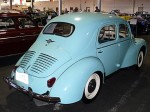 The car pictured at the top of the article is not mine, although it looks pretty much the same. About the only difference is the wheels, and I’m going to use pictures of a car at the Lane Motor Museum in Nashville to talk about them and a few other items. My car had wheels like the ones at left. A bolt in the center of the chrome hubcap held it in place to cover the three, yes three, lugs. A friend who sometimes borrowed the car eventually bought it, and I can’t remember whether this story comes from before or after the transfer in ownership. In either case, he had a flat one night while driving the car near the UC campus. As he fumbled with the French jack, a couple of football player types came by and simply held up the car while he changed the tire.
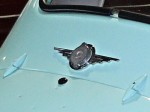
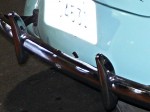 Zooming in on a couple of spots on the Lane car will help in describing some of the 4CV’s other unique features. Look closely at the bumper in the first picture. Notice that the hole in the bumper lines up perfectly with the hole in the body, which lines up perfectly with the end of the engine’s crankshaft. Yep, a folding crank, possibly the same one that worked the jack, fit through those holes and could turn the engine. And yes, I did use it to start the car on occasion. In fact, I used it several times on one particular drive until I figured out that a short in a cable was draining the 6-volt battery.
That’s a radiator cap in the middle of the chrome wings on the rear deck. The engine was water-cooled. The climate control system consisted of a little door under the rear seat and a toggle switch on the dash. Opening the door and flipping the switch caused some air to be pushed through the opening. Since the air passed through the radiator, it was a few degrees above ambient and stayed that way for as much as an inch beyond the little door. Those French. What a great sense of humor.
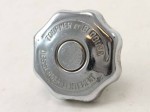 On the Lane car, the original cap has been replaced with a stamped metal one that actually looks like a radiator cap. The cap on my car was big and chrome and looked like the one at left. Full-service gas stations were the norm, but I had to be extremely careful with them to prevent my radiator being topped up with regular. The gas tank fill tube was inside the engine compartment. I once got a parking ticket on the OSU campus in Columbus. Since that big chrome radiator cap was the only thing on the outside of the car with any lettering, the ticket identified the vehicle make as Tourner et Bloquer.
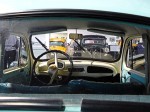 Here is one more picture of the Lane car taken through the rear window. The wipers are in their off position. The front windows actually rolled down, though the rear ones just slid sideways to clear half of the framed area. My roommate and I once took a fairly long road trip in the Renault. By rearranging the rear seat and the front passenger’s seat, we made a “bed” where one of us could sleep while the other drove. In some now-forgotten small Indiana town, I almost got a speeding ticket while Dale, my roommate, slept.
It was late at night, and I had essentially passed through the town when the flashing light came on behind me. An uncle who spent a lifetime in law enforcement always advised getting out of the car if pulled over. The officer would feel safer if he could see you in the open with both hands visible. That always made sense to me, but somewhere along the way, it became just about the worst thing you can do. But it was still a good thing in 1966, and that’s what I did. The man in the car motioned for me to come back and get in the front seat beside him. He was an older fellow who wrote in a small lined notebook as he asked me where I was from, where I was going, and similar questions. When he learned that I lived in Cincinnati, he told me that he had once lived there, too. His family had moved away not long after the canal was closed down. That was, he thought he remembered, about the same time the buffalo nickel came out. (Both happened in 1913.) About that time, he stopped writing and, after a few more questions, tore the page from the notebook and wadded it up. “Guess you won’t be coming through here again very soon”, he said. “No use giving you this ticket.” I’ve got a feeling that talking to me just made the old guy’s night go a little quicker, and at the time, I was certainly glad to move on without a ticket, even one handwritten on notebook paper. Looking back, though, it would be kind of cool to say I got a speeding ticket in a Renault 4CV. Can’t be many of those, I bet.
Previous Wheels: Chapter 6 — 1959 Chevrolet
Next Wheels: Chapter 8 — 1957 Austin Healey

 This book has thousands of words, many with multiple syllables, and dozens of pictures in 50+ shades of grey. It tells the story of an old man in an old car on an old road and is available here and at Amazon, including Amazon UK and Europe, on an old medium — paper.
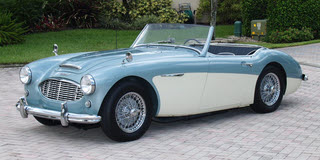 Why in the world would a couple of newly weds buy a ten year old British sports car in the middle of winter? I am, at present, as baffled as anyone though I apparently once knew the answer to that question. A month or so after our 1966 Boxing Day wedding, my bride and I purchased a 1957 Austin-Healey 100-6. The one pictured is a 1958 model but looks pretty much like our ’57. This was not a play car to park next to a dependable sedan. This was our only car.
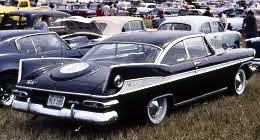 The 1959 Plymouth Fury at left is a dead ringer for the one I passed up to get the Austin-Healey. A rather spiffy ride, don’t you think? On one snowy night, my new wife and I were out with a friend in my borrowed car. The snow was not deep but the big Plymouth was not doing well on the slick streets. At one point, as we attempted to climb a slight incline, the friend and I got out to push while my wife took over driving. It did not take much to get the car moving but stopping to let us back in would have left the car stuck once again. Instead, my friend and I each grabbed a fin and “skied” alongside the Plymouth to the top of the hill.
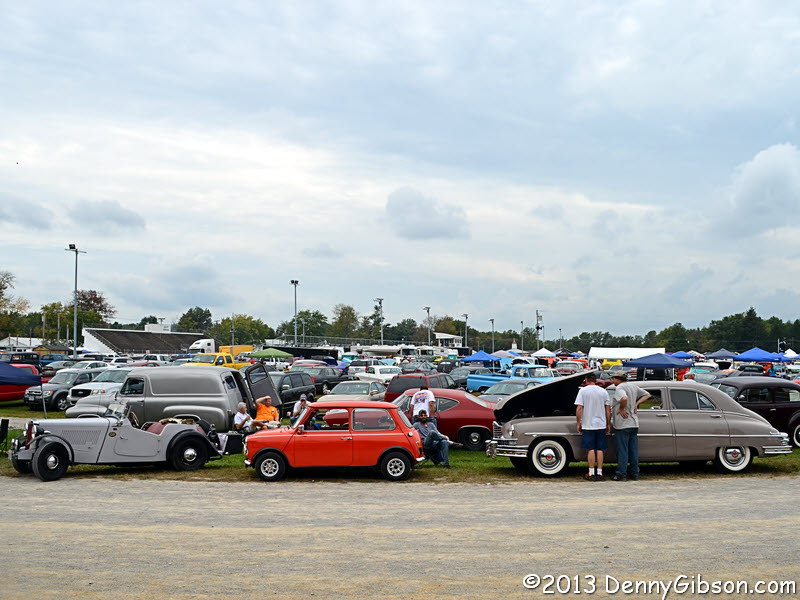
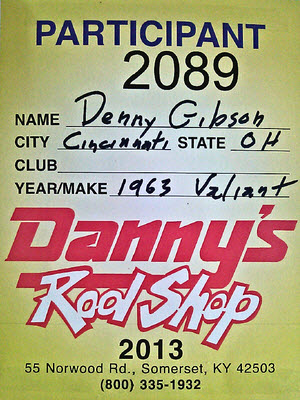 I made my first attempt to sell the Valiant this weekend. It was feeble and half-hearted and impressively unsuccessful. What I did was put the car on display in southwest Ohio’s largest car show with a “For Sale” sign on it. At the end of two days, I had not a single indication of serious interest in the car but I’m neither disappointed nor particularly surprised. The whole thing was something of an experiment and I think I learned quite a bit which is essentially what experiments are for. I certainly hope I no longer own the car when next year’s show rolls around but I’m pretty sure I could generate a little more interest if that were the case. I’ve got a somewhat better handle on the crowd and I’ve got a much better handle on pricing.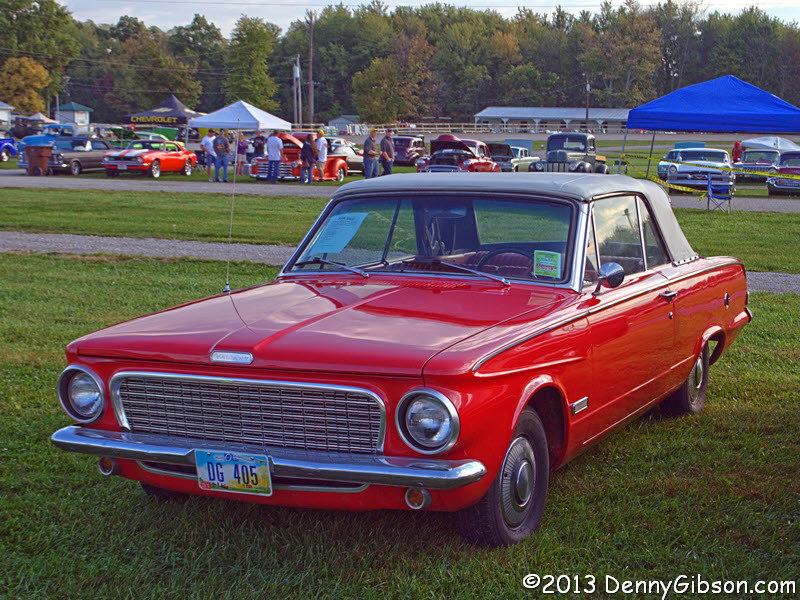
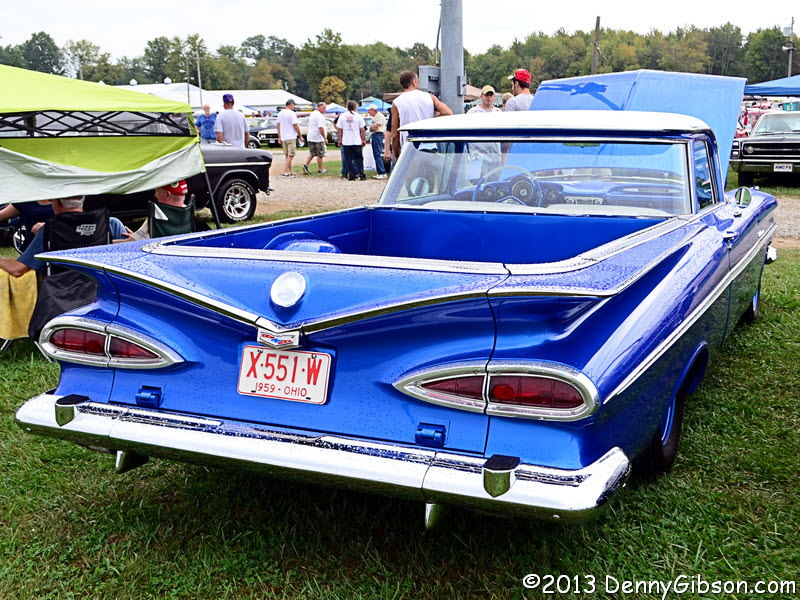


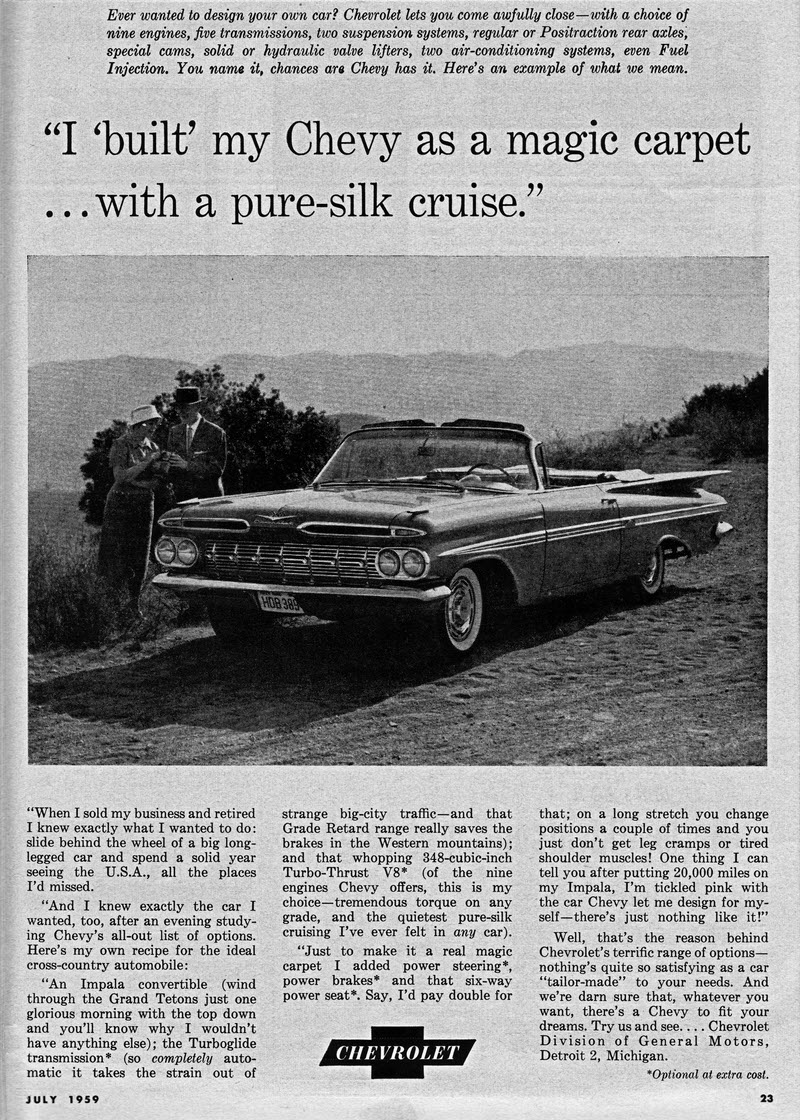
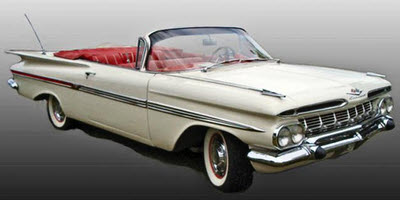 Getting back to my, I mean our, Chevy, you don’t have to imagine anything different from the car in the photo. That’s not our car but it could be. White with red interior and black top. 283 V8 with Powerglide automatic transmission. As we had planned, the car stayed with my sister while I lived in an on campus dormitory in Cincinnati — mostly. I did take the car with me for the last few weeks of the school year and I no doubt felt like one really cool dude. I don’t recall specific issues but the joint ownership thing came to an end that summer. For one thing, I decided I wanted a car with me for the next school year. I’m sure I didn’t have the money to buy out my sister and going with something that got a little better gas mileage seemed like a good idea. My sister became sole owner of the Impala but not its sole driver. I never did know all the details but there was at least one wreck when someone else was driving. I don’t believe the car was actually totaled but there was enough damage that the car went off to a new home.
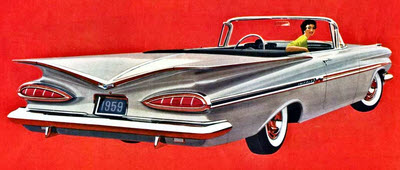 I’ve always liked this publicity picture. It emphasizes the car’s unique appearance and offers a hint at what it might be like in the front seat. I remember what it was like in the front seat. The hood was far from short — this was a full-size American cruiser — but it could seem that way by comparison with the rest of the car. With the top down, the view in the mirror was of a rear deck that reached to the horizon and extended all the way across it.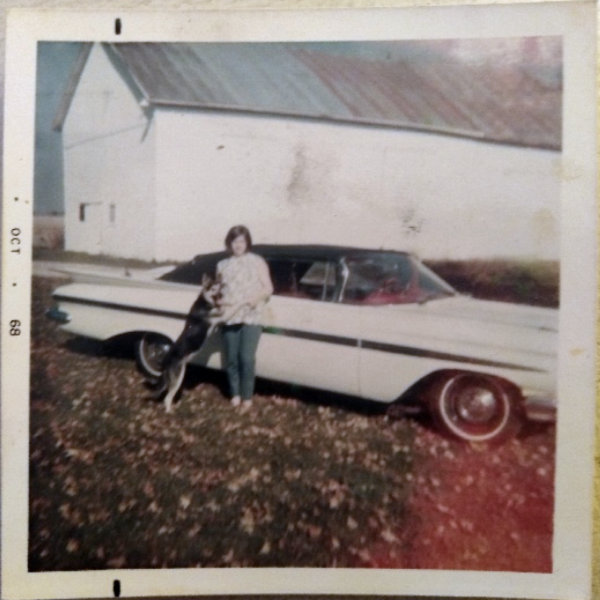

 Imagine the car in this picture with dark blue paint and baby moon hub caps and you’ll have something close to what I was driving in the spring of 1965. Besides two doors, it had dual two-barrels on an Offenhauser manifold, dual points in a Mallory distributor, and dual exhausts. It wasn’t particularly fast by 1965 standards, but its description sounded fast.


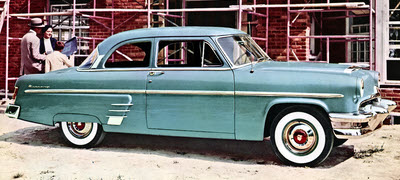 When new, my car probably resembled the one at left. It never really did look all that bad and, unlike the Chevy before it, its engine just kept on going. But things were different underneath. I owned the car for less than a year and during that time the rear end lowered itself by a couple of inches due to rusting suspension. The floor pans had similar issues and the driver’s seat developed a noticeable rearward rake. I’m certain it was preparing to eject me downward at some point.
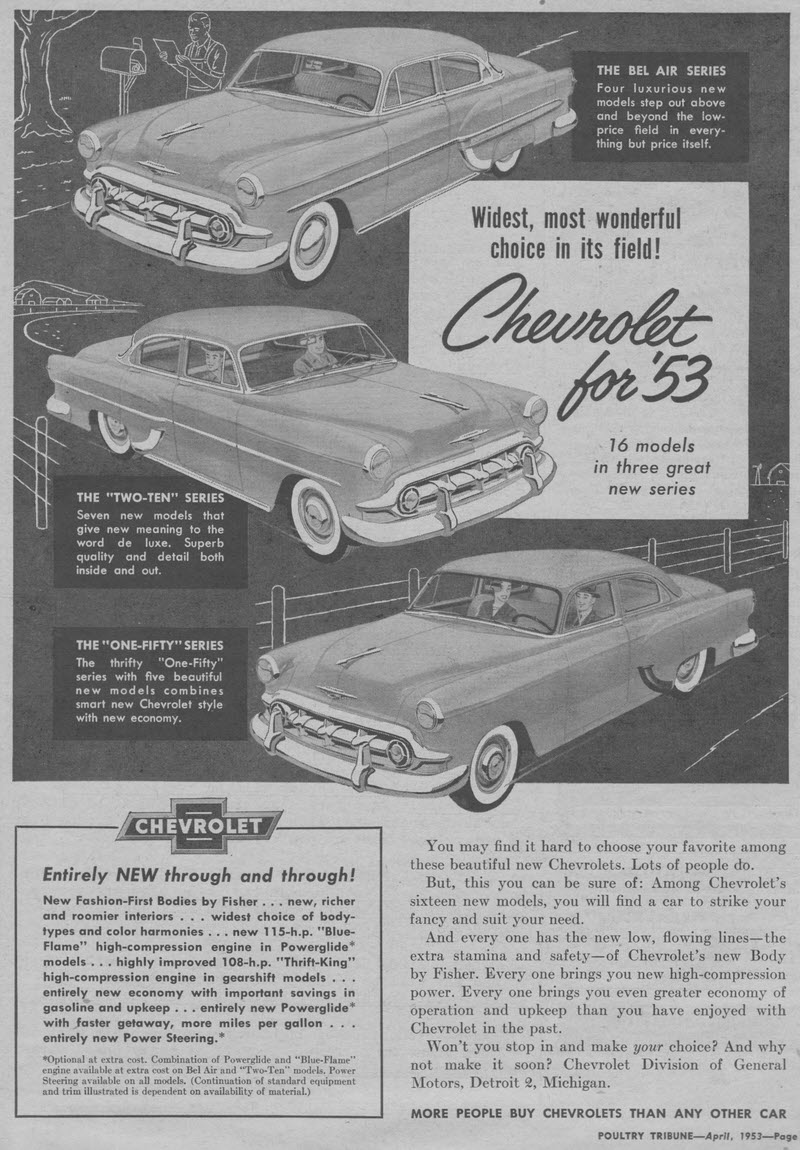
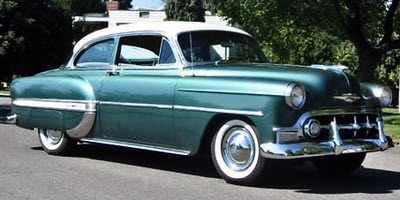 My car was a green and white Bel Air that looked a lot like the car at left. Exceptions were that mine was a 4-door and it never looked nearly that shiny while I owned it. Late in the summer I threw a rod and did my first engine swap with something out of a wreck. During the winter, the front got a little wrinkled when I was intentionally doing donuts in the snow and unintentionally found a guard rail in my path. When the rods in my junkyard engine started knocking in the spring, the Chevy was done.