Not Long Ago. Not Far Away.

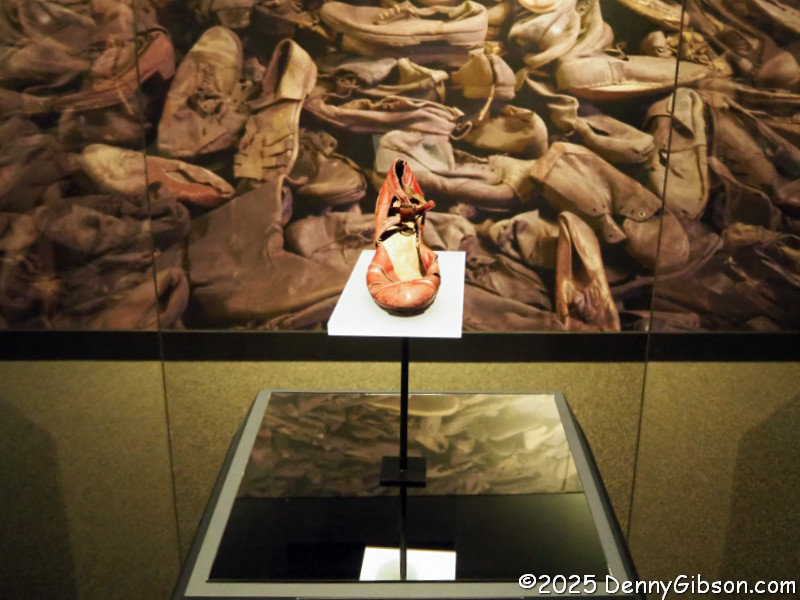
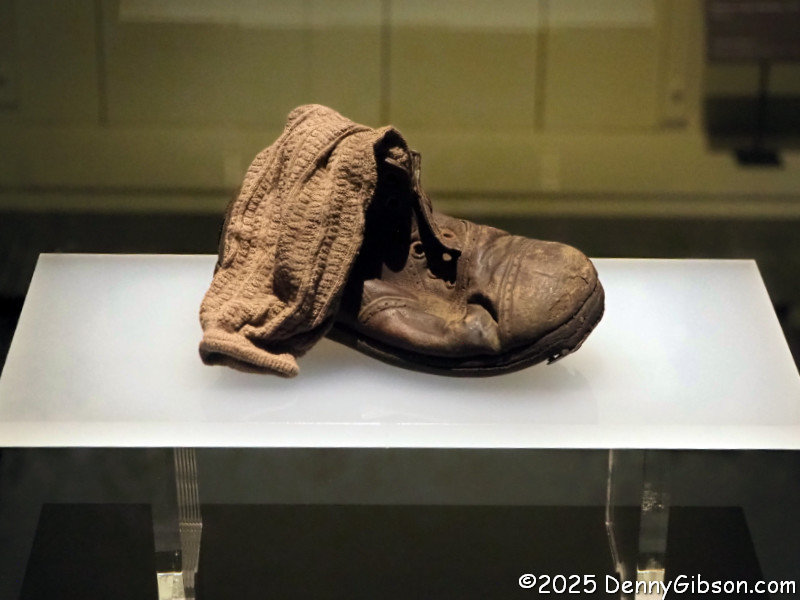
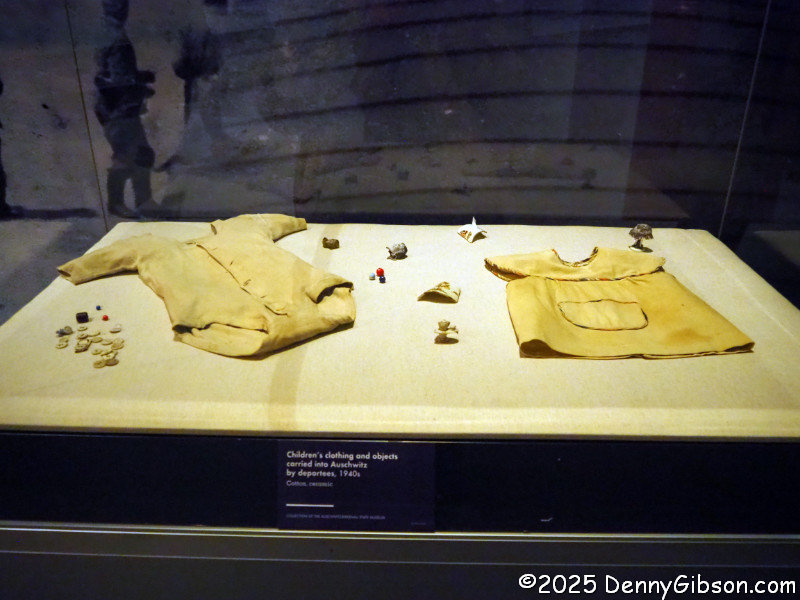
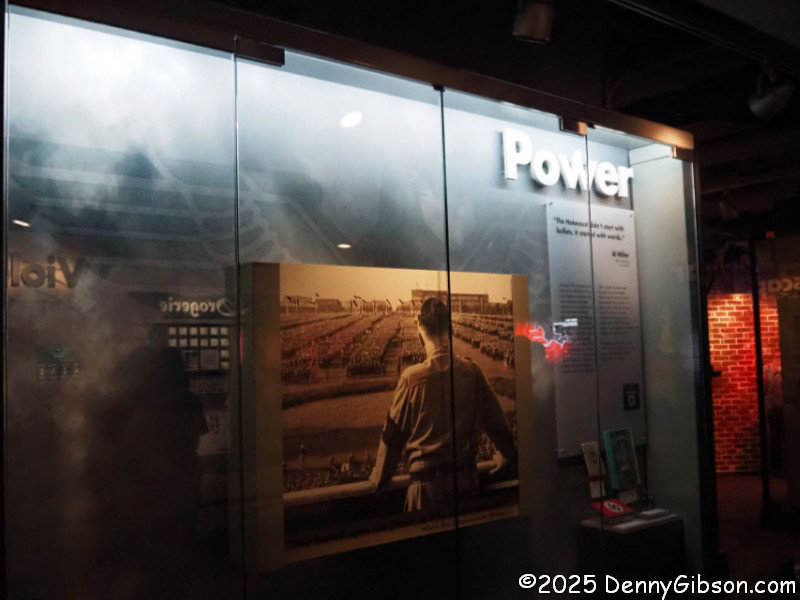
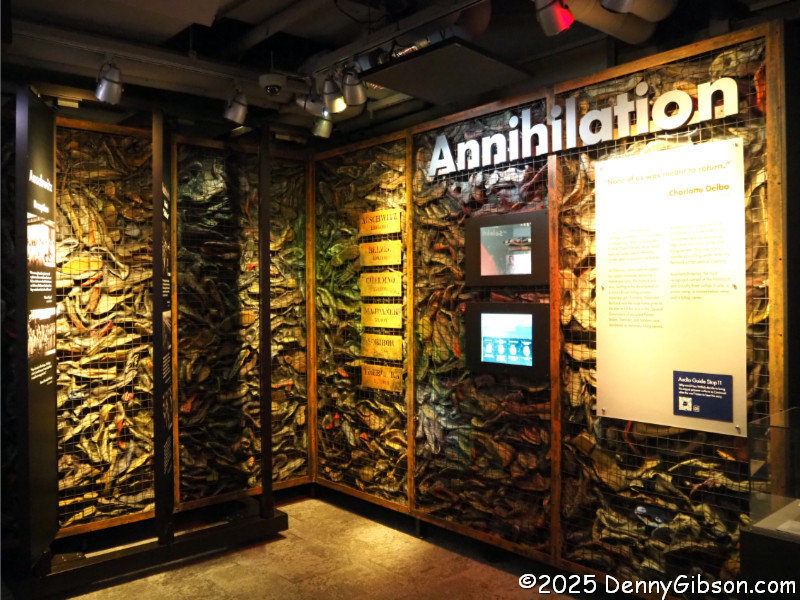
On Saturday, October 18, “Auschwitz. Not long ago. Not far away.” opened at the Cincinnati Museum Center. I attended on Wednesday. The red shoe pictured at right is one of the first items visitors see when they enter the exhibit. Photos of the shoe, backed by the image of countless other empty shoes, have been used to promote the display. The wall-filling image boggles the mind as the realization that the owners of all those shoes walked into Auschwitz but never walked out slowly forms. The mind nearly breaks realizing that the photo contains just a fraction of such shoes.

Having seen pictures of that red shoe, and knowing that this was “the largest collection of artifacts from Auschwitz outside of Europe”, I probably could have predicted the question that formed as I moved into the exhibit and listened to the included audio guide. It’s a question that most of us ask ourselves anytime we give much thought to the Holocaust. “How could this have happened?” we wonder. The exhibit doesn’t really explain it, but it does tell some of the history. It describes and displays artifacts from the small Polish village that would become home to the largest of the Nazi concentration and extermination camps.

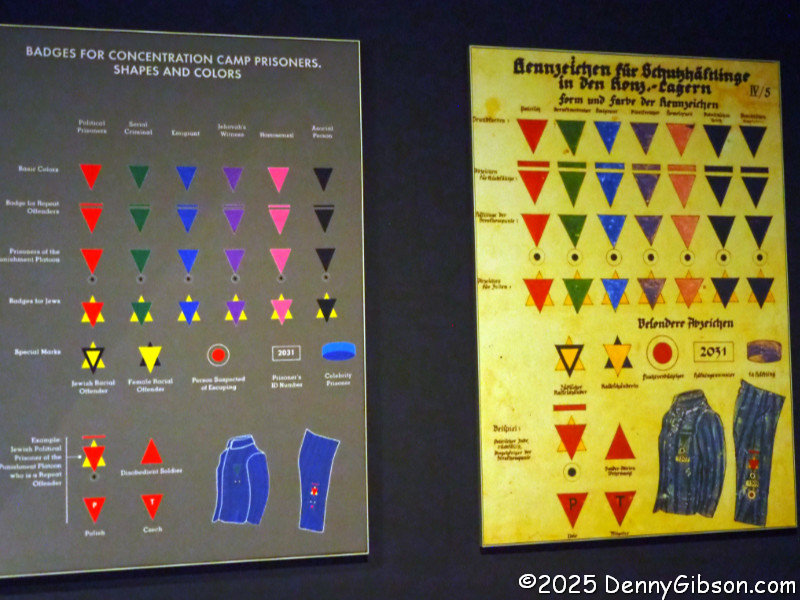
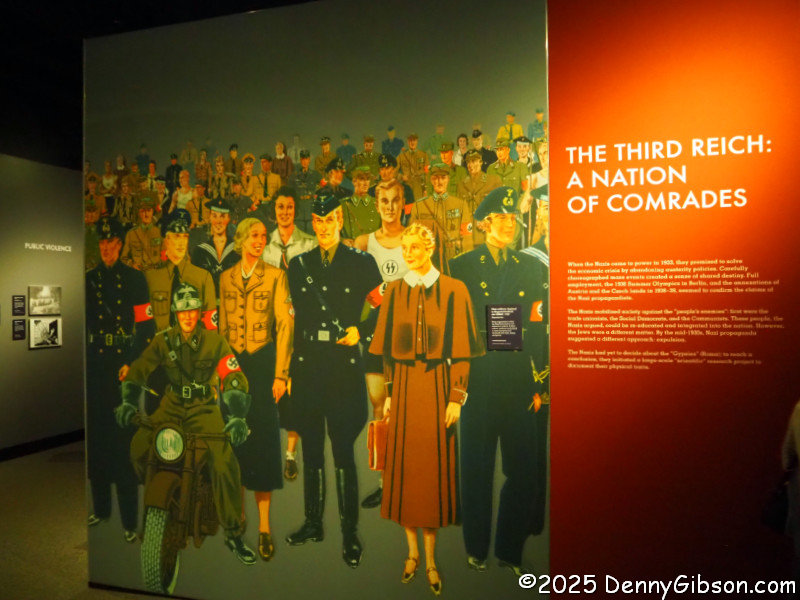
Establishing that the “other” was responsible for all of Germany’s problems was essential. The “other” was mostly, but not exclusively, Jews. Blacks, Roma, homosexuals, and people with disabilities were among those persecuted by the Nazis.

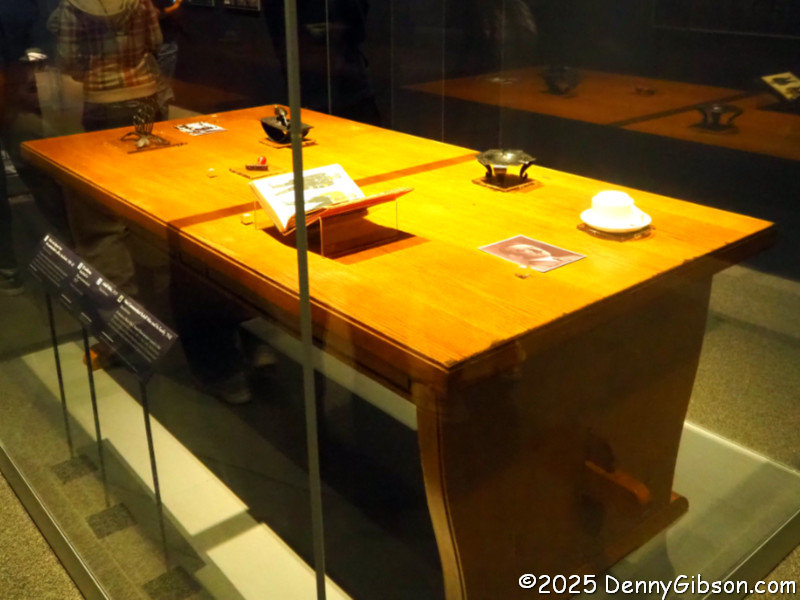
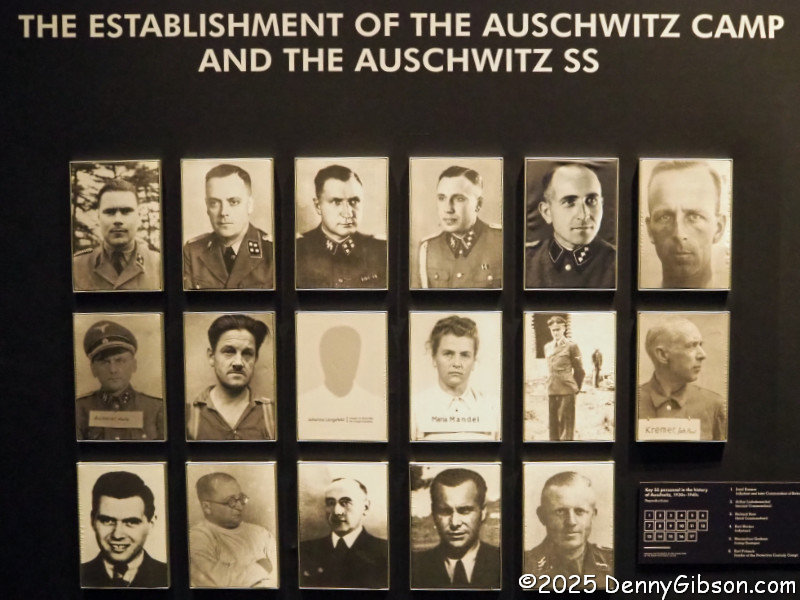
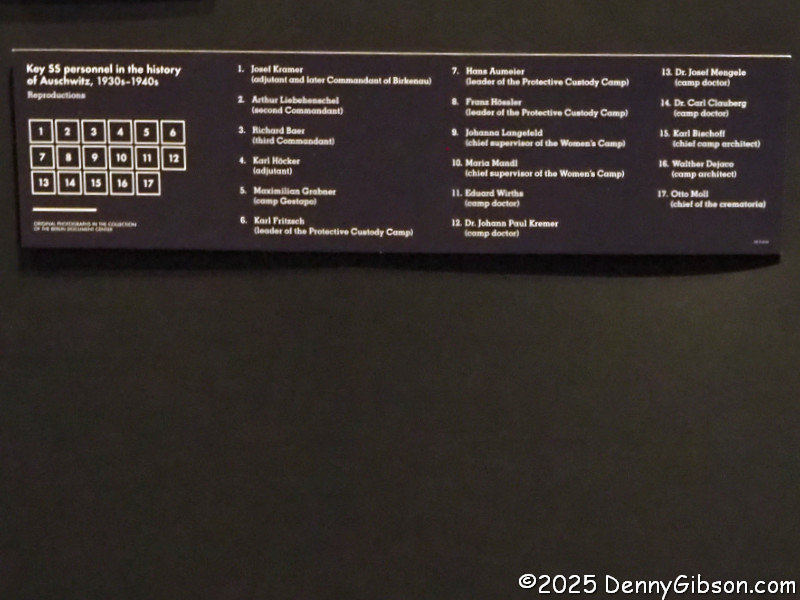
This is the desk of the camp commandant, Rudolf Höss. Photos of key Auschwitz personnel are displayed nearby with an identifying legend.

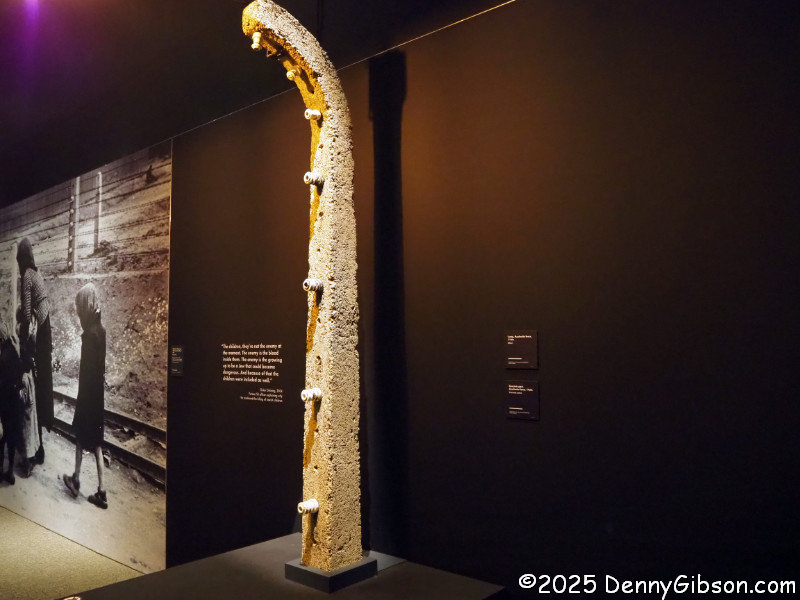
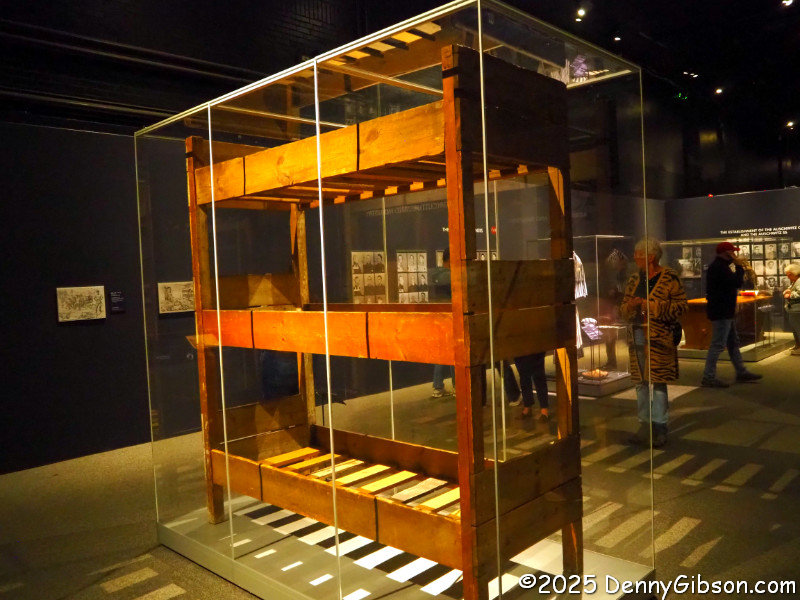
Roughly 80% of those arriving at Auschwitz were sent directly to the gas chambers. The other 20% became slaves, and not many survived the starvation, beatings, and forced labor. Many more than three people occupied the three-tiered bunks. The concrete post held barbed wire, as seen in the photo in the background.

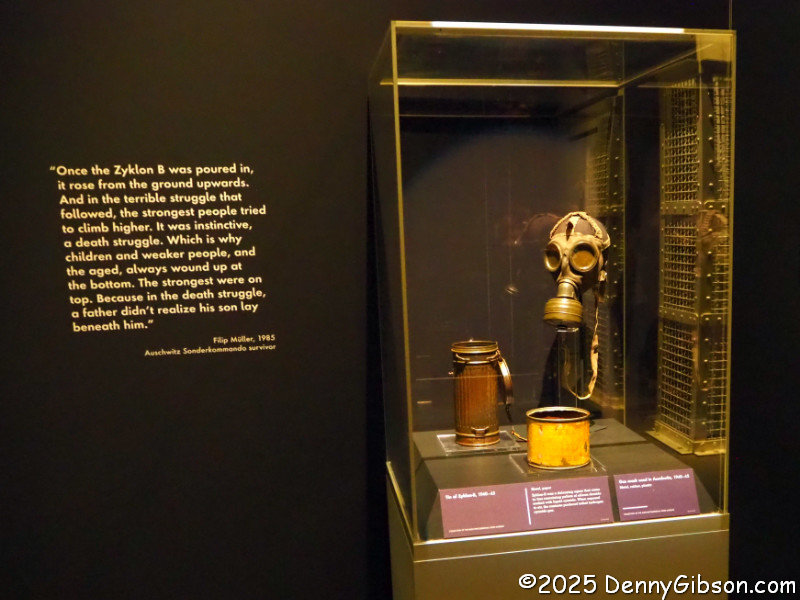
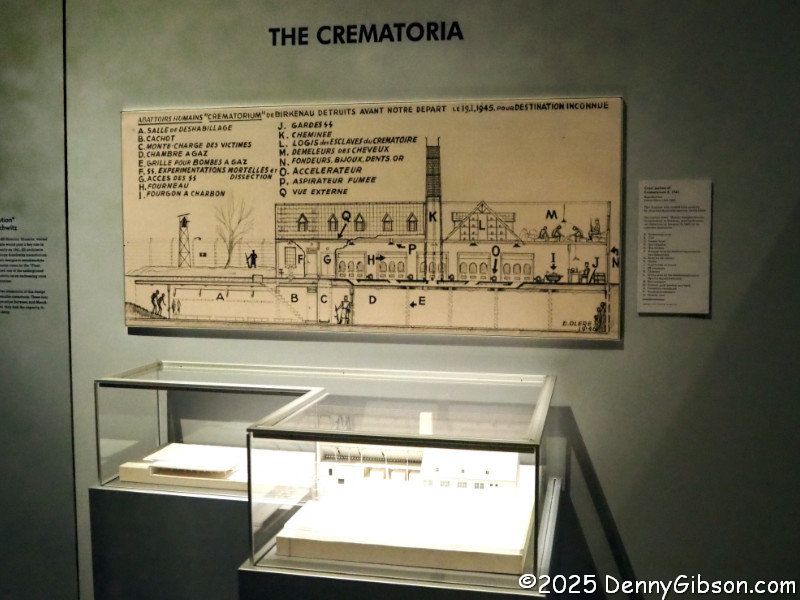
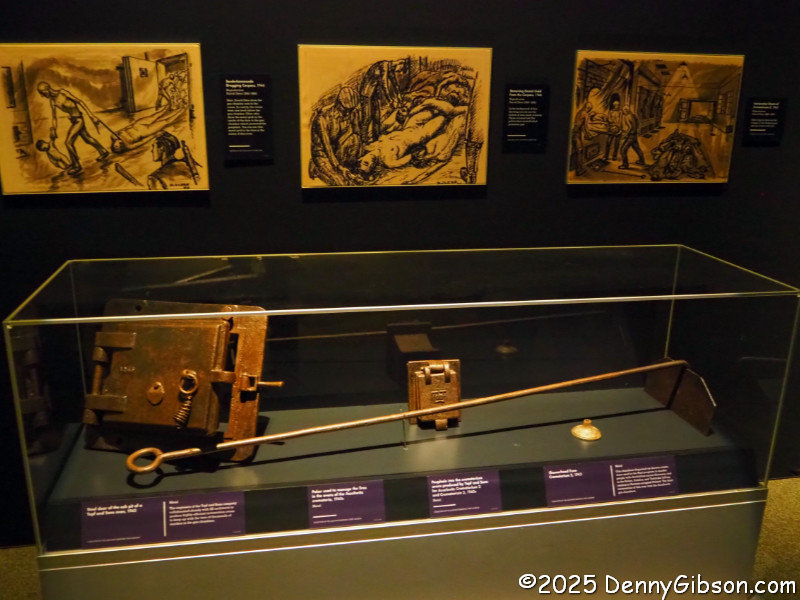
Some of the prisoners were “rented” to various privately held companies, but many were assigned tasks in the camp, such as removing bodies from the gas chambers or moving them through the crematorium. The first photo contains items from gas chambers and crematoriums. There is a “shower head” in the lower right corner. The gas mask in the second photo was worn by a soldier who dropped the Zyklon B once the chamber was sealed.

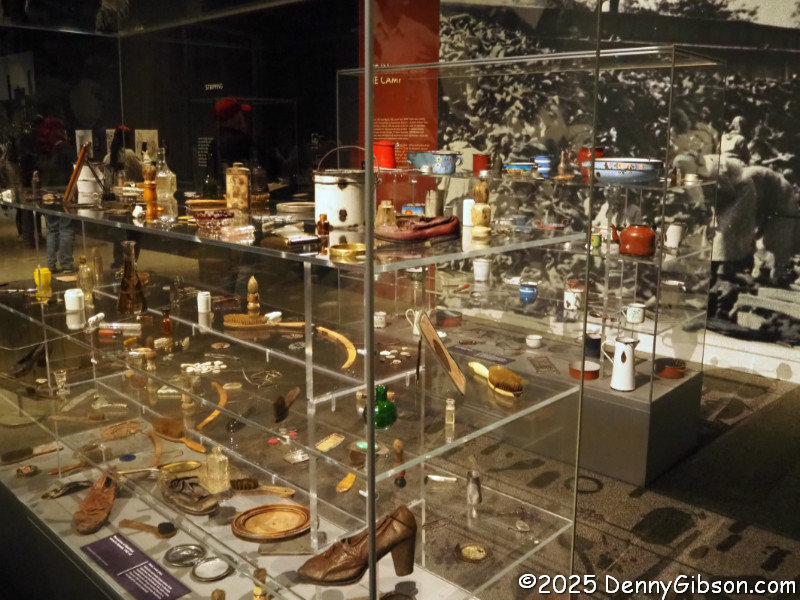
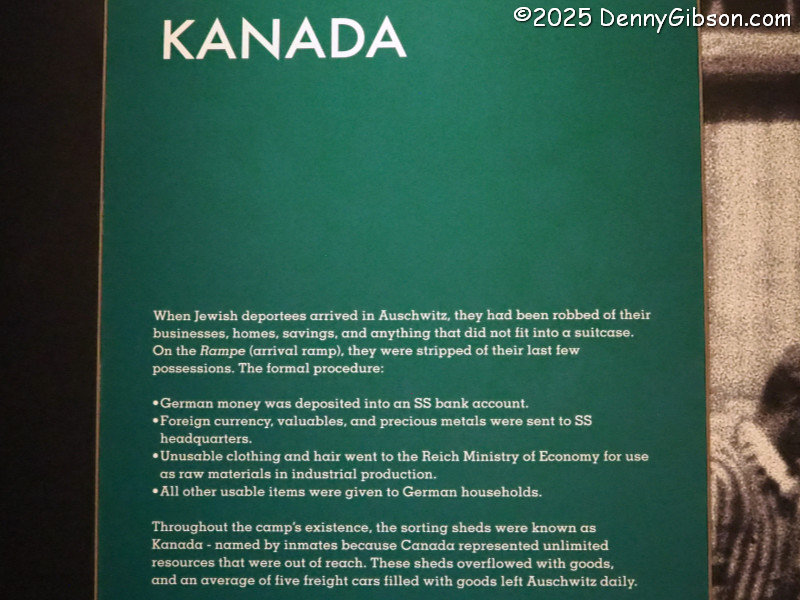
Other prisoners were forced to sort through the few possessions that actually made it to the camp. Prisoners referred to the sorting sheds as Kanada.
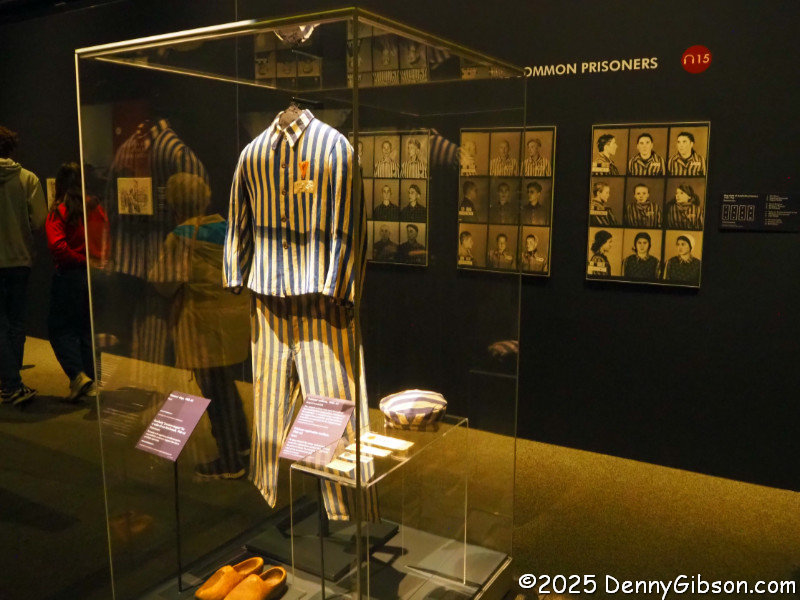
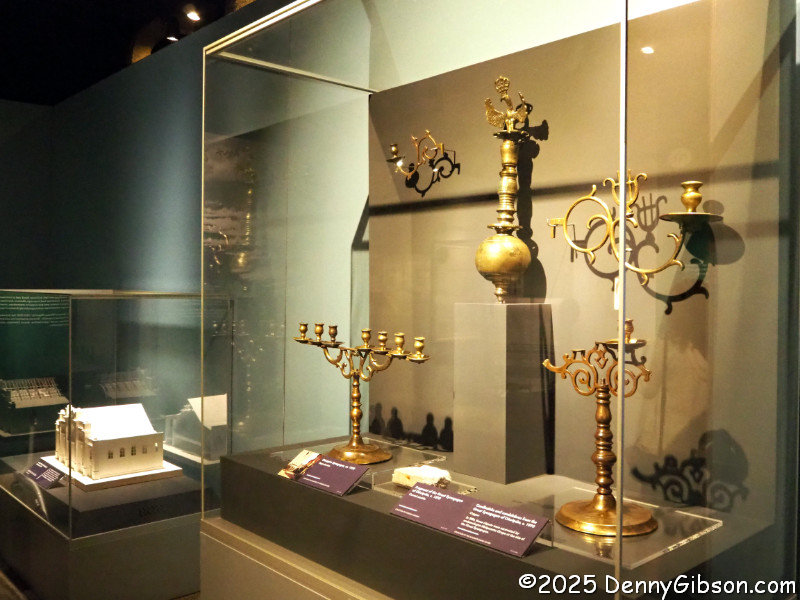
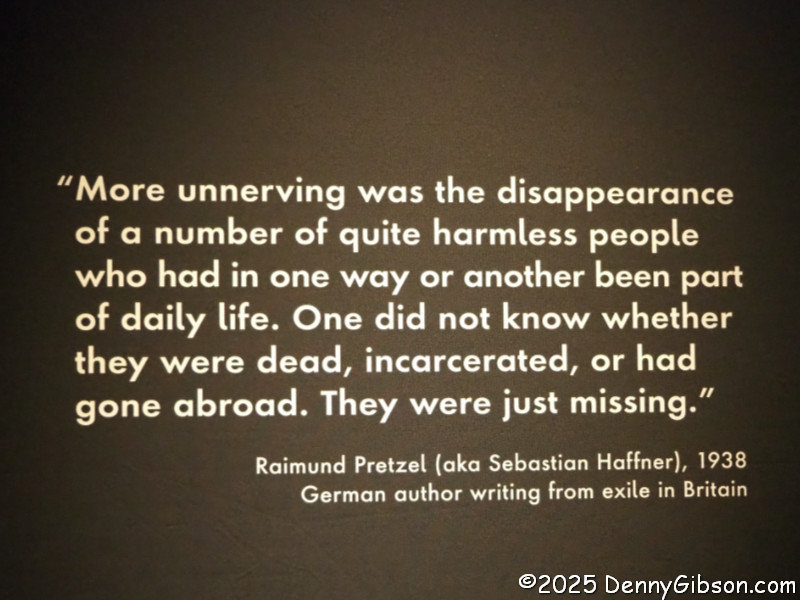
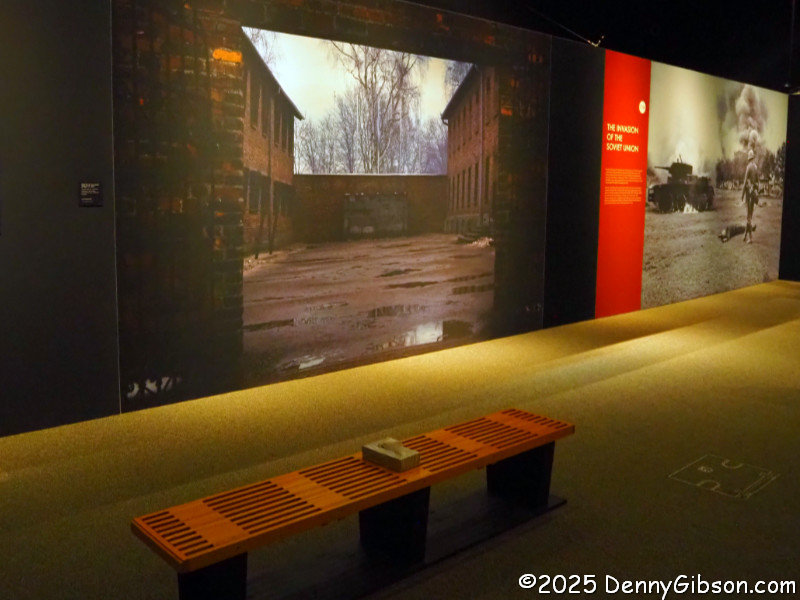
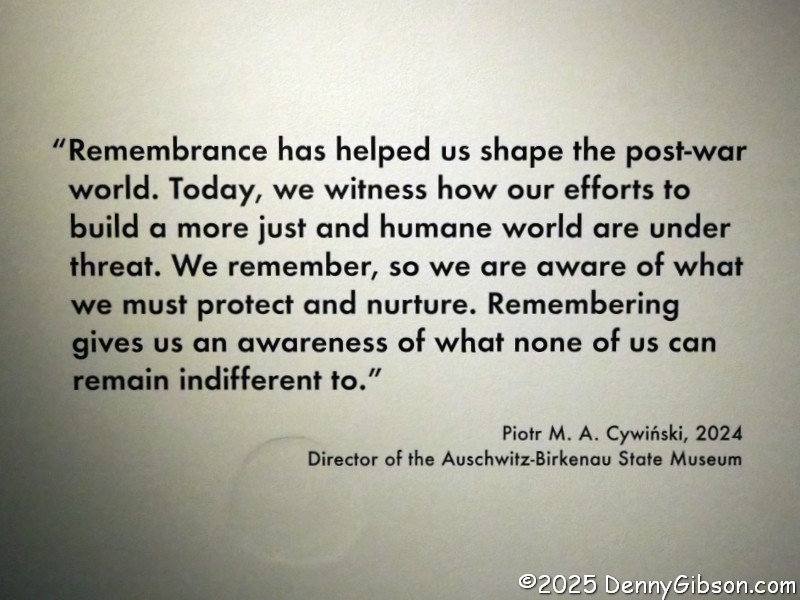
There were several benches placed throughout the exhibit. Many were positioned in front of screens showing videos of scenes related to the camps. All had a box of tissues placed at their center. There was no lack of tear-inducing images, artifacts, and stories in the exhibit. Nearly all of the items on display are from the Auschwitz-Birkenau State Museum. The last picture is of a quote from the director of that museum about remembrance. I immediately thought of Eisenhower’s 1945 command, “Get it all on record now. Get the films, get the witnesses, because somewhere down the track of history some bastard will get up and say this never happened.” He was right, of course. That quote on the wall notes that today “…our efforts to build a more just and humane world are under threat.” Nearer the beginning of this article, there is a photo of a quote about  “…the disappearance of a number of quite harmless people…” It’s from 1938 Germany during the Nazi rise to power. As I read it, it occurred to me that it could have easily come from certain Central or South American countries a few decades ago. Or it could have come from somewhere not even that far away or that long ago.
Auschwitz. Not long ago. Not far away.” runs through April 12, 2026.


The Holocaust and Humanities Center helped bring the Auschwitz exhibit to Cincinnati. Although a separate operation, it is housed in the Cincinnati Museum Center and throughout the exhibit’s run is offering discounted adult admission of $7.50 to anyone presenting an “Auschwitz. Not long ago. Not far away.” ticket. This rate is available year-round to seniors and military.

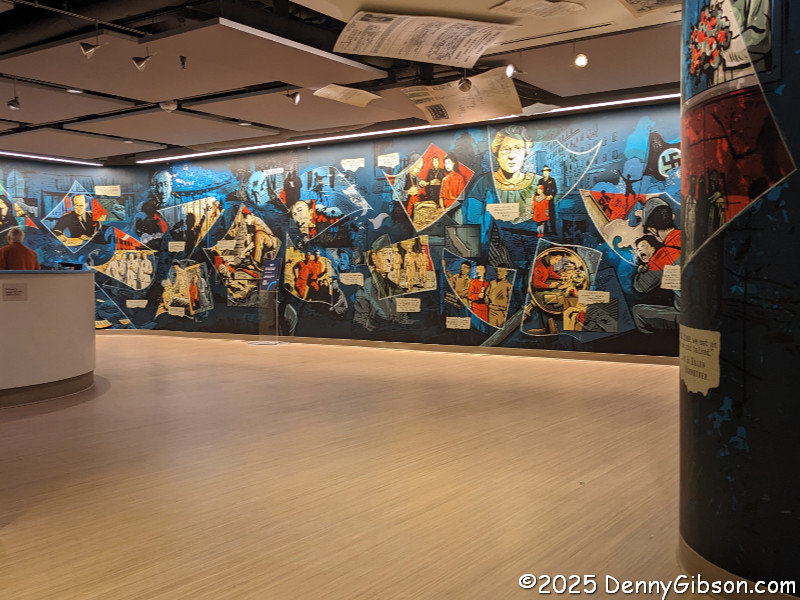
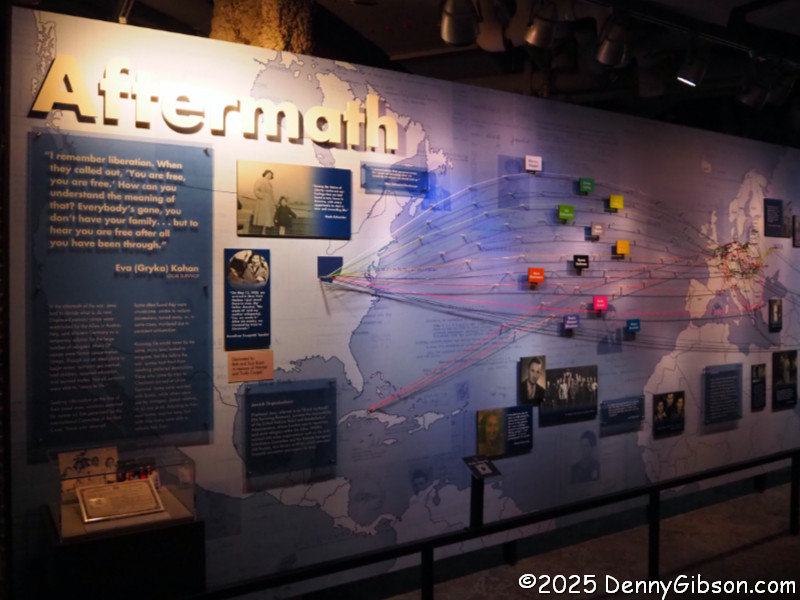
Naturally, there is overlap between the Auschwitz displays and those in the Holocaust Museum. A notable example is this molded wall of abandoned shoes that echoes the red shoe and large photo from Auschwitz. But there are also a lot of differences. The museum has many interactive displays, and the story it tells is broader than the one with a specific concentration camp at its center. In particular, the museum continues the story well beyond the liberation of the prisoners with reporting on the post-war trials and tales of recovery.

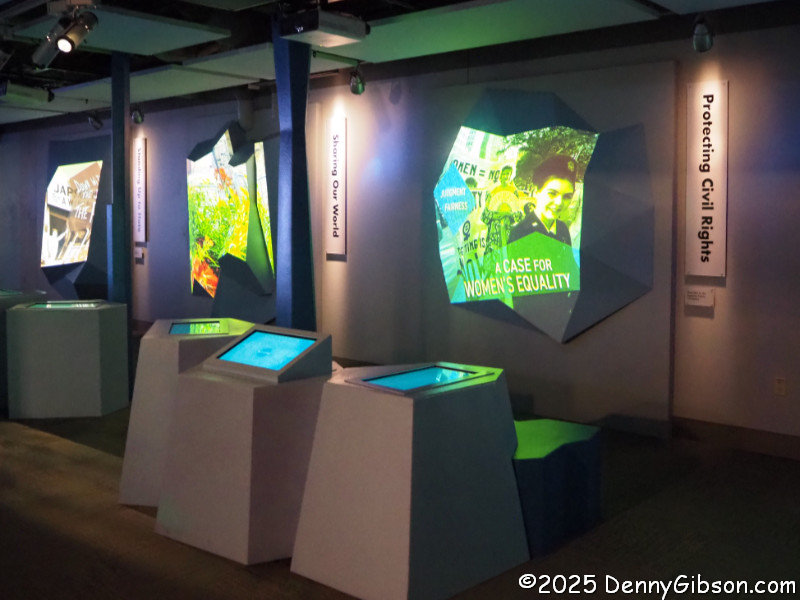
When I spoke with a friend about the Auschwitz exhibit, I encouraged a follow-on visit to the Holocaust Museum, and it wasn’t just because of the broader story. The Holocaust is humanity at its worst. Studying it and acknowledging it is important and necessary, but it is hardly uplifting. The museum offsets that just a little by presenting recent examples of bigotry being defeated and human rights being defended. Your mood probably won’t be exactly celebratory when you leave, but it very well might be hopeful.

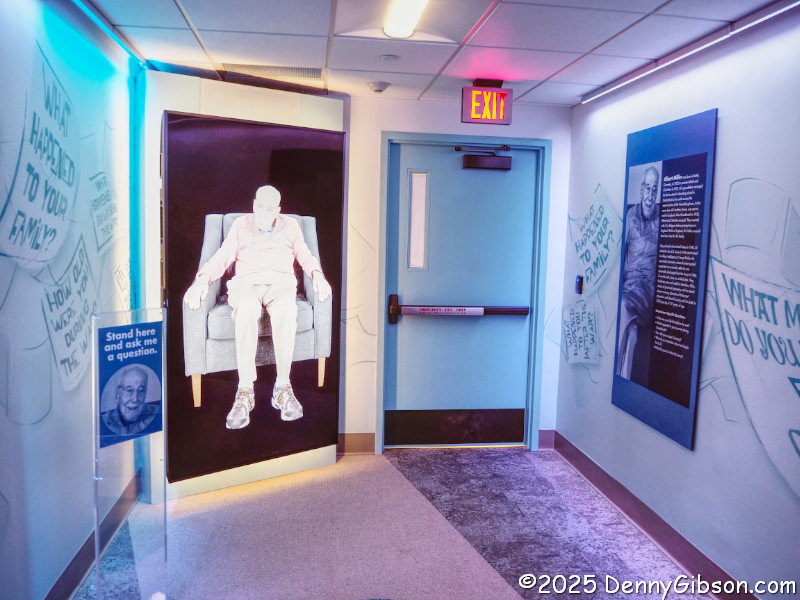
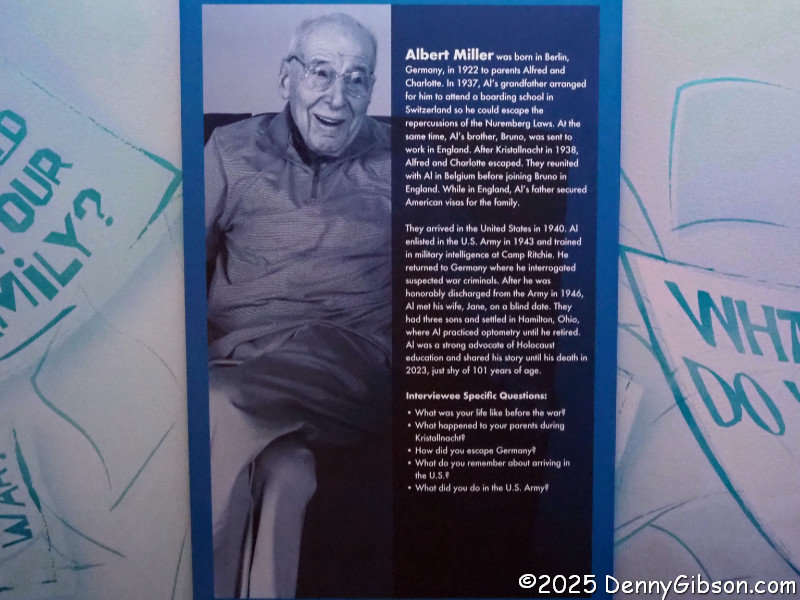
With every museum that exists, it is always possible to see something you’ve previously missed when you revisit. But sometimes that new discovery really is something new. That is the case with this recently installed interactive display featuring Albert Miller (1922-2023). Albert, who escaped Europe with his parents in 1940, then returned as a Nazi interrogator in 1943, tirelessly answers spoken questions about the life he lived.

I documented my first visit to the museum here

Bones, Butterflies, Bison, Bunnies, and Beavers

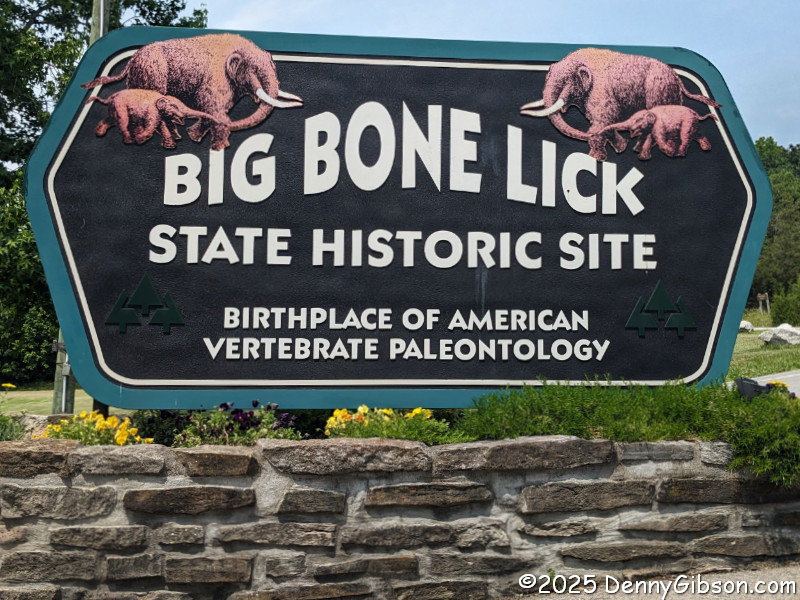
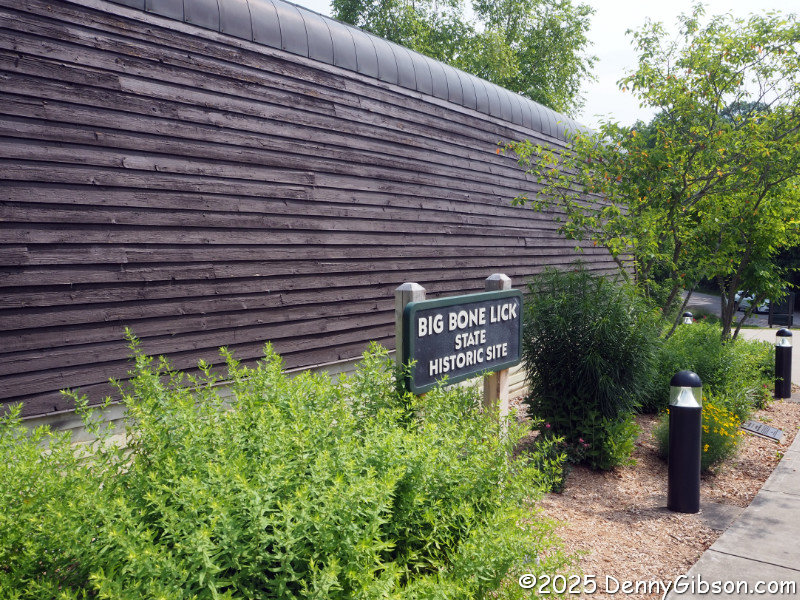
I have visited Big Bone Lick State Historic Site a couple of times in the past, but that was many years ago. Since then, I’ve passed it several times, without stopping, on the way to Rabbit Hash. A friend visited both last week, and their description of that visit made me promise myself that I would return. A sunny Thursday almost immediately provided a perfect opportunity.

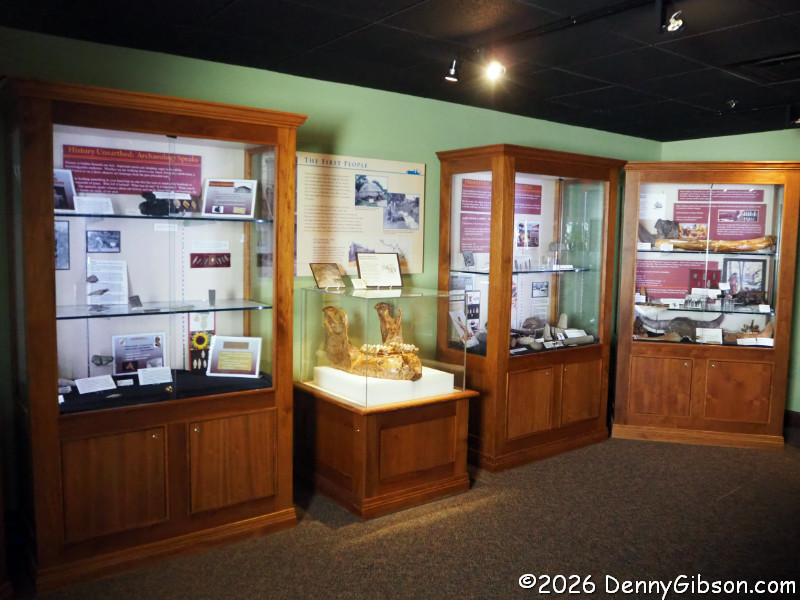
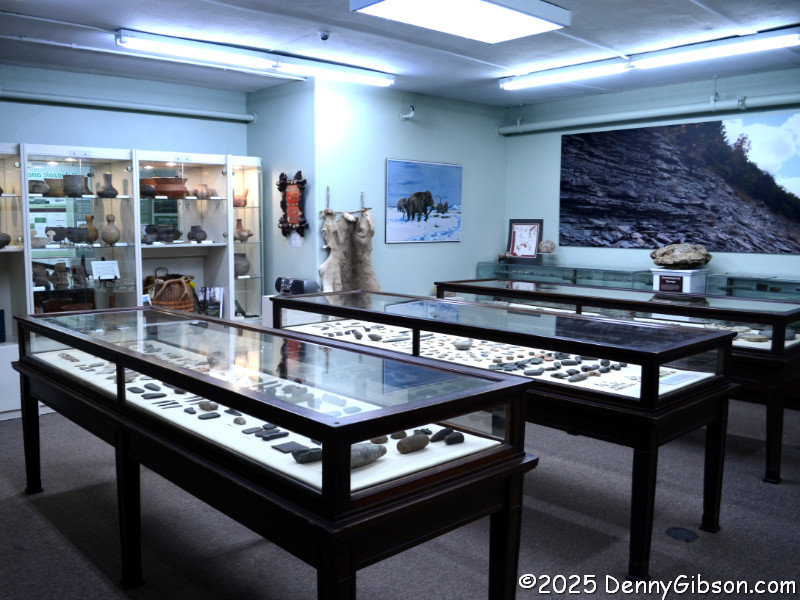
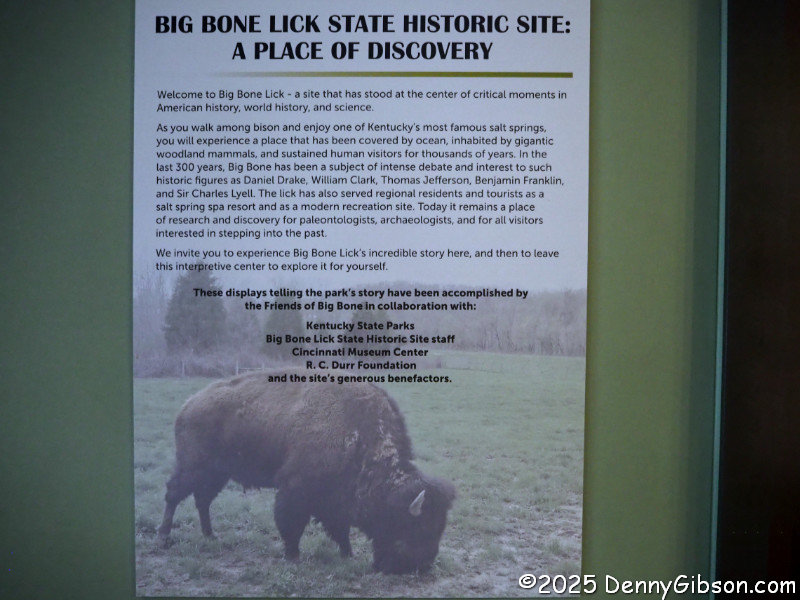
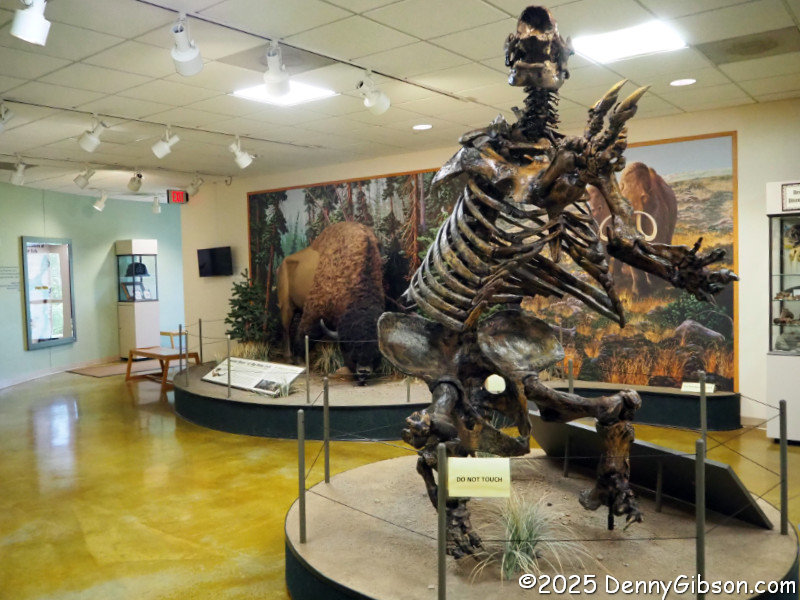
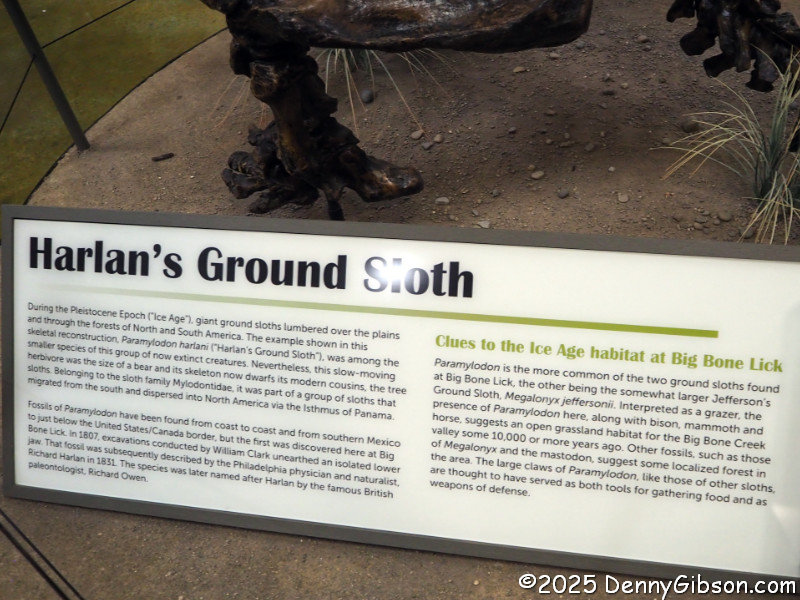
My first stop at the park was the Visitor Center. In addition to having a gift shop, helpful attendants, and a supply of information and maps, the center houses a small but very interesting museum. A panel just inside the door offers a pretty good overview of the park. That big guy in the foreground of the third photo is a Harlan’s Ground Sloth.

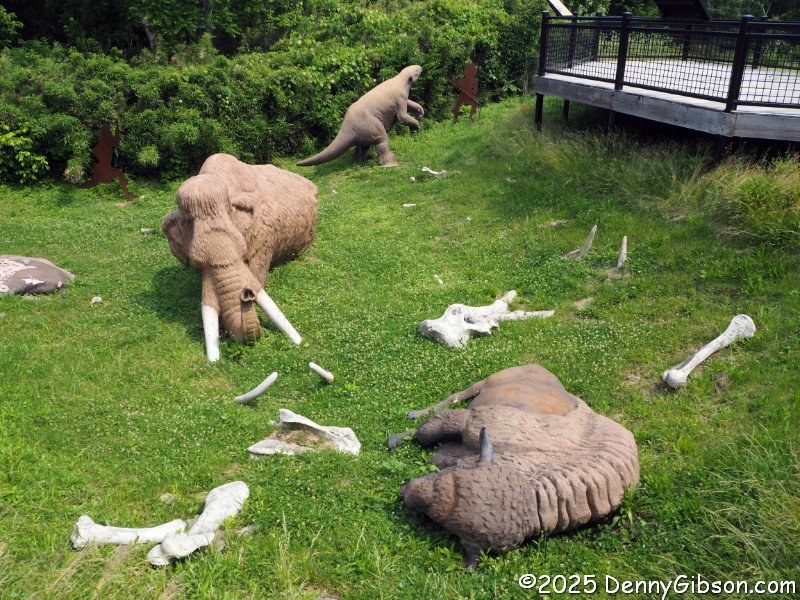
At the rear of the Visitor Center is a life-sized diorama depicting how earlier visitors to the salt springs might become trapped in the bogs and involuntarily leave their bones for future scientists. Big Bone Lick is on the Lewis and Clark National Historic Trail, not because the Corps of Discovery stopped here but because both of its captains did. At the urging of President Jefferson, Meriwether Lewis visited the site in 1803 on his way west to join William Clark. The boat carrying the specimens he collected sank on its way to Jefferson. In 1807, after that famous expedition to the Pacific Ocean, Clark made a stop here to collect and ship specimens that did reach the President.

Although they have absolutely nothing to do with vertebrate paleontology, I found the smallish examples of wildlife flitting about in front of the Visitor Center a lot of fun to watch.

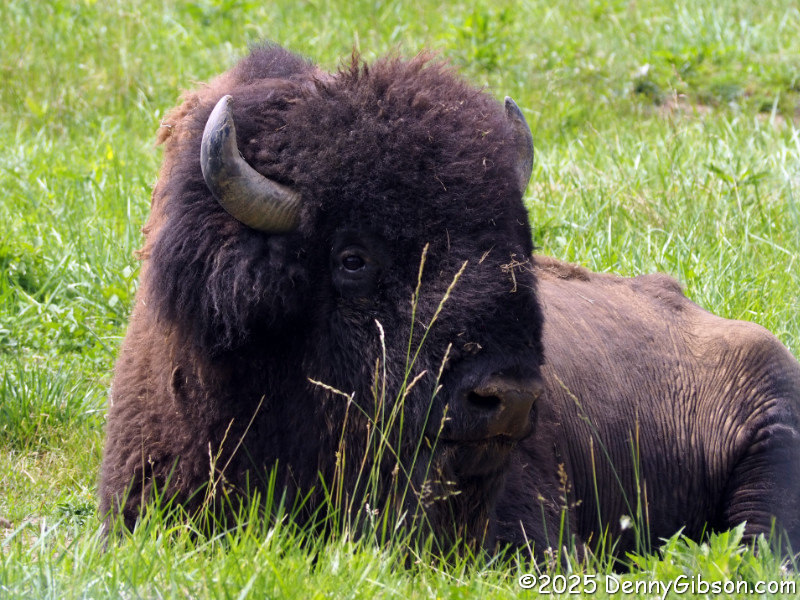
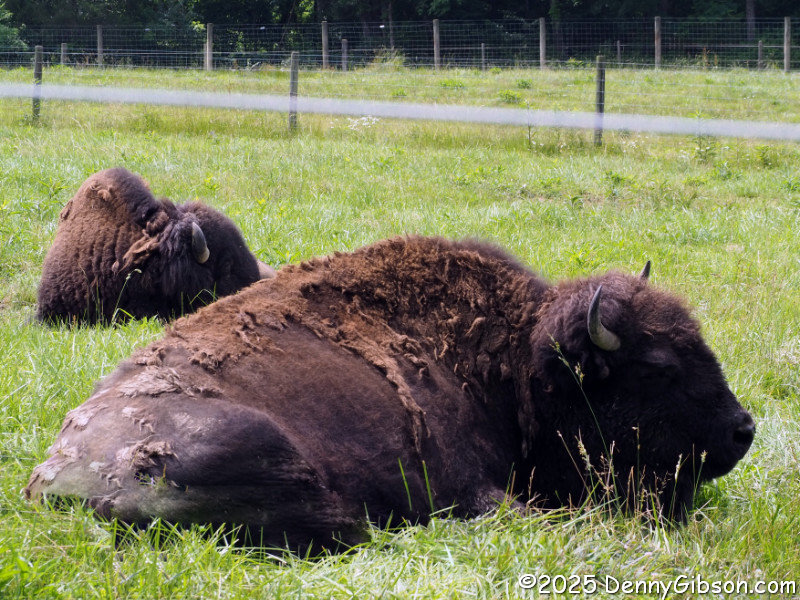
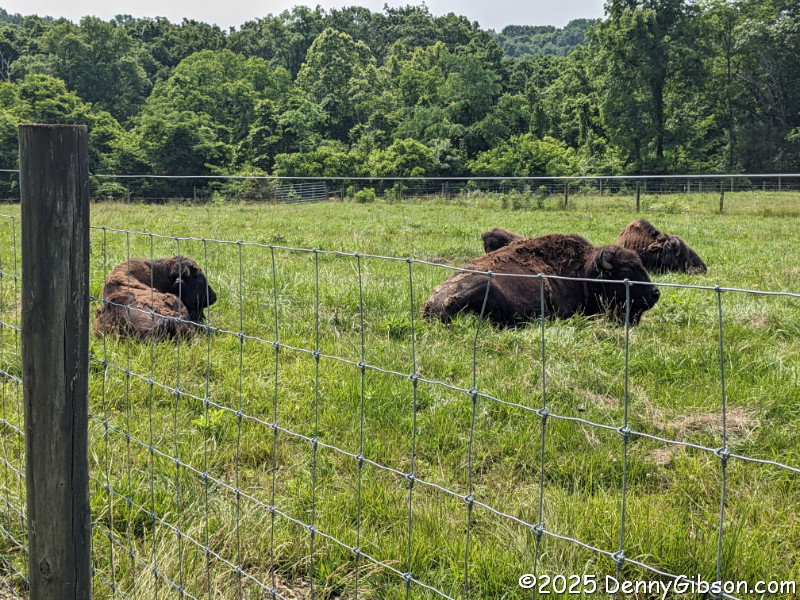
A paved path that begins a short distance from the Visitor Center leads to an elevated bison viewing stand. But no bison presented themselves to be viewed there today. Instead, the small herd was lounging in the grass, just out of sight, a short distance away.

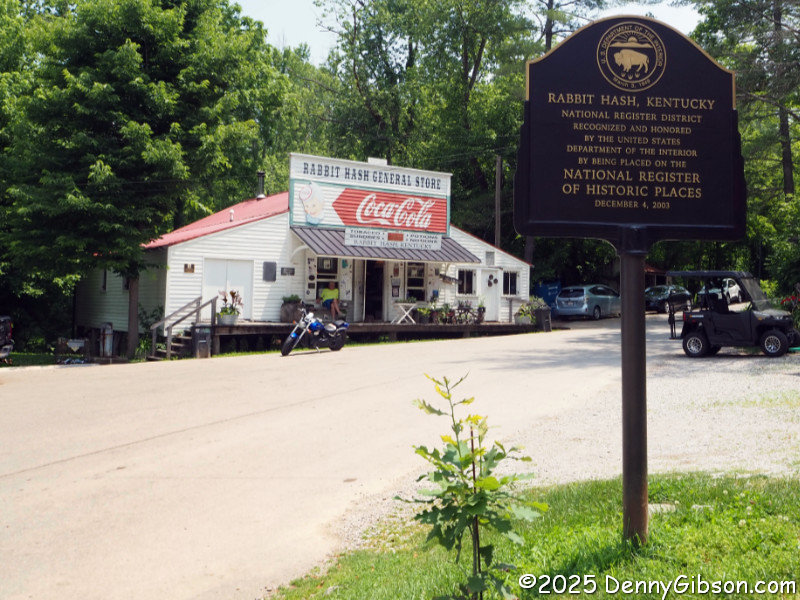
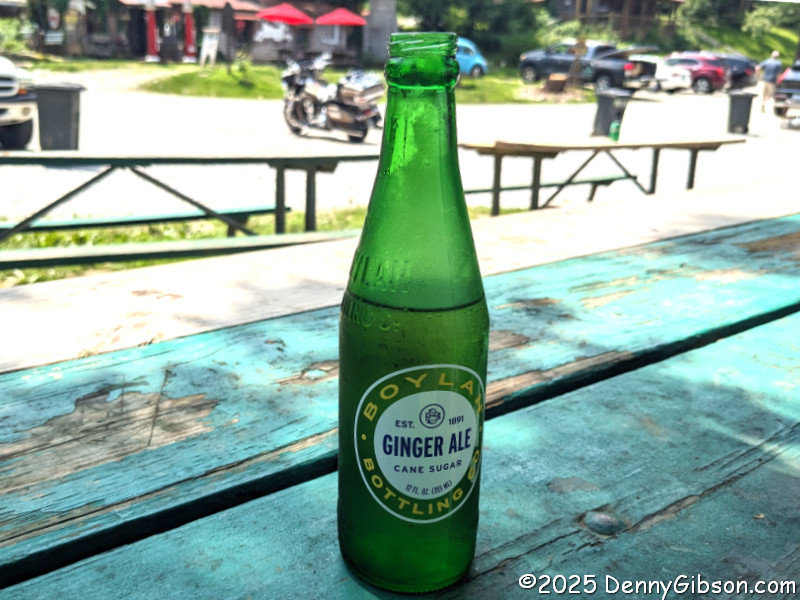
Having noted that I’ve passed Big Bone Lick a number of times while driving to Rabbit Hash, continuing on to the one-of-a-kind river town after my stop was rather natural. Besides, if I hadn’t, I could not have put “bunnies” in the title. I grabbed an ice-cold ginger ale at the general store, then sipped it as I watched the Ohio River flow by.

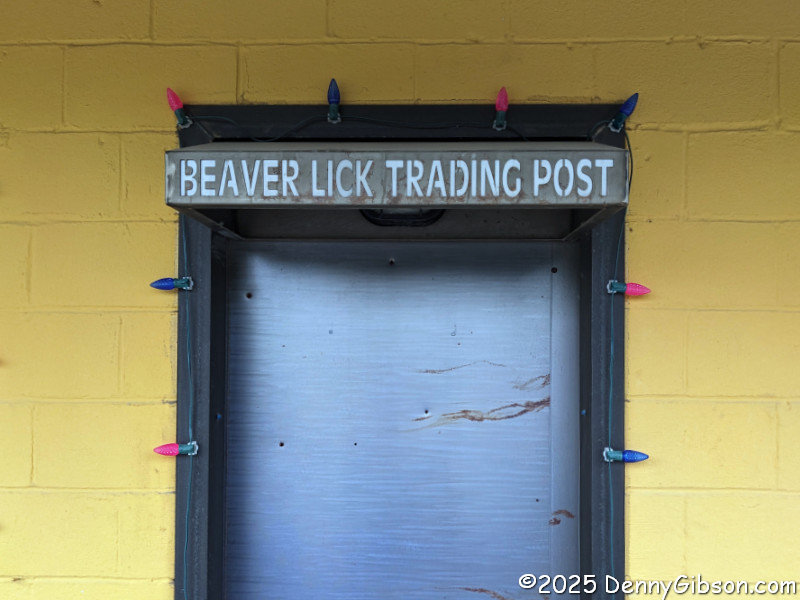
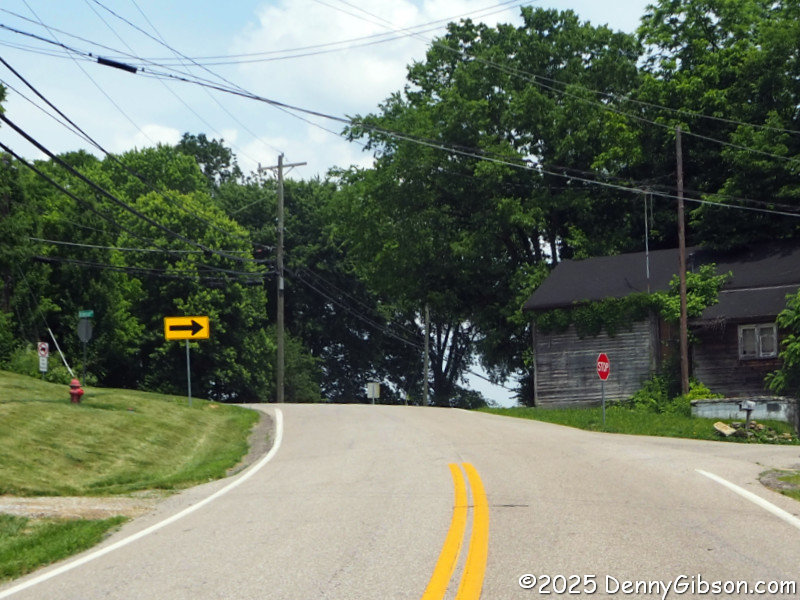
This intersection, just east of US 42 about two and a half miles east of Big Bone Lick, marks the community of Beaverlick. I believe there used to be limit signs here, but I found none today. If I didn’t imagine them, I’m guessing they are hanging on a college dorm wall somewhere. Until a year or so ago, there was a Beaverlick Trading Post at US 42, but it is now an ice cream stand, and almost all of the signage has been changed. They’ve not yet taken care of a couple of side doors, however. Places like Big Bone Lick and Beaver Lick (now Beaverlick) were salt licks where various animals came to get a little salt in their diet. They were named for the lickers, not the lickees.

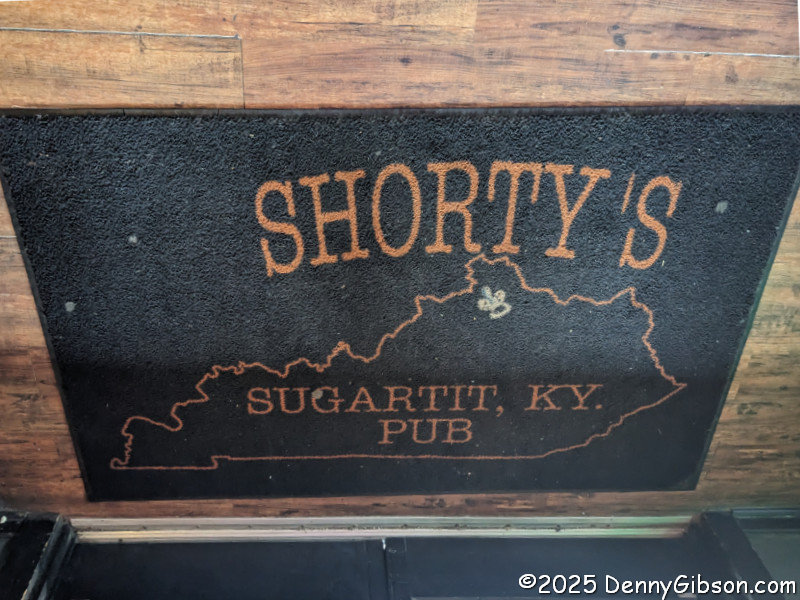
To complete what has turned into a survey of the area’s smile-inducing place names, I stopped at an establishment that appears to be the last remaining enterprise acknowledging that the community of Sugartit once existed. It’s just a few miles north of those spots made famous by salt-licking beavers and big boned animals.

Book Review
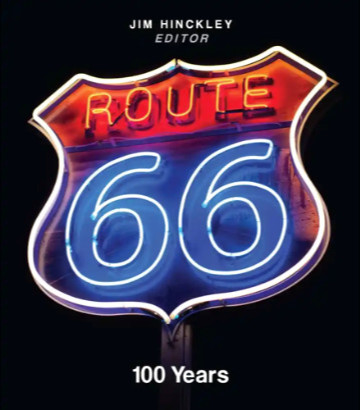
Route 66: The First 100 Years
Jim Ross and Shellee Graham

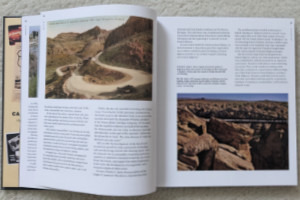
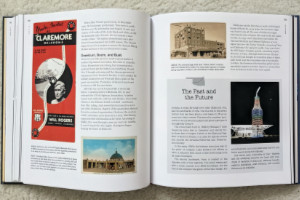
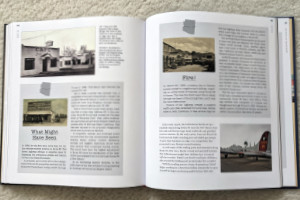
It’s a beauty. That was my initial thought when I first held this book in my hands and flipped it open. I wasn’t surprised, of course. I’ve seen enough of Jim and Shellee’s work to make me expect great photography and writing, a top-tier knowledge of history, and a rock-solid commitment to quality. I’m not quite as familiar with Reedy Press, but what I have seen smacks of the quality targeted in that previously mentioned commitment. My instant declaration of beauty came from seeing great images accurately reproduced on thick glossy pages. Including the text in my appraisal took only a little more time.

Route 66: The First 100 Years differs from some of the authors’ previous books in that it does not rely almost exclusively on their own photography for the book’s images. It’s a history book, so naturally, historic images are used; however, contemporary pictures from other photographers are also included, with each being properly credited.

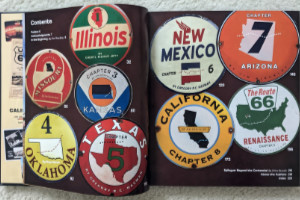
Unlike many other Route 66-related books, Route 66: The First 100 Years is not organized geographically. Nor is it organized chronologically as history books often are. There is a slight hint of chronology in discussing the roads that preceded US 66 in Chapter 1, “Revolutionizing Travel”, and covering “Renaissance” and “Preservation” in the last two chapters. In between, chapter subjects might be eras (e.g., “Hard Times”), collections of people (e.g., “Ladies of Legend”) and businesses (e.g., “Trading Posts and Tourist Traps”), or something else. Whatever the subject, a wide-ranging set of examples is included. But 100 years and 2400+ miles cover a lot of space and time, and anyone with more than a passing familiarity with Route 66 will probably come up with a personal favorite or two that didn’t get included. The selection process could not have been easy, but the selections are excellent.

Every chapter, like the vast majority of real-life road trips, has a “Detour”. The book’s detours are deep dives into one of the chapter’s subjects, and not all of them are obvious. The detour for the “Revolutionizing Travel” chapter is “The Ozark Trails”. This was an early named auto trail, or actually a system of auto trails, that, in my experience, doesn’t seem to get enough recognition. The “Hard Times” chapter takes a detour into an area that has been overlooked far too often for far too long: “The Green Book and Threatt Filling Station”.

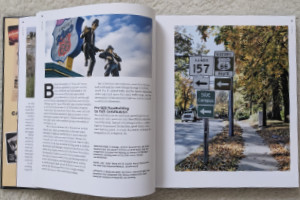
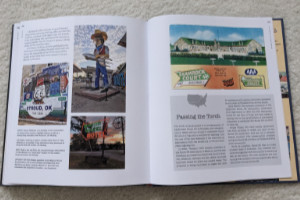
It’s probably not all that surprising that Route 66: The First 100 Years overflows its twelve numbered chapters. It starts with a full page of Acknowledgments, followed by a Forward written by Route 66’s storytelling king, Michael Wallis. Jim and Shellee follow that with a Preamble, then include an Epilogue, Road Facts, and a few other sections after Chapter 12. One of these sections, titled “Happy Trails”, is a collection of roadside photos taken over the Mother Road’s first 100 years. Many are of unidentified travelers, but there are some real celebrities in the mix. There’s Jack Rittenhouse standing beside a California U.S. 66 sign, Lillian Redman by an Arizona 66 sign, and Cynthia Troup gazing at a U.S. 66 sign in New Mexico. As I said earlier, 100 years and 2400+ miles cover a lot of space and time. Jim and Shellee have done an impressive job of capturing the big picture and quite a few of the small picture details, too.

While writing this, I took a look back at a post from this blog’s first few months of existence. My review of “Route 66 Sightings” by Jim and Shellee, along with their good friend Jerry McClanahan, was one of the first reviews published here. I was surprised to see that its last sentence starts with the exact same words that begin this review: “It’s a beauty”. Maybe I’m in a rut, but at least I’m being honest.

Route 66: The First 100 Years, Jim Ross and Shellee Graham, Reedy Press (May 22, 2025), 11 x 9 inches, 208 pages, ISBN 978-1681065823
Available through Amazon.

Sixty Years After

Ten years ago, on the day following the fiftieth reunion of my high school graduating class, I posted “Fifty Years After“. It ended with a reference to the far-in-the-future sixtieth reunion and the line, “If I can, I will”. I did. So did another seven members of the Ansonia High School class of 1965.

Not surprisingly, that was considerably less than the nineteen who attended the all-alumni banquet in 2015 or the twenty-six who attended the our-class-only gathering the night before. There is a banquet every year that is open to all graduates with emphasis on the “5s”. I have gone to most, if not all, of those, but there wasn’t one for our fifty-fifth. That was the year of the COVID pandemic. The lack of a get-together at the five-and-a-half-decade mark was somewhat disappointing, but it is the class of 2020 that really deserves our sympathy. I thought there might be something a little special for them on their fifth, but there was not. Actually, there was not a single member of the class of 2020 in attendance. It’s hard not to try reading something into that, but it’s just as hard, as an outsider, to know what that something should be.

Ten years ago, I wrote that “We graduated smack dab in the middle of a decade that was about as turbulent and confusing, yet as filled with promise and potential, as any could be.” It feels like we just might be smack dab in the middle of another one. Of course, the decade we were born in held the horrors of World War II and was clearly even more turbulent, but that decade is outside of our personal memories. It is the 1960s and 2020s that more or less bracket our lives as adults.

By coincidence, a blog I follow published a piece a few days ago that makes some comparisons between today and the world of sixty years ago. It is here, and I encourage reading it in its entirety. Among the events of sixty years ago it mentions is the Social Security Act of 1965. That’s the act that established Medicare and Medicaid. Both are facing cuts today. Our generation also benefited from things like the 1965 Voting Rights Act, the Water Quality Act of 1965, and others.

What I have just written makes me aware that my and my classmates’ adulthood more or less aligns with the rise and potential fall of numerous efforts to make life better for the general population. That, in turn, made me think of the cringeworthy idea that “We got ours. Sorry about your bad timing, kids.” Oh, how I hope that’s not true.

Classes celebrating one of the 5s are provided with a room to gather in before meal time. Our room wasn’t overflowing, but everyone there had a good time studying old photos and sharing the memories those photos, and just being together, stirred up.

Of course, classes are seated together at the banquet. Yeah, we took up a lot less room than we did in 2015. I didn’t try very hard to get a picture of the group as a professional took a posed group shot of us, and I’ll share that here as soon as it is available. Most of our class is in the foreground of the second picture, but that’s not the target. The target is every past cheerleader in attendance, lined up to lead us in a spirited singing of the old fight song.

ADDENDUM 23-Jun-2025: Here is that posed picture I promised. Someone must have told me an anti-joke just before it was snapped, or maybe I’m unhappy because I wasn’t let in on the joke that has everyone else smiling. Whatever the reason, I apologize to my classmates for grimming up at exactly the wrong time.

As usual, the banquet was followed by a dance. I always skip the dancing part, but this year I even skipped the going part. In the past, the dance was held at Eldora Ballroom on the Eldora Speedway property. The Ballroom was a weekend hotspot back in the day, and going there on alumni weekend always provided a little glimpse of the past. This year, it was at the American Legion, which would not have fed my nostalgia. It is at the same location I remember, but the building is a newer one. I’ve said I would have gone if it had been at Eldora, but maybe not. Starting the drive home before midnight seems a sensible thing to do these days.

The best information available indicates that we have lost a total of sixteen members of our class of sixty-five. That means that just about three-quarters of us are still around. In that 2015 post, I mentioned that the men who were living had already exceeded their at-birth life expectancy, and that the women were getting close. We are all in overtime now. A study I found online says that anyone turning 78 in 2025 can expect to live another 11.09 years. That would cover a 70th reunion. If I can, I will.

1950s Flashback

The Cincinnati Museum Center has presented a 1940s Day or Weekend annually since 2011. I attended the third in 2013. Saturday was their first-ever 1950s Day. Asked on their Facebook page if this would also be an annual event, the museum said no. It is intended to be a one-time thing to mate up with the ongoing Julia Child and Barbie exhibits. “But,” they added, “it could come back!” I don’t really remember the 1940s, but I do remember the 1950s, and the rain on Saturday looked just like rain did when Ike was in the White House and Waite Hoyt was on the radio.

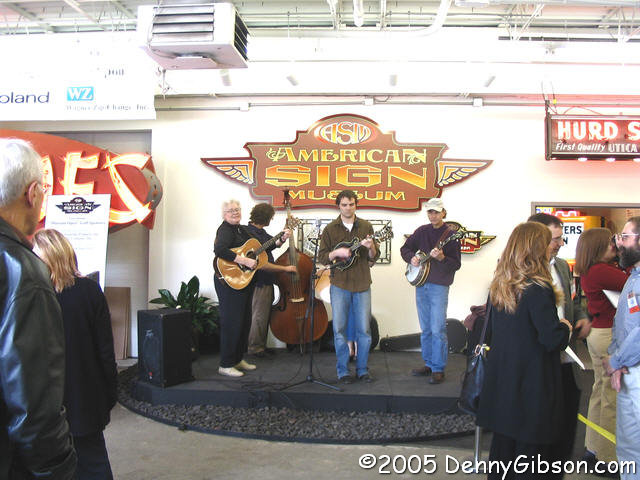
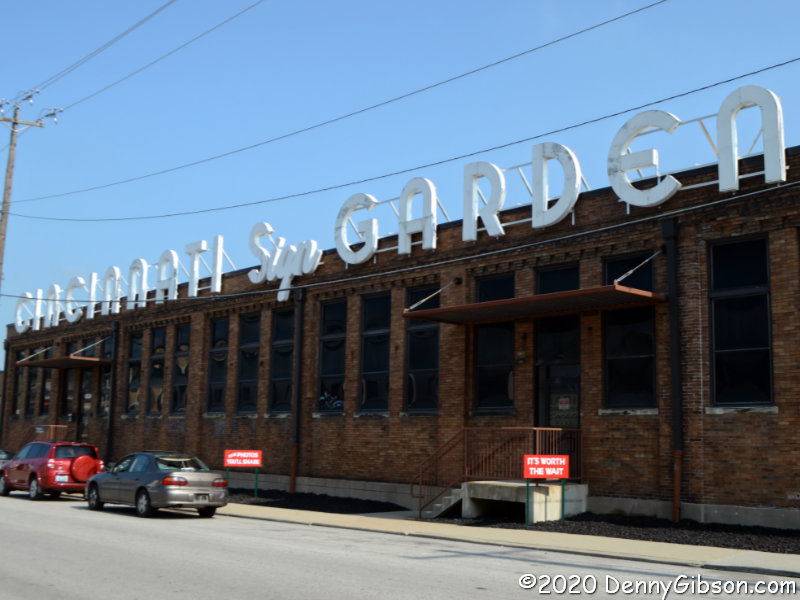
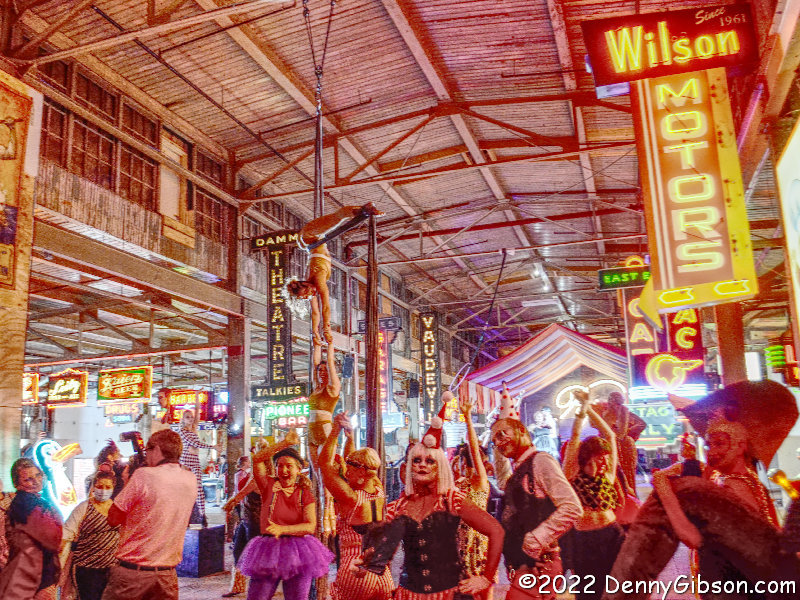
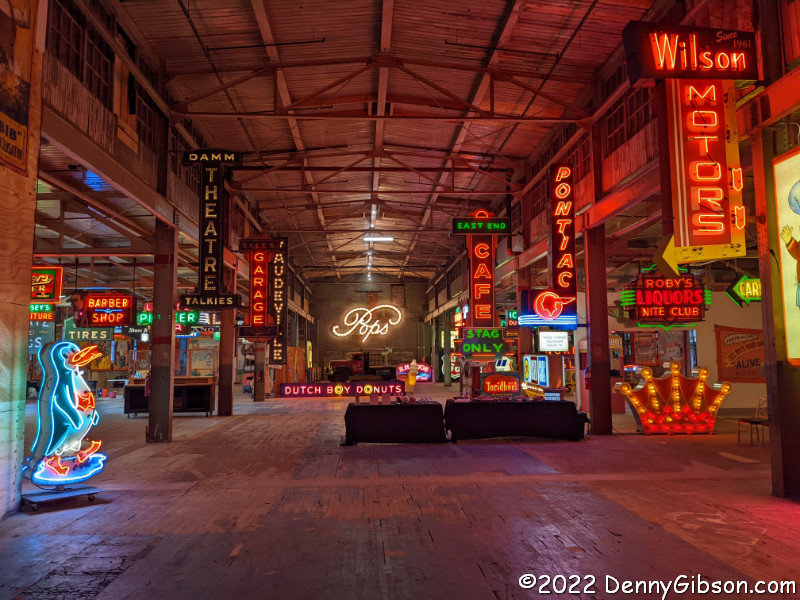
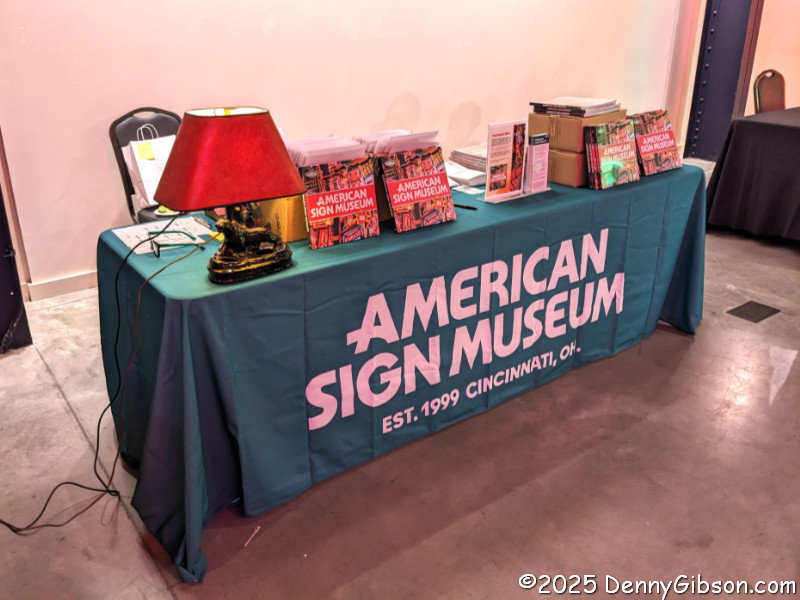
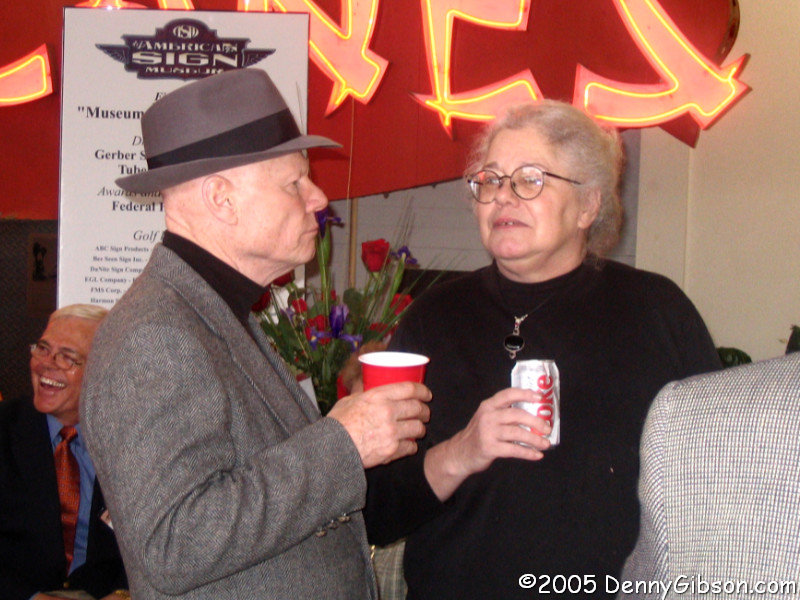
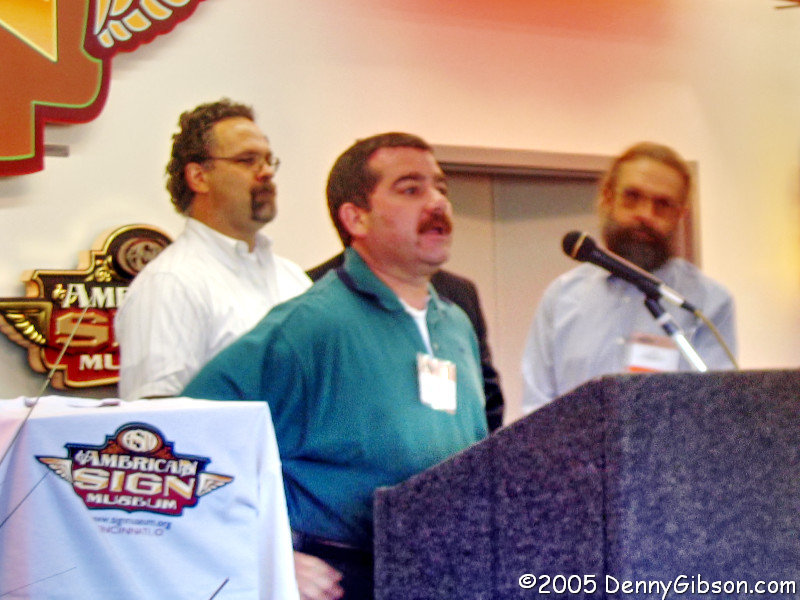
Individual information tables lined the rotunda. Pictured are King Records Legacy, Casablanca Vintage Clothing, and the American Sign Museum with a genuine 1950 NEON SIGN.

I stepped into the Newsreel Theater intending to watch a few minutes of the Moving Images presentation and ended up staying more than an hour watching clips of “Melody Showcase”, “Midwestern Hayride”, and commercials. I don’t remember “Melody Showcase”, but “Midwestern Hayride” was a staple at our house, and it’s even possible that I saw some of what I saw today when it was broadcast live.

1950s Day included quite a bit of live music. I caught the P&G Big Band, the Queen City Sisters, and Naomi Carman and the Bluecreek Boys. I do intend to check out the Barbie and Julia Child exhibits sometime, but the museum was far too crowded for that on Saturday. I’ll slip them in on a weekday when school’s in session and employed people are doing employee things.  

Cincy’s Fire Fighting Heritage

I once ate dinner here. It was sometime in the 1980s. The company I worked for held a banquet for a sales conference here, and we were all allowed to tour the museum before the meal. I recall that I found the Cincinnati Fire Museum quite interesting at the time, but for some reason gave those memories the better part of four decades to fade. During Saturday’s visit, I did find a few pieces of equipment to be somewhat familiar, but I don’t really remember anything about the layout of the museum and have a hunch it has changed more than a little since I was here.

Steps — or for adventurous youngsters, a pole — lead to a lower level where the oldest items in the museum are on display. The city’s first fire engine has been lost to history, but its second survives. It is a pumper built by William C. Hunnerman of Boston in 1816. With a crew of twelve, it could throw water up to 133 feet. The massive drum was Cincinnati’s fire alarm from 1808 to 1824. After the city became too big for the drum to be heard by all, a bell took over, and the drum fell on hard times, which included a period of being used as an oat bin before someone recognized its importance and started to take better care of it. Bored-out logs like the one here were once common components in city water systems. When firemen reached the scene of a fire, they might drill a hole in the nearest pipe to access the water, then plug and mark it for possible reuse in the future. The name “fire plug” has outlived wooden pipes and hand drills by a bunch.

Before the middle of the nineteenth, things called fire engines were merely pumps that were usually mounted, almost always accompanied by some sort of tank, on wheels. Manpower pulled the engines to fires, and manpower operated the pump once they arrived. In 1853, Shawk and Latta, a Cincinnati company, developed the first practical steam pump for fighting fires. Cincinnati soon gained a reputation as a supplier of firefighting equipment. The horse-drawn fire engine (rear view here) was built in 1884 by the Ahrens (later Ahrens-Fox) Fire Engine Company, who had obtained the Latta patents in 1868.

At almost exactly the same time that steam power was dramatically changing firefighting equipment, an equally dramatic change was occurring with the firefighters. Boston began paying some of its firefighters in 1679. Cincinnati went further in 1853 and is considered to have established the nation’s first fully paid fire department. In 1873, Cincinnati firefighters were forbidden from holding other jobs, making them truly professional.

Closing things out is a pair of twentieth-century Ahrens-Fox fire engines. The chain-driven Model M-4 was delivered to Cincinnati’s Company 13 in 1918. The 1958 cab forward Model ECB is the last fire engine ever produced by Ahrens-Fox. It was retired in 1981.

Voice of America Museum Revisited

The nearby National Voice of America Museum of Broadcasting reopened last month after a seven-month closure for refurbishing. I visited the museum back in 2022 but had been hearing about the update and decided to fill an idle Saturday with a return visit. One thing that is different from the last time is noticeable from the outside. Visitors now enter from the side rather than the front. I’m guessing that’s part of the recent rework, but it might have been that way beforehand.

I arrived a few minutes ahead of the day’s first guided tour, and I used those minutes to look over the Cincinnati radio and TV displays near the entrance. Cincinnati was a real leader in the early development of both forms of broadcasting. The pictures are of the Larry Smith Puppets and the Ruth Lyons set. Smith came to fame on the Uncle Al Show and later had a show of his own. Ruth was a true pioneer in daytime talk TV. Note the converted-to-color Predicta TV next to Ruth’s sofa.

When I visited in 2022, the display of Cincinnati’s commercial broadcasting history was kind of like a big attic. These nicely designed exhibits are typical of the improvements made during the recent refurbishing. 

When the United States entered World War II, Cincinnati’s WLW was using this 50,000-watt transmitter to broadcast entertainment to South America via shortwave. The newly created Voice of America initially rented the transmitter and started broadcasting on February 1, 1942, less than two months after the bombing of Pearl Harbor. In the second picture, Joe, our guide, demonstrates how shortwave signals reflect off of the ionosphere and bounce around the globe.

The Volksempfänger (people’s receiver) existed to bring Nazi propaganda into German homes, and USSR-built transistor receivers did the same for the Soviet Block. The VOA never managed to get its programming to the Volksempfängers, but the BBC did. People figured out how to tweak the Soviet radios to pick up both. Incidentally, VOA has never broadcast propaganda, rightfully believing that broadcasting the truth is more effective.

Within about a year and a half, the building that is now the museum was complete, equipment was in place, and a huge array of antennas was erected. The last picture is just the front panels of the 250,000-watt transmitter, which is not just room-sized — it’s a room. I think at least half of our tour group stepped inside at the same time without a hint of crowding.

Here is something left over from World War II that is still pretty useful. 

Happy Lupercalia

Two weeks ago, I had nothing planned for this blog and was preparing to dust off an old Groundhog Day or Imbolc post when I spotted a notice for a motorcycle show on Groundhog Day Eve. That led to Beer and Bikes, and the Imbolc and Groundhog posts were left on the shelf for another day. When I found myself in the same situation around Valentine’s Day, I got to wondering if Valentine’s Day had the same relationship with older, often pagan, holidays that days like Easter, Christmas, and Candlemas have. After all, its full name is Saint Valentine’s Day.

For me, the answer is probably. Almost all online articles about the history of Valentine’s Day mention the Roman feast of Lupercalia but most stop short of firmly linking the two with phrases like “many believe” there is a connection or that a connection “has been suggested”. Count me among the many who believe.

Lupercalia comes from the Latin word lupus which means wolf. Theories about its association with the feast include a deity that protected herds from wolves and the wolf (pictured above) that kept Romulus and Remus alive so they could get Rome started. Some descriptions of Lupercalia imply it was a one-day event held on February 15. Others say it was a three-day affair that filled the 13th, 14th, and 15th.

Regardless of how long they say it lasted, everybody describes it as a quite raucous celebration. Participants were drunk and naked. Men sacrificed goats and dogs then whipped women with strips of the animal’s skins to increase fertility. At some point — which I assume was after the slaughter, skinning, and whipping — men and women were paired up by lot for the duration of the festival. Trysting with a possibly blood-splattered random lady after trying to make her more fertile doesn’t seem all that wise or even fun, but times were different.

That the Christian Church would want to replace that with something more sedate seems natural, but the origins of Valentine’s Day are not well documented. There seems to be no shortage of saints named Valentine. Two are connected to February 14 by virtue of reportedly being executed on that date in different years. The Eastern Orthodox Church celebrates a different Saint Valentine on July 6 and yet another on July 30. One of those guys executed on that special day in February was sentenced to die because he persisted in marrying Christian soldiers when the Roman emperor forbade it. That could be what initially got the day associated with love and romance, but I’m betting it was the Lupercalia lotteries.

Associating romance with the day really picked up steam after Chaucer published “The Parlement of Foules” in 1375, and a few Valentine cards were sent between lovers during the next couple of centuries. Then Cadbury came up with heart-shaped boxes of candy for the day in 1868, and Hallmark started printing Valentine’s Day Cards in 1913. It is predicted that Americans will spend $2.5 billion on candy this year and $1.4 billion on cards. Throw in jewelry, flowers, and romantic dinners, and the total bill is expected to reach $27.5 billion. I’m sure goats and dogs are also celebrating, but they’re doing it very quietly.


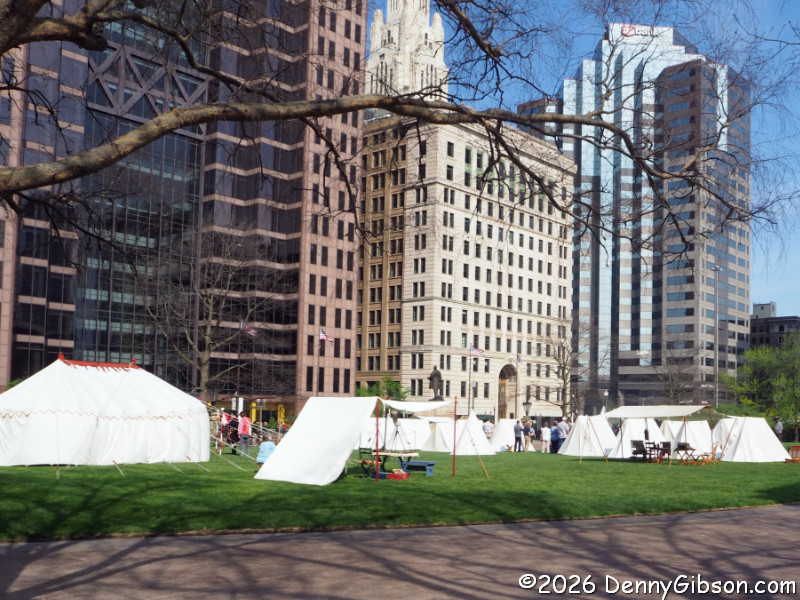
The opening photo is of the Capitoline Wolf in Cincinnati’s Eden Park, taken June 1, 2014. The statue has been admired, denounced, stolen, and replaced. Read about it here.

St. Clair’s Defeat Revisited

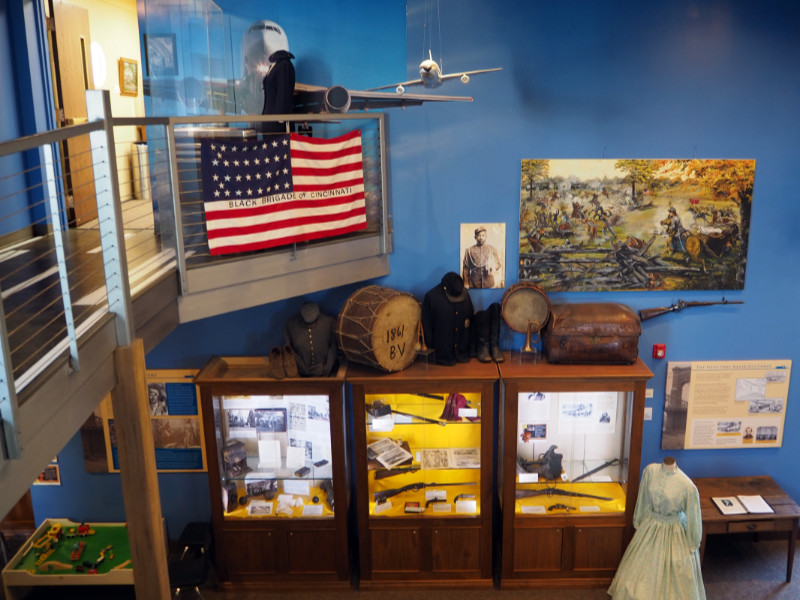
When I got the email about a preview of a new exhibit at Ohio History Connection, I quickly signed up. Only as the date approached and I started looking into the exhibit did I realize that, while I would get to preview the opening of “St. Clair’s Defeat Revisited: A New View of the Conflict,” this would not be the exhibit’s premiere. That had occurred at the Fort Recovery Museum, the actual site of St. Clair’s Defeat, in November of 2023. After spending about two months at Fort Recovery, the exhibit had appeared for nearly four months in Fort Wayne, IN, and more than six months in Miami, OK. The opening I was previewing was its fourth.

The disappointment I felt in this not being the world premiere I initially thought it was, was outweighed by my embarrassment in not knowing of the true world premiere that had happened more than a year before. Food and drink were pretty good compensation, however, and both disappointment and embarrassment were pretty much forgotten at the member’s reception. 

The member’s preview also included a panel presentation and a question and answer session. Bill, whose last name I failed to record, acted as MC, while Kim Rammel and Dr. Kristen Barry supplied the information. Rammel is president of the Fort Recovery Historical Society. Barry is a professor at  Ball State University and a member of the team responsible for the exhibit.

It has been said that history is written by the victors, but while that is generally true of wars, it isn’t always true of individual battles. The “new view” this exhibit provides comes from descendants of the nine Native American tribes that nearly annihilated the entire United States army in 1791. Specific details of the battle differ very little as related by the two sides, but there are differences in its overall assessment. Virtually every description of the battle that I have read attributes the overwhelming success of the native force to errors, poor training, and incompetence on the part of the Americans. Those certainly contributed, but the native’s brilliant plan of attack and its near-perfect execution were at the heart of their victory.

It was great to see the event so well attended even though it meant space to study the exhibits was in short supply. l snapped these pictures during the reception period when the display area was not quite as crowded as it was following the presentation in the auditorium. In addition to the battle, parts of the exhibit are dedicated to Background, Aftermath, and Persistence. The victory brought only a brief respite. In just a few years, a new U.S. Army was victorious at the same site and elsewhere, and the Treaty of Greenville soon followed. The Indian Removal Act of 1830 was followed by forced relocation and the systematic suppression of native culture. The tribes have survived, however. This exhibit spent those months in Oklahoma so descendants of the people who defeated St. Clair could see it.

Two smaller versions of the exhibit have been created. One is on permanent display at Fort Recovery. The other will travel and is currently at the Hopewell Culture National Historical Park near Chillicothe, OH, where it will remain until April 13. The exhibit at the Ohio History Connection runs until August 17.

You Never Even Called Me by My Name

The photo at right was taken at the very beginning of the longest night of 2024. It was supposed to show the sun setting over the Ohio River but the sun is doing its thing behind a wall of clouds. Winter Solstice is about eleven hours and thirty-eight minutes away. Sunrise is fourteen hours and twenty-three minutes away.

In four of the last five Decembers, I have published a solstice-related post. Three were versions of A Cosmic Reason for the Season which was first published in 2019. It basically tries to explain how modern-day Christmas had its beginning in celebrations of the Winter Solstice and how the two have become quite disconnected over the centuries. Last year’s Don’t Christmas My Yule post came from my realization that not everyone considers Yule to be synonymous with Christmas and that many celebrate a Yule that is just as tightly tied to the solstice as it ever was.

Those posts, along with a few others, talk about how holidays like Christmas, Easter, and Groundhog Day (Candlemas) have become so out of synch with nature that most see no connection at all. If that sort of thing interests you, I suggest reading them and I doubly suggest reading an article I’ve cited in them: The Winter Solstice and the Origins of Christmas

This article is being published during the gap between Solstice and Christmas and looks at a question I’ve had about the latter for some time. I guess the question had never bothered me enough to look for an answer because, when I did, I immediately found an article that used the question I was asking as its title and answered it quite nicely. The question — and article — is: Why is Christmas a Federal Holiday?

As I said, the article answers the question quite nicely and I won’t repeat it all here. The extremely short version is that it was declared a holiday by date rather than by name and that seems to be the primary reason it has survived First Amendment-based challenges. Some weight has also been given to the fact that three other clearly secular holidays were established at the same time. The pertinent text of the 1870 bill is: “The first day of January, commonly called New Year’s Day, the fourth day of July, the twenty-fifth day of December, commonly called Christmas, and any day appointed or recommended by the President of the United States as a day of public fast or thanksgiving shall be holidays…” The full bill is here.

Note that the bill tied three of the holidays to days of the month with no mention of days of the week and no consideration for solar or lunar positions. Thanksgiving was not tied to anything at all. It had been celebrated since the days of George Washington but its date was set by proclamation and varied considerably. Lincoln moved to tie it to the last Thursday of November with an 1863 proclamation but for some reason, the 1870 bill did not put that into law. Nonetheless, Lincoln’s proclamation held until Franklin Roosevelt tried moving the holiday to lengthen the 1939 “25th of December” shopping season. Not everyone went along and in 1941 the legislature finally stepped in to nail Thanksgiving to the fourth Thursday of November.

I felt somewhat chagrined when I read that 1870 holiday bill. For several years I have made a conscious effort to refer to that big mid-summer holiday as Independence Day instead of the — I thought — more informal 4th of July. I stand corrected and henceforth will try to remember to wish everyone a Happy 4th of July and a Merry 25th of December.