This series started in 2014 under the title “I Care Not How. Only If.” In 2018, I acknowledged that I did care how and changed the title to the one at the top of this post. In recent years, I’ve come close to acknowledging that I care a lot about how people vote and changing the title again. Two things have kept me from doing that. One is that the situation that prompted that first post ten years ago still exists — too many people eligible to vote in the USA don’t.
We are getting better. According to the Pew Research Center, 2020’s 66% turnout was the highest rate for any national election since 1900. Some people don’t vote because it is just too difficult and there have been recent efforts, often under the guise of “security” to make it more so even though voter fraud is so rare that it is almost non-existent. If you are in a position to help eliminate unjustified barriers to voting, do it. If you are capable of going over, around, or through unjustified barriers to voting, do that. If there are no unjustified barriers to your voting, vote.
The other reason I have stuck with and actually stand by this post’s title is one of the observations in an article I referenced in the 2018 post where the title was first used. That post is here, the article is here, and the observation I’m thinking of is that people are becoming more engaged in elections. Yes, in far too many cases engagement takes the form of personal insults and glib memes on social media. And yes, people seem to be doing a lot more talking than listening but I’d like to think that there are at least a few more people listening now than there were in 2014.
Ohio folks: Tomorrow, Oct 7, is the last day to register — in person, by mail, or online.
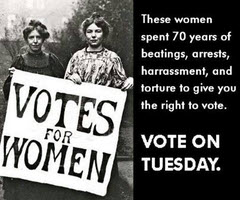
We fought a war to get this country going then gave every land-owning white male above the age of twenty-one the right to vote. A little more than fourscore years later, we fought a war with ourselves that cleared the way for non-whites to vote. Several decades of loud, disruptive, and sometimes dangerous behavior brought the granting of that same right to non-males a half-century later, and another half-century saw the voting age lowered to eighteen after a decade or so of protests and demonstrations.
Of course, putting something in a constitution does not automatically make it a practice throughout the land and I am painfully aware that resistance followed each of those changes and that efforts to make voting extremely difficult for “the other side” are ongoing today. I don’t want to ignore partisan obstructions and system flaws but neither do I want to get hung up on them. I meant my first paragraph to be a reminder that a hell of a lot of effort, property, and lives have gone into providing an opportunity to vote to a hell of a lot of people. Far too many of those opportunities go unused.
We may be getting slightly better, however. 2018 turnout set a record for midterm elections as reported in this Vox article. According to this Pew Research article, turnout was even better in 2020 although the United States continues to trail most of the world’s democracies. It was in the 2020 version of the Pew Research article that I noticed something that I simply hadn’t realized previously. The United States has the greatest difference between the percentage of voting-age population (VAP) actually voting and registered voters actually voting. In many countries, there is no difference at all since to be a citizen is to be allowed to vote. In other countries, the difference is trivial. In the U.S. presidential election of 2016, it was a whopping 31.1% (86.8-55.7). It was even a little bigger in 2020 at 31.3% (94.1 – 62.8). In 2020, I found that startling so I guess I can’t be startled by it again. However, I can be and am dismayed. The problem does not seem to be getting registered voters to the polls; 94.1% is an impressive turnout. The problem is getting people registered. That’s sinking in very slowly.
 I first posted the core of this article in 2014. In the original title, I claimed to not care how anyone votes. That was never entirely true, of course. I have my favorite candidates and issues. I’ll be disappointed in anyone who votes differently than I do but not nearly as disappointed as I’ll be in anyone who doesn’t vote at all. I’m reminded of parents working on getting their kids to clean their plates with lines like, “There are hungry children in China who would love to have your green beans.” I’m not sure what the demand for leftover beans is in Beijing these days but I’m pretty sure some folks there would like to have our access to ballots and voting booths.

 This picture is from my 2005 An Autumn Place trip. This started with an invitation from Pat Bremer to join the Impala SS Club for a visit to A Summer Place. This is the recreated 1950s town where the Bremer’s wedding had taken place just a couple of years earlier. The Parke County Covered Bridge Festival happened to be going on at the same time so since I was halfway there, I decided to do that too and make it a three-day trip.