 Carl Fisher was a busy man in 1913. His Prest-O-Lite Company and his automobile dealership were both going great guns, the Indianapolis Motor Speedway he co-founded looked like it might amount to something, the Ocean-to-Ocean Rock Highway he had proposed in September of 1912 was taking off, and then there was the Indiana Automobile Manufacturers’ Association.
In the early years of the industry, Indiana was second only to Michigan in number of automobile manufacturers. Several of them cooperated in a 1911 four state promotional tour that was so successful they organized the IAMA and another four state tour in 1912. In 1913 they were ready for something bigger. The result was the Indiana-Pacific Tour that went from Indianapolis to San Francisco then down the coast to end at Los Angeles. Carl Fisher was part of the tour that left Indianapolis on July 1, 1913, the same day that the Lincoln Highway Association, which is what his Rock Highway proposal had led to, was incorporated. That coincidence of dates and a connection with the troublesome Colorado loop of the Lincoln Highway were essentially the only details of the IAMA tour I knew of. Now, thanks to Dennis and Terri Horvath, I know a lot more.
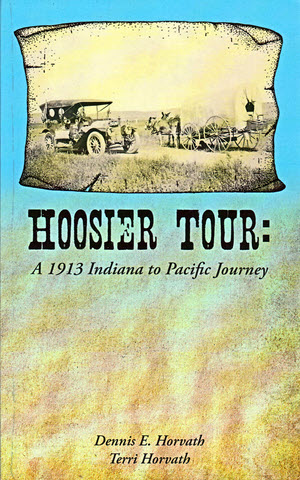
Hoosier Tour: A 1913 Indiana to Pacific Journey is not filled with flowery prose or lots of humor. That’s not how the Horvaths write. Neither is it filled with terse sentences and clipped descriptions. It is filled with an enjoyable and accurate account of the complete tour and the lead up to it. It tells of the men and machines on the tour and gives a hint of the tour’s impact on the acceptance of automobiles and the Good Roads Movement.
After a couple of chapters describing the IAMA and its planning for the tour, Hoosier Tour follows the Indiana vehicles across the country. Though not organized as such, the book is something of a group diary in that a day’s beginning and end points are usually mentioned along with highlights and lowlights.
This was a huge event in its day. It included eighteen cars and two trucks from fourteen manufacturers. Several journalists and a former Indianapolis mayor rode along. One car was driven by the winner of the inaugural Indianapolis 500, Ray Harroun. Several governors climbed aboard when the tour entered their state and rode along until it exited. Virtually every cluster of building on the route demanded a visit and presented the participants with gifts ranging from watermelons to free gas.
As an advertisement for Indiana built automobiles, the tour was a complete success. Not one car dropped out for mechanical reasons. It also performed well in regards to another stated purpose, boosting the Good Roads Movement. Aside from the high profile tour raising awareness considerably, it triggered improvement along the route it followed. Every locale wanted to make a good impression and the book tells of many improvements made just days ahead of the tour’s arrival.
One reason to impress was the belief, held by many, that Fisher was using the tour to evaluate the intended route of the Lincoln Highway. He denied any official connection between the route of the Indiana-Pacific Tour and the Lincoln Highway and much of the tour route was not even close to the path that would be announced in September but the belief was not totally without merit. Those familiar with Lincoln Highway history may know that the highway, as originally announced, did not enter Colorado but that a “Colorado Loop” was quickly added in response to pressure from the state. After reading the Horvaths’ account of the tour’s visit to Denver, which included a parade and a real brass band, it is rather easy to see why Colorado had expectations.
Even though the Indiana-Pacific Tour would continue on to Los Angeles, reaching San Francisco made good the title and there were great celebrations. A parade greeted them on arrival though the Horvaths do not say whether or not it included another brass band. Banquets, tours of the recently rebuilt city, and a stop at Cliff House kept the tourists busy for about three days. The book follows them down the coast to Los Angeles where most of the tourists boarded a train for the trip home. With the tourists back in Indianapolis, the final chapter touches on what followed for the Indiana automotive industry. Next are several pages of photos from the tour and appendices listing the tour’s people and vehicles.
There is little question that the Indiana-Pacific Tour should be better known than it is. It demonstrated the ability of automobiles, particularly Indiana built automobiles, to travel long distances and it brought nationwide attention to the value of good roads. It deserves to be more than a footnote to the Lincoln Highway and this book should help with that.
A lot has changed in one hundred years. It is a little sad that we can no longer purchase an Indiana built Stutz Bearcat but it is a good thing that we no longer have to dodge thrown ears of corn as the driver of the Stutz on the tour had to do after frightening a farmer’s horses.
Hoosier Tour: A 1913 Indiana to Pacific Journey, Dennis E. Horvath and Terri Horvath, AGG Publishing, 2013, paperback, 5 x 8 inches, 114 pages, ISBN 978-1490403267
Available through Amazon.
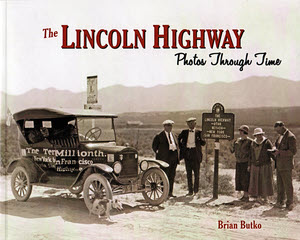 I was hesitant to post a review of this book because some of those “Photos Through Time” are mine but I decided that it would be a bad thing only if I rave about how marvelous the book is. No harm in simply describing it, right? So here are the facts.
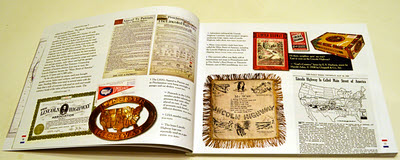 It is organized neither geographically nor chronologically. The first section following the foreword is titled “History”. Here, among pictures of collectibles and artifacts, Butko gives a very brief history of the road’s birth and short life. It is enough to give someone who knows little or nothing about the Lincoln Highway a starting point and someone who knows everything a quick refresher on key dates and events. It is a stripped down but adequate introduction to the pictures that follow.
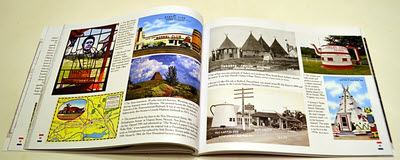 Those pictures are organized by their subjects. Butko identifies ten things that comprise the Lincoln Highway and gives each one a chapter. They are “People”, “Gas”, “Food”, “Lodging”, “Vehicles”, “Attractions”, “Signs”, “Markers”, “Bridges”, and “Roads”. The chapters are themselves samplers. Historic images from postcards and other sources are combined with modern photographs. Images of things along the road, which is every chapter other than “People”, are from locations spread over the road’s entire length.
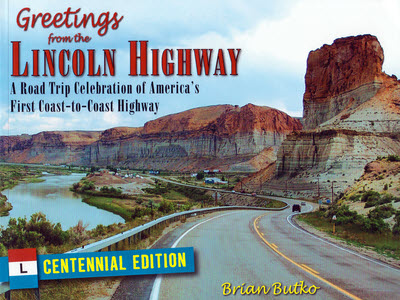 The Lincoln Highway turns a hundred this year. Brian Butko’s Greetings from the Lincoln Highway turns eight. At first glance, the 2013 Greetings… looks an awful lot like the 2005 Greetings… with a soft cover and a “Centennial Edition” banner on the front and it’s a fact that, in many ways, it is the same. It has the same organization with an introductory chapter and a chapter, with map, for each state the highway passed through and a very high percentage of the words and pictures in those chapters are the same, too. Another thing that remains the same and which accounts for the small in percentage but large in number changes is the care and attention to detail. Butko probably didn’t catch everything in the book that the passage of time has altered but he sure tried and he sure got a lot.
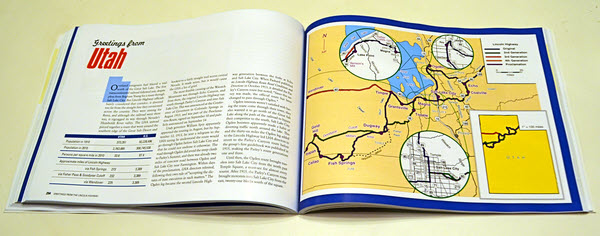 Aside from the occasional new photo, the most visible changes may be in the statistics and maps at the front of each state chapter. Here population numbers from the 2010 census replace those from the 2000 census and the maps get a line for the Proclamation Route. The Lincoln Highway Proclamation Route was a list of cities published by the Lincoln Highway Association on September 14, 1913. Shifts started happening almost immediately and a detailed route was never signed or published that matched the September 14 announcement. But several of the cities dropped in 1913 fought unsuccessfully to return and many have fought more recently and more successfully to be recognized. Butko acknowledges that by including the ephemeral route. All of the quotes from postcards and other period communication that appeared in the margins of the original are still there and a few more have been added.
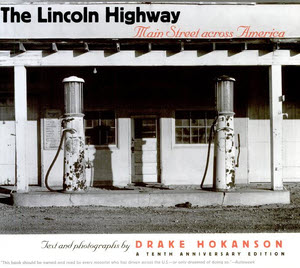 I’m reading this book for the third time. I read it around 2005 when I was dabbling with short drives on the Lincoln Highway to my east. I reread it in 2009 when I was getting ready to drive the Lincoln from the east edge of Illinois to the west coast. My current read is in anticipation of another long, hopefully full length, drive of what Drake Hokanson calls Main Street across America. I never read the original, only the pictured Tenth Anniversary Edition which is now fifteen years old itself.
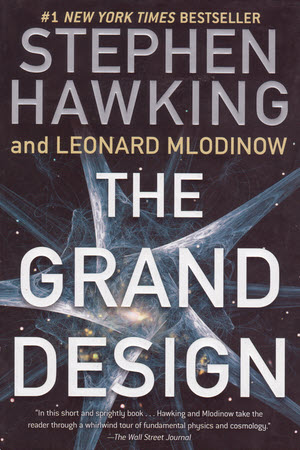 If you think this looks like it belongs here, you haven’t been paying attention. No, books about cosmology, quantum physics, and beyond aren’t what I typically read and I’m clearly not qualified to review them. I was given the book as a gift, I read and enjoyed it, and I intend to tell somebody about it.
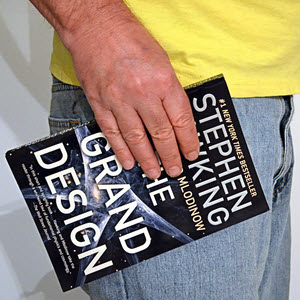 I started off admitting that this book was really out of place here. I do a lot of my reading over meals in restaurants and it was rather out of place in some of the joints where I eat, too. I quickly worked out a way to carry the book that cut down considerably on the funny looks aimed my way.
 Wow!
Wow!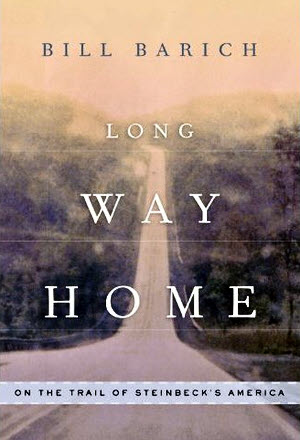 Not long ago, a friend mentioned a couple of travel related books he had just read and, when I found one of them available at the local library, I decided to give it a read. It’s Bill Barich’s Long Way Home – On the Trail of Steinbeck’s America. The subtitle is a reference to Steinbeck’s Travels with Charlie which Barich cites as an inspiration for his own road trip and book. The books’ basics are certainly similar. Each is the product of a successful American writer of a certain age undertaking a cross country road trip with hopes of learning something of a nation he’s been out of touch with for awhile. Steinbeck did it in 1960; Barich in 2008. Forty-eight years is not the only difference. Steinbeck did it in a custom built camper with unlimited time and, for all practical purposes, an unlimited budget. Barich did it in a rented Ford Focus, with a six week schedule, and a budget he calls “tight”. Steinbeck sort of circled the country, starting and ending at his home in Sag Harbor, New York. Barich makes one more or less straight pass through the center of the nation. But, for me, the biggest difference is that, while I’ve never really cared for Travels with Charlie, I ended up enjoying Long Way Home. Of course, Steinbeck didn’t seem to enjoy his own trip very much; Barich did. I think that rubbed off on me.
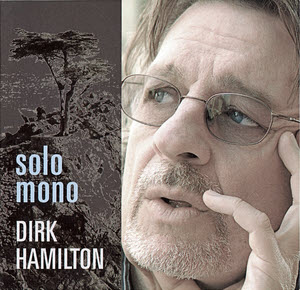 I’ve never seen Dirk Hamilton in person with a band. I’ve seen him twice with another guitarist and twice with no one else on stage period. Conversely, I’ve never listened to him without a band. OK, maybe “never” is a stretch but a bold print seldom sure isn’t. I own just about everything Dirk has released and it’s the rare track that doesn’t have at least a few top notch musicians backing him up. That’s not a bad thing. The tunes are served well by the added layers and the folks Dirk chooses to play with always add something to the mix. But listening to solo mono is kind of like a “being there” I can relate to.
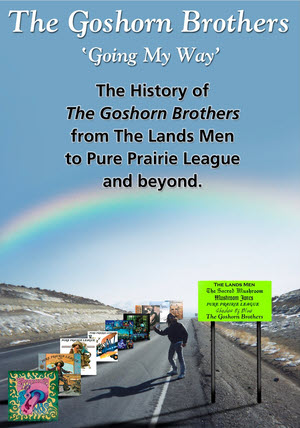 I am even less qualified to review DVDs than I am to review CDs and books. That won’t stop me of course. I just thought you should know. Going My Way is Chuck Land’s take on the story of Larry and Tim Goshorn’s musical adventures. Chuck Land is the guy behind
 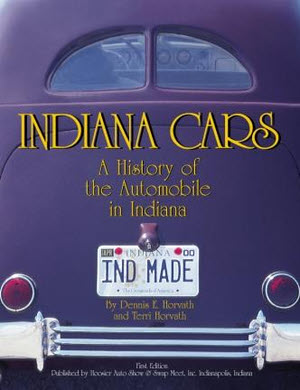 Yes, I am late to the party. This book on Indiana’s automotive history was published in 2002 but, since it’s about old cars, none of the history has changed and the cars have only gotten older.
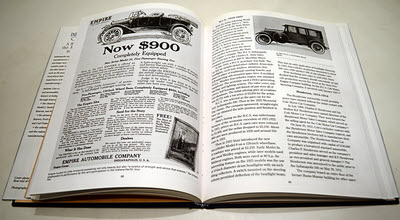 Once the background is set, the book moves onto the various manufacturers. Not every mark ever built in the state is covered but there are sizable sections on what the Horvaths consider “Significant Automobiles”. The reading isn’t so dry now. There are fairly lengthy articles on the likes of Duesenberg and Studebaker and shorter ones on others. The book is well illustrated with photographs and clippings from period literature. Facts are seasoned with entertaining anecdotes. Joe Cole got his first car running and took off without installing the brakes. Lack of fuel finally stopped it after many laps around Monument Circle in Indianapolis. In 1891, Charley Black’s six-block drive in a Benz included crashing into both a surrey and a shop window. Those were the good old days.
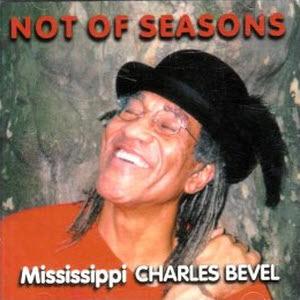 I went to see Hank Williams: Lost Highway last week. The first sound that came from the stage wasn’t the voice of Hank or his mother or the cry of a pedal steel guitar. When the lights dimmed and the play began, it was the pure voice of Mississippi Charles Bevel that came unfaltering from the darkness. Bevel plays Tee-Tot, Williams’ mentor. The CD that this post claims to review is not new. It’s a dozen years old and I don’t recall ever hearing of it or Charles Bevel before last Wednesday.