Book Review
Ten Years Behind the Mast
Fritz Damler

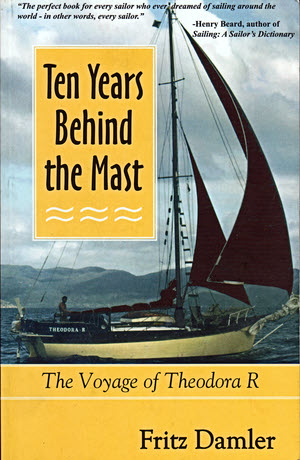
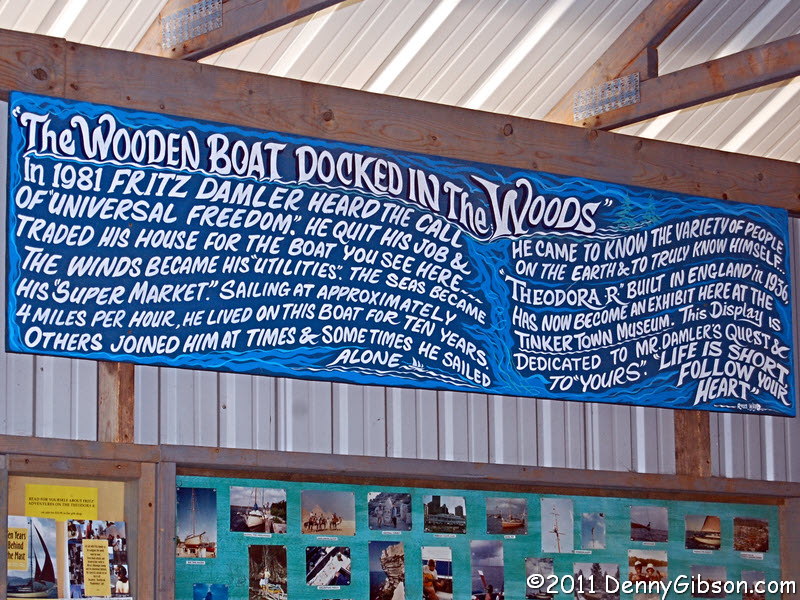
Ten Years behind the Mast CoverBefore I get around to actually talking about this book, I am going to tell how I learned of its existence. I first saw Theodora R, the boat whose mast the author was behind, in July of 2011. I was in Albuquerque, New Mexico, when a friend tipped me off to a nearby museum called Tinkertown. The museum was different than anything I’d ever seen and the boat was different than anything else in the museum. There were similarities, of course, because the same man who created the museum of small items, many hand carved, had also created the signage and other details in the display of the thirty-five foot boat. Then another similarity occurred to me. The unique folk art museum created by Ross Ward represented his “Follow Your Heart” attitude and the boat that Fritz Damler sailed around the world represented that same attitude. Now the boat didn’t seem out of place at all.

TinkertownTinkertownI had chatted with Ross Ward’s widow, Carla, when I first arrived and learned just a bit about the man who passed away in 2002. I spoke with her again before leaving and learned that Fritz Damler was her brother and that he now lived in the Bahamas. I can’t recall why I didn’t buy this book on that first visit. Maybe I was really watching cash flow on the way home from a west coast road trip or maybe I wasn’t even aware that it existed. Carla is not much into high pressure sales. I bought it three months ago on my second visit.

Ten Years Behind the Mast was published seven years ago. Fritz Damler completed his circumnavigation fifteen years before that. Maybe taking fifteen years to finish a book about a ten year journey is a little higher than average but it makes me feel less guilty about coming to it seven years later. A friend and I once met a couple who were sailing south along the Americas’ east coast. Fritz’s publishing — and living — schedule reminds me of something they said often: “If we were in a hurry, we wouldn’t be on a sailboat.”

You also wouldn’t be living on a sailboat without wide ranging skills and the willingness to learn more — sometimes instantly. It isn’t too far fetched to believe that Fritz spent his first thirty-two years training for this journey. He was building guitars for a living immediately before acquiring the Theorora R and he was actually well into building his own wooden boat for the trip when he was betrayed by the epoxy he used and it fell apart. Some of his other jobs included paramedic, volunteer fireman, musician, and ski instructor. Each of those, and no doubt others, provided experience and training that served him well on his journey.

His wife was along when the trip started but it turned out she wasn’t as keen about living on a thirty-five foot boat as she initially thought and she was nowhere near as keen on sailing around the world as Fritz was. Before long, Fritz was without a wife which also meant he was without a permanent crew. Some of the sailing was done solo but most of it was done with an ever changing cast of characters which are all identified and described to some degree. So too are most, if not all, of the ports where Fritz and Theodora R dropped anchor and many of the people he met in those ports. It is a lot to pack into a couple hundred pages but Damler does a pretty good job of covering the ten years evenly.

There are visits from friends and family and Damler never really loses connection with the USA but he does get up close and sometimes personal with a lot of different cultures. He is able to report that fruit bat, the daily special of a Madagascar restaurant “tastes like sweet chicken”. He determined that a small village on New Guinea’s Sanaroa Island was the most remote he ever visited with the help of his guitar. It was the only place where not one person showed even a flicker of recognition when he played “House of the Rising Sun”. That is remote indeed.

Through lots of little glimpses, Damler provides something of a feel for what cruising through far off waters is like. Theodora R was far from alone in doing this. Apparently a sizable “cruisers” culture exists though not everyone is heading around the world or living aboard full time. It is ever so slightly like the RV culture with distances and degree of isolation cranked up to imagination challenging levels.

This is not a guide book or a how to sail book. It is a story book that tells a true and entertaining story. Damler’s writing style makes the reading easy without excess tension or artificial suspense. The final phrase of the back cover blurb sums it up pretty well. “…his story of a decade at sea has it all: Discovery. Heartbreak. Misadventure. Salt.”

Ten Years Behind the Mast, Fritz Damler, Jackson Harbor Press, 2006, paperback, 8.4 x 5.5 inches, 211 pages, ISBN 978-1890352202.
Available through Amazon.


On my first visit to Tinkertown, seeing and reading about Damler’s boat instantly reminded me of one of my favorite Michael McCloud songs, Chasin’ the Wind. I quoted from it in the journal entry for that 2011 visit. Here is a little longer quote:

The job got to feel just like an anchor
and that young wife started to roll just like the waves.
So he traded them both for a sturdy old boat
and the one dream that he’d always saved.

And another couple of lines:

Seen most of the world and a few lovely girls
who spent a short time working as the crew.

When I left Tinkertown after the 2013 visit, I had Damler’s book in my trunk and McCloud’s song in my head. The day after arriving home from that trip I listened to Chasin’ the Wind as I drove to meet friends. Before the song was even half over, I had decided where I would be going for Christmas. For several years now, I have made a “Christmas Escape Run” around the year end holidays. I have been to Key West and seen Michael McCloud just twice; Most recently on on my 2008 “Christmas Escape Run”. Sometime around Christmas 2013, I intend to be in Key West, Florida, where I can listen to Michael McCloud and at least look at some sailboats.

ADDENDUM 21-Aug-2015: It took a new comment to draw my attention to one I’d missed over a year before and, when that happened, I reread my announcement of firm intentions to head to Key West for Christmas. It didn’t happen. It wasn’t until Christmas of 2014 that I made it to Key West.

Book Review
Hoosier Tour
Dennis & Terri Horvath

hoosiertour_cvrCarl Fisher was a busy man in 1913. His Prest-O-Lite Company and his automobile dealership were both going great guns, the Indianapolis Motor Speedway he co-founded looked like it might amount to something, the Ocean-to-Ocean Rock Highway he had proposed in September of 1912 was taking off, and then there was the Indiana Automobile Manufacturers’ Association.

In the early years of the industry, Indiana was second only to Michigan in number of automobile manufacturers. Several of them cooperated in a 1911 four state promotional tour that was so successful they organized the IAMA and another four state tour in 1912. In 1913 they were ready for something bigger. The result was the Indiana-Pacific Tour that went from Indianapolis to San Francisco then down the coast to end at Los Angeles. Carl Fisher was part of the tour that left Indianapolis on July 1, 1913, the same day that the Lincoln Highway Association, which is what his Rock Highway proposal had led to, was incorporated. That coincidence of dates and a connection with the troublesome Colorado loop of the Lincoln Highway were essentially the only details of the IAMA tour I knew of. Now, thanks to Dennis and Terri Horvath, I know a lot more.

Hoosier Tour: A 1913 Indiana to Pacific Journey is not filled with flowery prose or lots of humor. That’s not how the Horvaths write. Neither is it filled with terse sentences and clipped descriptions. It is filled with an enjoyable and accurate account of the complete tour and the lead up to it. It tells of the men and machines on the tour and gives a hint of the tour’s impact on the acceptance of automobiles and the Good Roads Movement.

After a couple of chapters describing the IAMA and its planning for the tour, Hoosier Tour follows the Indiana vehicles across the country. Though not organized as such, the book is something of a group diary in that a day’s beginning and end points are usually mentioned along with highlights and lowlights.

This was a huge event in its day. It included eighteen cars and two trucks from fourteen manufacturers. Several journalists and a former Indianapolis mayor rode along. One car was driven by the winner of the inaugural Indianapolis 500, Ray Harroun. Several governors climbed aboard when the tour entered their state and rode along until it exited. Virtually every cluster of building on the route demanded a visit and presented the participants with gifts ranging from watermelons to free gas.

As an advertisement for Indiana built automobiles, the tour was a complete success. Not one car dropped out for mechanical reasons. It also performed well in regards to another stated purpose, boosting the Good Roads Movement. Aside from the high profile tour raising awareness considerably, it triggered improvement along the route it followed. Every locale wanted to make a good impression and the book tells of many improvements made just days ahead of the tour’s arrival.

One reason to impress was the belief, held by many, that Fisher was using the tour to evaluate the intended route of the Lincoln Highway. He denied any official connection between the route of the Indiana-Pacific Tour and the Lincoln Highway and much of the tour route was not even close to the path that would be announced in September but the belief was not totally without merit. Those familiar with Lincoln Highway history may know that the highway, as originally announced, did not enter Colorado but that a “Colorado Loop” was quickly added in response to pressure from the state. After reading the Horvaths’ account of the tour’s visit to Denver, which included a parade and a real brass band, it is rather easy to see why Colorado had expectations.

Even though the Indiana-Pacific Tour would continue on to Los Angeles, reaching San Francisco made good the title and there were great celebrations. A parade greeted them on arrival though the Horvaths do not say whether or not it included another brass band. Banquets, tours of the recently rebuilt city, and a stop at Cliff House kept the tourists busy for about three days. The book follows them down the coast to Los Angeles where most of the tourists boarded a train for the trip home. With the tourists back in Indianapolis, the final chapter touches on what followed for the Indiana automotive industry. Next are several pages of photos from the tour and appendices listing the tour’s people and vehicles.

There is little question that the Indiana-Pacific Tour should be better known than it is. It demonstrated the ability of automobiles, particularly Indiana built automobiles, to travel long distances and it brought nationwide attention to the value of good roads. It deserves to be more than a footnote to the Lincoln Highway and this book should help with that.

A lot has changed in one hundred years. It is a little sad that we can no longer purchase an Indiana built Stutz Bearcat but it is a good thing that we no longer have to dodge thrown ears of corn as the driver of the Stutz on the tour had to do after frightening a farmer’s horses.

Hoosier Tour: A 1913 Indiana to Pacific Journey, Dennis E. Horvath and Terri Horvath, AGG Publishing, 2013, paperback, 5 x 8 inches, 114 pages, ISBN 978-1490403267
Available through Amazon.

Book Review
The Lincoln Highway: Photos Through Time
Brian Butko

Lincoln Highway Pictures Through Time - coverI was hesitant to post a review of this book because some of those “Photos Through Time” are mine but I decided that it would be a bad thing only if I rave about how marvelous the book is. No harm in simply describing it, right? So here are the facts.

The Lincoln Highway: Photos Through Time was created for the Lincoln Highway Association as part of its centennial celebration. One of the most visible parts of that celebration was the pair of car tours traveling the Lincoln Highway from its two ends to a meeting in the middle. A copy of the book was part of the tour package and it is also available for sale exclusively through the Lincoln Highway Trading Post.

It’s a sampler. Its purpose is to give an overview of a century of Lincoln Highway. It is not a guide book or a scholarly history book. It does not contain pictures of every scenic spot along the road or every notable building or every key association member. It does, however, contain a whole bunch of each of those.

Lincoln Highway Pictures Through Time - sampleIt is organized neither geographically nor chronologically. The first section following the foreword is titled “History”. Here, among pictures of collectibles and artifacts, Butko gives a very brief history of the road’s birth and short life. It is enough to give someone who knows little or nothing about the Lincoln Highway a starting point and someone who knows everything a quick refresher on key dates and events. It is a stripped down but adequate introduction to the pictures that follow.

Lincoln Highway Pictures Through Time - sampleThose pictures are organized by their subjects. Butko identifies ten things that comprise the Lincoln Highway and gives each one a chapter. They are “People”, “Gas”, “Food”, “Lodging”, “Vehicles”, “Attractions”, “Signs”, “Markers”, “Bridges”, and “Roads”. The chapters are themselves samplers. Historic images from postcards and other sources are combined with modern photographs. Images of things along the road, which is every chapter other than “People”, are from locations spread over the road’s entire length.

The sources of the photos are pretty diverse, too. Butko lists more than fifty contributors. He supplied a large number of images himself and, at a presentation at the Centennial Celebration in Kearney, Nebraska, he singled out Russell Rein, Jeff Blair, and me as next in number of contributions. Many of the historic images came from Russell’s huge collection. Jeff and I are both amateurs who happened to be the the right place fairly often but our pictures get to appear alongside stuff from real pros like Michael Williamson, Drake Hokanson, Rick Pisio, Shellee Graham, and Jim Ross and Brian has made sure they all look as good as possible.

I described the “History” chapter of having value for two very different audiences. Maybe that’s true of the whole book. Most of its first recipients, members of those centennial tours, are probably somewhat familiar with almost everything in the book. For them and others like them, the book might be a memory booster or a chance to see an image of something they’ve only heard about. On the other hand, there is a large group of people who ask “What’s that?” when hearing of the Lincoln Highway. Flipping through the pages provides glimpses of what’s there today and some of what was there in times long past. Turn the pages slowly and read all the captions for an even better answer to the question.

The Lincoln Highway, Photos Through Time, Brian Butko, Lincoln Highway Association, 2013, paperback, 10 x 8 inches, 136 pages, ISBN 978-0989208000

Available at Lincoln Highway Trading Post.

Book Review
Greetings from the Lincoln Highway – Centennial Edition
Brian Butko

Greetings from the Lincoln Highway cover The Lincoln Highway turns a hundred this year. Brian Butko’s Greetings from the Lincoln Highway turns eight. At first glance, the 2013 Greetings… looks an awful lot like the 2005 Greetings… with a soft cover and a “Centennial Edition” banner on the front and it’s a fact that, in many ways, it is the same. It has the same organization with an introductory chapter and a chapter, with map, for each state the highway passed through and a very high percentage of the words and pictures in those chapters are the same, too. Another thing that remains the same and which accounts for the small in percentage but large in number changes is the care and attention to detail. Butko probably didn’t catch everything in the book that the passage of time has altered but he sure tried and he sure got a lot.

Most of changes are tiny and hard to spot. A lot are downers; Diners and motels that were operating in 2005 but have been closed or worse. Some, like the growth of Pennsylvania’s Lincoln Highway Heritage Corridor from 140 to 200 miles, are positive. A few changed words handle the bulk of these updates though some are more involved and a few include a photo change. New photographs are easier to spot than new words and I suppose a larger fraction of photos than words were changed but that’s just because the word count is higher that the picture count. The majority of the book’s graphics remain the same. Though I in no way benefit from the sale of this book, in the interest of full disclosure I need to say that I contributed a half dozen or so of the new photos.

Greetings from the Lincoln Highway insideAside from the occasional new photo, the most visible changes may be in the statistics and maps at the front of each state chapter. Here population numbers from the 2010 census replace those from the 2000 census and the maps get a line for the Proclamation Route. The Lincoln Highway Proclamation Route was a list of cities published by the Lincoln Highway Association on September 14, 1913. Shifts started happening almost immediately and a detailed route was never signed or published that matched the September 14 announcement. But several of the cities dropped in 1913 fought unsuccessfully to return and many have fought more recently and more successfully to be recognized. Butko acknowledges that by including the ephemeral route. All of the quotes from postcards and other period communication that appeared in the margins of the original are still there and a few more have been added.

Greetings from the Lincoln Highway is almost universally accepted as the best book available for anyone wanting to travel or otherwise interact with the Lincoln Highway of today. And it’s more. That’s something I had forgotten. “The Good, the Bad and the Muddy”, the book’s opening chapter, not only introduces the Lincoln Highway, it provides a nice overview of the early days of motoring. When the book moves on to the individual states and a more concentrated Lincoln Highway focus, it offers both history and guidance. It is not a lay-in-your-lap turn-by-turn guide book but the text and maps contain most of what is needed to travel any alignment of any segment. Doing it for real is certainly best but there are enough pictures that doing it in an easy chair ain’t too bad.

Greetings from the Lincoln Highway — Centennial Edition, Brian Butko, Stackpole Books, 2013, paperback, 11 x 8.5 inches, 288 pages, ISBN 978-0811711746
Available through Amazon.


Main Street across America coverI’m reading this book for the third time. I read it around 2005 when I was dabbling with short drives on the Lincoln Highway to my east. I reread it in 2009 when I was getting ready to drive the Lincoln from the east edge of Illinois to the west coast. My current read is in anticipation of another long, hopefully full length, drive of what Drake Hokanson calls Main Street across America. I never read the original, only the pictured Tenth Anniversary Edition which is now fifteen years old itself.

I’m reading the book primarily because Hokanson’s appreciation of the road puts me in just the right mood to appreciate it myself but there are other reasons, too. One is that, like Butko’s book above, much of the original remained in the anniversary edition and provides its own glimpses of the highway when it was only three-quarters, rather than a full, century old. Lastly, it’s a chance to appreciate Drake Hokanson. It you think the Lincoln Highway is largely forgotten now, imagine what it was like in 1988. Hokanson didn’t invent a new road like Carl Fisher and his buddies but he did kind of invent the remembering of it. And that’s pretty cool.

The Lincoln Highway — Main Street across America — Tenth Anniversary Edition, Drake Hokanson, University Of Iowa Press, 1999, paperback, 10.6 x 9.4 inches, 256 pages, ISBN 978-0877456766
Available through Amazon.

Book Review
The Grand Design
Hawking and Mlodinow

The Grand Design coverIf you think this looks like it belongs here, you haven’t been paying attention. No, books about cosmology, quantum physics, and beyond aren’t what I typically read and I’m clearly not qualified to review them. I was given the book as a gift, I read and enjoyed it, and I intend to tell somebody about it.

Note that I said “read and enjoyed”, not “read and understood”. I suppose it is a sort of “Quantum Physics for Dummies” but quantum physics is not really a field for dummies. The way the book worked for me was as history and as a glossary. Bits of the history of mankind’s progress in understanding his world is scattered throughout with references to folks like Archimedes and Newton and Einstein. There is a real glossary at the back but I felt as if the body of the book gave me a glossary level understanding of things. As I read about string theory, multiverses, no-boundary conditions, and the like, I may have understood the definitions but fell a little short of fully comprehending the concepts. I don’t mean that I was constantly shaking my head and moving on in bewilderment. I simply mean there were no “ah-ha, of course the world needs quarks” moments.

There are frequent almost folksy attempts at humor or lightness. Some bring on a smile; Many don’t. But I think they all do their job as reminders of just who this is written for. I did not have a thorough understanding of quantum physics when I finished my reading but I did have confidence that others do. I guess that’s really what I got out of the book. I think there’s something of a tendency for us “civilians” to dismiss stuff like multiple universes as crazy talk but there really are people who can get their heads around the theory and I find that reassuring. Maybe some of the ideas really are half baked but the truly wrong ones will eventually be found out and the half right ones will be improved upon. That’s what science at this level is; Admiring and appreciating guys like Newton and Einstein while working as hard as you can to find their mistakes.

granddesign_cryI started off admitting that this book was really out of place here. I do a lot of my reading over meals in restaurants and it was rather out of place in some of the joints where I eat, too. I quickly worked out a way to carry the book that cut down considerably on the funny looks aimed my way.

The Grand Design, Stephen Hawking and Leonard Mlodinow,  Bantam, 2012, paperback, 6 x 9 inches, 208 pages, ISBN 978-0553384666
Available through Amazon.

Book Review
Long Way Home
Bill Barich

longwh_cvrNot long ago, a friend mentioned a couple of travel related books he had just read and, when I found one of them available at the local library, I decided to give it a read. It’s Bill Barich’s Long Way Home – On the Trail of Steinbeck’s America. The subtitle is a reference to Steinbeck’s Travels with Charlie which Barich cites as an inspiration for his own road trip and book. The books’ basics are certainly similar. Each is the product of a successful American writer of a certain age undertaking a cross country road trip with hopes of learning something of a nation he’s been out of touch with for awhile. Steinbeck did it in 1960; Barich in 2008. Forty-eight years is not the only difference. Steinbeck did it in a custom built camper with unlimited time and, for all practical purposes, an unlimited budget. Barich did it in a rented Ford Focus, with a six week schedule, and a budget he calls “tight”. Steinbeck sort of circled the country, starting and ending at his home in Sag Harbor, New York. Barich makes one more or less straight pass through the center of the nation. But, for me, the biggest difference is that, while I’ve never really cared for Travels with Charlie, I ended up enjoying Long Way Home. Of course, Steinbeck didn’t seem to enjoy his own trip very much; Barich did. I think that rubbed off on me.

I probably also like the fact that Barich describes his route a little better than Steinbeck and that it goes through places much more familiar to me. He drives right through Ohio and tells of eating at a restaurant where I’d eaten just days before reading of his visit. It’s hard to ignore connections like that.

Long Way Home begins with Barich recounting how much he had enjoyed reading Travels with Charlie as a teenager. Stumbling across the book decades later in Dublin, Ireland, triggered plans for his own trip but re-reading it didn’t bring back the pleasure he remembered. I suspect the teenage Barich loved the idea of an unplanned journey across the USA enough to overlook shortcomings in its execution.

Both authors do their “learning” by observing the nation’s countryside, its small towns, and, less frequently, its cities. The story telling is most interesting when it involves some interaction with the locals and that usually happens, as you might expect, in the small towns. Both trips took place during election years and both authors sometimes attempt to get those locals to discuss their political feelings with mixed success. My impression is that Barich is more successful but I can’t back that up with hard facts. Both are pretty successful at getting folks to talk, in general terms, about their and the nation’s financial situation.

Of course, John Steinbeck wasn’t the first person to write a book about driving around the US and Bill Barich won’t be the last. As someone who enjoys writing trip journals, it stands to reason that I enjoy reading them. I enjoyed reading Long Way Home and even Travels with Charlie. Both are, as you would expect, very well written. Trip journals are snapshots. Like photographic snapshots, they record how something appeared to one person at one time. I have little desire to visit the country in Steinbeck’s snapshot while Barich’s is much more inviting. I suspect that On the Trail of Steinbeck’s America subtitle was more of an attention getting device than a description of Barich’s true intentions. I doubt he was really looking for Steinbeck’s America and I’m rather glad he didn’t find it.

Long Way Home: On the Trail of Steinbeck’s America, Bill Barich, Walker & Company, 2010, hardback, 9.4 x 6.4 inches, 256 pages, ISBN 978-0802717542
Available through Amazon.

Music Review
solo mono
Dirk Hamilton

solo_mono_cvrI’ve never seen Dirk Hamilton in person with a band. I’ve seen him twice with another guitarist and twice with no one else on stage period. Conversely, I’ve never listened to him without a band. OK, maybe “never” is a stretch but a bold print seldom sure isn’t. I own just about everything Dirk has released and it’s the rare track that doesn’t have at least a few top notch musicians backing him up. That’s not a bad thing. The tunes are served well by the added layers and the folks Dirk chooses to play with always add something to the mix. But listening to solo mono is kind of like a “being there” I can relate to.

Depending on who is counting and how they do it, this could be Dirk’s eighteenth release or maybe “only” his fifteenth or maybe something else. Counting solo studio albums is a lot easier. This is it. Dirk is an excellent performer and a darn good front man but his song writing is what has captured most of his fans. solo mono contains thirteen new songs though they’re not all entirely new to me. The album, released in June of 2012, contains several tunes I’d seen Dirk perform the previous October. I put off ordering solo mono thinking that our paths might cross again in the fall of 2012 and I’d buy it at a show. That didn’t work out so I finally did the mail order thing a few weeks ago and not long after I popped the CD into the player I was struck with “that’s just the way I remember it” thoughts.

As with just about any collection of Dirk Hamilton tunes, the lyrics range from insightful to comical with Hamiltonian wit and romanticism everywhere. At this point I intended to quote examples of wit and insight and the rest but I found myself going around in circles trying to make my selections. Instead, I’m going to cheat big time and just point to the lyrics for the entire album. They’re here. All of Dirks lyrics are on his website; From the “First off let me say that I get sick and I get bored” that opened his first album in 1976 through the “Tommy gun placed on a polka dot gown” that opens this one. I’ve always appreciated the fact that, almost from the moment he and the internet found each other, Dirk has made his lyrics available online. With packageless downloads steadily increasing, that is ever more important and something I wish more artists would do

There is Dirk style social/political commentary — usually oblique and sometimes cryptic — in songs like “Delete Deletions” and “Slow Suicide” and there are genuinely fun songs like “Nobody I Know” and “Jan Jan Janet”. Smack dab in the middle there is a five line splash of silliness in “The Pygmy Forest”. And there are love songs; Several love songs. I don’t like love songs but I like Dirk’s. I don’t know the inspirations behind “She Calls Me Bello”, “Our Sweet Love”, “Unreachable”, and “Kalea” though I’d bet they are real. Dirk’s heart writes quite a few songs for him.

The only instruments on the album are Dirk’s guitar, harmonica, and voice and I confess to having lower expectations because of that. I shouldn’t have because I know, from seeing him live and alone, that many of his tunes work just as well without layers of sound as with. And there is, of course, a certain advantage to having less between ears and lyrics.

It is always a treat to hear new Dirk Hamilton material in any form. I know there will be more stuff with a band (a CD with the Italian boys is already in the works) and I hope there will be more stuff like solo mono.

You can order the CD here or purchase its contents here. You can watch Dirk and Don Evans do a song from the album here and Dirk do a song not from the album (it’s from 1978’s Meet Me at the Crux) at that October, 2011, concert here.

Video Review
Going My Way
Chuck Land

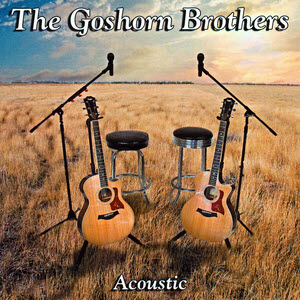
Going My Way coverI am even less qualified to review DVDs than I am to review CDs and books. That won’t stop me of course. I just thought you should know. Going My Way is Chuck Land’s take on the story of Larry and Tim Goshorn’s musical adventures. Chuck Land is the guy behind Landman Productions, The Chuck Land Show, and, as often as possible, a Hammond B3. Larry & Tim are the guitar playing siblings who have powered a few decades of music in Cincinnati and carried a lot of Cincinnati music a long long way from home. Those album covers on the DVD jacket represent music from the 1960’s Sacred Mushroom, through Pure Prairie League and the Goshorn Brothers Band, to their most recent duo recording Acoustic. In case you didn’t notice, those album covers are posed along the center line of a two lane highway.

This is a Cincinnati story. The brothers have been back in Cincinnati for many years now and so has Chuck. He and the Goshorns are close friends these days but much of the brothers’ story is outside of Chuck’s personal experience. Those bits he covers through period photos and interviews with people who were there. Recent parts of the story include Landman Production performance footage.

The documentary opens with Sacred Mushroom bassist Joe Stewart praising his former bandmate. Joe appears in the video several more times and talks about making music with Larry long before the Mushroom even existed as well as filling in some of the Sacred Mushroom story. Other persons interviewed include concert promoter and former Cincinnati Vice-Mayor Jim Tarbell and retired radio personality Gary Burbank. Tim and Larry are recorded talking about themselves, each other, and individuals they’ve performed with over the years. Other musicians and fans are also interviewed but, somewhat curiously, Rick “Bam” Powell is the only Goshorn Brothers Band member, other than the brothers, to talk to the camera. More understandable is the fact that no other members of Pure Prairie League are interviewed, either.

The DVD is packaged with a CD containing eight songs from throughout the Goshorns’ careers. The Pure Prairie League years are well represented with songs penned by Tim or Larry and first released by PPL but presented here in post-PPL versions. It’s a nice sampler.

No matter where you live, it’s all but certain that you have heard some Goshorn music. If you’ve lived around Cincinnati, there is also a darned good chance that you have seen one or both Goshorns perform at a club, concert, or festival. Going My Way offers a look on the other side of the speakers and serves up a lot of history on this pair of talented and significant Cincinnati music makers. Find it here.

Book Review
Indiana Cars
Dennis & Terri Horvath

Indiana Cars coverYes, I am late to the party. This book on Indiana’s automotive history was published in 2002 but, since it’s about old cars, none of the history has changed and the cars have only gotten older.

I learned of and purchased the book when one of its authors performed guide duty on a tour that was part of the Lincoln Highway Centennial Kickoff in Indianapolis. On that tour, Dennis Horvath took us to many of the city’s automotive landmarks and this book contains all of those and more. Though few might consider Indiana Cars light reading, it is certainly interesting reading. Dennis knows automotive history. And he really knows Indiana automotive history.

There is a tremendous amount of it. At one time second only to Michigan in automobile production, Indiana has been home to more than 400 vehicle brands. Some are still widely recognized — Stutz, Studebaker, Duesenberg. Other, such as Lexington, Flandermobile, and Empire, are pretty much forgotten outside of hardcore automotive circles and the pages of this book. Similarly, Indiana had plenty of automobile pioneers. Louis Chevrolet, Harry Stutz, and Eddie Rickenbacker are fairly well known; Guys like Elwood Haynes, Charles Black, and Louis Schwitzer not so much. They’re all there in Indiana Cars.

There is an introduction and “A General Overview by Decade” to get things started. That overview begins in the 1890s. It talks of the overall automotive industry and Indiana’s role in it. There are lots of numbers. It was this I had most in mind when I said that some folks would not consider the book light reading. Statistics are necessary, of course, in showing growth and relationships. The Horvaths do a good job of presenting them but they are still numbers. Numbers don’t make for exciting reading but they make for a good reference book and that’s a role Indiana Cars plays quite well.

Indiana Cars sampleOnce the background is set, the book moves onto the various manufacturers. Not every mark ever built in the state is covered but there are sizable sections on what the Horvaths consider “Significant Automobiles”. The reading isn’t so dry now. There are fairly lengthy articles on the likes of Duesenberg and Studebaker and shorter ones on others. The book is well illustrated with photographs and clippings from period literature. Facts are seasoned with entertaining anecdotes. Joe Cole got his first car running and took off without installing the brakes. Lack of fuel finally stopped it after many laps around Monument Circle in Indianapolis. In 1891, Charley Black’s six-block drive in a Benz included crashing into both a surrey and a shop window. Those were the good old days.

Trucks built in Indiana have a section as do military vehicles. Many of those pioneering Hoosiers who put Indiana near the front of the early automotive development are covered, too. Appendices include listings of all Indiana cars, major milestones, and other items.

Indiana Cars excels as a source of information  The book most likely contains the answer to whatever questions you may have about the automotive industry in Indiana. Car nuts will find it entertaining. They and history buffs will find it educational. Those in neither group may find it a wee bit dry.

Indiana Cars: A History of the Automobile in Indiana, Dennis E. Horvath and Terri Horvath,  Hoosier Auto Show & Swap Meet Inc. (printed by Jackson Press), 2002, hardback, 8.8 x 11.2 inches, 198 pages, ISBN 978-0964436459
Available through Amazon.