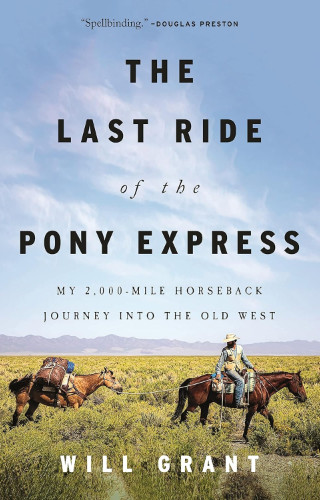
I have read and reviewed more than a few books about modern retracings of historic routes, including some I was personally responsible for. Almost all of them involved automobiles, with the result that those doing the retracing typically traveled significantly faster than the route’s original users. For the original travelers on the route that Will Grant followed in 2019, speed was far and away the main consideration. Relay riders moved mail over the nearly 2,000-mile-long route in ten days. Grant’s main consideration was safety. About 75 horses were ridden to near exhaustion in each Pony Express run. Grant’s safety and the success of his ride depended on two horses covering the entire distance. Will, Chicken Fry, and Badger got to know each other quite well during the 142 days they spent together during The Last Ride of the Pony Express.
I’ve been to the stable-turned-museum where Grant and all of those Pony Express riders began their journies west, and I have crossed the Missouri River at Saint Joseph, but it somehow never registered with me just how close that stable was to the riverbank. The stable and the river are less than half a mile apart. When I finally realized that, my first thought was to question why the Pony Express did not just place its eastern terminus on the other side of the river. It was a dumb question that I almost instantly answered. The Missouri River marked the border of the United States in 1860. St. Joseph was on the frontier. Pony Express riders began their westward dash with a ferry ride. Will Grant began his unhurried retrace with a police escort over a bridge.
Grant was very familiar with horses from a lifetime of riding, and I suspect he was more familiar than most with the history of the Pony Express and the geography of the American West. But he became a lot more familiar with these subjects as he prepared for his ride, and he shares that knowledge throughout the book. He also shares what I see as a sense of awe at the logistics of managing the hundreds of horses and men involved in the Pony Express. Many of us see only a galloping horse and rider when thinking of the Pony Express. Some may also think of brave station masters. Grant thinks and writes about all the men, and probably a few women, responsible for a constant supply of water, hay, and other necessities to those isolated stations, for the speedy breaking of horses to be ridden, and for all the other behind-the-scenes details of keeping an operation this big and spread out functioning.
The lack of that widespread support organization might be just as big a difference between Grant’s ride and those of 1860 as the speed of travel. Grant had the benefit of modern resources, including a sometimes-connected cell phone, and numerous generous routeside residents provided meals, showers, and places to camp. But he was basically self-contained and, despite several invitations, never slept in someone’s home. Surroundings ranged from too much civilization to essentially none at all. The severe isolation of parts of the trail is illustrated by Grant arranging for six caches of water and hay to be placed along the route through the Great Salt Lake Desert to make up for the lack of staffed and provisioned Pony Express stations.
The routeside residents also provide conversation. Sometimes history is explored, and sometimes the topic is something very current. Some subjects, like corporate ranches, wind farms, and wild mustangs, have the potential to become political, but Grant somehow manages to avoid that. Not only in his real-life conversations but in his informative writings. He’s really good at sharing facts, and maybe even describing a couple of viewpoints, without letting his own opinion distort them. In fact, most opinions held by others are reported with any rough edge they might have had removed.
I enjoyed encountering place names I recognized. Just as parts of the Pony Express route followed paths marked earlier by wagon wheels, feet, and hooves, some of it would later be followed by the tires of automobiles. Saint Joseph, MO, where it started, is where the Jefferson Highway and the Pikes Peak Ocean to Ocean Highway crossed. I recognized one of Grant’s camping spots, Hollenberg Station, from having stopped there while driving the PPOO. Farther west, the Lincoln Highway has led me to Dugway, Fish Springs, and other Pony Express-connected places that Grant mentions.
At Willow Spring Station in Callao, UT, another place the Lincoln Highway has taken me, Grant pauses for a day to rest himself and the horses. The last of his arranged caches lies between Callao and the stateline and beyond that, Nevada and California. There was still a long way to go, but the big desert was essentially behind him, and the day of rest may have prompted a look back. “No one, I thought, knows the ride of a Pony Express rider, but I’d come pretty close. My time in the desert, free from the distractions of population or vegetation or paved roads, had revealed what no book had conveyed, what I could not fully articulate, but what I knew was a past informant to our current psyche.”
On September 22, 2019, 142 days after crossing that bridge in Saint Joseph, Will Grant rode Chicken Fry up to the Pony Express statue in Sacramento with Badger in tow. The three had surely traveled more than the 1,966 miles said to comprise the actual Pony Express route. I’m still not sure whether I think the Pony Express was insane or brilliant. Crossing a 1,400-mile-wide gap in our country on horseback once in ten days is an impressive accomplishment. Establishing a system to do that in both directions twice a week is incredibly so. It is commonly estimated that something like 500 horses were used. Grant’s not buying it. He thinks a number between 1,500 and 2,000 is more believable.
I doubt I have ever spent much more than an hour on horseback at any one time, and I certainly don’t intend to try it now. I gained a slight sense of what multiple days in the saddle might be like without risking snakebites, saddle sores, or wild mustang attacks, and that’s close enough for me.
The Last Ride of the Pony Express: My 2,000-mile Horseback Journey into the Old West, Will Grant, Little, Brown and Company (June 6, 2023), 6.3 x 9.55 inches, 336 pages, ISBN 978-0316422314
Available through Amazon.
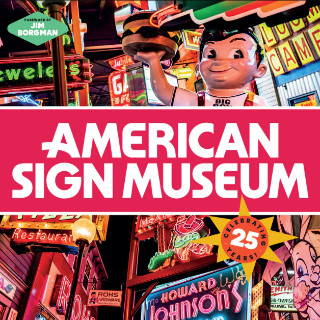 This book, just like its subject, is bright, colorful, eye-catching, and informative. That subject, quite obviously, is the 25-year-old
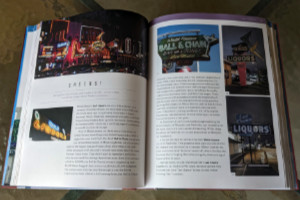
 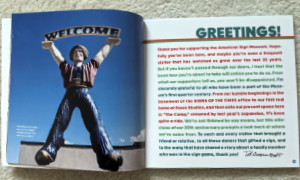 Museum founder Tod Swormstedt provided a welcome page and an introduction, and his influence is evident throughout. It’s a given that some of the information presented in Roberts’ text came from Tod and others. To me, it seems almost as obvious that a guy so adept at organizing walls, rooms, and buildings filled with signs would have a hand in organizing sign-filled pages, and I have a strong hunch that he might have suggested a few targets for Grilli’s camera.
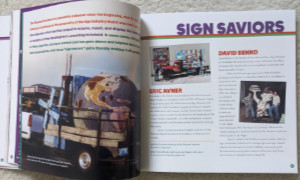 As Tod describes in the introduction, the book consists of three sections. The first describes what the museum is. It begins with some statistics, such as size (40,000 sq ft), oldest sign (155 years), and tallest sign (21 ft). That is followed by “A Founder’s Vision” (written by Tod), some words about the museum’s mission and its relationship with the community, and recognition of some of the many individuals who have been instrumental in the museum’s development and ongoing operation.
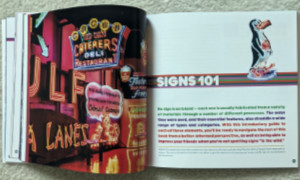 The second section concerns signs in general. There is a condensed history of signs in America that starts with carved and painted signs and progresses through materials like glass and plastic. The major changes electricity brought and the development of various illumination methods are covered. The section concludes with a glossary of sign types and the techniques and materials used in their construction.
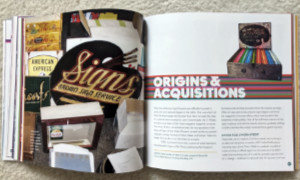 I first became aware of the museum with the 2005 opening of its original Walnut Hills location. To someone not involved with the sign business in any way, it seemed to me that this wonderful new attraction had magically appeared, fully formed, in my city overnight. However, we all know that’s not how things work, and I soon learned about some, but far from all, of the work behind that magic. The first part of section three nicely covers the period between forming a board of directors in 1999, incorporating as a non-profit in 2000, and that delightful grand opening on April 28, 2005. This is also where I found more photos of Tod wearing a tie (3) than I’d ever seen before.
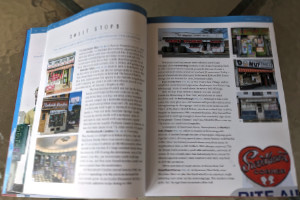
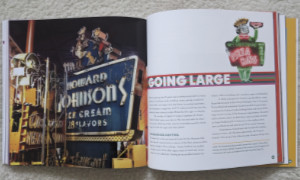 That first home in Essex Studios in the Walnut Hills neighborhood of Cincinnati was outgrown before it was occupied. Behind-the-scenes coverage continues as the current location in Camp Washington is acquired and made ready for another grand opening in June 2012. Central to “A Founder’s Vision” was the desire to not just display signs but to tell the story of American signage. Two envisioned methods for doing that were a Letter Wall showing the evolution of sign lettering and a faux street where signs were displayed in period-appropriate settings. A short Letter Wall existed at Essex, and some signs were sort of arranged as if they were on a street, but the backing was mostly plain white walls. In the new location, there was room to create proper versions of these two features. A much longer Letter Wall was constructed at the entrance to the main display area, and a Main Street was built with various storefronts lining both sides. To add another layer of realism, a diverse group of sign painters known as Letterheads descended on the museum to add signs to windows and doors to augment the big signs hanging on the storefronts and standing in the street. The store windows serve as natural display locations for items like painter kits and books.
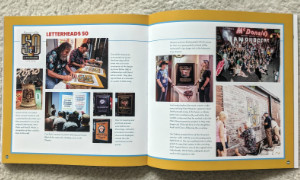 The Letterheads and the museum have a wonderful relationship that is well documented in the book. The museum hosted the group’s 40th and 50th reunions in 2015 and 2025, and the group added murals and other features to the museum each time. When the museum expanded and Main Street doubled in length in 2024, the Letterheads returned to work their magic on the new storefronts. The Letterhead story is just one of many that show how the museum is appreciated by sign makers as well as sign fans.
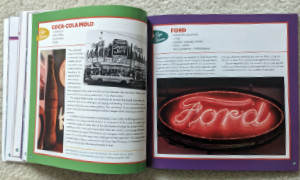 There is something akin to a fourth section spread throughout the book. It is made up of things called “Sign Stories”, which are like sidebars in that they are standalone and not tied to the main flow of the book. But each is at least one full page, and some fill a two-page spread. Most describe a sign or group of signs in the museum’s collection. They typically provide a date and original location and identify the sign material and type. Then the page is filled with details about the sign’s original owner, its acquisition, or some other truly interesting aspect of the sign. I didn’t count them, but there’s a bunch. Enough to believe that some people might think the book worthy of purchase if these were all it contained.
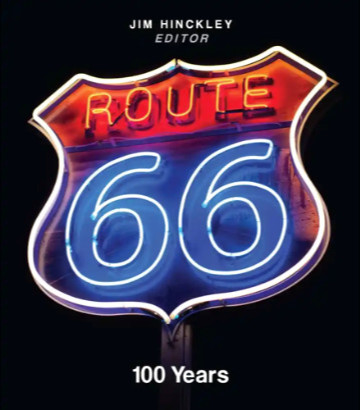 That title may look familiar. If so, one reason might be the similarly named Route 66: The First 100 Years, reviewed
  Route 66: 100 Years is an anthology edited by Jim Hinckley of
 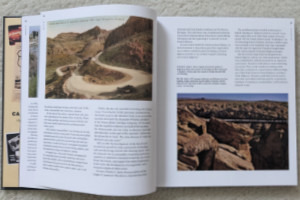 Like the beginning pages of many books about historic highways, the introduction includes tales of how the early automobile roads followed native trails, animal migration paths, and train tracks. And it talks about the impact that the popularity of bicycles had on the desire for and development of roads outside of cities toward the end of the 19th century. What makes it a little different from most similar writings is that it provides some details about organizations and specific events during road development during this era of pedal-powered transportation.
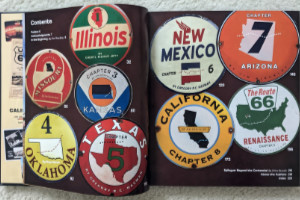
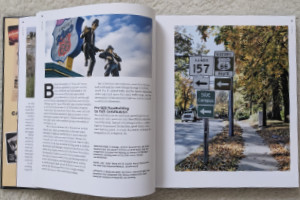 The state chapters appear in geographic sequence, east to west, which is the direction most people travel the route. Together, they provide a sort of combination travel guide and history lesson. I’m not talking about a travel guide with turn-by-turn directions, motel phone numbers, and such. However, most towns along the route are mentioned — and US 66 was a great connector of small towns — along with numerous points of interest. There is usually some history given about each town and POI, and there is plenty of history about the route itself.
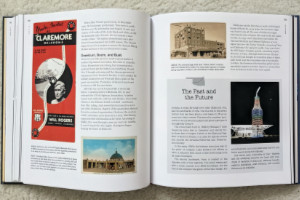 The book is definitely well-illustrated. I don’t believe there is a single page, besides the index and authors’ bios, without at least one image. These include modern and period photographs, postcards, advertising brochures, and other items. Joe Sonderman supplied some of those postcards and brochures, as did big-time collectors Mike Ward and Steve Rider. I was extremely pleased to see a photo from the collection of the late Laurel Kane included. Many of the modern photos were taken by Jim Hinckley and his wife, Judy. I saw no photos from either Rhys Martin or Greg Hasman, although I know both are excellent photographers. I did see photos from Shutterstock, Alamy, and Getty. I thought both situations were curious, but the final product comes off well.
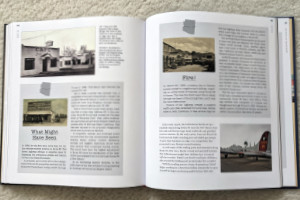 The quality of the book is quite good. Color and black-and-white images show nicely on the heavyweight glossy pages, and the layout serves them well. All have descriptive cut lines that include source credits. There are numerous sidebars, most with their own images, providing extra information outside of the main text flow.
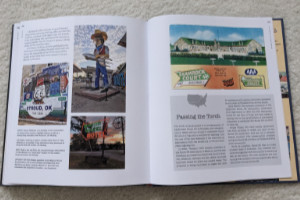 The individual states that carried US 66 account for eight chapters. The book has nine. Dries Bessels, a resident of the Netherlands, authored a chapter named “Renaissance”. Dries has guided multiple tours down the length of Route 66 and provides an outside-the-country view of the historic road. The “renaissance” he writes about is its emergence as a travel destination for both Americans and foreigners after being bypassed and decommissioned. America, essentially spared the devastation that WWII brought to Europe, was the land of dreams to post-war Europeans, and Route 66 was a tangible thing that rolled right through those dreams. Today, Route 66 is still regarded as a way to experience a diverse range of America.
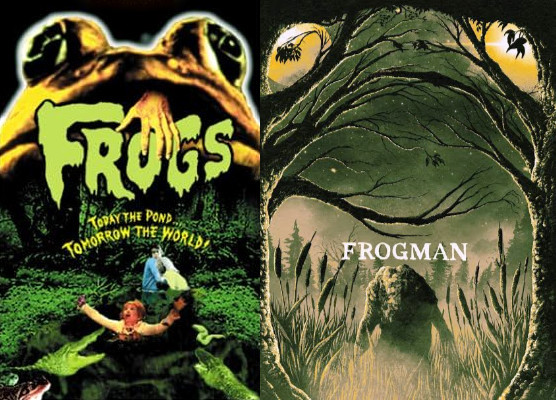
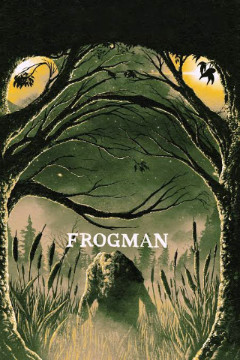 Frogman is a horror movie. I’m pretty sure the last horror movie that I paid to see in a theater was The Exorcist in 1973. I did that because I liked the book. I went to see Frogman because I liked the festival.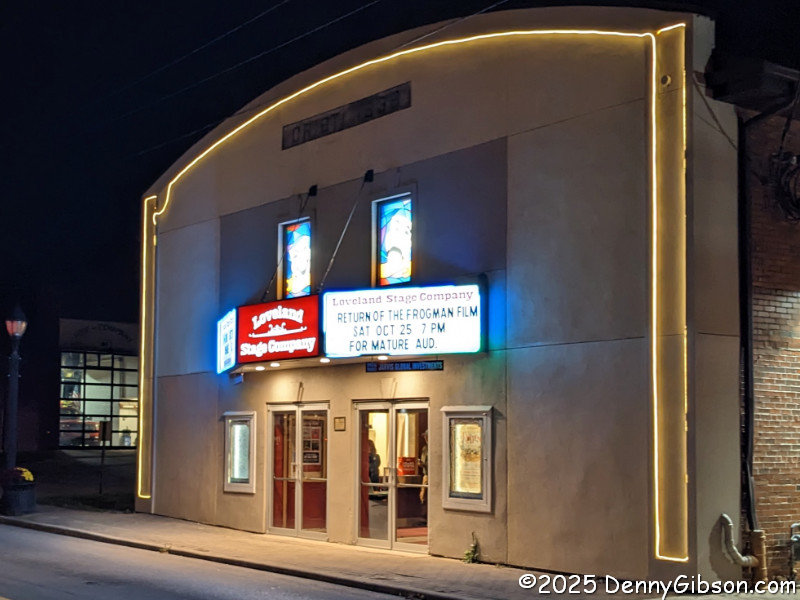
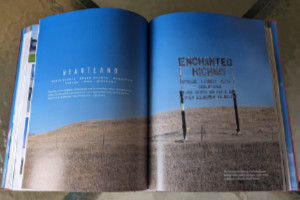
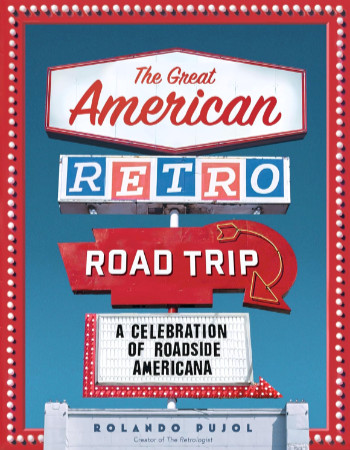 There’s no road trip here. The Great American Road Trip is not a travelogue. Nor is it a guide for traveling to or through a particular place. It is a well-done, very inclusive, nicely illustrated catalog of stuff that people like me drive around the country to see.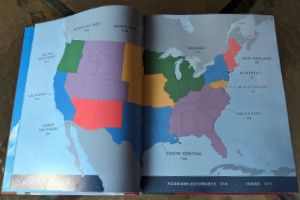
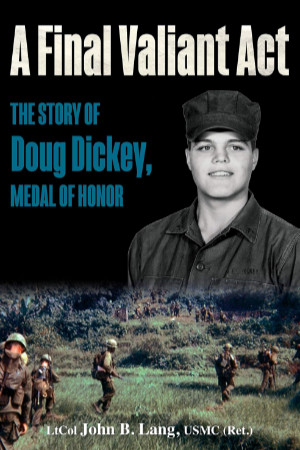 This is the second book that I’m aware of about Medal of Honor recipient Doug Dickey. I was aware of the first one,
 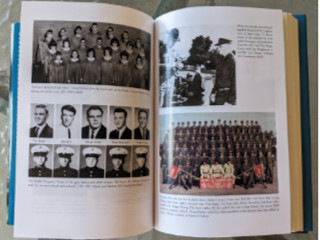 The book includes several maps and diagrams to help describe things like locations and organization hierarchies. There are even a few black and white pictures mixed in with the text. That’s nice, but they are on matte paper. What is even nicer is the section of twenty-two glossy pages containing higher quality images, many of which are in color.
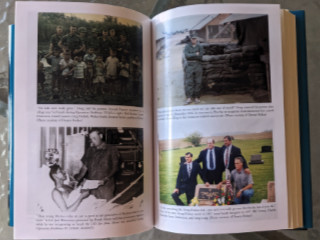 As mentioned several times on this website, Doug Dickey was a classmate of mine. I have attended events that honored him and read much that has been written about him. Two things from this book that I’d not heard before stood out. The common belief was that Doug fell on top of a single grenade, and that is what the Medal of Honor citation describes. But years later, when witnesses were able to compare notes, it was determined that there was a second grenade that Doug pulled under his body after falling on the first one. I was also struck by the sentence that Lang ends his book with, and with which I’ll end this review. It’s something that Doug’s mother, Leona Dickey, said when talking about her oldest son. “The guy who threw the grenade — he would have loved him, if he could have just met him.”