
Book Review
Thus Fell Tecumseh
Frank E. Kuron

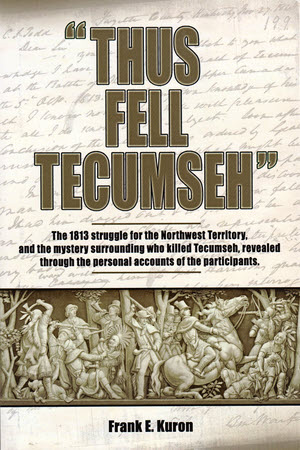
Thus Fell Tecumseh coverOne of the few undisputed facts of Tecumseh’s life is the date of his death. The date of his birth is only known approximately and there are multiple possibilities for its location. He was born about March 1768 somewhere in the Ohio territory. It’s pretty much accepted that he met his end at the Battle of the Thames but that statement isn’t quite as precise as it might appear. While it is generally believed, as most reports indicate, that he died as a combatant in the battle, reports do exist that describe his death as an accidental shooting some distance away from the actual fighting. What no one questions is that Tecumseh was alive on the morning of October 5, 1813, and dead at the end of the day.


Use Grammarly’s grammar check because smart words should be presented smartly.


A little more than half of Thus Fell Tecumseh involves that day, which means that nearly half of it doesn’t. Kuron spends that other half providing a well-researched and well-written description of the early part of the War of 1812 and the circumstances that led to it. He also manages to fit a pretty good biography of Tecumseh in there. By the time the Battle of the Thames begins, the reader has a more than decent idea of what those British, Canadian, American, and Indian forces are doing there.

Kuron also provides a good summary of the battle before starting to present the various accounts of Tecunseh’s death. There are accounts from eyewitnesses with details that, if there were no other reports, would make them readily accepted as absolute truth. But there are other reports. Lots of them. Some name different individuals as the slayer and some name the same man but differ in other significant details. Even more problematic are the differing reports that one witness might give over time. Like testimony in a trial, the reports are presented unmodified. Kuron never urges the reader to accept one report or another. He does point out the discrepancies in each. If this were a real trial where the killer would be punished rather than glorified, every suspect named would almost certainly be acquitted thanks to mounds of reasonable doubt.

Of course, the killing of Tecumseh was no crime. The Shawnee chief was almost universally admired and respected by friend and foe, but another of those rare undisputed facts about him is that he was a very active and effective enemy of the young United States. There was fame to be gained from his killing, and the man most often named as the killer, Colonel Richard Johnson, was boosted to the Vice Presidency by that fame. Of the three most popular candidates for the honor, one (David King) shied away from any publicity, and another (William Whitley) died on the battlefield. Johnson himself never quite claimed to have slain Tecumseh, but supporters did make the claim for him, and his political career clearly benefited.

Part of the difficulty in identifying the slayer is in identifying the slain. At least two of the bodies left on the field of battle were identified as Tecumseh plus there are claims that the body was carried away by companions and even that it was never there.

Kuron does not offer an answer to the question of who killed Tecumseh. He does supply a terrific amount of testimony, from participants in both sides of the battle as well as others, that suggests several possibilities. Interest in the War of 1812 has certainly increased during its bicentennial but has been overshadowed even in that by the sesquicentennial of the American Civil War. As the final use of the British military against the United States and nearly the last, and possibly the largest, organized resistance by Native Americans to advances of the new country, the War of 1812 is extremely important in this country’s development. Thus Fell Tecumseh is a very well done look at the war, the Battle of the Thames, and the many ways in which Tecumseh might have fallen.

Thus Fell Tecumseh, Frank E Kuron, Kuron Publishing (January 14, 2011), paperback, 9 x 6 inches, 352 pages, ISBN 978-0615415222
Available through Amazon.

Book Review
The House on Hathaway Road
The Henkalines

The House on Hathaway Road coverNot only did I graduate from high school smack dab in in the middle of the ’60s, it was smack dab in the middle of the Henkalines, too. There were four of them; a girl and three boys. The girl was a few years older than the boys. The oldest boy graduated a year before me and the next a year after. Though I was most familiar with the two boys closest to me in age, I knew them all. It was a small school in a small town in rural Ohio. Everybody knew everybody.

All four siblings contributed to the book. Jack, the guy just a year behind me, got things started in the 1990s by recording remembered stories on his laptop during idle time on business trips. The idea was to provide some personal history to his own children. This was a low priority and sometimes forgotten task until the death of a friend gave Jack a nudge. The friend had long maintained a journal and his widow told Jack how much that helped her and the children deal with the loss. It prompted Jack to return to his recording. In time, the brothers and sister became involved in filling in some blanks and recording their own stories and ultimately producing The House on Hathaway Road.

After introducing their parents and the house they grew up in, each of the four “kids” provides a chapter. Chapters on the final days of the parents and on the next generation follow. A member of that next generation died in an automobile accident in 2007 and there is a chapter dedicated to her. A Henkaline family tree concludes the book.

Jack’s original goal, to pass on some history to the next generation, is clearly accomplished and then some. There are certainly items in the book that will be of little interest for non-Henkalines but there are many more that provide glimpses of the 1950s and ’60s that almost anyone can enjoy. There are some truly universal memories like 24 cent gas and gathering in front of the TV to watch whatever Dad wanted to watch. The Henkalines even include a chapter titled “Nostalgia” with pictures of things that most people of a certain age will remember. Things like skate keys, TV test patterns, and Burma Shave signs. Other memories might not be exactly universal unless you lived in “the country” in the Midwest. In that case, things like chicks in the mail, laundry day with a wringer washer and “on line” drying, party line telephones, and all-purpose aprons might sound familiar.

One of the stories that Jerry (the guy a year ahead of me) tells might be simply entertaining to most readers but for anyone attending Ansonia High School in 1963 it’s a major highlight on the memory reel. Jerry was a starting tackle on the team that broke a 38 game losing streak. I recall a story that newscasters Huntley and Brinkley, who ended most programs with something lighthearted, used our first victory since 1958 as that night’s closer. I’ve never found any documentation for that but Jerry’s reporting of an uncle in Oregon who first heard the news on radio indicates there was some national coverage and that the Huntley-Brinkley story could possibly be true. I’ve always considered my time at AHS to have been excellent preparation for being a Bengals’ fan.

The book’s dust cover speculates that readers might find themselves saying, “That story reminds me of what happened to me growing up.” That’s likely true of almost any member of my generation regardless of where that growing up occurred and absolutely true for those of us who grew up within a few miles of Hathaway Road. Those in other generations will still enjoy the book but they might get jealous.

The House on Hathaway Road: Where Memories Began, The Henkalines, Aventine Press, February 18, 2013, hardcover, 9 x 6 inches, 286 pages, ISBN 978-1593308124
Available through Amazon.

Book Review
Twelve Years a Slave
Solomon Northup

Twelve Years a Slave coverLike most of the world, I had no idea this book even existed before the movie about the New Yorker kidnapped into slavery came out. When I saw the movie, I was moderately less impressed than some but I left the theater with two basic questions: was the book an actual memoir and how close did the movie track it? As I poked around the internet, I encountered no suspicion that either Solomon Northup or the story he told were fiction which made the answer to the first question “yes”. I then located a free PDF copy of the book and set out to answer the second question myself. I had my doubts as I read the book’s early pages but it became apparent before too long that that answer was “very close”.

The real Solomon Northup did not have quite the wealth and social rank that the movie Solomon Northup seems to have. My guess is that’s to make his enslavement more shocking and I have no problem with that. Quite a few pages of print are used to establish that Northup had little reason to fear for his safety. On film, fancy clothes and strolls in the park do that more quickly. There are a few cases of the movie combining multiple incidents into a single event or more than one person into a single character but that’s a fairly common practice and does no damage to the gist of the story. I might not be crazy about the too long shots of unmoving faces or moss draped trees but I have to say the movie is fairly well done and more than fairly accurate.

But, just as the book didn’t become a movie without compromise, neither did Northup’s story get to the page completely pure. The book is one of those “as told to” things. In this case, the printed story is as told to and edited by David Wilson. The prose at times becomes more flowery and stilted than how I imagine Northup actually communicated his tale but there is nothing at all wrong with that. That’s why professional writers are employed in situations such as this. Wilson’s job was to make the story readable and attractive. Did he also alter or embellish things? I can’t really say, of course, but my sense is that he did little or none of the former but did slip in some amount of the latter. I suppose that’s to be expected since his job also involved making the book successful. That it was; selling 30,000 copies and being considered a best-seller in its day.

About halfway through the book, I thought of posting a review of it. Nothing too serious, as the book was 161 years old, but something as sort of a novelty in the midst of all the bustle around the movie. Then, about three-quarters of the way through, I decided there was something else I needed to do first.

Twelve Years a Slave was published less than a year after Uncle Tom’s Cabin, originally a serial, was published as a book. Northup dedicated it to Harriet Beecher Stowe. Thinking that I had not read Uncle Tom’s Cabin since high-school, I decided that reading it now was a good idea so that I might compare the two. So I found a free PDF of Stowe’s book and soon after I started reading it came to the realization that I had not just gone since high-school without reading the book. I may have read some chopped down “Cliff’s Notes” style version and I’ve seen skits and other portrayals but it was soon obvious to me that I had never read the full original novel. I found myself very impressed with Stowe’s writing as well as her story. I found her story quite similar to Northup’s or at least to Wilson’s recording of it. By the time I finished Uncle Tom’s Cabin and got ready to do this review, I was starting to think that Wilson might have taken nearly as much from Stowe as he did from Northup. I was, however, very wrong.

I saw the movie in early December and searched out the free PDF shortly thereafter. Then as now, the search phrase “12 years a slave” yields a list of hits that almost all reference the 2013 movie one way or another. It takes adding “book”  or some other qualifier to get much else. I must have done something like that in December — I did find that PDF somehow — but now there seems to be more. I’m sure there are things that I simply didn’t notice before but it’s also true that there are new things. One example is a USA Today article that is just a few days old and talks about the recent growth of interest in the original writing that I felt but could not quantify.

One of the things I became aware of only after reading both Twelve Years a Slave and Uncle Tom’s Cabin is the work that Dr. Sue Eakin and Dr Joseph Logsdon did in verifying events in Northup’s narrative. I shelled out 99 cents for an electronic version of the recently published “enhanced” version of Twelve Years a Slave that includes some of their findings and more. I did not reread Northup’s story or even all of the notes but just skimming over them made it evident that the story was firmly anchored in reality. Another real world connection popped up in the search list. An article here tells of the diary of a Union captain who reached the plantation from which Northup was rescued some ten years after that event.

Even with the help of a professional, Twelve Years a Slave is not as well written or easy to read as Uncle Tom’s Cabin but the stories they tell are frighteningly similar. Maybe the totally factual basis of the one compensates for the skill of the other (and neither is poorly written). I’m actually somewhat glad that I was mistaken in believing I had read Stowe’s novel decades ago because reading these two back to back made quite an impression on me. The movie is really good and deserving of awards and praise. I’ll even offer my own praise for it being a whole lot truer to the book than many I’ve seen. But, as is very often the case for some of us, the book is better.

Twelve Years a Slave, Solomon Northup through David Wilson, Derby & Miller, 1853, hardcover, 5 x 7.5 inches, 336 pages

Book Review
How to Visit All 50 States in 12 Trips
Terri Weeks

How to Visit All 50 States in 12 Trips coverI thought of reviewing this ebook when it came out last March but it didn’t happen. There were actually multiple items, including a couple of CDs, that were review candidates about that time which got pushed aside by stuff like preparations for the coming summer. By releasing this second edition, Terri Weeks combines a reminder that I missed posting a review last year along with a second chance.

Terri lives within ten miles of me, does a goodly amount of traveling, and writes a blog about it. Add to that the book she’s co-written called Adventures Around Cincinnati and the travel related lecturing she does around the area and you might think it almost a given that I’ve met her. Not so and what at first might seem odd, might not be at all surprising once you learn that the full title of that book is Adventures Around Cincinnati: A Parent’s Guide to Unique and Memorable Places to Explore with your Kids and that her blog is called Travel 50 States with Kids. I’ve nothing against kids, of course. I did, once upon a time, some traveling with my own and my trip journals include at least one outing with just me and a grandson. But it’s an obvious fact that I seldom travel with anyone and that I travel with kids even seldomer.

But kid-friendly attractions are hardly uninteresting attractions and I’ve been following Weeks’ blog for some time as she describes visits to quite an assortment of them. I did — and continue to — read the blog through its RSS feed but I also have an email subscription. Why email? Because signing up for email is the ticket for getting a free download of How to Visit All 50 States in 12 Trips.

The twelve trips described in the ebook are not just theoretical lines on a map. The routes are practical and mostly proven. They are the routes that the Weeks family has or will follow to taste every state in the union before the youngsters finish high school. Terri Weeks has an engineering background which I’m sure served her well when she set out some years ago to devise a plan to accomplish the family’s travel goals. They are getting close. One change for the second edition is an update of “…eight states and three years to go” to “…six states and two years to go”. If I understand the scoring properly, nine trips are history and three are yet in the future.

Even if you exactly share Weeks’ goal of visiting all 50 states with your offspring before they finish high school, you might not want to do it in exactly twelve trips or exactly the same twelve. In fact, I imagine the chances of someone using this book as a precise blueprint for their own travels are pretty low but I’m confident that’s not what Weeks intended. The twelve trips are her way of making sure her family accomplishes its goal. They provide an obvious way to organize the nice catalog of attractions which is the book’s primary offering and they serve as an example of how the 50 state task can be accomplished.

For Weeks, the goal is not to simply reach each state but to actually visit each one; to experience, where possible, something unique for which a state is known. Things like the Grand Canyon in Arizona, a Mardi Gras museum in Louisiana, the Grand Ole Opry in Tennessee, Crater Lake National Park in Oregon, Yosemite National Park in California, and even the Mall of America in Minnesota.

How to Visit All 50 States in 12 Trips mapThe book is not large, 40 pages, 4.5 KB. There are no detailed directions. There is a general map, like the one at left, for each trip followed by a daily itinerary. Itinerary entries are usually one-liners with any details provided through a web link. Being an ebook, How to Visit All 50 States in 12 Trips can assume some connectivity that paper books can’t. That means web links for many attractions. Sometimes the links lead directly to an attraction’s website and sometimes, for attractions already visited, to a Travel 50 States with Kids blog entry which often contains a link to the attraction’s website along with a report on the family’s visit.

As indicated, identifying various attractions is the ebook’s strong suit. The trip routes and itineraries are also quite useful if only as examples for creating your own. And there is a third subtle value in the the ebook. Both it and the blog behind it serve as gentle reminders that, if there is a long term goal in your life, you will probably need some sort of plan in order to reach it. In the case of getting kids to fifty states before graduation, merely keeping score won’t get it. Having just three or four states to go when the senior year rolls around sounds good unless those states are Maine, Florida, Alaska, and Hawaii.

How to Visit All 50 States in 12 Trips – Second Edition, Terri Weeks, self published, February 2014, ebook, 8.5 x 11 inches, 40 pages, free with email subscription at How to Visit All 50 Atates in 12 Trips


By Mopar to the Golden Gate coverBy coincidence, the first review of my own book, By Mopar to the Golden Gate, appeared yesterday. Written by Ron Warnick at Route 66 News, the very positive in depth review can be read here.

Concert Review
Willie Nile
Southgate House Revival

Willie NileWhen Willie Nile‘s American Ride appeared on my road trip oriented radar last spring, I thought his name sounded vaguely familiar but couldn’t really connect it with anything. When I later heard a tune, Vagabond Moon, from his 1980 debut album, it, too, sounded vaguely familiar. I probably did hear both the name and the music thirty years ago but I didn’t hear it enough or pay enough attention for it to stick with me. I’m now realizing that I am certainly the poorer for that and I’m learning that I’m not alone.

I was pretty happy when I first learned that Willie was coming to the Southgate House Revival in Newport, Kentucky. Then, when I found out it would be on Groundhog Day Eve and my plans for the holiday started to form, Willie’s concert got pushed aside. I intended to visit a friend in northern Illinois where another Willie, a groundhog named Woodstock Willie, is the focus of a pretty good party in the town where the movie Groundhog Day was filmed. Then weather forecasts, which turned out to be rather accurate, called for several inches of snow in Illinois and I decided to stay in Ohio which meant I could make the concert and that was a very good thing.

Even after the event was firmly on my agenda, I had no idea that it would compel me to post my first actual concert review. I didn’t have a camera with me and, though I could have tried to grab something with my phone, I did not and resorted to a stock publicity shot to start this post. Fortunately, Kirsten O’Connell shared this photo of the show on Willie’s Facebook page so you can get a glimpse of how things looked.

Thinking I would not be be going, I did no research and had no idea what to expect. I thought it quite possible that it would be a solo show with just Willie and a guitar. Boy, was that ever wrong. Willie took the stage with a topnotch high-powered 4-piece that blew me and the rest of the packed Revival Room away.

There are three performance spaces at SGHR. The Sanctuary is the biggest and there is a stage in the smallish Lounge. The Revival Room is a mid-sized place on the second floor. Yes, SGHR is a re-purposed church; the 1866 Grace Methodist Episcopal Church. How they resisted calling the upstairs venue The Upper Room, I’ll never know. I’ve seen a few shows in the Sanctuary and a couple in the Lounge. This was my first time in the Revival Room and it instantly became my favorite. It held forty-eight folding chairs. There would have been fifty but the middle of five rows was truncated by support posts. Every seat was filled and another thirty or so people stood at the back and along the walls.

The show was riveting from beginning to end. Despite never having seen Willie Nile before and knowing only a few of the songs, I felt right at home. There was a touch of Springsteen and Dylan and Grahm Parker and Lou Reed and Elvis Costello and other rock ‘n’ rollers I can’t exactly name. But it was all Willie Nile. Willie doesn’t bring to mind first tier singer-songwriters because he mimics them but because he is one.

The band was top tier, too. I believe Alex Alexander, who played drums on the American Ride album, has been touring with the group but Larry the Chicago Guy (Sorry, forgot the last name.) is wielding the sticks for a few shows. If that subtracted anything from the performance, it’s hard to imagine what. The group was tight and professional. Matt Hogan’s guitar solos were impressive without being over indulgent and bassist Johnny Pisano got in his own share of fancy licks — and leaps. Hogan and Pisano both appear on American Ride. In addition to looking good and sounding great, it was obvious that all four musicians were enjoying themselves to the max. Nothing impresses me more than an entertainer having fun while delivering quality.

Things mellowed briefly when Willie sat down at an electric piano — after they found the plug — and the band left the stage. The piano is Willie’s first instrument. He performed The Crossing solo then moved onto Love is a Train. One by one, the others returned as the song progressed and before long the train was a rockin’. Apparently a song and a half of mellow is enough for Willie. Other songs I remember were three dedications to musicians the world lost quite recently. Heaven Help The Lonely was dedicated to Phil Everly, One Guitar to Pete Seeger, and a rousing version of Sweet Jane was dedicated to the man who wrote it, Lou Reed. Surprisingly, he did not play American Ride and I did not miss it and I mean that both it not being played and me not missing it were surprises. I don’t mean that I did not notice its absence; I mean that the concert seemed full and complete and satisfying without it.

Early on, Willie let it be known that he thought SGHR was a pretty cool place. He also talked of it being his first time in Kentucky until a fan in the front row reminded him of his 1980 gig opening for The Who in Lexington. Willie smiled at the correction and said he intended to be back again before long. I believe him and I’ll be waiting.


I learned of the song American Ride, first on the radio then in this video, in the week preceding the start of my Lincoln Highway centennial drive. The album had not yet been released but the title song was available as a 99 cent download. I bought the song and had thoughts of it playing as we departed Times Square. I failed at making that happen but, at 7:23 AM on June 22, as we were leaving Manhattan, I did send the following pre-written Tweet:

Leaving New York City with a tank of gas.
Got my bag and my camera, I’m gonna get out fast.

The album was released June 25.

Webpage Review
Highway One Road Trip
Shout Digital

Highway 1 Virtual Road TripFor me, virtual road trips will never replace the real thing but with sub-zero temperatures and several inches of snow on the ground, I took a look at one and had some fun. I did not discover it because I was searching the web for just this sort of thing. I learned of it through an email of the sort that contain link exchange offers or promises to increase your search engine ranking or something similar and which are usually deleted about the time my eyes reach the third or fourth sentence. But this one was well written and polite and, not only did I read it all, I actually clicked on the link it contained and, as I said, had some fun.

Highway 1 Virtual Road Trip
The graphics are reminiscent of a 1980s Atari game though there are a bunch more elements and they’re a lot smoother. The vehicle is a Cadillac convertible which is moved south along California Highway 1 by scrolling. Flyout tabs allow jumping to specific locations such as Big Sur and Santa Monica if you don’t want to “drive” there. Along the way popups provide information about landmarks and areas and clickable pads appear from time to time that link to Google Street View.

Although bits of data appear for goodly number of landmarks and attractions, it is hardly an exhaustive list and no contact information is provided. The page is intended to be a fun way to cruise/scroll down the California coast and maybe learn a few things on the way. It does not purport to be a practical trip guide.

The page is part of the website of Exsus, a purveyor of “luxury holidays & honeymoons” and not the sort of outfit you might immediately associate with drive-it-yourself road trips. But CA 1 goes through some pretty high class neighborhoods where honeymoons and holidays can certainly be luxurious and Exsus is certainly capable of arranging them. One purpose of the virtual road trip is to make people aware of Exsus. Another is to make people aware of Shout Digital, the company that built it. It is something of a showcase for them and uses some fancy website techniques, such as parallax scrolling, that are better explained in a Creative Bloq article on the page (They call it a “microsite” which I sort of like.) here.

The Highway One Road Trip is here. It won’t clear the snow or make the thermometer less depressing but it can provide some fun and maybe some information on west coast attractions.

Book Review
By Mopar to the Golden Gate
Denny Gibson

bmttgg_cvrThis book has thousands of words, many with multiple syllables, and dozens of pictures in 50+ shades of grey. It tells the story of an old man in an old car on an old road and is available here and at Amazon, including Amazon UK and Europe, on an old medium — paper.

By Mopar to the Golden Gate, Denny Gibson, Trip Mouse Publishing, 2013, paperback, 9 x 6 inches, 140 pages, ISBN 978-0615921990.

bmttgg_int

Book Review
Fallen Timbers 1794
John F Winkler

Fallen Timbers coverEveryone loves a winner and, in 1794, the United States Army finally became one. In his earlier work, Wabash 1791, Winkler tells of the new nation’s first military campaign and the disaster that resulted. Fallen Timbers 1794, describes the campaign that led to a victory at Fallen Timbers and ultimately to the Treaty of Greenville.

The 1791 Battle of the Wabash, more commonly known as St Clair’s Defeat, essentially destroyed the United States Army. In 1792, congress created a new one. To lead this new army, The Legion of the United States of America, President Washington chose Revolutionary War veteran Anthony Wayne. Wayne did things quite a bit differently than did St Clair. He made sure his troops were trained and equipped before setting out and he placed a series of defensible forts so as to protect his supply line. Perhaps more importantly, he understood the Indian methods of combat and devised tactics to counter them. Like St Clair, Wayne had difficulties with supplies and contractors but it seems that now it was not only greed and incompetence that fueled them but an actual conspiracy aimed at causing his failure.

As he did in Wabash 1791, Winkler sets the scene for the campaign by describing the “strategic situation” and with chapters on the opposing commanders, armies, and plans. In many respects, the world situation was still much like it was in 1791. The United States was only a few years older and only a tiny bit more stable. Britain’s support and encouragement of the natives may have actually increased and neither France not Spain had vanished from North America. In fact, French elements were very much at play, often for the worse, inside the young nation. Of course, there were also plenty of homegrown problems. That previously mentioned conspiracy was one of them and, in the westernmost reaches, open revolt was a real possibility. These were the days of the Whiskey Rebellion. Less than three weeks before the Battle of Fallen Timbers, a crowd of 7,000 threatened to march on Pittsburgh. It was less than two months after the battle that President Washington personally went into the field to put down the uprising.

Three dimensional maps, like those that helped in understanding the Battle of Wabash, do the same for the Battle of Fallen Timbers. Other maps, along with period portraits and modern photographs, help understand the people and places involved. Peter Dennis’ wonderful paintings, one of which is used for the cover, provide realistic visualizations of specific battle scenes.

Winkler’s book on the Battle of the Wabash had nowhere near the shortcomings of the battle it described but he did manage to improve on it a little with Fallen Timbers 1794. I resorted to the word “scholarly” in describing the front end of Wabash 1791. It was justified, I offered, because it presented a lot of information that made later portions of the book flow more smoothly. But in this latest book, I never did get the feeling of slogging through mounds of dry facts that I had before. I have no way to quantify this and it may be simply that less preliminary facts are required or that they are less dry or that I am better prepared. Any or all of those could be true but my gut feel is that Winkler has refined his language and maybe even the structure to produce something more easily read.

During the last few years, any time that the average person felt like devoting to history was spent, more than likely, on the Civil War sesquicentennial. I have absolutely no disagreement with that but still thought it nice that, here and there, the bicentennial of the War of 1812 got some attention. The territory in dispute in 1812 was not all that different than what was being fought over in 1791 and 1794. Some of the nations and even some of the individuals involved were the very same. To the War of 1812 and especially to the Battle of the Thames, the battles at Wabash and Fallen Timbers were “prequels”.

Fallen Timbers 1794: The US Army’s first victory, John F Winkler, Osprey Publishing, February 2013, paperback, 9.8 x 7.2 inches, 96 pages, ISBN 978-1780963754
Available through Amazon.

Music Review
Acoustic
The Goshorn Brothers

Goshorn Brothers AcousticI thought I might never get this posted but I did it and it’s not even a year late. It’s close, though. The official release of Acoustic, which coincided with Larry Goshorn’s “retirement” party, was 349 days ago. I knew the CD was coming and intended to get a copy at the party, then, figuring I’d pick it up in the near future, opted not to stand in line. To be honest, I could have bought the CD without a hassle but I wanted it signed and for that there was a line and I really believed I’d catch the boys performing together in a couple of weeks. If I had known that wouldn’t happen for six months, I’d have stood in line.

I got my copy just days before leaving on a month long road trip so that, even though I really liked the album and knew what I wanted to say about it, I had no time. Then, when the trip was over, I had no… Well, I had no excuses. Yes, the main reason this review did not get done during the last four month is because I just kept putting it off each week. When it comes to crastination, I’m a pro.

It seems a curious coincidence that the last music review I did, in March, was for an acoustic album and some of the thoughts I had then are applicable here. That album was Dirk Hamilton’s solo mono. and, though it was recorded in a studio, it represented my personal experience with Dirk quite well. Dirk is best known for his work with a full band but that’s something I’ve never seen. With solo mono, I could hear Dirk at home the way I’ve heard him live.

Larry and Tim Goshorn are also best known for their work with a full band though that’s something I’ve seen a lot. From Larry’s early days with Sacred Mushroom, and the time both brothers spent with Pure Prairie League, through various incarnations of the Goshorn Brothers Band. But I’ve also heard them a lot as an acoustic duo. In recent years, seeing the brothers front a band became something of a special event; Something more likely to be at a festival or a concert than a club gig.

There were club gigs but most were, quite literally, Goshorn Brothers gigs rather than Goshorn Brothers Band gigs. I and plenty of other Cincinnati area music lovers have spent many enjoyable evenings in a small bar or restaurant listening to the two brothers trade off guitar and vocal leads and blend their voices in brotherly harmonies. It’s an experience that Acoustic captures pretty darned well but with very little crowd noise and no interruptions from the waiter.

There’s nothing new on the CD and I think that’s the point; To remind you of an evening you’ve enjoyed or reproduce part of a pleasant evening for someone who hasn’t experienced the real thing. Like a typical Goshorn Brothers set, the CD is heavy on originals with a few covers thrown in. Some of the tunes, like Tim’s Just Fly and Larry’s Kentucky Moonshine from their Pure Prairie League days, might very well be familiar even to those who haven’t seen the brothers performing in a local bar. Others, such as Devil’s Due, are more recent and less widely known. Devil’s Due is, to me, the CD’s standout track. It’s a catchy Larry Goshorn tune with some great lyrics and Tim’s excellent slide guitar sets it off perfectly.

Recording for the album took place over a few years in a several locations but rumor has it that most if not all of the tracks that made it to the CD are from the recently demolished Twenty Mile House. They all sound good. There is, as mentioned, little crowd noise; Essentially just some applause and cheering between tracks. These guys have been doing this a long time. They know how to get things sounding right for their live performances and this recording captures both voices and both guitars cleanly. “Just like the record”, Tim sometimes quips at the end of some familiar song. Acoustic is “just like the club” — without clinking glasses and the noisy couple at the next table.

Acoustic available at Everybody’s Records or a Goshorn performance.

Book Preview
Walking to Listen
Andrew Forsthoefel

Walking to Listen - Andrew ForsthoefelYes, that says “Preview”. The book does not yet exist. I don’t know exactly when it will exist or if Walking to Listen will even be its title. But I am confident that it will exist and that it will be worth reading.

In a recent blog post, I told how, when I travel, I quickly get behind on the RSS feeds I subscribe to. The same thing happens to the few podcasts that I follow. Heck, I even get behind on them when I don’t travel. So I am seriously behind on This American Life. So much behind that yesterday, October, 15, I listened to the program from May 3. My timing was perfect.

It was a three act program named “Hit the Road”. Act one was “The Slowest Distance Between Between Two Points” which was Andrew Forsthoefel’s story. Andrew had walked across the country, from Philadelphia to the San Francisco, covering 4000 miles in eleven months. He wore a sign bearing the phrase “Walking to Listen” and that is what he did. He met lots of people and he listened to them. He recorded lots of what he heard. From that he produced a one hour audio program that can be heard here. In some regards, the This American Life program is a trimmed down version. It can be heard here.

I was walking when I listened to the podcast and I suppose that might have had a tiny bit to do with my liking of the podcast but only a very tiny bit. The idea of seeing the USA through its people is always intriguing and that’s what Andrew was doing with his walk. He was twenty-three years old and he was asking people what advice they might give to a twenty-three year old version of themselves. Listening to some of the answers was intriguing to the extreme. So too was Andrew’s commentary recorded both during and after the walk.

Near the end of the program the host, Ira Glass, shared information about the one hour program and also mentioned that a book was in the works. When I got home, I listened to the longer audio program and I visited Andrew’s website at WalkingToListen.com. There are pictures there and more information about the walk and a blog. Andrew started the blog about two weeks into the walk. I haven’t read the entire thing but it looks as if he posted every few days during the walk and mentioned everyone he had recently talked to. Thanked them, actually. After the walk, the entries slowed, as they should, to a trickle. The most recent was posted on October 14; The day before I first heard the podcast and the second anniversary of the walk’s beginning. In addition to noting the anniversary, the post announced that Houghton Mifflin had picked up the book. As I said, my timing was perfect. I’ve subscribed to Andrew’s blog and will be anxiously watching for a publication date.

The picture at the top of this post was taken by Andrew’s mother as he set off to walk and listen. I hope neither she nor Andrew are too angry at me for snitching it.