
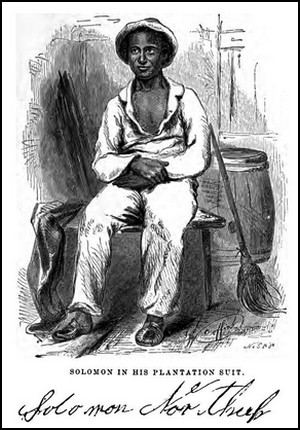
 Like most of the world, I had no idea this book even existed before the movie about the New Yorker kidnapped into slavery came out. When I saw the movie, I was moderately less impressed than some but I left the theater with two basic questions: was the book an actual memoir and how close did the movie track it? As I poked around the internet, I encountered no suspicion that either Solomon Northup or the story he told were fiction which made the answer to the first question “yes”. I then located a free PDF copy of the book and set out to answer the second question myself. I had my doubts as I read the book’s early pages but it became apparent before too long that that answer was “very close”.
The real Solomon Northup did not have quite the wealth and social rank that the movie Solomon Northup seems to have. My guess is that’s to make his enslavement more shocking and I have no problem with that. Quite a few pages of print are used to establish that Northup had little reason to fear for his safety. On film, fancy clothes and strolls in the park do that more quickly. There are a few cases of the movie combining multiple incidents into a single event or more than one person into a single character but that’s a fairly common practice and does no damage to the gist of the story. I might not be crazy about the too long shots of unmoving faces or moss draped trees but I have to say the movie is fairly well done and more than fairly accurate.
But, just as the book didn’t become a movie without compromise, neither did Northup’s story get to the page completely pure. The book is one of those “as told to” things. In this case, the printed story is as told to and edited by David Wilson. The prose at times becomes more flowery and stilted than how I imagine Northup actually communicated his tale but there is nothing at all wrong with that. That’s why professional writers are employed in situations such as this. Wilson’s job was to make the story readable and attractive. Did he also alter or embellish things? I can’t really say, of course, but my sense is that he did little or none of the former but did slip in some amount of the latter. I suppose that’s to be expected since his job also involved making the book successful. That it was; selling 30,000 copies and being considered a best-seller in its day.
About halfway through the book, I thought of posting a review of it. Nothing too serious, as the book was 161 years old, but something as sort of a novelty in the midst of all the bustle around the movie. Then, about three-quarters of the way through, I decided there was something else I needed to do first.
Twelve Years a Slave was published less than a year after Uncle Tom’s Cabin, originally a serial, was published as a book. Northup dedicated it to Harriet Beecher Stowe. Thinking that I had not read Uncle Tom’s Cabin since high-school, I decided that reading it now was a good idea so that I might compare the two. So I found a free PDF of Stowe’s book and soon after I started reading it came to the realization that I had not just gone since high-school without reading the book. I may have read some chopped down “Cliff’s Notes” style version and I’ve seen skits and other portrayals but it was soon obvious to me that I had never read the full original novel. I found myself very impressed with Stowe’s writing as well as her story. I found her story quite similar to Northup’s or at least to Wilson’s recording of it. By the time I finished Uncle Tom’s Cabin and got ready to do this review, I was starting to think that Wilson might have taken nearly as much from Stowe as he did from Northup. I was, however, very wrong.
I saw the movie in early December and searched out the free PDF shortly thereafter. Then as now, the search phrase “12 years a slave” yields a list of hits that almost all reference the 2013 movie one way or another. It takes adding “book” or some other qualifier to get much else. I must have done something like that in December — I did find that PDF somehow — but now there seems to be more. I’m sure there are things that I simply didn’t notice before but it’s also true that there are new things. One example is a USA Today article that is just a few days old and talks about the recent growth of interest in the original writing that I felt but could not quantify.
One of the things I became aware of only after reading both Twelve Years a Slave and Uncle Tom’s Cabin is the work that Dr. Sue Eakin and Dr Joseph Logsdon did in verifying events in Northup’s narrative. I shelled out 99 cents for an electronic version of the recently published “enhanced” version of Twelve Years a Slave that includes some of their findings and more. I did not reread Northup’s story or even all of the notes but just skimming over them made it evident that the story was firmly anchored in reality. Another real world connection popped up in the search list. An article here tells of the diary of a Union captain who reached the plantation from which Northup was rescued some ten years after that event.
Even with the help of a professional, Twelve Years a Slave is not as well written or easy to read as Uncle Tom’s Cabin but the stories they tell are frighteningly similar. Maybe the totally factual basis of the one compensates for the skill of the other (and neither is poorly written). I’m actually somewhat glad that I was mistaken in believing I had read Stowe’s novel decades ago because reading these two back to back made quite an impression on me. The movie is really good and deserving of awards and praise. I’ll even offer my own praise for it being a whole lot truer to the book than many I’ve seen. But, as is very often the case for some of us, the book is better.
Twelve Years a Slave, Solomon Northup through David Wilson, Derby & Miller, 1853, hardcover, 5 x 7.5 inches, 336 pages
 I thought of reviewing this ebook when it came out last March but it didn’t happen. There were actually multiple items, including a couple of CDs, that were review candidates about that time which got pushed aside by stuff like preparations for the coming summer. By releasing this second edition, Terri Weeks combines a reminder that I missed posting a review last year along with a second chance.
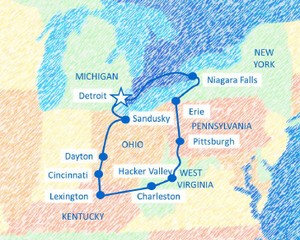 The book is not large, 40 pages, 4.5 KB. There are no detailed directions. There is a general map, like the one at left, for each trip followed by a daily itinerary. Itinerary entries are usually one-liners with any details provided through a web link. Being an ebook, How to Visit All 50 States in 12 Trips can assume some connectivity that paper books can’t. That means web links for many attractions. Sometimes the links lead directly to an attraction’s website and sometimes, for attractions already visited, to a Travel 50 States with Kids blog entry which often contains a link to the attraction’s website along with a report on the family’s visit.
 By coincidence, the first review of my own book, By Mopar to the Golden Gate, appeared yesterday. Written by Ron Warnick at Route 66 News, the very positive in depth review can be read
  This book has thousands of words, many with multiple syllables, and dozens of pictures in 50+ shades of grey. It tells the story of an old man in an old car on an old road and is available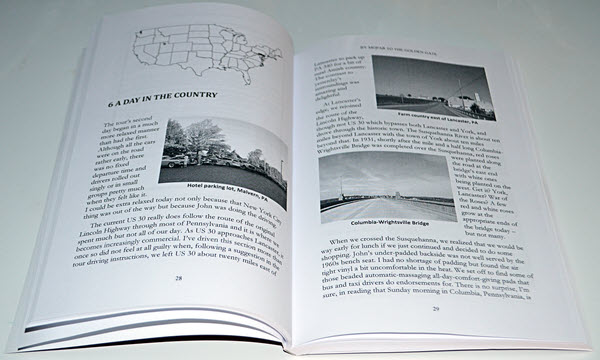
 Everyone loves a winner and, in 1794, the United States Army finally became one. In his earlier work,
  Yes, that says “Preview”. The book does not yet exist. I don’t know exactly when it will exist or if Walking to Listen will even be its title. But I am confident that it will exist and that it will be worth reading.
 Before I get around to actually talking about this book, I am going to tell how I learned of its existence. I first saw Theodora R, the boat whose mast the author was behind, in July of 2011. I was in Albuquerque, New Mexico, when a friend tipped me off to a nearby museum called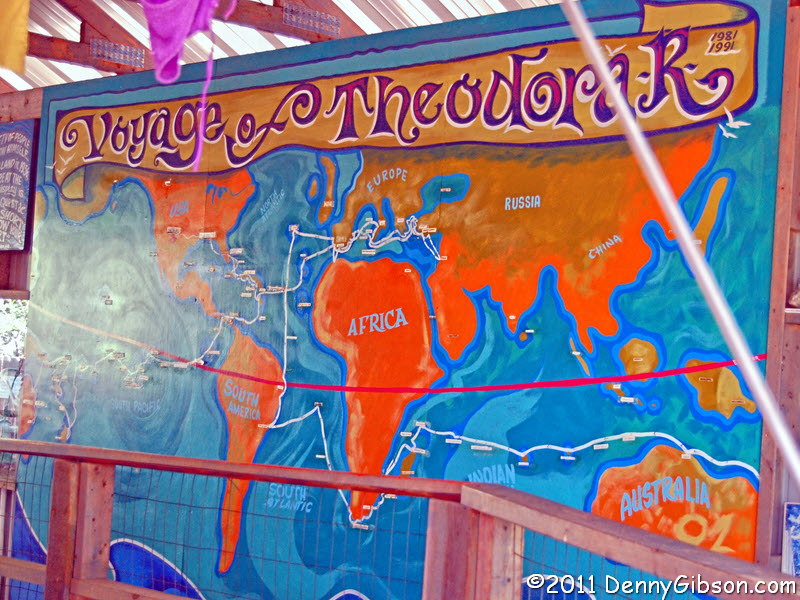
 Carl Fisher was a busy man in 1913. His Prest-O-Lite Company and his automobile dealership were both going great guns, the Indianapolis Motor Speedway he co-founded looked like it might amount to something, the Ocean-to-Ocean Rock Highway he had proposed in September of 1912 was taking off, and then there was the Indiana Automobile Manufacturers’ Association.
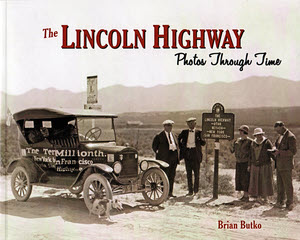 I was hesitant to post a review of this book because some of those “Photos Through Time” are mine but I decided that it would be a bad thing only if I rave about how marvelous the book is. No harm in simply describing it, right? So here are the facts.
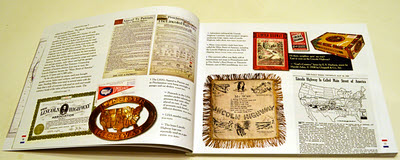 It is organized neither geographically nor chronologically. The first section following the foreword is titled “History”. Here, among pictures of collectibles and artifacts, Butko gives a very brief history of the road’s birth and short life. It is enough to give someone who knows little or nothing about the Lincoln Highway a starting point and someone who knows everything a quick refresher on key dates and events. It is a stripped down but adequate introduction to the pictures that follow.
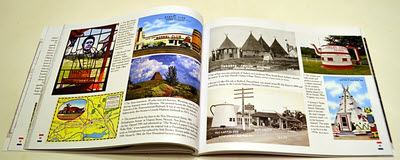 Those pictures are organized by their subjects. Butko identifies ten things that comprise the Lincoln Highway and gives each one a chapter. They are “People”, “Gas”, “Food”, “Lodging”, “Vehicles”, “Attractions”, “Signs”, “Markers”, “Bridges”, and “Roads”. The chapters are themselves samplers. Historic images from postcards and other sources are combined with modern photographs. Images of things along the road, which is every chapter other than “People”, are from locations spread over the road’s entire length.
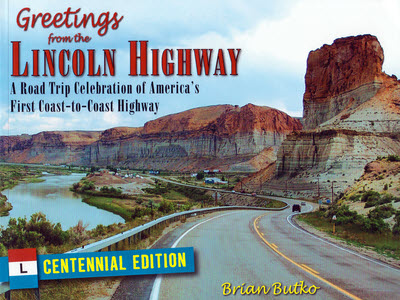 The Lincoln Highway turns a hundred this year. Brian Butko’s Greetings from the Lincoln Highway turns eight. At first glance, the 2013 Greetings… looks an awful lot like the 2005 Greetings… with a soft cover and a “Centennial Edition” banner on the front and it’s a fact that, in many ways, it is the same. It has the same organization with an introductory chapter and a chapter, with map, for each state the highway passed through and a very high percentage of the words and pictures in those chapters are the same, too. Another thing that remains the same and which accounts for the small in percentage but large in number changes is the care and attention to detail. Butko probably didn’t catch everything in the book that the passage of time has altered but he sure tried and he sure got a lot.
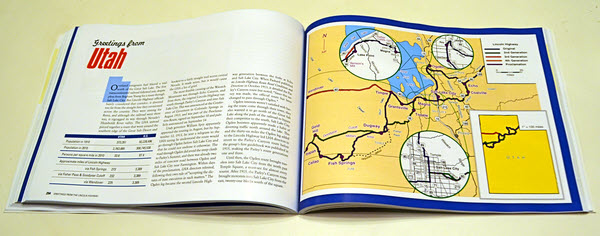 Aside from the occasional new photo, the most visible changes may be in the statistics and maps at the front of each state chapter. Here population numbers from the 2010 census replace those from the 2000 census and the maps get a line for the Proclamation Route. The Lincoln Highway Proclamation Route was a list of cities published by the Lincoln Highway Association on September 14, 1913. Shifts started happening almost immediately and a detailed route was never signed or published that matched the September 14 announcement. But several of the cities dropped in 1913 fought unsuccessfully to return and many have fought more recently and more successfully to be recognized. Butko acknowledges that by including the ephemeral route. All of the quotes from postcards and other period communication that appeared in the margins of the original are still there and a few more have been added.
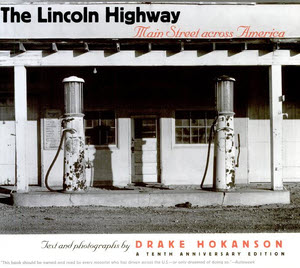 I’m reading this book for the third time. I read it around 2005 when I was dabbling with short drives on the Lincoln Highway to my east. I reread it in 2009 when I was getting ready to drive the Lincoln from the east edge of Illinois to the west coast. My current read is in anticipation of another long, hopefully full length, drive of what Drake Hokanson calls Main Street across America. I never read the original, only the pictured Tenth Anniversary Edition which is now fifteen years old itself.
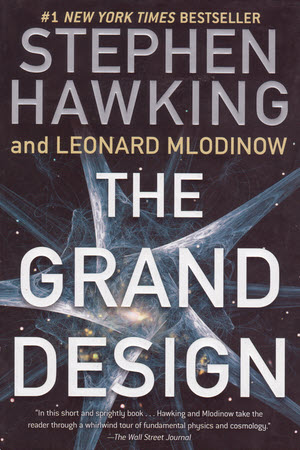 If you think this looks like it belongs here, you haven’t been paying attention. No, books about cosmology, quantum physics, and beyond aren’t what I typically read and I’m clearly not qualified to review them. I was given the book as a gift, I read and enjoyed it, and I intend to tell somebody about it.
 I started off admitting that this book was really out of place here. I do a lot of my reading over meals in restaurants and it was rather out of place in some of the joints where I eat, too. I quickly worked out a way to carry the book that cut down considerably on the funny looks aimed my way.