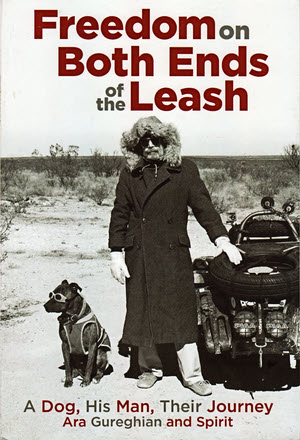
 I really looked forward to the publication of this book. I certainly enjoyed reading it and expect to enjoy reviewing it once I get started but reviewing a book that is near impossible to describe isn’t all that easy. Saying it is the story of a man and dog traveling around the US on a motorcycle isn’t wrong but it sure is incomplete. The man, Ara Gureghian, and the dog, Spirit, have been traveling around the US on a motorcycle since November of 2006 with no plans to stop. I’ve followed their blog since April, 2007, and I have no plans to stop, either. When they started their journey, they were not leaving a home where they planned to someday return. They did acquire some land fairly early on and they do spend winters there but even it is more of a base camp than what most would call a home. From the beginning, Ara had called his online journal The Oasis of My Soul and the ten acres of Texas that his mother bought for him instantly became known as The Oasis. One definition of oasis is “something that provides refuge, relief, or pleasant contrast” and that is something both man and dog needed. Ara had suffered the painful loss of his son and Spirit has suffered abuse from a previous owner. Almost everything — the riding, the writing, the sunrises, the stars, the sunsets — is therapy to some degree but the writing is particularly therapeutic. Ara wrote, and continues to write, his journal for himself. He writes about his travels, his surroundings, and his thoughts. This book is something of a “Reader’s Digest” version of the journal. Neither book nor journal actually tries to be a travel guide or provide insights into living. Nonetheless, they do both.
In an introductory section of Freedom on Both Ends of the Leash called “About Us”, we are told that “This book has no chapters, a continuous life story.” That is one of two big differences, in addition to the major condensing, between the journal and the book. The journal, by its very nature, is broken into pieces clearly marked by dates while the book isn’t broken into pieces at all. In Ara’s words, “There really is no beginning as there will be no end.” The story is told in chronological order but with no artificial breaks or numbers or headings. The other big difference is the photos. Ara started his journey as a very good photographer and developed into an even better one. Journal entries almost always contain several photographs. They typically aren’t directly tied to the text but provide an often stunning view of what Ara was seeing during the time he composed and posted an entry. I believe Ara’s decision not to include any photos in the book is a good one. Trying to do justice to the photos would have really complicated an already complex task and they would not have really illuminated the text in any case.
Ara Guregian was born in France and spent time with relatives in Egypt and other parts of Europe and North Africa. Although he is quite fluent and comfortable with it, English is not Ara’a first language and he is not an English wordsmith whose product one devours for its own sake regardless of content. On the other hand, he can describe a sunset or a valley view in a a way that not only allows you to visualize it but that makes you want to go to that spot and experience it the way he did. That’s impossible, of course. There is too much of Ara in his experiences for anyone to have a shot at duplicating them.
Ara and Spirit cover a lot of territory. There are multiple visits to Utah, New Mexico, Colorado, Washington, Oregon, and beyond and between. At one point I thought I would describe their rides as going from here to there without, in many cases, any real idea of where “there” would be. Then, when I really thought about it, I realized that most of their rides were from here to here. It seems as if a majority of their camps are base camps from which they explore the surrounding area extensively by both motorcycle and foot. The exploration is not just to see different things but, perhaps partly because of Ara’s photographer’s eye, to see the same things differently.
Early on I referred to this book as “near impossible to describe” and four paragraphs of not describing it very well bear that out. It’s a little bit Blue Highways and it’s a little bit Zen and the Art of Motorcycle Maintenance but it is, of course, neither. On the other hand, anyone who enjoyed either or both of those books will most likely enjoy Freedom on Both Ends of the Leash. The book is available from Amazon and other sources at a discount or, for a few dollars more, signed by the authors, through Ara’s Oasis of my Soul website.
Freedom on Both ends of the Leash, Ara Gureghian and Spirit, Ara Gureghian (May 26, 2014), paperback, 9 x 6 inches, 216 pages, ISBN 978-0996083706
Available through Amazon.
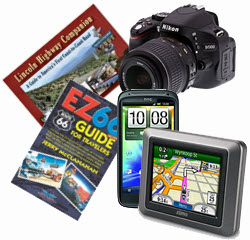 I recently received a request/suggestion for a post on “must have” road trip items. I initially blew it off but returned to it a week or so later. Since I am about to actually head out on a road trip, I need to stockpile some “dateless” (“timeless” almost, but not quite, fits) articles for posting while I travel. You know, the “Trip Peek” or “My Wheels” sort of things that have no connection to what I’m actually doing but can be posted at anytime to meet the blog’s every Sunday schedule. In the middle of generating a couple of “Trip Peeks”, I remembered the email and realized that the suggested “Road Trip Essentials” was as good a topic as any. Of course, it would take more time than a “Trip Peek” but it could be sort of a consolidated “My Gear” and it might be fun. If it also made somebody (the requester) happy, even better.
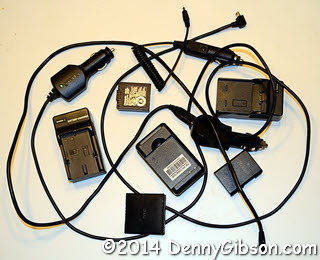 Of course, all of those accessories have their own accessories. For many years, I only bought gear that used AA batteries on the theory that I could always buy power at the corner drug store if required. I believe that happened once. I carried around a bag of nicads and the chargers to fill them in either car or motel. I eventually had to abandon that position but I still cling to the ability to recharge everything whether stopped or on the go. I now carry spare proprietary batteries and AC/DC chargers for two different cameras and a cell phone. I do not carry a spare for the GPS since I seldom operate it on battery power.
 Two really big things have happened since I reviewed Terri Weeks ebook,
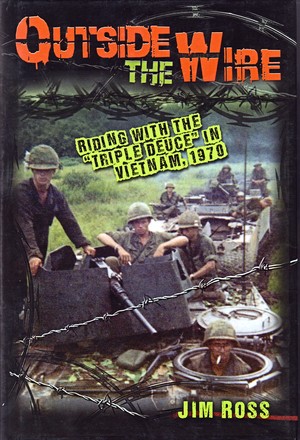 This book is different. It’s different from what I typically read and it’s different from what Jim Ross typically writes. It is also different from other Vietnam memoirs; at least I think it is. I’ve not read a ton of Vietnam memoirs so I can’t speak to that last point with any authority but I can try to explain why I believe it. In the more than forty years between the events told of in the book and the book’s completion, Ross wrote or co-wrote several other books and developed some formidable writing skills. That’s hardly all he learned, of course, but he somehow manages to keep most of those other things out of this book. In Outside the Wire: Riding with the “Triple Deuce in Vietnam, 1970, Jim Ross tells the story of a twenty year old kid, including the words and thoughts of that kid, with the skill of an accomplished writer and my sense is that that is a rare combination.
 This book could be called a near opposite of the one in my most recent review. That one contained lots of information and was well researched but not so well written. The Narrow Road: An Adventure on the Lincoln Highway tells me little that’s new and involved almost no research but is fairly well written. Yes, I do have variety in my reading.
 There is definitely a lot of information in this book. That’s why it’s here. I’ve often said that all my reviews are positive not because I like everything I read but because I see no reason to spend time reviewing something I don’t like. The Authentic History of Cincinnati Chili had me wavering. The subject matter is clearly in my strike zone. History? Check. Cincinnati? Check. Chili? Are you kidding? This looks like a book that could have been written specifically for me, right? Digging into it, however, was not quite as tasty as I thought it would be.
 One of the few undisputed facts of Tecumseh’s life is the date of his death. The date of his birth is only known approximately and there are multiple possibilities for its location. He was born about March 1768 somewhere in the Ohio territory. It’s pretty much accepted that he met his end at the Battle of the Thames but that statement isn’t quite as precise as it might appear. While it is generally believed, as most reports indicate, that he died as a combatant in the battle, reports do exist that describe his death as an accidental shooting some distance away from the actual fighting. What no one questions is that Tecumseh was alive on the morning of October 5, 1813, and dead at the end of the day.
 Not only did I graduate from high school smack dab in in the middle of the ’60s, it was smack dab in the middle of the Henkalines, too. There were four of them; a girl and three boys. The girl was a few years older than the boys. The oldest boy graduated a year before me and the next a year after. Though I was most familiar with the two boys closest to me in age, I knew them all. It was a small school in a small town in rural Ohio. Everybody knew everybody.