Recently, after reviewing a pair of books documenting the first one hundred years of Route 66, I published a post about my own, somewhat shorter, experience with the highway. That post is here. The origins of this post are much the same. While reading and reviewing American Sign Museum: Celebrating 25 Years, I naturally recalled my own experience with the subject of the book. As I noted in that review, I first became aware of the American Sign Museum when it opened in Walnut Hills in 2005. My memory is that I became a member soon after, but receipts indicate that might not have happened until 2010. If that’s true (and I’d like to think it isn’t), shame on me.
The picture of the ribbon-cutting at the April 28, 2005, grand opening at the top of this page is similar to a much better one appearing on page 97 of the 25-year book. The museum opened before this blog existed, and things that were not road trips appeared as Oddments. The Oddment for the 2005 opening is here. That’s the Katie Laur Band in the picture at left. While putting this post together, I found a couple of unpublished pictures from that day that I think deserve sharing. One is Katie Laur and “Mr Cincinnati” Jim Tarbell chatting as things wound down. The other is of Lenny Diaspro, to whom the 25-year book is dedicated and after whom the museum’s Lenny’ Bar is named. I remember Lenny as a tour guide and more in Camp Washington, but admit to not really being familiar with him at Essex Studios. Obviously, I should have been.
The next time the museum appears on this website is on the second day of a road fan outing called “Madonnas & Signs”. The first day of the trip was spent on the National Old Trails Road with stops at the Indiana and Ohio Madonna of the Trail Monuments. We reached the museum on the second day for a tour with Tod. The journal for this 2009 trip is here.
This blog was added to the website in August of 2011, and in January of 2012, the ASM made its first appearance. The occasion was the last hurrah at the Essex Studio location before it was shut down for the move to Camp Washington. A reopening on the seventh anniversary of the April 28 opening in Essex Studios was the target.
The April date turned out to be only slightly overly optimistic. There was a soft opening for members on Friday, June 1, 2012, and a full opening on Saturday. For some unknown reason, even though the blog was obviously up and running, this reopening was covered as an Oddment. It is here.
The museum had been open in its new location for less than a month when I got to show it off to visiting friends. Fred Zander, from Kansas, more or less scheduled a Cincinnati visit to follow the reopening, and the place was easily the highlight of his trip. His day in the Queen City is covered here.
Just about a month later, Don Hatch, from Illinois, was in town and anxious to see the expanded museum. Don had been part of the “Madonnas & Signs” group that visited the original location back in ’09. We both enjoyed our first neon tube lighting demonstration in the Neon Works shop attached to the museum. Don’s July 2012 visit is here.
It doesn’t seem likely, but I guess it’s possible that Dinner and a Movie – Cincinnati Style, near the end of January 2015, was the first event I attended at the museum in its new home. The movie was Sign Painters, directed by Faythe Levine & Sam Macon. Dinner was catered by Camp Washington Chili. What’s not to like?
On April 19, 2015, I was back at the museum to celebrate the tenth anniversary of its opening at Essex Studios, which was a little more than a week away. The next day, I attended the twentieth annual butterfly show at Krohn Conservatory. A Ten and Twenty Years in Cincinnati blog post covered both events.
I attended my first Society for Commercial Archeology conference in 2017. It was held in Cincinnati, and the zero lodging cost and almost zero transportation cost made it quite affordable. The SCA marked its fourtieth year with goetta (a Cincinnati treat) sliders at the Sign Museum.
The spring and summer of 2020 were tough on everybody, and that definitely included museums. The COVID-19 pandemic had closed them all, but by mid-summer, three of my local favorites had worked out procedures that allowed them to reopen. The Cincinnati Art Museum reopened in June. The Cincinnati Museum Center and the American Sign Museum reopened in July. I documented my visit on the day of the reopening with a Return of the Signs post. With no lines permitted inside, but hoping there might still be a need for lines, the Sign Museum used the Buma-Shave method to mark an area for a widely spaced line outside.
One of the most fantastic events I’ve ever attended was presented by the museum in June of 2022. The Signmaker’s Circus was a truly outlandish celebration of the tenth anniversary of the move to Camp Washington. Things were really falling into place to allow expansion into the other half of the building. This party took advantage of that situation and was actually sort of a step toward the expansion. The storage area was cleared, and just about every sign in the museum’s possession was hung and illuminated. An entire troupe of circus performers moved into the space so that the image at left is what we saw when the curtains opened.

In addition to the grand openings and anniversary celebrations, the museum has presented quite a number of smaller events. Some have been members-only affairs, like a series of Saturday morning “Coffee with Tod” gatherings, and others were open to all, with some even being streamed live. Here are a couple directly connected to The Signmaker’s Circus. In August 2022, after the circus gear had been cleared out, Tod used a “Coffee with Tod” session to share some of his thinking in placing signs for the event. Of course, many of those were advanced placement for the more formal extension of Main Street. A lot of wall space at the circus had been filled with authentic banners from the 1940s and ’50s. They had all been loaned for the event by David Waller of Boston. In November, while the banners were still hanging at the museum, Walker came to Cincinnati to deliver a presentation on them. I documented Walker’s presentation as Sideshow Signage. Nothing was posted on the “Coffee with Tod” session.
I don’t believe there was ever a time when all of the Sign Museum’s holdings were stored in one place, but for a while, a lot of them were stored in the unoccupied half of the building. Most was moved out for the circus and for the expansion. I had been privileged to peek inside that attached attic a couple of times over the years, and in May 2023, got A Glimpse of ASM’s Attic (detached version) with a special “Coffee with Tod” gathering. The Sign-Painter that opened that post now has a home in the museum, along with many other items seen that day.
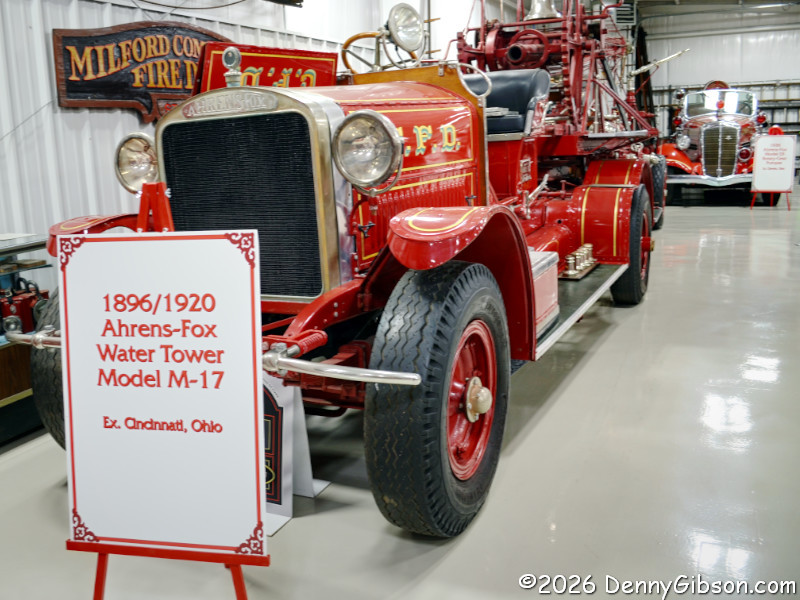
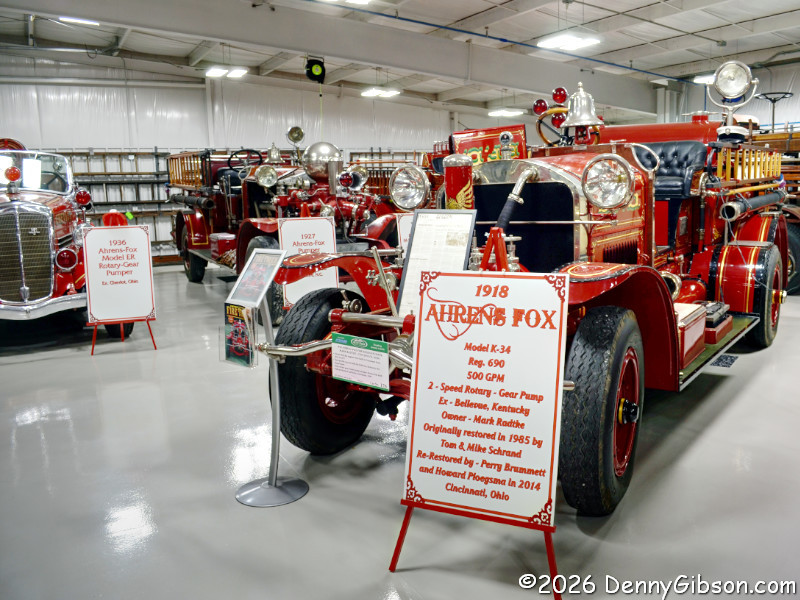
In 2024, that expansion I’ve mentioned a time or ten was completed, and I got another ribbon-cutting picture. The ribbon was cut on Friday, July 13, at a member-only event. The bigger and better museum opened to the public on Saturday morning, and so did a Negro Motorist Green Book exhibit at the Freedom Center. I documented them together with New Stuff to Look At. In the post, I mention a preview with the Letterheads still onsite and talking with the fellow working on the Maisonette. In reading the 25-year book, I learned he had died about a year later. I had not noticed the plaque placed in the museum and shown in the book, but I sure do now.

A couple of notable visits to the museum since the expansion were Sign Museum Threefer, which happened shortly after the Frisch’s Mainliner sign was moved into the museum, and A Night at the Museum, where I picked up the book that led to this post. Now I’m all caught up—for a while.
This book, just like its subject, is bright, colorful, eye-catching, and informative. That subject, quite obviously, is the 25-year-old
Museum founder Tod Swormstedt provided a welcome page and an introduction, and his influence is evident throughout. It’s a given that some of the information presented in Roberts’ text came from Tod and others. To me, it seems almost as obvious that a guy so adept at organizing walls, rooms, and buildings filled with signs would have a hand in organizing sign-filled pages, and I have a strong hunch that he might have suggested a few targets for Grilli’s camera.
As Tod describes in the introduction, the book consists of three sections. The first describes what the museum is. It begins with some statistics, such as size (40,000 sq ft), oldest sign (155 years), and tallest sign (21 ft). That is followed by “A Founder’s Vision” (written by Tod), some words about the museum’s mission and its relationship with the community, and recognition of some of the many individuals who have been instrumental in the museum’s development and ongoing operation.
The second section concerns signs in general. There is a condensed history of signs in America that starts with carved and painted signs and progresses through materials like glass and plastic. The major changes electricity brought and the development of various illumination methods are covered. The section concludes with a glossary of sign types and the techniques and materials used in their construction.
I first became aware of the museum with the 2005 opening of its original Walnut Hills location. To someone not involved with the sign business in any way, it seemed to me that this wonderful new attraction had magically appeared, fully formed, in my city overnight. However, we all know that’s not how things work, and I soon learned about some, but far from all, of the work behind that magic. The first part of section three nicely covers the period between forming a board of directors in 1999, incorporating as a non-profit in 2000, and that delightful grand opening on April 28, 2005. This is also where I found more photos of Tod wearing a tie (3) than I’d ever seen before.
That first home in Essex Studios in the Walnut Hills neighborhood of Cincinnati was outgrown before it was occupied. Behind-the-scenes coverage continues as the current location in Camp Washington is acquired and made ready for another grand opening in June 2012. Central to “A Founder’s Vision” was the desire to not just display signs but to tell the story of American signage. Two envisioned methods for doing that were a Letter Wall showing the evolution of sign lettering and a faux street where signs were displayed in period-appropriate settings. A short Letter Wall existed at Essex, and some signs were sort of arranged as if they were on a street, but the backing was mostly plain white walls. In the new location, there was room to create proper versions of these two features. A much longer Letter Wall was constructed at the entrance to the main display area, and a Main Street was built with various storefronts lining both sides. To add another layer of realism, a diverse group of sign painters known as Letterheads descended on the museum to add signs to windows and doors to augment the big signs hanging on the storefronts and standing in the street. The store windows serve as natural display locations for items like painter kits and books.
The Letterheads and the museum have a wonderful relationship that is well documented in the book. The museum hosted the group’s 40th and 50th reunions in 2015 and 2025, and the group added murals and other features to the museum each time. When the museum expanded and Main Street doubled in length in 2024, the Letterheads returned to work their magic on the new storefronts. The Letterhead story is just one of many that show how the museum is appreciated by sign makers as well as sign fans.
There is something akin to a fourth section spread throughout the book. It is made up of things called “Sign Stories”, which are like sidebars in that they are standalone and not tied to the main flow of the book. But each is at least one full page, and some fill a two-page spread. Most describe a sign or group of signs in the museum’s collection. They typically provide a date and original location and identify the sign material and type. Then the page is filled with details about the sign’s original owner, its acquisition, or some other truly interesting aspect of the sign. I didn’t count them, but there’s a bunch. Enough to believe that some people might think the book worthy of purchase if these were all it contained.


Back in 2018, I noted this blog’s 500th post and figured I ought to note the 1000th as well. But, as it neared, I decided to be a little perverse and mark the 1Kth (1024th) post instead. The 500th post was noted in the regularly scheduled Sunday post that followed. That was more or less the plan for this post. However, when the 1Kth post went up last Sunday, I quickly realized that a post was already planned for the next Sunday. That’s why I’m taking Wednesday, the day normally reserved for reviews, to wish this blog a Happy 1Kth.


It’s probably not hard to guess that this post was triggered by two recent reviews of books with titles (


There has always been a GPS in my car, starting with the very first of my documented road trips. The earliest ones I used showed me my position on a map and the straight-line distance to cities and other places. They did not offer routing. I actually doubt that routing was even possible before the government dropped “selective availability”, which limited the accuracy of civilian receivers, in 2000. I acquired a unit capable of routing in 2006 and started plotting downloadable routes for my trips. This included some partial Route 66 outings using directions in a first-edition EZ66 Guide, which I’d bought from Jerry in 2005. For my third full-length trip in 2012, I used a store-bought route.
That title may look familiar. If so, one reason might be the similarly named Route 66: The First 100 Years, reviewed
Route 66: 100 Years is an anthology edited by Jim Hinckley of
Like the beginning pages of many books about historic highways, the introduction includes tales of how the early automobile roads followed native trails, animal migration paths, and train tracks. And it talks about the impact that the popularity of bicycles had on the desire for and development of roads outside of cities toward the end of the 19th century. What makes it a little different from most similar writings is that it provides some details about organizations and specific events during road development during this era of pedal-powered transportation.
The state chapters appear in geographic sequence, east to west, which is the direction most people travel the route. Together, they provide a sort of combination travel guide and history lesson. I’m not talking about a travel guide with turn-by-turn directions, motel phone numbers, and such. However, most towns along the route are mentioned — and US 66 was a great connector of small towns — along with numerous points of interest. There is usually some history given about each town and POI, and there is plenty of history about the route itself.
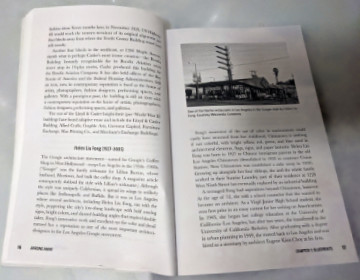
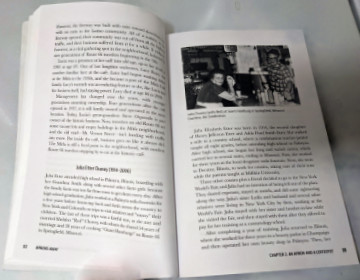
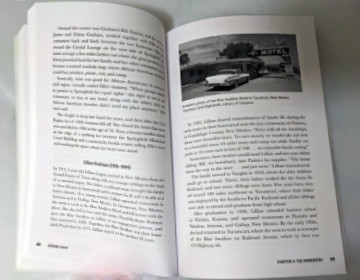
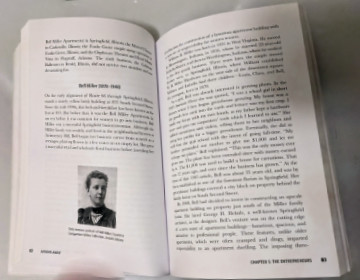
The book is definitely well-illustrated. I don’t believe there is a single page, besides the index and authors’ bios, without at least one image. These include modern and period photographs, postcards, advertising brochures, and other items. Joe Sonderman supplied some of those postcards and brochures, as did big-time collectors Mike Ward and Steve Rider. I was extremely pleased to see a photo from the collection of the late Laurel Kane included. Many of the modern photos were taken by Jim Hinckley and his wife, Judy. I saw no photos from either Rhys Martin or Greg Hasman, although I know both are excellent photographers. I did see photos from Shutterstock, Alamy, and Getty. I thought both situations were curious, but the final product comes off well.
The quality of the book is quite good. Color and black-and-white images show nicely on the heavyweight glossy pages, and the layout serves them well. All have descriptive cut lines that include source credits. There are numerous sidebars, most with their own images, providing extra information outside of the main text flow.
The individual states that carried US 66 account for eight chapters. The book has nine. Dries Bessels, a resident of the Netherlands, authored a chapter named “Renaissance”. Dries has guided multiple tours down the length of Route 66 and provides an outside-the-country view of the historic road. The “renaissance” he writes about is its emergence as a travel destination for both Americans and foreigners after being bypassed and decommissioned. America, essentially spared the devastation that WWII brought to Europe, was the land of dreams to post-war Europeans, and Route 66 was a tangible thing that rolled right through those dreams. Today, Route 66 is still regarded as a way to experience a diverse range of America.


Frogman is a horror movie. I’m pretty sure the last horror movie that I paid to see in a theater was The Exorcist in 1973. I did that because I liked the book. I went to see Frogman because I liked the festival.