Trip Peek #67
Trip #131
It’s a Wanderful Life

This picture is from my 2015 It’s a Wanderful Life trip. I had spent Christmas of 2013 in a state park lodge in West Virginia and in 2015 did something similar in Indiana. The park I chose was Turkey Run on the western side of the state. The suspension pedestrian bridge in the picture is on one of the park’s hiking trails. There was some rain involved in both the going and the coming but Christmas Day was dry — and cold. I worked up an appetite for the buffet by hiking a bit including crossing the pictured bridge.


Trip Peeks are short articles published when my world is too busy or too boring for a current events piece to be completed in time for the Sunday posting. In addition to a photo thumbnail from a completed road trip, each Peek includes a brief description of that photo plus links to the full sized photo and the associated trip journal.

Book Review
Not For Morbidity’s Sake
Malcolm P. Fletcher

It’s a familiar story I’d never heard before. In no way is use of the word “familiar” meant to be dismissive. It’s just my way of acknowledging that many aspects of Malcolm Fletcher’s story are to be found in the stories of thousands of other World War II soldiers. Of course, each of those stories is also unique in ways both small and large. Large happenings that make Fletcher’s story unique include the actions that earned him a bronze star and the day he watched his brother get shot and captured. Getting coffee and doughnuts from the Red Cross in February and washing clothes and shaving in May are among the not-so-large pieces of the story that make it real. Numerous photographs, maps, and drawings — many by Fletcher himself — really fill things out.

It’s a great story and well told, but there’s no denying that the mere fact that it is being shared plays a big role in setting this story apart from most of the others. The majority of those soldiers never told their story to anyone. A relative few did write it down or record it but not many saw an audience beyond family, friends, or a veterans organization. That Malcolm Fletcher wanted to share his story is obvious. He expanded his wartime notes and produced a “diary”. The title is his. Not For Morbidity’s Sake came from the fact that, as his son Michael says in the foreword, “…he took no pleasure in telling most of this story”. Malcolm Fletcher died in 1994, and Michael, with help from his brother Mark, made publication of the diary a reality. To a large degree, this meant editing their father’s writings, but they also augmented the story with information gathered from other family members, friends, and even some of the men who served with Malcolm.

As mentioned, not many World War II veterans made any attempt to share their stories. In addition, not all who did were particularly good at it. Malcolm Fletcher was. At twenty-four, he was a little older than most of the enlistees he headed to Europe with in 1944. Maybe that made him a little more observant, or maybe that just came naturally. Either way, his observations fed some rather good sketches and some articulate writing.

Those observations also fed some slightly philosophical thinking on the horrors of war and the brotherhood of man. He had personal experience with both. Whether the deeper of Fletcher’s thoughts came during his time in Europe or while he subsequently transcribed his notes in safety in the USA is unclear and unimportant. He was in the midst of battles where men destroyed each other with cannons, bombs, rifles, bayonets, and flame-throwers. He saw many and met a few French, Belgian, and German civilians whose world was ravaged beyond comprehension. And he was there at the end of the conflict, interacting with German and Russian soldiers to learn that “These Russies are just like us.”

He was there as a strange calmness came to a devastated Europe, and plans were being made to send him and lots of other men to tackle the Japanese. He was there when Hiroshima and Nagasaki were bombed, and the war ended without an invasion. He came home to a world that was damaged in its own way. He stumbled. He regained his balance. He wrote his story. The basic plot may be familiar, but the details are unique and personal, and the telling is something special.

Not For Morbidity’s Sake: A World War II Yankee Division War Diary, Malcolm P. Fletcher, CreateSpace Independent Publishing Platform (December 10, 2017), 6 x 9 inches, 226 pages, ISBN 978-1981114696
Available through Amazon.


I know Michael Fletcher through his work as a bassist with several local bands. I’ll admit that it’s rather unlikely I would have found this book on my own otherwise. But, if I had, there is no doubt that I would have enjoyed it. Knowing Mike or even knowing who Mike is is certainly not required to appreciate his father’s story. On the other hand, I probably enjoyed this book more than many, and it’s certain that the story is more familiar to me than most. Malcolm Fletcher’s time in the military more or less parallels that of my own father. Both probably crossed the Atlantic in the same convoy, although Dad landed in England rather than France. Both were at the Battle of the Bulge, and both were early crossers of the Siegfried Line.

But there were definitely big differences. Dad was a courier and spent most of his time driving a Jeep or truck. He was usually at or near the front but was not directly involved in the fighting in the way Malcolm Fletcher was. And he never talked about it the way Malcolm Fletcher did. I kind of wish he had. I’d certainly like to know more, but I think his “silence” was rather typical. There were occasional, seemingly spontaneous, reminisces that provided cherished glimpses but no long stories and no writing or recording.

Dad served with the 78th “Lightning” Division. Until about four years ago, there was an associated veterans group that published a quarterly newsletter called The Flash. Veterans’ memories were an important part of its makeup, and I read many of them. There are, naturally, similarities between the stories of every soldier in every war in every location, but I was thinking specifically of the stories I’d read in The Flash when I called Not For Morbidity’s Sake “..a familiar story I’d never heard before.” I wrote about the newsletter’s end in One Last Flash in 2013.

Three Fortnights to Go

On Friday, I made my second excursion to see Buckeye Chuck with no more planning than the first and with worse timing. In 2016 I arrived long enough before sunrise to look around a little and down a free SPAM sandwich before the big event. I cut it a little closer this year and, while I did have a few minutes to wait, the SPAM (i.e., ground hog) sandwiches provided by local sponsors were all gone. To be honest, they weren’t entirely gone but the last few had been distributed moments before I arrived and all I could do was watch them disappear into the mouths of nearby spectators.

My arrival preceded sunrise by only about ten minutes and co-hosts Scott Shawver and Paul James filled the time with banter and guests including Marion Mayor Scott Schertzer. I’m guessing that Schertzer appears every year (he did in 2016) but this year he has a little extra claim to fame. Just two weeks ago, Cincinnatian Connie Pillich picked him as her running mate in her campaign for governor. Pillich is an occasional patron of the place where I eat pizza, drink beer, and play trivia. When James and Shawver polled the crowd to see who came the farthest, my shouted “Cincinnati” was the apparent winner but, because there was no one from out of state, not much was made of it. Actually nothing was made of it at all.

James and Shawver claim to alternate duties but, having only been here in two even numbered years, Shawver is the only one I’ve personally seen deal with Chuck. He bravely — it was 12 degrees Fahrenheit — stripped down to shirtsleeves and briefly studied the situation before announcing the obvious. In the bright sunlight. Buckeye Chuck couldn’t help but see his shadow and predict six more weeks of winter.

Before leaving town, I again satisfied my need for ground hog with sausage and eggs at Baires Restaurant then stopped by President Harding’s memorial. Look at those clouds and consider how much different Chuck’s prediction would have been if delivered just a short while later.

My Apps — Chapter 11
Affinity Photo

Affinity Photo is a Serif product. Serif’s PhotoPlus had been my photo editor of choice since 2001 when I started using Version 4.0. More than a dozen releases later, at Version 6X, I was still using it although I sensed the end of our relationship was near. In the My Apps PhotoPlus post I wrote of feeling like a Beta Max user in a VHS world. (Younger readers may have to Google that.) Most people I knew used PhotoShop. Not one of them used PhotoPlus. But what really got me to thinking about moving on was that PhotoPlus seemed to have reached an odd sort of dead-end. I had no wish list of features, so it didn’t bother me that new releases added very few. What did bother me was the tweaking for tweaking’s sake of existing features. Someone must have thought the tweaks were good but I found some actually detrimental to the way I worked. I wasn’t about to spend big bucks on Adobe’s full featured PhotoShop Creative Suite but their Elements product was only a few dollars more than PhotoPlus and seemed to have everything I needed and most of what I merely wanted. I started thinking it was about time to jump ship.

An opportunity to do just that came along in 2016 with the purchase of a new computer. Switching computers means transferring existing software or acquiring new, and I did a little of both. For my photo editing needs, I planned to acquire PhotoShop Elements rather than transferring PhotoPlus 6X but Serif came up with some news and an offer that resulted in me doing neither. The news also offered a little insight into the “odd sort of dead-end” behavior I’d noted with PhotoPlus. Affinity was an entirely new-from-the-ground-up product. It was initially developed for Apple’s macOS and had been shipping for that platform for a year or more. The news was that it was now available for MS Windows. Apparently PhotoPlus for Windows really had been a dead ended product for some time.

The offer was much like those I’d seen with each new PhotoPlus release. Current owners could get the new software at a heavily discounted price. I’d long before decided that I wouldn’t spend any more money on Serif’s PhotoPlus and I didn’t. Instead, I spent money on Serif’s Affinity.

I have no regrets. The Apple version of Affinity had some very positive reviews and had even received an award or two. It was at least as powerful as PhotoPlus and both were more powerful than I needed. From the start Affinity Photo for Windows was fully featured with few problems. I’ve a hunch that the Apple version being around for a while had something to do with that. In addition, a nice collection of video tutorials was available. Those came in really handy in getting up to speed on the new product.
For me, up to speed isn’t all that fast. I’m basically a resize, rotate, and crop sort of guy. I was nearly at speed once those were mastered. I do, on occasion, dabble with tone a bit and do a little touch-up work. About as fancy as I ever get is the rare collage or the slightly less rare HDR. Accomplishing these with Affinity is quite different than with PhotoPlus but I eventually figured it out. I’m a long way from being a master of the software but I manage to do what I need.

Is Affinity better than PhotoPlus? Yes, if for no other reason than it gets a nice clean start without the baggage and limits of a product that has been tweaked and twisted for many years. Is it better than PhotoShop Elements? Probably, but I’m no expert on either so can’t say for sure or even explain how it might be. Is it better than the full PhotoShop? I’m guessing not although some people who demand a lot more from their photo editor than I do consider it a worthy competitor. Even if that’s a stretch, and I’m not saying it is, I’m thinking that Affinity is worth a look from anyone not tied to PhotoShop by corporate decree or something similar. Maybe the truly discerning can see differences in output quality or maybe there’s something missing that real photographers depend on. I don’t know. I do know that it does what I need for about half the price of PhotoShop Elements or a little bit less than two monthly payments on a PhotoShop Creative Cloud annual subscription.

My Apps – Chapter 10 — Garmin BaseCamp

Book Review
Darlene’s Silver Streak
John G. Butte

I first heard of Darlene Dorgan and her friends from a presentation on early female travelers at the Lincoln Highway Association in June. Then they were part of a similar presentation at a Route 66 conference in October. This book may have been mentioned in either or both of those presentations but, if so, it didn’t register. What finally got me interested in Darlene’s Silver Streak and The Bradford Model T Girls was when a blog I follow, Curbside Classics, ran a three part story in November that was akin to a condensed version of the book. Those posts also made me aware of a website, Gypsy Coeds, created by the book’s author and the fact that the car was currently on loan to the Model T Museum in nearby Richmond, Indiana. I headed over, checked out the car, and bought the book.

By then, I knew the basics of the story. In a deal that had his daughter give up her dreams of college, Bill Dorgan gave her a car and dreams of college turned into dreams of travel. Over the next several years, Bill’s daughter Darlene used that car to carry her and her friends to the USA’s east and west coasts, its northern and southern borders, and even into Canada. That would not seem particularly unusual if it happened today and only slightly more so if it happened a few decades ago. But it happened in the 1930s when groups of young women typically didn’t undertake anything of the sort without males at their side.

The car was a 1926 Ford Model T that was painted silver and eventually given the name “Silver Streak”. Between 1934 and 1942, Darlene made eight major outings in the car along with four or five friends. John Butte’s mother was on one of those trips and his aunt on another. Having read that Butte had done considerable research, I expected the book to include details of those trips and it does. For each of the journeys Butte identifies the participants, the dates, and the general route. Among his sources are newspaper articles, conversations with Gypsy Coed descendants, some Gypsy Coed diaries, and even conversations with a couple of the Coeds themselves. He documents his findings with reproductions of articles and various communications, excerpts from diaries and interviews, and plenty of photographs. Even though, as I said, I expected details of that sort to be there, I was a little surprised at the amount of detail presented.

The “Bradford”, in the title is Bradford, Illinois. It’s the small town about thirty miles north of Peoria that Darlene called home. Butte begins his book by talking about the town and the Dorgan family’s role there. To some extent it’s a familiar tale of small town America and the changes brought on by the automobile and other developments, but Butte mixes general observations about the period with details of the Dorgans and Bradford to paint a solid picture of the world from which the young women launched their adventures.

Those adventures — and adventure seems exactly the right word — included seeing two World Fairs, the Dionne Quintuplets, and Henry Ford. Of those, the Quints came first, on the third big trip in 1937. After driving to Callander, Canada, the girls weren’t about to settle for a few orchestrated peeks at the children. They also managed to meet Dr. Dafoe who had delivered the quintuplets. That was not a common occurrence at all. The next year, they spontaneously interrupted a Wisconsin camping trip to drive to Detroit to wish Henry Ford a happy birthday. They managed to meet him, too.

The meeting with Ford proved quite valuable to the girls, particularly on their next two trips. In 1939 they attended the World Fair in New York and in 1940 drove to the one in San Francisco. On both trips, the girls and the car benefited greatly from special attention from the Ford Motor Company.

There are two parts to Darlene’s Silver Streak. The first, called “Creating the Legacy”, consists of what I’ve described so far. Part two, “Continuing the Legacy”, is John Butte’s own story. Following the passing of his parents, he and his siblings reminisced about the stories their mother told of her experience as a Gypsy Coed in 1939. One thing led to another and John ended up finding and buying the Silver Streak in 2012. At times it seems that too much of this second part involves things that have nothing to do with the car but it does provide a picture of someone who is not a “car guy” becoming the owner and caretaker of a unique piece of automotive history. He hasn’t suddenly turned into what most think of as a “car guy” but he does seem to enjoy his stewardship role and clearly takes it seriously. Part of being a good steward can be learning and sharing everything you can about your charge. John Butte earns high marks in that department with Darlene’s Silver Streak.

Darlene’s Silver Streak and The Bradford Model T Girls, John G. Butte, John Butte Publishing (August 25, 2015), 8 x 10 inches, 304 pages, ISBN 978-0692491201
Available through Amazon.


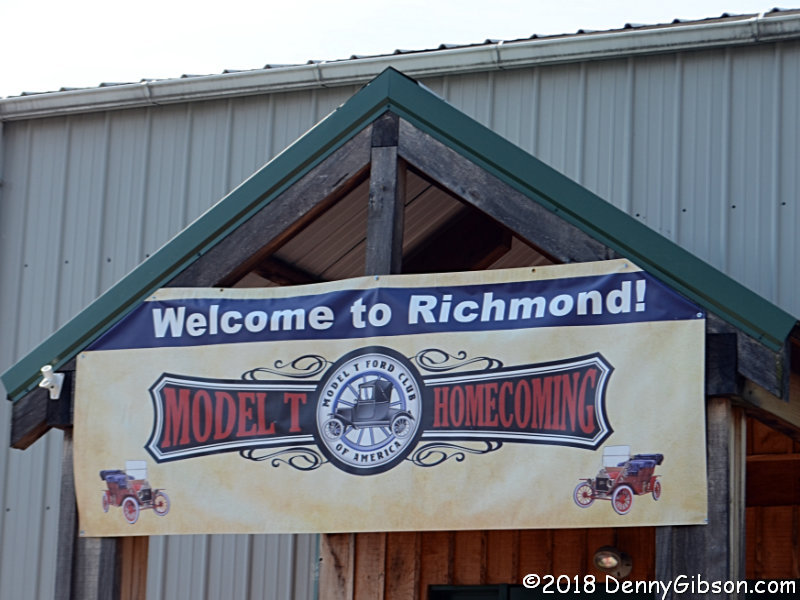
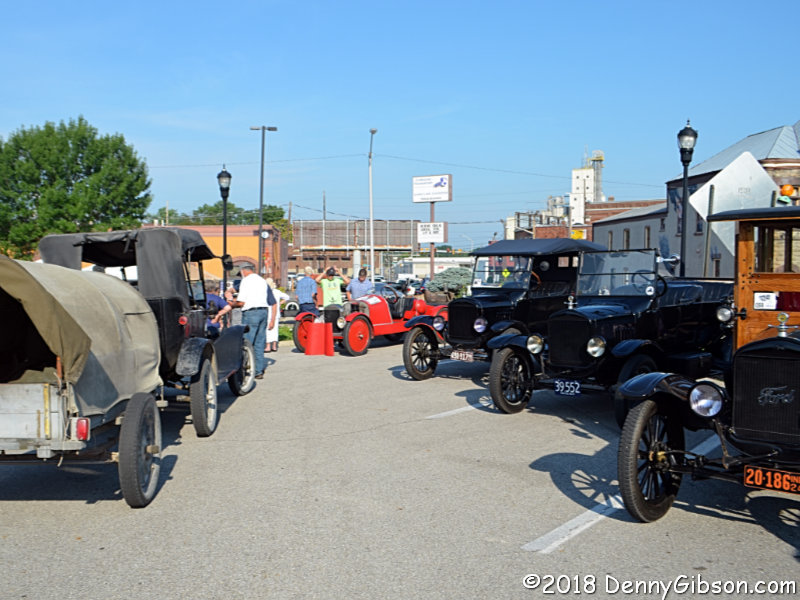
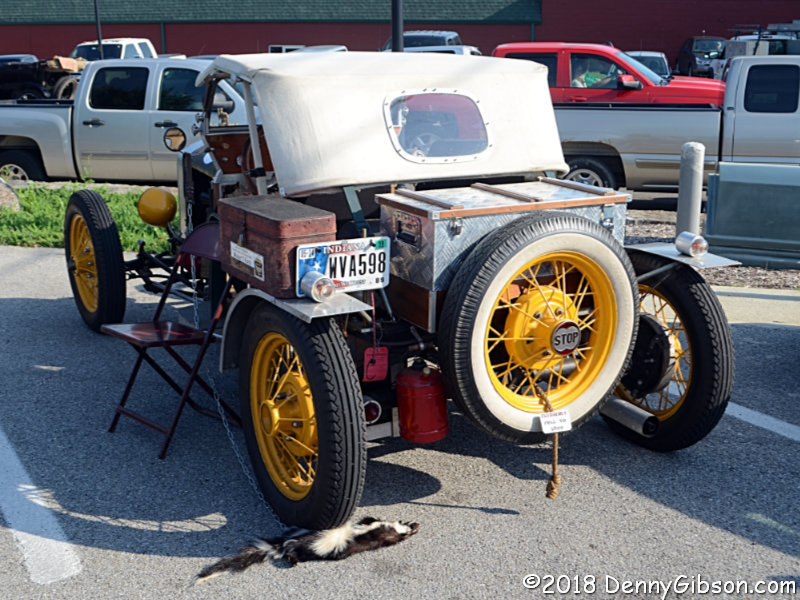
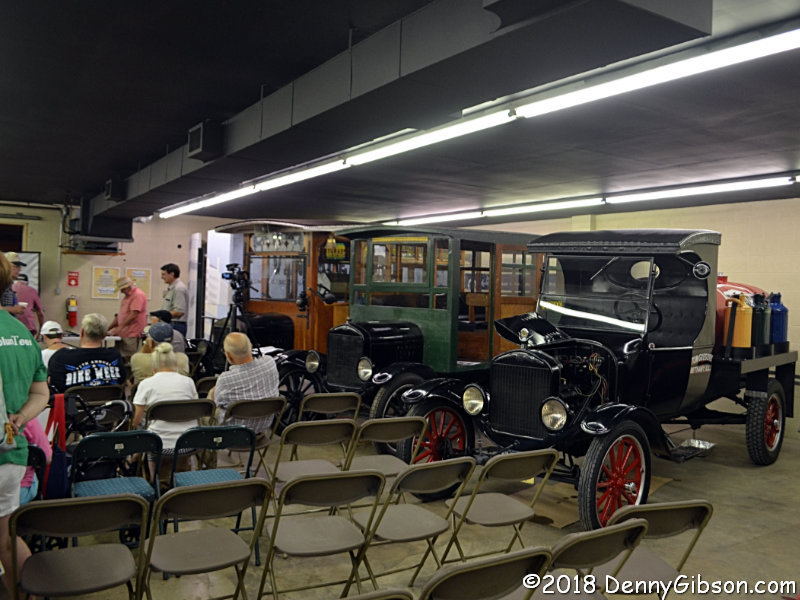
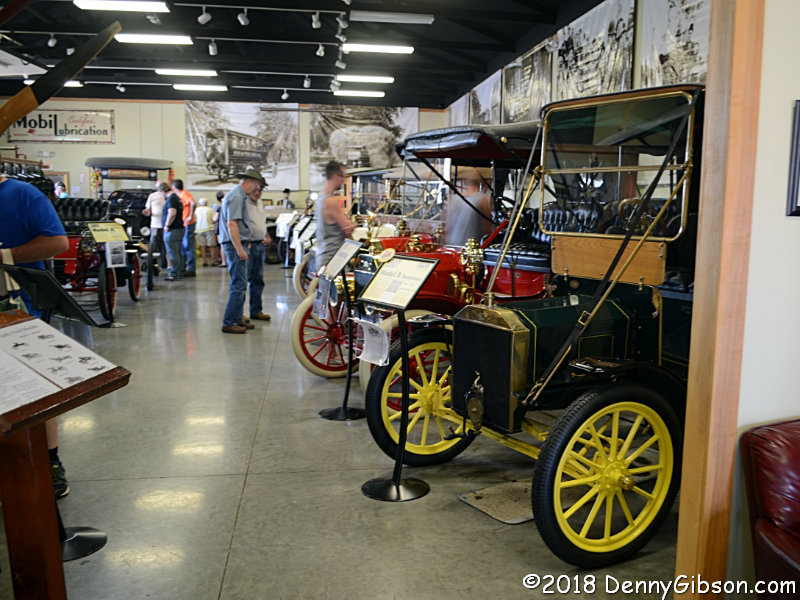
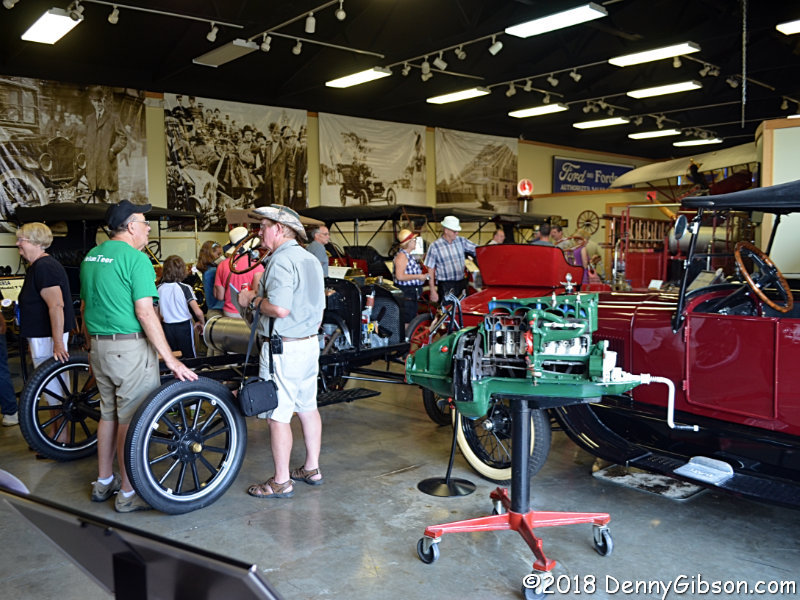
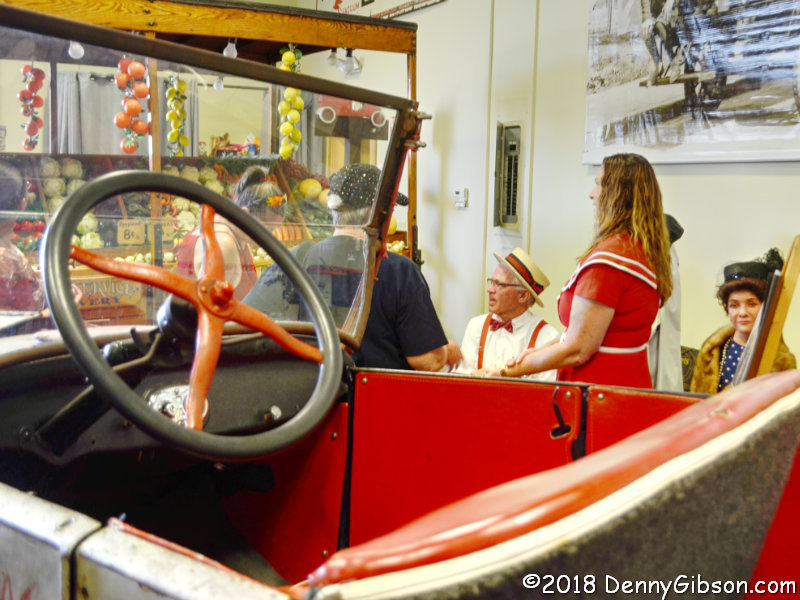
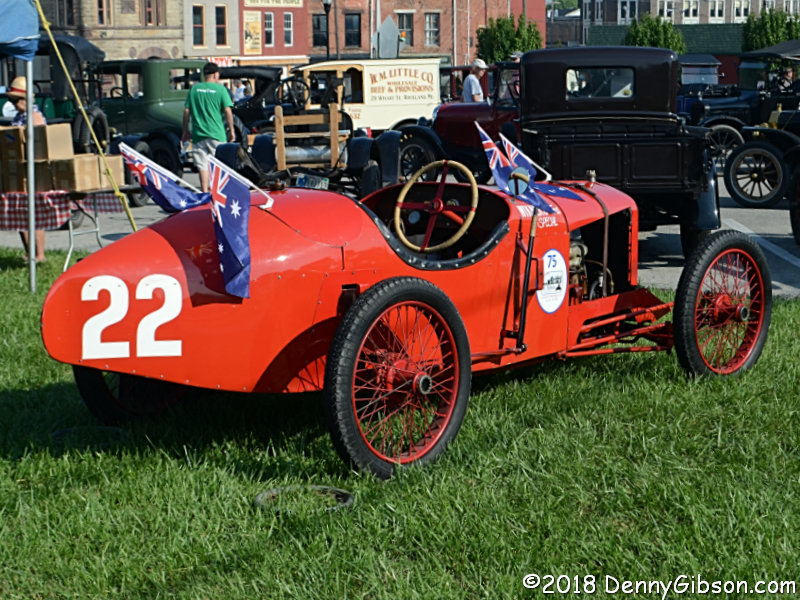
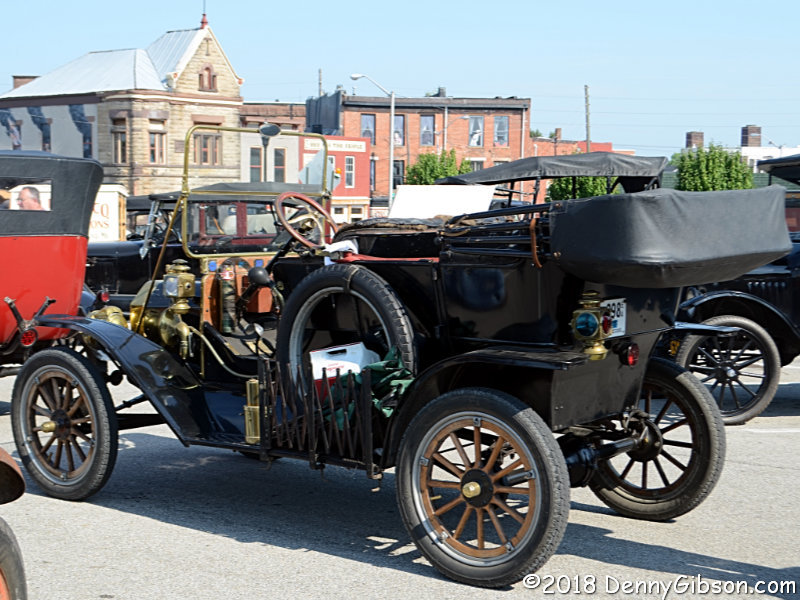
I mentioned in the review that I saw the Silver Streak at the Model T Museum in Richmond, Indiana. Here are some pictures from that visit. The car is on loan to the museum until August, 2018.

Trip Peek #66
Trip #137
Sixty-Six and More

This picture is from my 2016 Sixty-Six and More trip. It was my fourth and most recent end-to-end drive of Historic Route 66 although it wasn’t conceived as such. This trip just kept growing from first seed until I got home. In the beginning there was a decision to attend the Route 66 Conference in Los Angeles with a visit to my son in San Diego tacked on. I could fly to that but didn’t want to. A decision to drive was accompanied by a decision to follow Sixty-Six all the way. Before long I’d added a 5K walk in Tulsa and a Dirk Hamilton concert in San Pedro. Logistics for the concert gave me a chance to stay on the Queen Mary for a night. My route home was mostly on US-50 which allowed me to visit a cousin in Colorado and stop at the two Madonna of the Trail Monuments I hadn’t seen previously. Throw in a Super Moon and the LA protests following the presidential election and the justification for “More” in the title quickly becomes apparent. The picture is of the Palace Theater in the middle of what was the most western block of the original US-66 alignment. Trip Peeks really are selected randomly and it is pure coincidence that the 66th Peek involves Route 66.


Trip Peeks are short articles published when my world is too busy or too boring for a current events piece to be completed in time for the Sunday posting. In addition to a photo thumbnail from a completed road trip, each Peek includes a brief description of that photo plus links to the full sized photo and the associated trip journal.

Trip Peek #65
Trip #121
Faux Fight at Franklin

This picture is from my 2014 Faux Fight at Franklin trip. The city of Franklin, Tennessee, was the destination and watching a reenactment of the 1864 Battle of Franklin was the purpose. I would reach my destination but not accomplish my purpose. The picture is of the main house at Carnton Plantation. It was used as a field hospital when the battle began nearby. The reenactment was also to take place nearby but a night of solid rain left the ground unsuitable and the faux fight was called off. I made do with an extended tour of the house and museum. Although the battle cancellation was something of a disappointment, the overall trip was not. I’d spent the previous day in Nashville with lots of music and a visit to the newly opened Johnny Cash Museum. On the way home, l stopped by the Horseshoe Camp Cabins for the first time since the April fire that left them essentially destroyed.


Trip Peeks are short articles published when my world is too busy or too boring for a current events piece to be completed in time for the Sunday posting. In addition to a photo thumbnail from a completed road trip, each Peek includes a brief description of that photo plus links to the full sized photo and the associated trip journal.

2017 in the Rear View

The year in numbers with 2016 values in parentheses:

  • 9 (7) = Road trips reported
  • 73 (69) = Blog posts
  • 66 (90) = Days on the road
  • 1896 (2418) = Pictures posted — 284 (323) in the blog and 1612 (2095) in Road Trips

Things are more or less back to normal after last year’s extra long (and extra exotic) Alaska trip boosted the days and pictures counts significantly. The number of blog posts was nudged upward by 2017 having 53 Sundays. The regular weekly posts were augmented with links for the nine road trips and eleven reviews. In a flip-flop from last year’s summary, two new-for-2017 blog posts made the top five while no new-for-2017 trip journal entries did. The Hawaii trip was closest at number ten.

Top Blog Posts:

  1. Remembering Timmy
    The most visited post of 2017 was also the saddest. Musician and friend Tim Goshorn died in mid-April just weeks after being diagnosed with cancer. Tim and brothers Larry and Dan put the Goshorn name in the top tier of the Cincinnati music scene and Tim and Larry became nationally known as members of Pure Prairie League. That fame and the fact that he was just such a wonderful person had a lot of people sharing memories on the internet. In this post I shared some of mine.
  2. My Wheels – Chapter 1 1960 J. C. Higgins Flightliner
    The first post in the My Wheel series maintains its perfect top five record with a third second place ranking to go with two firsts. Visitors appear to continue to come through specific searches with no interest in anything else on this site. But I still appreciate them.
  3. Book Review — The World from My Bike
    This is the other 2017 post in the top five. It’s a book review that is here due to the author’s popularity and because she shared the review with her own followers. Anna Grechishkina is not yet a famous author but she is becoming well known as a traveler. This is her first book and it’s filled with photos and thoughts from her not yet complete motorcycle ride around the world. It’s certainly impressive and I’m betting there will be at least one more after she completes her journey and is back home in Ukraine.
  4. Scoring the Dixie
    This post about keeping track of driven sections of the Dixie Highway placed fourth when it was published in 2012, was third in 2015, and is back at fourth for 2017. I’m sensing a slow increase in interest in all old roads including the Dixie Highway. In the year’s closing months, there was even a slight uptick in the popularity of my own Dixie Highway related book, A Decade Driving the Dixie Highway, as sales rose from abysmal to anemic.
  5. Ohio’s Revolutionary War Battle
    This 2012 post appears in the top five for the second time. In 2013, when it ranked fourth, I attributed its popularity to the bicentennial of the War of 1812 and the post’s mention of names associated with that war. This year I have no theory at all.

Top Non-Blog Posts:

  1. Ohio Barn Dance
    Both of this year’s top two non-blog posts are mysteries to me. The most visited journal entry is a rather simple 2007 day trip on some scenic southern Ohio roads. The name comes from the fact that several old barns were passed along the way. In researching 2017 statistics, I discovered a big goof. Trip Peeks are blog posts that I publish when I have nothing better. Each one references the journal of a randomly selected road trip. A Trip Peek for Ohio Barn Dance was published in 2017. In fact it was published twice. First on October 22 and again on November 26. How that happened I don’t know but it did. It’s tempting to say the journal traffic is the result of the double posting but it clearly isn’t. For one thing, Trip Peeks never generate enough interest to account for anything near what this entry saw. Besides, the surge appears to have started back in April long before the first Trip Peek posting.
  2. Bi Byways
    I don’t understand this 2004 two day trip coming in second in in 2017 any more than I understood it coming in second in 2015 or first in 2016. The byways involved are the Miami and Erie Canal Scenic Byway and the Maumee Valley Byway and all of OH-66 is included.
  3. Tadmor
    This is an Oddment page about an Ohio ghost town. After ranking first, second, and first in the first three “Rearview” posts (2011, 2012, 2013), it dropped out of the rankings but reappears for 2017.
  4. Alaska
    T
    he journal for that long 2016 trip to Alaska was number three last year and hangs on to number four this year.
  5. Finding It Here
    This was a three day Christmas Escape Run that never left Ohio, but it was the last trip of 2016 so had all year to accumulate enough views to claim fifth place.

Once again, overall traffic numbers were mixed. Visits, which dropped slightly last year, increased from 107,898 to 138,047, while blog views dropped again, going from 8,136 to 7485. Page views were nearly unchanged with 579,110 for 2016 and 578,893 for 2017.

Though it didn’t make the top five, the highest ranked new journal entry, My Fiftieth: Hawaii, marked a significant real word milestone for me. As the title suggests, reaching Hawaii meant I could now claim to have visited all fifty states of the union. It also provided a pretty good reason to write another book. That book, 50 @ 70, celebrates reaching fifty states and seventy years of age at the same time. Unlike my previous two books, 50 @ 70 isn’t associated with a particular road (or any thing else) so doesn’t even get attention from niche road fans. Sales need to increase a bunch to be considered abysmal. Anemic is probably out of range. 

My Wheels — Chapter 29
1991 Geo Storm

In the previous My Wheels chapter, I mentioned that the motorcycle it featured passed through my hands sometime in the period around my second divorce. The same was true of the subject of the chapter before that. The Mazda, the Yamaha, and the wife all came and went while the leased Acura remained. Eventually, however, even it went away. In the fall of 1991, I found myself in need of a car with nothing to trade in and with credit not all that good in light of the recent divorce.
I’d enjoyed driving the Mazda and, with the family down to just me and my daughter, thought I’d go for something sporty. The Mitsubishi 3000GT had recently been introduced, and I really liked its looks. I picked out one I wanted, took it for a quite satisfying test drive, then quickly discovered the credit issue. I simply couldn’t afford the car.

The Isuzu-based Geo Storm had appeared at Chevrolet dealers about the same time. It was kinda sporty, kinda fun to drive, and a lot cheaper than the Mitsubishi. My credit was good enough for a blue Geo Storm GSI 5-speed coupe.

Even as I closed the deal, I considered it something of a stopgap. The Storm was a step down from the Acura I had been driving and, more importantly, from the Mitsubishi I wanted. I intended to move on just as soon as the smoke and ashes from the divorce cleared a little. I became more serious about doing that as I quickly realized how wrong I had been about my transportation needs.

Sure, there were now only two of us in the household I headed, but I hadn’t considered the fact that teenage girls hardly ever go anywhere alone. My chauffeuring duties weren’t all that heavy, but when I did need to deliver or retrieve my daughter, she was usually accompanied by a friend or two. The Storm could handle three teens and me for short distances, but that was its limit. In hindsight, I was better off realizing this for the price of a Geo rather than the Mitsubishi I’d targeted.
The worst of the impact of the divorce on my credit was over about as quickly as the marriage. I was able to upsize in less than a year. As a result, I really have no stories about the Storm. It did its job even when overloaded with teenagers, and I really had no problems with it at all. My problem-free experience made finding an article titled “Famously Unsafe: Geo Storm” a huge surprise.

I found the article (It’s here.) as I searched the internet to refresh my memory for this post. I dived into it expecting to learn of major flaws or failures that I had somehow miraculously avoided. Turns out that the car wasn’t particularly fragile or uncontrollable, but supposedly had a reputation I was unaware of. The only hard fact I saw to support this is, “The NHTSA actually rated the Storm as having the most aggressive drivers in its class.” In other words, the “unsafe” reputation came from the car having more than its share of owners who overdrove their and the car’s capabilities. The article ends by referencing the Storm’s “tendency to attract morons”. Nolo contendere.

My Previous Wheels: Chapter 28 — 1978? Yamaha 400
My Next Wheels: Chapter 30 1992 — Chevrolet Lumina

Santa Z’s Legacy

Here’s a Christmas display that looks a bit more traditional than the one in last week’s post. And it doesn’t just look traditional, Zapf’s Christmas Display is a definite Cincinnati tradition with decades of history. In 1970, Bill “Santa Z” Zapf marked the first Christmas in his new home with some outside decorations and the house has been the site of an ever growing holiday display every December since then.

Bill died in 2008 but his son, known as Billy, keeps the tradition going. Billy was busy replacing some lights in his father’s name when I stopped by in the afternoon, but he still offered up a friendly hello and chatted a bit as he worked. It’s obvious that Billy gets a lot of pleasure from the display and a good deal of that pleasure comes from the memories it triggers. Memories of his dad and the time the two of them spent creating and maintaining the glowing wonderland.

Yes, there is a normal nativity scene among all those figures. I’m including both day and night views of the nativity because that’s what I did last week but it’s an undeniable fact that this is a display meant to be enjoyed at night.

In early December, Cincinnati Magazine published their Top 5 Holiday Light Displays. All five are commercial or municipal operations. Described as “…your average neighborhood light display…on steroids”, Zapf’s received the lone Honorable Mention. Four of the top five have fixed admission prices and the fifth requests donations. Although it might no be as obvious, the Zapf family does too. There is a “Thank You Box” by the porch and the North Side Bank and Trust accepts donations to the Keep Santa Z’s Lights On fund. Electricity isn’t free.

The porch itself is packed with smaller decorations including one that hints at the Zapfs receiving a well deserved Major Award.

The display is located at 2032 W Galbraith Road. A recent Channel 5 story on the display is here.