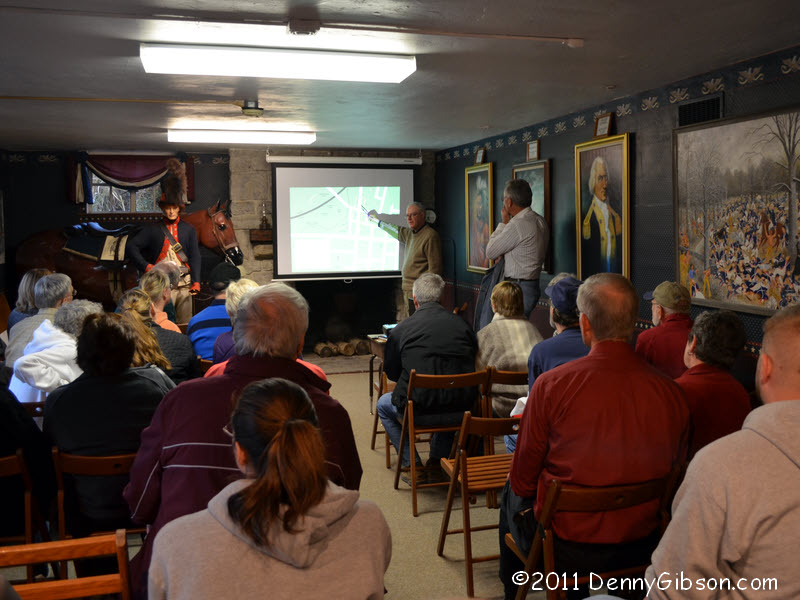
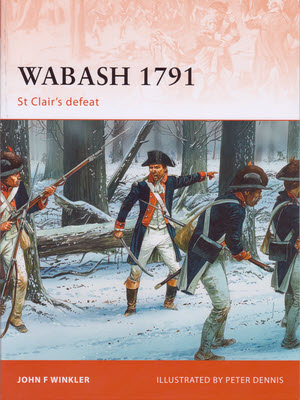
 Back in November, I stopped at Fort Recovery specifically to pick up a copy of Wabash 1791: St Clair’s Defeat and to hear the author speak. There’s a blog entry about that visit here. John Winkler began his talk that day by briefly describing the circumstances that preceded the battle then, while frequently pointing to a projected map of the battlefield, he stepped through November 4, 1791, by locating key figures and events in space and time. He spoke from memory and it was obvious he knew his stuff. The knowledge he demonstrated in that talk fills the pages of Wabash 1791. In fact, the book could be considered a hard copy version of that talk — with a few thousand-fold increase in detail.
Winkler begins the book, as he did that presentation, by talking of things that led to the battle only here he is not quite so brief. The world at the end of the eighteenth century can be pretty tough for modern-day readers to imagine. When the Battle of the Wabash took place, the United States constitution was barely three years old and our very first president was only halfway through his first term. The Ohio River was the nation’s border. England was still very much a military presence in North America and would officially be at war with the US in another twenty years. In 1791, there were plenty who thought England just might be picking up the pieces of her old colonies once the US collapsed.
After Winkler describes what he calls “The Strategic Situation”, he moves on to describe the opposing forces. The leaders of the two armies were certainly different but all were among the best of their time. St Clair, Butler, and Darke are just a few of the proven officers leading the Americans. On the Indian side, an equally qualified group of leaders surrounded chiefs such as Little Turtle, Blue Jacket, and Buckongahelas and the hated renegade Simon Girty. Also present were some out-of-uniform British officers. At the level of individual combatants, however, different meant unequal.
Recruiting had not gone well and continuing supply problems made it worse. Delays in supplies resulted in expiring enlistments and lack of supplies hampered training. In a sad “For want of a nail the shoe was lost…” style example, a shortage of paper led to a shortage of musket cartridges for training and target practice. As hard as it is to believe, some new recruits marched out of Camp Washington without ever having fired their guns. By contrast, fighting was part of every Indian’s life. Winkler quotes an officer who wrote, “…war is their principal study, in this they have arrived at considerable perfection.”
I hesitate to use the word “scholarly” but it really is appropriate for portions of the book. In particular, some of this early background information reads like a textbook and can be rather dry going. But there’s lots of good information being conveyed and the payoff occurs when the battle begins. Winkler can report the action without the need to repeatedly explain why one side did this and the other that. And report the action he does and it is brutal. Though the two armies were roughly equal in size, approximately 1700 soldiers and militia versus 1400 Indians, most of the experience and all of the surprise was with the Indians.
Two types of illustrations augment Winkler’s battle descriptions. Color-coded diagrams show three stages of the battle and artist Peter Dennis has produced three “snapshots” to help visualize the scene. The one used for the cover shows Captain Henry Carberry shouting at the demoralized soldiers to charge the encircling Indians simply in order to escape. Numerous photographs and drawings illustrate other sections of the book.
More US soldiers died that day than in any battle prior to the Civil War. This battle was the greatest victory American Indians ever achieved over US forces. The loss nearly eliminated all United States military capabilities and had the potential for destroying the young nation. In fact, a proposed investigation into supply chain corruption was abandoned to avoid that very risk. With the passage of time, this clearly significant battle has been largely forgotten by non-historians. How much success Winkler’s book has in reviving the memory is yet to be seen but it seems to contain all of the details needed for filling in the blanks.
Wabash 1791: St Clair’s Defeat, John F Winkler, Osprey Publishing, November 2011, paperback, 9.6 x 7.1 inches, 96 pages, ISBN 978-1849086769
Available through Amazon.
I’ve seen other accounts of St Clair’s Defeat. Allen Eckert’s fairly short one in That Dark and Bloody River is a pretty easy read. Eckert writes in the style of a novel with the factual base of a text book. In my youth, as I was first learning of the battle that occurred just about fifteen miles from where I grew up, I formed the impression that St Clair was a bumbling idiot and was almost single-handedly responsible for the disaster. As I learned more about the supply and equipment problems, my view softened. Eckert blames St Clair for not aborting the campaign in light of the huge recruiting and supply issues but little else. Winkler hardly blames him even for that. That could just be the result of Winkler’s even-handed reporting where he presents facts and holds back opinions.
As I read Wabash 1791 with the internet at my fingertips, I learned of a 1896 Harper’s Magazine article on the subject written by Theodore Roosevelt. This was just over a hundred years after the battle. A slightly edited version was included in volume 5 of Roosevelt’s Winning of the West published in 1905. Roosevelt doesn’t think much of St Clair and describes him as possessing “none of the qualities of leadership save courage.” Perhaps he was a bumbling idiot after all. ‘Tis a puzzlement.
Thumbnails of scans of the Roosevelt article appear in the archives section of the Harper’s website. Accessing full-sized readable copies requires a subscription. However, there is another section of the website, apparently sponsored by Balvenie Scotch whiskey, which contains articles written by folks such as Lewis Carroll, Mark Twain, and… Theodore Roosevelt. Maybe they’re all Balvenie drinkers. The 1896 Roosevelt article is available there. A far-from-full bottle of The Balvenie sits in my liquor cabinet and I poured myself a wee dram to drink a toast in thanks for the article. You can read the article here but you’ll have to supply your own whiskey.

 The National Museum of the US Air Force is about 35 miles away from my home. I drive by it at least a couple of times a year. Almost the instant I retired I told myself I’d get up there soon on a weekday and avoid those weekend crowds. So, over two years after telling myself that and well over two decades after my last visit, I made it to the museum on an unseasonably warm February Friday. I’ve posted an Oddment page here. Comments may be made to this blog entry.







 The subject of this review is a book I picked up from the author,
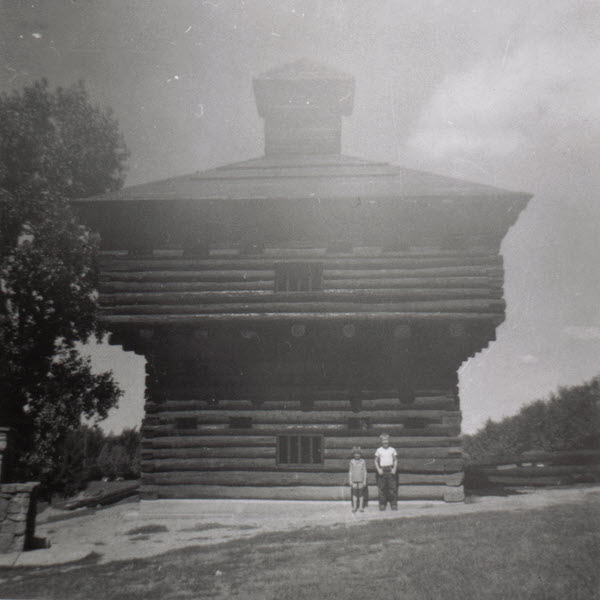
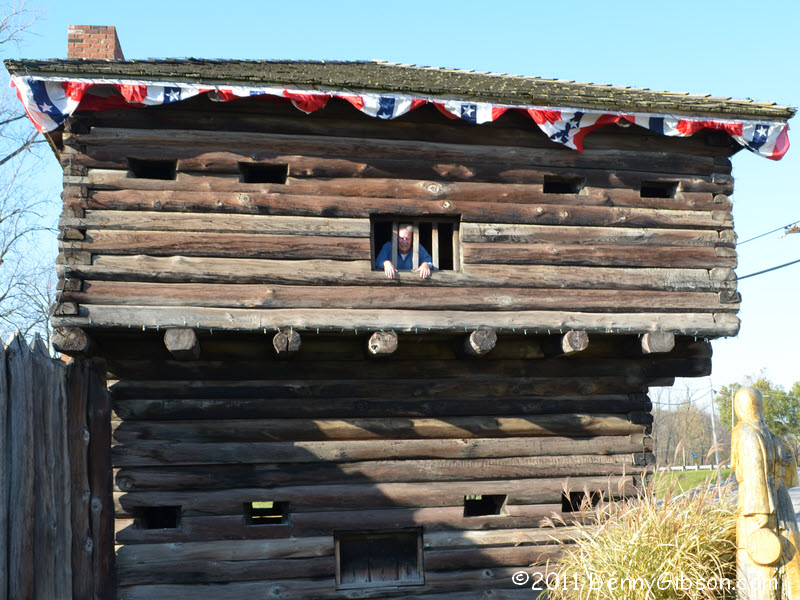
 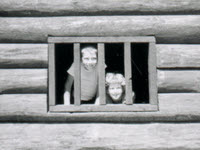 That’s my sister and me in the lock-up at Fort Recovery sometime in the mid-1950s. From about age six to age ten or so, the site of the 18th century fort was my favorite “vacation” spot. During those years, a summer was not complete until I’d talked my parents into taking us to this far away and ancient attraction. In time I learned that the log structures were not the originals from 1794. Those were already long gone when a 1938 WPA project produced the one-third sized replica that was there on my first visit. The building we’re peering out of was part of the replacement constructed toward the end of my fascination. A worker at the museum thought 1957 or ’58. Eventually I even learned that this particular “far away” was something less than fifteen miles north on the very road we lived on. Figuring that out took me awhile since all other travels — school, shopping, relatives, Dad’s job — were in some other direction. I still greatly appreciate my parents taking me there even if the effort wasn’t quite as extreme as I once thought.