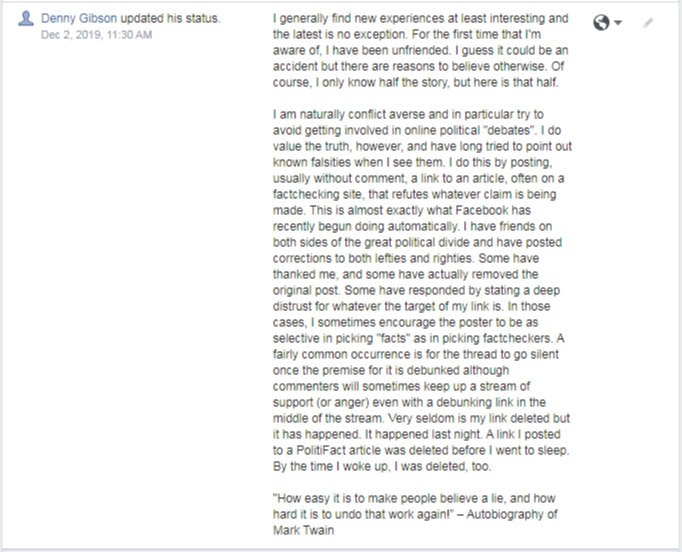
 Back in December, I was unfriended on Facebook for what I believe to be the first time. I can now add being blocked to my list of Facebook experiences. On the occasion of the unfriending, I noted it in a Facebook post, and my first thought was to do the same for the blocking, but I decided to do a blog post instead. For one thing, I did not have a post planned for this week, and for another, I thought something longer than what comfortably fits in a Facebook post was appropriate. It also lets me include a few more details about both the December unfriending that surprised me and the recent blocking that didn’t.
As I said in that December post, I am conflict-averse. I don’t go out of my way to stir up trouble or to seek it out. Very few (possibly none) of my own posts are overtly political and I don’t even respond to all that many which are. I do occasionally hit the “Like” button on posts I agree with and find especially clever or insightful. I think I may have tapped “Angry” on a post or two I didn’t agree with, and I know I’ve punched in “Haha” on some posts linked to satire that I’m pretty sure the poster did not recognize as such. Those are enough, I would guess, that, even though I haven’t shouted out my political position, anyone who cared and was paying attention could make a tolerably good guess.
I almost never get any more aggressive than providing links to items debunking claims I know to be false. This is what got me unfriended and blocked. The fellow who unfriended me is someone I’ve met in real life and with whom I share some interests. Our politics probably don’t align perfectly, but they lean in the same direction. The end of our cyber-friendship began when he posted a meme comprised of a picture of Donald Trump with a quote that started with, “If I were to run, I’d run as a Republican. They’re the dumbest group of voters in the country.” It was something I’d seen before and which I knew was a fabrication. I commented with a link (possibly this one) providing some evidence of that. In very short order, the comment was deleted, and I was unfriended within the next few hours.
I was very surprised and thrashed around for a while looking for other explanations but eventually decided that I had actually been cut loose because of that comment. Part of my surprise was due to the meme being one I’d probably welcome if it were true. But misinformation doesn’t become truth by being palatable.
This was hardly the only time I’ve posted corrections to items I might have wished were true, though I’ll admit to there being even more times I’ve offered corrections to posts I was very happy weren’t true. A common response is simply silence, but reactions range from thanking me and deleting the post to disparaging my sources and attempting to justify the post. If I respond at all to people denigrating fact-checking sites such as Snopes or Politifact, it is to encourage them to be as selective in the sources they do believe as in the sources they won’t believe. I accept that some fact-checking sites can be perceived as having a bias, but it makes no sense to me to automatically dismiss a statement that offers some supporting evidence in favor of a meme that offers none. At the extreme, and I’ve only seen this a couple of times, people have claimed that something must be true purely because a disliked fact-checking site says it is false.
Rarely does the defense of a post I’ve responded to involve evidence. It’s almost always along the lines of “Well, it could be true.” or “But, that’s what they want to do.” I really find that disheartening as it’s saying that it doesn’t matter if something is true or not, as long as it’s for “my side”. In my mind, defending your position with falsehoods does more harm than good. Those attempted defenses aren’t quite as disheartening as being unfriended or blocked, though. Taking those steps seems to be saying that, not only don’t I care about this particular bit of truth but I don’t want to hear about any others, either.
This week’s blocking wasn’t much of a surprise at all. The blocker regularly posts multiple pro-Trump memes and comments, brimming with misspellings, and errors in grammar and punctuation, every day. The majority are simply rah rah opinions, but once in a great while, he posts something that makes a claim of fact. Once in a greater while, I’ll offer a correction.
Once was in May of last year when he posted a somewhat popular meme about the repeal of a 1952 law that prevented Muslims from holding political office. It is debunked here, which I linked to in a comment. At that time, I didn’t even know that anyone other than the originator and Mark Z could delete a comment so, when it disappeared, I assumed I hadn’t posted it properly and tried again. It disappeared again. That day I learned that the owner of a post can delete comments, then grinned, and moved on.
On Tuesday, I happened to catch a post of his with a quite old meme claiming that ABC had banned the wearing of US flag pins. I recognized it instantly and spent a few seconds to pass along this link that debunks it. It wasn’t long until both my comment and the post disappeared, and I eventually figured out I’d been blocked. On Wednesday I learned that blocking is kind of like unfriending-plus, then grinned and moved on.
 I’ll admit that the guy was kind of fun to watch and in some odd way, I might even miss his strings of commas and other “creative” bits of punctuation now and then. But in my heart, I know this breakup was for the best. I’ve never unfriended or blocked anyone, but during the leadup to the 2016 election, I did temporarily stop following some people. I suspect I’ll have to do that again in the next few months. Unless, of course, some more trash takes itself out.
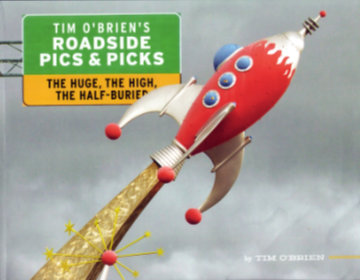 The subject of
 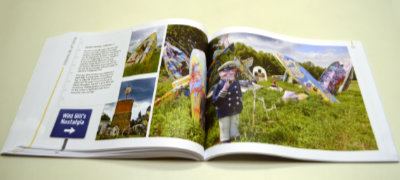 The bonus section comes first. “Roadside Art Parks” documents seven of the more famous examples of the genre with quite a few pictures of each. I got an exaggerated opinion of my own worldliness when I counted two of the first three as ones I’d visited. I was put back in my proper place when I ended the section with a score of 3 out of 7.
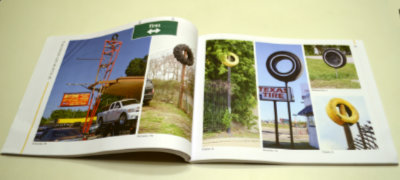 The “high” of the subtitle appears next in “Things-On-A-Pole”. I’d quickly learned my lesson and made no attempt to count and compare what I’d seen. In addition to tires, there are pictures of elevated fish, airplanes, cars, trucks, boats, etc. Et cetera includes a category labeled “Stuff”.
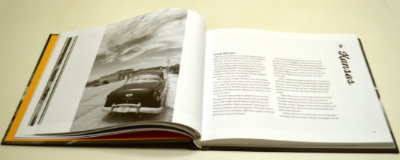
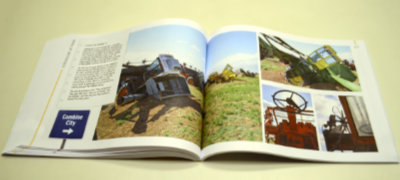 In addition to famous installations such as Cadillac Ranch, Carhenge, and the sadly vanished Airstream Ranch, “Half-Buried” includes quite a few of the not so well known examples of things poking out of the ground. The pages pictured at left show a personal favorite. When I visited Combine City in 2007, there were ten retired machines planted in the Texas field. There are fourteen in O’Brien’s description so it apparently kept growing for at least a while. On the other hand, the dedicated website that existed in 2007 has gone missing.
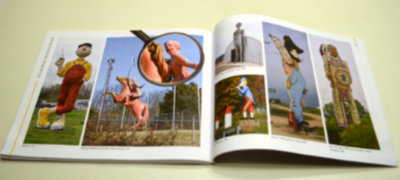 Section four, “Roadside Giants” fulfills the promise of the subtitle’s “huge”. There are subcategories like animals, donuts, people, and the ever-popular stuff. The donuts category offers a find-the-bagel challenge you can play at home.
 I started off my recent
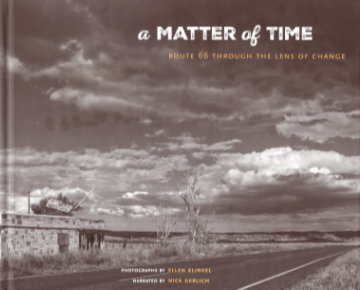 There’s not much point in counting the number of books published about Route 66; The likelihood that the count would increase before you were done is just too great. An Amazon search simply says “over 2,000”. So why review this one? What sets it apart from the others? The most obvious reason for reviewing it is a simple one: I know one of the people whose name is on the cover. The things that set it apart are not as obvious (or benignly biased). In fact, I’ve only found one thing about the book that I think is actually unique, and I’m not really sure about that. The book has no author; It has a narrator.
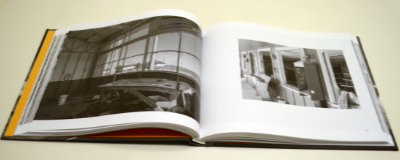 The photos are black and white, which is unusual but not unique. What may be unique is how they came to be at all. Klinkel tells that story in the book’s preface. It begins in 2013. She lives in Germany and was in the western U.S. with her husband for a four-week vacation which she describes as “the first time I ever had a serious camera in my hands”. Planned visits to several national parks fell victim to the sixteen-day government shutdown in October of that year and driving a portion of Route 66 was substituted. Klinkel credits this very first time on the historic highway coupled with the “serious camera” as having “instantly sparked my passion for photography”.
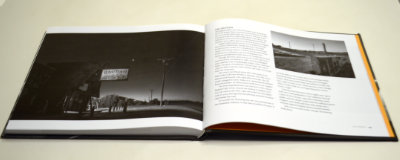 Most, but far from all, of the photos are of places I recognize from my own travels on Sixty-Six, and some of those nearly reproduce visions I’ve had myself. There are plenty of pictures of places I do not recognize. Sometimes that’s because they are from a location where I’ve never stopped or maybe even passed, but sometimes it’s because Klinkel sees and shares a vision that never occurred to me even though I’ve stood at or near the very spot she did. I don’t mean to imply that I expected anything else. It’s great to be shown something you’ve never seen, but it can be even better to be shown something known in a new way. Although it is a place I instantly recognized, a favorite example of being shown something in a new way is the early morning shot of the Bagdad Cafe with the coming sun just a tiny but significant twinkle. Another is the low-level shot of a protective wall of tires at a long-abandoned gas station at Texas Exit 0 of I-40.
 However, something clicked on a rereading of that preface that hadn’t quite registered on the first pass. Klinkel explains the title quite clearly: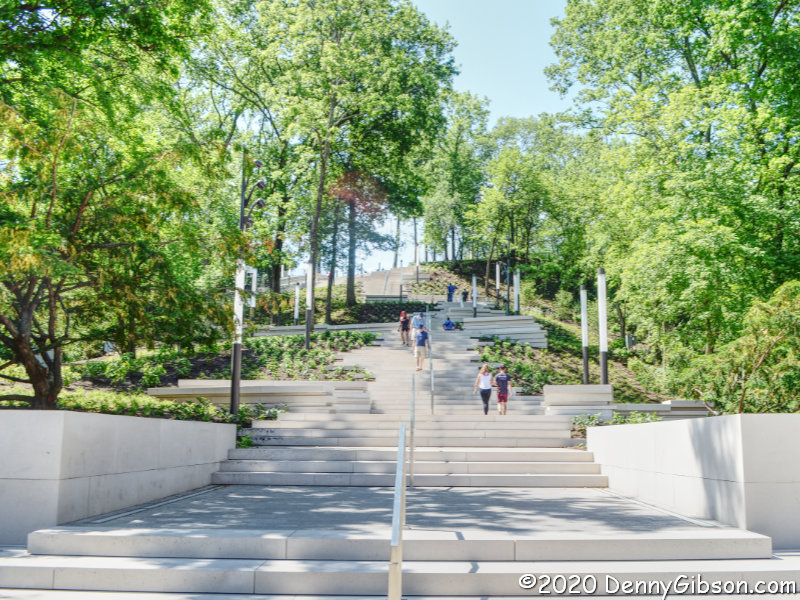


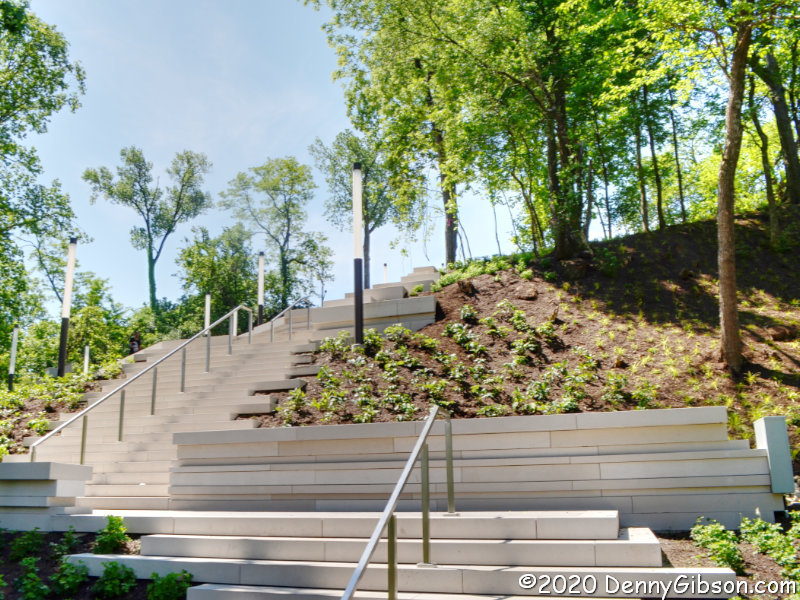


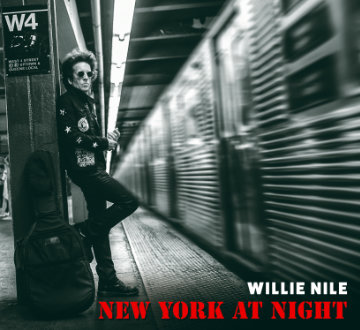 I didn’t actually try to produce a flashback last week but I thought about it. Because I’d pre-ordered the CD, when Willie Nile released World War Willie back in 2016, I got a digital copy before the actual CD arrived. It was early spring and I took a nice walk around the neighborhood with the new music playing in my ears. The walk and the songs both made an impression. A similar situation existed with New York at Night. A digital version became available before the physical version arrived. My World War Willie introductory walkabout was powered by a 2011 vintage iPod. It still works fine but I no longer have any way to maintain its contents. This time I downloaded the music to my phone and set out to enjoy some fine weather and new music.