This article first appeared on May 20, 2012. Recent memories and shared pictures reminded me of the places it features so I decided to repost it as close to its anniversary as possible. With concerts, museums, travel, and other story-generating activities currently non-existent, there will likely be more of this sort of reuse before the current summer slips into the past.
 The fountain in front of Union Terminal, a.k.a., Cincinnati Museum Center, runs all summer and is turned off all winter. Therefore, one sure sign of summer in Cincinnati is the turning on of the fountain. That happened Friday at 10:30 AM. I had kind of hoped to see the stepped pools below the fountain go from bare concrete to a series of waterfalls right before our eyes but it wasn’t quite that dramatic. Whether the pools were primed in the interest of time or whether the standing water was simply left over from some secret testing I cannot say, but they started the day ready to overflow at the slightest provocation.


I still think bare concrete morphing to cascading waterfalls would have been cooler but watching the fountain go from zilch to a spurt to a full spray wasn’t bad.

 All the kids, and there were plenty, were properly wowed and they also enjoyed the characters on hand to promote the ongoing A Day in Pompeii exhibit. I’ve seen the exhibit and it’s a duesy. University of Cincinnati Professor Steven Ellis, along with several UC students, has been instrumental in the current excavations in Pompeii and that was instrumental in making Cincinnati one of only four US cities hosting the exhibit. As you can see, security was tight.
The weather was obviously quite nice for the events at the fountain but Friday was just one of several consecutive near-perfect days. Perfect not only for fountains of water but for fountains — or taps — of root beer. I made it to three different root beer stands on three of those near-perfect days.

 On Thursday it was the Jolly’s on the west side of Hamilton, Ohio. Back in 1938, Vinny Jolivette opened an A&W Root Beer franchise in Hamilton. He built this place in 1967 and, casting off the A&W identity, used the family name to inspire a new one for the restaurant. It’s west of the Great Miami River on Brookwood. Somewhere along the line, they added another on the east side of town on Erie. That one has a cooler sign but this one still makes its own root beer and that trumps the sign. The two remain officially connected (The car side signs carry both telephone numbers.) but are managed somewhat separately by two brothers. There is a third Jolly’s in Tiffin, Ohio, that was started, also as an A&W, in 1947 by Vinny’s brother, Roy, and it seems there was a fourth somewhere in Indiana (possibly Bloomington) but I know very little about it.

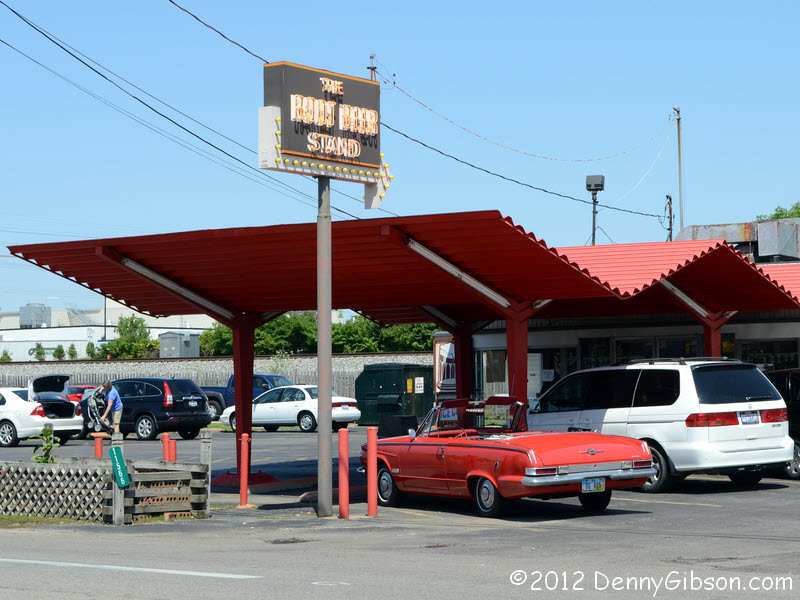 I stopped by The Root Beer Stand in Sharonville, Ohio, on Friday afternoon. It started life in 1957 as an A&W then went independent in 1982. It stopped using carhops in 1972. Originally built and operated by the Rideour family, it moved on to its second and current owners, Scott & Jackie Donley, in 1990. The Donleys have kept everything pretty much the same and that definitely includes making the root beer using water from their 280 foot well. Claims that “it’s something in the water” may very well be true here.

 I got my Saturday root beer fix at the A&W in Union City, Ohio. Despite this being a place I frequented as a teenager, I know few details of its history. I do recall that is was owned by a fellow named Smith in the 1960s and that he operated a used car lot right next door. I have vivid memories of sipping root beer and drooling over a black 1956 Thunderbird that sat in that lot when I was about seventeen. At some point, it became Neil’s A&W Drive In and so it remains today. Curiously, this place doesn’t show up on the official A&W website nor does it have its own site but it does have a FaceBook page.
All three of these places make their own root beer using at least some of the original A&W equipment. Guess that stuff was made to last. All of them taste great and I’m guessing that the recipes are all the same or similar. The Root Beer Stand has its special water and both it and Jolly’s serve their brew in chilled glass mugs. I love ’em both and I do tend to dislike chains but “real” A&Ws (Not stuffed-into-a-corner-of-a-gas-station A&Ws.) are pretty cool and it’s hard to beat an ice-covered mug.

 I’m guessing that some noticed the slightly red convertible in the center of the Root Beer Stand photo. That’s my 1963 Valiant and plans to drive it to Darke County and the A&W at the border led to the warm-up visits to Hamilton and Sharonville. The 200-mile round trip was the car’s longest outing since the cold drive home from Cambridge in early 2011. She done good. These pictures show her at Jolly’s and Neil’s.
 I recently learned that the neighborhood Flipdaddy’s does brunch on Sundays so I walked over this morning to check it out. It was quite good. I’m always dismayed but rarely surprised to find myself alone on a restaurant’s patio. But, with the thermometer at 74 degrees, I was a little bit surprised today. Lots of people just don’t like any temperature I guess. To be fair, one couple and their home from college daughter did venture outside to eat. That was it. The restaurant was fairly busy inside but just one other outside table was ever used all the while I leisurely worked through my bacon & eggs and slowly sipped my Magic Hat dessert.

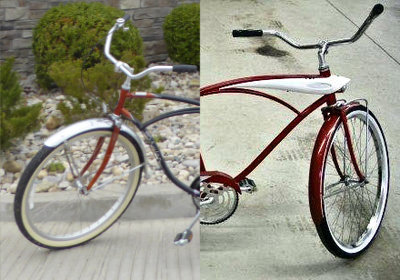 This series has reached a pause. Even though the forty vehicles I’ve owned to date have all been covered, I don’t think that the My Wheels series is truly at an end. I suspect I’ll buy something else someday. It does, however, seem like a good time for a look back and a bit of a summary. Because of a goof in sequencing, the earliest and most recent chapters both featured bicycles. They are the only two bicycles in the series although I actually owned a couple of used bicycles prior to purchasing the J.C.Higgins. In between were five motorcycles, one truck, and thirty-two automobiles. The autos varied greatly in details, but all had four wheels as did the truck. Therefore, the current count of wheels in My Wheels is 146.
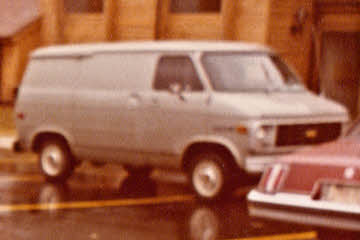 The first vehicle I custom ordered was the
 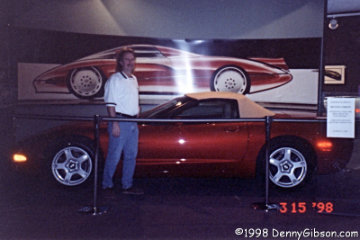 It would be nearly twenty years before I’d fill out another order sheet. By then, the kids were grown and gone and I had moved from a four-bedroom house to a two-bedroom condo. The
 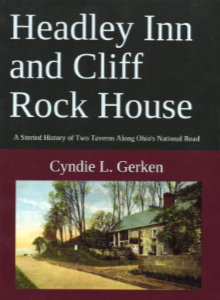 Cyndie Gerken’s third big helping of National Road knowledge was served up a bit more than a year ago, and I have no good excuse, or even enough bad ones, to account for waiting so long to take a look. Of course, once I did, the same accuracy and thoroughness that marked her earlier books were instantly apparent in this one. In 2015, she documented Ohio’s National Road mile markers with
 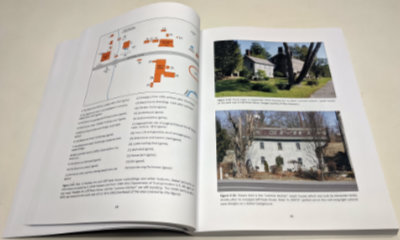 Both of the book’s subjects appeared almost immediately after the National Road passed by the land they would occupy. The first section of the Cliff Rock House was completed in 1830 and the Headley Inn’s first section in 1833. Other dates have appeared in articles and even on signs but Gerken sorts through the various claims and presents a solid case for these dates. Both structures have been enlarged and modified over the years. Despite their nearness to each other, the inns were constructed and operated independently by two separate families. That has not always been the case although it is again today.
 It is generally thought that the Headley Inn initially served as a stagecoach stop while the larger Cliff Rock House catered more to drovers herding sheep and other animals to market. That sort of division was never iron clad, of course, but that kind of thinking does serve to justify the two businesses being so close.
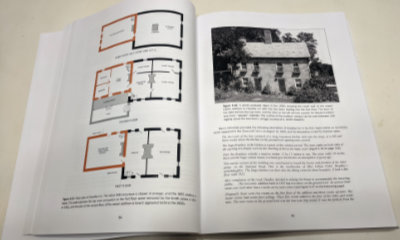
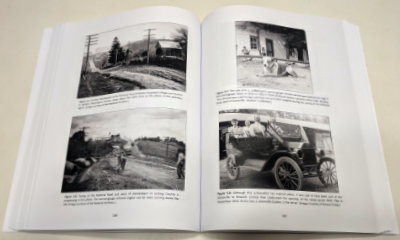 Living memory provides even more input to the post-tearoom era and here the living memory is sometimes Gerken’s own although it is more often her personal interviews with the short series of owners. The book is heavily illustrated with historical photos, maps, diagrams, newspaper clippings, and more. Modern photos include many taken by the author herself.
 This post first appeared last year. It is being reused due in part to 2020’s reduced mobility and (apparently) creativity. Articles in
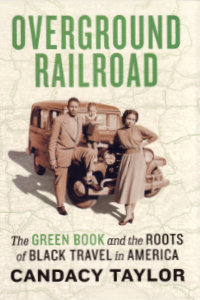 “This is not a book about the history of road-tripping and black travel”, is the first sentence of the last paragraph of the introduction. That’s something I knew long before I read it. It was something Candacy Taylor said early in the presentation I attended in Indianapolis back in February. It may even have been something she said during another presentation of hers I attended back in 2016. I discovered Taylor the same way she discovered the Green Book. Well, not exactly the same way. She learned of the Green Book while doing research for a Moon Travel Guide on Route 66. I learned of Candacy Taylor as a mere attendee at a conference on the historic road. Research for the book was well underway when Taylor spoke at that conference in Los Angeles but Overground Railroad: The Green Book and the Roots of Black Travel in America was still a concept. It was a reality when she spoke in Indianapolis, and that’s where I acquired my copy.
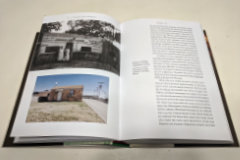 Overground Railroad is heavily illustrated. Taylor’s research for this project included cataloging and visiting businesses listed in the Green Book, and several of her photographs of sites that remain appear throughout the book. She also includes some personal photos. Numerous historic photos along with reproductions from the Green Book accompany the text. A section in the back of the book lists surviving “Green Book sites” and includes Taylor’s photos of many. It is followed by a section with reproductions of every known Green Book cover other than the very first edition of 1936.
 This picture is indeed a repeat. It appeared last November in a post about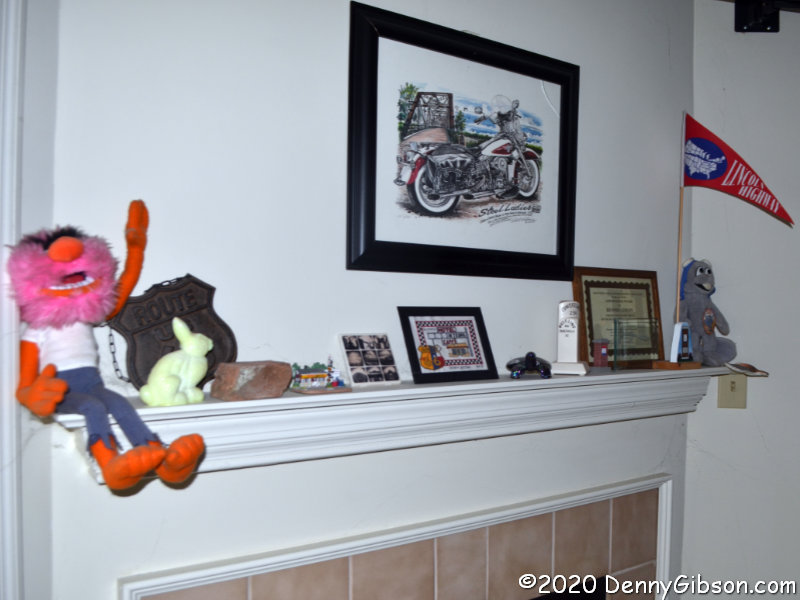
 Sometime after the
 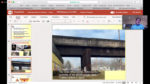 I only took one screenshot during the lecture and it was very near the end. Ray talked about how people made decisions before and during the Holocaust. He spoke not only of how but when. Don’t be late, he said. He mentioned some more recent events that deserved decisions. He mentioned the white supremacist gatherings in Charlottesville and elsewhere and he mentioned the much closer and more recent incident in the photo. Just over two weeks before the lecture and barely ten miles from my home, someone painted “The Jews killed Christ. They are the enemies of the whole human race.” Don’t be late.