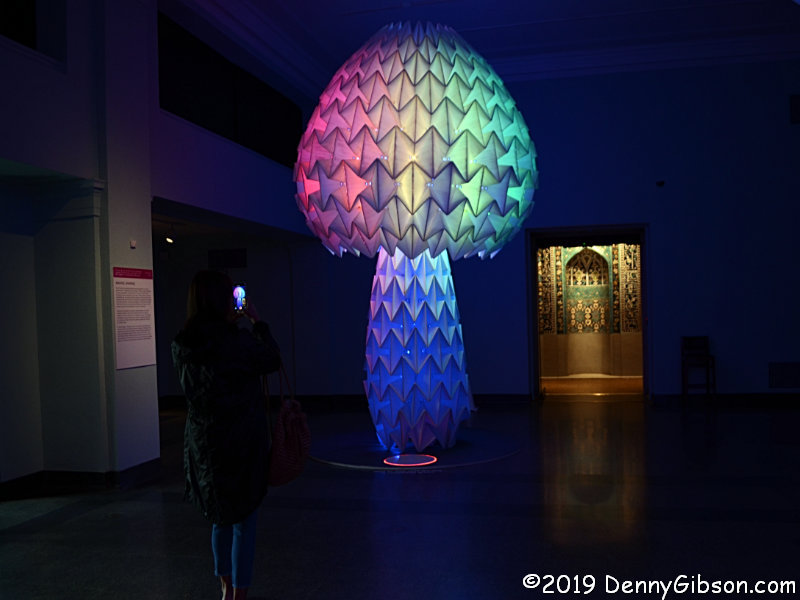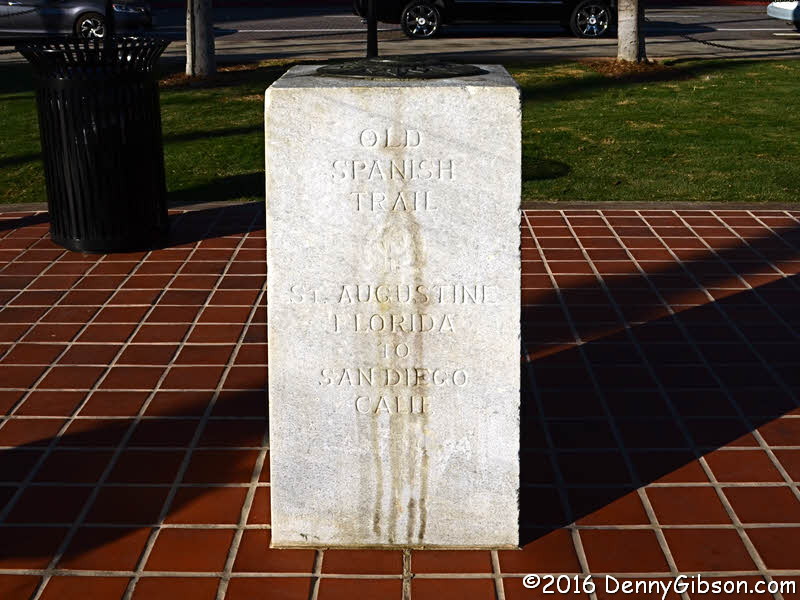
Relocated Cincy

Attending the Cincinnati Museum Center preview last week reminded me that I’d sort of lost track of the murals that once hung in the terminal’s passenger concourse. When the concourse was demolished back in the 1970s, they were moved to the Cincinnati Airport in northern Kentucky. They once again became homeless when the airport terminal they were installed in came up for demolition. A new home was found on the west side of the Duke Energy Convention Center and they took up residence there about a month ago. You can read about the re-dedication ceremony here. Those panels above the murals form the city’s name tag. Anyone visiting or even passing through Cincinnati at night may have seen the name spelled out in lights. I apologize for this crappy picture being the only one that I own but I know there are some good ones out there on the web.

The nine 20 feet square murals are in a climate controlled space behind tinted glass. That’s good for the murals which deserve all the protection they can get, but not so good for taking photographs. That bit of glare is a just minor inconvenience, however, and I’m certainly not complaining. I’m really quite happy to see the murals both protected and accessible. Passersby can now study these nine images of Cincinnati history with out so much as a train or plane ticket.

And here’s a bit of relocated Cincinnati history I’ve been remiss in checking out. I saw sketches of this installation while Cincinnati Gardens, the letters’ original home, was still standing. I mentioned the plan when I wrote about the Gardens in this post. Then I read about it being completed here. I can’t say why it took me nearly three months to get to see it but sometimes that happens. Cool and clever.  

Musical Review
Cincinnati King

Although it didn’t feel much like it, this was actually something of a repeat. I attended a reading of KJ Sanchez’ Cincinnati King in Washington Park back in 2015. It was during a King Records celebration and drummer Philip Paul was among the musicians performing before the reading. There was music during the reading, too, but it didn’t make me think of the play as a musical. They’re calling it that now, and they’re right. I don’t doubt that my 2015 perception was off a little. In fact, I’ve probably forgotten more about that performance than I remember. But, as enjoyable as that Washington Park reading was, Cincinnati King sure has sure come a long way since then.

From the long list of colorful and talented people associated with King Records, Sanchez picked three to tell her tale. Syd Nathan, the label’s founder and beyond colorful owner, had to be one of them, of course. To represent Syd’s stable of singers, she chose Little Willie John whose story contains some of King’s best and worst. To help keep that volatile pair on point, she picked the guy who did the same thing for much of King’s product, long time session drummer Philip Paul.

Those great characters are portrayed by great actors. Neal Benari is a convincing and properly blustery Syd Nathans, Stanley Wayne Mathis nails Philip Paul, and Richard Crandle made me wish I could have attended just one Little Willie John performance. Benari and Mathis do sing one song each, but it’s Crandle, along with Cullen R. Titmas and Anita Welch, doing the heavy vocal lifting. Titmas and Welch kind of work their way through the King roster from Cowboy Copas to Moon Mullican and Annisteen Allen to Lula Reed. Welch has a wonderful voice and her dancing certainly adds to the show as well. The singers are backed by a top notch quartet comprised of Music Director Richard Livingston Huntley on drums, Terrell Montgomery on bass, Ralph Huntley on piano, and Seth L. Johnson on guitar.

Cincinnati King doesn’t tell the complete King story but it does paint a representative picture. From our current perspective the King Record story may seem rather sad but that could be mostly perception. King Records was successful: the sixth largest record company in the country. It was innovative: the first record company to record, manufacture, package, and distribute its product. It was progressive: generally colorblind hiring practices and minorities in key positions. It was trend setting: Little Willie John preceded James Brown, Moon Mullican preceded Jerry Lee Lewis. It was inspired: Fever, The Twist, The Train Kept A-Rollin’, and other long lived songs originated there. It was noticed: Syd Nathan is in the Rock & Roll and Bluegrass Halls of Fame and several King artists are in one or the other. KJ Sanchez gives us a feel for all of that in a highly entertaining two hours.

It’s also an informative two hours, and I could tell that parts of the story were real revelations to some of the audience. I’m no authority but I have read a fair amount about King Records and Syd Nathan over the years. Still, one piece of the story was entirely new to me. Syd Nathan, in the very early 1960s, traveled to Hamburg, Germany, to see the Beatles. It’s implied that he could have signed them but missed his chance. Whether or not an actual signing was likely, the reason for Syd not even making it to the club is telling. At some point on the day he was to see the Beatles, he watched a group of German boys walk by from his hotel room window. It’s not clear what it was about the boys that seemed menacing but the sighting caused Syd to stay in his room until time to return to London the next day. The Third Reich had been defeated little more than fifteen years earlier. Germany was not a place the Cincinnati Jew wanted to be.

I think it was the day after I saw Cincinnati King that I read a review written a few days earlier. It was very positive. I’d enjoyed the show immensely and the review reinforced my impressions. It praised the story, the actors, the musicians, and the staging. It was all flowers and sunbeams until the very last paragraph. Describing the show as “anchored in local history”, it concluded that it is “not a show that’s likely to move on to other cities and venues.” Maybe so, I thought. King was definitely a Cincinnati company. But I almost immediately started questioning the review’s conclusion. The company’s influence sure wasn’t limited to its home town. People all across the nation were once interested in its music; Why wouldn’t they be interested in its story? There’s a quote from former Rock & Roll Hall of Fame Director Terry Stewart on that panel I photographed:

There are only three places in the country that can claim to be the birthplace of Rock and Roll: New Orleans, Memphis, and Cincinnati.

I’ve no idea what plans may or may not exist for Cincinnati King. I’ve a hunch that KJ Sanchez doesn’t believe that “other cities and venues” are out of reach. I don’t.

Cincinnati King is at Playhouse in the Park through December 23.

Our Terminal Returns

Back in July of 2016 much of the Cincinnati Museum Center at Union Terminal shut down for a major renovation of the 85 year old building. On the building’s lower level, the Children’s Museum stayed open through most — but not all — of the work and some traveling exhibits were presented, but the rest of the building was essentially closed while $228 million in renovations took place. That ended yesterday when the building officially opened to the public. In the days preceding the grand opening, some special receptions and other sneak peeks occurred. A biggie was Friday’s Members Only Preview which is when these photos were taken.

The renovation of the building is more or less complete but reestablishing the museum displays and other features is still in progress. The technically open Natural History Museum is just a skeleton of what it once was and will eventually be again. But it’s a really nice skeleton! Dinosaur Hall, the main display in the museum space currently, is brand new which is one reason it gets a jump on the return of some older exhibits. A crowd favorite, the artificial limestone cave, is scheduled to return in the spring.

Next stop was Holiday Junction where the Duke Energy Holiday Trains are in operation. The last photo is of a 1904 Carlisle & Fitch street car. The Cincinnati company introduced toy electric trains to the world in 1896.

Although the Cincinnati History Museum will not actually be open until April, there is a connection to its Public Landing area from Holiday Junction. Before the closing, a painter sat on top of that scaffolding perpetually engaged in completing the sign for my hotel. He’s apparently been given some time off during the renovation but I expect him to be back at work when the museum officially opens. Scheuman’s Bierhalle is a new addition that recognizes Cincinnati’s big time brewing history and fits in with the current resurgence of brewing in the city and across the nation.

Two traveling exhibits are currently active at the museum center and I was presented with a 2-for-1 offer when I registered for the preview. One I was rather anxious to see but the other hadn’t really stoked my interest. This, Chocolate, is “the other”. I guess I expected a bunch of frilly boxes and bonbon praising placards. What I got was the interesting history of this product of the cacao tree as it spread from Central America to the world and went from being the drink of kings to an affordable, though sometimes guilty, pleasure for everyone. I was pleasantly surprised though I should have realized that you never know what you’re gonna get with a room of chocolate.

I had rather high expectations for the Guitar exhibit but I was pleasantly surprised again. The history of the instrument was presented and there were several interactive displays on some of its technical aspects. There were also plenty of examples of its current role as the face of rock and roll and a popular symbol of music in general. Of course, one such example is the first generation Les Paul in the third picture and it’s not alone. There’s more Les here. I could fill much more than one panel with pictures from this exhibit but I’ll stop with two more. One is this industrial grade Rostov Stella from the USSR that I’ve never seen before. The other is an all in one rock star kit that I (and just about every dreamer of a certain age) have seen plenty of. By the way, that 43 foot Flying V in the first picture is the Guinness certified largest playable guitar in the world.

After the two traveling exhibits, I took part in two tours. The first was through the space where the Holocaust and Humanity Center will be moving in January. Despite its current location being only about five miles from my home and on my radar for some time, I’ve yet to visit the Center. Seems like something I ought to do before they start carrying stuff out. In the last picture, we’re getting a peek at a corner of a mural that wraps around the entire room and will be unveiled at the Center’s reopening on January 27, the 73rd anniversary of the liberation of Auschwitz.

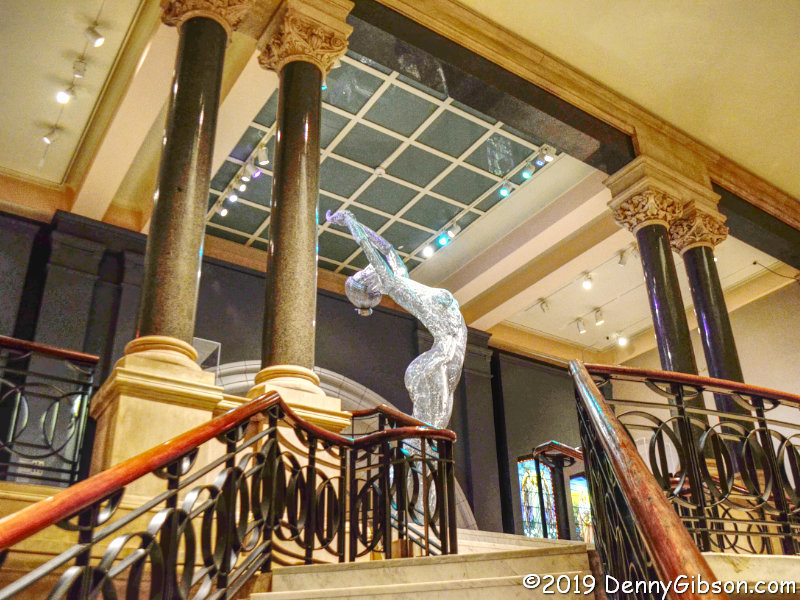
As I waited for my Rotunda Tour, I snapped a picture of another tour group as the crossed the walkway high above the floor. The pictures of the murals were taken from about where that group is standing. This tour was somewhat abbreviated from Rotunda Tours I’ve taken in the past since some areas, like the offices, are not quite ready. Those areas will eventually be added back into the tours but even without them the tour is certainly worthwhile for the views of cleaned and repaired features and inside information passed on by the guide.

The Winold Reiss murals in the half dome had been cleaned at least once before; The two in the hallway behind it: never. Our guide mentioned that she always thought the brown suit in the mural on the south side was one of the most unattractive she’d ever seen. Now, all cleaned up, it looks pretty good. She then pointed out some small figures in the background of the mural on the other wall. I’d never noticed them at all before and I guess they were nearly impossible to see before the cleaning. I believe she said there were a total of seven. I had no trouble finding the four in this section. I’d also never seen the Pierre Bourdelle murals in the dining room before. The twenty-two canvas murals have been in storage since the late 1980s and have just been cleaned and restored. I guess I’ve probably never seen the actual floor of the dining room either. When this was an operating terminal, a serpentine counter filled the room. The counter was gone when the museums moved in and the area where it once stood was three inches lower than the room’s terrazzo floor. The depression was filled with concrete and the whole thing covered with carpet. Now green terrazzo marks where the counter once stood.

The terminal looks fantastic. This was no hurried patch job. Much of the building was more or less disassembled then put back together. Huge steel beams and other major components were replaced. The next several months, as the museums populate their areas, the Holocaust and Humanity Center moves in, the Historical Society Library returns, and the theater reopens with the latest digital technology, are going to be exciting. After the tours, I relaxed in the rotunda for a bit preparing myself for what I planned on being a cold but quick walk to the car. It wasn’t very quick.

The biggest surprise of the day waited outside. I clearly had not been paying enough attention to plans for the reopening. A projection mapping display, the technology used in the city’s Lumenocity and Blink events, covered the front of the terminal. This was the sixth and final show leading up to Saturday’s official reopening. Each night featured a different theme in a fifteen minute loop. Tonight’s theme was “Thanks Cincy!” Every scene in the loop was incredible but I’ve held myself to the “Thank You” display and two of my favorites. I guess I was most impressed with the 3D aspects of the display. The perfect shadowing made the moving dinosaur skeletons appear to be several feet in front of the terminal. The moving satellite in the Saturn scene also appears to be some distance from the building. The walk to my car was about twenty minutes longer than I’d planned but I’ve got absolutely no complaints.

My Wheels — Chapter 34
2003 Pontiac Vibe

This was the car that replaced the Bronco II when its dependability decreased and my dependency on it increased. In addition to providing reliable year-round transportation, I wanted something that could occasionally serve as a sleeping platform as the Bronco had. Part of my shopping ritual was climbing in the back of any candidate to see if I could stretch out. As you can see, the Vibe worked out fairly well for that.

Having a second vehicle that I wasn’t afraid to drive for long distances meant that the Corvette did not have to carry road trip duty all by itself. The little Pontiac wasn’t heavily used in long trips but it did take part in sixteen documented outings. However, not being a particularly glamorous vehicle, it did not show up in many pictures. Both photos included here were taken on a SCCA race weekend when I was proving to someone that I really did sleep in the car.

As mentioned, the car was not glamorous. Nor was it fast, a great handler, super comfortable, or overly capable in snow. But it was adequate in all those departments, and it was a Toyota Matrix at heart, so it was wonderfully reliable. I got a little more than a hundred thousand miles out of it, and by the last report, its third owner is nearing 180,000 after replacing the clutch.

The Vibe didn’t give me much trouble or many stories. I guess the closest thing to a problem was finding the battery dead on three occasions when it was left outside overnight in quite cold temperatures. Online research led me to a possible cause. There was no on/off switch for the headlights. They operated automatically. It was reported that something in the mechanism could freeze up, turn them on in error, and drain the battery. It was suggested that leaving the high beams selected (there was a switch for that) might keep that from happening. I started doing that and never had the problem again but can’t be certain that was the reason.

The list of complaints was almost non-existent but there weren’t many standout features either. There was the legendary Toyota Corolla reliability, of course, and the surprisingly usable interior space. There was an AC outlet that came in handy for charging things and now and then using a laptop computer. Seat height was something I came to appreciate over time. For the Corvette, entry and exit was a matter of falling in and climbing out. It was the reverse for the Bronco. The Vibe seat seemed just right for easily stepping out for a few pictures then just as easily stepping back in.

As I hinted, a non-glamorous, highly reliable car is simply not a great source for stories. Looking through the trip reports turned up just one significant mention of the Vibe. It involved the Tail of the Dragon on the TN-NC border. You may recognize the name; if so, you’ll know that it consists of 318 curves packed into 11 miles. It’s a fun north-to-south downhill challenge for motorcycles and sports cars on sunny days. I drove the Vibe south-to-north uphill in the rain. It just ain’t the same.

My Previous Wheels: Chapter 33 — 1998 Chevrolet Corvette
My Next Wheels: Chapter 35 — 2006 Chevrolet Corvette


Dirk and Lincoln

After a short break, it’s on to more rock and roll. This time it’s a Dirk Hamilton Band reunion in Stockton, California, which will be followed by driving some of the area’s Lincoln Highway. The first day, which includes the very successful reunion, is posted. 

This entry is to let blog only subscribers now about the trip and to provide a place for comments. The journal is here.

I Care Less About How You Vote Than If. (2018)

This post has appeared four times under the title “I Care Not How. Only If.” and each appearance after the first started off with a defense of that title. The defense was basically, “Yeah, I do care how you vote but, even if you’re doing it wrong, I think you should.” This year I changed the title so I can skip the defense. Next year I hope to skip the explanation, too.

On January 30, the day of President Trump’s first State of the Union speech, NPR aired a Mara Liasson article entitled “The State Of Our Politics Is Divided, Mistrustful And Engaged“. The text of the article simplified this to “tribal” and “engaged” which I think would have been a better title. Those two words registered with me as I listened and they’ve stuck with me ever since. One’s bad and one’s good. One negative and the other positive. I’d long been painfully aware of the tribalism which pushed Liasson to note that “More than ever before voters and politicians seem to be taking sides not according to issues or principles or ideology but according to their political tribe.” I was much less aware of the increased engagement she saw but I have noted, with great hope, some since then. Some analysts, in fact, predict record voter turnout for a midterm election. Liasson ended her article with, “Whether you’re a woman or from an immigrant community running for the first time or a white working-class Trump supporter who voted for the first time two years ago, this renewed sense of civic responsibility is the first step to making the state of our politics less broken.” I like the way she thinks. I hope she’s right.


yvyvWe fought a war to get this country going then gave every land owning white male above the age of twenty-one the right to vote. A little more than four score years later, we fought a war with ourselves that cleared the way for non-whites to vote. Several decades of loud, disruptive, and sometimes dangerous behavior brought the granting of that same right to non-males a half-century later, and another half century saw the voting age lowered to eighteen after a decade or so of protests and demonstrations.

dftv1Of course, putting something in a constitution does not automatically make it a practice throughout the land and I am painfully aware that resistance followed each of those changes and that efforts to make voting extremely difficult for “the other side” are ongoing today. I don’t want to ignore partisan obstructions and system flaws but neither do I want to get hung up on them. I meant my first paragraph to be a reminder that a hell of a lot of effort, property, and lives have gone into providing an opportunity to vote to a hell of a lot of people. Far too many of those opportunities go unused.

There are so many ways to slice and dice the numbers that producing a fair and accurate measure of voter turn out may not be possible. A Wikipedia article on the subject includes a table of voter turnout in a number of countries for the period 1960-1995. The United States is at the bottom. The numbers are more than twenty years old and open to interpretation so maybe we’re doing better now or maybe we shouldn’t have been dead last even then. But even if you want to think we are better than that, being anywhere near the bottom of the list and having something in the vicinity of 50% turnout is embarrassing… and frightening.

dftv2In the original title I claimed to not care how anyone votes. That was never entirely true, of course. I have my favorite candidates and issues. I’ll be disappointed in anyone who votes differently than I do but not nearly as disappointed as I’ll be in anyone who doesn’t vote at all. I’m reminded of parents working on getting their kids to clean their plates with lines like, “There are hungry children in China who would love to have your green beans.” I’m not sure what the demand for leftover beans is in Beijing these days but I’m pretty sure some folks there would like to have our access to ballots and voting booths.

Trip Peek #76
Trip #52
Blues, Books, & Battles

This picture is from my 2007 Blues, Books, & Battles trip. It was, as indicated by the title, a three parter. The blues part was a Patrick Sweany show at The Purple Fiddle in Thomas, West Virginia. I got there on the rather scenic US-50. Following a night in Thomas, I headed to Pittsburgh, Pennsylvania, for the book part. The target was a promotional event for a new book, The Lincoln Highway: Coast to Coast from Times Square to the Golden Gate, from Michael Wallis and Michael Williamson. I’ve met Wallis several times before and since but this was my first and only time meeting Williamson. Although I enjoyed that and wandering through the Heinz History Center, the real highlight was meeting Brian Butko and Bernie Queneau for the first time. I did not charge into battle for part three; I visited the Soldiers and Sailors Memorial where lots of military history is on display. Of particular interest and the reason for my visit, was a section devoted to the 78th Infantry Division. That’s the unit my dad was with in World War II.


Trip Peeks are short articles published when my world is too busy or too boring for a current events piece to be completed in time for the Sunday posting. In addition to a photo thumbnail from a completed road trip, each Peek includes a brief description of that photo plus links to the full sized photo and the associated trip journal.

Only Rock and Roll

In getting in position for my personalized three ring rock and roll circus, I passed through a town whose name has a rock and roll connection even if it’s actually just a stand-in for the place Credence Clearwater Revival made infamous. The circus starts with the Rock and Roll Hall of Fame on Friday, then The Tubes on Saturday. On Monday, Little Steven and the Disciples of Soul will be in ring #3, and I predict a little Lincoln Highway and other stuff in between.

This entry is to let blog only subscribers now about the trip and to provide a place for comments. The journal is here.

The Growing Season

In 1968, it took a full seven games to determine a MLB World Series champion. The seventh game, which saw the Tigers top the Cardinals, was played on October 10.

Last night, just a little before 11:30, the teams participating in the 2018 World Series were finally determined. It will be the American League Red Sox versus the National League Dodgers in the best of seven contest that starts next Tuesday. If somebody sweeps the series in four games, it will be over on Saturday. If all seven games are required, it won’t be over until the following Wednesday. That’s Wednesday, October 31. Halloween. The last day of the month. The game is scheduled to start at 8:09 ET so it’s conceivable that extra innings could push it past midnight and into November. That’s exactly what occurred in game #4 in 2001. That series was delayed due to the September 11 terrorist attacks. The game went to ten innings and ended at 12:04 AM November 1 marking the first time Major League Baseball was played in November. The series went to seven games meaning three were played entirely in the eleventh month of the year. In fact, between that first extra-inning slip into November and this year’s potential for doing the same, a total of nine games have started and ended beyond October. What the heck — besides color cameras everywhere — happened?

Expansion, with maybe just a touch of Participation Trophy mentality, happened. From 1903 through 1960, the top tier of professional baseball was comprised of sixteen teams divided into two eight team leagues. Two teams were added to the American League in 1961 and two more to the National League in 1962. The regular season became a little longer, meaning the post season started a little later, but it still looked the same. The team with the best record in one league went off to battle the team with the best record in the other league. Simple, straight forward, and easy to understand. Your top outfit plays our top outfit and the winner takes all.

Then the expansion of 1969 added two more teams to each league. Someone decided that the dozen teams in each league was too many to simply play each other and compare end of season records, so the leagues were divided into two divisions each and the league playoff series was invented. In 1977, the American League once again took the lead in number of teams by adding two more. The National League didn’t catch up until 1993.

Two more teams were added in 1998. Some strange shuffling took place but things eventually settled down to today’s arrangement of two leagues with three five team divisions each. When the regular season ends these days, ten teams, a full third, have a shot at the World Series. Each of the two leagues has a Wild Card Game, two Division Playoff Series, and a League Championship Series to figure out who gets to play in the final games of the year.

Incidentally, the shuffling that occurred in the wake of adding the 29th and 30th teams led to teams playing across the league boundaries to help with scheduling. Before that, no American League team ever faced a National League team in a real game before the World Series.

Roger Maris hit 61 home runs in 1961 to top Babe Ruth’s record of 60 for a season. Because Maris played 162 games versus Ruth’s 154, there was talk of marking his record with an asterisk. The asterisk never actually existed but the two records were kept separate. I know not everyone agrees, but that more or less made sense to me at the time. What would make even more sense to me is to put an asterisk on every post season game since that playoff stuff started in 1969. And maybe two asterisks on games with a designated hitter.

Book Review
Unlikely General
Mary Stockwell

Anthony Wayne gave Fort Greene Ville and Fort Recovery their names. They were significant in both his life and mine although the level of significance is severely tilted toward Wayne. Fort Recovery is where the army led by Arthur St. Clair was nearly annihilated in 1791. It got its name when soldiers under Wayne’s command built a small fort there in 1793. Also built in 1793, Fort Greene Ville stood twenty some miles to the south and was Wayne’s home base during the Northwest Indian War. The treaty ending that war was signed there in 1795. The town that developed on the site of the abandoned fort adopted the shortened name Greenville. I grew up near the midpoint between Greenville and Fort Recovery and adopted Anthony Wayne as a hero at a very early age. I eventually figured out that much of the initial attraction was due the the cool bicorne hat he was commonly shown in, but the fact remains that I’ve known of General “Mad” Anthony Wayne nearly all of my life.

When I learned that Mary Stockwell would be discussing her new book about Wayne in nearby Lebanon, I jumped at the chance to attend. At a minimum, I hoped to learn what the word “unlikely” was doing in her book’s title. With what I knew of Wayne, he seemed the most likely of generals to attempt a turn around following St. Clair’s disaster. Turns out there was a lot I didn’t know.

I knew about his time in Ohio with a fair level of detail, but I knew only highlights and generalities about his Revolutionary War days. I knew that he had been successful in several battles and that his biggest claim to fame at that time was taking Stoney Point, New York, from the British. I did not know that his personal life and lack of success in business meant that many of those in power did not have much confidence in the man. There was plenty of opposition to putting him in charge of what was essentially the entire army of the United States, and he was not at all the likely choice for the role I’d long assumed.

Some attending the presentation knew even less than I about Wayne’s pre-Indian War days. It was rather common, Stockwell noted, for people living in the east to know all about his Revolutionary War exploits and little or nothing about his post-revolution accomplishments and for the opposite situation to exist in our part of the country. Her book fills in details from both phases of his military career and the rest of his life as well. In doing that, she also provides glimpses of the birth of the United States of America and of the beginning of its westward expansion.

Much of Stockwell’s information on Wayne comes from reading actual letters written by and to him. This provides insight into his relationship with some of the most prominent figures of the day, such as Washington, Knox, Lafayette, St. Clair, and others, and with his friends and family. That last group, friends and family, was one I previously knew very little about. That personal life I referenced earlier included numerous involvements with women other than his wife, Polly. Correspondence between the two varied from frequent and loving to seldom and formal. His long absences and his womanizing were certainly related but which was the cause of the other isn’t really consistent. There is little doubt that he sometimes used his military activities as an excuse for staying away from home, but there is no doubt that his devotion to the new nation was completely genuine. The United States of America was something he was never anything but faithful to during its birth and infancy.

Stockwell skillfully weaves Wayne’s two wars together. There are some similarities, of course, such as the constant struggle to get government officials to feed and cloth the men they sent off to fight. But there are big differences in Wayne himself. He experienced periods of deep depression in both but during the Revolutionary War he was young, energetic, enthusiastic, and uncommonly handsome. By the time he set out to create the Legion of the United States from virtually nothing, old war wounds and severe gout might incapacitate him for days at a time. During that final campaign, his staff often wrapped his limbs in flannel and lifted him onto his horse out of sight of the troops.

It was probably about sixty-five years ago that I was hooked by that super groovy hat and decided that the dude under it was my hero. It was only a few years later that I saw a painting of a hat-less Wayne and was shocked to learn it was the same person. That painting might even be the same one that appears on the cover of this book. It was at least similar. I recognized that there was more to a man than his hat and Wayne survived as a childhood hero. Inside Unlikely General, Mary Stockwell reveals a lot more than a high forehead. Anthony Wayne was not, as some have interpreted his nickname, insane, but he was a long way from perfect. Perhaps the fact that I’m much older now explains why I was less shocked at learning of the imperfections than I had been at my first sight of Wayne bare-headed.

Anthony Wayne was once the most honored and well known military man in the country. Today, despite being on towns, streets, and other items, his name seems to be be barely recognized outside of Pennsylvania, Ohio, and Indiana. Hopefully this book will make his name a little better known. On the other hand, part of me can’t help but think he might never have fallen from the public consciousness if only he’d kept that hat on.

Unlikely General: “Mad” Anthony Wayne and the Battle for America, Mary Stockwell, Yale University Press, April 24, 2018, 9.2 x 6.1 inches, 376 pages, ISBN 978-0300214758
Available through Amazon.