Season of the Clown

Not everybody decorates for Halloween with store-bought skeletons and inflatable witches. Some people, like this guy in Delhi Township that I just learned of, do it with personal creativity. For the last ten years, Shaun Reynolds has filled his front yard with unique creations based on different themes. This year, it’s clowns.

“I’ve wanted to do this since I was a kid,” Reynolds told TV station WCPO. It was through their article and video that I learned of the seasonal attraction. Check it out here. I didn’t get to meet Reynolds when I visited on Thursday, but I have a feeling that he’s not quite finished with being a kid.

I did get to meet Teresa, a long-time neighbor. I was poised to ask what it was like having a big, spooky attraction in your neighborhood, but I didn’t really need to. Her smile when she greeted me let me know she was loving it. I had thought of counting the figures on display, but had not followed through. Theresa made that unnecessary, too. “38 or 39,” she said. She also tried to describe how great the place looks at night with the lights on, as well as just how crowded and fun it gets on Fridays and Saturdays.

Reynolds makes it very clear that he does this for fun and that sharing it and seeing others enjoy it is part of that fun. Of course, some folks have wanted to contribute something, so the Reynolds family has taken to accepting donations of food and money, which they pass on to the Delshire Elementary School food drive.

I’d sure like to see this place at night, and I’m going to try to make that happen. Maybe you can, too, but it is obviously pretty cool day or night. It’s on Assisiview Court.

One for Sun(flowers) in Ohio

Remember last month’s Two for Four in Ohio post, when one of the targeted museums was closed and the sunflowers were barely out of the ground? At the time, I noted that the projected date for Tecumseh Land Trust blooms was near the end of September. Well, the end of September is near, and the blooming sunflowers are here.

Thursday morning’s rain ended, and the forecast said it would not be back until evening. That wasn’t correct, but I did manage to get my visit in before the rain returned just past noon. This time, I was not alone. There were about half a dozen cars parked in the designated area next to the flowers, and some small winged beings hanging out right in their midst. Here’s a closer look at the bloom in the center of the opening photo.

The ground was wet but apparently not actually muddy, as a few of the humans from the parked cars ventured out into the field to take selfies surrounded by yellow flowers. Most, however, walked around the edge like I did. Just before I left, a group of women arrived with their young daughters wearing some very pretty dresses and posed the group at the field’s edge for photos. I worked at keeping all wingless creatures out of frame.

Even though none of the sunflowers said a word, I left with the impression that they were glad to see me.

Book Review
The Great American Retro Road Trip
Rolando Pujol

There’s no road trip here. The Great American Road Trip is not a travelogue. Nor is it a guide for traveling to or through a particular place. It is a well-done, very inclusive, nicely illustrated catalog of stuff that people like me drive around the country to see.

The subtitle is more accurate. This book is indeed A Celebration of Roadside Americana, and that’s a celebration I’m always ready to put on my party hat for. It’s a celebration that Rolando Pujol is extremely well qualified to host. He is an award-winning print and TV journalist, and is the man behind The Retrologist website. Surprisingly, this appears to be his first book.

Pujol identifies seven categories of stuff people like me/us drive around the country to see, and has divided the country we drive around in into eleven regions. The chapters are the regions: Northeast, New England, Mid-Atlantic, Southeast, South Central, Midwest, Heartland, Desert Southwest, Mountain West, Pacific Northwest, and California. Sections in each of those chapters are devoted to the categories: Roadside Quirks, Roadside Eats, Mainstays of Main Street, On with the Show, The Inn Crowd, Sweet Stops, and Cheers! I bet most of you can come up with an example of something in each of the categories, even without a precise definition. Sidebars appear here and there to expand on or drill down on selected topics.

The book is jam-packed with bright color photos that range in size from small thumbnails, measuring only an inch or so on a side, to double-page spreads at the front of each chapter. Many are integrated into the book’s text layout. I believe that all photos were taken by the author.

Every photo is identified in the text, and a few points of interest are described without an accompanying photo. Some attractions are covered in a single paragraph, but many get a lot more. The city and state are always provided, and more often than not, some interesting history about the building, the owners, or both is also included.

For the first time, I’m writing a book review without reading every word in the book. I did read every word from the beginning through the end of the Midwest chapter. That’s where my home is, and there are quite a few familiar items in that chapter. However, there is no storyline or itinerary to move the reader forward, and I found my page-turning motivation beginning to fade at that point. The pictures are great, and the nuggets are well-written and informative. I may finish it in some short spurts over the winter, and in all likelihood, I’ll give it a look when planning a trip to a specific area. I have not removed my bookmark.

This is a good quality hardback publication with glossy pages that properly present the photos. It is fully indexed for help in finding specific points of interest. I ordered this book when it was announced that Pujol would be featured in the Society for Commercial Archeology’s August Zoom presentation. I thought I might get in some advance reading, but that didn’t quite work out. That presentation was recorded and, like other SCA Zoom presentations, has been made available for anyone to view. Learn more about The Great American Retro Road Trip straight from the Retrologist’s mouth here.

The Great American Retro Road Trip: A Celebration of Roadside Americana, Rolando Pujol, Artisan (June 24, 2025), 7.2 x 9.25 inches, 320 pages, ISBN 978-1648293719
Available through Amazon.

A Thoroughly Modern Attic

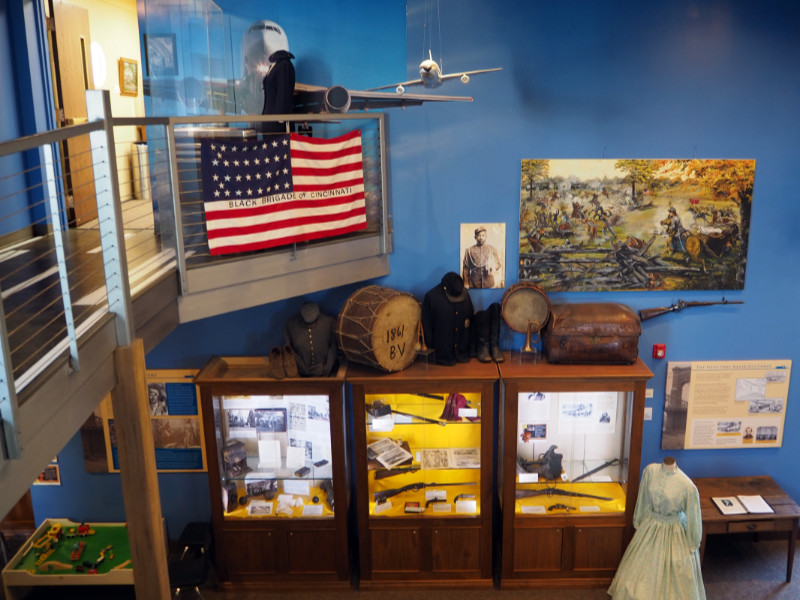
Museums in small towns are sometimes referred to as the village attic. Some of them really do resemble an old farmhouse attic with little filtering or organization of objects displayed. Most, however, display items in an organized manner that avoids looking overcrowded. Part of how this is accomplished is by being selective in what items are displayed and having only a portion — often a very small portion — of the museum’s collection on display at any one time. As the state’s attic, the Ohio History Connection is very organized, with a rather tiny fraction of its collection on display and the bulk stored elsewhere. Last year, it got a brand new “attic”, and on Thursday, I got to see it.

The occasion was an architectural tour preceded by a reception and presentation. I didn’t realize that food would be available, but I did realize that it was National Cheeseburger Day. I enjoyed the lemonade, but I skipped the food because I had just left Urban Gourmet, where I had celebrated the holiday.

The tour began with a presentation in the auditorium. Several people gave short presentations about different aspects of the project, which began several years ago with the Collection Care Center opening in June 2024. I happened to catch architect Carlos Lugo at the podium.

Following the presentation, we all went out to our cars and drove from the museum, past Ohio Village, to the Collection Care Center on the north side of the campus. At the door, the fifty or so attendees were split into smaller groups to tour the building.

The group I was in began our tour in the actual storage section. Among the wide range of things stored here are lots of fossils. Some are authentic, while others are cast copies. 

The bones of mastodon feet aren’t typically found intact in the wild. These are castings from assembled fragments. I thought a shelf filled with mastodon feet was pretty unusual, regardless of whether they were bone or plaster.

There is an enclosed loading dock at the other end of the building with offices, lab areas, and an extra-wide corridor in between.We paused in that corridor to learn about the building’s use of pre-formed concrete to speed construction and about other efficiency-focused aspects of the building. We then went outside to learn more about the climate control systems. I have the impression that the majority of attendees were architects. For many, hearing these details was as practical as it was entertaining. I was very impressed by the thoughtful answers to the building’s many unique requirements, but that was probably fueled as much by things I didn’t understand as by those I did.

Our last stop was just outside the front door after we passed back through the building. Here we learned about the landscaping. Native plants are used, and there is no mown lawn. There are some paved as well as gravel paths with a few benches along the way. Several glacial erratics encountered during excavation have been incorporated. The place has been incredibly well thought through, both inside and out.

For a much better overview of the project than I’ve provided, I suggest an article and video published by The Columbus Dispatch when the center opened. It is here


500 Breweries

In previous posts about milestones in my count of brewery visits, I’ve commented about how Untappd, the score-keeping app, can create surprises with changes in the counts. I know it has added to my count of breweries by reclassifying places as breweries that were classified as something else when I logged them. Apparently, it can do the reverse as well, since the brewery that was my 400th when I logged it is now my 396th. I’m not going to analyze and try to explain these changes anymore. I will merely note that I visited 104 breweries to move from 400 to 500. It may look like I visit nothing but breweries, and they do account for the majority of my check-ins, but I also log brews at other venues. A volleyball court, an art museum, a cemetery, and two gay bars are just a few of the non-brewery venues among my Untappd recorded locations.

I confess to rigging this brewery’s position just a little. I first learned of Appalachian Artisan Ales (#500, 9/13/25) back on August 15 when I visited the World’s Largest Acorn in Oak Hill, OH (Two for Four in Ohio). The acorn was the last of the destinations planned for that day, and a search for breweries while parked at the big nut turned up this place not too far away and pretty much on the path home. Without further research, I drove directly there to find it closed. I did the research I should have done earlier in the brewery’s parking lot and learned that it was only open on selected weekends, and this was not one of them. It looked so cool that I immediately resolved to return. When I logged my next brewery about a week later, I saw that 500 was only a few breweries away, and quickly decided to make this the one. I don’t regret it a bit. The brewery opened on April 24 of this year. Founders Shane and Nate both have day jobs, which is one reason the brewery is currently open just two weekends a month. Shane told me that he and Nate both have homebrewing experience, and both put time into it, but that Nate is really the owner. Cool location, cool building, and cool beer.

In past posts about reaching a multiple of 100 breweries, I’ve not only noted the brewery that did it, but the one just beyond that started the next 100. I’m not doing that this time because 1) I haven’t yet visited brewery 501, and 2) it might change before I reach 600. But I am maintaining the practice of naming a few of the preceding 100 breweries that made an impression. First up is Harpers Ferry Brewing (#414 12/24/23), which I visited on Christmas Eve 2023. Its Big Bucks Brown Ale is quite good, but it is largely because the brews, as the bear points out, come with views, that I’m including it here. Those views are of the Potomac River as it flows east toward the town of Harpers Ferry.  

As a guy drawn to mom & pop diners and motels, finding this mom & pop brewery within a year of it opening was extra special. That it’s close enough to visit now and then makes it even more so. Pop Scott brews the excellent beer, and Mom Laura makes the wonderful from-scratch pizza in this wood-fired oven. Besides being a great place to eat and drink, GlendAlehouse Brewery (#434, 7/7/24) is a popular gathering spot where live music is often heard and recorded (on vinyl!) music can be heard any time. There are a number of painted squirrel statues around Glendale, which is known for its large population of black squirrels. The one in front of GlendAlehouse is named “Squarely”, and an IPA with that name is among the brewery’s offerings. 

Santa Fe Brewing (#459 10/21/24) is not in the area around the downtown plaza that many people, including me, picture when they think of Santa Fe, NM. Although it does operate a taproom in a historic building within a half mile or so of the plaza, the main brewery is several miles away to the southwest. At that location, you will find a “brewery campus” with nicely landscaped outdoor areas, a concert venue with a capacity of 400, and a giant taproom, in addition to lots of brewing gear.   

Deep in the last century, long before craft beer even existed in any real sense, there were beer connoisseurs and mavens who compared and wrote about the brews of the day. I don’t recall details, but I do know that Point Special was at or near the top of multiple lists, and I remember being rather excited when a business trip brought me within range of this storied beverage sometime in the 1980s. I have been by the brewery a couple of times since then, but since there had never been anything particularly exciting going on there, I almost skipped it when I passed through Stevens Point, WI, in July. I was sure glad I didn’t when I saw that a taproom was operating in their old garage. It had opened just over a year before. I walked in with plans to order a Point Special, but when I saw some of the “available here only” offerings, I had to go for a Coconut Rum Stout. Stevens Point Brewery (#490 7/29/25)

With the count changing slightly due to venue reclassification and such, pace calculations are not entirely precise. They are still of some interest, however, and the small variations don’t really affect the overall averages that much. It appears that, even though I’ve “lost” some of my earlier logged breweries, I have picked up the pace just a wee bit. My 500th brewery was logged 4243 days after the first one. That’s a scosh over 0.82 breweries a week for about 11 1/2 years. As I said almost two years ago after brewery #400,  I don’t know how much longer I can keep this up.

My previous brewery boasts… I mean posts are here (200), here (300), and here (400).

More Cars, More Coffee

There’s a bit of a chain reaction going on here. Last week’s visit to the museum at 4 Speed on 50 was the result of the previous week’s stop for a hamburger at the diner there, and this week’s visit to Horsepower Farm is the direct result of that museum visit. As Steve Ashcraft and I were saying goodbye at the end of my museum tour, we did some name checks on other car collections in the area. As if to demonstrate just how oblivious people can be to attractions in their own neighborhood, Steve mentioned Horsepower Farm, which is less than fifteen miles from my home and which I had never heard of. A check of the Farm’s website revealed that their monthly Cars & Coffee would be taking place on the very next Saturday, so that’s where I headed yesterday morning.

Horsepower Farm came into being as a place for Opie Willis to store his growing car collection. It has become a scenic event center where numerous public events are held, and which can be rented for private events such as weddings and meetings. I believe the first Saturday of every month Cars & Coffee is the only regularly scheduled event open to the public. It is adjacent to a residential area that has lots of these “PLEASE DRIVE SLOWLY AND QUIETLY” signs displayed, and I have no doubt that anyone ignoring the signs would not find a very friendly welcome at the farm.

There were signs pointing in both directions for parking, and I didn’t realize that a more proper area for mundane cars like Subaru Foresters was to the left until after I drove past the garages and the main area for cool cars. It’s a very non-judgmental crowd, and no one complained or even looked at me funny. Even so, rather than immediately driving back through the area, I parked at the far end of a large open space and walked back.

I naturally looked over some of the cars parked outside, but cut my walk short to step inside the main building. These are, I assume, some of the cars in Willis’ personal collection.

There are several objets d’art mixed in with the cars. Although it’s out of sequence, this seems like a good place to include a full-length shot of that beautiful stainless steel “Horseplay” in the opening photo.

I did not get a car count, but it was way beyond respectable, and the variety was pretty incredible.

Here are a few of my favorites. I think I did mention variety.

When I walked back to my car, I paused to look a little closer at the Hudson “tribute car” parked near the main building. I found the interior, some of which is explained here, especially interesting. I don’t recall ever hearing of holes for on-the-go tire wear checks, but I did some searching online and learned that it was truly a thing in the early days of NASCAR.

So, even though I had to go to Indiana to learn about it, I now know that one of the best Cars & Coffee gatherings in the area is only about half an hour from my home. You can bet your bippy and your VW roof rack that I’ll be back.

An Auto Park Turns Two

I’ve not been overly secretive about the fact that I’m generally not crazy about bright and shiny brand-new diners or diners of any vintage with a hard-core Marilyn & Elvis vibe. Just the “bright & shiny” thing is probably enough to explain why I’ve passed the 4 Speed on 50 Diner multiple times without stopping. Two Fridays ago, I was headed home from a spot a bit deeper into Indiana than Lawrenceburg with a stomach empty enough and a bladder full enough to pull me in. Inside was a staff so friendly and food so good that I was very glad I stopped. I sat at the counter and watched this burger prepared on the grill in front of me, then ate it. I swear it didn’t look that big on the menu. At some point, I asked the cook about the museum I’d seen signs for, and he pointed to a fellow he called one of the owners at the end of the counter. He explained that the museum contained some very interesting cars but had just closed for the day. Then he went on to tell me the diner’s second anniversary was being celebrated in just over a week with some special entertainment and the weekly Cars & Coffee.

I decided that was a good activity for an absolutely beautiful Saturday, and headed over in time to catch a decent chunk of Cars & Coffee. The day’s entertainment highlight would be a renowned Elvis impersonator, but that was scheduled for the evening when I intended to be sitting quietly at home. I did get to see one of the event’s guest celebrities, however. This Ford appeared in the Movie Hoosiers. I confess to being one of the few people in the world and possibly the only male over 16 living within 60 miles of Milan, IN, carrying that shame. Yeah, I know. I will fix that someday. I promise.
The setup here is sort of a car culture campus. A separate website, 4 Speed on 50 Auto Park, covers the non-diner part of the operation. The Hoosier car is displayed in front of the diner. Cars & Coffee makes use of a parking area between the diner and an associated gas station so that diner access is not affected. I’m guessing that might not remain the case once the Elvis crowd starts rolling in. There appeared to be a pretty decent turnout, and it certainly included some real classics.

Once I had checked out all the cars, I went inside and don’t even pretend you’re surprised. There’s a real greeter with a real smile just out of frame to the left. I once again sat at the counter and watched as my meal was cooked. It was then delivered with a smile. This time it was a Local Omelet (goetta, onion, peppers, mushrooms, cheddar jack cheese). After eating, I carefully selected and then made use of one of the restrooms.

Now I was ready to visit that museum. When I purchased my ticket, the fellow I had spoken with the previous week was sitting nearby, and I made a comment about him being the owner. His dad was the actual owner, he now explained as he walked with me to the museum entrance. Both he and his dad were named Steve, and there was a third Steve who helped run the place I would probably encounter while I was there. Not long after he left, I was looking over a 1969 427 Corvette when three men entered, and I made some joke about one or two of them being Steve. I was off by one. One was the owner and creator of the complex, and one was the other Steve I’d just been told about. The third was a visiting friend who was also named Steve. So, minutes after learning the name of Steve the Younger, I met Steve the Elder, Steve the Other, and Steve the Visitor.

Steve TE has brought together a rather impressive collection of cars spanning a wide range of years and styles. Some are extremely rare, and many have remarkably low mileage. I believe the oldest car in the museum is the 1911 Brass Era Model T Ford. The 2010 Hit King Edition Camaro is one of just 27 made. Pete Rose signed the engine covers, and each car came with a spare, unsigned cover, in case the owner wanted to save the signature and actually use the car. The 1948 Buick parade car once belonged to the family that owned the land where the museum now stands. It had been sold before Steve TE bought the land, but he managed to track it down and have it restored.

There’s really a lot more than cars here. Guys who put together car collections like this seem to naturally pick up lots of other things car-related, as well as some stuff that’s not really car-related at all. The cigarette vending machine served up a pack of smokes when a dime and a nickel were inserted simultaneously. Out of view are climate-controlled spaces similar to those seen here that are rented by individuals for car storage. And even the public space isn’t exactly all museum. A large section called The Hub can be rented for private events and has been the site of birthday and graduation parties, club meetings, and at least one wedding. Of course, parts of it do look pretty much like a museum.

For a different view of some of the cars and maybe some fun and games, climb the stairs to the mezzanine. I did and snapped pictures that include the Hit King Camaro, the Brass Era T, and Steve TO waiting for me to come back down. He basically gave me a fully guided tour and answered every question I had, including some called down from the mezzanine.

The mezzanine also provides a nice overlook of the diner and US-50 passing by. I’ve not suddenly become a fan of brand-new chrome-plated diners, and I’ll probably still cringe a little when I next find myself knee deep in Elvis & Marilyn paraphernalia, but Steve Caudill… I mean, Steve TE and his wife, Barbara, have created something pretty cool in Lawrenceburg, Indiana. The diner isn’t trying to pretend it’s something it’s not, and the museum’s impressive collection is very nicely presented. A miniature golf course is to be added to the complex in the near future. If the folks running that are as cheerful and competent as everyone I’ve met on my two visits, I might be tempted to pick up a putter for the first time in a few decades. Maybe not, though. I’m more likely to sip a milkshake while looking at cool cars and watching someone else count strokes.

Trip Peek #148
Trip #2
Packard Museum & Garage-mahal

This picture is from my 2000 Packard Museum & Garage-mahal day trip. It was only the second trip documented here, and the first day trip. It wasn’t documented very well, as the idea of this as a permanent website had not yet taken root. It was an Eastgate Corvette Club outing with two museum visits separated by a lunch stop. First up was America’s Packard Museum in Dayton, OH. It’s in a former Packard dealership, and may have been going by the name of that dealership, Citizens Motorcar Company, at the time. The afternoon stop was at the home and garage of Cincinnati Microwave co-founder Jim Jaeger. I have subsequently re-visited both collections with my most recent visit to the Packard Museum documented here. Apparently, other visits to Jaeger’s garage went undocumented.


Trip Peeks are short articles published when my world is too busy or too boring for a current events piece to be completed in time for the Sunday posting. In addition to a photo thumbnail from a completed road trip, each Peek includes a brief description of that photo plus links to the full-sized photo and the associated trip journal.

Two for Four in Ohio

After my return visit to an outstanding Ohio museum last week, my thoughts rather naturally turned to other Ohio museums when considering activities for the mostly open following week. I settled on two I had never visited, then added a sunflower field and a nearly new member of the World’s Biggest club to create a four-stop Friday outing. Although I reached all four, only two can be counted as successful visits.

I actually knew there would be no blooming flowers at Tecumseh Land Trust before I left home. When I initially made my plans, I’d found some general information indicating that the field operated in August and September. A few days later, I learned that projected bloom dates for 2025 were near the end of September.

Of course, I considered dropping the field from my agenda, but my appetite was already aimed at one of my favorite restaurants in nearby Yellow Springs. So I stuck with the circuitous two-lane drive and breakfast at Sunrise Cafe rather than the direct but boring expressway route to my second stop. Maybe I’ll come back for a meal — with flowers — next month.

This was what the trip was more or less built around and what I anticipated being the trip’s highlight. Instead, it provided only an accidental selfie. I believe that when I first became aware of the National Barber Museum, all visits were by appointment only. At some point, regular hours on Fridays and Saturdays were added. I was disappointed when I saw the closed notice, but since I was there just a bit before the scheduled opening, I did what I probably should have done earlier. I called. I spoke, I assume, with museum director Mike Ippoliti, who explained that a lack of volunteers and his own recent foot surgery prevented normal operation at present. He expected regular hours to return in a few weeks. I wished Mike well in his recovery and headed to stop number three.

I missed the first two iterations of the Paul A. Johnson Pencil Sharpener Museum. The first iteration was assembled in a shed at Paul A. Johnson’s home. After Johnson’s death in 2010, the nearly 3,500 sharpeners and the shed housing them were moved to the Hocking Hills Regional Welcome Center near Logan, OH. In 2024, the deteriorating shed was replaced by the building on the right side of the first picture. By then, the collection had grown to somewhere around 5,000 sharpeners when the widow of Florida collector Frank Paredes donated all the sharpeners he had amassed to the museum.
The incredible collection includes sharpeners I remember from my school days, and some even older than that.

Just over two months before I got there, the town of Oak Hill, OH, erected this giant acorn and declared it the World’s Largest. As far as I know, Raleigh, NC, never claimed that the big nut dropped there on New Year’s Eve was the World’s Largest, but, having some experience with that particular acorn, I was curious about how they compared. It’s not really close. The Raleigh acorn is 10 feet tall, while the height of this one is 15 feet and 5 1/2 inches. That and other statistics are noted on a nearby sign. However, when I went looking for the dimensions of the Carolina nut, I learned that some folks in Silver Springs, MD, may have a legitimate challenge to Oak Hill’s claim. Take a look here. It doesn’t appear that the Guinness record trackers were involved in any of this, so where it all will lead is unclear.

Sunflowers had yet to arrive at the Tehcumseh Land Trust, but I did find some standing tall in the Pioneer Garden at the Hocking Hills Regional Welcome Center, and that lets me end this post on a bright note with a bright bloom.

Book Review
A Final Valiant Act
John B. Lang

This is the second book that I’m aware of about Medal of Honor recipient Doug Dickey. I was aware of the first one, Remembering Douglas Eugene Dickey, USMC, before its 2015 publication. I quickly bought it, but did not get my review written and posted until nearly a year later. Although A Final Valiant Act was published in 2020, I only became aware of it last fall when I spotted it in the Garst Museum gift shop. It then took me several months to get it read and reviewed. It shouldn’t have.

It’s a well-written, straightforward telling of the story. Doug enlisted in the Marines with four classmates as part of the Buddy Program, which assured they would stay together through boot camp. Lang met with the survivors of the group as he researched the story. He also spoke with members of Doug’s family and with many of the men he served with in Vietnam. These contacts provided lots of quotes and details. He also dug through military records and things like newspapers to produce a proper background for Doug’s Easter morning sacrifice. That background is so complete that the book’s dust cover calls Lang’s writing “the most detailed account of Operation Beacon Hill yet written.” I don’t doubt that, but the “detailed account” is so well woven into the flow of the story that it’s not something I would have guessed.

The book’s title comes from a phrase in Doug Dickey’s Congressional Medal of Honor citation. I suspect it is a phrase that appears in far too many award citations. In this case, it appears as part of the sentence, “Fully realizing the inevitable result of his actions, Private First Class Dickey, in a final valiant act, quickly and unhesitatingly threw himself upon the deadly grenade, absorbing with his own body the full and complete force of the explosion.” There’s more to the citation, of course, although that is the essence of it. It mentions that there was “a fierce battle” going on, that “a grenade landed in the midst of a group of Marines”, and that Doug’s actions “saved a number of his comrades from certain injury and possible death.” Lang describes that “fierce battle” and how it came to be. He puts names and personalities to the “group of Marines”, and he tells us what became of those “comrades” as they returned to their homes and eventually started having reunions. The first reunion was in Doug Dickey’s hometown, so that Doug’s parents were able to meet some of the men their son had saved. Some of the reunions that followed were held in the hometowns of other fallen comrades.

The book includes several maps and diagrams to help describe things like locations and organization hierarchies. There are even a few black and white pictures mixed in with the text. That’s nice, but they are on matte paper. What is even nicer is the section of twenty-two glossy pages containing higher quality images, many of which are in color.

When I reviewed Remembering Douglas Eugene Dickey, USMC, I recommended it, but not for everybody because of it being very comprehensive and somewhat scholarly. I have no such caveats regarding A Final Valiant Act. There are fewer historic details and less auxiliary information, but nothing central to the story is missing, and it reads more like a novel.

As mentioned several times on this website, Doug Dickey was a classmate of mine. I have attended events that honored him and read much that has been written about him. Two things from this book that I’d not heard before stood out. The common belief was that Doug fell on top of a single grenade, and that is what the Medal of Honor citation describes. But years later, when witnesses were able to compare notes, it was determined that there was a second grenade that Doug pulled under his body after falling on the first one. I was also struck by the sentence that Lang ends his book with, and with which I’ll end this review. It’s something that Doug’s mother, Leona Dickey, said when talking about her oldest son. “The guy who threw the grenade — he would have loved him, if he could have just met him.”

A Final Valiant Act, LtCol John B. Lang, USMC (Ret.), Casemate (April 28, 2020), 6.25 x 1 x 9.5 inches, 296 pages, ISBN 978-1612007571
Available through Amazon.