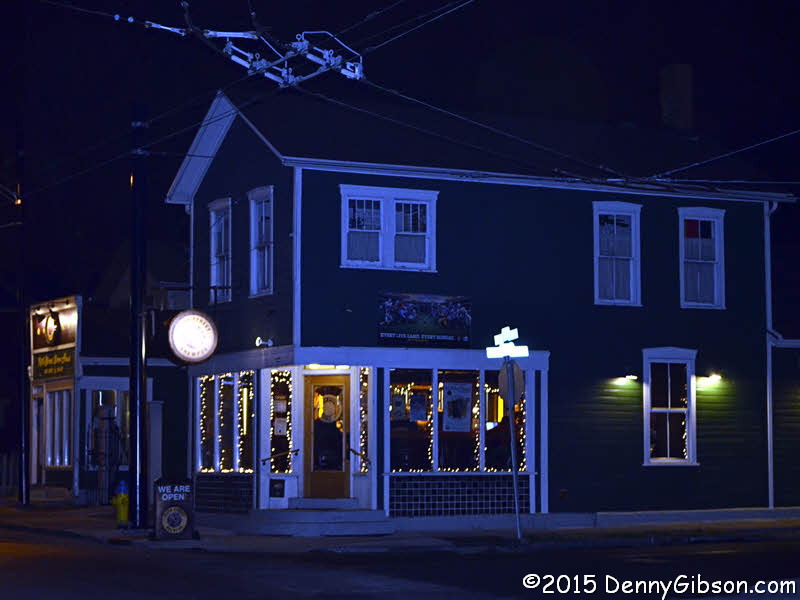
 Neighborhood taverns may not be as common as they once were but they are hardly extinct. Traditional beer towns like Cincinnati, Saint Louis, and Milwaukee have them and I’m sure they’re not alone. Once upon a time, some of the neighborhoods in those beer towns had a neighborhood brewery. A precious few do so today. One that does is the Saint Anne’s Hill Historic District in Dayton, Ohio. That’s the neighborhood brewery at right. It’s the Fifth Street Brewpub, the first co-op brewery in Ohio and the second in the nation. Today patrons come from near and far and even the owner/members are a widespread bunch but the founders who had the idea and made it happen are neighbors. They did it to save a little history and to put some more life back into their neighborhood. The rest of the Saint Anne’s Hill pictures are posted in sequence but this was taken at the end of the evening as I approached the brewpub for a little R&R after a guided walk around the neighborhood. There’s something of a “bonus” in the photo. The contraption at the very top is part of the rigging for the overhead wires that power Dayton’s electric trolley buses. Dayton is one of only five US cities operating electric trolley buses. The others are Boston, Philadelphia, San Francisco, and Seattle.
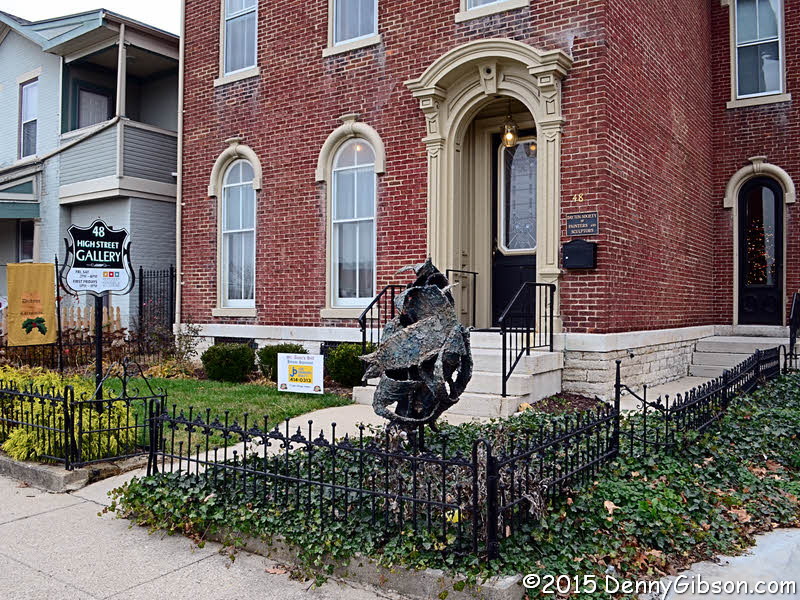 Saint Anne’s Hill was hardly lifeless even before the brewpub opened in 2013. A downward slide that had started with the Great Depression and World War II was halted in the early 1970s as a modern sort of pioneer started restoring some of the elegant old houses in the area. A some point, residents began offering tours of homes decorated for Christmas to raise funds for community projects. The biennial tours continue to be offered in odd numbered years. They begin at this 1869 house which is now the High Street Art Gallery operated by the Dayton Society of Painters and Sculptors.
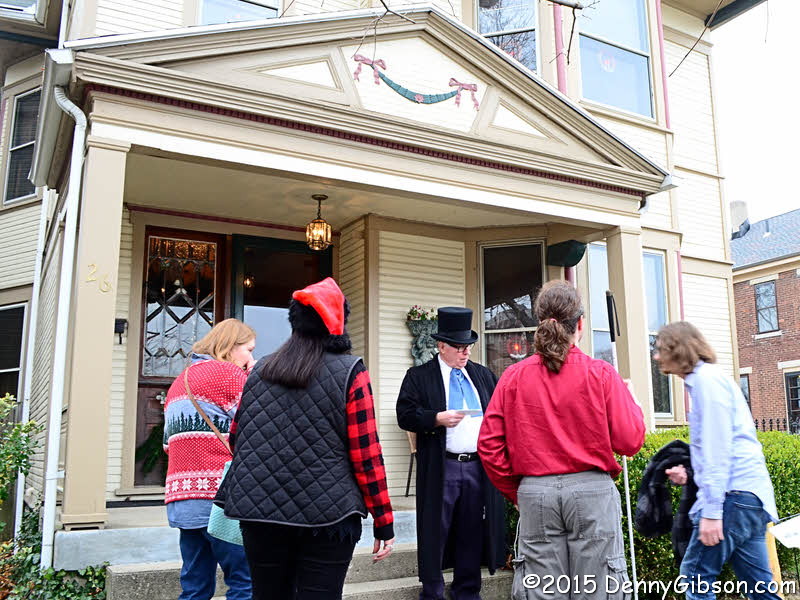 The area’s original heyday was in the early twentieth century and tour guides dress in the height of period fashion. That’s our tour guide, Jack, under the top-hat. There were eight homes on the tour and Jack told us about each one before we entered. In the picture we are learning about a house on High Street built by a family named Bennington in 1890.


 The tour’s appeal comes from the wonderfully restored historic homes themselves as well as beautiful Christmas decorations both inside and out. Two, three, or more trees are a big part of each home’s charm which meant there were many great looking trees to chose from. The trees shown here were chosen largely because their photos came out OK and I won’t attempt to identify the houses they were in. In addition to the Bennington house this year’s tour included a 1902 house also on High Street, an 1886 house on McLain Street, 1900 and 1853 houses on LaBelle Street, and 1855 and 1865 houses on Detoit Street.
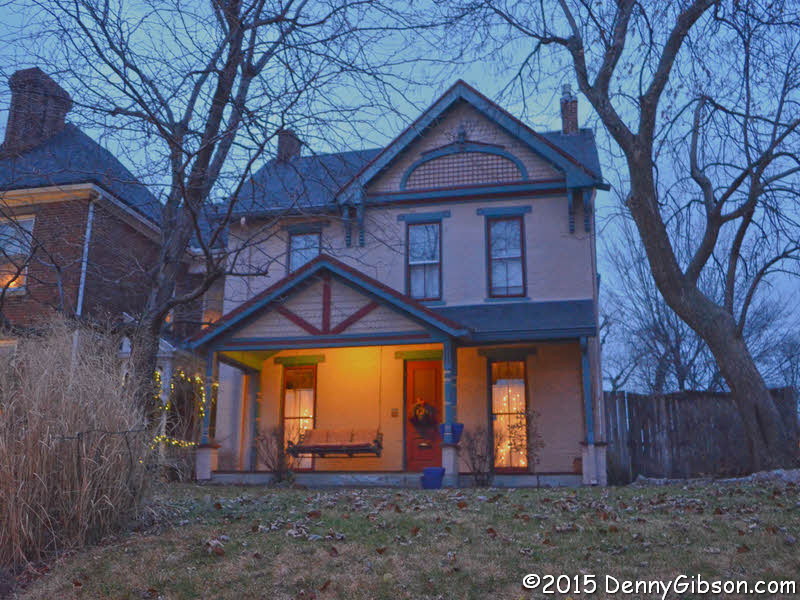 In addition to telling us about each home we entered, Jack provided information on several other houses as we passed. This house, on what is now Detoit Street, was built by Eugene Detoit in 1838. It is the oldest house in Saint Anne’s Hill and one of the oldest in Dayton.
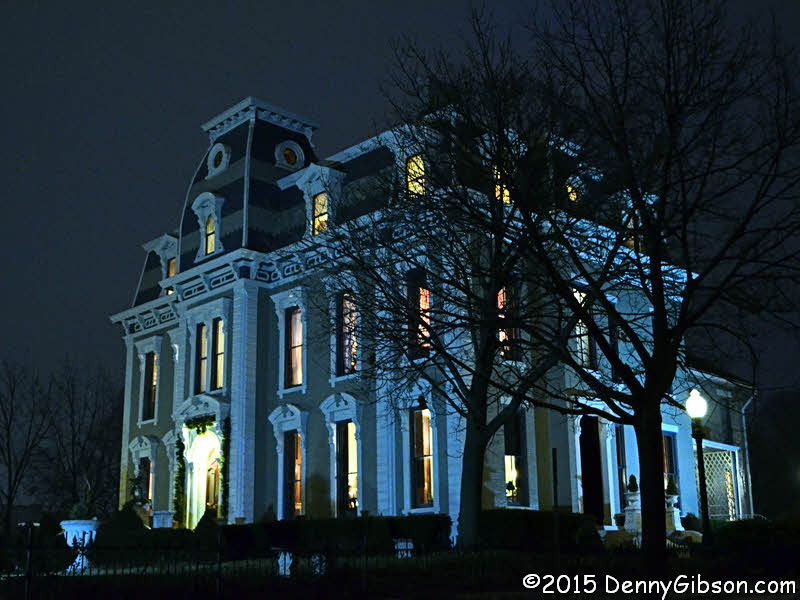
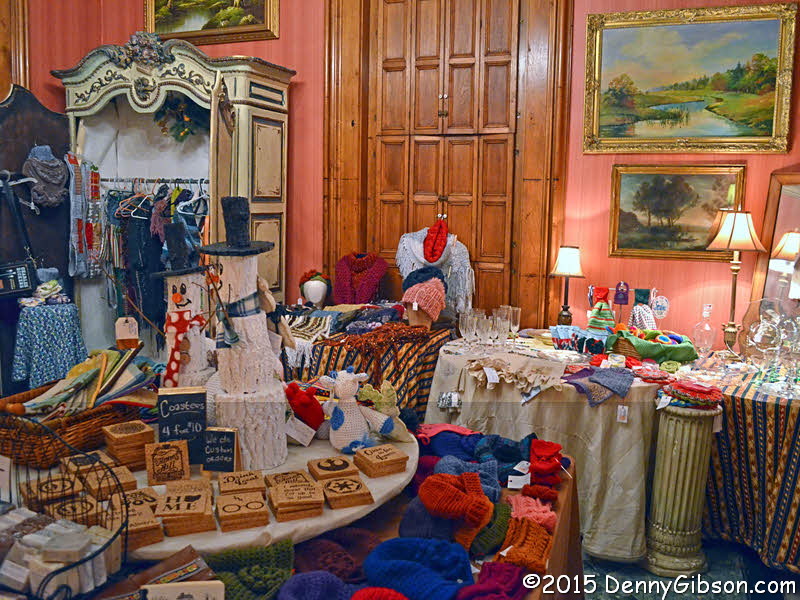
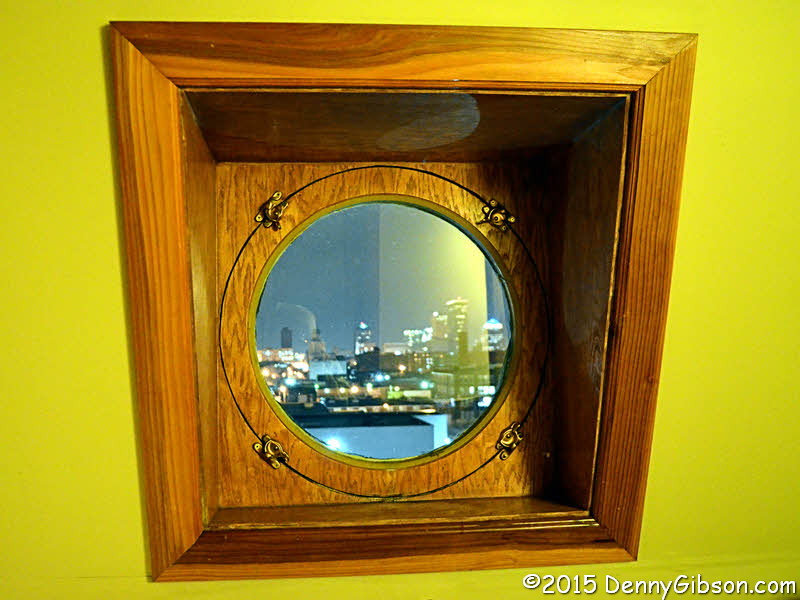 Different homes participate in each year’s tour with one exception. The 1869 Bossler Mansion is always the final stop and that is where we were treated to some incredible bread pudding as were all the tour groups in previous years. The mansion’s thirty rooms were once divided into thirteen apartments. During tour weekend, the second floor holds a gift shop filled largely with items made by local craftsmen. The last photo is the view from the cupula atop the mansion.
This was the second time I’ve taken a tour of decorated historic homes. The first was in 2012 in Morristown on the National Road.

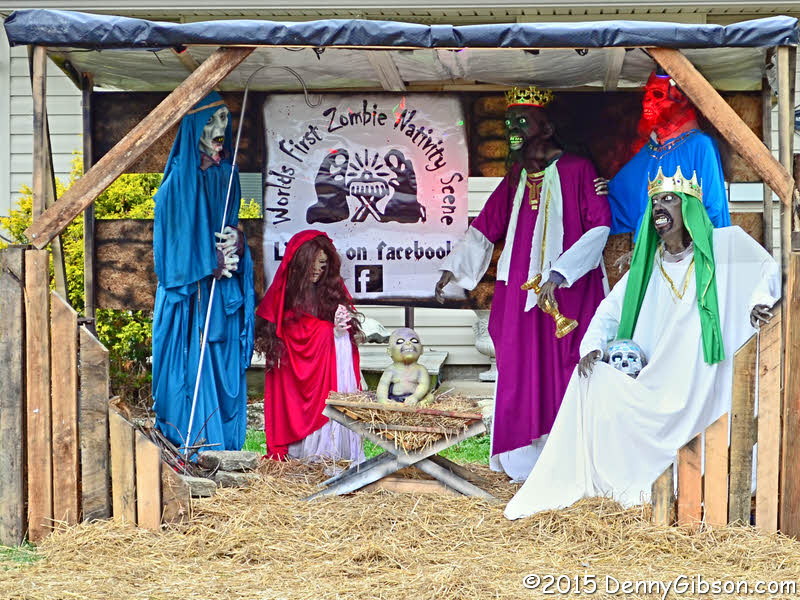 Saint Anne’s Hill is something over thirty crow miles from where I live. A holiday display that has been getting a lot of press is much closer. The World’s First Zombie Nativity Scene, which has been covered by the New York Times, CNN, and the BBC among others, is about a half dozen miles from my door. Most of the big time coverage was triggered by threats by the township to fine the owner up to $500 per day. Officials have always claimed that the threats were because of zoning violations and it seems they were even if that might not be what initially caught their attention. A day or two before I took these pictures on Friday, the display had been made smaller and a roof that extended upward a few feet removed. The township says it’s now good to stay.
Even though it was the threatened fines that brought the world wide attention, most reports focused on the “non-traditional” nature of the display. Fair and balanced Lou Dobbs called it an “obscenity” and said “I think if you’re going to mock a religion, I’m thinking they should have chosen the Islamic religion to see what would happen.” Lou and company notwithstanding, my sense is that defenders out number those who are upset and that, after two years of what some would call oppression, a new local Christmas tradition has been established.
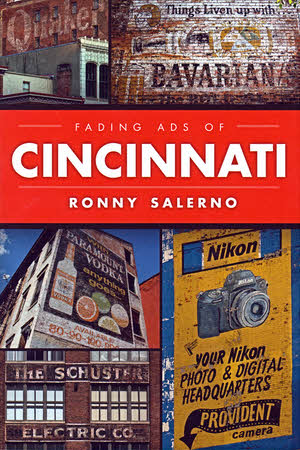 Buying local is a good thing and so is reading local. I was able to combine the two recently. November 30 was the official release date for a new book about Cincinnati and in the early evening its author made the book and his signature available at a downtown location that appears between its covers. The book was Fading Ads of Cincinnati, the author Ronny Salerno, and the location Igby’s Bar inside a building with a fading “TWINE PAPER” painted on its side. Those two dim words are typical of the fading ads that are the book’s subject. How could I not?
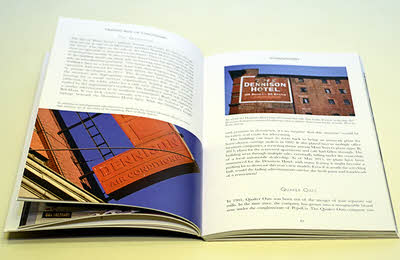 The photos aren’t left to stand alone. Captions describe each of them, of course, and many get multiple paragraphs of attention. Salerno has been successful in digging up many of the signs’ histories with some of the best stories coming from signs identifying local or regional companies that are no longer with us. Names like Shillito’s and Brendamour’s will be recognized by many Cincinnatians and probably some others as well. Out-of-towners might not be familiar with local landmarks like Davis Furniture (“The Friendly Store”) or the Dennison Hotel (“105 Rooms – 60 baths”) but they are exactly what I and some other locals think of when we think of “fading ads” or the more common “ghost signs”.
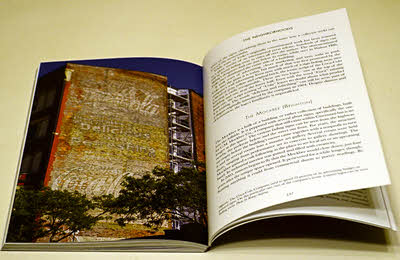 Salerno brings up the phrase “ghost signs” in the introduction and says people often thought he was writing about the supernatural when he used the term. “Fading advertisements”, he says, doesn’t have that problem. Fair enough but it’s just possible that his position also has something to do with the book’s predetermined title. “Ghost sign” slips into the book a time or two and in the final chapter Salerno more or less acknowledges the validity of both. As for me, I’m comfortable and most familiar with the term “ghost signs” (and “ghost bridges” and “ghost towns”) so I’ll just continue to think of Fading Ads of Cincinnati as a book about ghost signs.

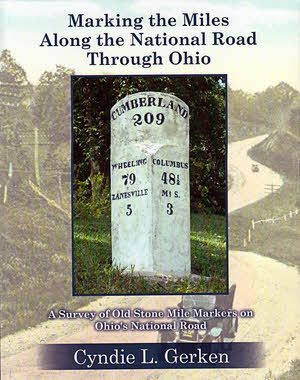 That’s a pretty long book title. There’s a subtitle, too, which makes the whole thing Marking the Miles Along the National Road Through Ohio: A Survey of Old Stone Mile Markers on Ohio’s National Road. It’s long because it, just like the book it identifies, is accurate and precise. The book accurately and precisely locates the 175 mile markers originally set, as accurately and precisely as early nineteenth century technology and local politicians would allow, beside the Ohio portion of the very first federal highway. With all that accuracy and precision you might think this volume would be completely dry and boring but that’s not the case. Stories about the road, the countryside, and even the markers themselves lighten and soften things considerably. Color photos and maps make the book attractive.
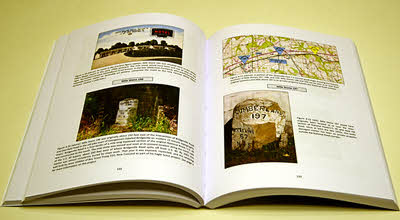
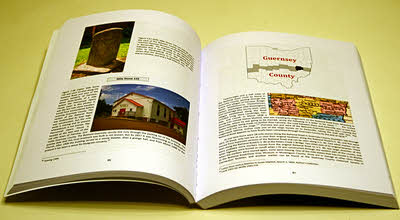 Seven of the ten Ohio counties through which the National Road passed are covered in individual chapters following the introduction. No markers were ever placed in the three westernmost counties on the route as federal funding ended near Springfield in Clark County. Each of these chapters begins with an overview of the county that includes a summary of how many original markers there were, how many remain at their original location, how many exist elsewhere, and how many are lost. Each marker is then addressed individually. With few exceptions there is at least one picture. If a given marker survives, a current photo is included and one or more historical photos are usually presented regardless of whether or not the marker is still around. Understandably, markings on many of the older stones are not exactly legible. Not to worry. Appendix B contains crisp drawings of the inscription of every marker. Markers can often be seen, accidentally perhaps, in old postcards and other photos and many of these appear in the book. Each marker’s history is given and stories about the marker or the area around it frequently add a little fun and background. Placed among the individual marker descriptions are sections of US Geological Survey 7.5 minute topographical maps showing the location of the markers three at a time. Other National Road related landmarks are often shown on the maps as well.
 Bringing all of this information together is clearly a major accomplishment but Gerken, a past ONRA president herself, says the information is only a portion of what she has collected on the National Road in Ohio. A well deserved breather follows wrapping up Marking the Miles Along the National Road Through Ohio. Nothing is currently scheduled or promised but the future could see a Gerken penned treatise on bridges or taverns or toll houses or something else. I certainly hope so. I like accuracy and precision and I also like anecdotes and insight. Marking the Miles… provides a pretty good mix.
 On Friday morning a friend observed on Facebook that he was getting email from every website he had ever visited that had something to sell. His situation was hardly unique. I’m rather confident that everyone with any sort of internet connection was seeing an uptick in activity on the official beginning of open season on customers. The barrage had been building as anxious hunters fired off emails and other communications telling us that their Black Friday started on Thursday or Wednesday or even earlier. This is, I assume, the same sort of time warp that allows certain drinking establishments to advertise “The world’s longest Happy Hour”. I considered emailing him some sympathy but didn’t for two reasons. One was that to do so would be to add to the tide of useless messages in his inbox. The other was that I would soon be part of the problem.
 The image at the top of this article shows the ad that appears in what Facebook calls the “Desktop Right Column”. The one at left is for the “Mobile News Feed”. Other variations appear in other channels. As can be seen in the “News Feed” version, the ads are sponsored not by me but by
  I’m going to admit right up front that defending this post against my About page claim that readers will “not be seeing a review of the latest novel” is pretty much a lost cause. I proclaimed my earlier review of















 I recently received a request/suggestion for a post on “must have” road trip items. I initially blew it off but returned to it a week or so later. Since I am about to actually head out on a road trip, I need to stockpile some “dateless” (“timeless” almost, but not quite, fits) articles for posting while I travel. You know, the “Trip Peek” or “My Wheels” sort of things that have no connection to what I’m actually doing but can be posted at anytime to meet the blog’s every Sunday schedule. In the middle of generating a couple of “Trip Peeks”, I remembered the email and realized that the suggested “Road Trip Essentials” was as good a topic as any. Of course, it would take more time than a “Trip Peek” but it could be sort of a consolidated “My Gear” and it might be fun. If it also made somebody (the requester) happy, even better.
 Of course, all of those accessories have their own accessories. For many years, I only bought gear that used AA batteries on the theory that I could always buy power at the corner drug store if required. I believe that happened once. I carried around a bag of nicads and the chargers to fill them in either car or motel. I eventually had to abandon that position but I still cling to the ability to recharge everything whether stopped or on the go. I now carry spare proprietary batteries and AC/DC chargers for two different cameras and a cell phone. I do not carry a spare for the GPS since I seldom operate it on battery power.
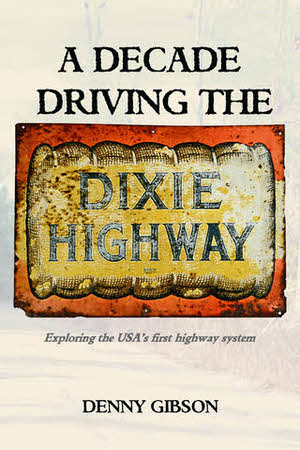 I did it again. I wrote another book. It’s a lot like the other one. It’s an illustrated travelogue and, although there is no old car involved, there is an old man and an old road. That other book,