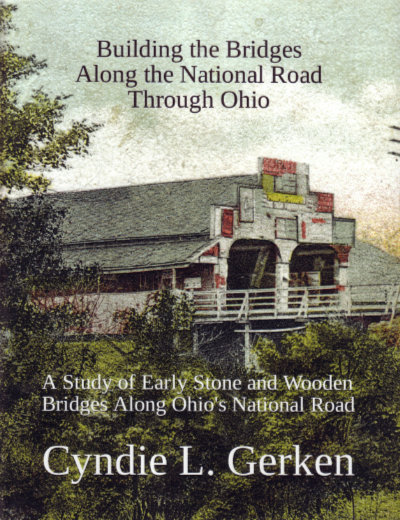
 Cyndie’s done it again. As I began to write this review of Cyndie L. Gerken’s fourth book on the National Road in Ohio, I revisited my reviews of the previous three thinking I might come up with a better opening line but everything I saw just reinforced my initial thought. Cyndie has indeed done it again.
The words “accurate” or “accuracy” appear in the opening paragraphs of all three along with words like “precision” and “thoroughness”, and all those words certainly fit once again. In my review of the third book, Headley Inn and Cliff Rock House, I noted that it differed from the previous two by focusing on a small stretch of roadside rather than all of the state. That difference struck me again as I read Building the Bridges Along the National Road Through Ohio but in a slightly different way. The “Along the National Road Through Ohio” in the title tells us that this is something of a “return to form” but it occurred to me that the set of four is just a bigger version of something going on within each of the individual books. There is no denying that reading lots of details about lots of very similar things can become repetitious. In Marking the Miles… and Taking the Tolls… and again in Building the Bridges…, Gerken often intersperses human-interest style stories among the facts and statistics to help fend off boredom. Thinking of Headley Inn and Cliff Rock House playing a similar role in the series, despite having its own sets of facts and statistics, brought a smile to my face. It might have had just as much value in that regard to the writer as to the reader.
 Although I certainly know better, I tend to instinctively think of big stone arches when I hear the phrase “National Road bridges”. One reason is that many of those stone bridges, some of them S-shaped, are still in existence. There were also many wooden bridges along the road but all were much shorter-lived. Building the Bridges… includes both. It identifies twenty-one covered wooden bridges built for the National Road in Ohio in addition to probably forty-some stone bridges. There were also well over a thousand stone culverts and one reason an accurate count of stone bridges is difficult to produce is that not everyone followed the same rules when distinguishing culverts and bridges. Span length was and is the distinguishing characteristic. Twelve feet, twenty feet, and no doubt some other numbers of feet were used to make the distinction and some reports did not distinguish the two at all.
Gerken talks about culverts vs. bridges in the introduction along with many other topics related to the Ohio National Road bridges in general and some that simply concern all bridges in general. Building techniques are described as are bridge types and bridge components. Thanks to an annotated picture of one of the Blaine Bridge arches, I now know what a voussoir is although I’ve no idea how to pronounce it. (Voussoirs are the wedge-shaped stones that form an arch.)
A chapter titled “The Builders of Ohio’s National Road Bridges” follows the introduction. Its opening pages contain information about the road’s Superintendents, how the road was divided, what contracts looked like, and similar subjects. Then comes fifty+ entries on individual builders.
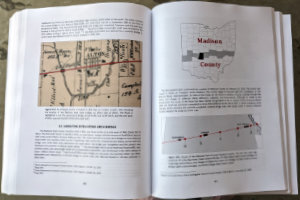 After telling us about as many of the bridge builders as she could identify, Gerken touches on some of the iconic National Road bridges east of Ohio, including the Wheeling Suspension Bridge, before beginning a county-by-county trek across the state. Each county chapter begins with a thumbnail of the county and the National Road through it. A map locating the National Road bridges in the county appears very early in each chapter. Sections on each of the bridges and some of the culverts in the county appear also in east-to-west sequence. Just as some bridges east of Ohio were touched upon preceding the border-to-border coverage, a few in Indiana follow it.
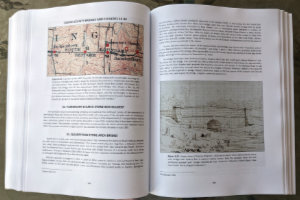 At a minimum, the location of each structure and what it crossed is given. The builder or builders are identified if known and, thanks to some pretty good sleuthing, many of them are. Beyond that, the information given for each bridge or culvert varies widely but it is a natural variation. For unnamed culverts over unnamed intermittent streams, location might be just about the only thing known. For major structures, lots of additional information might be included and usually supported by various graphics. Topographic maps are fairly common and there are lots of historic photographs and drawings. Plenty of modern photos also appear and if a structure is still standing there’s a good chance that the book contains a very modern picture of it taken by the author herself. Stories about events associated with happenings at or near a particular bridge can pop up anytime and are often fleshed out by reproducing contemporary reports.
The current status of each structure is always given if known. I’ve long been impressed with the number of National Road bridges still standing. Maybe I should be even more impressed after reading about all that failed and had to be replaced within a year or two of completion due to shoddy materials or workmanship. The number of contracts that had to be reissued after being abandoned by the initial winning bidder was also somewhat surprising. Building the first interstate was no simple task.
Ample anecdotes and news reports are mixed in with or printed beside all the facts and statistics. Some are funny and some are sad but almost all provide a glimpse into another time. I’ll share a piece of one that struck a chord with me. In her reminisces on the two-lane covered bridge over the South Fork of the Licking River, Minnie Moody describes a sound from another time.
What I liked was to go clattering through one lane of the bridge at the same time another vehicle was passing through on the other side of the center partition. Whang, bang, clickty-clack! With a roof over our heads the uproar was terrific.
I believe I have passed through a two-lane “double barrel” covered bridge but I’m not 100% certain. I am 100% certain that I’ve not done it in the presence of even one, let alone two, horse-drawn vehicles. I’m nearly 100% certain that I never will but thanks to Minnie — with the help of Cyndie — I have a pretty good idea of what it was like.
Yep. Cyndie has done it again. Building the Bridges… is quite clearly a valuable reference book for National Road fans but it’s something of a storybook, too. It has people in it along with the stones and lumber. The Ohio Genealogical Society hands out awards to several books each year. One of these is the Henry Howe Award which goes to a book on “Ohio state, county, or local history”. Each of Gerken’s previous three National Road books has won the award and I’ve a hunch this one will as well. Yeah, I think Cyndie’s going to do that again, too.
Building the Bridges Along the National Road Through Ohio: A Study of Early Stone and Wooden Bridges Along Ohio’s National Road, Cyndie L. Gerken, Independently Published (May 14, 2023), 8.5 x 11 inches, 521 pages, ISBN 979-8393147471
Available through Amazon.















































































 When I wrote about
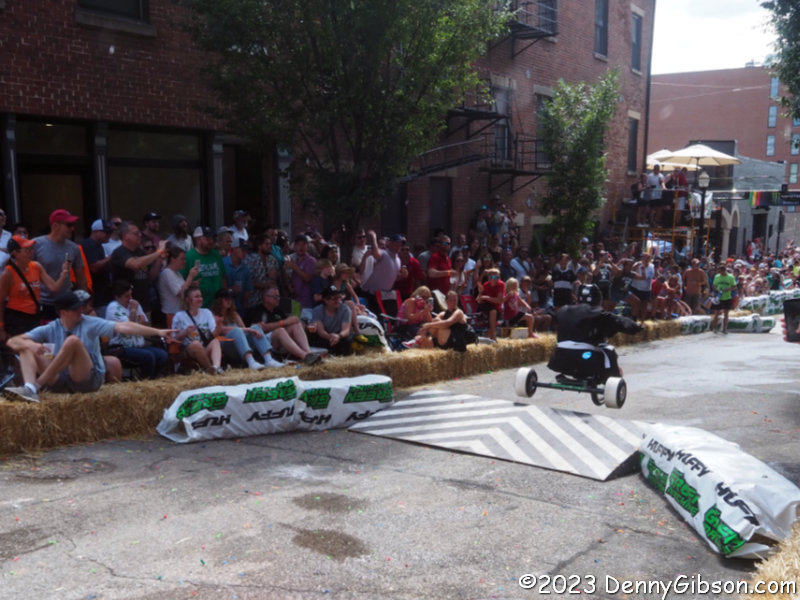
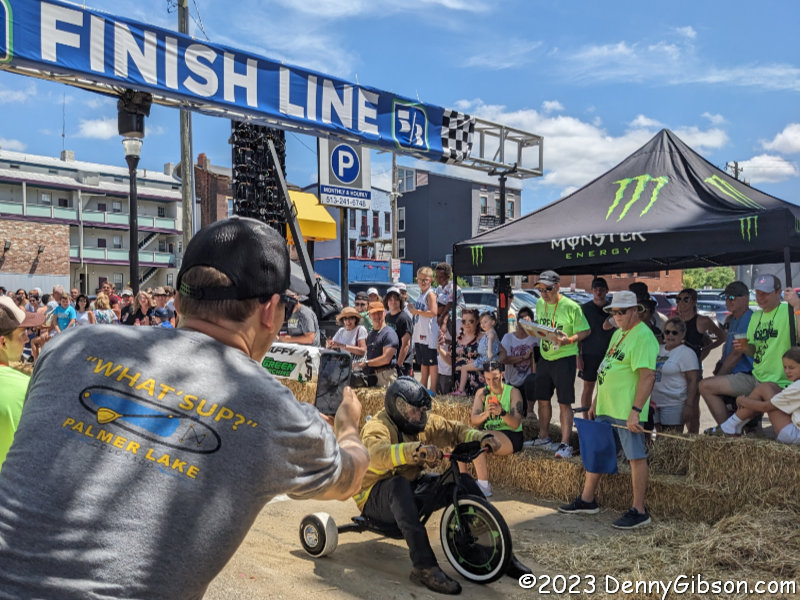
 History does repeat itself. In the early 1970s, I lived with my wife and two sons in a house with a driveway that sloped to a paved area in the back. That driveway was an ideal spot for the four-year-old to give his Big Wheel a workout. While I worked on something on a car behind the house, he repeatedly pushed the three-wheeler to the top of the hill so he could come rocketing down the hill, brace his feet on the pedals to stop the big front wheel, and throw the rear wheels into a perfect 180-degree slide. This was exactly what Big Wheels were designed for. After one of his countless slides, he looked up at me and made an incredibly insightful observation. “Dad”, he said, “I bet you wish you could do this.”