 The crumpling of the Corvair was just one of several major events occurring within a few months time. Wreaking the Corvair led to purchasing another car and one of the other events led to purchasing a house. That event was my wife’s announcement that she was pregnant. We lived in a small one-bedroom apartment and immediately started looking for something larger. We looked at multi-bedroom apartments and a few rental houses. The owners of one house we looked at were considering renting as a last resort. They had already moved to a fancier place and were paying two mortgages. The financial strain coupled, I believe, with a little sympathy for the growing young family, resulted in them selling us the house on a land contract; a form of owner financing. So, in fairly short order, we became expectant parents, bought a three-bedroom house, and moved across town. Somewhere in there, we also bought a car.
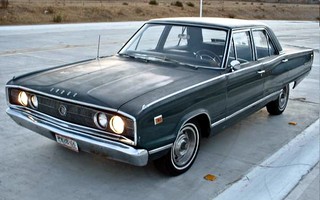
We bought the car at one of those shady looking lots that can be found lined up on certain streets in every city. That’s not our car in the picture. Some of the paint looks really dull on the car in the picture and that wasn’t the case with our car at all. Otherwise, it’s a pretty close match. The lot where we made our purchase wasn’t a “buy here, pay here” place but it was barely one step removed. I’m sure the lot owner and the guy from the finance company were good friends or maybe related. The Dodge Coronet was no more than two years old but had obviously just been retired from some sort of fleet work. I don’t remember the mileage but doubt it was accurate, anyway. Other than the 318 V8 and automatic transmission, the car was completely devoid of options; not even a radio. But the salesman was slick and the dark blue four-door did look the part of a family sedan for our developing family image. I hung an 8-track player under the empty dash and used the new car to bring our new son to our new house.
Here are a couple of stories involving this car.
Our house sat on a hillside with a small almost unusable garage in the back at the level of the walkout basement. The driveway sloped sharply beside the house. The normal parking spot was about even with the front of the house at the top of the slope. One night, at just about the same time as I heard my wife at the door, I heard a loud bang. Half joking, I said something about the car rolling. She was only part way through the door and, looking over her shoulder, assured me that the car was still there. We laughed and forgot about it — until morning. When I headed off to work, there was no car in the driveway. Most likely left in “Drive”. it had rolled down the slope and halfway over a low stone wall at the top of a steeper and longer slope. It took a tow truck with a long cable to winch the car from its perch atop the wall.
During the time we had the Dodge, I was in a band and occasionally towed a trailer full of equipment. That wasn’t at all good for the transmission which I’m sure wasn’t treated particularly kindly in its previous life. It eventually died and was sent off to some shade tree mechanic for a rebuild. It seems likely that what he did was swap in an oldie from a junkyard but the car once again became mobile and I was happy. Before long, however, the transmission started slipping again. This happened while I was visiting my friend John and he was pretty sure the problem was merely a clogged filter. After we pulled the pan off of the transmission, we realized we needed some technical information so we took out our smart phones and looked up the specifications for a ’67 Coronet. Actually we did the 1970 equivalent and drove to the library to copy some information from a Chilton auto repair manual. Before leaving, we placed the transmission pan on some trash cans beside John’s house. I’m sure our jaws really dropped when we got back from the library and realized that the trash man had come and gone in our absence. Our panic was short lived, however, as John’s wife pointed to the pan lying beside the door. The trash man had started to cart off the detached piece of my car then had second thoughts and knocked at the door to see if it might not really be part of the week’s trash. Saved from myself by another unnamed hero.
Previous Wheels: Chapter 10 — 1964 Corvair
Next Wheels: Chapter 12 — 1961 Falcon


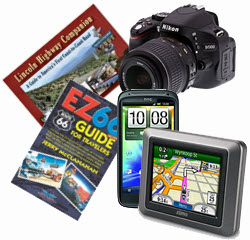 I recently received a request/suggestion for a post on “must have” road trip items. I initially blew it off but returned to it a week or so later. Since I am about to actually head out on a road trip, I need to stockpile some “dateless” (“timeless” almost, but not quite, fits) articles for posting while I travel. You know, the “Trip Peek” or “My Wheels” sort of things that have no connection to what I’m actually doing but can be posted at anytime to meet the blog’s every Sunday schedule. In the middle of generating a couple of “Trip Peeks”, I remembered the email and realized that the suggested “Road Trip Essentials” was as good a topic as any. Of course, it would take more time than a “Trip Peek” but it could be sort of a consolidated “My Gear” and it might be fun. If it also made somebody (the requester) happy, even better.
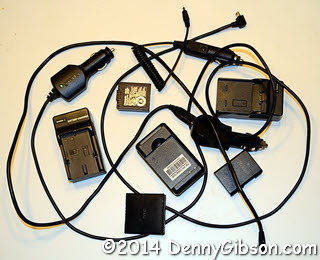 Of course, all of those accessories have their own accessories. For many years, I only bought gear that used AA batteries on the theory that I could always buy power at the corner drug store if required. I believe that happened once. I carried around a bag of nicads and the chargers to fill them in either car or motel. I eventually had to abandon that position but I still cling to the ability to recharge everything whether stopped or on the go. I now carry spare proprietary batteries and AC/DC chargers for two different cameras and a cell phone. I do not carry a spare for the GPS since I seldom operate it on battery power.
 They did it again. Co-producers EG Kight and Paul Hornsby captured another set of tracks that feature Lisa’s wonderful voice but don’t short the listener one bit in the sound behind it. Back in 2012, Kight, Hornsby, and Biales hooked up for