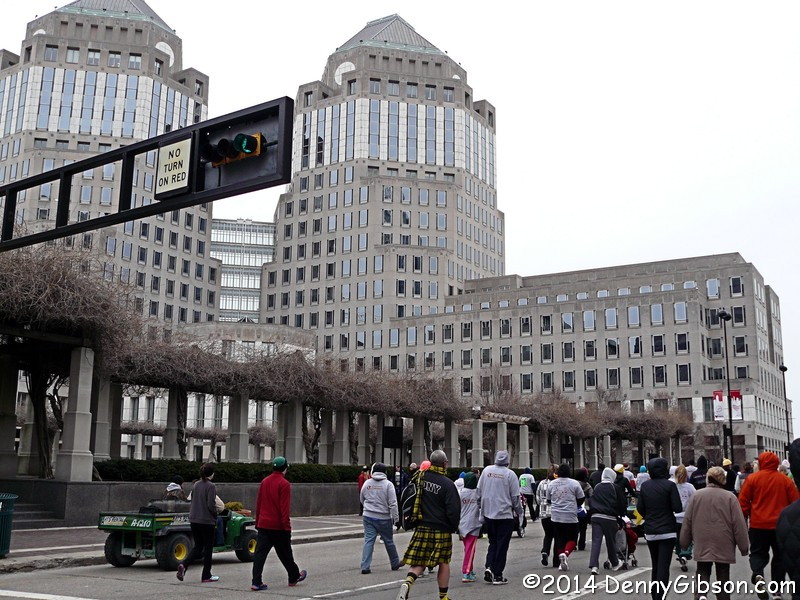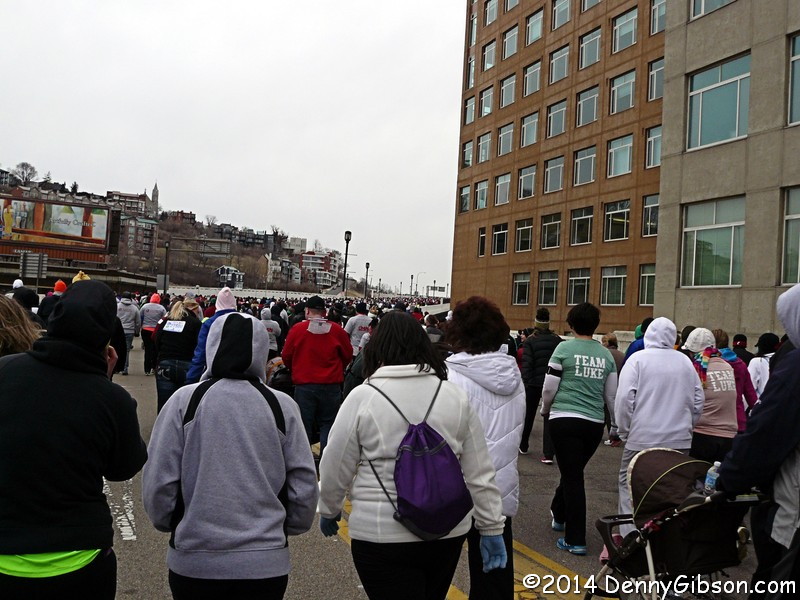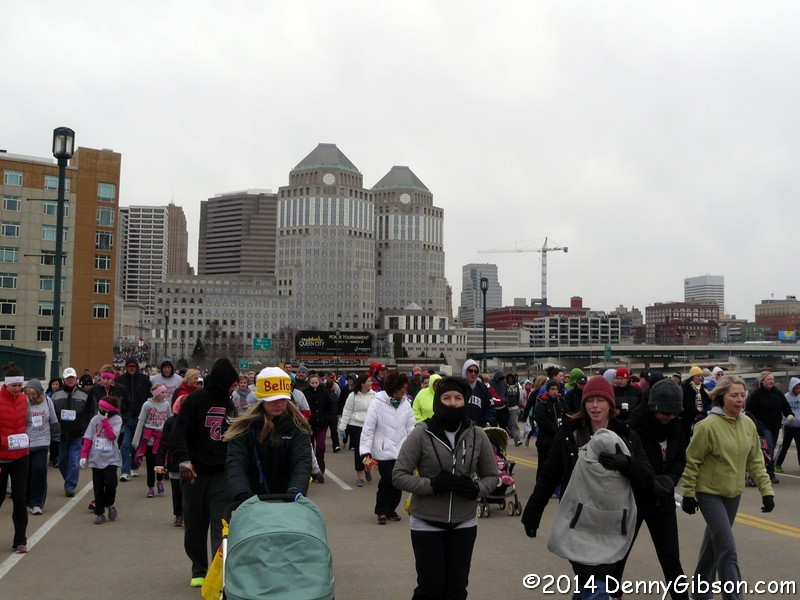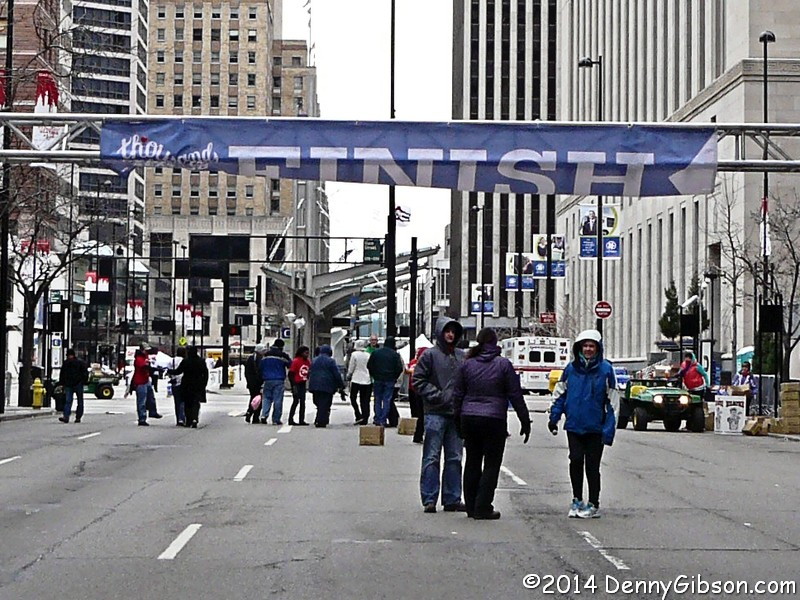
Drinking the Bocks Outside

Cincinnati Bockfest 2014When I attended my first Cincinnati Bockfest in 2010, I bemoaned the fact that I’d missed the previous eighteen which implied I intended to be a more regular attendee in the future. I have not done well. I made it back and had a blast in 2011. In 2012, I was out of town for a Missouri road trip. Last year I was actually downtown with good intentions but turned back home when moisture and the temperature both kept falling. I remember thinking “I’m too old for this” as I made my decision. That could be be a sign that I’ve grown wise but is more likely a sign I’ve grown wimpy.

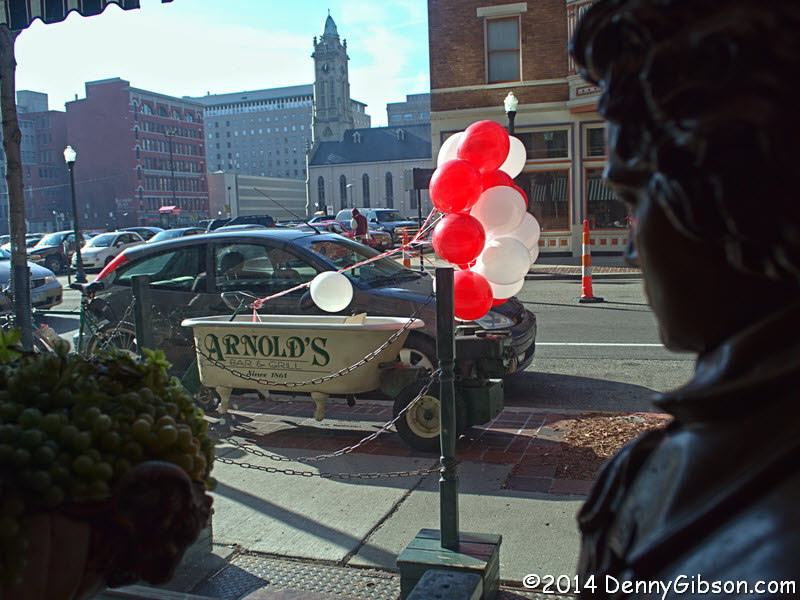
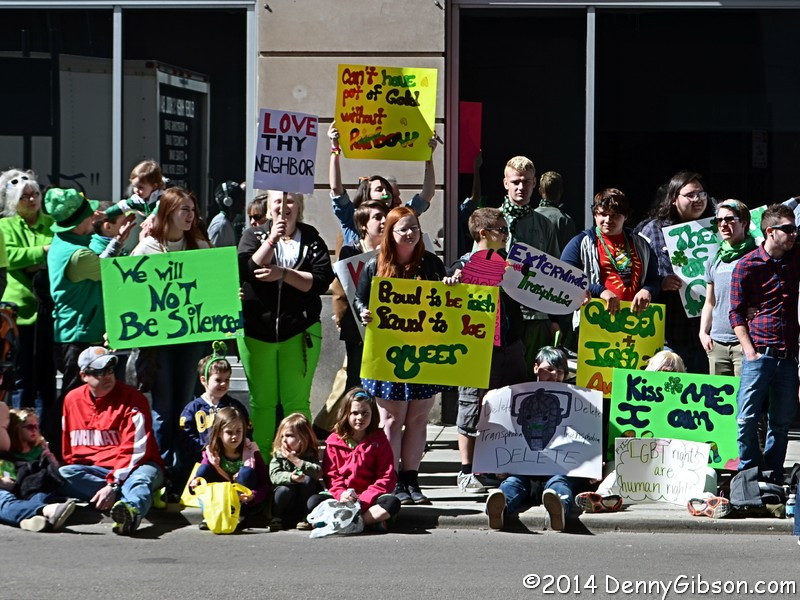
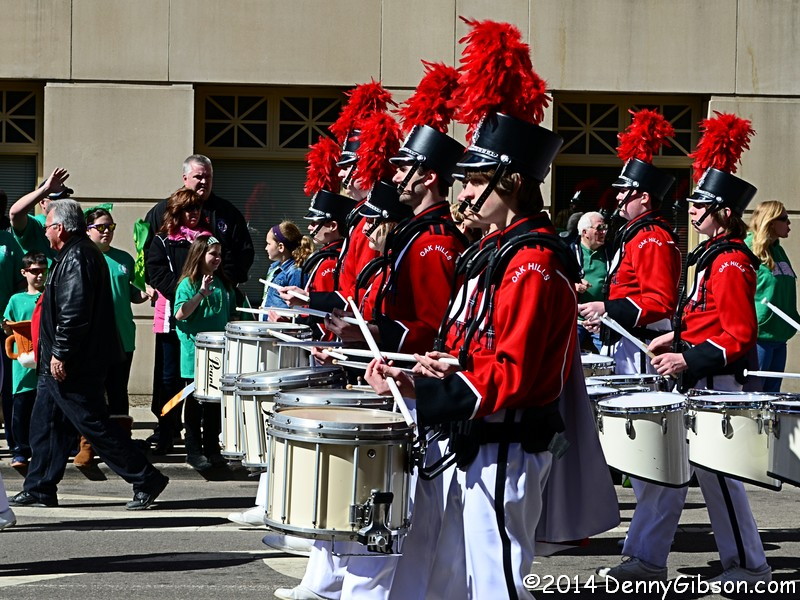
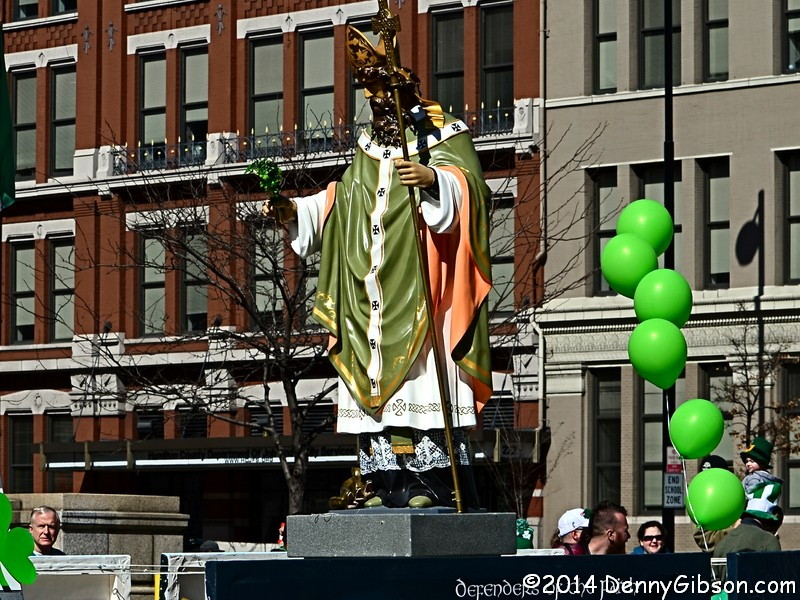
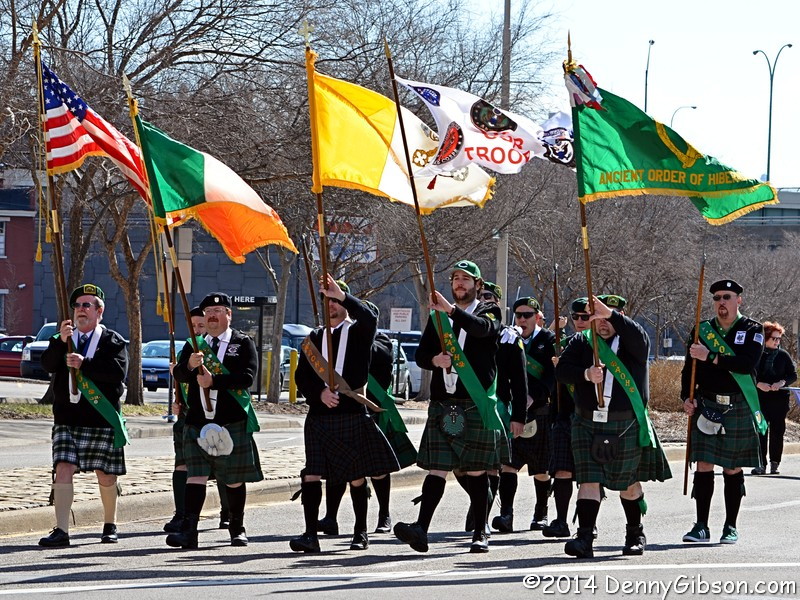
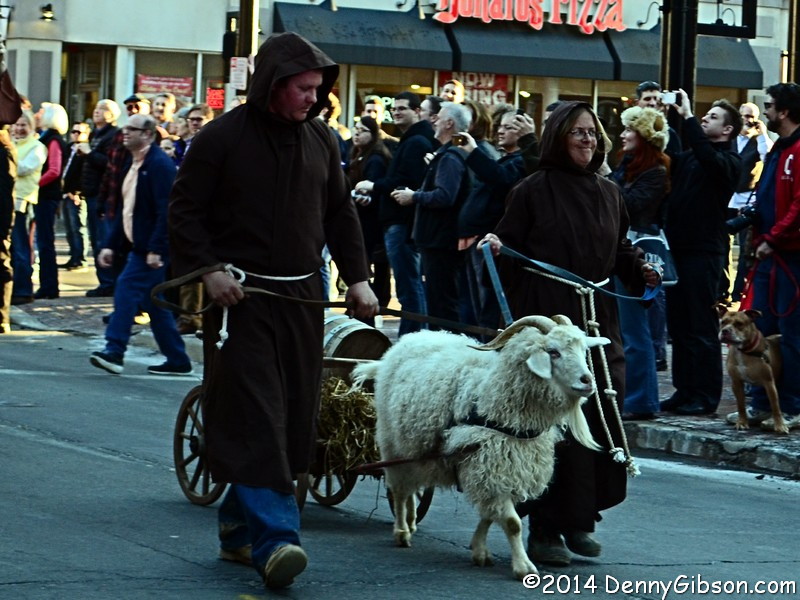
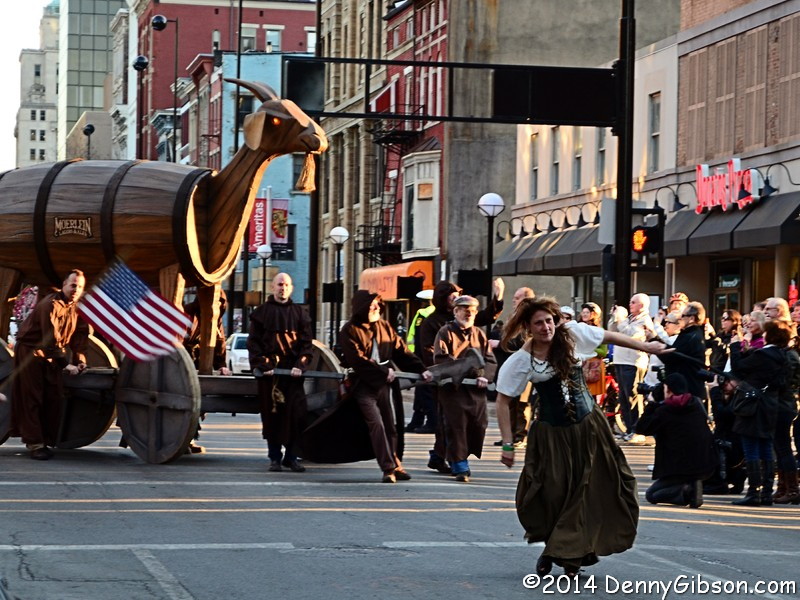
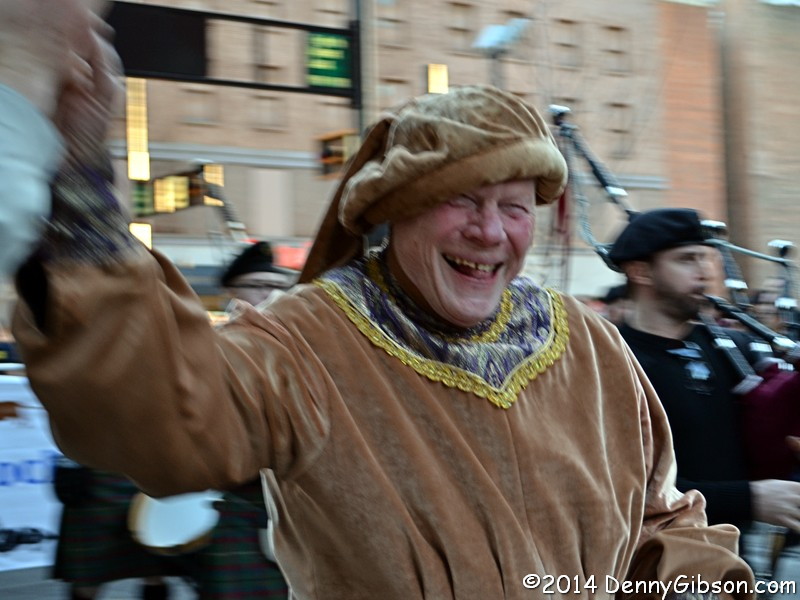
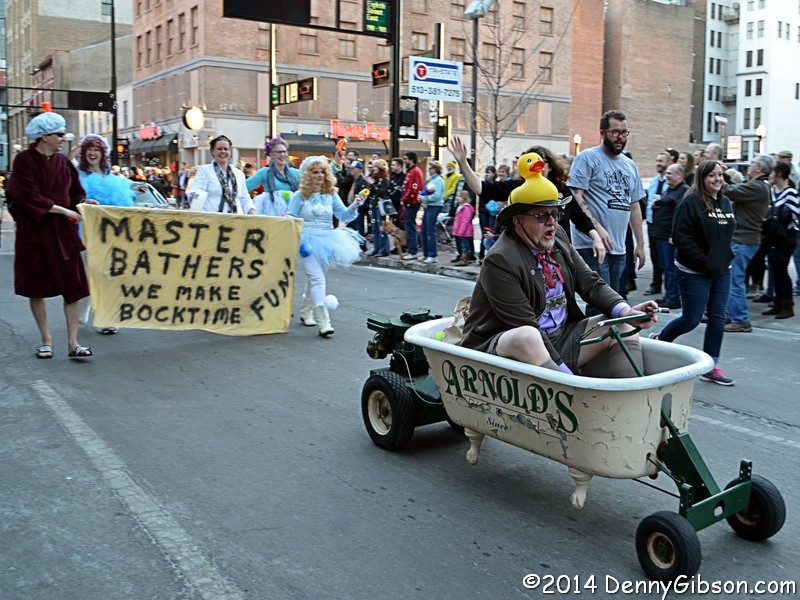
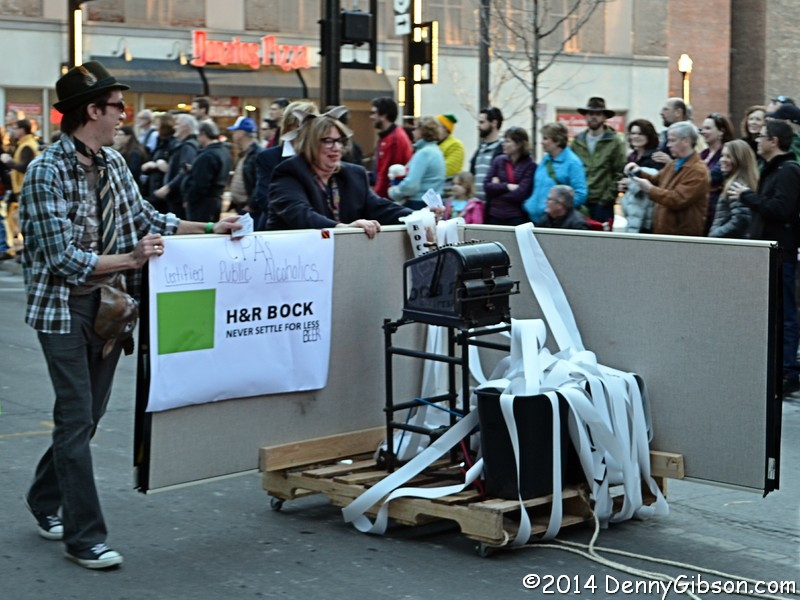
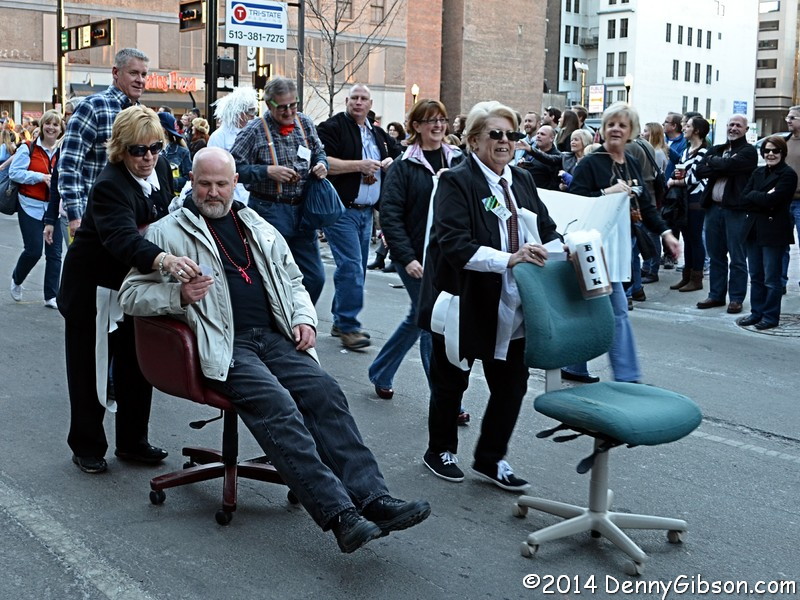
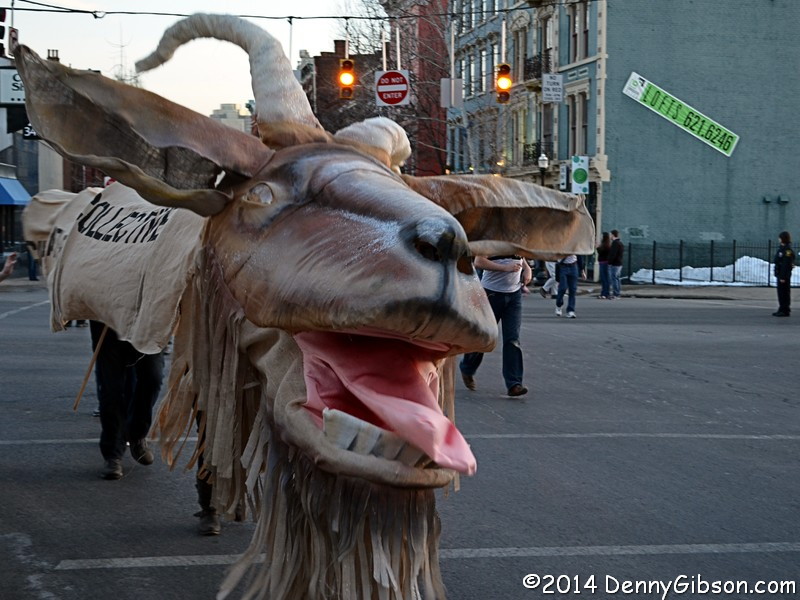
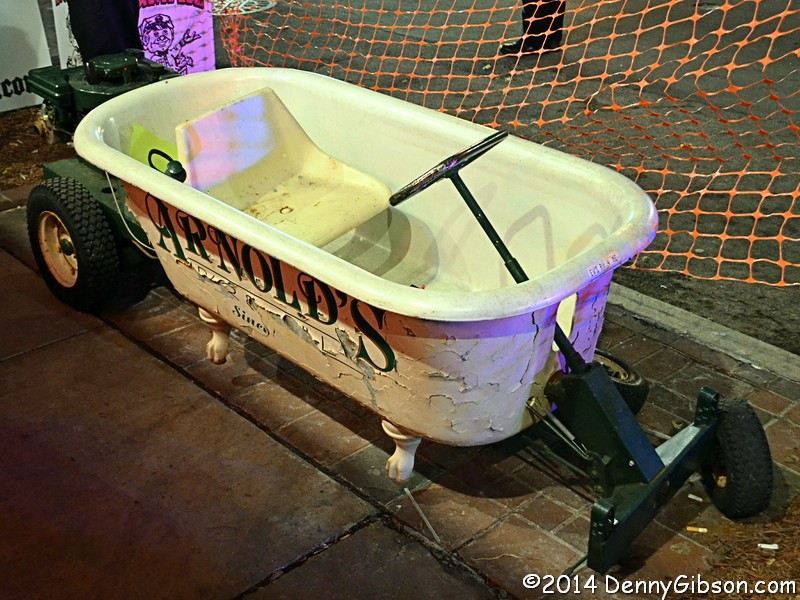
Cincinnati Bockfest 2014Cincinnati Bockfest 2014Cincinnati Bockfest 2014Clear skies and 59 degrees — up 21 from the previous Friday — made attending this year’s event a no-brainer. Schnitzel the goat leads things off with the ceremonial first keg then it’s the Lady with the Whip (a personal favorite) and the Goat with the Glowing Eyes (a.k.a. the Trojan Goat). Cincy legend Jim Tarbell is usually one of the parade’s leaders but apparently missed his cue this year. He hurried toward the front occasionally breaking into a jog and high-fiving fans all the way. Among other claims to fame, Jim was the owner of Arnold’s, Cincinnati’s oldest bar and parade starting point, when Bockfest was born. The self-propelled bathtub is a reminder of the claw-foot tub that still sits on the bar’s second floor and may or may not have been used to produce gin during prohibition.

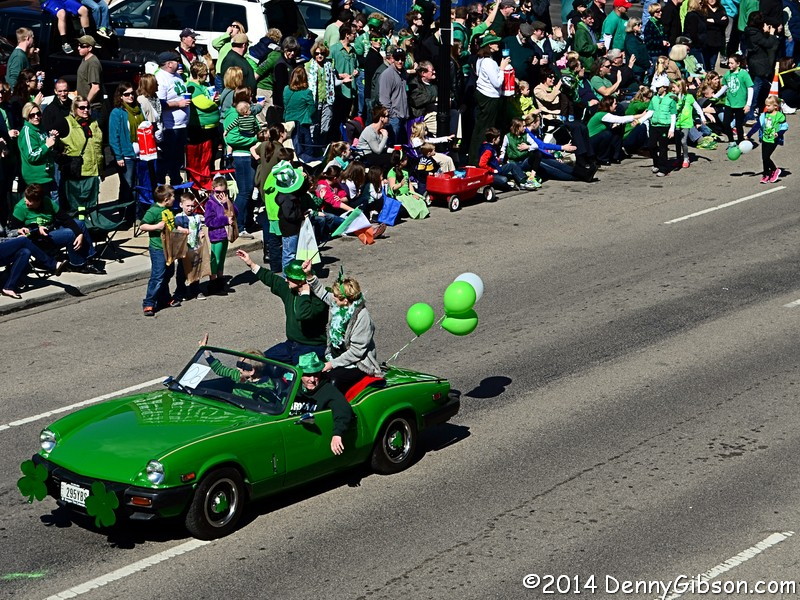
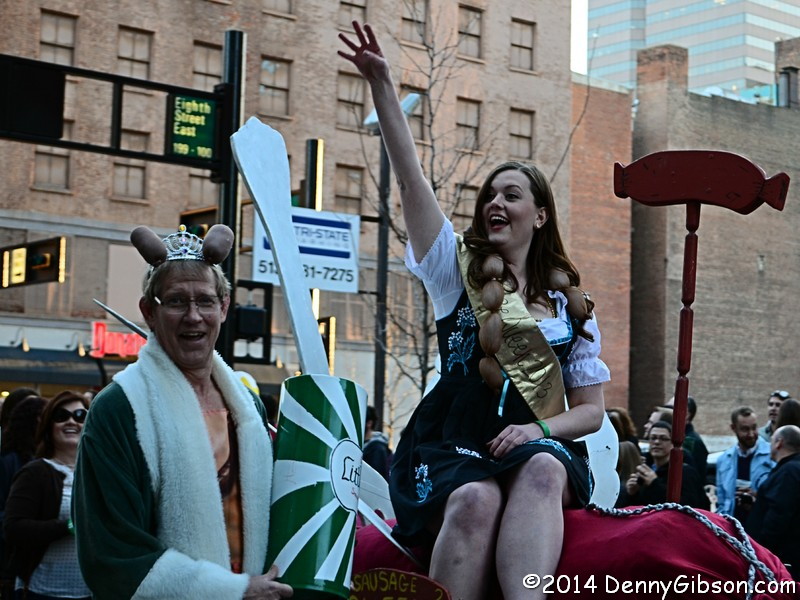
Cincinnati Bockfest 2014A somewhat sad fact about the life of a Sausage Queen is that her biggest moment, waving to cheering subjects while riding an eight foot sausage, takes place just one day before a new queen is selected. Queen Emily Berger handled her parade obligations splendidly during this last full day of her reign.

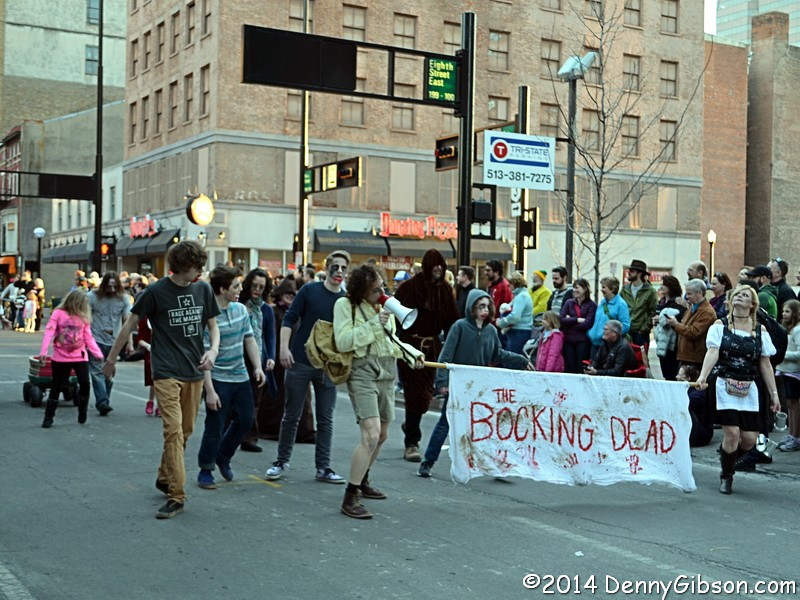
Cincinnati Bockfest 2014Cincinnati Bockfest 2014Cincinnati Bockfest 2014There is just one requirement for parade entries but it is rigidly enforced. You absolutely must be present to participate. No exceptions.

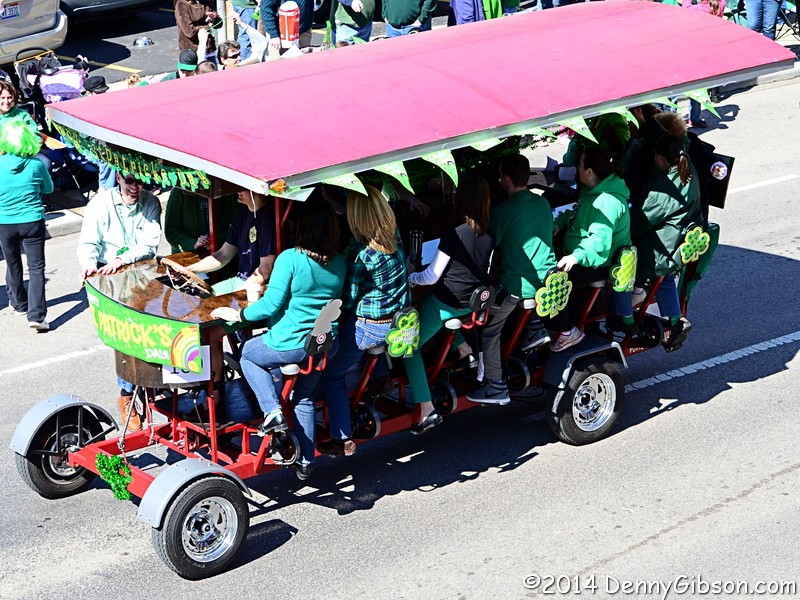
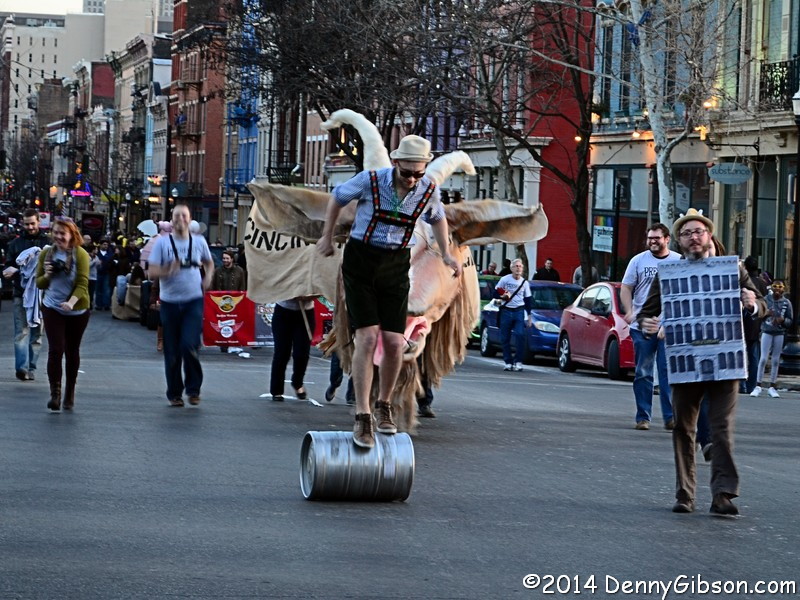
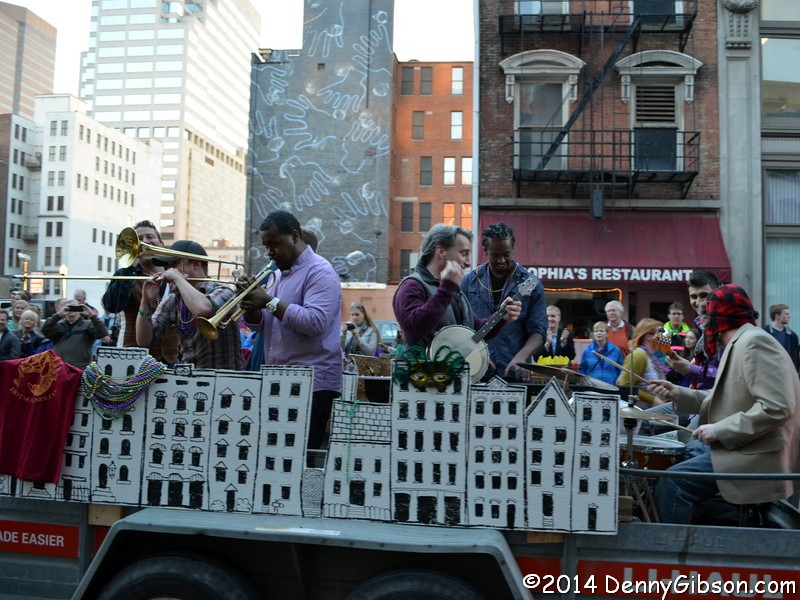
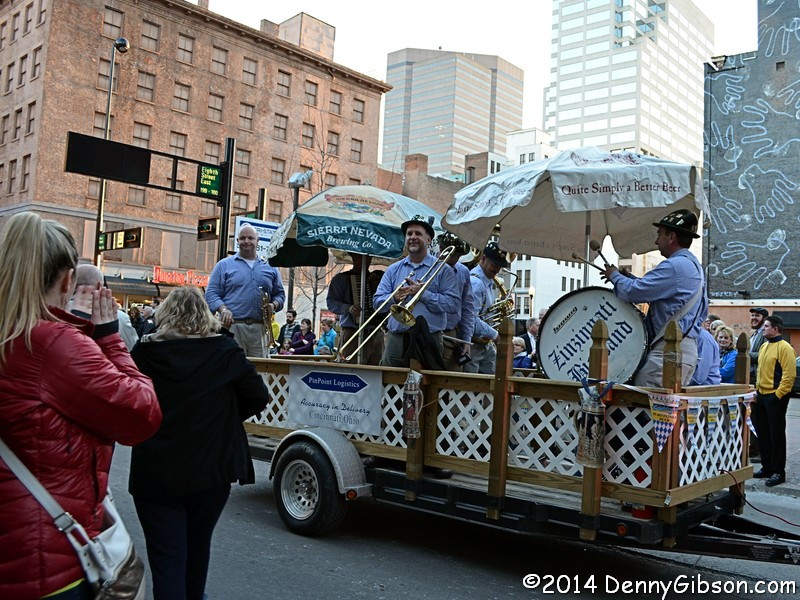
Cincinnati Bockfest 2014Cincinnati Bockfest 2014Cincinnati Bockfest 2014Musical offerings included polkas from the Zinzinnati Beirband (“The more you drink, the better we sound.”), excellent Dixieland from an unknown-to-me band, and the gentle sound of aluminum on asphalt. It’s only rolling bock but I like it.

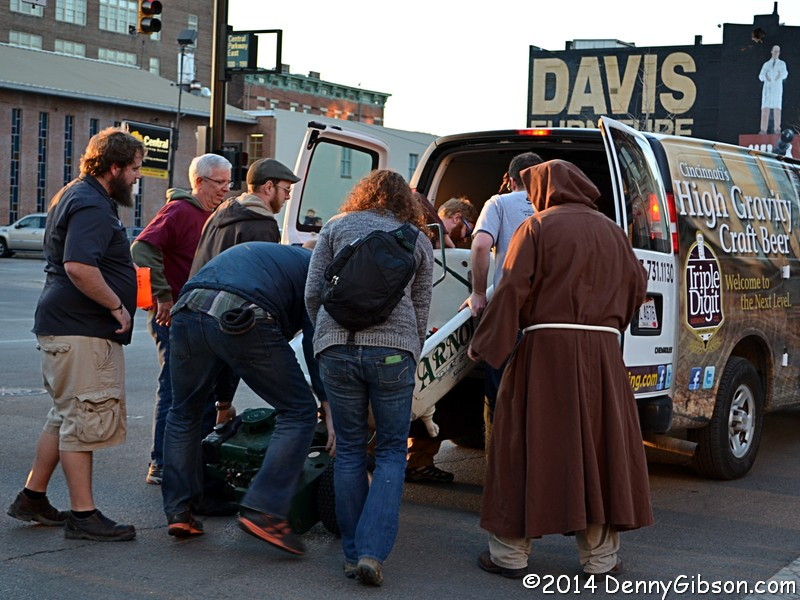
Cincinnati Bockfest 2014Cincinnati Bockfest 2014Here’s a better look at the dragon/goat behind the barrel walker in the previous photo plus a picture of the only parade casualty I am aware of. That motorized bathtub from Arnold’s lost a front wheel but was rescued when Triple Digit Brewing’s van came along. Paraders and spectators, which are essentially the same thing, stepped up to hoist the tub into the back of the van for a ride home. I passed by Arnold’s later in the evening and saw the tub back in its normal parking spot. I’m confident it will be mobile in no time.

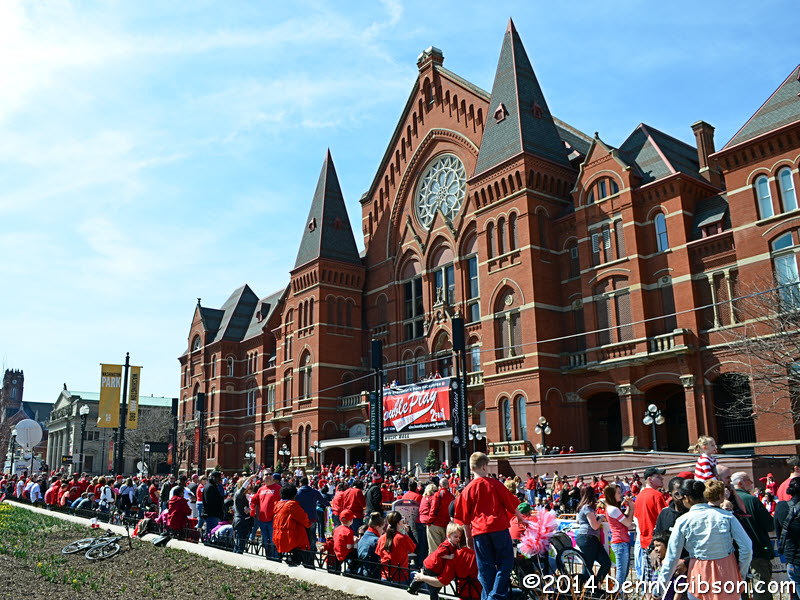
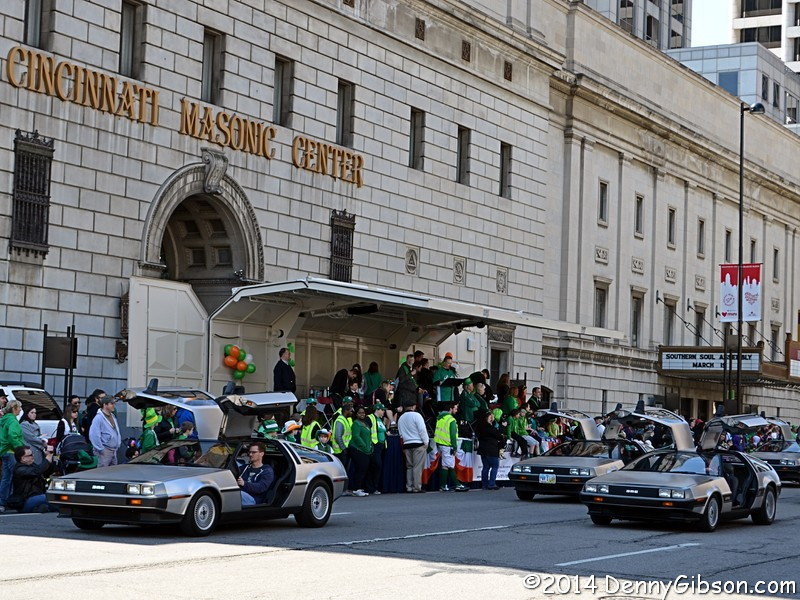
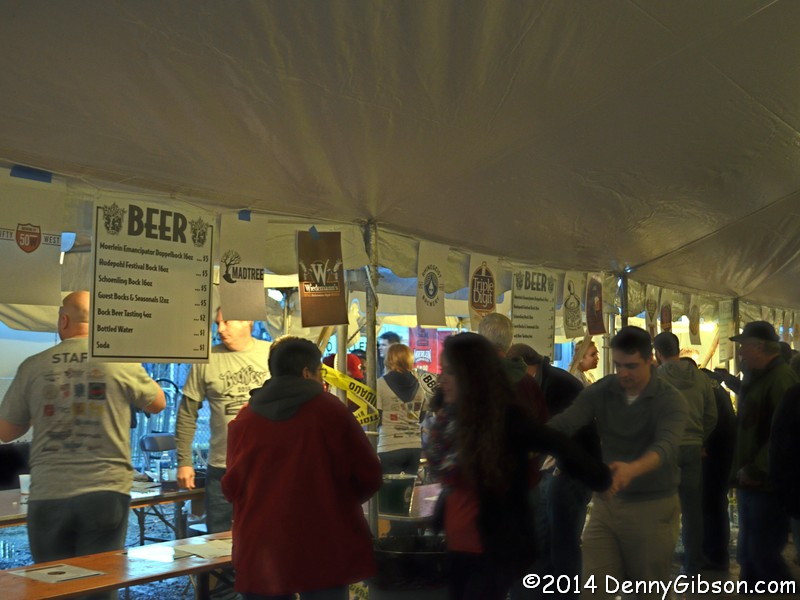
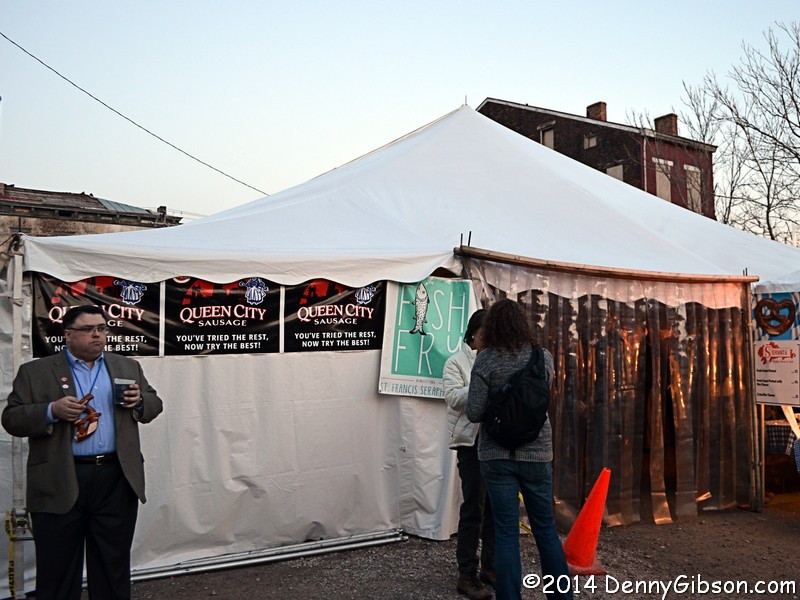
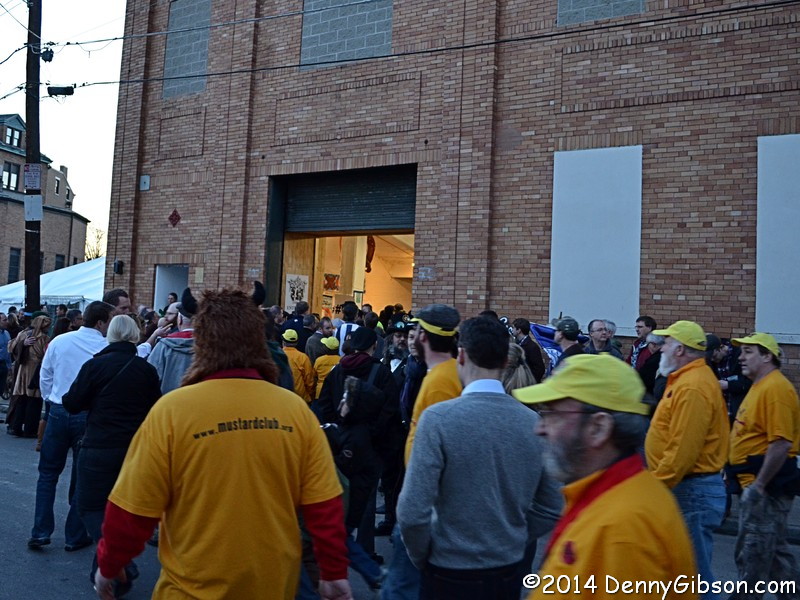
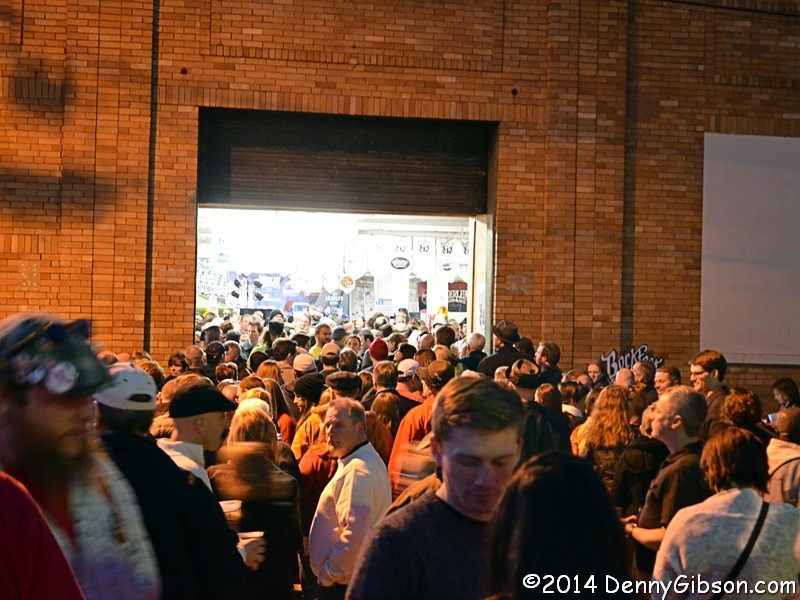
Cincinnati Bockfest 2014Cincinnati Bockfest 2014Cincinnati Bockfest 2014The first picture is of people, at parade’s end, attempting to get inside a packed Bockfest Hall (a.k.a. Christian Moerlein Taproom). I took one look and didn’t even try. A large tent had been set up across the street and that’s where I headed. It looked to me as if most, if not all, local breweries were represented. I had just one beer, a Hudepohl Festival Bock, in the tent.

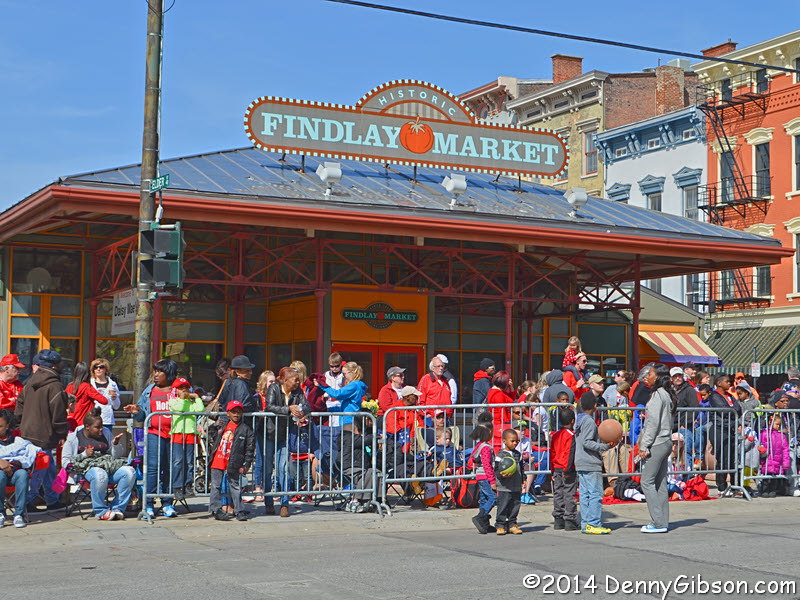
Cincinnati Bockfest 2014When I stepped out of the tent, the crush at the entrance to Bock Hall had only worsened and the area between Hall and tent was now pretty much full. I ran into a couple of friends and we talked about the crowd and the growth of Bockfest. One of them, unlike me, had been to every previous parade but barely caught the end of this one due to the crowd and parking complications throwing his timing way off. I decided not to even work my way back into the tent but headed back towards the car. Many other bars and restaurants participated in Bockfest this year and those I passed on Main were full with lines outside a couple. This event, helped by spring-like temperatures, was obviously a good thing for area businesses.

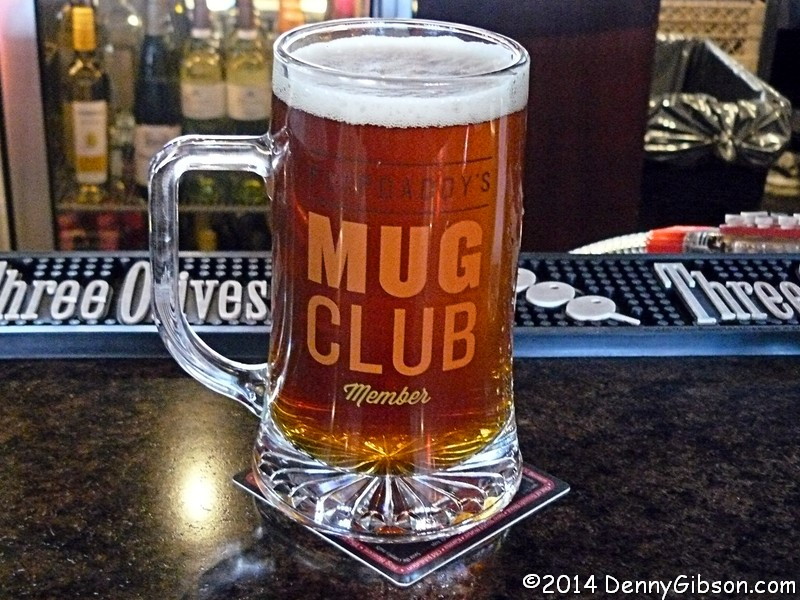
It didn’t bother me at all that I never got inside Bock Hall. I saw the parade, which is the main event as far as I’m concerned, and I drank a little beer. I had my beer in a tent where melted snow and maybe some spilled brew made a few spots into reminders that I was outdoors but being outdoors was cool. It’s what led to this post’s frightfully clever title.

Concert Review
Lake Street Dive
20th Century Theater

Lake Street Dive at 20th CenturyHot on the heels of my first ever concert review, comes another. Not only another review but another first. This is the first time I’ve ever posted two reviews of any kind in the same day.

By the time I left the theater last night, I really wanted to post something about the show. I had a book review queued up for this morning and, even though I briefly considered rescheduling it, I knew I could not put a post together in time and still get some sleep. Besides, I really wanted to run the book review and I didn’t want to get even further behind in that department. Like that other concert review (Willie Nile) I didn’t plan a post and took no camera. Unlike at that concert, I did break down and snapped a couple of shots with my phone. The best (If you want a picture really bad, I’ve got a really bad picture.) is above.

I first heard of Lake Street Dive less than a year ago in a friend’s blog post. I was extremely impressed and, as I said I’d do in a comment on that post, I’ve been “keeping my ears open”. In January, when I heard of this Cincinnati show, I wasted only a little time before grabbing a ticket.

Midnight Moxie, an all girl trio with fantastic voices and adequate instrumental skills, did a nice job opening the show. It seemed like Lake Street Dive, as their career moves to a new level, are willing to help others do the same. I like that.

Frontwoman Rachael Price’s powerful voice is usually what grabs people’s attention when they hear Lake Street Dive for the first time but most soon realize that it is just one piece of the skills and talents making up the band. The other three members also sing and the harmonies are incredible. Each of them — Mike Olson guitar & trumpet, Bridget Kearney bass, and Mike Calabrese drums — is a master of their instrument. A video, of course, is worth all the words I could ever write. There are plenty on YouTube but I’ll point out two for starters. Here is the first video I saw via that blog post. Apparently it was the first look for a lot of other people, too, and is getting some credit for the recent popularity upswing. Here is a more recent four song clip of a radio station studio performance.

Saying that last night’s concert sounded just like the videos is definitely accurate and I could sum things up with that but there are a couple of specific moments worth reporting.

The place was full. I’ve seen it packed tighter and, although a sellout may have been announced, that’s probably not true in practical terms. But it was full. The audience was shoulder-to-shoulder in front of the stage. It seems the band simply had not expected this. Rachel actually used the word “surprised” when talking about the crowd. And it soon became apparent that it was a knowledgeable and enthusiastic crowd. It wouldn’t be fair to say that we impressed them as much as they impressed us but there is no doubt that Lake Street Dive appreciated their Cincinnati welcome. A few songs from concert’s end, as loud applause and cheers were fading, Rachel looked over the crowd, sort of shook her head, and stepped back to the mic. “Excuse my language”, she began, “but I don’t know what the f— we’ve been doing driving across Ohio.” A little later, when they returned to the stage for an encore, the first thing she did was try to make sure everyone knew what she meant. Someone up front assured her that we understood that she meant they should have been stopping in Ohio and not that they should have been avoiding it. That’s cute. That’s endearing.

They’re stopping in Ohio again tonight. In Columbus. The website says sold out but if you have a buddy at Skully’s who owes you a favor, this would be a good time to collect.

Their recently released album, Bad Self Portraits, is available at Amazon.

My Wheels — Chapter 9
Honda 65

Honda 65The Honda 65 occupied, but didn’t really fill, the space between the ultra-popular 50 and the more powerful 90. It just wasn’t as cool as either of those other “groovy little motor bikes” which meant it wasn’t as desirable or pricey. And that, of course, is the reason I could own one. I don’t recall how I came by the Honda or how much I paid, but it couldn’t have been much. I didn’t have much. I acquired it at roughly the same time as the Austin-Healey and had it for a short while after the Healey was gone. While my wife drove the car to work, the two-wheeler was my transportation to and from campus.

This was not a vehicle for long-distance travel, and I don’t believe I ever had the bike out of the Clifton area. It was involved in no big adventures, and the only mildly interesting incident I can recall was the one time I laid it down.

I was heading west on Ludlow in a light rain. As I approached Clifton Avenue, the light changed, and I tapped the rear brake. The 65 was much closer to a Schwinn than a Harley, so a little slide was not a big thing at all. With the bike leaned to the left, I no doubt had visions of a smooth sideways stop at the intersection when the rear wheel reached the manhole cover. The surface of the cover was kept dry by whatever source of heat was below it, and the difference in traction between wet pavement and dry steel is significant. The slide stopped, and the Honda immediately went from leaning slightly to its left to lying completely flat on its right. The two of us slid together to the curb. At higher speed, the curb might have made a real impression on my unhelmeted head, but there was no damage at all that day. I stopped at the feet of two men standing by the street. I’ve always thought they must have been waiting for a bus, but I don’t really know that. They didn’t move but merely leaned forward with their umbrellas and asked if I was alright.

At the time, I’m sure intense embarrassment kept me from laughing, but the memory of those faces calmly chatting with the kid who had washed up at their feet will always bring on a smile these days.

Previous Wheels: Chapter 8 — 1957 Austin Healey
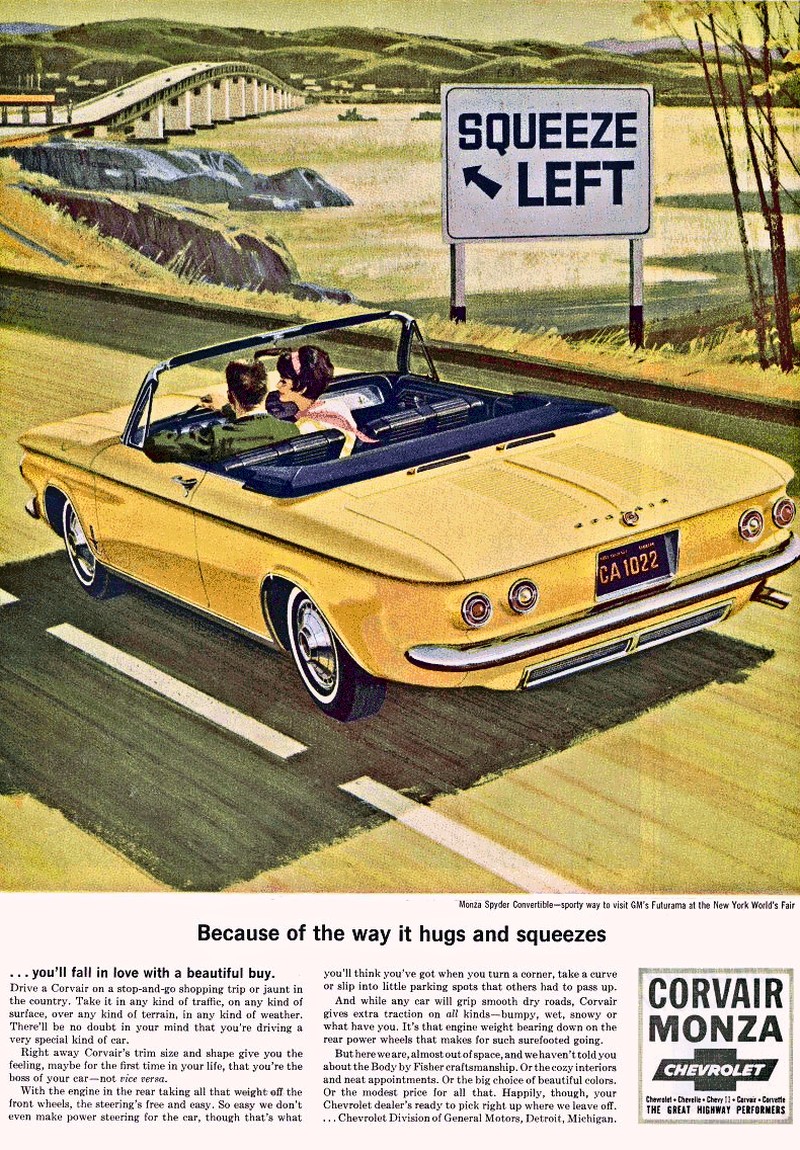
Next Wheels: Chapter 10 — 1964 Corvair

Book Review
How to Visit All 50 States in 12 Trips
Terri Weeks

How to Visit All 50 States in 12 Trips coverI thought of reviewing this ebook when it came out last March but it didn’t happen. There were actually multiple items, including a couple of CDs, that were review candidates about that time which got pushed aside by stuff like preparations for the coming summer. By releasing this second edition, Terri Weeks combines a reminder that I missed posting a review last year along with a second chance.
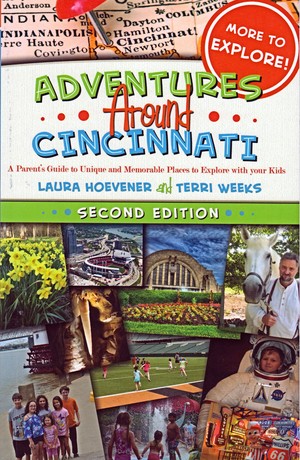
Terri lives within ten miles of me, does a goodly amount of traveling, and writes a blog about it. Add to that the book she’s co-written called Adventures Around Cincinnati and the travel related lecturing she does around the area and you might think it almost a given that I’ve met her. Not so and what at first might seem odd, might not be at all surprising once you learn that the full title of that book is Adventures Around Cincinnati: A Parent’s Guide to Unique and Memorable Places to Explore with your Kids and that her blog is called Travel 50 States with Kids. I’ve nothing against kids, of course. I did, once upon a time, some traveling with my own and my trip journals include at least one outing with just me and a grandson. But it’s an obvious fact that I seldom travel with anyone and that I travel with kids even seldomer.

But kid-friendly attractions are hardly uninteresting attractions and I’ve been following Weeks’ blog for some time as she describes visits to quite an assortment of them. I did — and continue to — read the blog through its RSS feed but I also have an email subscription. Why email? Because signing up for email is the ticket for getting a free download of How to Visit All 50 States in 12 Trips.

The twelve trips described in the ebook are not just theoretical lines on a map. The routes are practical and mostly proven. They are the routes that the Weeks family has or will follow to taste every state in the union before the youngsters finish high school. Terri Weeks has an engineering background which I’m sure served her well when she set out some years ago to devise a plan to accomplish the family’s travel goals. They are getting close. One change for the second edition is an update of “…eight states and three years to go” to “…six states and two years to go”. If I understand the scoring properly, nine trips are history and three are yet in the future.

Even if you exactly share Weeks’ goal of visiting all 50 states with your offspring before they finish high school, you might not want to do it in exactly twelve trips or exactly the same twelve. In fact, I imagine the chances of someone using this book as a precise blueprint for their own travels are pretty low but I’m confident that’s not what Weeks intended. The twelve trips are her way of making sure her family accomplishes its goal. They provide an obvious way to organize the nice catalog of attractions which is the book’s primary offering and they serve as an example of how the 50 state task can be accomplished.

For Weeks, the goal is not to simply reach each state but to actually visit each one; to experience, where possible, something unique for which a state is known. Things like the Grand Canyon in Arizona, a Mardi Gras museum in Louisiana, the Grand Ole Opry in Tennessee, Crater Lake National Park in Oregon, Yosemite National Park in California, and even the Mall of America in Minnesota.

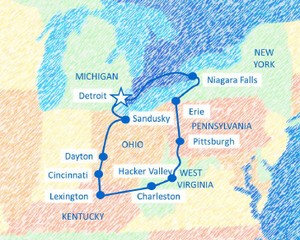
How to Visit All 50 States in 12 Trips mapThe book is not large, 40 pages, 4.5 KB. There are no detailed directions. There is a general map, like the one at left, for each trip followed by a daily itinerary. Itinerary entries are usually one-liners with any details provided through a web link. Being an ebook, How to Visit All 50 States in 12 Trips can assume some connectivity that paper books can’t. That means web links for many attractions. Sometimes the links lead directly to an attraction’s website and sometimes, for attractions already visited, to a Travel 50 States with Kids blog entry which often contains a link to the attraction’s website along with a report on the family’s visit.
As indicated, identifying various attractions is the ebook’s strong suit. The trip routes and itineraries are also quite useful if only as examples for creating your own. And there is a third subtle value in the the ebook. Both it and the blog behind it serve as gentle reminders that, if there is a long term goal in your life, you will probably need some sort of plan in order to reach it. In the case of getting kids to fifty states before graduation, merely keeping score won’t get it. Having just three or four states to go when the senior year rolls around sounds good unless those states are Maine, Florida, Alaska, and Hawaii.

How to Visit All 50 States in 12 Trips – Second Edition, Terri Weeks, self published, February 2014, ebook, 8.5 x 11 inches, 40 pages, free with email subscription at How to Visit All 50 Atates in 12 Trips


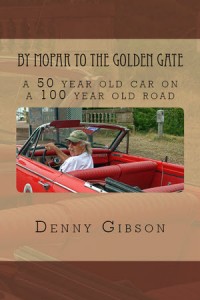
By Mopar to the Golden Gate coverBy coincidence, the first review of my own book, By Mopar to the Golden Gate, appeared yesterday. Written by Ron Warnick at Route 66 News, the very positive in depth review can be read here.
Beer not Weak. Beer Week.

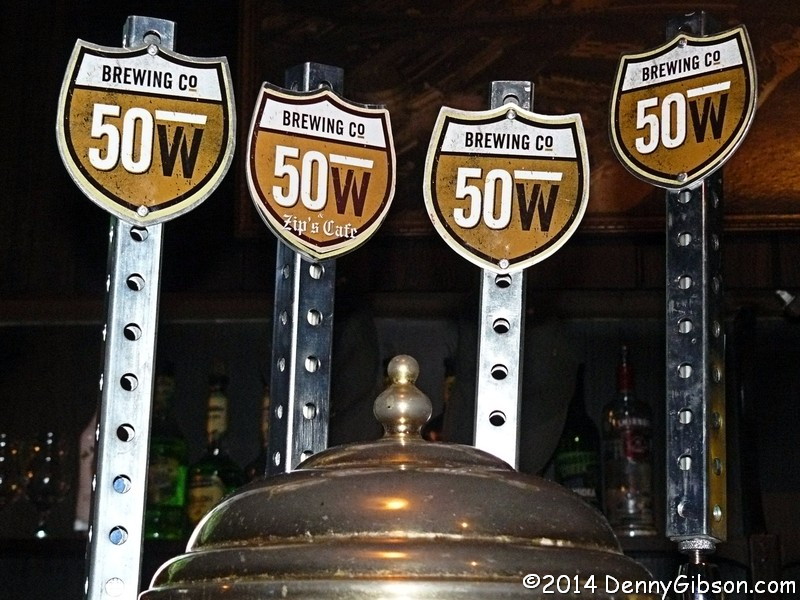
Taps at Zip's CafeOne response to a request to name 212 things that first appeared in 1926 would be Zip’s Cafe and 211* US Highways. One of the routes designated when the US Highway System was adopted was US 50 from which Fifty West Brewing Company gets its name. When Zip’s and Fifty West collaborated on a beer to become the restaurant’s house brew, the name 1926 Amber Ale was chosen as something that had meaning to both. The “official” tapping took place on Thursday, the first day of Cincinnati Beer Week.

This post appears very near the mid-point of Cincinnati Beer Week which, like all good weeks since 1964, is eight days long. Cincinnati Beer Week is immediately followed by, but not connected with, the Cincy Beerfest. The Beerfest is a great place to sample a large number of beers though I personally don’t find big events of that sort nearly as enjoyable as I once did. Fortunately, the appearance of “rotating taps” in a large number of taverns lines up well with my own proclivities and allows me to sample a variety of beers over time from the comfort of a bar stool.

So, while I encourage others to do so, I won’t be attending the Beerfest this year nor, for similar reasons, will I be going to the bigger Beer Week events. At least not during their peak periods. The event that started my Beer Week, the Brewer’s Choice for Charity at Arthur’s Cafe, is a big event that packs the place in the evening but I was there early in the afternoon. Arthur’s was the first (if not only) area bar to switch all of their draft beer taps to local brands. For this event, each of the eight taps pours something from a different brewery and each brewery picks a charity to receive a dollar for each pint sold. The restaurant then matches the amount earned by the top selling brew. I beat the crowd while scoring a buck apiece for Madtree and Blank Slate.

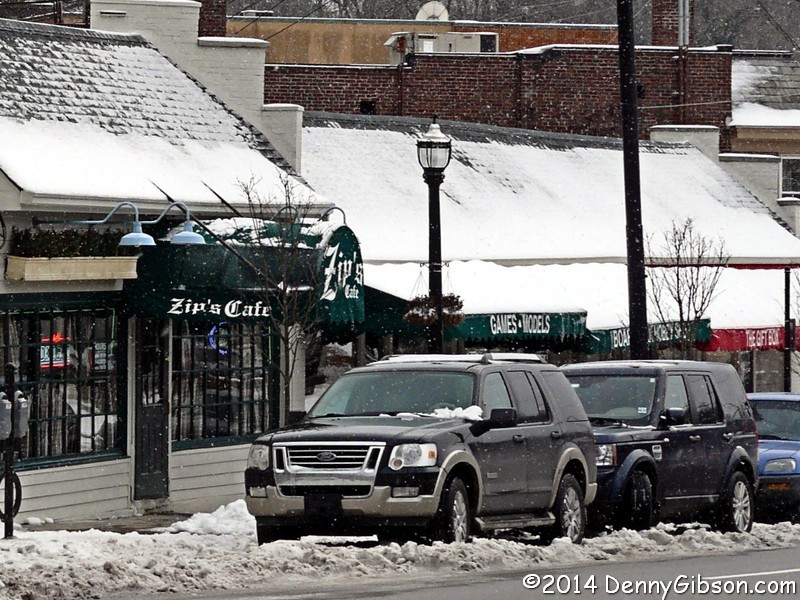
Zip's entrance in snowThen I headed on over to Zip’s and even snapped a photo of the entrance with a fair amount of snow covering the curbside area out front. I feared that the tapping at Zip’s might be something of a frenzy but, even though the place was quite busy, it wasn’t crazy. There was not a big ceremony and the new beer started flowing well before the clock struck 5:00. I suspect the introduction was even less formal at the brewery itself, which had several representatives on hand.

At least one of the Fifty West people used to work at Jackie O’s in Athens, Ohio, and there is still a connection of sorts. On this evening, four of the eight taps at Zip’s were devoted to Jackie O’s products and the other four (in the top picture) to Fifty West. While waiting for the 1926 Amber Ale, I stayed hydrated with a standard Fifty West brew, the Thirty-37 Pale Ale.

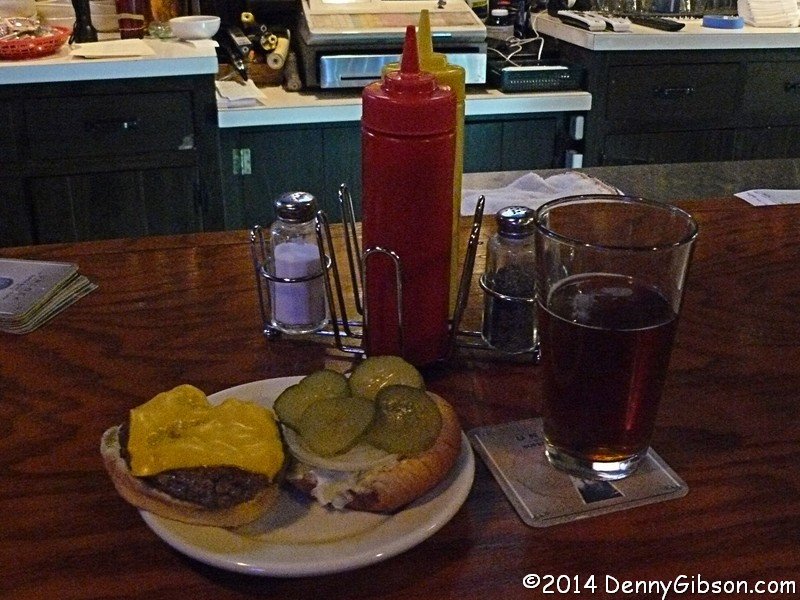
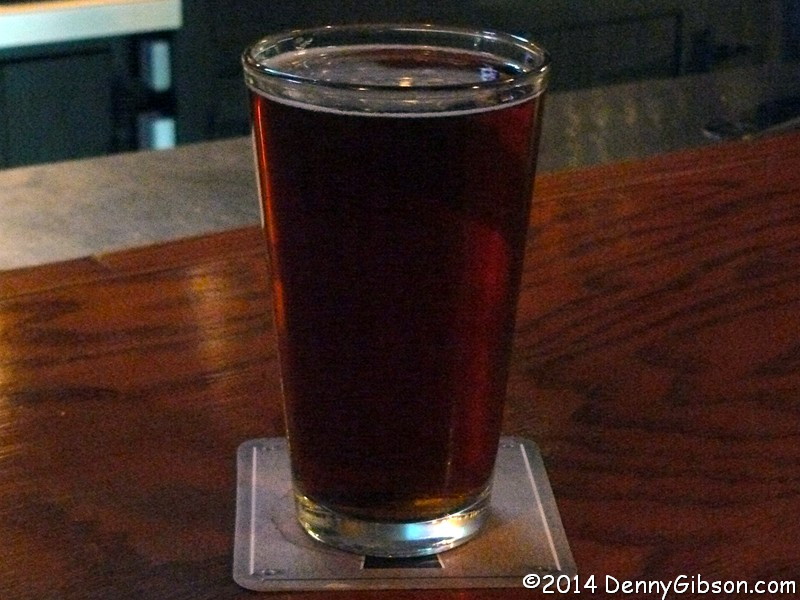
Zipburger and 1926 Amber AleFifty West 1926 Amber Ale’26, as I heard one of the brewery guys call it, struck me as a pleasant middle of the road brew that should fill the role of restaurant house beer quite nicely. My own timing was no more precise than the new brew tapping and my glass of 1926 Amber Ale was half gone when my Zipburger arrived. They still still make a lovely pair.

* There are many ways to count the number of “routes” covered by the adoption of a national numbering system on November 11, 1926. 211 is the number of entries in the list provided here by Robert V. Droz.


Feedly Fumble: Two weeks ago, this website switched hosting companies. On the morning of January 26, a blog entry titled “Moving Day” was posted from the old server. Toward the end of the day, when the move was essentially complete, an entry titled “Meet the New Host” was posted from the new server. The actual RSS feed and most accesses behaved as expected with the morning post disappearing to be replaced by the evening post in due time. The Feedly reader, which I use and generally like, has been the exception. To date, it continues to show the early post rather than the later one and no flushing, resubscribing, or incense burning has helped. If you use Feedly and fear there is something you’ve missed, the first blog entry from the new host is here. Feedly has performed just fine with subsequent posts.

A Birthday Bash and a Big Bashing

Pleasant Ridge Chili 50th AnniversaryConsistent is not the way to describe my news input. I hardly ever read a newspaper anymore. I do occasionally watch some national news on the broadcast networks and some national and international stuff on PBS. I think I watch local morning news fairly often but it’s hardly regular and I guess it can’t really be called often in the way that most of the world defines the word. I’m writing all of this in an effort to establish an excuse for missing a landmark event in a nearby community where I once lived. Despite significant advance coverage by local TV stations and others, it wasn’t until I saw an “after the fact” report that I learned of Pleasant Ridge Chili‘s 50th anniversary.

It was Friday evening when I saw the report on Wednesday’s celebration. I felt embarrassed, of course, and even a little guilty that I not only missed attending but was totally ignorant of the big event. I corrected things as quickly as I could. On Saturday afternoon, I headed to PRC, grabbed a seat at the counter, and ordered a 4-way. In chatting with the waitresses, I realized that missing the big day wasn’t all bad. It had been a madhouse; in a good way, of course. Ninety-nine cent coneys and free baklava had customers lined up “out the door”. Though things had calmed down considerably, it was still extra busy on Saturday and everyone was looking forward to a day off on Sunday. Owner Danny Sideris was one of the people hustling to keep things running smoothly but he sure was happy and I even got to talk with him a little when he would pause near the end of the counter to contemplate his next move. He estimated that about half of the customers were there for the first time and he wanted to make sure their first impression was a good one.

Before I knew of the anniversary, I had determined that nothing blog-worthy was happening this week and scheduled a Trip Pic Peek for the Sunday morning post. I briefly reconsidered this after my Saturday afternoon visit but decided that a post about missing the party would not be very interesting and not worth the effort to put together before bedtime. So, what changed my mind? Actually, nothing changed my mind about the story being interesting. It isn’t and I know it. But, before I fell asleep, I discovered something else I had missed and which made a chili related post almost mandatory. The thing I discovered was posted in October so I’m already really late in reacting. No use waiting another week.

In an unguarded moment, I was led, through some sort of internet baiting, to a blog post titled “The Great American Menu: Foods Of The States, Ranked And Mapped”. The post is here. It is an honest article that declares up front that it is not “scientific”, “researched”, or “fair”. It didn’t take long to realize that the writer was some sort of cyberspace Don Rickles who felt obligated to insult almost every state and edible including those he claimed to like. I never cared much for Rickles but admit that he did occasionally say something funny. Same with the writer and I found myself smiling now and then as I read through the list. As I crossed the halfway point, it occurred to me that he would likely be even more obnoxious with his unscientific, unresearched, and unfair set of losers. I also realized that Ohio had not yet been mentioned and that’s probably what drew me on. As the list moved into the lower fifth, I started fearing that Ohio would pop up around 44 or 48. “Please, Rickles wannabe”, I silently pleaded, “don’t rank Ohio merely near the bottom. We want nothing but the worst.”

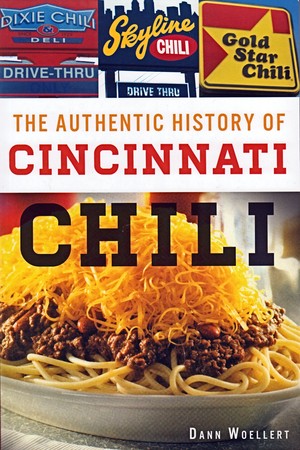
My pleas were answered with a tirade that was so far over the top that I suspected the entire list was created just as an introduction for this blast. (It was.) The District of Columbia was included in the list but Ohio did not come in at 51. In addition the the 50 states and DC, the writer inserted “Being Hit By A Car” in front of Ohio for the apparent purpose of moving the state down another notch. Few states got more than a paragraph in the list and many were dismissed with just a few words. Ohio got four paragraphs and over 400 words all targeting Cincinnati Chili. Skyline is the only brand name used but it’s unclear whether that’s the only name he knows or if he has a special grudge against the company. It’s no more clear why the bonus blather for Cincinnati Chili. Maybe a Skyline waitress once saw the guy naked and laughed or maybe he heard a rumor that his conception involved a 3-way and misunderstood. Or maybe southwest Ohio just doesn’t visit deadspin.com enough.

Deadspin is the website where the list appeared. It is described as a sports website with a sarcastic and humorous editorial tone. Add the connection between food lists and sports to things unclear. Perhaps there was a “get more Cincy clicks” directive and the chili bashing was the result. If so, it worked. I visited the deadspin site one more time than I would have otherwise. Hope that’s enough.

Meeting Mister Mallory

wlmalloryTwo judges, a state lottery sales representative, a former mayor, a former vice mayor, and a state representative all lost their father recently. William L. Mallory, Sr., died on December 10. The one time high school dropout had an extremely successful career in politics and was obviously pretty good at parenting, too. I met him once.

It was Reds Opening Day in 2004. It was also my birthday. As is my habit, I headed downtown for the parade. My friend John came down later to meet me and go to the game. I don’t remember much about the game but know that the Reds lost it to the Chicago Cubs. Afterwards, we found ourselves in La Normandie, the classy but easy going tavern and restaurant beneath the perennial 5-star Maisonette.

We sat at the bar and before long were engaged in conversation with a well dressed fellow sitting just around the bar’s corner. That fellow was, of course, William Mallory. John had met him once at a fundraiser but I had no idea who he was. Even after learning his name and realizing or being told that he had been a state representative, I was ignorant of the full stature of the man I was talking with. I did not and, perhaps to my shame, still do not, follow state politics very closely. Even if I connected the name with the Ohio congress without being told (which may not be the case) that was the extent of my recognition. I see that as a good thing. While it is unlikely that knowing I was chatting with Ohio’s longest serving House of Representatives Majority Leader and the first African-American to hold that position would have turned me into an overawed blatherer, it probably would have made things a lot less natural and casual.

Although I’m not sure it was our intent when we entered, at some point John decided he should buy me dinner for my birthday and I thought that a fine idea. He asked Mr. Mallory to join us and the former congressman graciously accepted. The three of us moved to a booth.

I recall nothing specific about our conversation. I do recall that it was friendly and easy flowing. If there was anything at all political in the conversation, it was light. I’m sure we talked about the Reds and we probably talked about some current events and our families and jobs. We neither solved problems nor created any. High-caliber small-talk seems a pretty good description. I can’t recall whether Mr. Mallory had walked downtown or ridden a Metro bus. It could easily have been either. I would later learn that, as co-chairman of the Citizen’s Transportation Committee, he had been instrumental in the formation of the publicly owned Metro. He accepted our offer of a ride home and, possibly because mine was the closer of our two cars, I was chosen as “chauffeur”. We chatted easily as we walked to my car. The red Corvette convertible I was driving was not the most dignified of vehicles but it did not bother the congressman in the slightest. He settled into the seat and directed me to his home with easy to follow instructions. Once there, he thanked me and headed into the house.

It was the next morning before the internet let me know just who it was that John had bought dinner for and I had driven home. A newspaper article announcing his death and a 2008 Greatest Living Cincinnatians citation contain what are no doubt incomplete lists of his accomplishments and awards. A wonderful StoryCore interview is here. Southwest Ohio lost a great and caring man this month but he left behind a generation of Mallorys well prepared to at least try filling the gap. The memory of that nearly ten year old meeting is one that I am truly fond of and thankful for.


wlmallory_clIn addition to an earlier private service for the family, a public Celebration of Life took place in the rotunda of Union Terminal (a.k.a. Cincinnati Museum Center) on Sunday, December 22. A report of the celebration is here. This building and Mr. Mallory were very important to each other. It was a prominent landmark in the west end neighborhood of his youth and a place where he worked shining shoes and busing tables among other things. When demolition threatened in the 1980s, he played a key role in securing state funding that helped enable the conversion to the museum center and actually delivered the multi-million dollar check to the museum himself. “I often reflect on a shoe shine boy becoming the delivery man for $8 million”, he has said. That’s just one of many things about William L. Mallory, Sr., that’s worth reflecting on.


Cincinnati Christmas Traditions

Among the many interesting pieces of information presented in Cincinnati Museum Center‘s most recent Brown Bag Lecture, “Cincinnati’s Winter Holiday Traditions”, was a listing of the city’s four oldest Christmas traditions.

cintrad014. Duke Energy Holiday Trains – 1946
Duke Energy gave its name to the trains in 2006 when it bought Cinergy Corporation. In 2011, it gave the trains to the museum. Before Cinergy was formed in 1994, the company name was Cincinnati Gas & Electric so these trains spent most of their lives as the CG&E trains and that is still how many people think of them.

cintrad03cintrad02The O gauge layout was originally constructed by the Baltimore & Ohio Railroad as a training tool just prior to World War II. It came to Cincinnati in 1946 and for years was displayed in CG&E’s lobby each Christmas season. Today it is the centerpiece of the Cincinnati Museum Center’s Holiday Junction which includes several other model trains, the “Toys through Time” exhibit, Grif Teller railroad paintings, and more. Kids can ride a train or have a conversation with Patter & Pogie, the talking — and listening — reindeer who were a long time Christmas fixture at Pogue’s department store.

Holiday Junction and the Duke Energy Holiday Trains are are inside the fee required museum but free passes are available to all Duke Energy customers.

cintrad113. Boar’s Head Festival – 1940
I have never attended the Boar’s Head and Yule Log Festival and I won’t again this year. Tickets for the free event go fast and those for this year’s festival have long been gone. The first Boar’s Head Festival took place in Oxford, England, in 1340 which means it had been going on exactly 600 years when Cincinnati’s Christ Church Cathedral held its first. The locals have now added 70+ years of their own traditions to establish a unique event for the city. I confess to not even knowing of the festival before the lecture but, the more I learn about it, the more I want to go. There are three performances on January 4 and 5. Tickets were distributed, first-come, first-served, on December 14. Maybe I can snag one of those hot ducats next year.

cintrad212. W & S Nativity Scene – 1939
Officially known as Western & Southern Financial Group presents the Crib of the Nativity, this Cincinnati tradition has one year on the Boar’s Head Festival. Western & Southern’s President, Charles F. Williams, had the crib built in 1938 for display in the company’s parking lot. It went public and started the tradition during the very next Christmas season. Initially displayed in downtown’s Lytle Park, it was moved to Union Terminal after the country’s entry into World War II in 1941. It stayed there, a welcome sight to the train loads of GIs who passed through the station, until the war was over. It returned to Lytle Park in 1946.

cintrad22cintrad23With the upheaval and shrinking of Lytle Park that came with the construction of I-71, the nativity scene moved to Eden Park in 1967. It remains there, next to Krohn Conservatory, today.

cintrad26cintrad25cintrad24Parking and visiting the outdoor nativity scene is free. Entering the conservatory is not. The conservatory’s Christmas display is not one of Cincinnati’s oldest but it is one of its most beautiful. If you have parked to visit the nativity scene, you should at least consider spending the $7 to see “A Cincinnati Scenic Railway”, a ton of poinsettias, and other holiday themed displays. The railway incorporates “botanical architecture” which uses “locally gathered willow and other natural materials” to build structures such as the Roebling Bridge, the Tyler Davidson Fountain, and the Christian Moerlein Lager House..

cintrad311. Fountain Square Tree – 1913/1924
According to the “Cincinnati’s Winter Holiday Traditions” lecture, Cincinnatians first put a tree on Fountain Square in 1913. A large crowd had gathered for the ceremonial lighting when someone yelled “fire” and the resulting stampede caused enough injuries to keep the city from trying again until 1924. Things went much better that year and, although the fountain and the square have moved around some, a Christmas tree has stood on Fountain Square every year since.

cintrad32cintrad33cintrad34There was a snag this year when the first tree selected snapped in two at a weak spot in its trunk. A replacement was quickly obtained and the 55-foot Norway Spruce was placed on the square after a one week delay.

My Wheels — Chapter 8
1957 Austin Healey

Austin-Healey 100-6Why in the world would a couple of newly weds buy a ten year old British sports car in the middle of winter? I am, at present, as baffled as anyone though I apparently once knew the answer to that question. A month or so after our 1966 Boxing Day wedding, my bride and I purchased a 1957 Austin-Healey 100-6. The one pictured is a 1958 model but looks pretty much like our ’57. This was not a play car to park next to a dependable sedan. This was our only car.

The Renault‘s reliability had steadily decreased until I sold it to a friend who either rebuilt or replaced the engine and drove it for quite awhile. I almost bought a 1959 Plymouth an aunt had recently replaced and actually “test drove” the car for a few weeks before acquiring the Healey. Buying the Plymouth would have been the sensible thing to do. But we were 18 and 19, I was a full time student, she was just out of high school, and we had just gotten married. Why spoil it by doing something sensible?

The Healey lasted more than a year. It was a great summer car and an OK winter car. Climbing snow covered Cincinnati hills was not its strong suit but it got around as good as many other cars of the day and it was reasonably warm in slowish city driving. Things were a little different on the open road. It helped that it had a removable hard top. It was fiberglass and not heavily insulated but was infinitely better than the cloth top. But it was a true roadster with sliding Plexiglas side curtains rather than roll up windows. At highway speed on a cold day, the heater stayed on full blast trying to keep up with the air escaping through the side curtains.

That soft top I mentioned was on the car once while I owned it. Attaching it had much more in common with raising a tent than with raising a convertible top. The hard top came off in the spring and went on in the fall. In between, with the one exception to prove that erecting the canvas top was possible, we made do with a tonneau cover and, yes, we did get wet now and then.

It was called a 2+2 with a pair of padded depressions in a shelf behind the seats. I actually remember carrying someone in those “seats” for a short distance but the shelf was much better at holding a couple bags of groceries than a couple derrieres.

The 100-6 was produced for three years. In 1956 it replaced the four-cylinder 100 which immediately became known as the 100-4. The 100-6 had a 2.6 liter six-cylinder engine and a four-speed transmission with overdrive. In 1959, it was replaced with the 2.9 liter Austin-Healey 3000 which had a rather long run through 1967.

Cars are often remembered for the misadventures they were part of and here is a story that helps me remember the Healey. For reasons not quite remembered, there was no license bracket on the front for awhile. It had been damaged somehow and repairing it had slipped entirely off my schedule. We were driving home after a visit to my parents. On state route 49, near the town of Arcanum, we passed a state trooper headed the other direction. He turned around, turned on his lights, and pulled us over. There was no “serious” issue, like speeding, but there was no front license. After checking a few things, he gave me a written warning and went on his way.

A couple of weeks later, I was back in Darke County. The low slung Healey had suffered a few scrapes and bumps on its crankcase and had developed a minor leak. I arranged to meet a high school buddy who had a welder so we — actually he — could fix the leak. The repair was accomplished and I headed home. At just about the same spot as before, that same state trooper passed the Healey with the same license plate not there. When I saw his brake lights come on, I immediately turned off on a side road and, with a few quick turns on the narrow roads, made my getaway. Satisfied that my evasive maneuvers had worked, I was starting to slow when I saw it. The road ahead was unpaved. It had not been graded for awhile. A fairly tall gravel ridge stood in its center. Before I could stop, I was plowing that gravel. Then I was oiling it.

The gravel had ripped off the recently applied weld and the crankcase was leaking much worse than it ever had before. I lost a lot of oil by the time I made it back to the main road. At a little gas station and grocery store, I bought a five gallon can of used oil. I believe farmers sometimes used used oil in slow reving equipment so it was often available for sale. The leak was not quite as bad as I feared but I still lost close to another gallon getting back to the friend’s house. He had just been visiting from college and was already gone when I got there. His dad let me use the welder and I managed to plug the leak with one of the ugliest welding jobs ever. This was the first and last time anyone ever left me alone with a welder. Then I drove home and fixed the license bracket the very next day.

Although our car must have looked just like the one in the picture when new, when we had it the paint had lost its shine and there was rust. Not major visible rust but hidden and interior rust in floor pans and such. The car was never garaged while we had it and I suspect that was true of much of its life. The rust and mechanical malaise led to the Austin-Healey being replaced before the next summer rolled around.

Previous Wheels: Chapter 7 — 1961 Renault 4CV
Next Wheels: Chapter 9 — Honda 65


Although this post is semi-random (I picked it from two possibilities) it appears during Cincinnati’s first snow event of the year (which is kinda why I picked it) and gives me an excuse to tell a semi-related story.

1959 Plymouth FuryThe 1959 Plymouth Fury at left is a dead ringer for the one I passed up to get the Austin-Healey. A rather spiffy ride, don’t you think? On one snowy night, my new wife and I were out with a friend in my borrowed car. The snow was not deep but the big Plymouth was not doing well on the slick streets. At one point, as we attempted to climb a slight incline, the friend and I got out to push while my wife took over driving. It did not take much to get the car moving but stopping to let us back in would have left the car stuck once again. Instead, my friend and I each grabbed a fin and “skied” alongside the Plymouth to the top of the hill.

5K: The Ventures Way

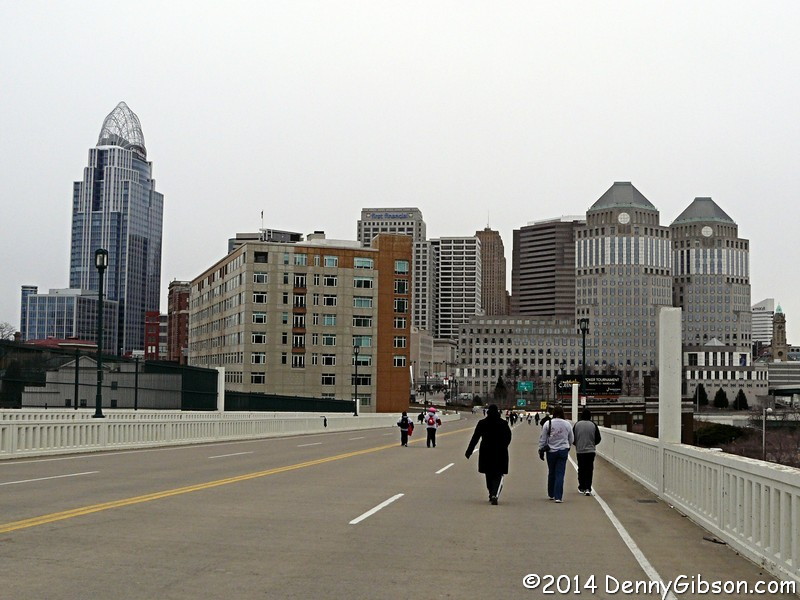
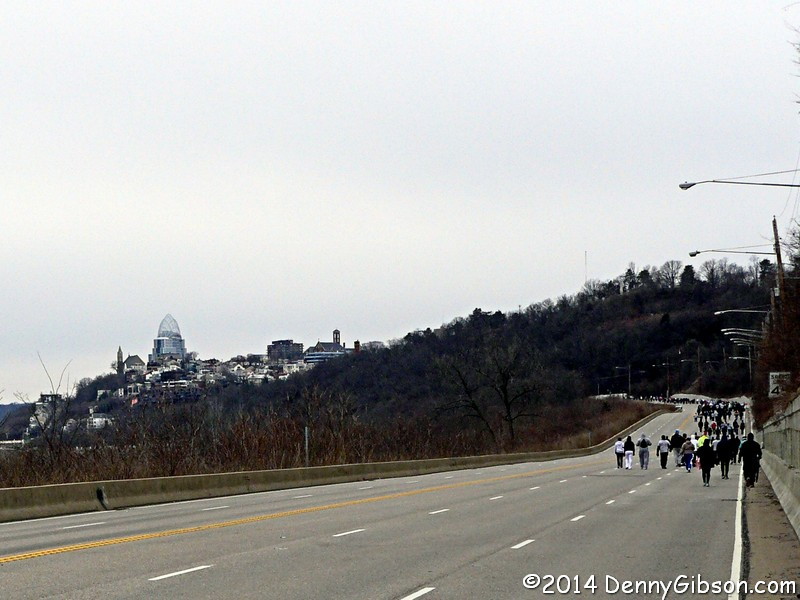
DAV 5K The Disabled American Veterans organization held a race Saturday. It was the inaugural running of what they called the National 5K Run/Walk/Roll/Ride. I first heard of it a few weeks ago when my friend, Dave, announced that he had signed up. Some people ran, some walked, some rolled on hand-cycles, and some rode motorcycles. Dave walked. So did I.

When the event came up in a conversation, Dave said something like “You ought to do it, too”. Then I said something like “Yeah, maybe” without really meaning it but the seed was planted. l’m a firm believer in the only-if-chased concept of running. There is absolutely no way I would ever consider running any farther than the last lane of a street crossing to avoid an approaching SUV on auto-pilot. But walking is a different story. I walk quite a bit. I’ve always done it on road trips where I will park the car and walk around a town or park or other attraction. This summer I’ve been doing more of it at home and even think I feel a little deprived on days when I don’t walk.

Five kilometers is about three miles; 3.106855961 to be be precise. I might walk that far a few times each week although there is usually a restaurant or bar somewhere near midpoint. I started to somewhat seriously consider doing the walk about the same time that another friend and I picked that day to take an underground Cincinnati tour we had been talking about for awhile. I assumed I couldn’t do both until a week or two later when I looked at the details. Start time for the “race” was 9:00; for the tour 1:00. That was plenty of time for even sluggish old me to finish the walk, which had awards scheduled for 10:45, and get to the tour.

DAV 5KSo I signed on. Dave and I were a little surprised by the size of the crowd when we arrived about a half hour before the start time. We later learned that the event had more than two thousand entrants. I registered late and in person and had picked up my stuff when I did. Dave had registered very early on line and was picking up his stuff today. An entrant’s stuff consisted of a long sleeve shirt, a “bib”, and four safety pins. The pins were to attach the numbered “bib”, with its attached timing chip, to the shirt. Shirts were black for veterans and white for civilians. Dave’s a Navy vet. I’m a civilian.

DAV 5KDAV 5KWe did not have long to wait until the starting gun went off and, presumably, the serious runners up front went dashing away. Eventually the more casual crowd near us started moving and we were off. We started fairly close to the back and by the first turn had managed to work our way even closer.

DAV 5KDAV 5KDAV 5KThere were several bands performing along the way and we were given water at strategic spots just like real runners. Near the end, we were even cheered and encouraged just like real runners. Dave was the target of extra cheering when some in the crowd recognized him as the model for a widely used street sign of which an example can be seen to his right.

DAV 5KWe crossed the finish line to the sound of bells and cheers from an enthusiastic group who had probably come near to dozing off during the lull that preceded us. Two bicycles had been the first to cross the line with times of 14:44 and 15:07. The first place runner had a time of 16:26. Dave and I finished 2019th & 2020th in an hour and twelve minutes. There were 2033 finishers so we were denied last place but we were close. On the other hand, we were only about 56 minutes out of first.

The cheering and applause even for old guys finishing in the 99th percentile is intended to make you feel like you accomplished something and it did. Both Dave and I have walked 5 kilometers many times so neither of us felt any great affirmation but we did feel good and it sure was fun. In years past I’ve attended parades and concerts and other events associated with Veterans Day (I even remember Armistice Day.) but this is the first time since being in the high school band that I have participated. Maybe I really did accomplish something after all.

dav5k2013ddfADDENDUM 07-Nov-15: Here is a picture from the DAV website of Dave and I crossing the finish line.


The “Ventures Way” is, of course, walking rather than running. The Ventures first drummer had left the band and was on his way to becoming a veteran before Walk Don’t Run was released but did get to perform it with them again a few years later as captured here.


Queen City Underground TourQueen City Underground TourQueen City Underground TourI made it to the tour in plenty of time and I thoroughly enjoyed it. It was the “Queen City Underground Tour” from American Legacy Tours. Having done other tours of Cincinnati’s underground, I thought this might be something of a repeat but that was not so at all. Only the very last of the tour was familiar and by then we had been inside a 19th century tenement and an underground crypt and had been entertained and educated by a pair of knowledgeable guides. Plus, the familiar part led to the Christian Moerlein Tap Room which is hardly a bad thing.