My Wheels — Chapter 8
1957 Austin Healey

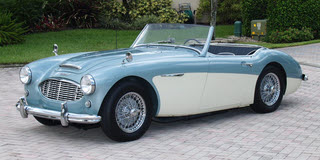
Austin-Healey 100-6Why in the world would a couple of newly weds buy a ten year old British sports car in the middle of winter? I am, at present, as baffled as anyone though I apparently once knew the answer to that question. A month or so after our 1966 Boxing Day wedding, my bride and I purchased a 1957 Austin-Healey 100-6. The one pictured is a 1958 model but looks pretty much like our ’57. This was not a play car to park next to a dependable sedan. This was our only car.
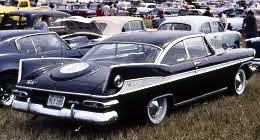
The Renault‘s reliability had steadily decreased until I sold it to a friend who either rebuilt or replaced the engine and drove it for quite awhile. I almost bought a 1959 Plymouth an aunt had recently replaced and actually “test drove” the car for a few weeks before acquiring the Healey. Buying the Plymouth would have been the sensible thing to do. But we were 18 and 19, I was a full time student, she was just out of high school, and we had just gotten married. Why spoil it by doing something sensible?

The Healey lasted more than a year. It was a great summer car and an OK winter car. Climbing snow covered Cincinnati hills was not its strong suit but it got around as good as many other cars of the day and it was reasonably warm in slowish city driving. Things were a little different on the open road. It helped that it had a removable hard top. It was fiberglass and not heavily insulated but was infinitely better than the cloth top. But it was a true roadster with sliding Plexiglas side curtains rather than roll up windows. At highway speed on a cold day, the heater stayed on full blast trying to keep up with the air escaping through the side curtains.

That soft top I mentioned was on the car once while I owned it. Attaching it had much more in common with raising a tent than with raising a convertible top. The hard top came off in the spring and went on in the fall. In between, with the one exception to prove that erecting the canvas top was possible, we made do with a tonneau cover and, yes, we did get wet now and then.

It was called a 2+2 with a pair of padded depressions in a shelf behind the seats. I actually remember carrying someone in those “seats” for a short distance but the shelf was much better at holding a couple bags of groceries than a couple derrieres.

The 100-6 was produced for three years. In 1956 it replaced the four-cylinder 100 which immediately became known as the 100-4. The 100-6 had a 2.6 liter six-cylinder engine and a four-speed transmission with overdrive. In 1959, it was replaced with the 2.9 liter Austin-Healey 3000 which had a rather long run through 1967.

Cars are often remembered for the misadventures they were part of and here is a story that helps me remember the Healey. For reasons not quite remembered, there was no license bracket on the front for awhile. It had been damaged somehow and repairing it had slipped entirely off my schedule. We were driving home after a visit to my parents. On state route 49, near the town of Arcanum, we passed a state trooper headed the other direction. He turned around, turned on his lights, and pulled us over. There was no “serious” issue, like speeding, but there was no front license. After checking a few things, he gave me a written warning and went on his way.

A couple of weeks later, I was back in Darke County. The low slung Healey had suffered a few scrapes and bumps on its crankcase and had developed a minor leak. I arranged to meet a high school buddy who had a welder so we — actually he — could fix the leak. The repair was accomplished and I headed home. At just about the same spot as before, that same state trooper passed the Healey with the same license plate not there. When I saw his brake lights come on, I immediately turned off on a side road and, with a few quick turns on the narrow roads, made my getaway. Satisfied that my evasive maneuvers had worked, I was starting to slow when I saw it. The road ahead was unpaved. It had not been graded for awhile. A fairly tall gravel ridge stood in its center. Before I could stop, I was plowing that gravel. Then I was oiling it.

The gravel had ripped off the recently applied weld and the crankcase was leaking much worse than it ever had before. I lost a lot of oil by the time I made it back to the main road. At a little gas station and grocery store, I bought a five gallon can of used oil. I believe farmers sometimes used used oil in slow reving equipment so it was often available for sale. The leak was not quite as bad as I feared but I still lost close to another gallon getting back to the friend’s house. He had just been visiting from college and was already gone when I got there. His dad let me use the welder and I managed to plug the leak with one of the ugliest welding jobs ever. This was the first and last time anyone ever left me alone with a welder. Then I drove home and fixed the license bracket the very next day.

Although our car must have looked just like the one in the picture when new, when we had it the paint had lost its shine and there was rust. Not major visible rust but hidden and interior rust in floor pans and such. The car was never garaged while we had it and I suspect that was true of much of its life. The rust and mechanical malaise led to the Austin-Healey being replaced before the next summer rolled around.

Previous Wheels: Chapter 7 — 1961 Renault 4CV
Next Wheels: Chapter 9 — Honda 65


Although this post is semi-random (I picked it from two possibilities) it appears during Cincinnati’s first snow event of the year (which is kinda why I picked it) and gives me an excuse to tell a semi-related story.

1959 Plymouth FuryThe 1959 Plymouth Fury at left is a dead ringer for the one I passed up to get the Austin-Healey. A rather spiffy ride, don’t you think? On one snowy night, my new wife and I were out with a friend in my borrowed car. The snow was not deep but the big Plymouth was not doing well on the slick streets. At one point, as we attempted to climb a slight incline, the friend and I got out to push while my wife took over driving. It did not take much to get the car moving but stopping to let us back in would have left the car stuck once again. Instead, my friend and I each grabbed a fin and “skied” alongside the Plymouth to the top of the hill.
5K: The Ventures Way

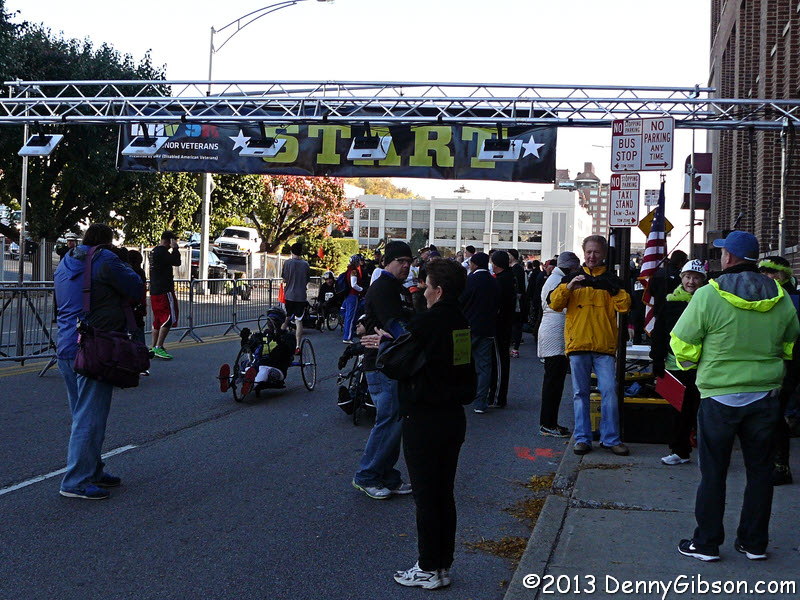
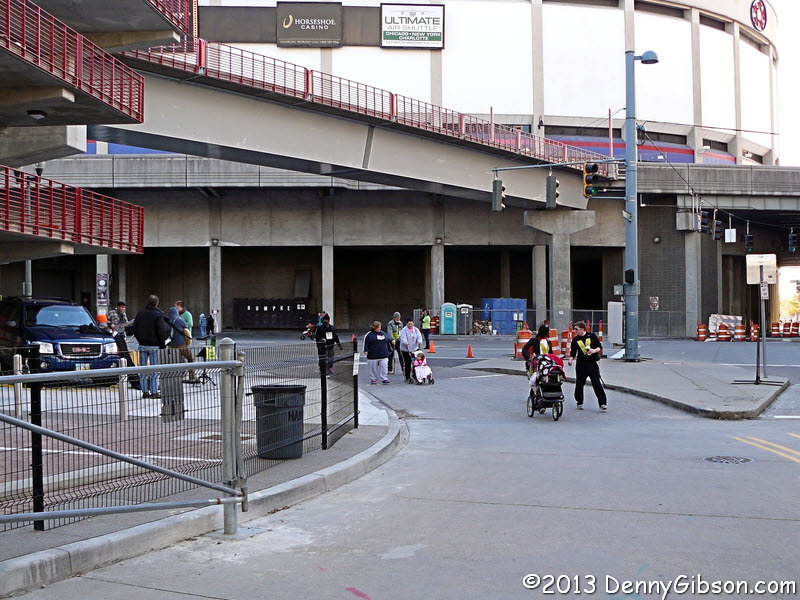
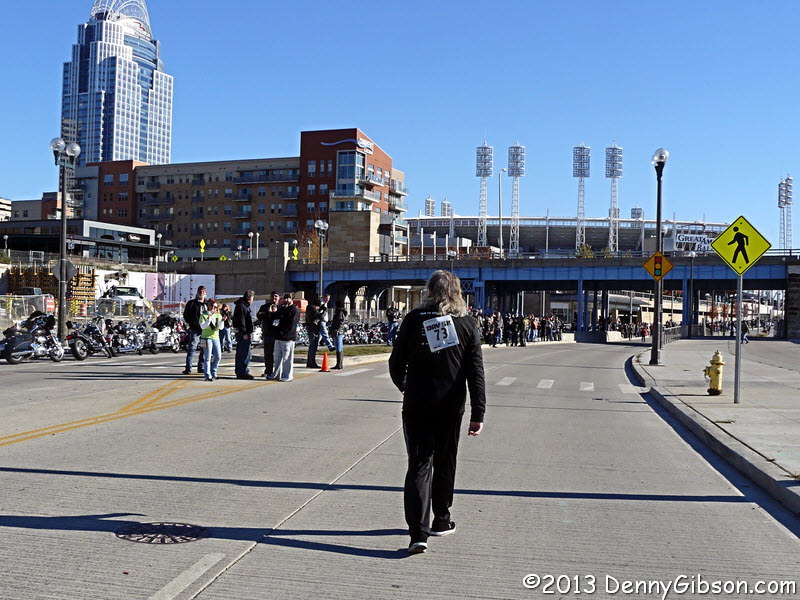
DAV 5K The Disabled American Veterans organization held a race Saturday. It was the inaugural running of what they called the National 5K Run/Walk/Roll/Ride. I first heard of it a few weeks ago when my friend, Dave, announced that he had signed up. Some people ran, some walked, some rolled on hand-cycles, and some rode motorcycles. Dave walked. So did I.

When the event came up in a conversation, Dave said something like “You ought to do it, too”. Then I said something like “Yeah, maybe” without really meaning it but the seed was planted. l’m a firm believer in the only-if-chased concept of running. There is absolutely no way I would ever consider running any farther than the last lane of a street crossing to avoid an approaching SUV on auto-pilot. But walking is a different story. I walk quite a bit. I’ve always done it on road trips where I will park the car and walk around a town or park or other attraction. This summer I’ve been doing more of it at home and even think I feel a little deprived on days when I don’t walk.

Five kilometers is about three miles; 3.106855961 to be be precise. I might walk that far a few times each week although there is usually a restaurant or bar somewhere near midpoint. I started to somewhat seriously consider doing the walk about the same time that another friend and I picked that day to take an underground Cincinnati tour we had been talking about for awhile. I assumed I couldn’t do both until a week or two later when I looked at the details. Start time for the “race” was 9:00; for the tour 1:00. That was plenty of time for even sluggish old me to finish the walk, which had awards scheduled for 10:45, and get to the tour.

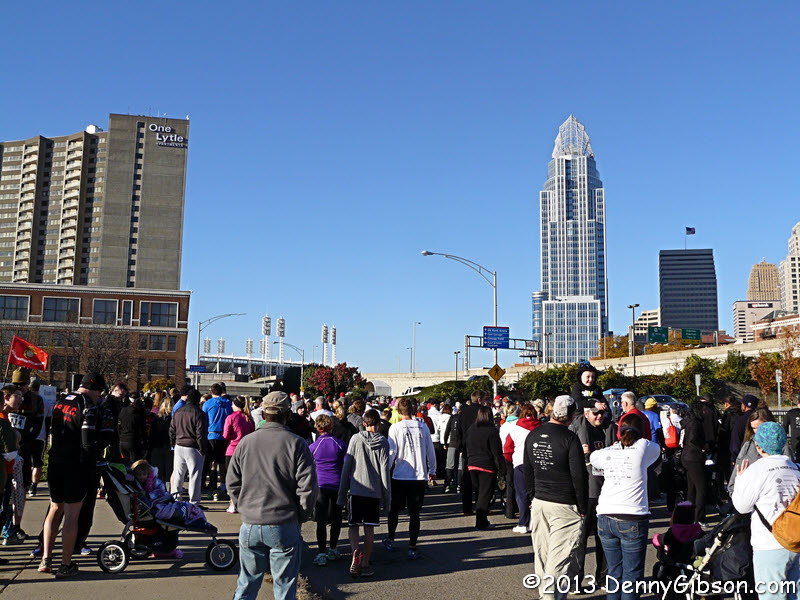
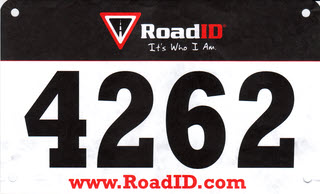
DAV 5KSo I signed on. Dave and I were a little surprised by the size of the crowd when we arrived about a half hour before the start time. We later learned that the event had more than two thousand entrants. I registered late and in person and had picked up my stuff when I did. Dave had registered very early on line and was picking up his stuff today. An entrant’s stuff consisted of a long sleeve shirt, a “bib”, and four safety pins. The pins were to attach the numbered “bib”, with its attached timing chip, to the shirt. Shirts were black for veterans and white for civilians. Dave’s a Navy vet. I’m a civilian.

DAV 5KDAV 5KWe did not have long to wait until the starting gun went off and, presumably, the serious runners up front went dashing away. Eventually the more casual crowd near us started moving and we were off. We started fairly close to the back and by the first turn had managed to work our way even closer.

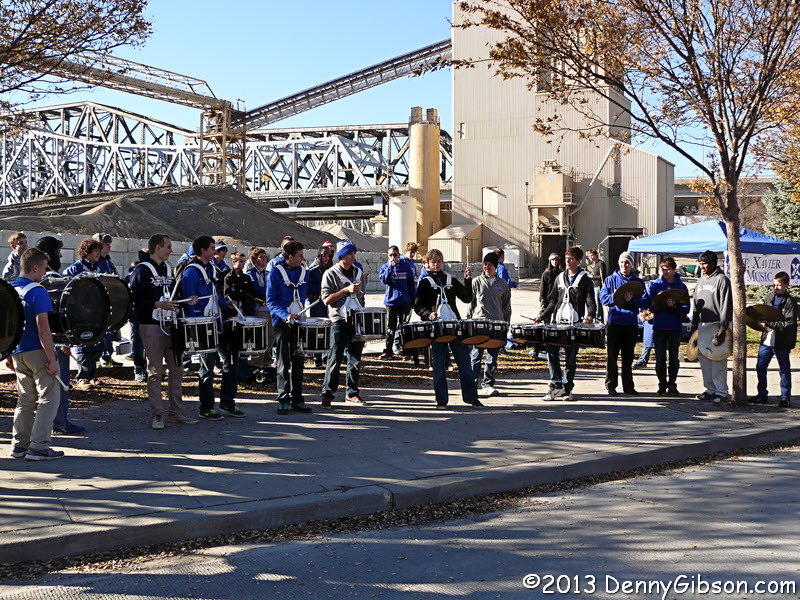
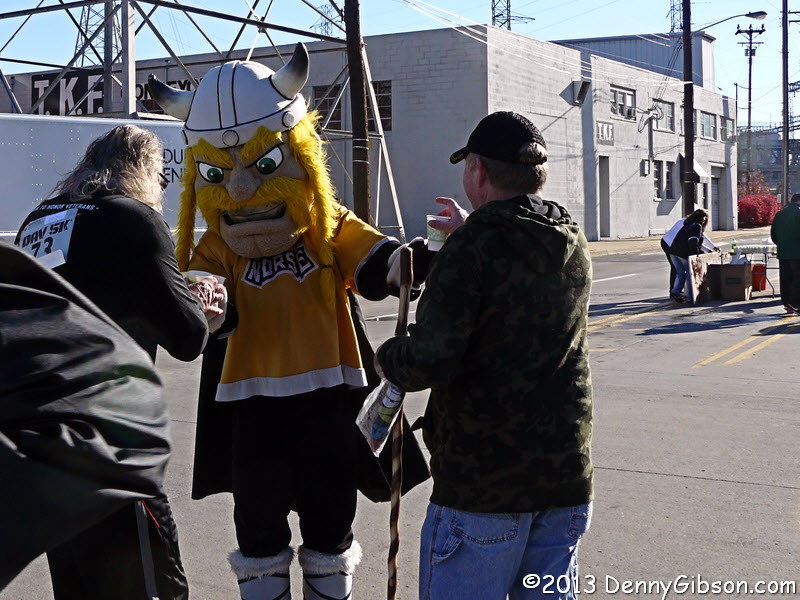
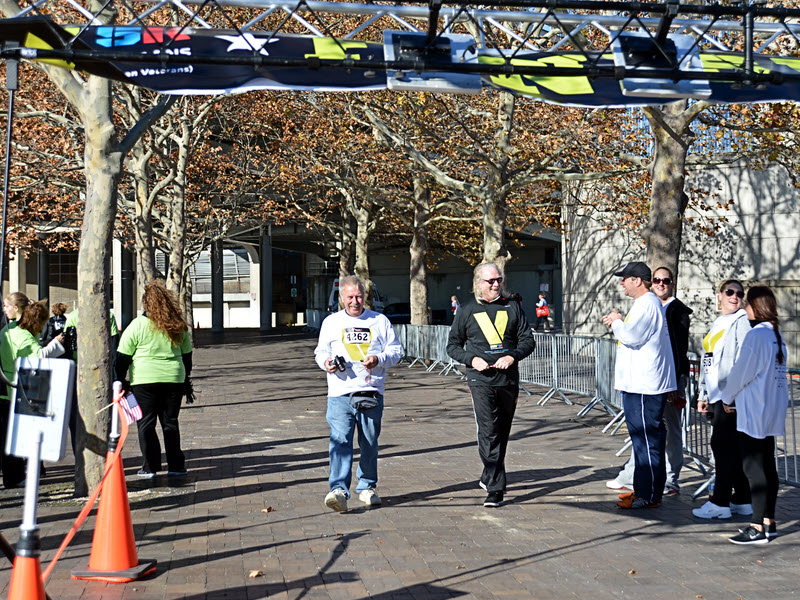
DAV 5KDAV 5KDAV 5KThere were several bands performing along the way and we were given water at strategic spots just like real runners. Near the end, we were even cheered and encouraged just like real runners. Dave was the target of extra cheering when some in the crowd recognized him as the model for a widely used street sign of which an example can be seen to his right.

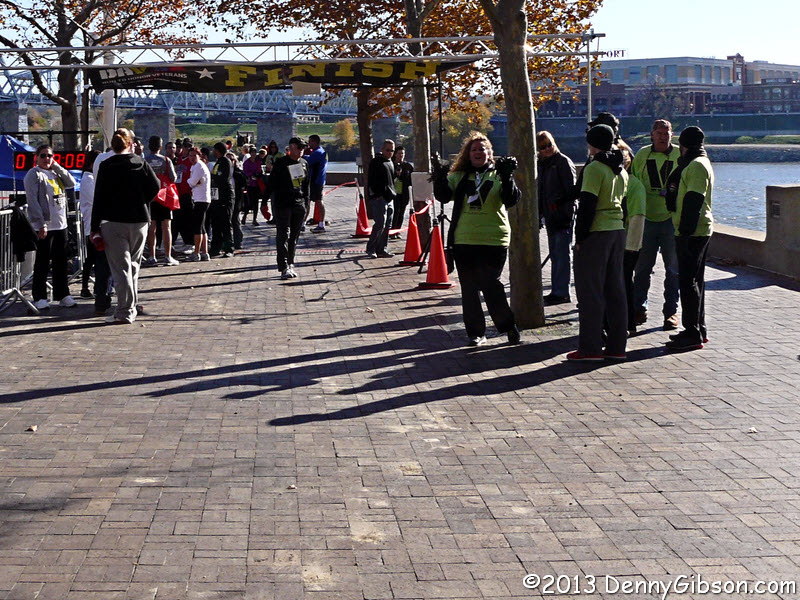
DAV 5KWe crossed the finish line to the sound of bells and cheers from an enthusiastic group who had probably come near to dozing off during the lull that preceded us. Two bicycles had been the first to cross the line with times of 14:44 and 15:07. The first place runner had a time of 16:26. Dave and I finished 2019th & 2020th in an hour and twelve minutes. There were 2033 finishers so we were denied last place but we were close. On the other hand, we were only about 56 minutes out of first.

The cheering and applause even for old guys finishing in the 99th percentile is intended to make you feel like you accomplished something and it did. Both Dave and I have walked 5 kilometers many times so neither of us felt any great affirmation but we did feel good and it sure was fun. In years past I’ve attended parades and concerts and other events associated with Veterans Day (I even remember Armistice Day.) but this is the first time since being in the high school band that I have participated. Maybe I really did accomplish something after all.

dav5k2013ddfADDENDUM 07-Nov-15: Here is a picture from the DAV website of Dave and I crossing the finish line.


The “Ventures Way” is, of course, walking rather than running. The Ventures first drummer had left the band and was on his way to becoming a veteran before Walk Don’t Run was released but did get to perform it with them again a few years later as captured here.


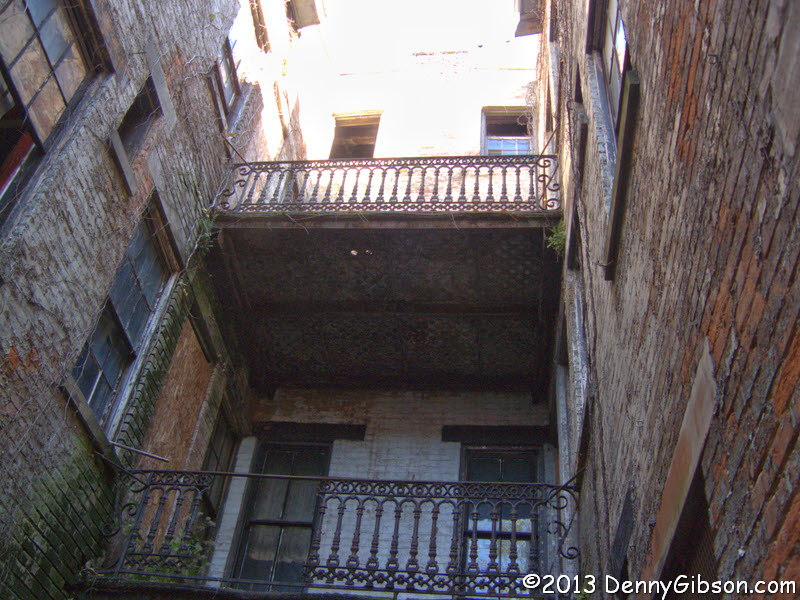
Queen City Underground TourQueen City Underground TourQueen City Underground TourI made it to the tour in plenty of time and I thoroughly enjoyed it. It was the “Queen City Underground Tour” from American Legacy Tours. Having done other tours of Cincinnati’s underground, I thought this might be something of a repeat but that was not so at all. Only the very last of the tour was familiar and by then we had been inside a 19th century tenement and an underground crypt and had been entertained and educated by a pair of knowledgeable guides. Plus, the familiar part led to the Christian Moerlein Tap Room which is hardly a bad thing.

Flying Pumpkins

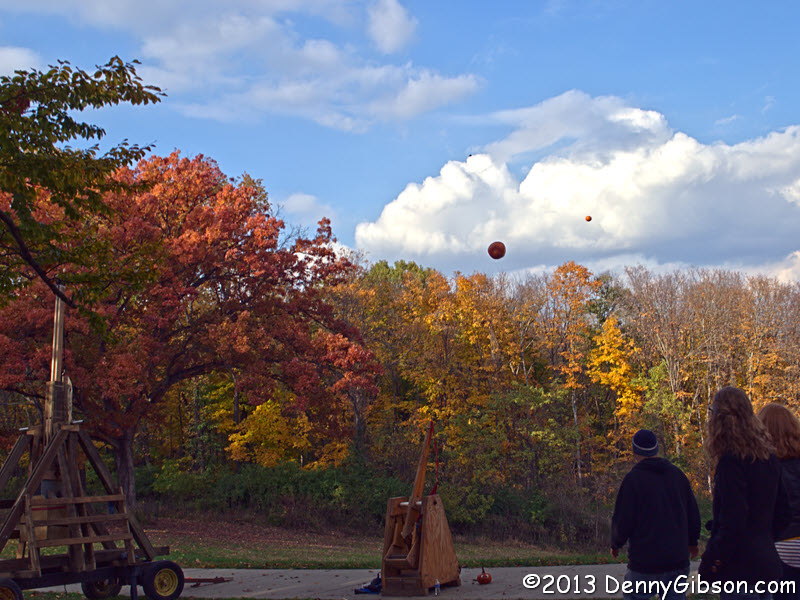
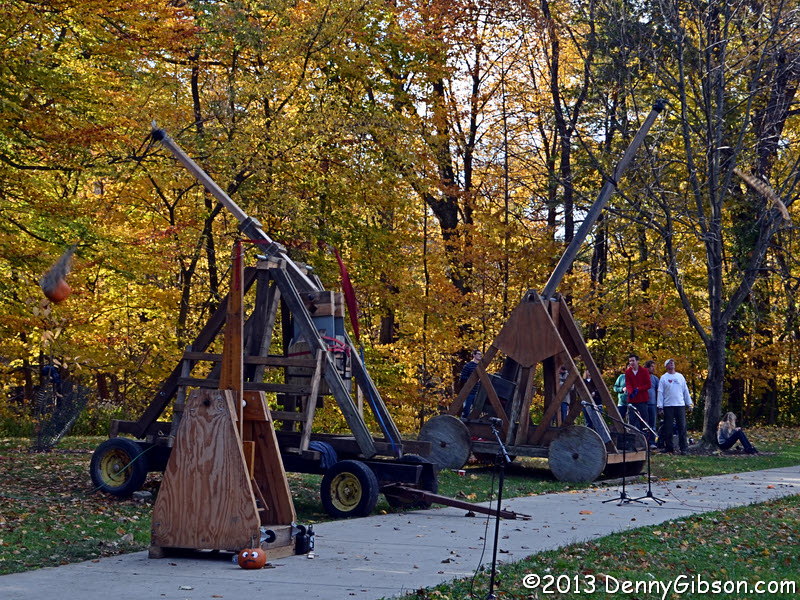
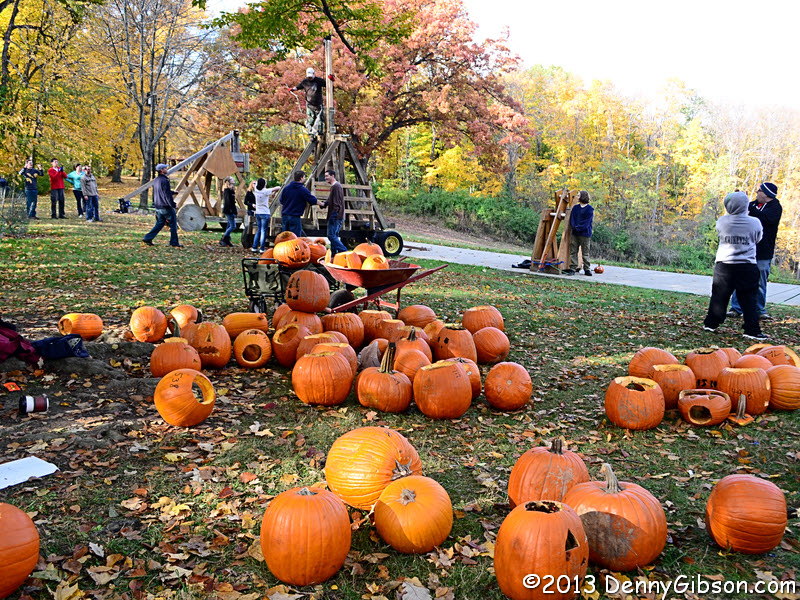
Stanbery Park Pumpkin ChuckWhat a clever way to get people to learn a French word and a little bit of history. Use trebuchets to hurl pumpkins high into the air and explain that their original purpose was to attack castles in the Middle Ages. Then, as the French would also say, voilà! Old and young are suddenly using the word trebuchet as if they’ve always known it though, to be honest, not everyone remembers the Middle Ages castle stuff.

Stanbery Park Pumpkin ChuckStanbery Park Pumpkin ChuckSaturday was the 7th (or maybe 8th) Heads-Up Pumpkin Chuck at Stanbery Park in Mount Washington, a Cincinnati suburb. The event raises money to help maintain the park. People bring in no longer needed –or wanted — Halloween pumpkins and, with help from the “pros”, load them into the slings of the trebuchets, then pull a rope (bet the French say lanyard) to launch them into the air. All for three bucks.

Stanbery Park Pumpkin ChuckSome of the carved and less fresh specimens burst apart mid-flight like exploding cannon balls while others smash into the ground with a solid thunk before scattering themselves about. The Real Mary Peale from my favorite radio station, WNKU, did her show live from the park with microphones strategically placed to capture the sounds of both launch and landing.

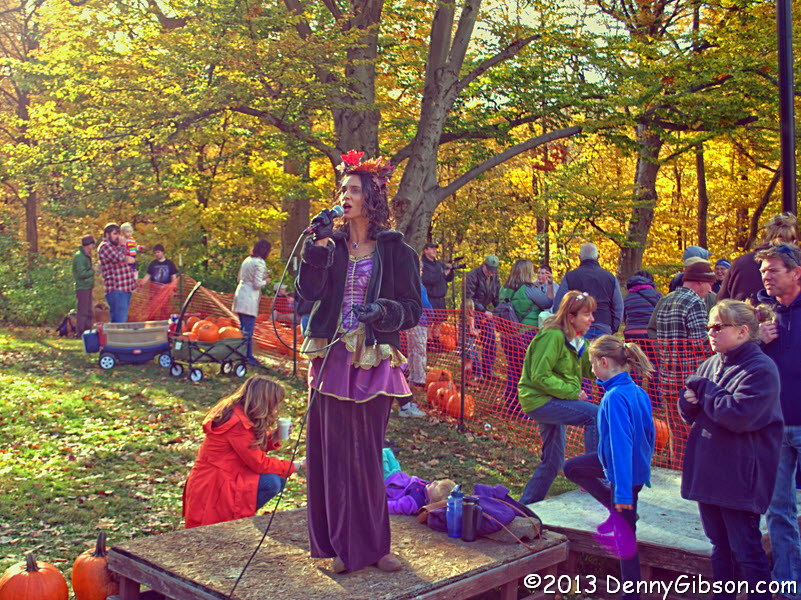
Stanbery Park Pumpkin ChuckThe event had been promoted as being the 7th but that is definitely in question. In an on-air interview, one of the trebuchet builders and operators said “…7th, 8th, 9th, whatever…” and Mary subsequently referred to it as 7th or 8th. An outdated but still online announcement for the 2010 Chuck called it the 5th. The counting of individual pumpkins also appears to be a little loose. In another on-air interview, the Pumpkin Queen (pictured at left) said, near day’s end, that “over 400” pumpkins had been chucked. Many pumpkins in view had numbers in the 5, 6, and 7 hundred range. There are, of course, aspects to chuck scheduling that I cannot know.

Stanbery Park Pumpkin ChuckI believe that both of the big trebuchets are purpose built. One was completed about 1:30 AM on chuck day. The smaller one, which handles smaller pumpkins but gets as much distance as the biggies, is from a privateer. Its owner is an engineer at GE who brings it every year. There are just not that many places a guy can go to play with his trebuchet.

Au revoir.

This Was the Walk That Was…
Risky

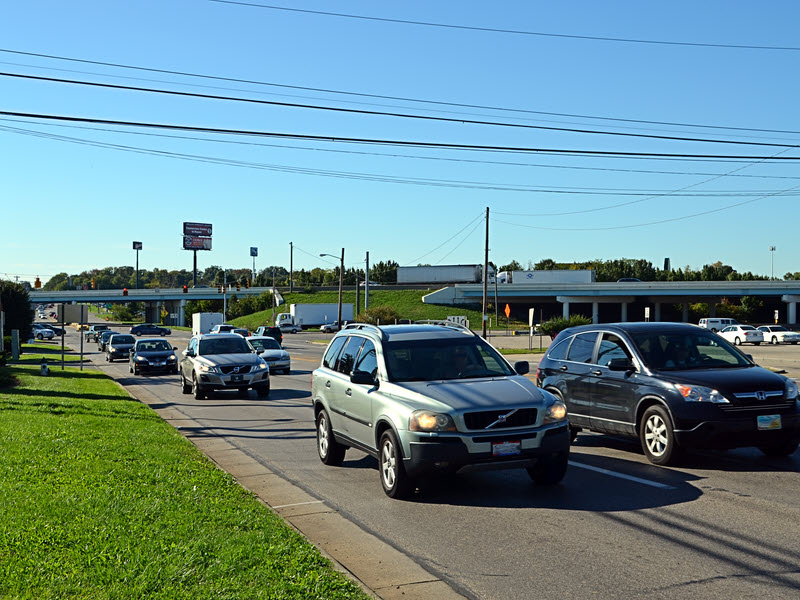
TW3-1I once rode my bicycle through this intersection. Twice, technically, because I had to return, but never again. My bicycle’s power plant is not the sort that delivers instant acceleration or quick sprints and it seemed that about the only thing in question was whether I got run over before or after I collapsed. Walking through it would have been even worse but I did manage to get to the “land beyond” on a few occasions by crossing each road at some distance from the intersection and being very patient. That changed this summer when pedestrian signals were installed here and at other nearby locations.

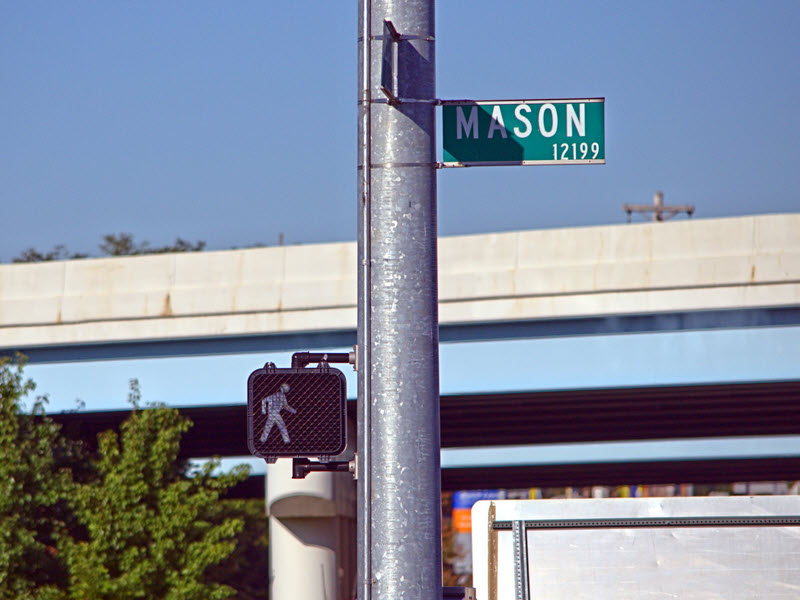
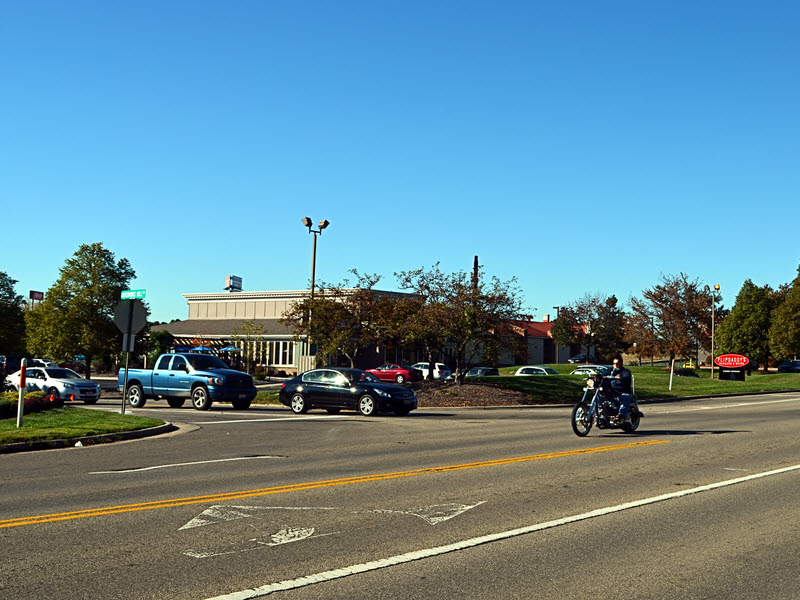
The photo shows the intersection of Mason Montgomery Road and Fields Ertel Road with I-71 overpasses in the background. I-71 exits onto Mason Montgomery Road and entry is from Fields Ertel which help make this intersection quite busy. A major project is underway to improve the flow of traffic getting on and off of the expressway at this point. It has its own website, AdvancingFieldsErtel, which tells not only about the project’s components and progress but what led to it. Few, if any, of the new pedestrian signals I mentioned have anything to do with the highway project. I believe that people really are trying to make this area walkable.

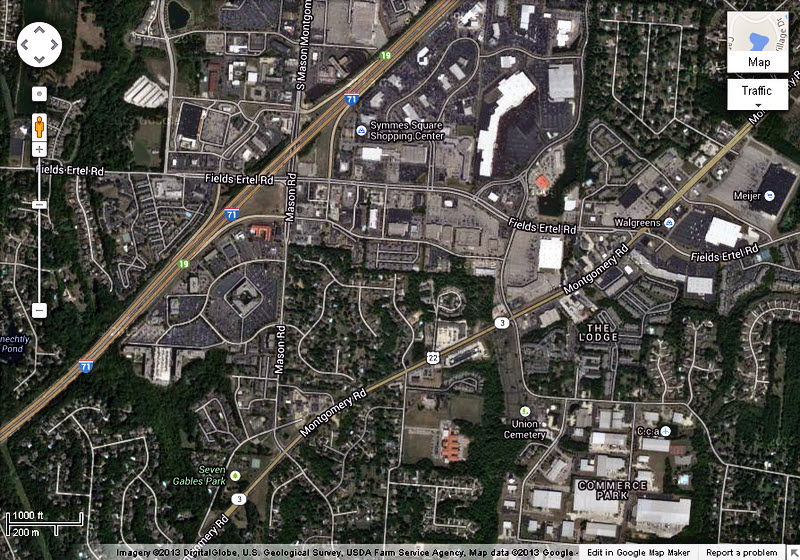
TW3-2I live north of Cincinnati inside the triangle bounded by Mason Montgomery Road, Fields Ertel Road, and Montgomery Road (a.k.a. US-22/OH-3). I-71 misses the northwest corner of this triangle by roughly a hundred yards. An overhead view of the triangle can be had by clicking on the small map at left. Some signs and maps refer to Mason Montgomery Road as simply Mason Road and that is what I’m going to do in the remainder of this article.

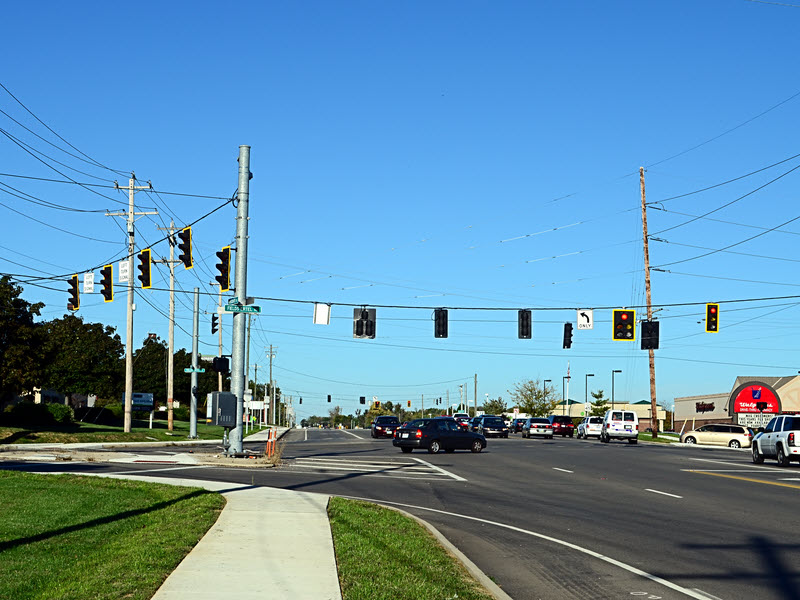
TW3-3The Mason and Fields Ertel intersection is the busiest corner of the triangle but the Fields Ertel and Montgomery intersection is not far behind. That’s it on the right. I once spent many minutes trying to cross Fields Ertel there before walking far from the intersection and crossing at a slightly narrower point. Mason Road essentially ends at Montgomery Road (It changes name and enters a residential area.) so that corner of the triangle isn’t particularly troublesome but it does have considerable traffic as do all three of the triangle’s sides.

I like to eat and I like to walk. I don’t like to cook. That means that an attractive meal for me is one that I didn’t cook and which, at least in fair weather, I walked to. There are several decent eateries (Fridays, Frisch’s, Golden Corral, Honey Baked Ham, Pizza Tower, etc.) inside the triangle so I could somewhat satisfy my walk-to-dinner proclivities without risking life and limb but other restaurants beckoned just beyond the lines of cars.

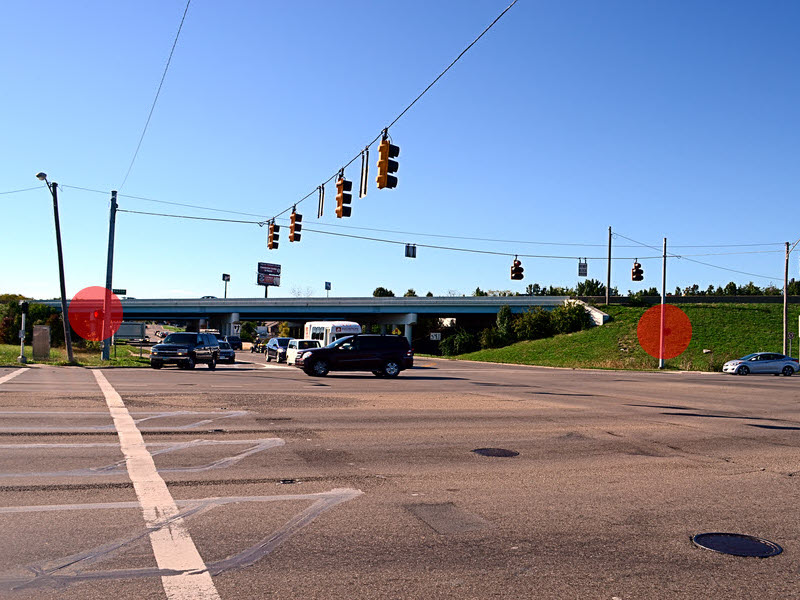
TW3-3TW3-4And now my walking world has exploded. I am able to escape the triangle on foot with some sense of safety. The first picture is of the Mason and Fields Ertel intersection with the new “WALK” signals circled in red. The second was taken as I began to walk across Mason Road while keeping a watchful eye on every car I passed. I can now safely reach the area northwest of the triangle where numerous restaurants, quite a few stores, and a 16 screen movie theater await. The intersection at Fields Ertel and Montgomery road can also be crossed safely and there are attractions in that direction, too. There are also crossing signals at several locations along Fields Ertel and Montgomery Roads and to help with crossing Mason Road north of Fields Ertel but none where it borders the triangle. More on that later.

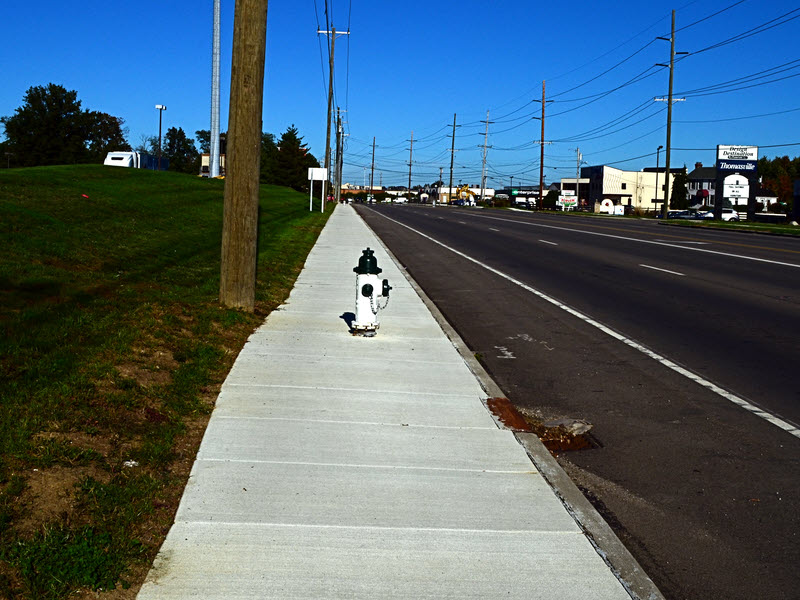
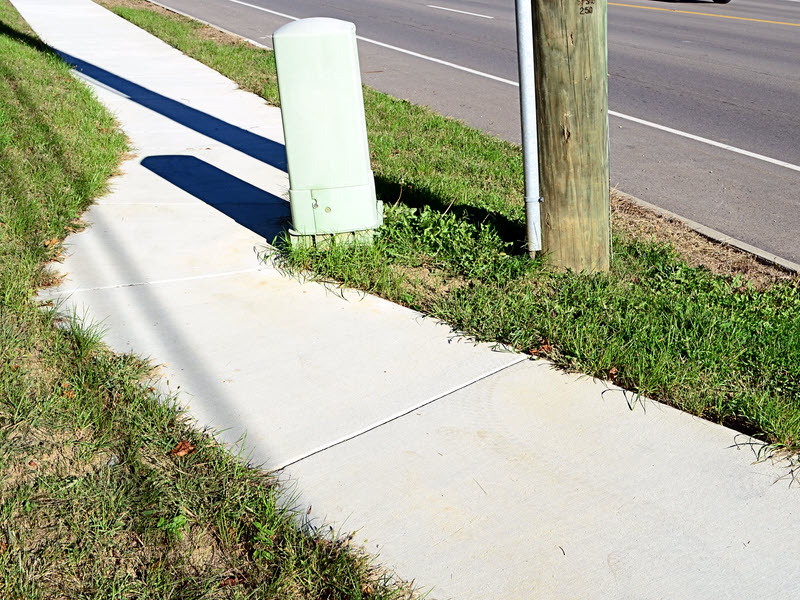
TW3-6TW3-5Sidewalks help increase an area’s walkability almost as much as pedestrian signals. The west side of Mason Road has long had a sidewalk north  of I-71. Montgomery Road got one on its north side, in the area of the triangle, this summer. It is a fact that the sidewalk on Montgomery Road was an afterthought and it sometimes shows. The need to curve around existing infrastructure, as in the first picture is easily understood. The reason behind the long bulge around the fire hydrant, or maybe the drain, is much less clear. It doesn’t matter, though, whether they curve, bulge, or run perfectly straight, I really appreciate the sidewalks. A map at the end of the Symmes Township Sidewalk Plan shows that sidewalks have been proposed but not funded for parts of Mason and Fields Ertel Roads. I’ll be very happy when that happens.

Incidentally, although it isn’t precisely true, the northern boundary of Hamilton County is often considered to be Fields Ertel Road. That means that all these improvements are split between two counties. The local entities responsible are Symmes Township in Hamilton County and Deerfield Township in Warren County. I suppose that makes things more difficult in some ways but it may also make things more evenhanded.

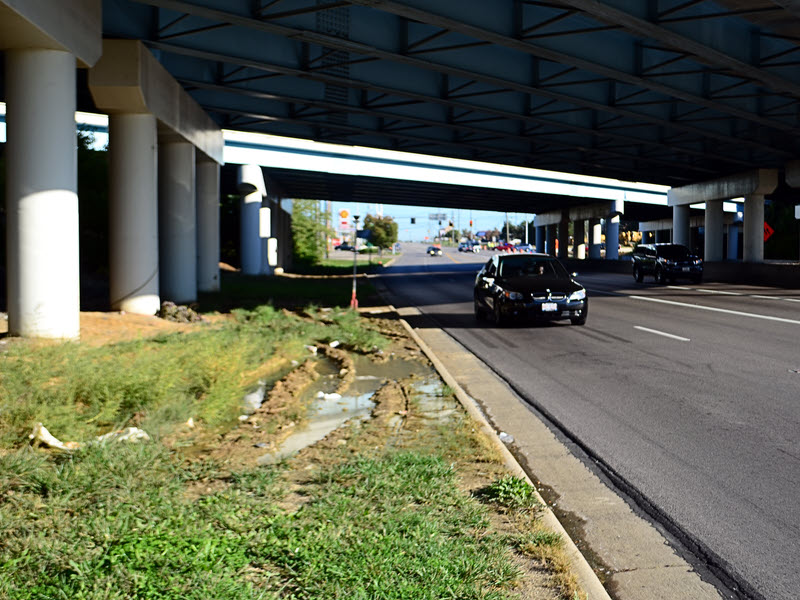
TW3-7TW3-8As things now stand, only two danger zones remain along my various popular paths. One is on Mason Road beneath the I-71 overpasses. It seems to never drain completely and there is no sidewalk. Although I almost never see vehicles there, the pattern of ruts in the mud is constantly changing. Maybe people pull over there every night while I sleep. Because of the standing water and squishy mud, walking in the roadway is more or less required here. Synchronizing the dash to the next dry spot with an empty curb lane helps but is challenging. I’m hoping that this gets improved somehow when the nearby ramp project is completed. The other danger zone is where I cross Mason Road to reach the building in the second picture. The line of cars in the picture have come from an office park and are waiting to turn left. Because of the traffic on Mason road, turning left can take a long time and the line rarely goes empty. This means that anyone attempting to cross the road in front of the building will very likely have to deal with a car from the side street whenever there is an opening in the Mason Road traffic. I handle the problem by crossing at about the point where the picture was taken so that those left turning cars are not an issue. Why would I go to this much trouble to reach that building? It’s called Flippdaddy’s with the subtitle “Burgers & Beer”. Any other questions?

Geeks in the ‘Hood

Cincinnati 2013 Road MeetI attended my third Road Meet on Saturday; This one in Cincinnati. The previous two were in Columbus and Dayton. I did a blog entry on the Dayton meet in which I tried to define “roadgeeks” and describe how they differ from “roadies”. That generated a little discussion on the blog post and more on a Facebook post pointing to it. The much condensed version is that I described “roadies” as liking old roads and “roadgeeks” as being attracted to new roads. The gist of the comments, mostly from those calling themselves “roadgeeks” was, “Hey, we like old roads, too.” And I know they do. As a result, I’ve been shying away from both names and mostly using “road fans” to describe folk who like roads and/or the stuff beside them. It remains true that members of Route 66 and Lincoln Highway groups often refer to themselves as “roadies” and that many of the Yahoo Roadgeek group postings concern new road construction but, as the discussion triggered on that earlier blog entry indicated, the old vs. new distinction really is just one of degree. On Saturday, a bunch of road fans, who are members of a group named Roadgeeks and who know a lot about the way roads are built and signed, met in Bellevue, Kentucky, just across the river from Cincinnati.

Cincinnati 2013 Road MeetThe Cincinnati meet had more of a mix of old and and new than the other meets in my limited experience. It started with drivebys of some old signs on a railroad overpass, which I did not photograph, and this embossed “END OF…” sign. We drove a bit further south before moving onto expressways to head back toward the river. That picture at the top of the article, taken in Devou Park, should have two more people in it. We lost them during on the expressway section and I am responsible for that.

The meet’s organizer, Jeremy Mose, was in my car so I was leading. Behind me, the other four cars shuffled a bit but I thought all were with me as we moved from I-275 onto I-75. But, when we left the interstate, I soon realized that a grey car I believed was part of our group was not. Before too long, I was feeling helpless as well as guilty. The lost couple were attending their first road meet. The first time any of the other attendees had met them was at the restaurant where the meet started. No one had a phone number for them. They had not been part of the group associated with the Facebook event entry for the meet which meant they had not received the cellphone number Jeremy had sent to everyone signing onto that event. They did have a set of driving instructions so it seemed a good possibility that they would find their way to Devou Park on their own but that did not happen during the hour or so we were there. There was only one car in the group which could be lost with no means of contact available and I did it.

EDIT 14-OCT-2013: I have just learned that the missing couple received a phone call from a son in need of a ride and, in their words “had to bolt the meet”. My guilt is gone but I will make more of an effort in the future to see that anyone following me can contact me.

Cincinnati 2013 Road MeetCincinnati 2013 Road MeetWe eventually headed across the river and through what Jeremy called the 6th Street viaduct project and which I, in my few encounters, thought of as a US 50 project. It apparently has an official name which is neither of those though, unless my memory surprises me by tucking away Valdvogel Viaduct, I may continue to use US 50 as the identifier. Valdvogel Viaduct is kind of fun to say so it could happen. We also got a view of part of the project and a lot of Cincinnati from Olden View Park near where the Price Hill Incline once terminated.

Cincinnati 2013 Road MeetThis is a view of the “Lockland Canyon” that I had never seen before. In fact, I don’t recall ever before hearing this section of southbound I-75 referred to by that name though it is apparently fairly common. The canyon aspect of the road comes largely from the fact that locks of the Miami & Erie Canal once occupied this space. Widening the “canyon” is part of a project planned for 2016. Although this was my first time at the “scenic overlook”, I have driven through here countless time. I have also ridden a motorcycle here and can attest to the buffeting that a semi-truck and those concrete walls can create.

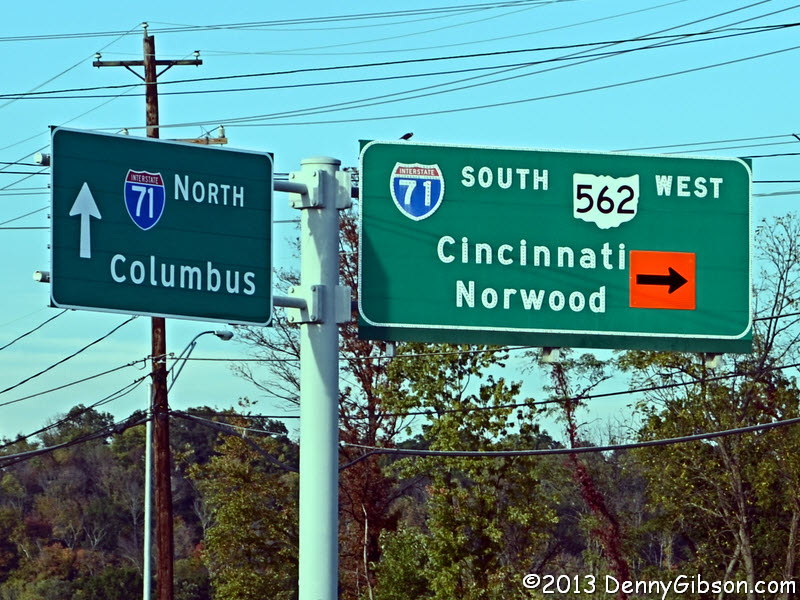
Cincinnati 2013 Road MeetOur last stop was near the Kennedy Connector project. I couldn’t get much of a picture of the project itself so here is a picture of a sign assembly associated with it. The photo illustrates two things. One is the odd mixes that can show up on roadside signs. The right hand panel contains button copy (reflective “buttons” on sign elements). Ohio was one of the last three states to use button copy (The last was Arizona in 2000.) so it is not as rare here as elsewhere but it is an old technology. The left hand panel contains Clearview Font which is sort of the leading edge of highway sign lettering. The second thing the photo illustrates is that roadgeeks notice these things — and the orange “detour arrow”, too.


1832 culvert, Richmond, IN1832 culvert, Richmond, INI had visited another construction project on Monday. A few days earlier, a Richmond, Indiana, newspaper published a story about a repair crew uncovering an 1832 stone culvert underneath US-40 (a.k.a., National Road). The uncovering was temporary and the culvert would again be hidden when the repairs were complete. I headed over for a look but it was already too late. Although the article had appeared just days before, the project it described had taken two months and was very near completion when I visited. The culvert was likely out of sight before the article was printed. Still, it’s nice to know it is intact even though it is out of sight and it is a wonderful thing that pictures were taken during the culvert’s brief appearance.

Majestic Still

Showboat Majestic“Mothballing” is a term used to describe putting boats and ships into storage. When theaters close down, they are said to “go dark”. In the very near future, both of these phrases may apply to long time Cincinnati riverfront fixture the Showboat Majestic. It’s the last of its kind. That sort of thing happens around here more than it should. Martha, the last known Passenger Pigeon died in the Cincinnati Zoo in 1914. The Delta Queen, the last steamboat carrying overnight passengers, called Cincinnati home before losing an important exemption in 2009. Now it is the last authentic showboat that is shutting down.

Showboat MajesticI put the word “authentic” in that last sentence since there may very well be other boats around on which shows are regularly performed. But the Majestic was built as a showboat and that is what it has always been. In 1923, Captain Thomas Jefferson Reynolds set out with his family on the boat he had built with the help of friends and relatives. For the next three decades or so, the boat would be home to the captain, his wife, and their eleven children, six of whom were born on board. Up to the start of World War II, the Majestic cruised the Ohio River and its tributaries providing welcome entertainment to the many small communities along the way. During the depression, seats at performances were traded for, literally, chickens and eggs. In 1943, the boat was docked in Henderson, West Virginia, while Captain Reynolds worked as a river security agent.

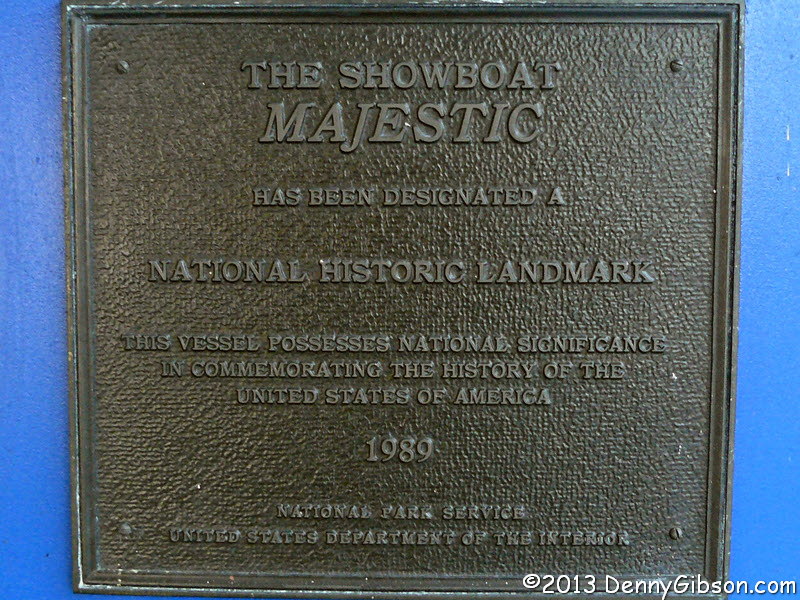
Showboat MajesticAfter the war, changes begun long before were even more apparent. Many of those little river towns now had their own theaters and the residents of those that didn’t had cars to drive to someplace that did. Captain Reynolds kept his family and boat afloat through contracts with universities who used the Majestic in summer theater projects. Reynolds died in 1959 just months after selling the showboat to Indiana University. The boat spent a couple of years, still working, tied up in Jeffersonville, Indiana, after the Safety at Sea Act of 1965 brought an end to traveling the river with cast and crew aboard. In 1967, the City of Cincinnati bought the boat and a long run of University of Cincinnati student performances began. Since 1991, the floating theater has been operated by Cincinnati Landmark Productions. More detailed histories of the Showboat Majestic can be found on CLP’s website and elsewhere. Those plaques on the bulkhead proclaim the boat an Historic Place and a National Historic Landmark.

My own first contact with the Majestic came early in the University Of Cincinnati era when my wife and her sisters, undoubtedly through some UC contacts, organized an on board birthday party for their mother. The family did not buy out the theater but did buy a few rows and guests were able to hang out after the performance eating cake and drinking sangria. I attended another performance or two in the 1970s then sort of forgot about the theater. Oh, I knew it was there, I saw it often enough, but I took little notice of it until reminded of it by someone on another boat. It was July 2009 and I was staying on the Delta Queen for the first time. The historic steamboat had docked in Chattanooga just a month before and many of the traveling workforce, including entertainers Laura Sable and Bill Wiemuth, were still aboard. As we bemoaned the status of the Queen, Laurel pointed out the treasure that Cincinnati still had with the Majestic. I did attend a performance on the showboat early the next season but Wednesday’s was my first since then and apparently my last.

Showboat MajesticThe show was fantastic. Showboat Follies! contains glimpses of all aspects of Showboat Majestic‘s history with plenty of Cincinnati’s past and present mixed in. It took some incredibly creative people to put it together and it was delivered by a wonderfully talented cast. The performance today, September 29, 2013, will be the last for Cincinnati Landmark Productions on board the Majestic. It is not because I haven’t attended more shows. They have been operating at over 80% capacity for some time now. A new theater, which can be used year round, is being built and will allow the company to deal more with performance issues and less with keeping their theater from sinking or floating away. Leaving the Majestic has not been an easy decision and it is obvious that the boat will be missed. Near the end of Wednesday’s show, CLP’s Artistic Director, Tim Perrino, came on stage to talk with the audience about the move. I sensed approaching tears more than once while he spoke and that was with four more shows on the schedule. I predict a lot of wet cheeks this afternoon.


Showboat MajesticMartha won’t be back but both the Delta Queen and the Showboat Majestic could be. The City of Cincinnati has no intention of scrapping the Majestic and hopes that a new tenant can be found. In a strange twist, the US House of Representatives voted to restore the Delta Queen‘s Safety at Sea exemption just hours before I sat down for Wednesday night’s show. The bill is expected to pass the Senate and get the President’s signature. A cruising Delta Queen is still a long long way off but it is a whole lot closer than it has been in a long long time. The picture is of the Delta Queen docked next to the Showboat Majestic during the steamboat’s last visit to Cincinnati in October, 2008.

Now That’s Art

Joe Morgan WeekendCincinnati got a new statue Saturday. There was a big unveiling ceremony with an estimated 3,000 people in attendance. Most of those 3,000 people were standing directly in front of me. I’d heard of the planned unveiling some time ago and probably even considered attending some time ago. But it never really made it onto my agenda until Friday night.

The statue is of Joe Morgan, second baseman of the Big Red Machine. If you didn’t already know that, I’m not sure I even want you reading this, but maybe you just forgot, so here’s a little refresher. The Big Red Machine was the remarkable Cincinnati Reds team of the 1970s. Between 1970 and 1976, they won their division five times, their league four times, and the World Series twice. Those World Series wins were back to back in 1975 and 1976. In both of those years, Joe Morgan was the National League MVP. So seeing a statue of him unveiled would certainly be a cool thing, but on the other hand, I didn’t think it cool enough to fight a crowd to see something I could probably have all to myself on most afternoons in a month or so.

Then, on Friday, I’m out playing trivia with the Reds game on TV. It’s live trivia so the TV sound is off. It is the start of a Joe Morgan weekend, and there is a pregame ceremony. I’m watching it out of the corner of my eye and eventually realize that, one by one, Joe’s old teammates are trotting out on the field. Soon the entire Big Red Machine starting lineup is there. The most astonishing thing about this is that it includes Pete Rose who has been banned for life from participating in any aspect of Major League Baseball. He was being permitted on the field so that Joe’s celebration could be complete. Seeing the Great Eight, as that group was called, was cool enough to justify dealing with a crowd.

Joe Morgan WeekendJoe Morgan WeekendJoe Morgan WeekendSo I fought the crowd and the crowd won. My resolve to go wasn’t nearly as strong when I woke up as when I went to bed. I alternately talked myself into and out of going until it reached the now-or-never point. It once again sunk in that seeing the Great Eight together just might not ever happen again. I left home with just enough time to get there before the unveiling. The first picture is what I saw when I arrived. The second is what I saw after I had worked myself to the other side of the crowd. When things actually started, I realized that, not only were all those heads between me and the speakers, so was the tent. I had incorrectly assumed they would be in an open space to the left. I could, every once in a while, see one of the speakers under the tent covering and over the bobbing heads and I’ve included a picture of Joe to prove it.

Joe Morgan WeekendDrat! I had not actually seen the Great Eight. However, there would be another ceremony of some sort preceding the afternoon game with the Los Angeles Dodgers. The game was sold out but I got a ticket for a bad seat for a so so price from a scalper. I walked around the area and grabbed a sandwich. The crowd that initially hid the statue (shown at right) eventually thinned out so I could take the picture at the top of this article.

Joe Morgan Weekendjmwe07jmwe08I misjudged the time and the ceremony was already underway when I entered the stadium. I made it just in time to see Pete being introduced and Joe soon followed. The other six were already on the field. There was, of course, more to the Big Red Machine than these eight players but they were the heart of it. Of the 88 games that all of the Great Eight played in 1975 and 1976, they won 69 or nearly 80%.

Joe Morgan WeekendJoe Morgan WeekendThere were a few speeches and even the unveiling of a miniature of the life size statue outside the stadium. The ever classy Morgan talked much more about his teammates than about himself.

Joe Morgan WeekendJoe Morgan WeekendWhen it was time for the ceremonial first pitch, all eight players moved to their positions. The 69 year old Morgan had no trouble getting the ball to the plate and the 65 year old Johnny Bench had no trouble catching it. Then, as they walked toward each other, Bench flipped the ball back to Morgan who casually one-handed it. Then the Big Red Machine gathered for one more meeting by the pitcher’s mound.

Joe Morgan WeekendJoe Morgan WeekendAt the end of the day, when I looked through the pictures I had taken, I noticed that Bench’s star, in the line where the Great Eight had stood, was turned sideways. Had someone goofed when they laid them out? Had it been accidentally kicked around as the players waved to the crowd? Nope. A check of earlier photos revealed the truth. Bench had turned the star himself when the players moved to their chairs. Johnny is a joker.

Joe Morgan WeekendJoe Morgan WeekendThere is an awful lot of Cincinnati history in these two murals at Great American Ball Park. For one thing, the mosaics are reminiscent of those that once hung in Union Terminal and have since been moved to the airport. Sadly, those are once again in danger as the building they are in is slated for demolition. Secondly, there is the suspension bridge in the background. The bridge officially opened January 1, 1867. It’s still there and can be seen from the current ball park. One mural is of the 1869 Red Stockings, the world’s first fully professional baseball team. Note that the bridge is correctly shown without the steel trusses that were added in the 1890s. The other is of the Big Red Machine, the same eight men who were on the field today. The Red Stockings had a 65-0 record in 1969. In the seven seasons between 1970 and 1976, the Big Red Machine had a record of 683-443.

With the game tied 3-3, I left after eight innings. The Reds won in the tenth. That’s when the Reds latest speedster, Billy Hamilton, scored from second, which he had stolen, on a Todd Frazier single. Today was the thirty-ninth anniversary of another Reds win over the Dodgers. During the 1970s, the Reds-Dodgers rivalry was one of the biggest in baseball. Joe Morgan was playing with a sprained ankle on September 7, 1974 so wouldn’t be stealing any bases. Instead, he beat the Dodgers with a two-run eighth-inning homer.

Dennis at Tennis at Last

Western Southern Open 2013Cincinnati is home to “the oldest tennis tournament in the United States played in its original city”. What was once called the Cincinnati Masters began in 1899. Its current name is the Western & Southern Open. It’s a big deal with the world’s top ranked players, both men and women, competing. Despite that “original city” statement, the tournament site is no longer within the city limits of Cincinnati. It has moved several times in its 114 years and is now a little north of the big city near Kings Island Amusement Park and the smaller city of Mason. It has been there since 1979. During all of those thirty four years, I have lived no farther away than six miles and as near as three. This year I decided to see what was responsible for those annual traffic jams.

Play began this year with some qualifying matches on Saturday, August 10. Finals for both men and women take place today, August 18. I went Tuesday when things were interesting but not yet at fever pitch. The stadium behind the big TV screen in the picture at the top of this article, is Center Court. There are a total of sixteen courts at the Lindner Family Tennis Center including three smaller stadiums. All Center Court seating is reserved but a ticket there permits free run of all courts where most seating is open. One reason that Center Court is half empty in my pictures is that there is a lot going on and some people are watching matches on other courts. I suspect, though, that a bigger reason is that many with full series tickets simply skip the earlier matches.

Western Southern Open 2013Western Southern Open 2013Separate tickets are sold for day and evening sessions. My day session ticket entitled me to watch three matches at Center Court. The evening session would include two Center Court matches. I watched my first big time tennis match from beginning to end. It turned out to be the only one I would do that with. Through some mechanism that I never got around to investigating, the couple at the center of the first picture had won the right to do the pre-match coin flip. Lots of similar honors could be won such as as the on field seat occupied by a six year old boy during player warm-ups. The player on the couple’s left (viewer’s right) is Victoria Azarenka, the world’s number 2 ranked woman player. Her opponent is Vania King who won qualifying matches on Saturday and Sunday to get here. Azarenka easily took the first set but barely won the second in a tiebreak.

Western Southern Open 2013With the match over in two sets, I figured there would be a fair amount of time before the next one and left the stadium to look around. This is Hickory Robot, who I’d actually been hearing while inside the stadium and who I now could see as well as hear.

Western Southern Open 2013Western Southern Open 2013Western Southern Open 2013By the time I got back to my seat, the match between John Isner and Florian Mayer was in progress. Isner had been in the news recently and, although I did not remember his name, I did remember the news. Isner is the top ranked U.S. player and recently dropped from 20 to 22 resulting in there being no male from the USA in the top twenty for the first time since ATP rankings began in 1973. The current 22 did in the current 50 in two quick sets.

Western Southern Open 2013Western Southern Open 2013Western Southern Open 2013I took another break but before leaving the stadium, climbed to the last row of seats to take a look out over the complex. That’s the one-third scale Eiffel Tower at Kings Island in the background. Then I caught a little of the action between Mikhail Youzhny and Ernests Gulbis on the Grandstand Court and what was apparently a doubles match between shirts and skins on another court. In reality, I think that shirts and skins thing was just practice.

Western Southern Open 2013Western Southern Open 2013Western Southern Open 2013The third match at Center Court was pretty impressive. It took all three sets, including a tiebreak in the first set, for number 3 ranked David Ferrer to defeat number 102 Ryan Harrison. I knew Ferrer’s ranking from the schedule but had no idea what Harrison’s rank was. Had I realized the size of the disparity, I’d have been even more impressed with Harrison’s full court play and serves like this.

https://dennygibson.com/blog//////wp-content/uploads/2013/08/wso_hs.jpghttps://dennygibson.com/blog//////wp-content/uploads/2013/08/wso_hs.jpghttps://dennygibson.com/blog//////wp-content/uploads/2013/08/wso_hs.jpgI selected the session I attended purely on convenience and felt lucky is seeing the number 2 ranked female, number 3 ranked male, and highest ranked American male in my three matches. That might not be luck, though. It may be that the level of talent at this tournament almost guarantees seeing players of that caliber at every session. As I headed out, I paused briefly to listen to Kelly Thomas and the Pickups and watch a bit of the action at Court 3. The second picture was taken from Court 3 showing courts 5 and 6 and illustrating just how much tennis is going on here. The last picture is of the Moet & Chandon stand by Center Court. Moet & Chandon is the official champagne of the tournament. Up in my old neighborhood, Greenville, Ohio, has hosted the World Horseshoe Pitching Championships on several occasions, most recently in 1999. I am sure they will be back someday and do not believe they have yet selected an official champagne. There lies opportunity.

At this article’s Sunday morning publication, the matches I watched on Tuesday are ancient history but two of the three players I saw win are still playing. Victoria Azarenka, winner of the first professional tennis match I ever saw, won again on Thursday , Friday, and Saturday and will face number 1 ranked Serena Williams in the WTA finals this afternoon. The winner of that second match, John Isner, is also playing today. He is pitted against Rafael Nadal for the championship after a march to the finals that included a victory over number 1 ranked  Novak Djokovic. Win or lose, I’m guessing that the next top twenty released will once again include an American male. David Ferrer, the third winner I watched on Tuesday, was eliminated on Thursday.

1940s Flashback

Cincinnati Museum Center 1940 WeekendCincinnati Museum Center held its first “1940s Day” in 2011. It became “1940s Weekend” in 2012 and is again a two-day (Aug 10 & 11) event this year. The Museum Center occupies Union Terminal, which saw its heaviest use in the 1940s. It opened in 1933 with a capacity of 17,000 passengers per day; A number that not only seemed adequate but, with rail travel already on the decline, major overkill. It was World War II, of course, that changed that. The terminal became a hub for the movement of troops, and as many as 34,000 passengers, twice as many as it was designed for, passed through it daily.

Cincinnati Museum Center 1940 WeekendCincinnati Museum Center 1940 WeekendThough it doesn’t completely ignore them, “1940s Weekend” doesn’t focus on the horrors and hardships of the war years but on the bright spots they contained and the brighter years that followed. Music figured into many of the bright spots both then and now. The Jump ‘n’ Jive Show Band and several guest vocalists kept energetic attendees jumping, and the Sweet and Lows roamed the building with their wonderful harmonies. The picture shows an “on location” performance of The Trolley Song (a.k.a., Clang Clang Clang went the Trolley). The Sweet and Lows perform both days, but the Jump ‘n’ Jive Show Band gives way to the P & G Big Band on Sunday.

Cincinnati Museum Center 1940 WeekendCincinnati Museum Center 1940 WeekendCincinnati Museum Center 1940 WeekendThe rotunda was filled with vendors of, mostly, railroad memorabilia, and there were demonstrations of some of the grooming procedures of the day. The theater showed newsreels that were post-war or at least post-V-E Day. The picture I’ve posted is of General Eisenhower praising the rank and file members of every military branch for their war contributions. I also attended two live presentations in the theater.

Cincinnati Museum Center 1940 WeekendCincinnati Museum Center 1940 WeekendThe first was a recreation of an episode of the Seckatary Hawkins radio program. Seckatary Hawkins was the creation of Covington, Kentucky, native Robert Franc Schulkers. The mystery-solving character first appeared in 1918 in the Cincinnati Enquirer, then in novels and a radio program. Initially, the show was done in Cincinnati by Schulkers and friends and family, but it soon moved to Chicago, where professional actors filled the roles. Following the presentation of a little history, a volunteer cast was assembled and a fine performance delivered. The once huge Seckatary Hawkins Fair and Square club has been revived, and you can join for free. I did.

Cincinnati Museum Center 1940 WeekendThe second presentation stepped away from music and laughter. For the first time, each day of the weekend will feature a Holocaust survivor presenting their own story. Today’s speaker was Werner Coppel, who had been sent to Auschwitz-Buna as a teenager. He subsequently escaped during a death march. I have seen movies and read books and have had other personal Holocaust stories told to me directly, but none more insightful or delivered as articulately as what I heard today. Calling it a highlight may seem strange, but that’s what it was for me. There is a short video of a previous Werner Coppel talk here. Henry Fenichel will share his story on Sunday. He can be seen in a video here.

Tasting Cincinnati

http://www.tasteofcincinnati.com/taste.aspx?menu_id=268&id=8780At 35 years of age, Taste of Cincinnati is “the nation’s longest running culinary arts festival”. It started as a one day affair in 1979 but within just a couple of years had grown to two. Since 1988 it has filled the entire three day weekend of Memorial Day with food, drink, and entertainment. When it expanded to three days, it moved from Piatt Park (Garfield Place) to Central Parkway. Since 2007, its home has been several blocks of Fifth Street around Fountain Square.

Taste of CincinnatiTaste of CincinnatiMy attendance has been spotty but when I do go I sort of target the winners and I did a pretty good job of that this year. At left is this year’s Best Entree, a very tasty Honey Sweet & Sour Shrimp from Arloi Dee. It was preceded by the Best Appetizer, Thai Taste’s Crab Rangoon. I’d also try the Best Dessert but that would be later.

Walking between the rows of booths exposed me to all sorts of tantalizing aromas and sights and I yielded to a Third Place Pulled Pork Sandwich from Giminetti’s Bakery. Third place is pretty impressive and it tasted mighty fine but, largely because of what I came to next, I didn’t really need it.

Taste of CincinnatiTaste of CincinnatiTaste of CincinnatiWhat I came to next was the Taste Experience. New this year, the Experience features some of the area’s top tier restaurants along with Les Chefs de Cuisine, the regional chapter of the American Culinary Federation. The restaurants generally do three hour stints while Les Chefs are there through the full weekend. I decided to try the Rigatoni Bolognese being offered by Palomino for $3 but, when told I could have it and the Pear Bread Pudding for $5, I just said yes. Considering the ladies doing the serving, it’s surprising I didn’t go for ten of each.

Taste of Cincinnatitoc08Shortly after arriving, I had registered for a Christian Moerlein brewery tour. As tour time neared, I returned to Fountain Square to board the shuttle. On the way to the brewery, we passed Piatt Park, site of the first nine Tastes, which was occupied today by the March Against Monsanto.

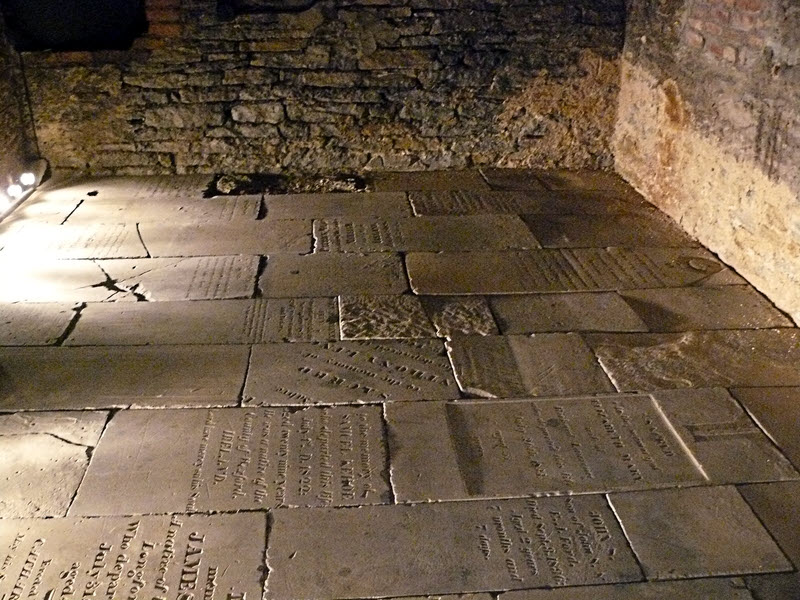
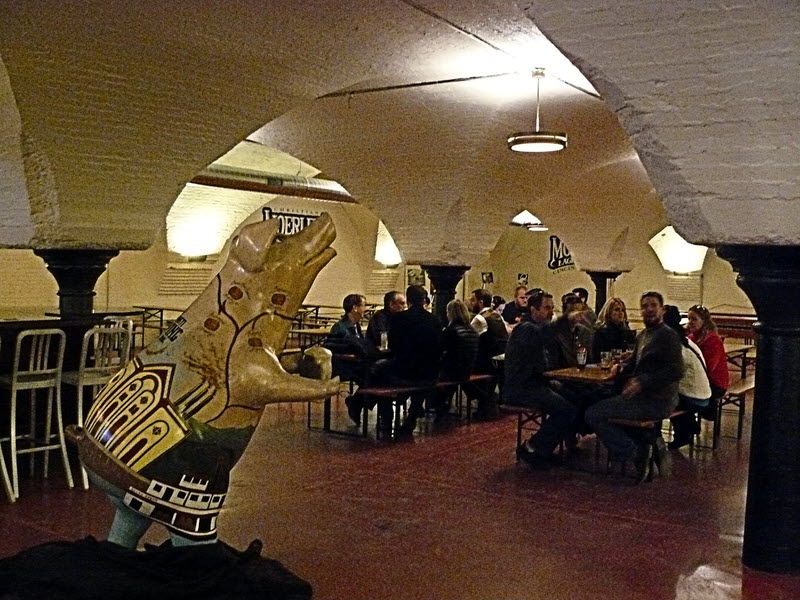
Taste of CincinnatiTaste of CincinnatiTaste of CincinnatiI had expected a tour of the rather new Moerlein production facilities so was surprised to learn that the tour involved the lagering cellars beneath the brewery. The building now occupied by Moerlein was home to the Kaufmann Brewery before prohibition did it in. I’ve been here before but it’s always interesting to visit the massive hand dug cellars and see what several decades of use as a trash bin produces.

Taste of CincinnatiTaste of CincinnatiThough there really wasn’t a tour, someone was on hand in the brewing area to answer questions. The taproom officially opened today and will be in operation regularly on weekends.

It always thought it a little embarrassing to attend a “taste” event in a city that was once a leader in beer production — and consumption — and find nothing but the likes of Budweiser and Miller. Christian Moerlein and owner Greg Hardman have changed that in a big way. Moerlein is a presenting sponsor of this year’s event and Moerlein booths were plentiful but there was no monopoly. Miller and Bud were there and so were folks like Rivertown, Great Lakes, and Bells.

Taste of CincinnatiTaste of CincinnatiAfter the tour, I returned to the festival area for two specific reasons. Food trucks have become increasingly popular in the area. Taste of Cincinnati added a Food Truck Alley this year and that’s something I hadn’t yet seen. And then there was that Best of Taste dessert. There were definitely some inviting food trucks in the “alley” but I was saving what little room I had left for the Vanilla Bourbon Bread Pudding at Blue Wisp. A color coded living statue made the place easy to find and the excellent bread pudding was the perfect finish to a day of epicurean delights.