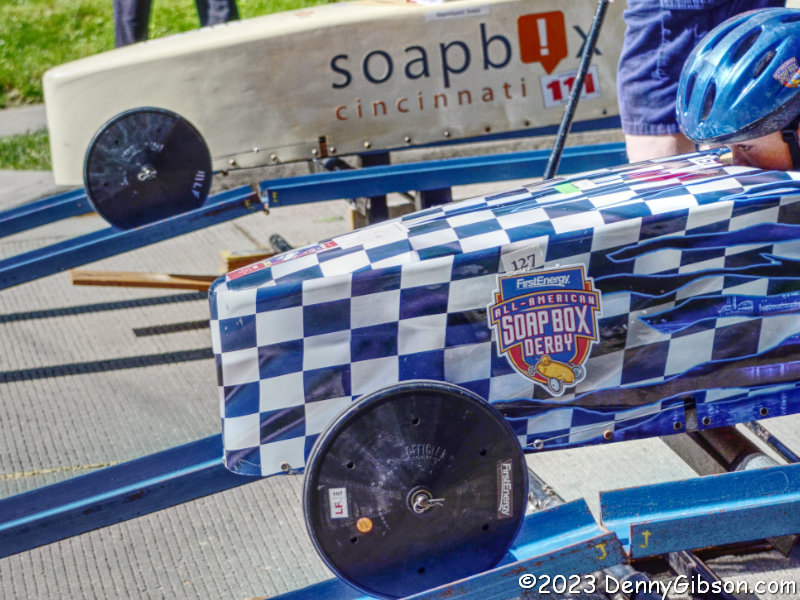
 I once attended a Cincinnati Soapbox Derby event and I know I took some pictures but apparently I did no reporting of it on this site. This post will keep last Sunday’s Golf Manor Grand Prix from suffering the same fate. The Golf Manor race is an International Soap Box Derby® sanctioned event but it is not a qualifier for the big derby in Akron, Ohio. For Cincinnati, that role is assigned to the Cincinnati Local Derby held in June. That means the Golf Manor event is something of a practice session with a sizable percentage of first-time drivers. Both Stock and Super Stock races are held but I attended only the Stock event that filled the morning. Stock car drivers are between 7 and 13 years old and under 5’3″ and 125 pounds. Super Stock cars are a little bigger with drivers between 9 and 18 years of age and up to 6’0″ tall and 150 pounds in weight.
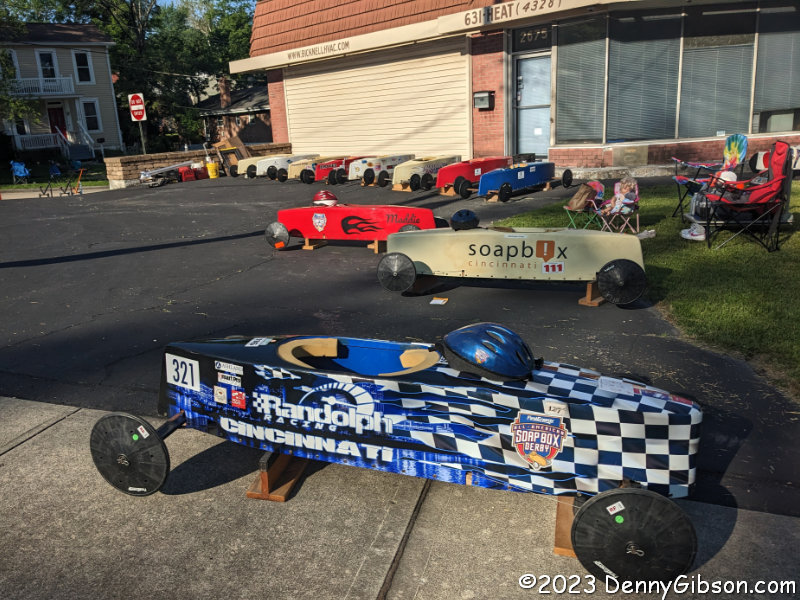
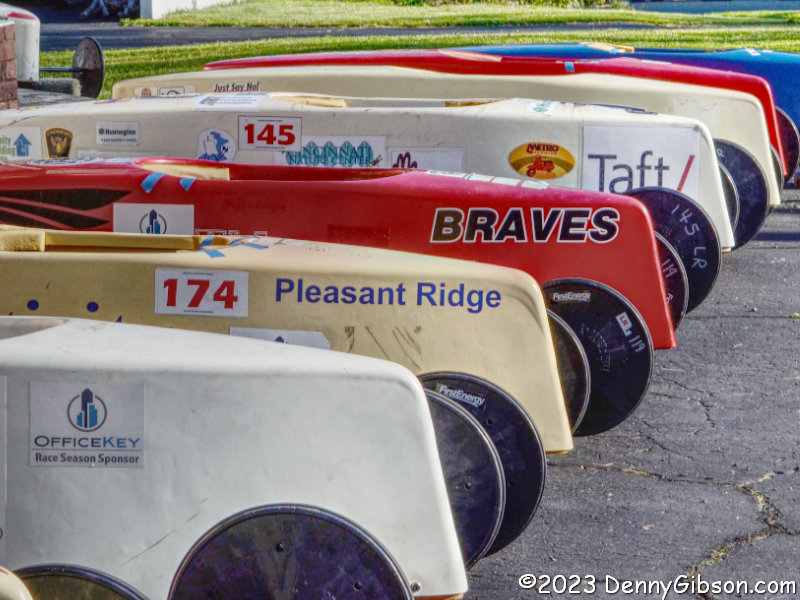 When I arrived, the pit crews (a.k.a., parents) were hovering around the cars and confering with the drivers. I snapped these pictures of the unattended cars when the drivers meeting was announced.

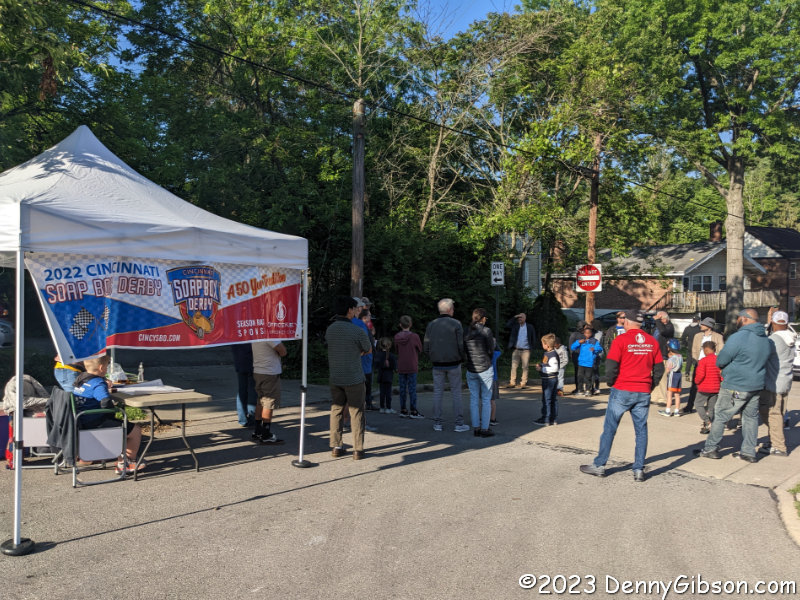 The drivers meeting was much like others I’ve seen or attended although the drivers were somewhat shorter than what I’m used to seeing. And I think they were less impressed with greetings from Mayor Stefan C. Densmore than were the pit crews and officials. Golf Manor is an independent municipality completely surrounded by the city of Cincinnati.
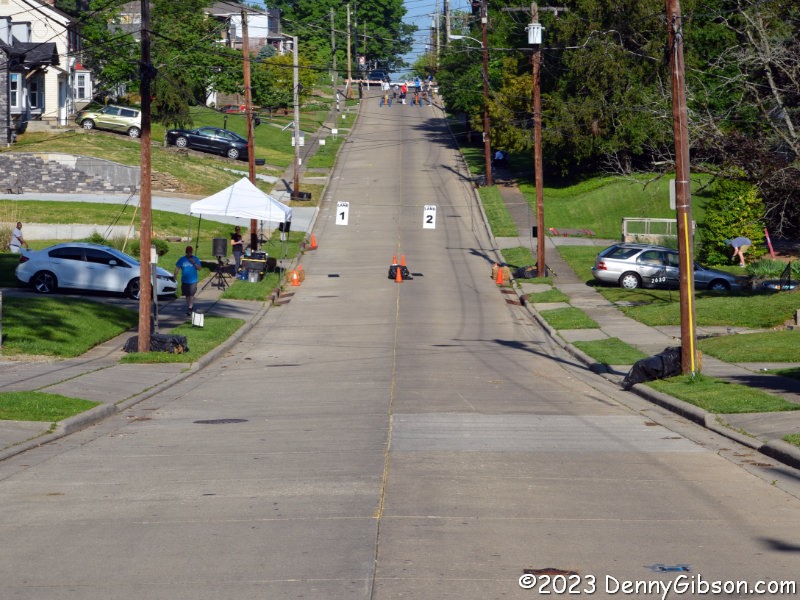 At 180 meters (about 200 yards) the track here is considerably shorter than the one in Akron (301 meters) but it has the advantage of an uphill slope beyond the finish line. This does slow the racers a bit to the benefit of young rookies who don’t always remember to apply the brakes appropriately.
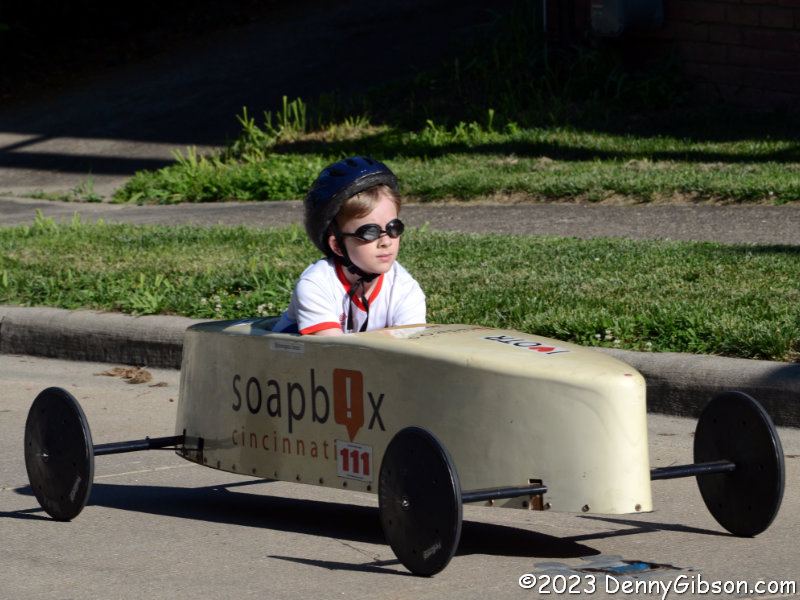
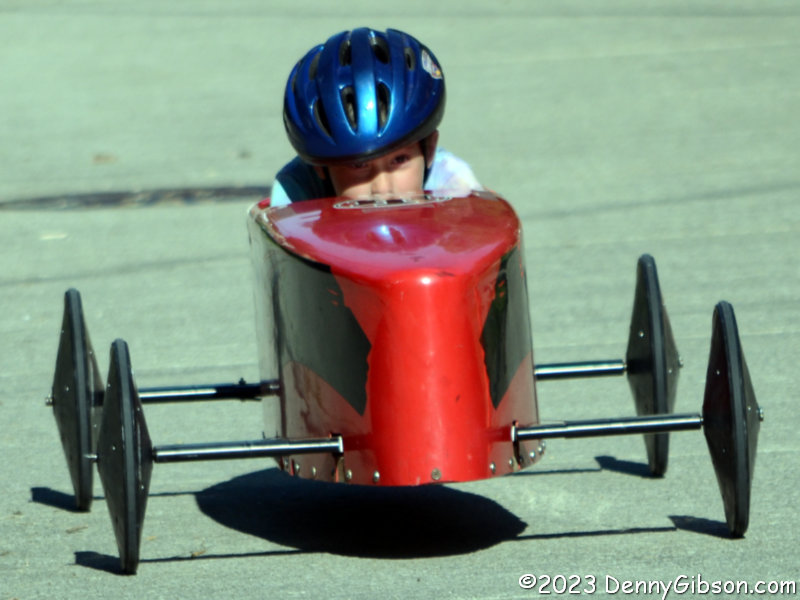
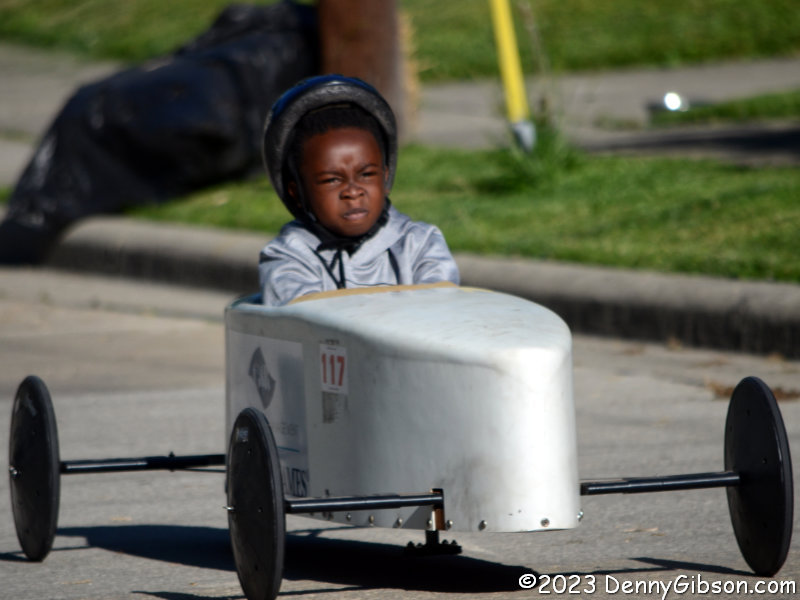
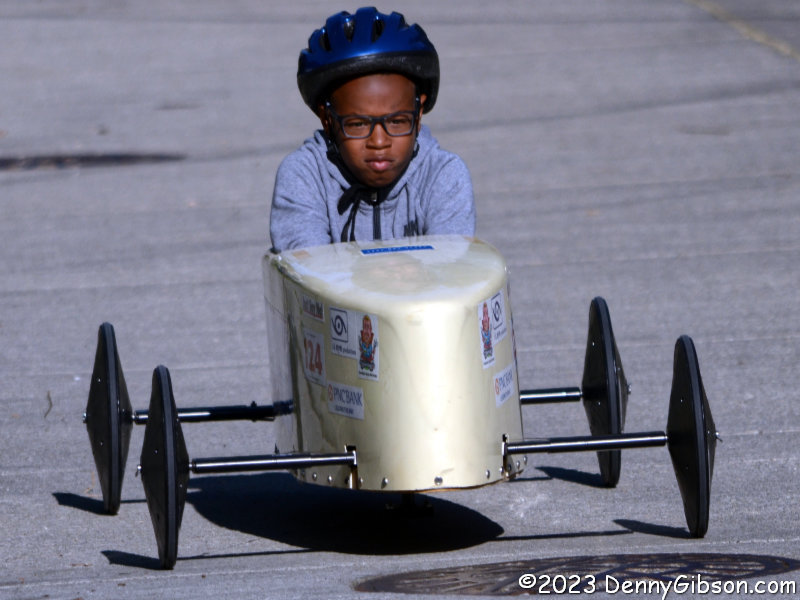
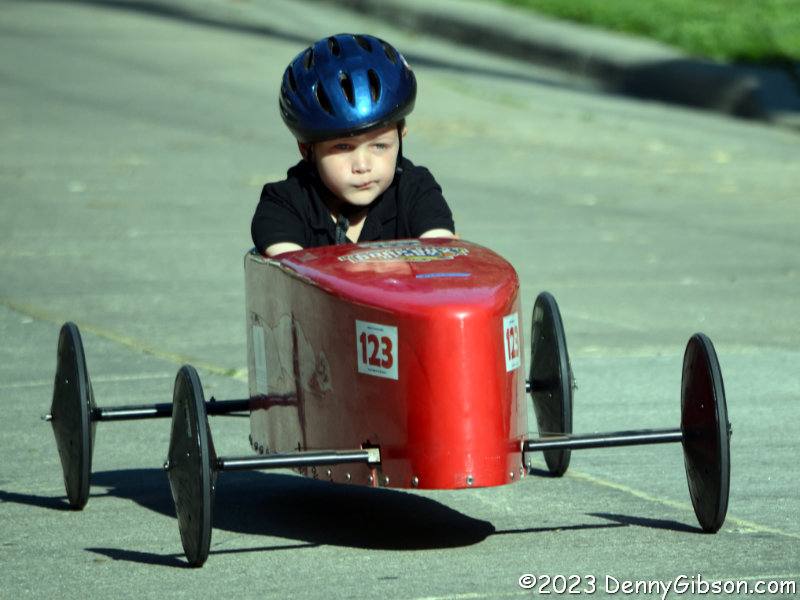 On-track action started with a number of solo runs which I guessed were to give first-timers a run with minimum distractions and no chance of interference. In reality, though, I don’t think these drivers were about to let anything distract them.
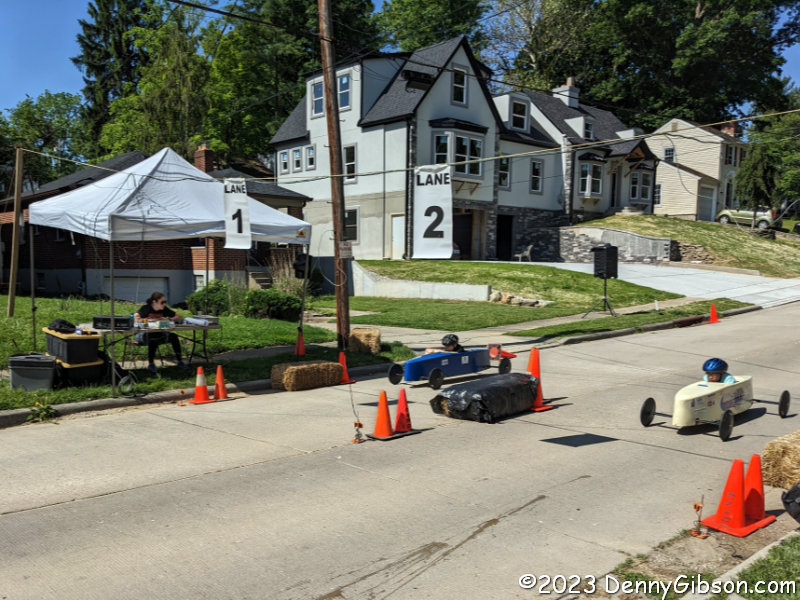 Precision electronic timing gear automatically picks and announces the winners. Elapsed time is not important meaning only the time between the two racers need be measured. Of course, very high-resolution measurement is required as just fractions of a second separate the cars. Math is just one of the things Soapbox Derby racing teaches its participants.
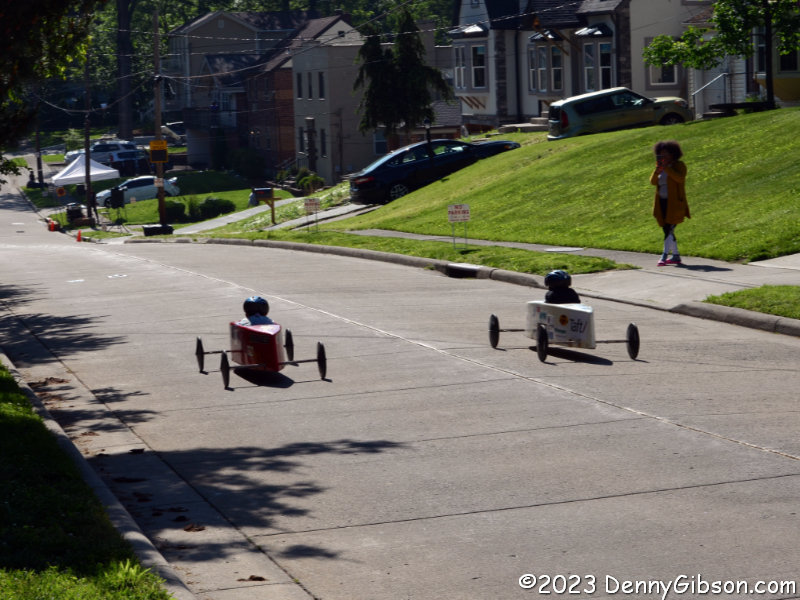
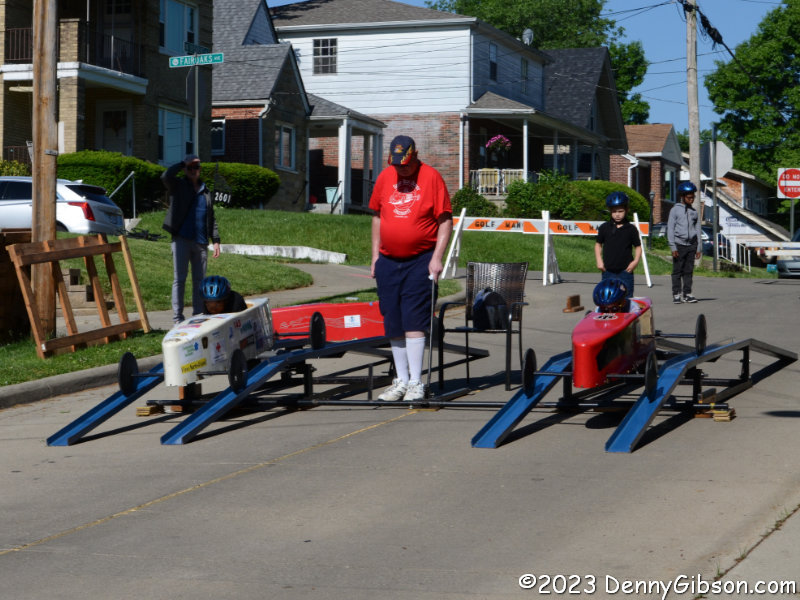 It also teaches sportsmanship. At the start of a race, the drivers are encouraged to wish each other luck before the starter triggers the mechanism that simultaneously releases both cars. Then the drivers get to learn about gravity, friction, aerodynamics, and lots of other things including just how cool a steering wheel and a burst of speed feels.
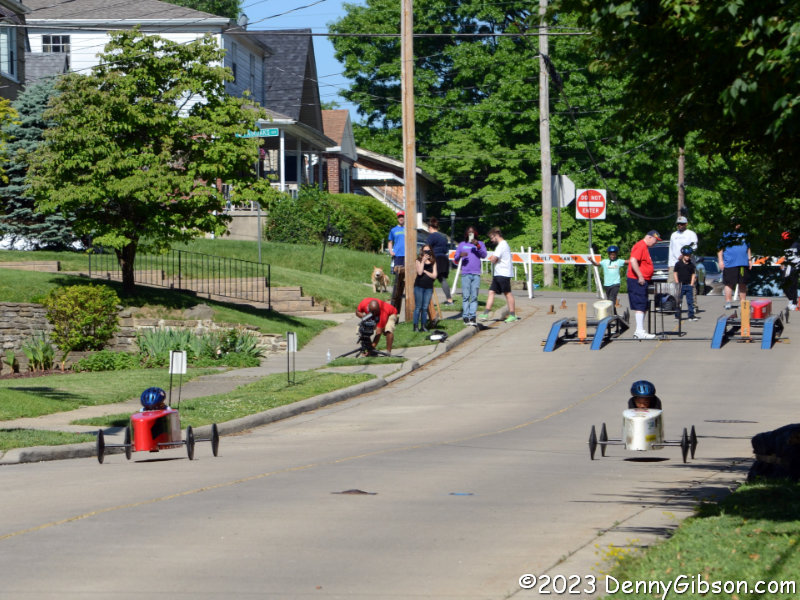
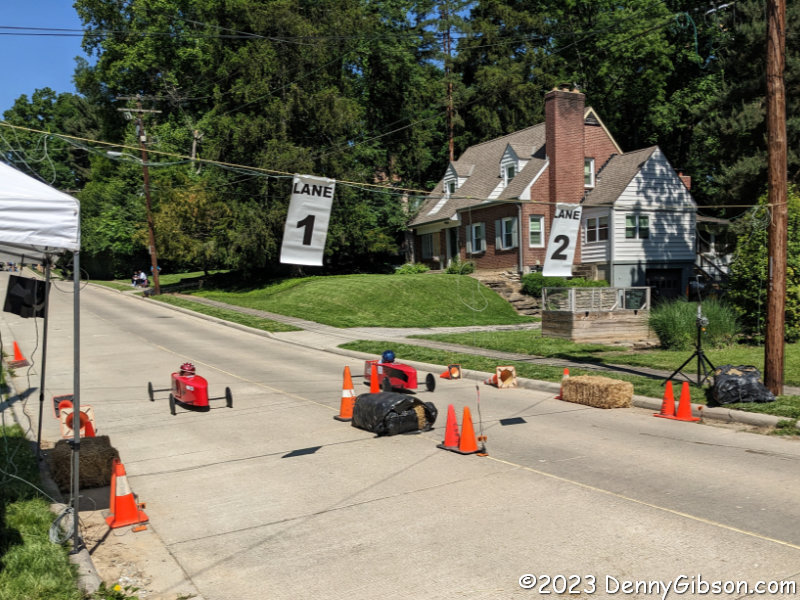 The racing was mostly without incident and I saw no reason to photograph the few incidents that did occur. A couple of drivers were still learning the mysteries of steering and shortened their runs by angling into the curb and one driver verified the brakes were working by stopping about halfway down the hill. One car veered into the other lane and ended up slamming into the straw bale protecting the timing sensors. I later overheard comments that something in the steering may have broken. Whatever the cause, it was a traumatic experience with some extra learning that was harsh but injury free.
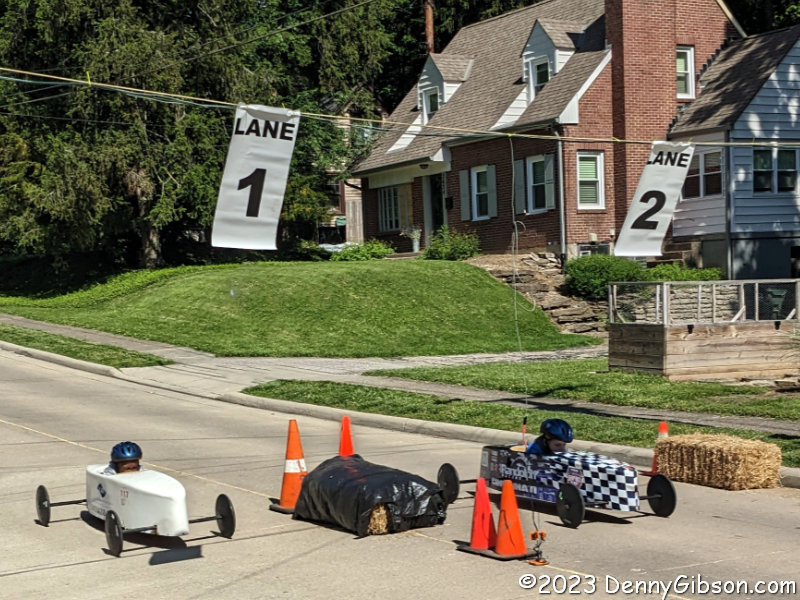 I’m seriously thinking about going to the big show in Akron this year although there are no firm plans in place. The Cincinnati qualifier would be a nice prelude to that but at the moment that looks to be something I’ll have to miss. If that’s the case, this driver’s practice will be my practice too.
 I did better this year than last, and last year I did better than in any of the preceding 148. As explained in a blog post (













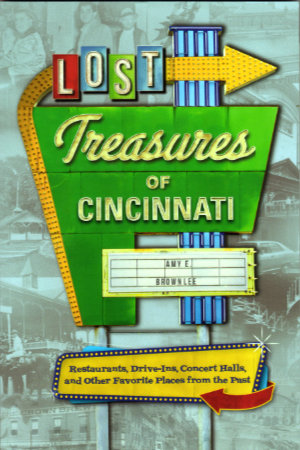 Amy E. Brownlee is a lifelong Cincinnatian. She naturally learned a lot about the city growing up here then used that knowledge and added much more during her ten years at Cincinnati Magazine. An awful lot of the treasures she writes about in Lost Treasures of Cincinnati were lost before she arrived but a rather frightening number have disappeared during her lifetime. Of course, an even larger number have disappeared during mine. Neither of us is responsible for that. I swear it’s coincidence pure and simple.
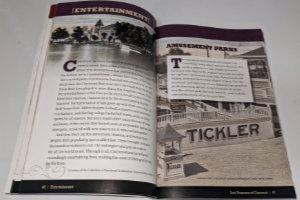 The book opens with “Food and Drink” in Section 1 then covers “Entertainment” and “Retail” in the next two sections. The smallest section, “Media”, is followed by the largest, “Community”. Definitions for those section titles are not particularly rigid and the size of the “Community” section probably indicates that it is the least rigid of all. It is where things like churches and breweries, of which Cincinnati had more than a few, appear.
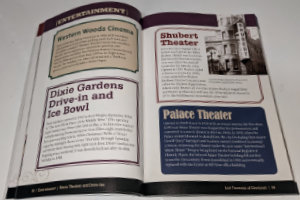 Most, but not quite all, of the breweries mentioned in the book were gone before I got here. Likewise with restaurants and attractions which together comprise the biggest part of things that have disappeared during my lifetime. I caught one show, Hair, at the Shubert (“Entertainment”) before it was torn down. I also saw one movie at the Albee (“Entertainment”) but I don’t remember what it was. I had one meal each at The Gourmet Room and the Maisonette (“Food and Drink”) before they closed. There are quite a few places in this book where I ate one or more meals or watched one or more movies, plays, games, or concerts. Encountering each of them on these pages prompted memories that went way beyond the single paragraph of text. Reading about places that were already gone when I came to Cincinnati didn’t prompt any memories, of course, but it did make me appreciate just how many treasures have been lost.
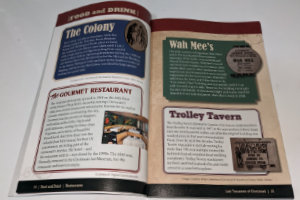 I really enjoyed reading Lost Treasures of Cincinnati cover-to-cover front-to-back but as I did, two other ways of reading the book came to mind. With its fairly short standalone essays, it seems like a natural fit for that popular personal reading room with the porcelain furniture. Its use as a reference book also seems rather natural. I don’t mean an every-last-detail reference book to use in conducting deep-dive research but a great place to answer questions like “What was the name of that boat-shaped restaurant?” or “What happened to our NBA team?”. The full index will help the book play that role.
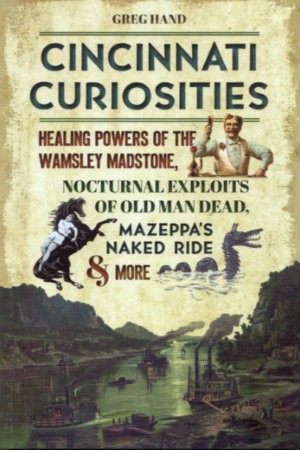 Greg Hand has been a man of letters — or at least a man of words — his entire adult life. He began as a newspaper reporter, moved up to editor, left to head up a university PR department, co-authored three books about the university while he was there, then retired. I was not even slightly aware of any of this as it was happening. I only became aware of Hand’s existence when I stumbled upon the blog he started post-retirement. His knowledge of local history and ability to dig up information to augment that knowledge was immediately apparent and I’ve been an ardent reader of that blog ever since that happy discovery. The blog’s name is Cincinnati Curiosities and it can be found
 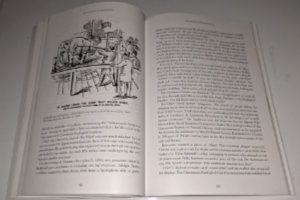 In fact, later in the book, Hand offers another very different capsulated view of the city. On December 12, 1890, he tells us, “The Palace Hotel had elephant steak on the menu because an elephant was executed by firing squad that morning at the Cincinnati Zoo. Hundreds of people watched. That pretty much summarizes Cincinnati in 1890.”
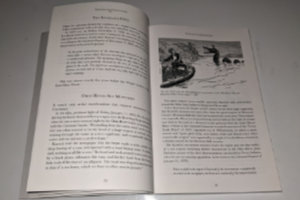 “The Sensational and the Senseless” is the fourth of ten chapters. Other chapters tell of monsters in the Ohio River (“The Old Weird Cincinnati”), Fanny Trollope’s visit during the “Porkoplis” period (“Tales From the Old City”), the possibility that striptease was invented in Cincinnati (“Freaks, Flesh, and Footlights”), and a large variety of other topics. The striptease claim is based on Millie De Leon’s orchestrated removal of several garters in 1901, and Hand cites the claim in suggesting that a Striptease Hall of Fame might be an “appropriate addition to our Over-the-Rhine neighborhood”.
 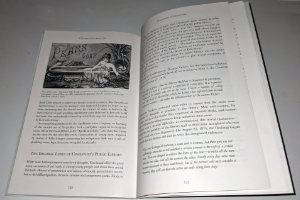 Hand’s usually light-hearted reports are often accompanied by contemporary illustrations. At left is a Pears Soap advertisement based on Lillie Langtry’s famous bath in Apollinaris water at Cincinnati’s Grand Hotel in 1883. It’s in the chapter titled “Nudity, Naughtness, and Negotiable Affection”, and if that doesn’t get you interested in the book I don’t know what will.
 This was one of the most flat-out enjoyable reads I’ve had in a long time. I have seen Katie perform many times, heard her talk on the radio several times, and even chatted with her personally a few times. I knew her as a talented musician and entertaining storyteller but I did not know her as a writer. Others, it seems, have been aware of Laur’s writing skills for some time. It’s my impression that nothing other than the foreword, an introduction, and Katie’s acknowledgments was written specifically for this book. In one of the book’s essays, Katie talks of selling her writing and says she sold everything she wrote. From that, I assume that each of the essays and stories that make up Red Dirt Girl has previously appeared in print somewhere. Where I don’t know and regret that where ever it was, it was outside my field of vision. That I am only now seeing the literary side of Katie is very much my loss. This gal can write.