Play Review
A Christmas Carol
Playhouse in the Park

This is less a review of a play than the reporting of one more Cincinnati Christmas tradition being checked off of my list. I seem to have gotten away with calling Cincinnati’s production of Every Christmas Story Ever Told a tradition even though its first year was just 2006. Cincinnati’s Playhouse in the Park first staged A Christmas Carol a decade and a half earlier, in 1991, so I’m sure its status as a tradition will not be questioned by anyone. What might be questioned is just how much of a reset to this tradition has just occurred, and whether or not it matters.

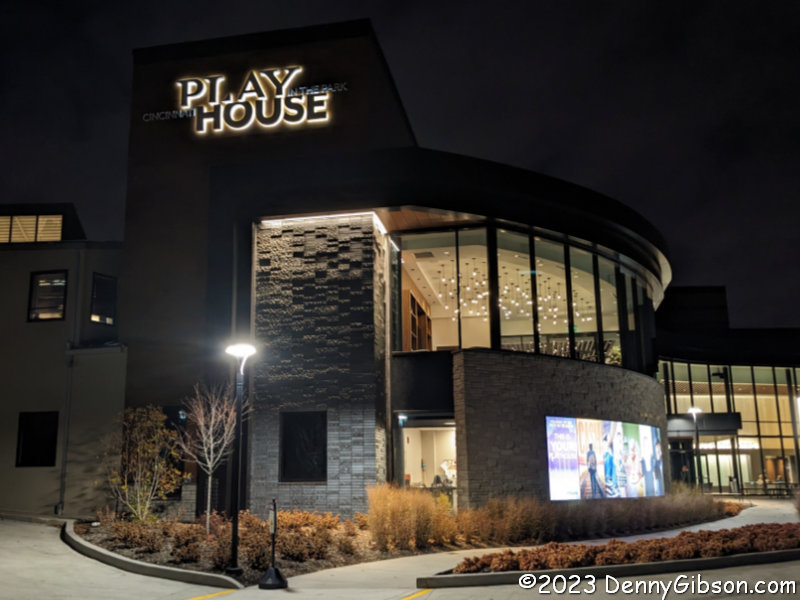
I don’t believe I had ever previously seen a live performance of A Christmas Carol let alone one of the beloved Playhouse in the Park performances. Although the names are the same, neither the play I saw nor its setting are the same as they were in 1991. A new main theater was built for the Playhouse last year and the annual A Christmas Carol run was put on hold while one theater was torn down and another built in its place. Some changes in the production were required because of physical differences in the stages, and the Playhouse’s artistic director, Blake Robison, took advantage of the hiatus to produce a new script. So the same Charles Dickens story of the ultimate grumpy old man being scared into a complete about-face is being told this year but the telling is not quite the same.

I obviously can’t tell you how the new compares with the old. I can tell you that the production I attended on Wednesday was spectacular in a way that could start a new tradition though I hope it will let an existing one get a new grip and continue.
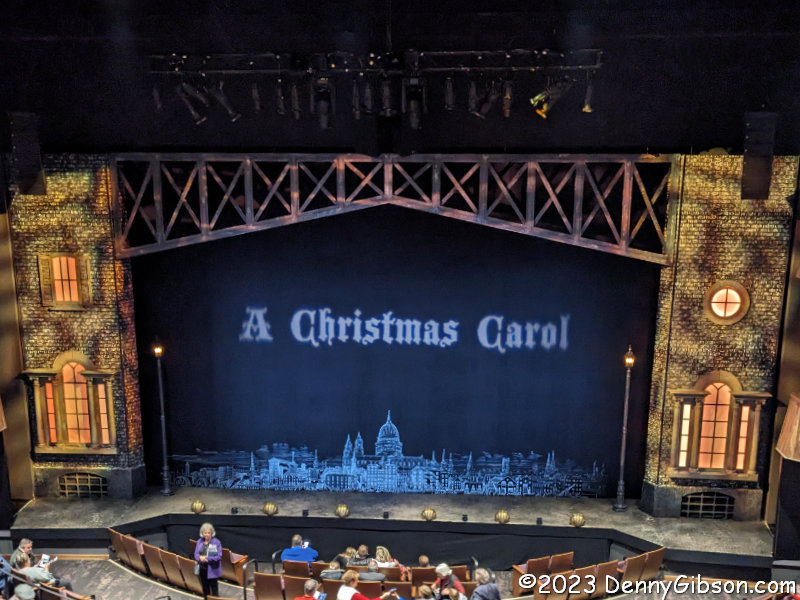
That word “spectacular” applies most readily to the scenery and costumes. The onstage world looks exactly like what I’d expect a cleaned-up Dickensian world to look like. A giant clock anchors the set and also anchors the audience in stepping through the events of a long Christmas Eve. Special effects, puppets, and moving stage elements add to the sense of spectacle. When telling a story that everyone knows, the “how” really does outweigh the “what”.

Except for my comments about the new theater, pretty much everything I’ve said could be replaced with “Looks good to me” and that’s really all I’m qualified to say. For a real review, check out David Lyman’s report in the Enquirer which includes some official photos. A Christmas Carol will be at Playhouse in the Park through December 30. Go help a new tradition get started or help nudge an old one into a new phase. 
Yippee-Ki-Yule, Y’all

On Thursday, I got a double dose of holiday hoopla. The first dose was administered at Krohn Conservatory in Cincinnati’s Eden Park. The second came at Thomas More Stadium in Florence, KY.

This year’s holiday show at Krohn is called “Golden Days of Yule”. That name, coupled with my improved understanding of Yule (the subject of next week’s post), was one reason I wanted to visit Krohn this month. Another was that I realized it had been ten years since I’d seen the holiday display at the conservatory. All of my visits since 2013 were to see butterflies.

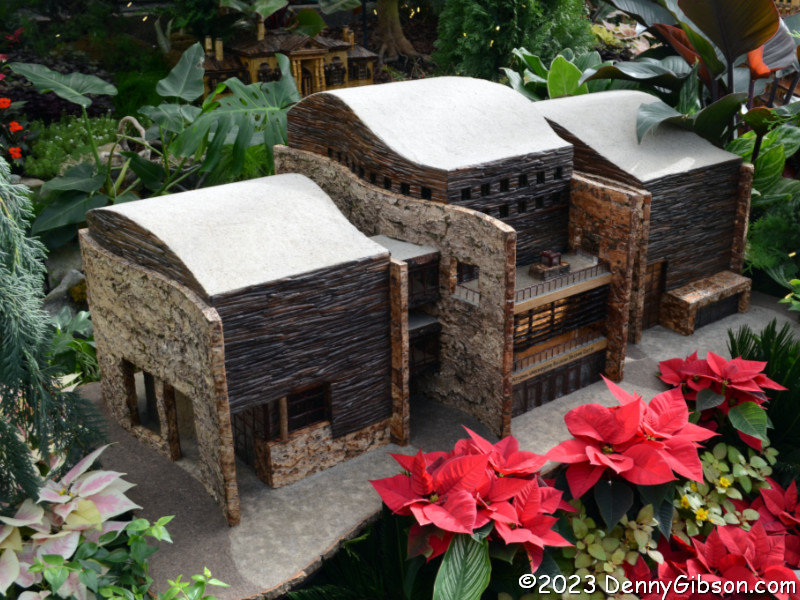
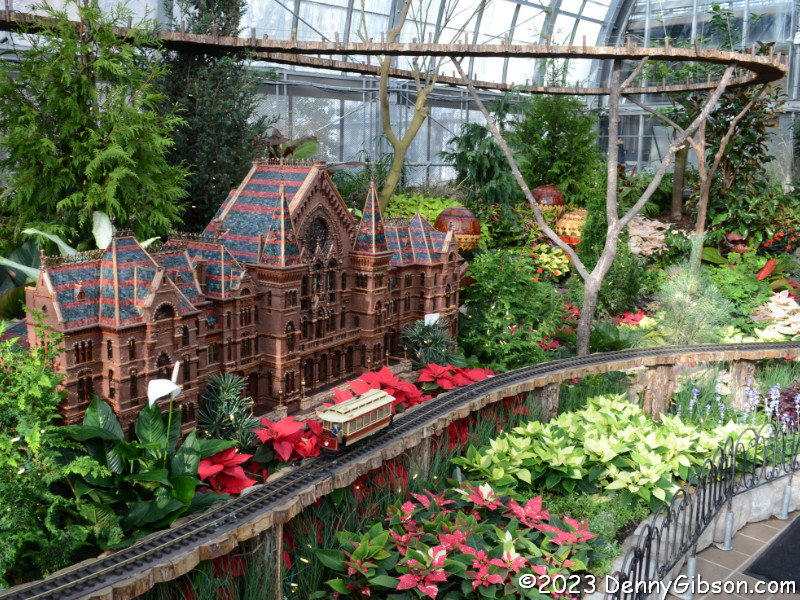
“Golden Days of Yule”, like previous holiday shows at Krohn, has lots of Cincinnati landmarks such as Music Hall in the opening photograph. All are made of locally sourced plant material and most return year after year. New this year is the National Underground Railroad Freedom Center pictured at left.

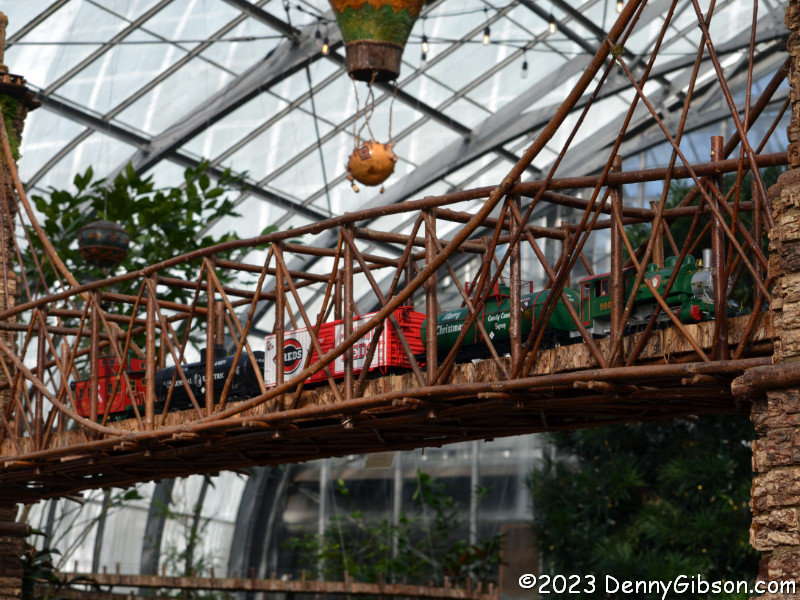
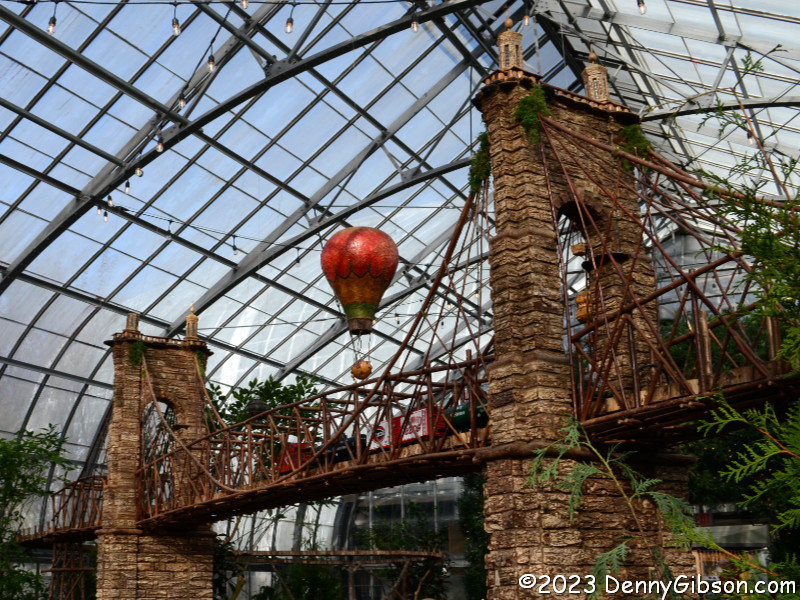
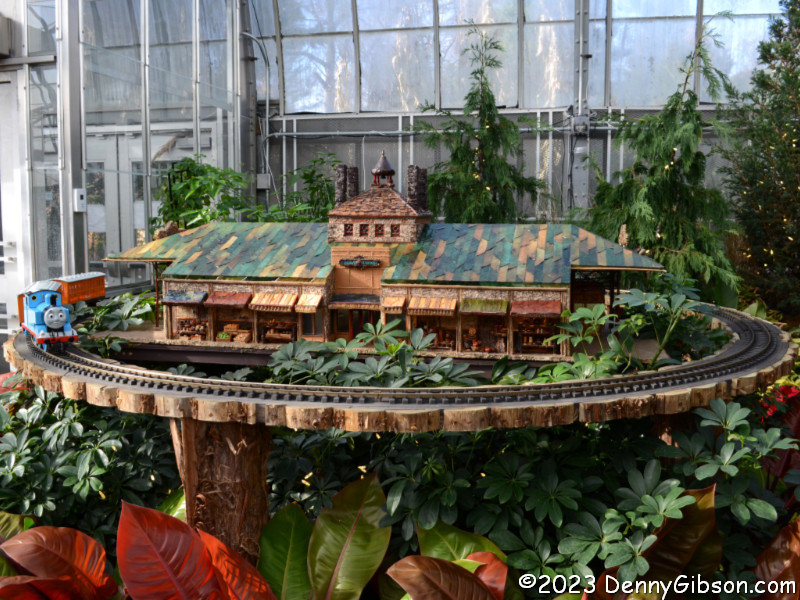
Numerous model trains travel among the landmarks and the conservatory’s normal display of plants. Even though no train has ever crossed the real John A. Roebling Suspension Bridge, this version has a double set of tracks so that a train with a Cincinnati Reds boxcar can cross it in both directions.

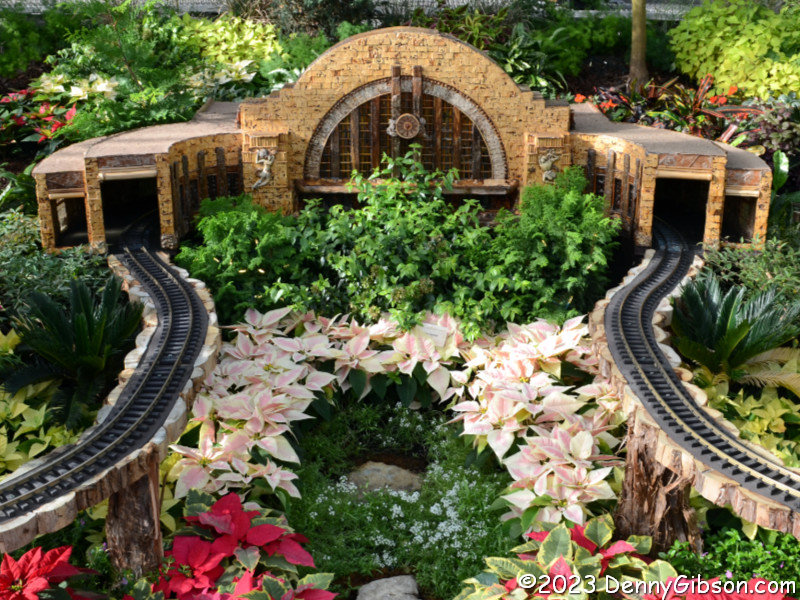
Other returning favorites include Union Terminal, now the Cincinnati Museum Center, and Findlay Market, which is encircled by Thomas the Train. Procter & Gamble’s Twin Towers and the Tyler Davidson Fountain, featuring The Genius of Water, appear together in the third photo although the relationship between the two is nowhere near accurate in either size or location.

It somehow makes sense that the Krohn Conservatory contains a model of the Krohn Conservatory and there might be nothing more natural for a conservatory to hold at Christmas time than a giant poinsettia tree. “Golden Days of Yule” runs through January 7 with live music on weekends.

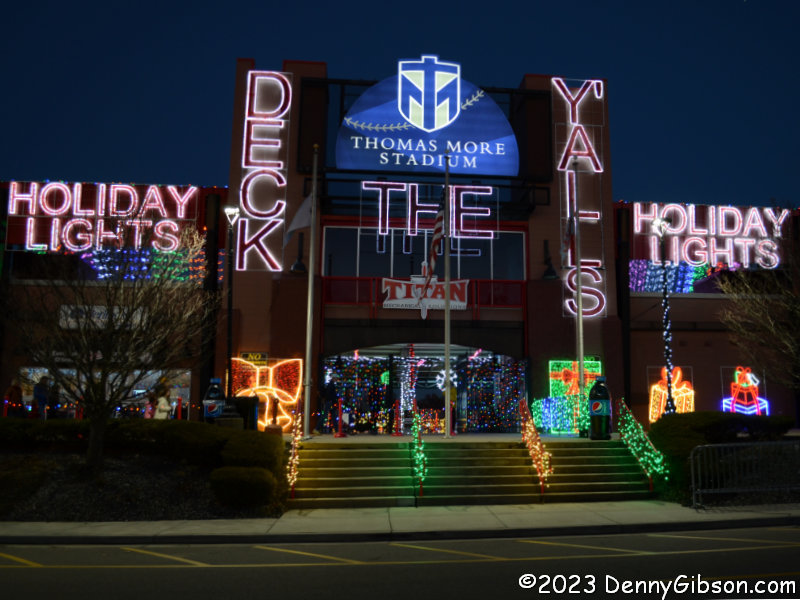
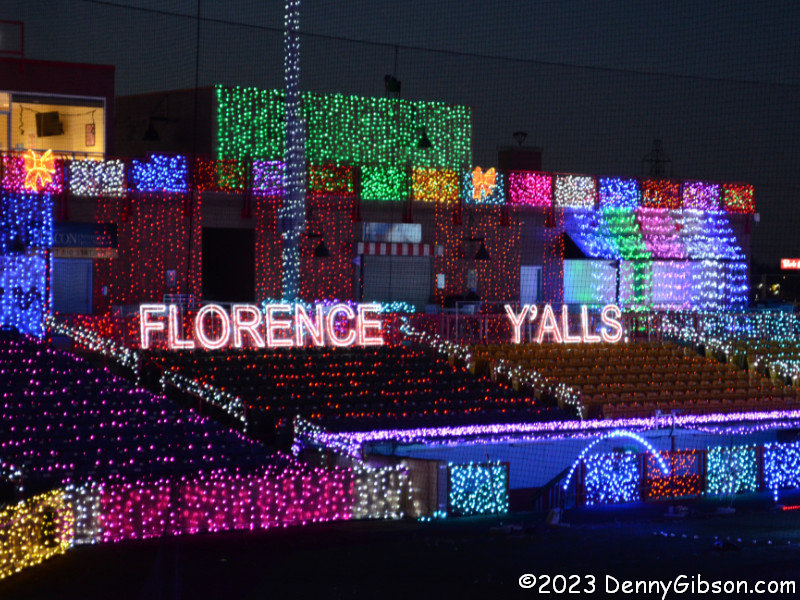
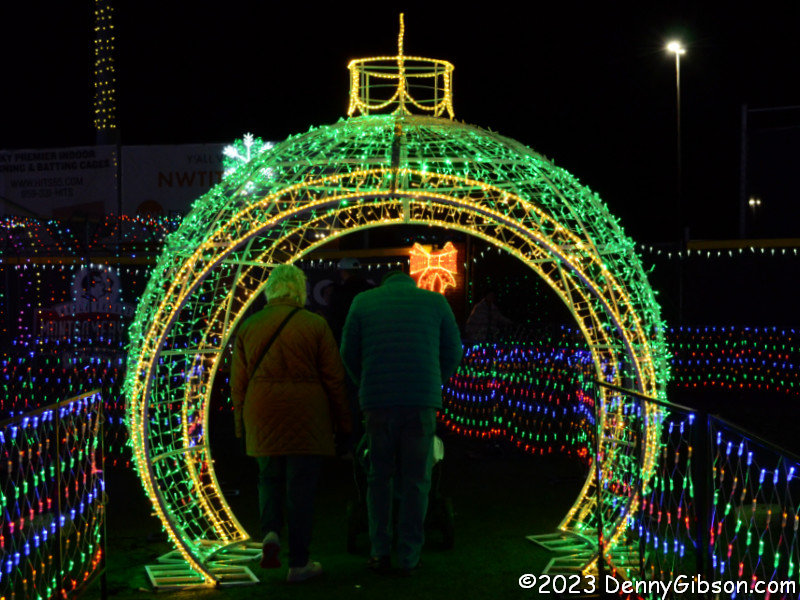
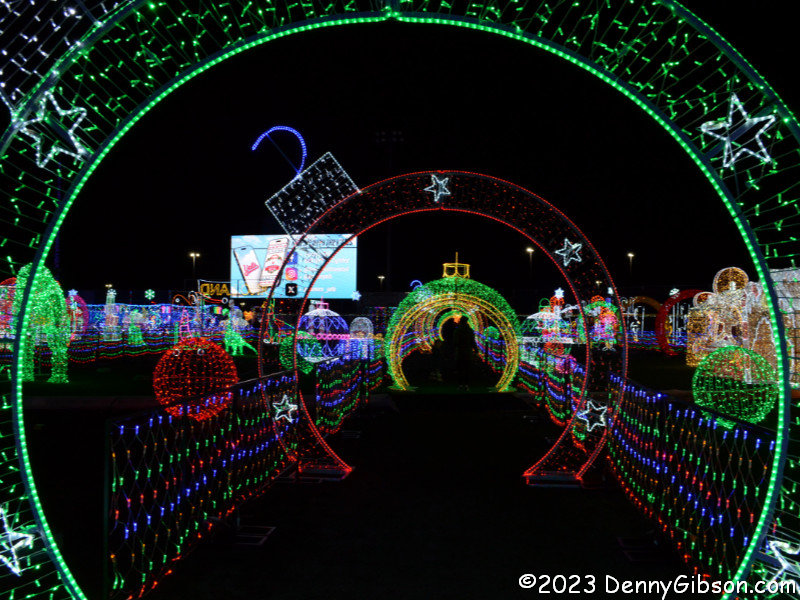
Thomas More Stadium, on the other side of the Ohio River, is home to the Florence Y’alls Class A baseball team. Winters here are way too cold for baseball so, for the second year in a row, a skating rink and 2.5 million lights have been moved in for Deck the Y’alls.

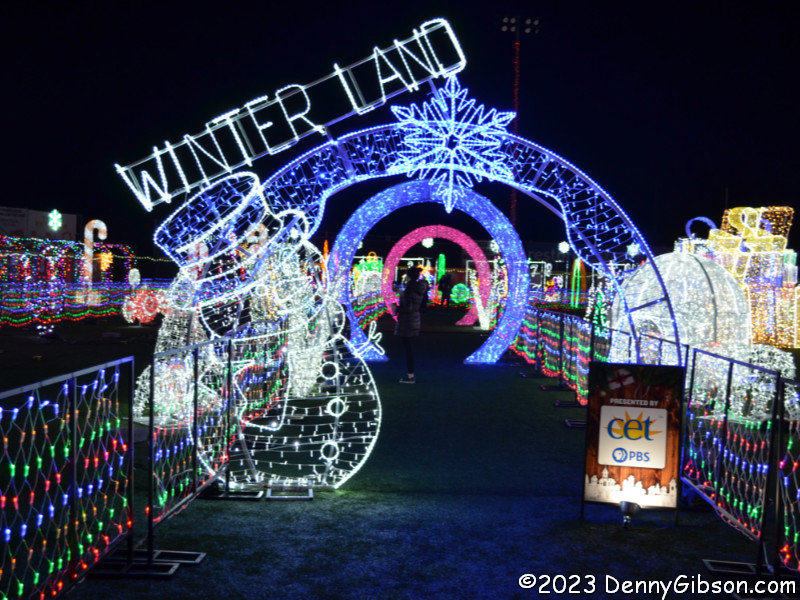
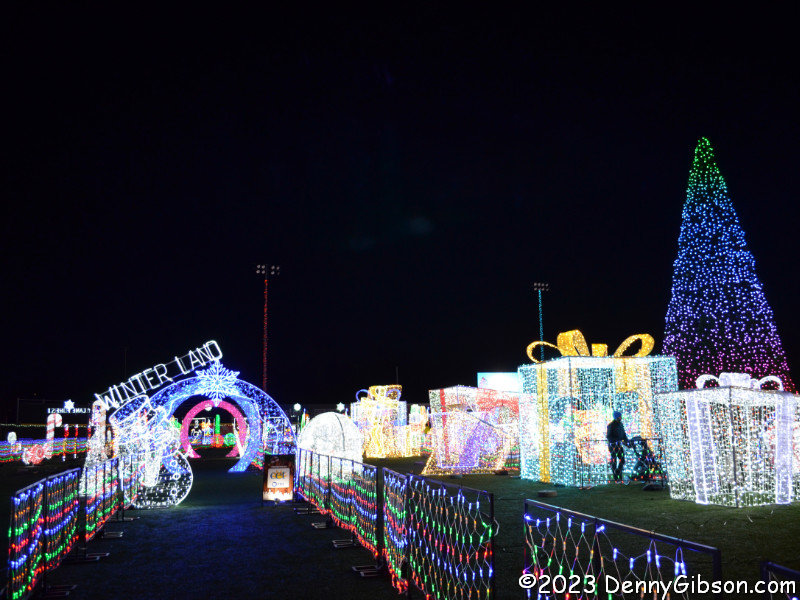
There are lights everywhere both inside and outside the stadium. They are impressive to look at from just about anywhere but following a path through the displays at field level is the main attraction.

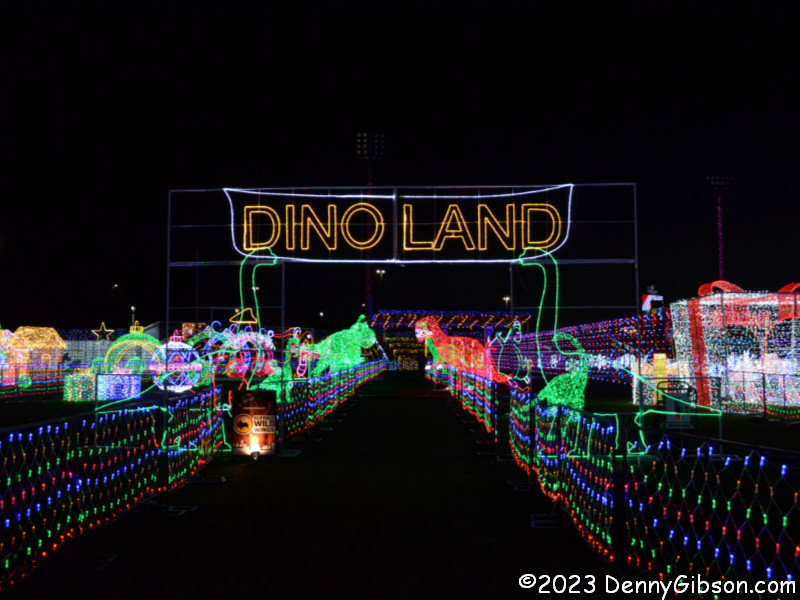
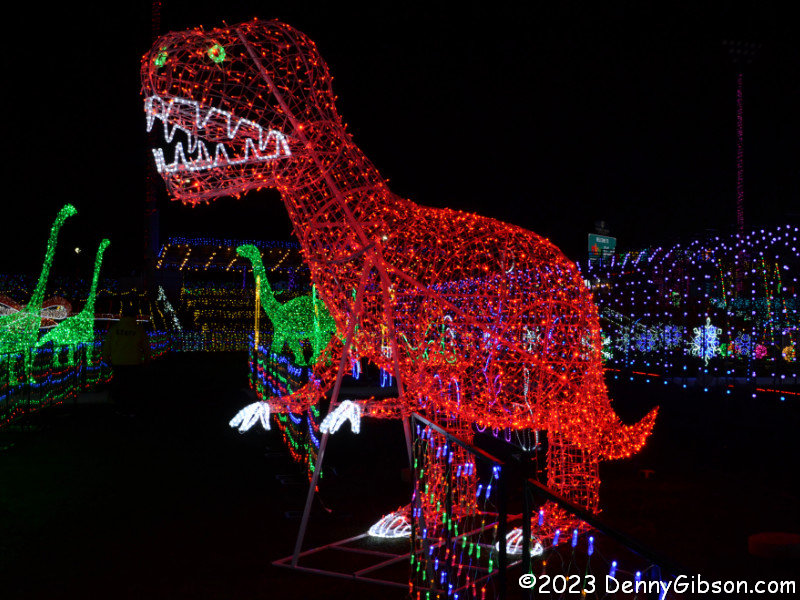
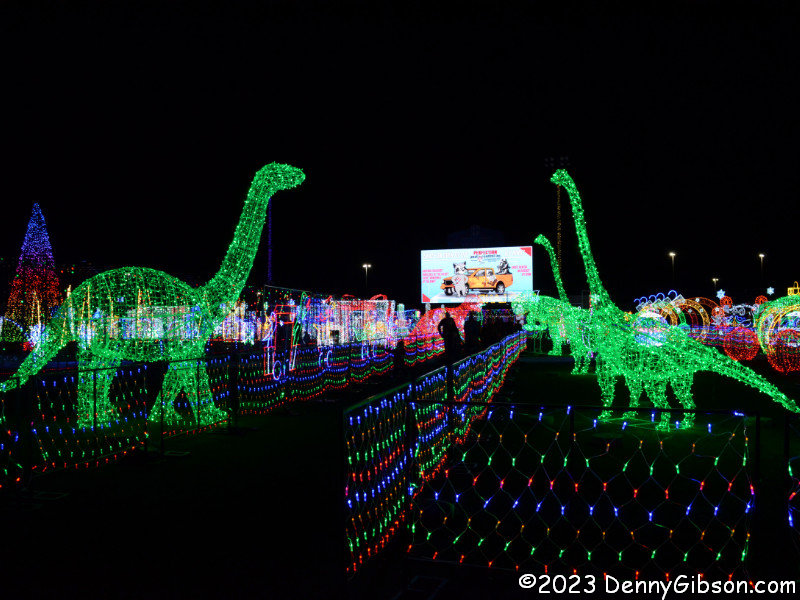
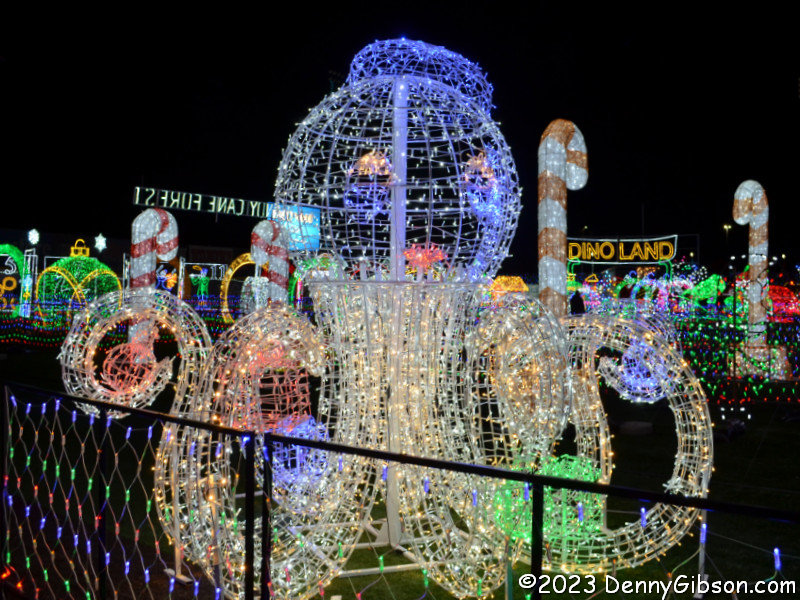
A family of four was near me during the early part of my walk and the youngest child asked her mother to read the lighted signs that marked each section. As soon as she heard “Dinoland”, she announced that she was not going in there. I’ve a hunch that it was what she saw and not what she heard that prompted her reluctance. The family hung back at the arch but after a few minutes, I saw them move ahead slowly. Before long they were back at their normal pace. Up close, dinosaurs made of electric lights just aren’t that scary, it seems.

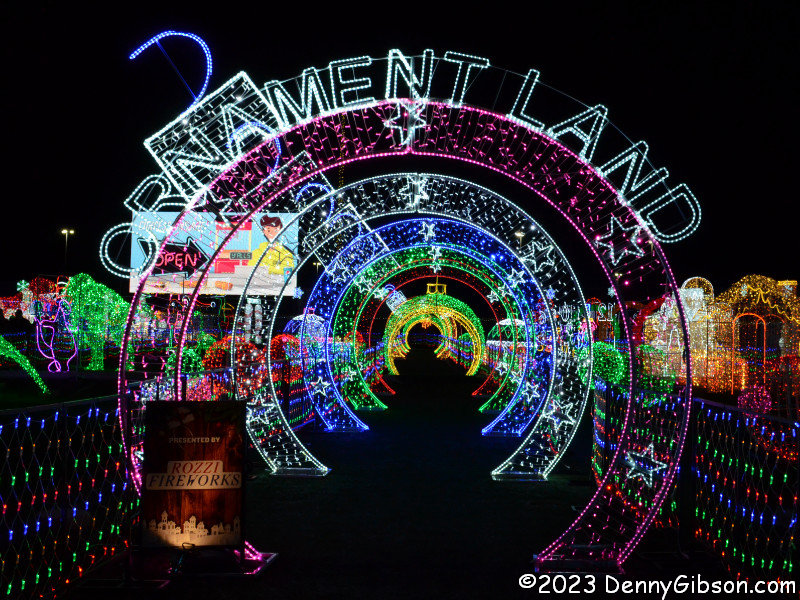
And “Ornament Land” just wasn’t scary at all.

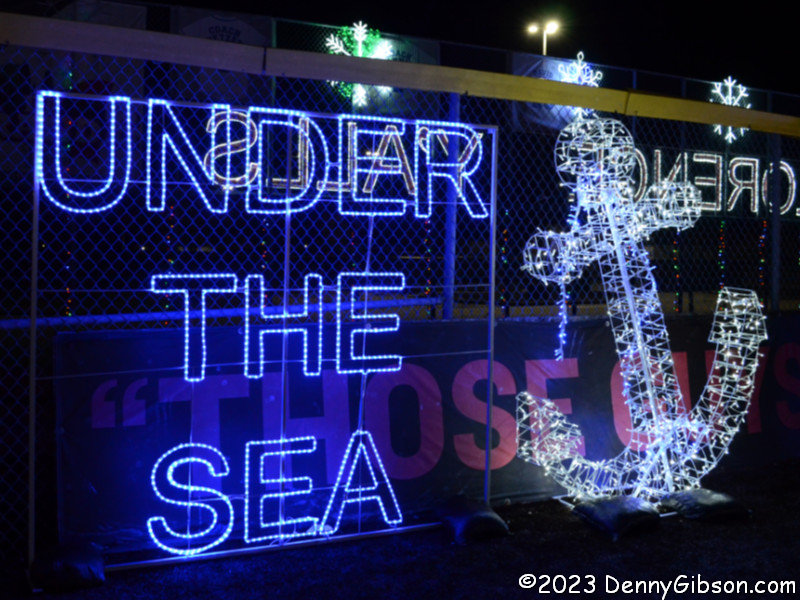
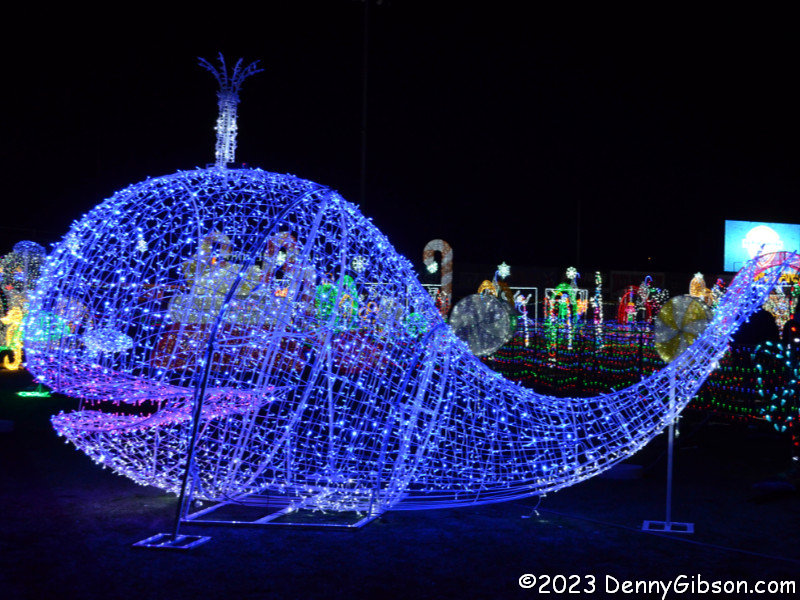
Apparently, neither was “Under the Sea” although I lost track of the family somewhere around The Blue Whale of Florence.

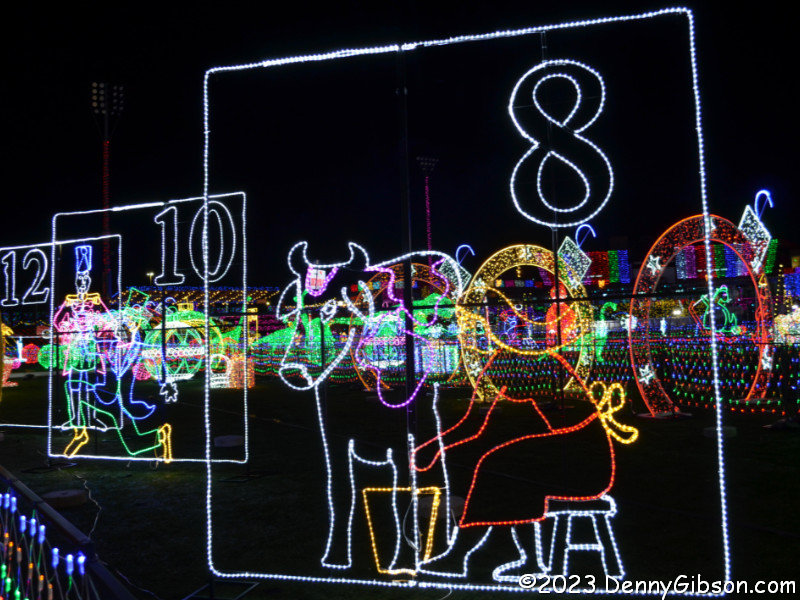
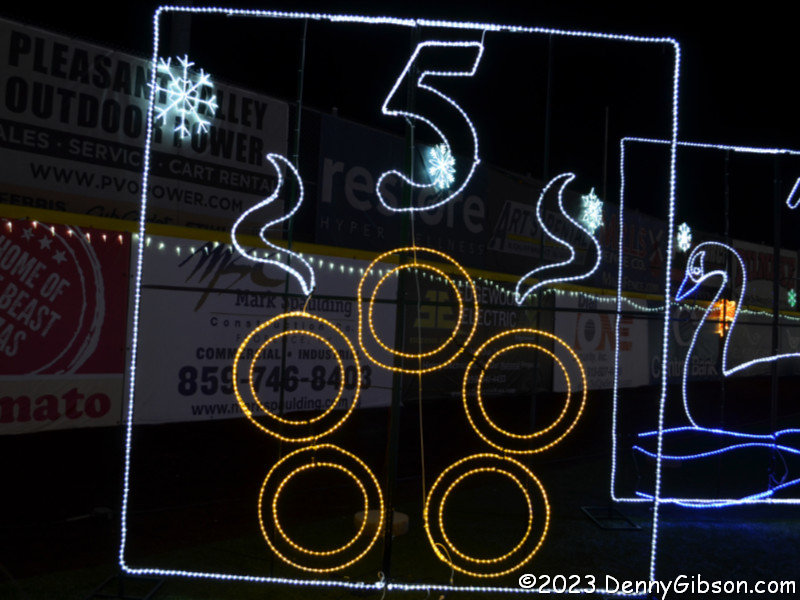
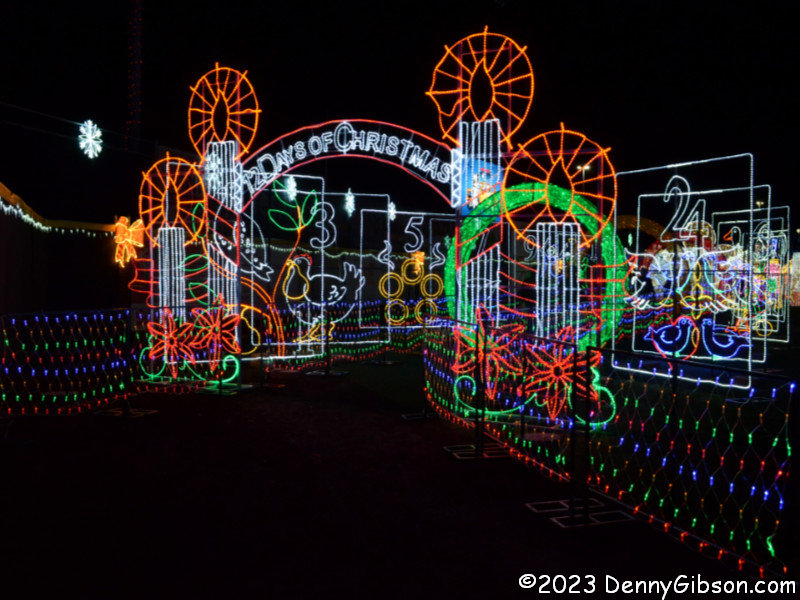
Here’s a sampling of the “12 Days of Christmas”. In reality, this whole post is just a sampling.  There’s a lot more here than what I’ve shown.

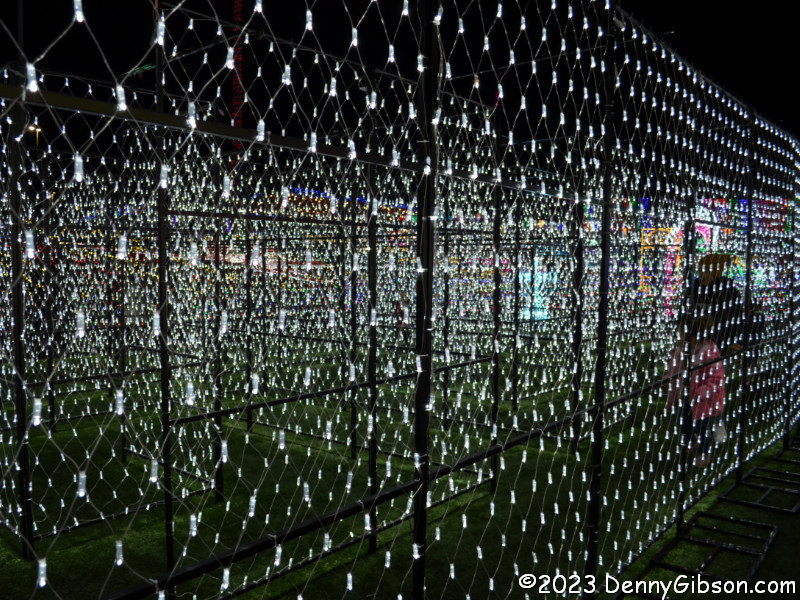
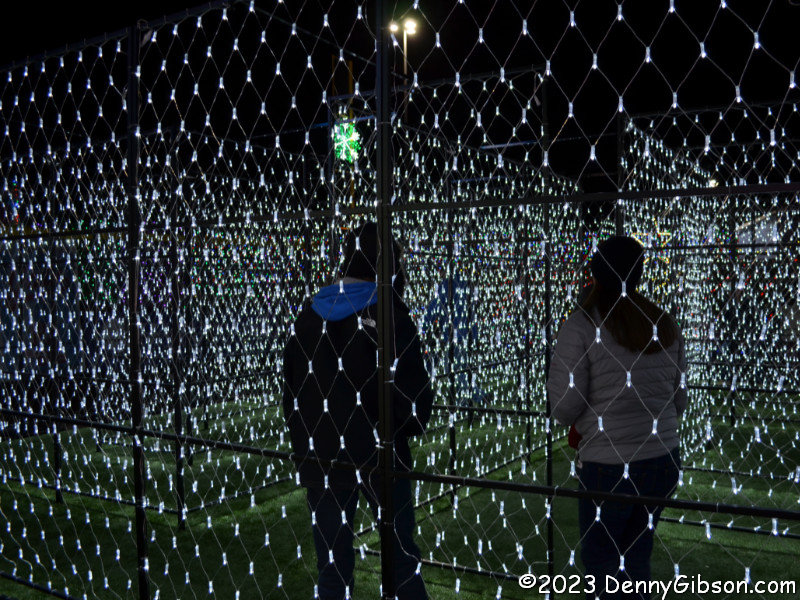
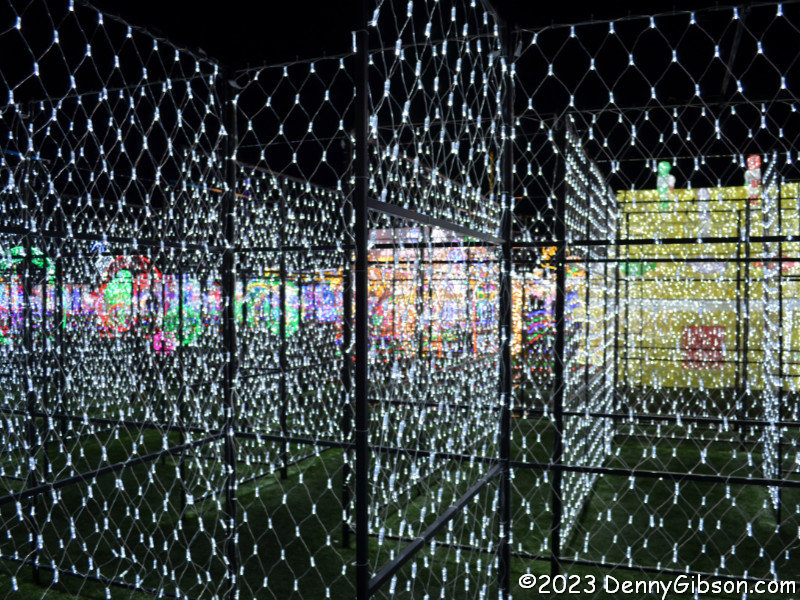
This is the exit. I hung back to take some pictures — and watch and learn from the people in front of me —  then passed through the maze and headed for a cup of hot coffee.

As I sipped that coffee, I captured a short overview video. Deck the Y’alls runs through New Year’s Day with fireworks on New Year’s Eve.


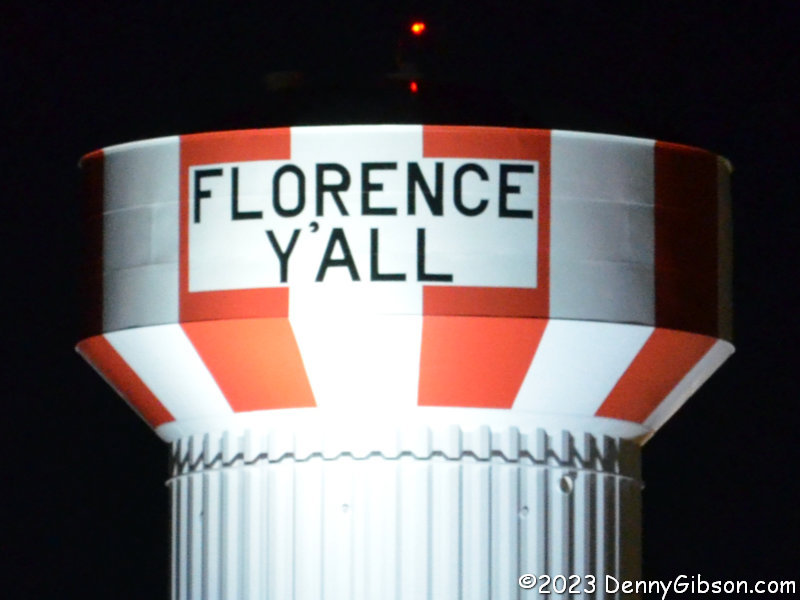
For anyone wondering about the team name, it comes from a water tower. The short story is that while Florence Mall was in development, a water tower advertising it was erected nearby. Because the mall did not yet actually exist, that led to some legal issues which were resolved by hastily converting the “M” to “Y'”. This was supposed to be temporary but proved so popular that it remains today even though the mall has now been in operation for decades. A fuller version of the story is here. The team was founded as the Florence Freedom in 2004 but changed its name to Y’alls in 2020.

Walking With Amal to Cincy

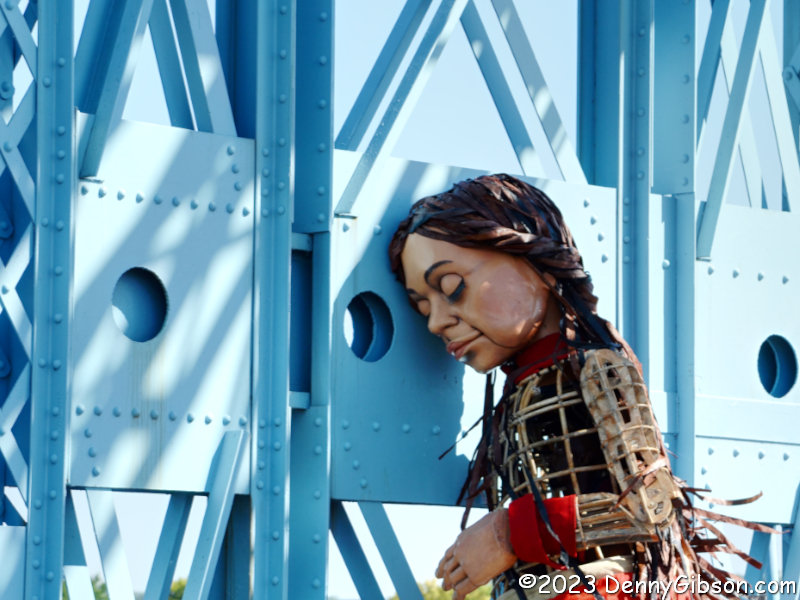
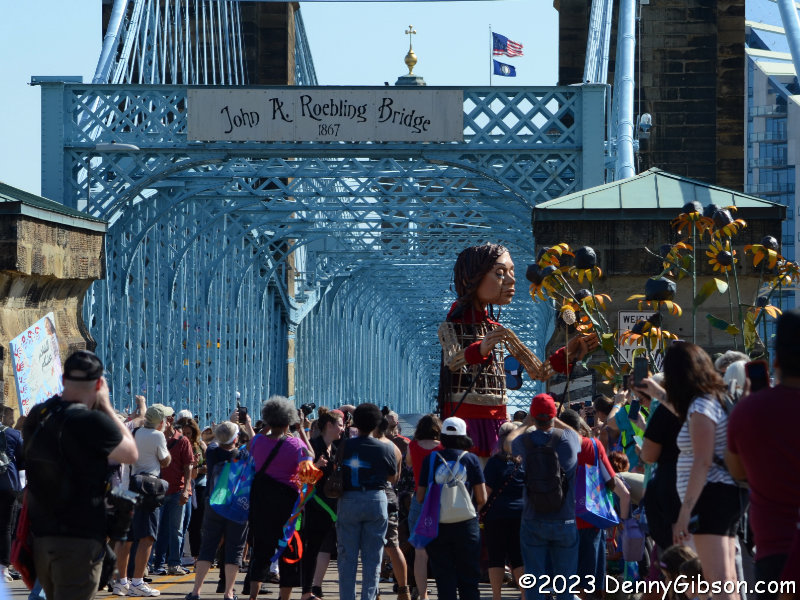
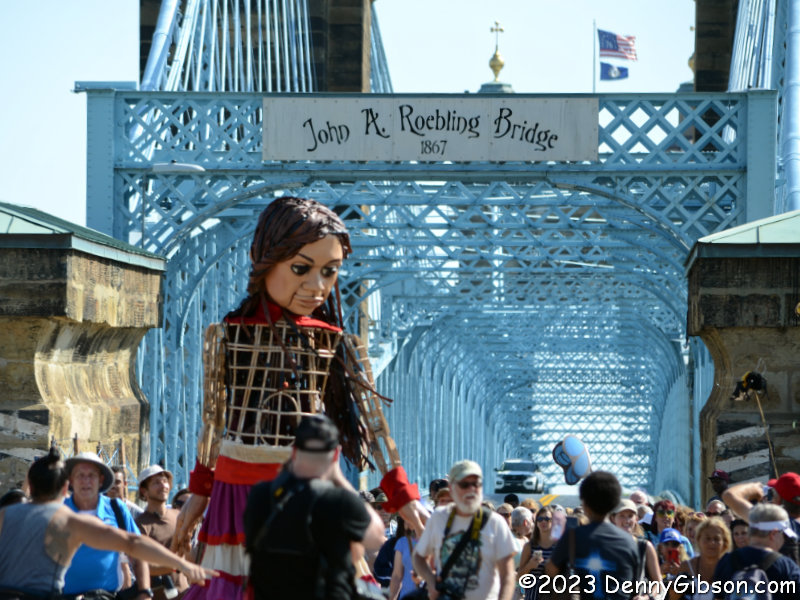
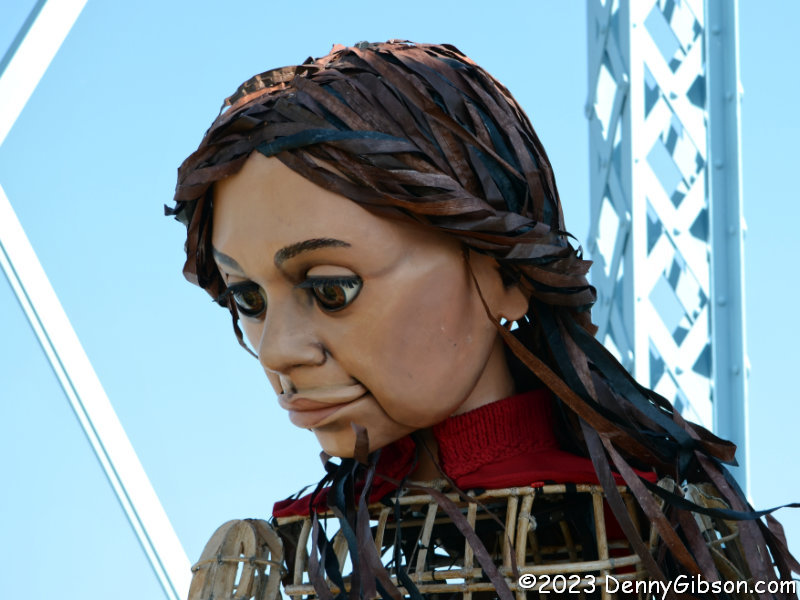
Little Amal had already covered a lot of ground and water before she reached the midpoint of the John A. Roebling Bridge on Friday afternoon. The twelve-foot-tall puppet representing a ten-year-old Syrian refugee began her trek in Turkey in July 2021. Much of her travels have been in Europe where she walked in Germany, Italy, France, Ukraine, Poland, and many other countries. She has also walked in Canada and this is not her first time in the U.S. She was in New York City for seventeen days in 2022.

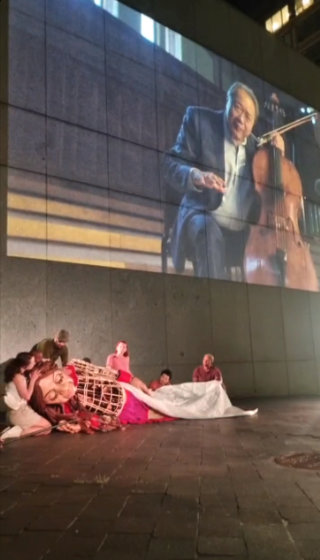
This time though, she will be walking across the entire country. The picture at left is a capture from a live feed of her first night in Boston where a pre-recorded message and lullaby from Yo-Yo Ma offered some comfort. That was on September 7. Cincinnati is just one of the forty cities she will stop in as she travels some 6,000 miles through the country before wrapping up the visit in San Diego on November 5. Check out her plans here.

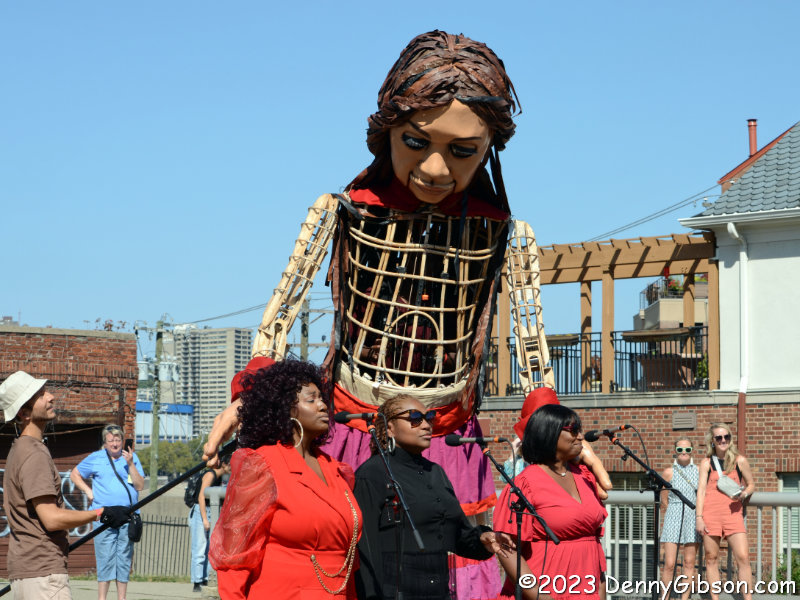
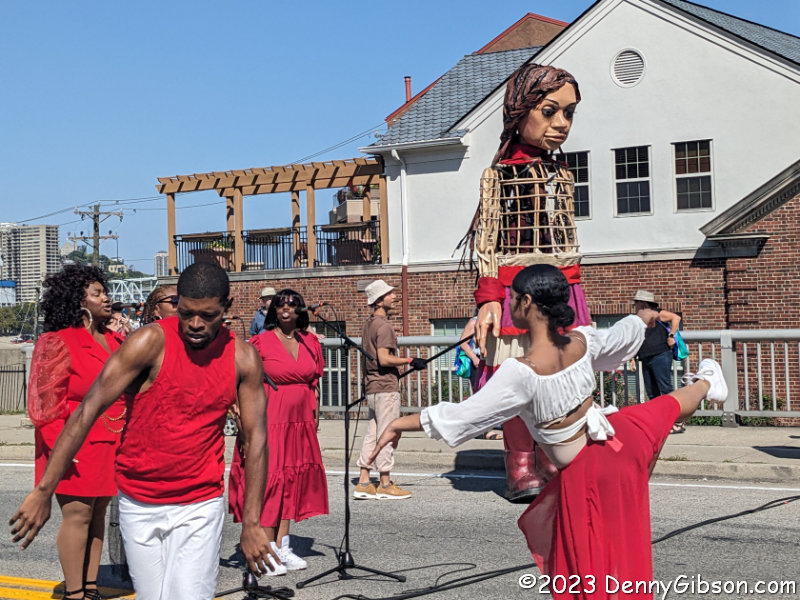
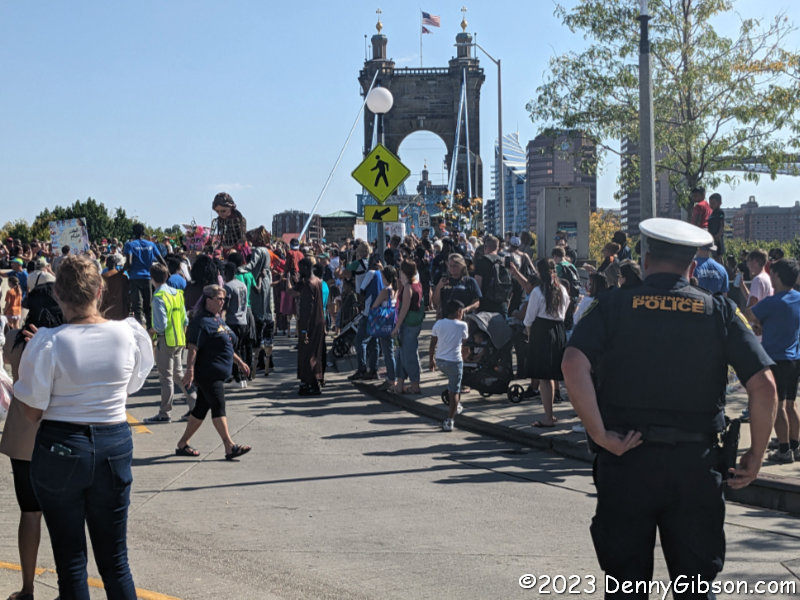
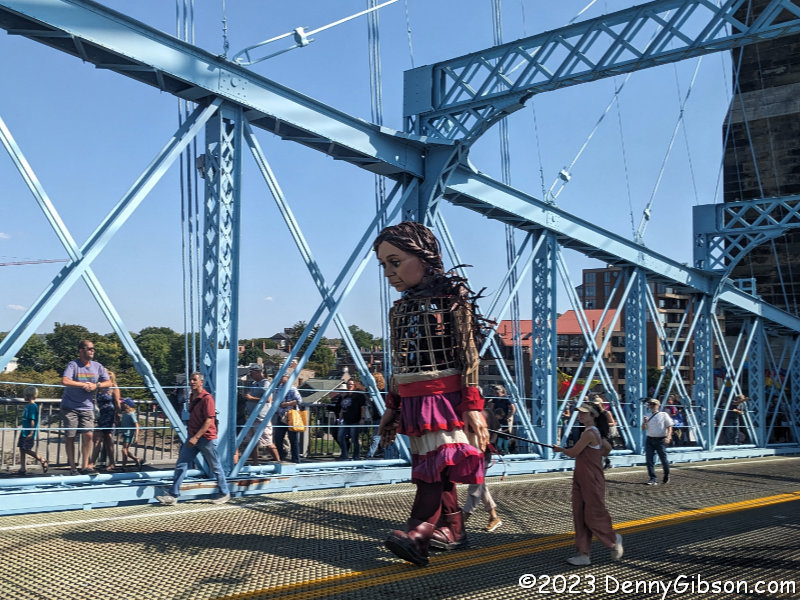
Friday’s walk started on the south side of the Ohio River in Covington, Kentucky. A bit of rustling in the crowd gathered at the entrance to the Roebling Bridge alerted me to Amal’s arrival, and I caught my first glimpse of her just a few minutes past 3:00. The Ciara Harper Trio and Revolution Dance Theatre began a wonderful performance of Wade in the Water (great harmonies!) as Amal worked her way forward. By the time the song ended, she had joined the singers.

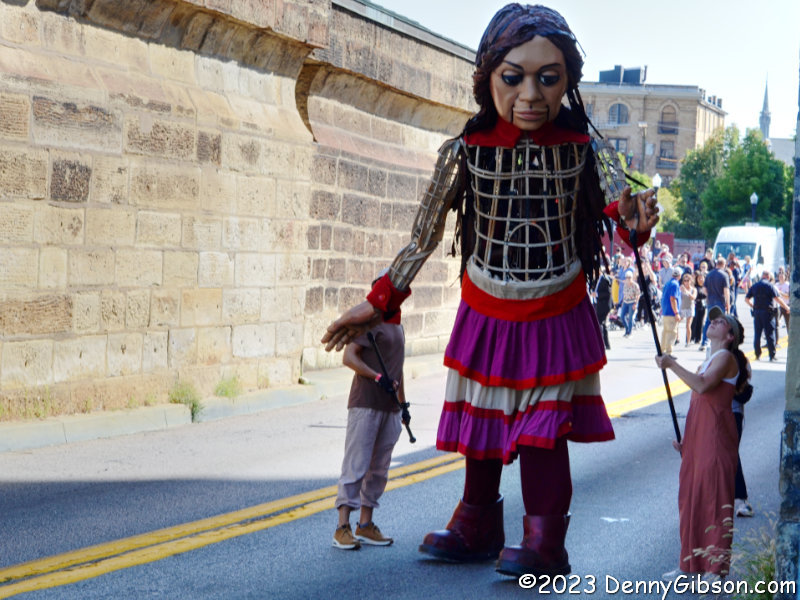
The two puppeteers handling Amal’s arms can be seen in this picture of her starting across the bridge. Some zooming, tweaking, and general mucking about allows the person responsible for Amal’s walking to be seen vaguely here. Most puppeteers are not athletes by any stretch of the imagination but this one is. For sure. Indubitably.

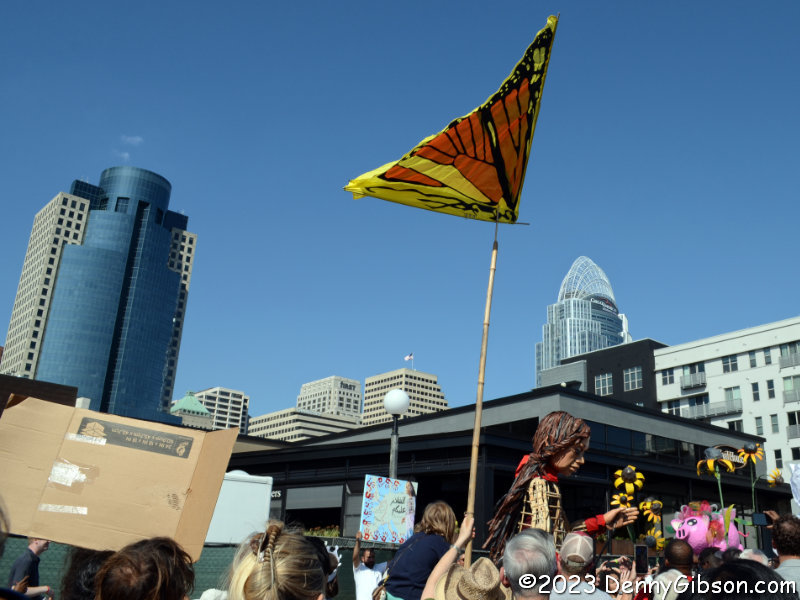
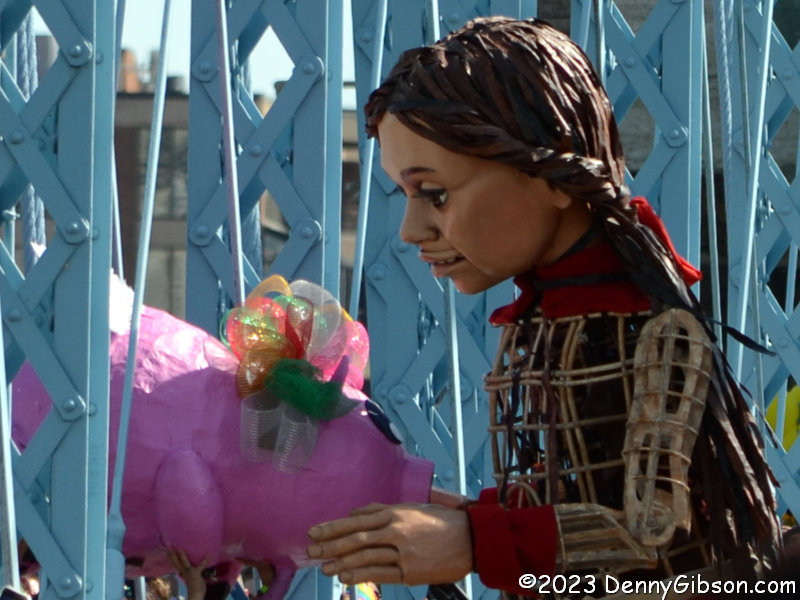
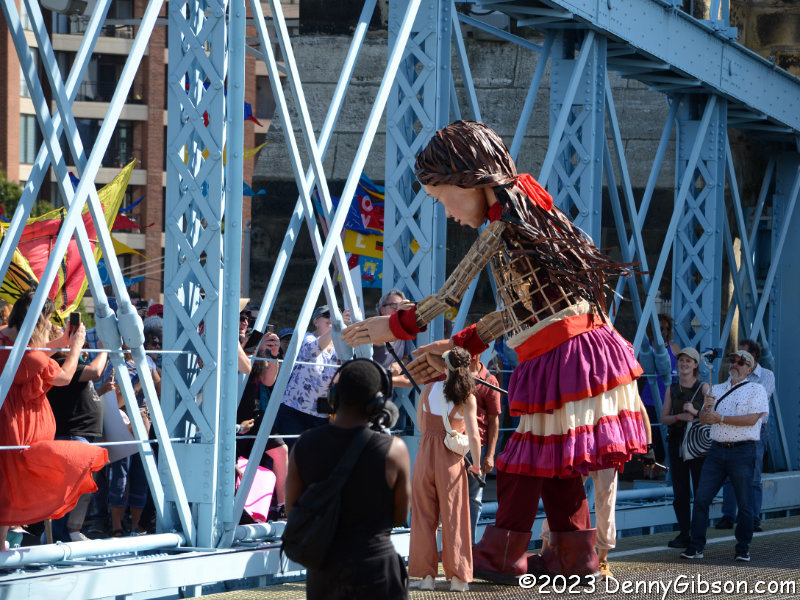
As she made her way over the bridge, Amal frequently paused to interact with the people greeting her. Near the Ohio side of the river, she pets one of Cincinnati’s flying — or maybe just dancing — pigs.

Keeping her pathway clear was at least partially successful and Amal does make it over the river. She takes another whiff of the giant flowers that have followed her from Kentucky as she exits the bridge and heads toward her designated spot.

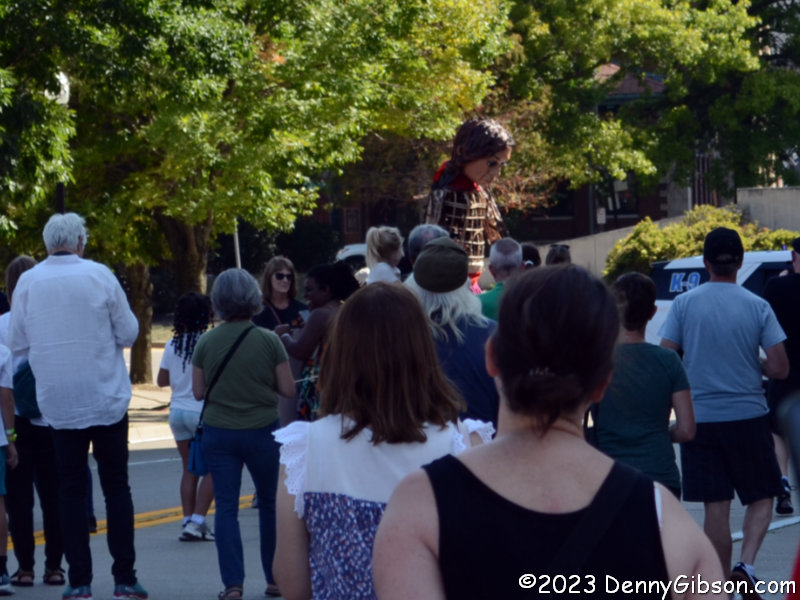
Reaching that spot, where the mayors of both Covington and Cincinnati awaited, took a while and when she got there all I could see was her head above the crowd. I couldn’t actually hear everything either but I did hear most of what Cincinnati Mayor Aftab Pureval had to say. This was not his first time meeting Amal. They had met last October when Pureval was in Amsterdam for a Mayor’s Conference and Amal was doing a walk in the city that included Anne Frank’s house.
Pureval has some very personal reasons for caring about the world’s refugees that Amal is walking on behalf of. He was born in Ohio but his parents were immigrants. His father was born in India. His mother was born in Tibet. Her parents had been forced to flee Tibet with her and she grew up in India — as a refugee.
Donate to the Amal Fund here.
Play Review
What the Constitution Means to Me
Ensemble Theater

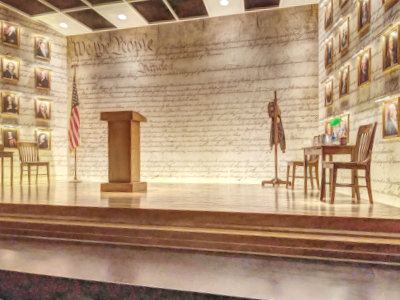
Some plays you watch. Some plays you experience. This one’s in the latter group. Heidi Schreck wrote the play which is rooted in her own life. She also starred in the play — as herself — in multiple productions including a nearly six-month run on Broadway in 2019. What the Constitution Means to Me has been nominated for a bunch of awards and has won several. It was a finalist for the 2019 Pulitzer Prize for Drama. I knew none of this when I first saw an announcement for the production at Cincinnati’s Ensemble Theater.

Schreck is not part of the Cincinnati cast. Here Heidi is a character played by Connan Morrissey. There is no intermission or numbered acts but the play rather naturally divides itself into three portions. As a teenager, the real Heidi earned college money by entering and winning US Constitution-based speaking contests sponsored by the American Legion. The play’s first portion depicts that period with Heidi, the character, frequently breaking the fourth wall and the rules of the contest to speak directly to the audience. It starts when she first steps onto the stage, describes the contest setting, and asks everyone in the audience to pretend to be an old white cis-gendered male.

A Legionnaire, played by Phil Fiorini, keeps time and generally facilitates things as Heidi, the character, repeatedly sidesteps the contest to share family history and personal thoughts with the audience. Eventually, the pretend speaking contest is completely abandoned, and Heidi, the character, proceeds to share her thoughts directly from center stage. Those thoughts include how the Constitution has failed women, Blacks, Native Americans, immigrants, and others. She points not only to the words of the Constitution but to how this document written by old white men has been interpreted by what until recently was just another group of old white men. Playing a few recordings of Supreme Court discussions provides some all-too-serious laughs.

Freed of his Legionnaire duties, Fiorini moves on to portray Mike, another character/real person. Mike Iveson originated the role which, like the real Heidi being embodied in the character Heidi, brings forward some of the real Mike’s experiences with masculinity and homophobia. This naturally provides opportunities for pointing out how the Constitution has failed another big group of citizens but the real Mike and the real Heidi both see the role as something more. Schreck refers to “positive male energy”. Iveson talks about “modeling what it looks like when a man actually listens to a woman”. I read those comments only after seeing the play but they instantly made sense.
The play’s third phase begins when a third cast member is introduced. Twenty-one-year-old Sydni Charity Solomon plays herself in a debate on the proposition that the US Constitution should be rewritten by a more diverse group for a more diverse world. Cheering and booing by the audience is very much encouraged at this point and everyone is given a pocket-sized copy of the Constitution for reference. At debate’s end, an audience member is selected to determine the winner. It is my understanding that sides in the debate are determined each night by a coin flip and that the actual arguments may be different from one night to the next. On Thursday night, Heidi defended the proposition while Sydni attacked it. The selected audience member declared Sydni the winner meaning the Constitution should be kept and fixed rather than discarded and completely done over.
One of the performances with Heidi Schreck and Mike Iveson has been recorded and is available for streaming through Amazon Prime. I’m sure it’s good and seeing the real Mike and the real Heidi is certainly attractive though not so much as to get me to subscribe. If you have Prime and want to watch it, by all means, go ahead. It is true, though, that watching a movie is not the same as watching a play, and watching a play is not the same as experiencing a play. The intimate Ensemble Theater is a good place to experience What the Constitution Means to Me. It’s there through October 1.

Lunken Airport Days 2023

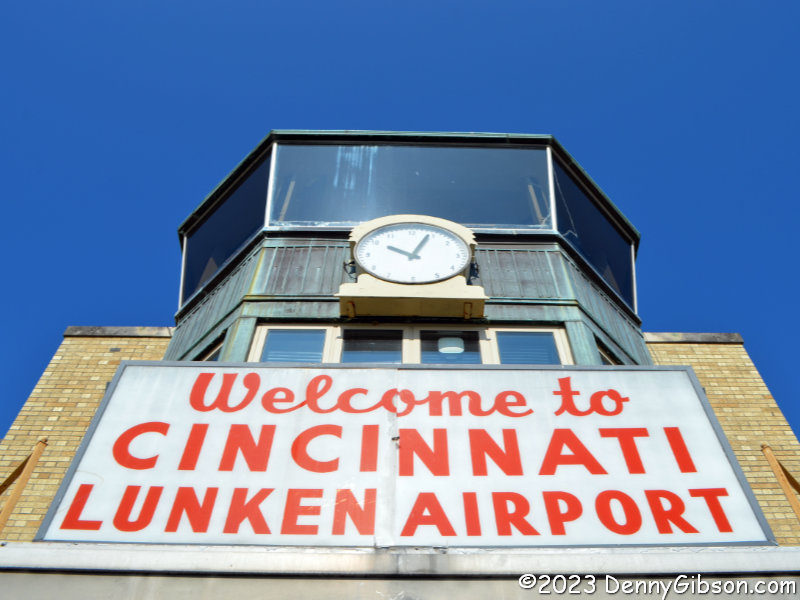
As I imagine the case is everywhere, Labor Day weekend is pretty crowded with activities around here. I picked Lunken Airport Days to fill my Saturday primarily because I had never attended before. It was also the closest of the events I considered and was the only one that was free. Lunken (LUK) opened in the 1920s and was Cincinnati’s principal airport until Cincinnati/Northern Kentucky International Airport (CVG) opened in 1947.

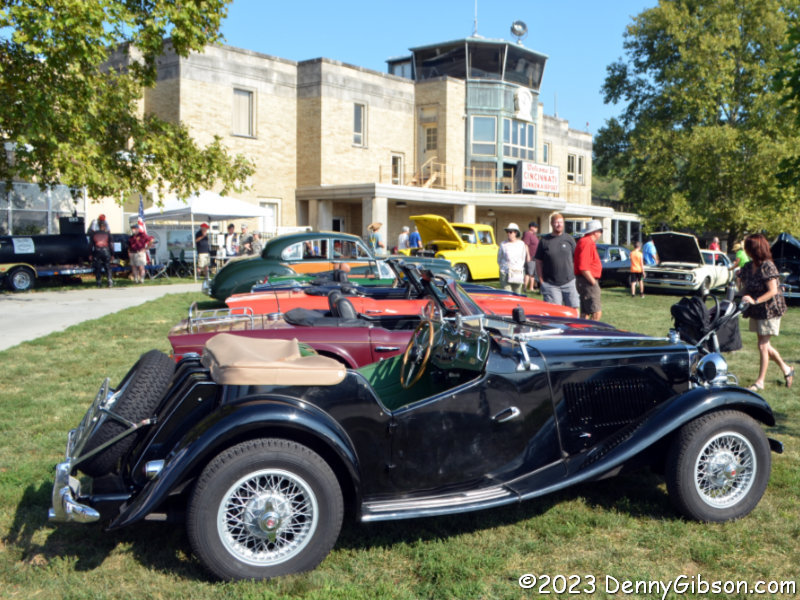
Airport Days is hosted by Cincinnati War Birds so basically features military aircraft. Several classic cars are on display and there are even a few civilian airplanes such as this 1940 WACO. The 100th anniversary of WACO Aircraft Company will be celebrated leter this month at the museum and field in Troy, Ohio.

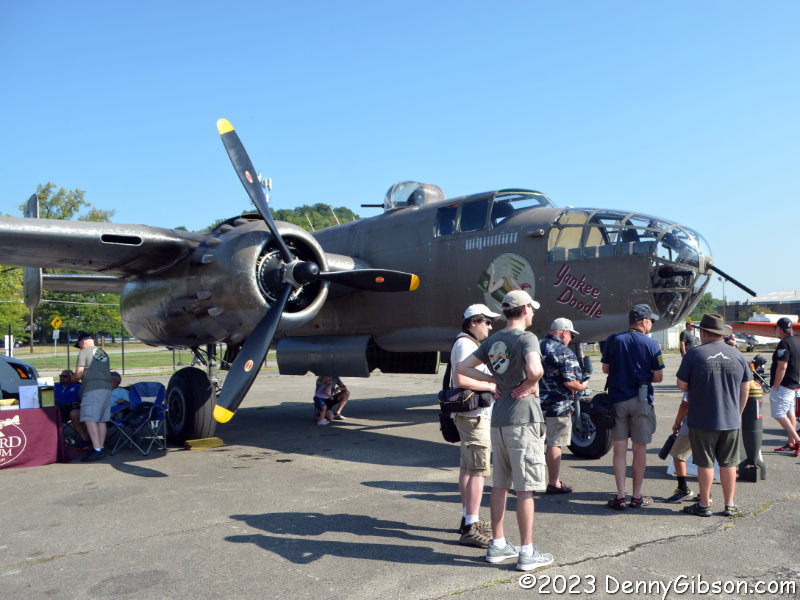
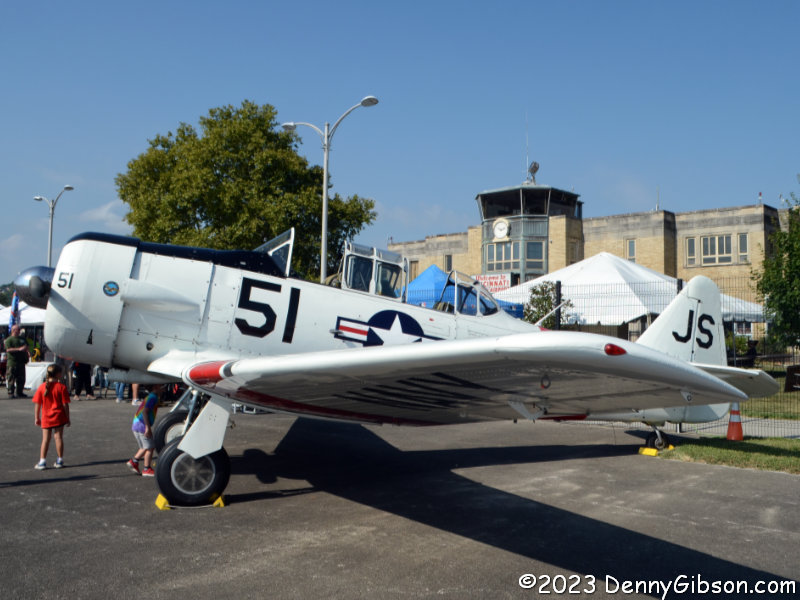
Military planes included a 1942 BT-13A VULTEE, the next to last B-25 ever built, and a 1944 P-51D Mustang. Seated in the foreground of the Mustang phot is one of the local artists participating in an informal “Lunken Days Sketch Outing”.

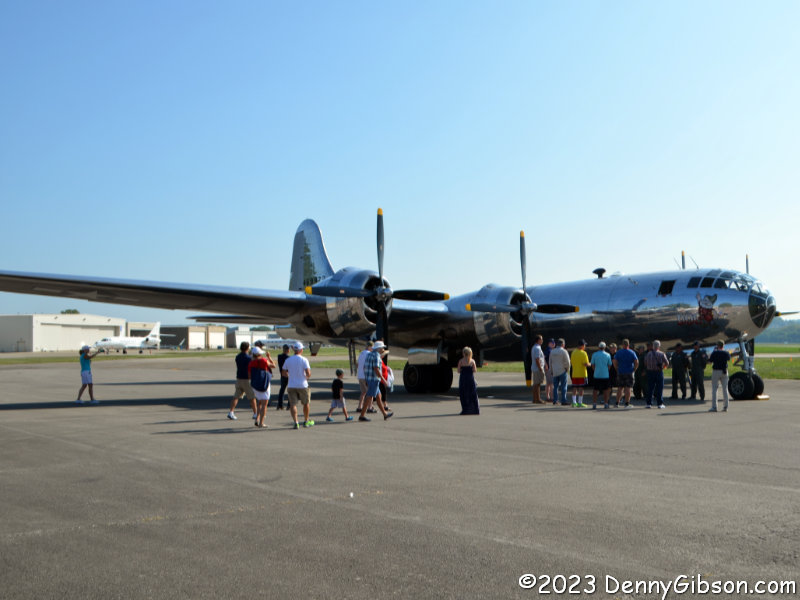
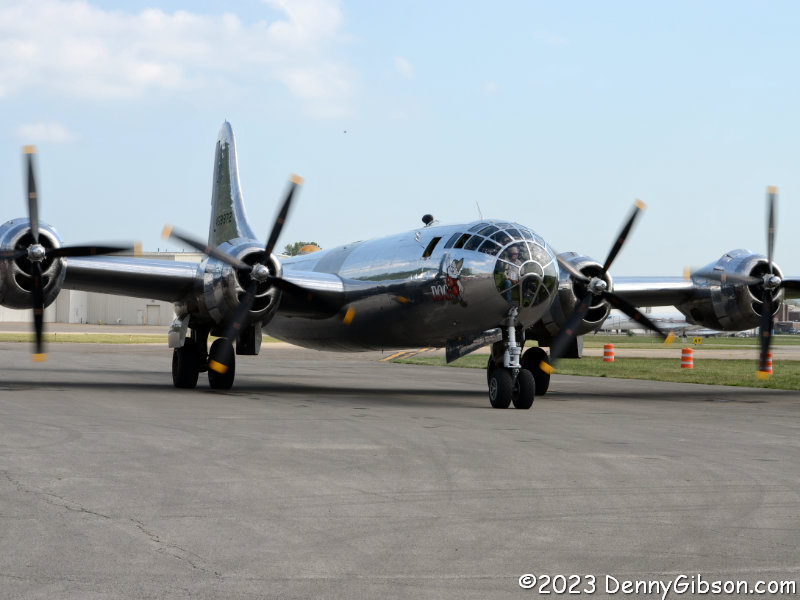
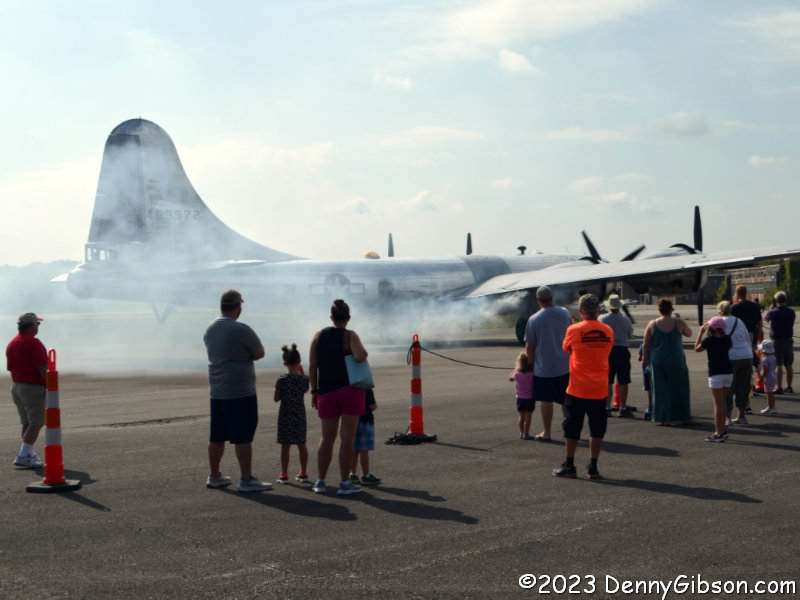
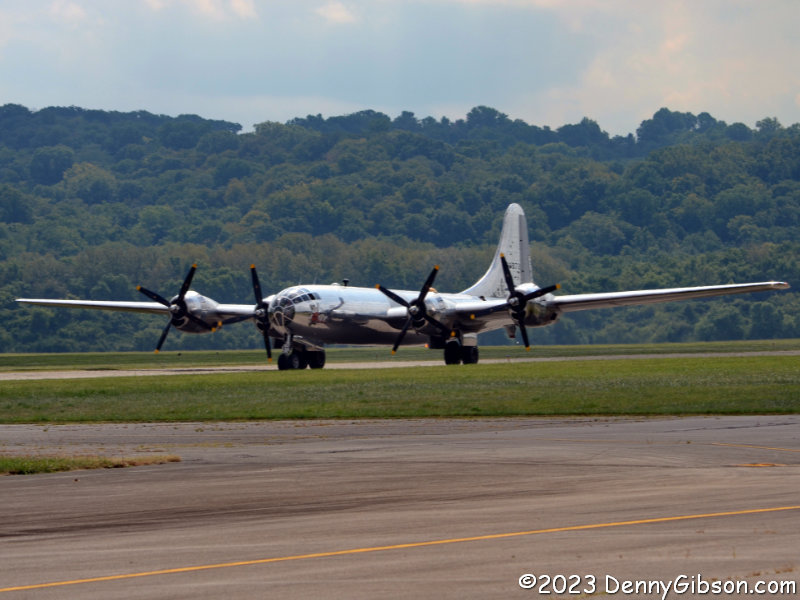
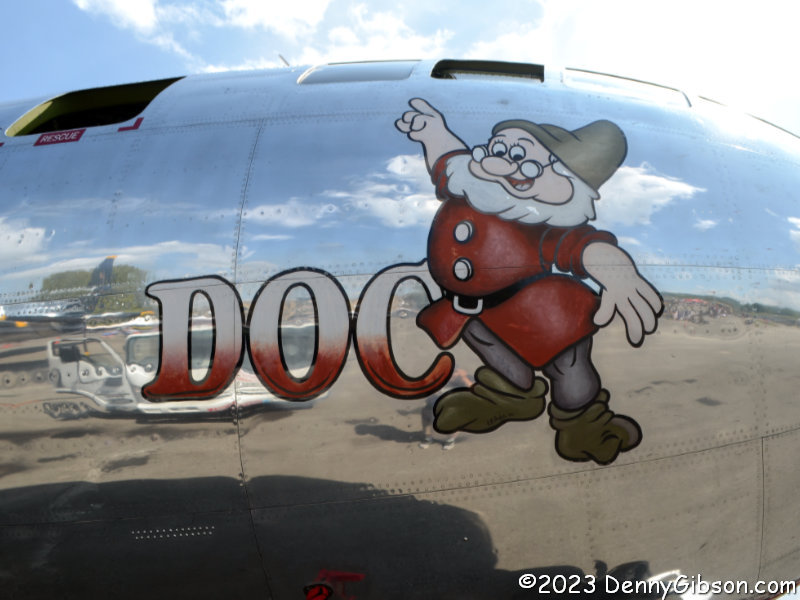
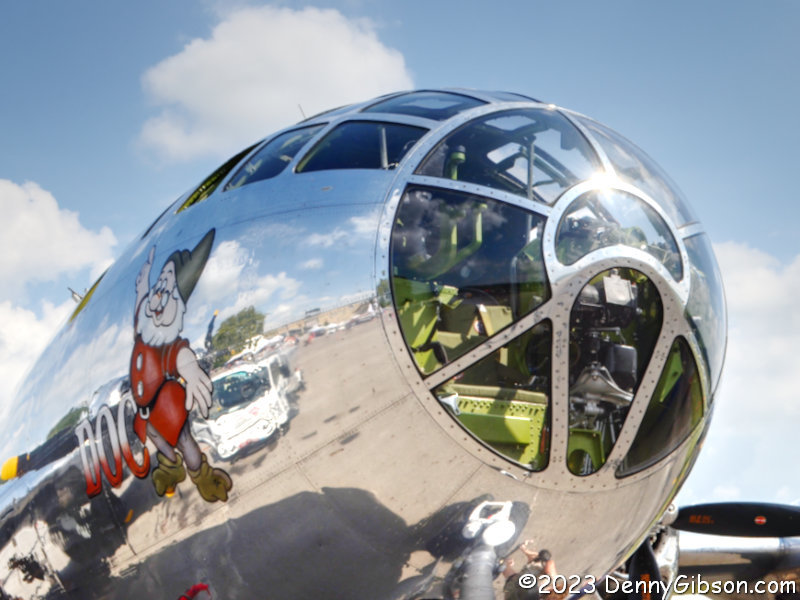
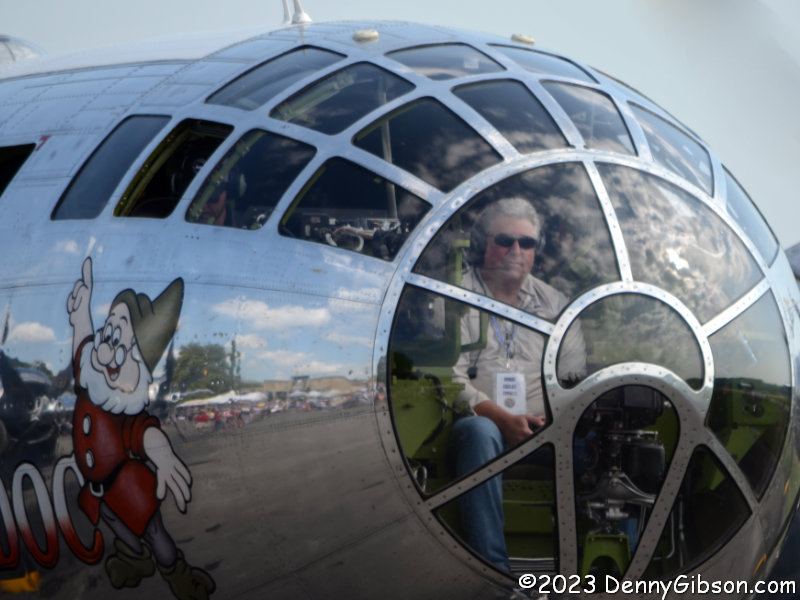
But the biggest plane on campus — actually one of the biggest planes ever built — was the B-29 Superfortress named Doc. 1644 Superfortresses were built during World War II. Only two are flying today. This remarkable airplane has its own website here.

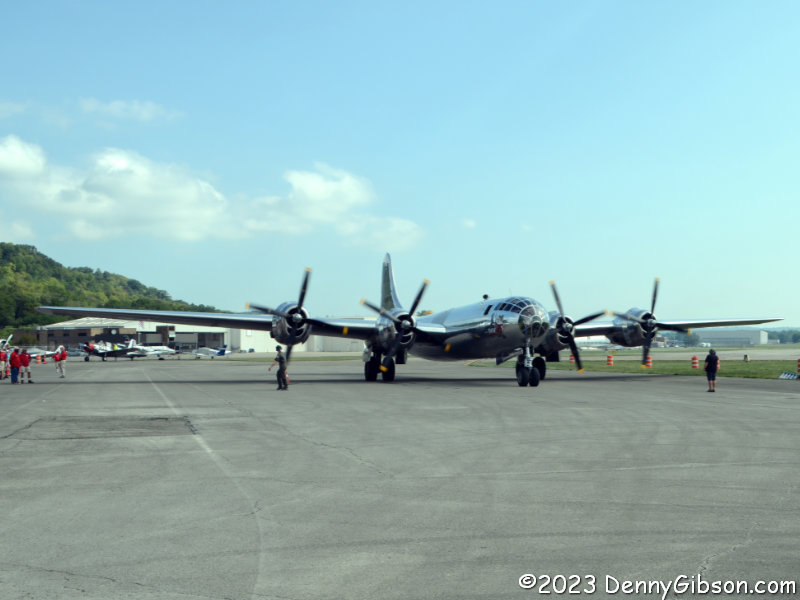
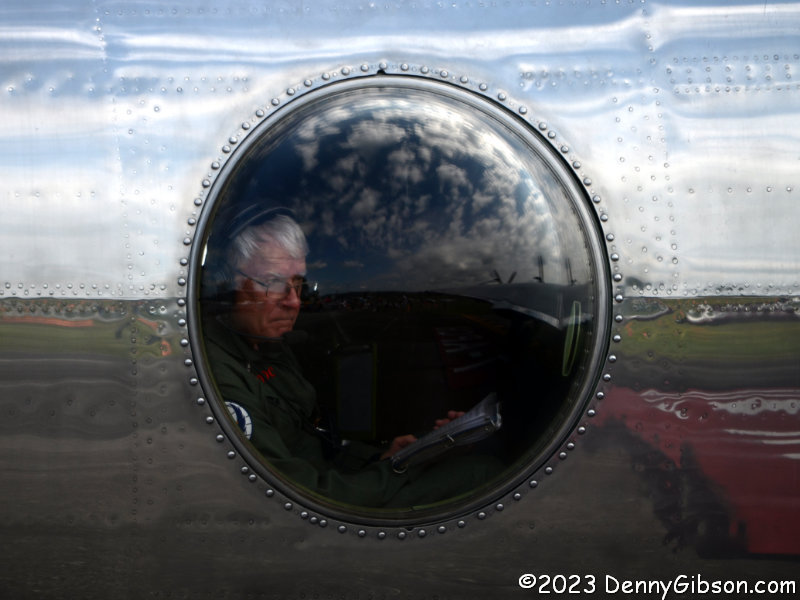
My attention focused entirely on Doc when I heard that first engine begin to turn. That initial bit of smoke was soon gone and soon all four engines were running smoothly. Doc earns his keep by taking paying passengers aloft Some of this flight’s passengers can be seen here and here as the plane taxies.

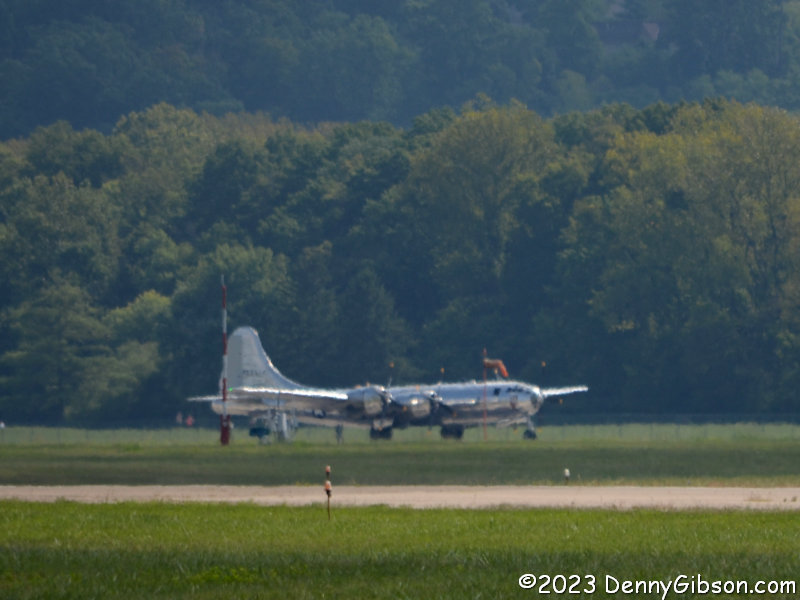
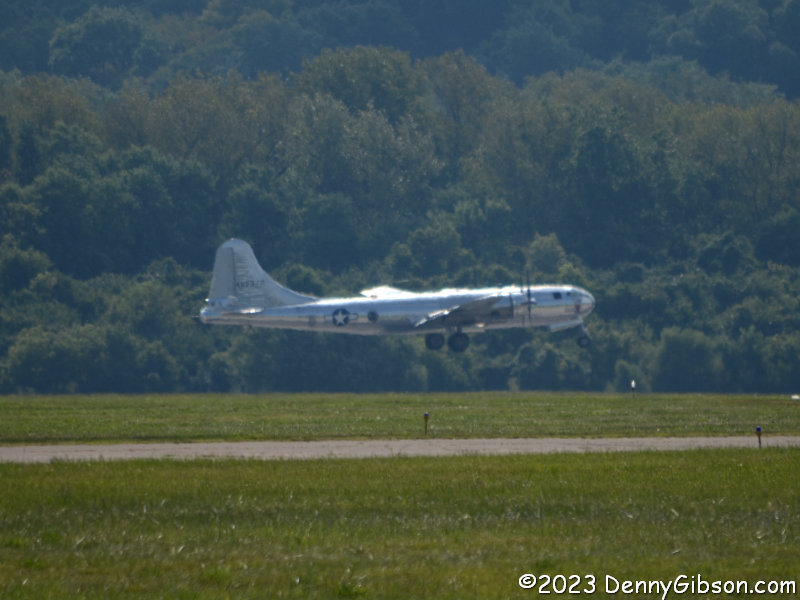
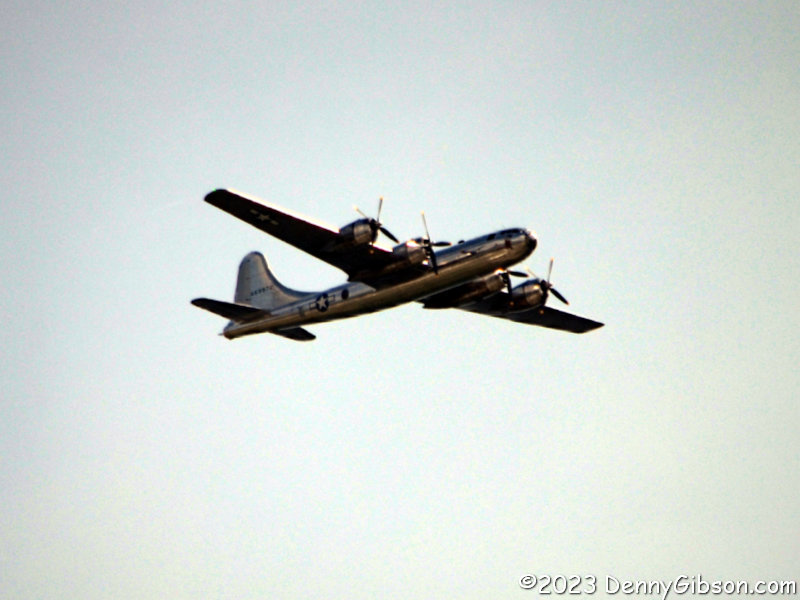
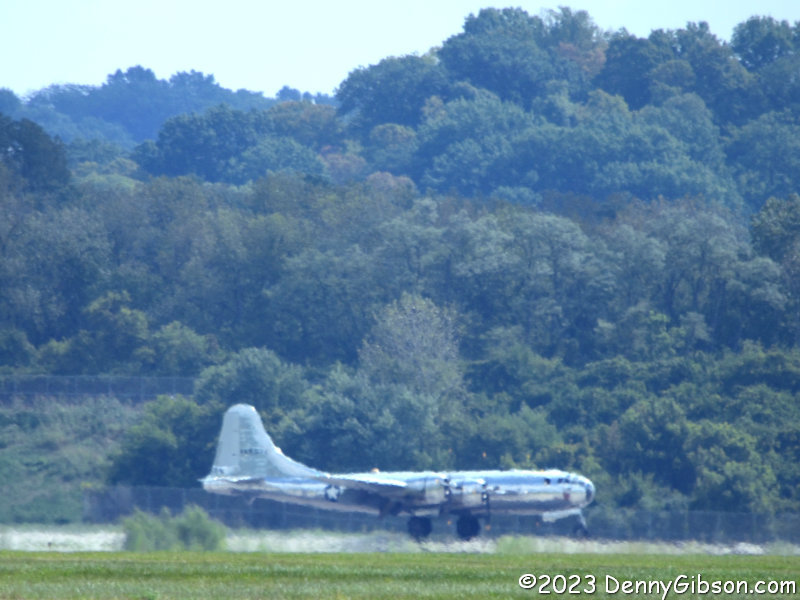
After taxieing to the far end of the field, Doc rumbles down the runway, lifts off, and disappears behind one of the airport buildings. Because of the surrounding trees and the plane’s low flight path, I don’t get a shot of the plane in flight until it returns and circles the field.

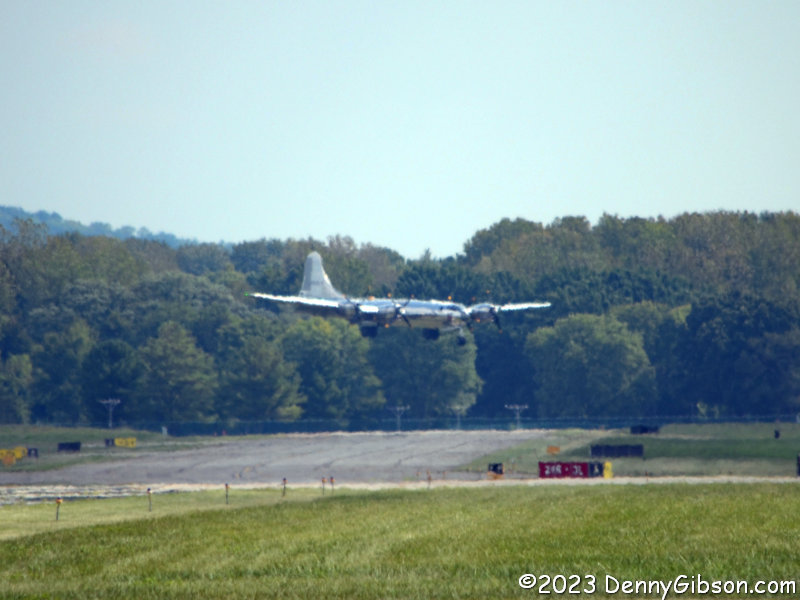
It is headed south, just as it was on takeoff, when it returns to the runway.

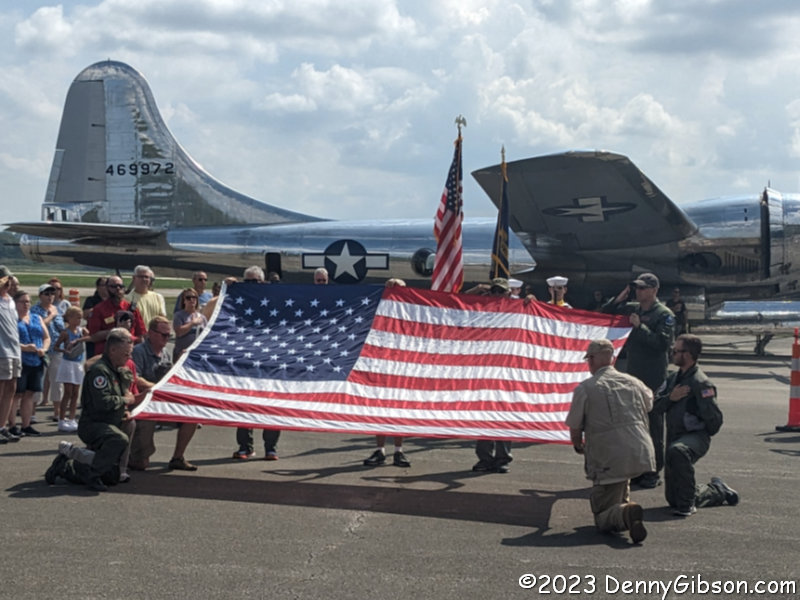
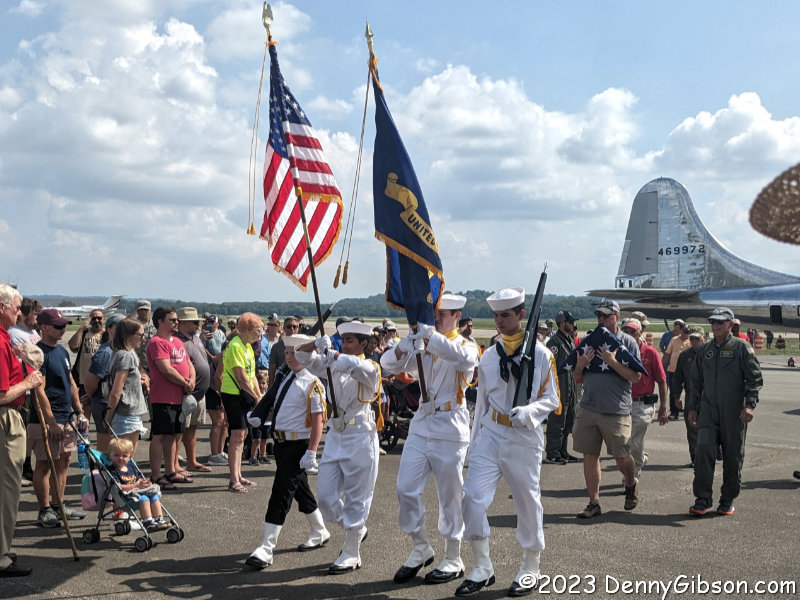
There was just enough time after the flight landed to prepare for the presentation of the flag and singing of the national anthem at noon. I was not able to photograph the color guard as they marched toward the plane but I caught them on the way back.

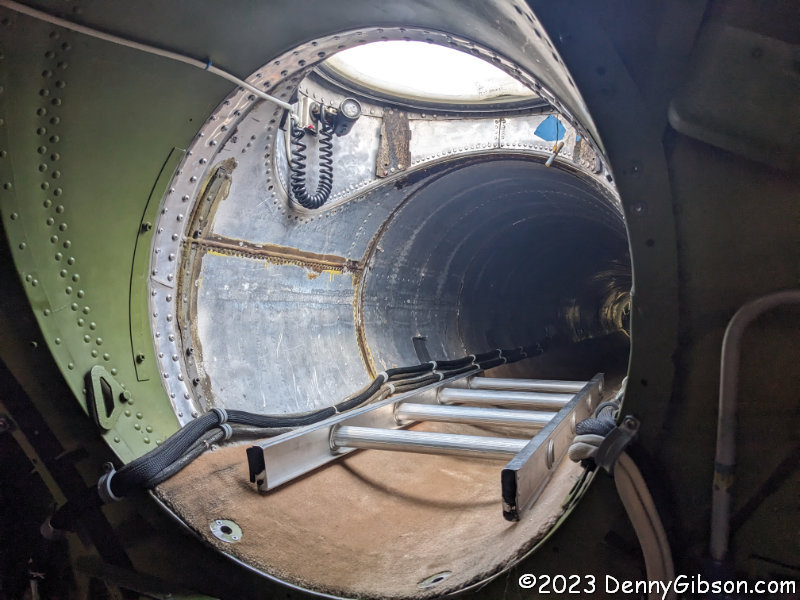
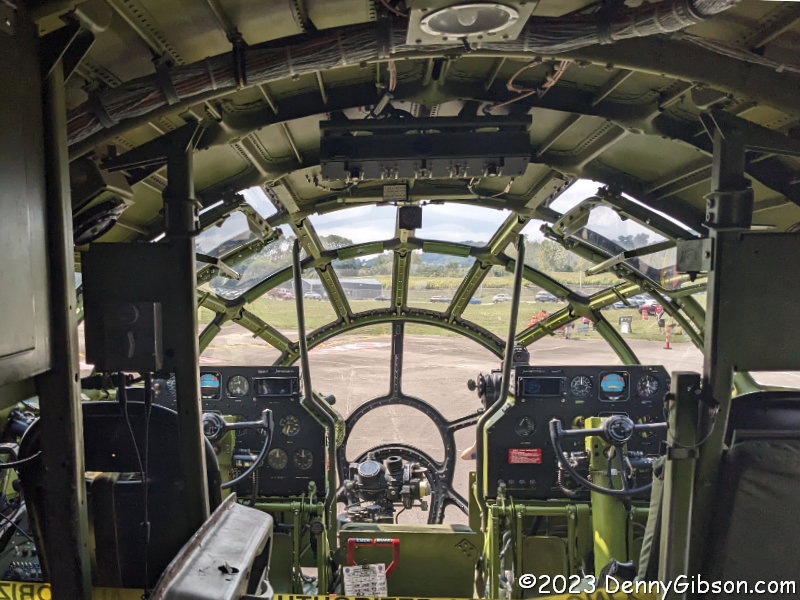
Although we could see everything the guide pointed out, there wasn’t much room in the cockpit for taking pictures. The tunnel to the rear of the airplane went unused as entry and exit were via vertical ladders.

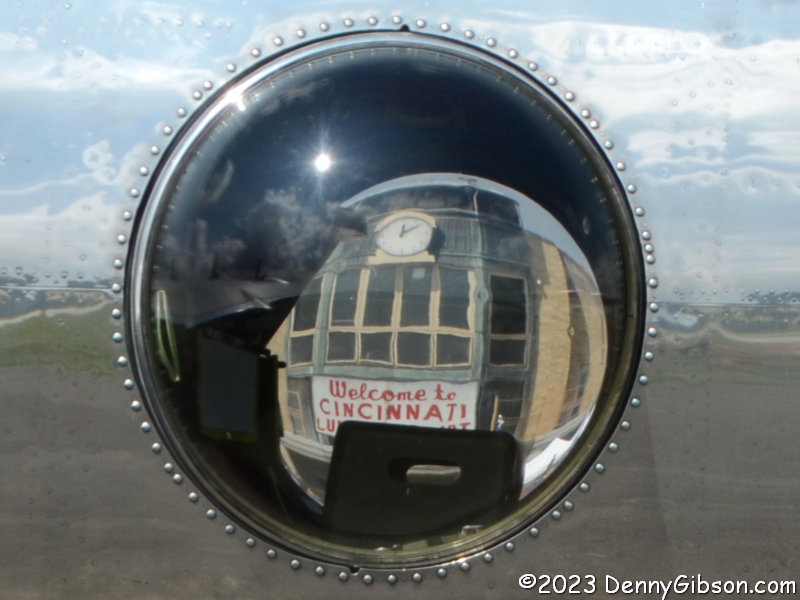
I could now get closeups of the nose art and bombardier’s position. With plexiglass domes in place of gun ports, I could look right through the plane to the historic terminal.

Airport Days is a two day affair so, if you are seeing this shortly after publication, you can easily catch the second half. The weather looks to be just as delightful today as it was yesterday.

Flying Day in Cincy

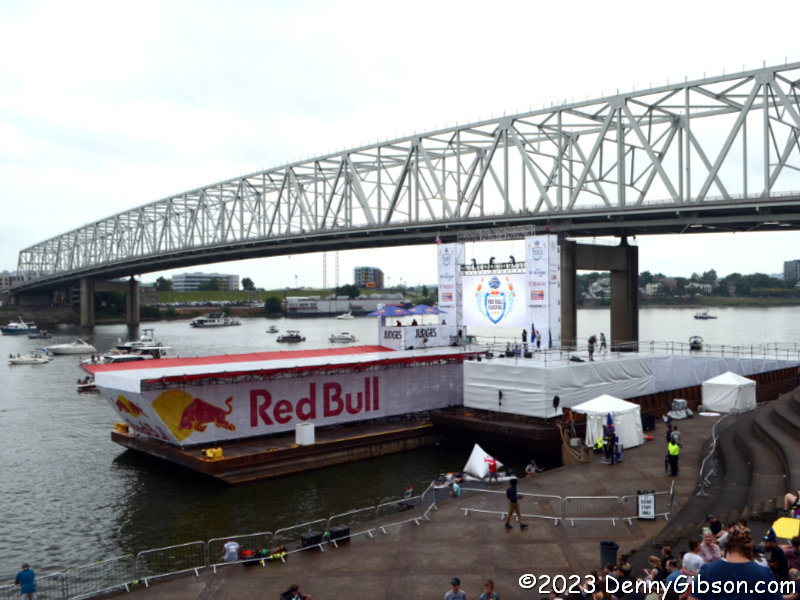
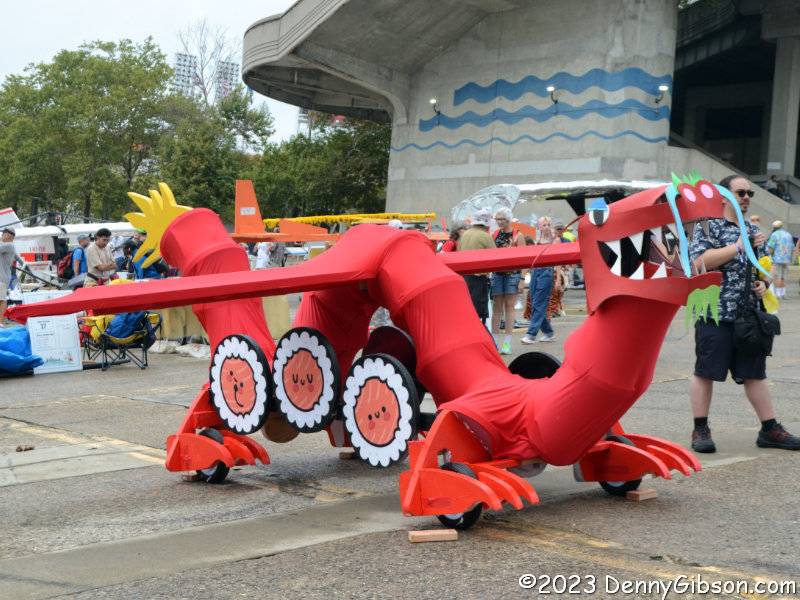
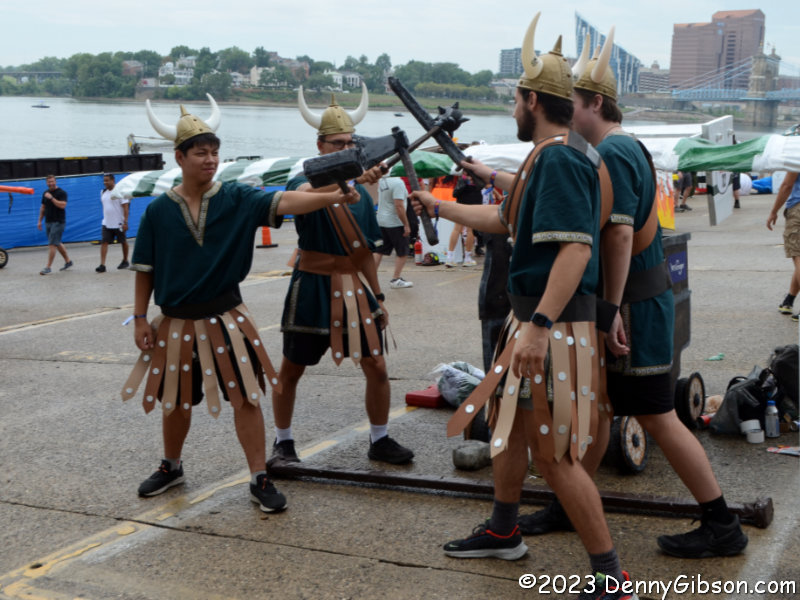
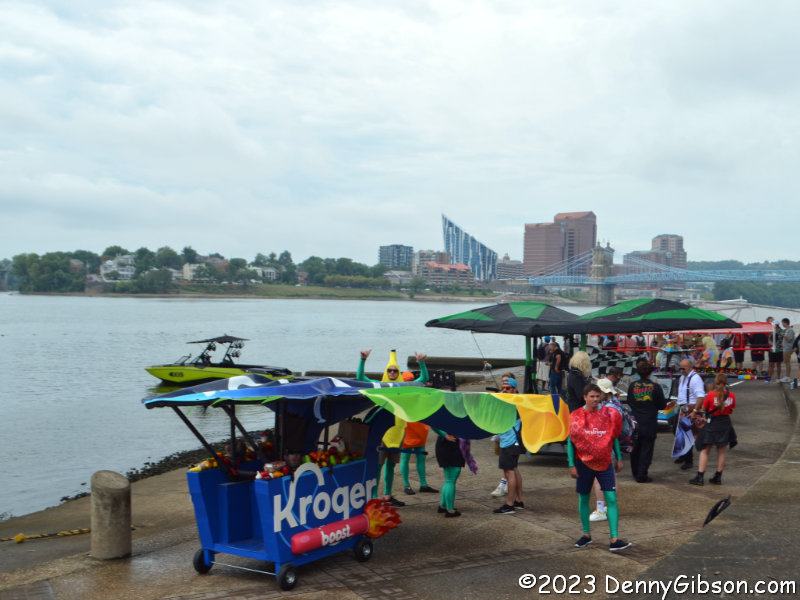
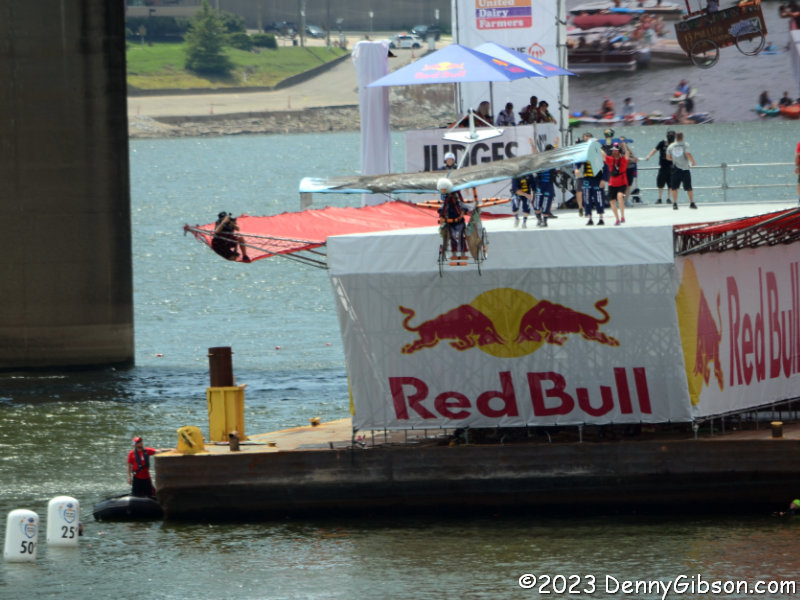
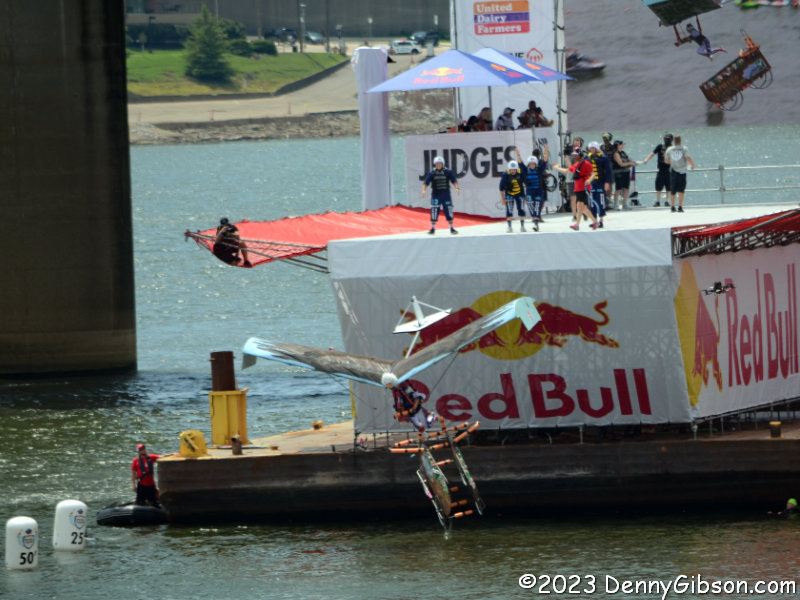
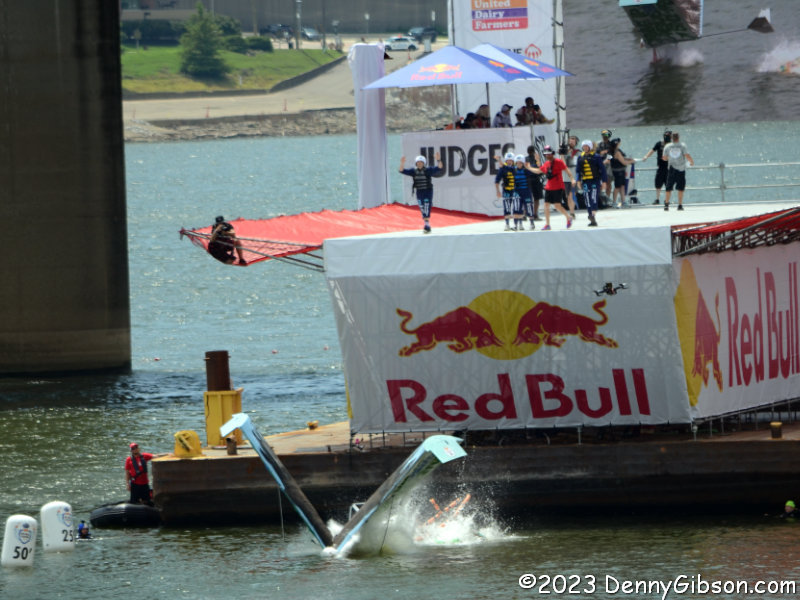
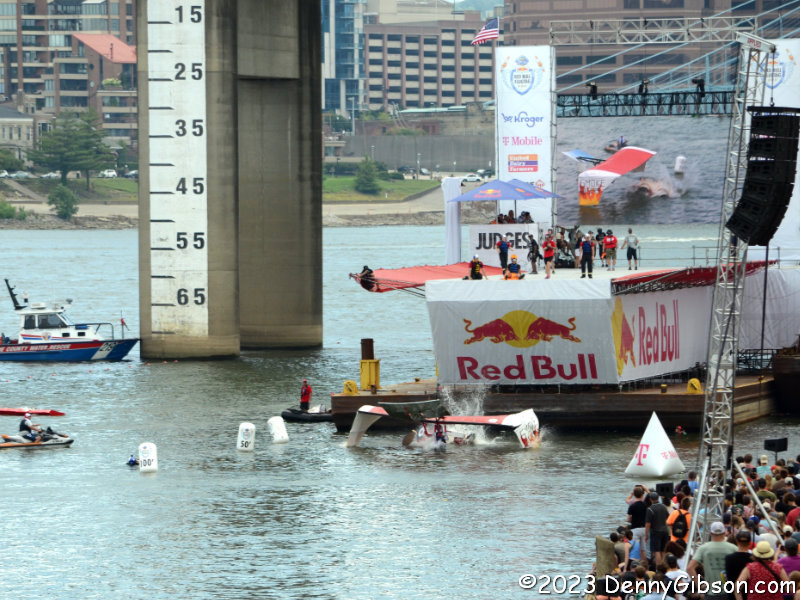
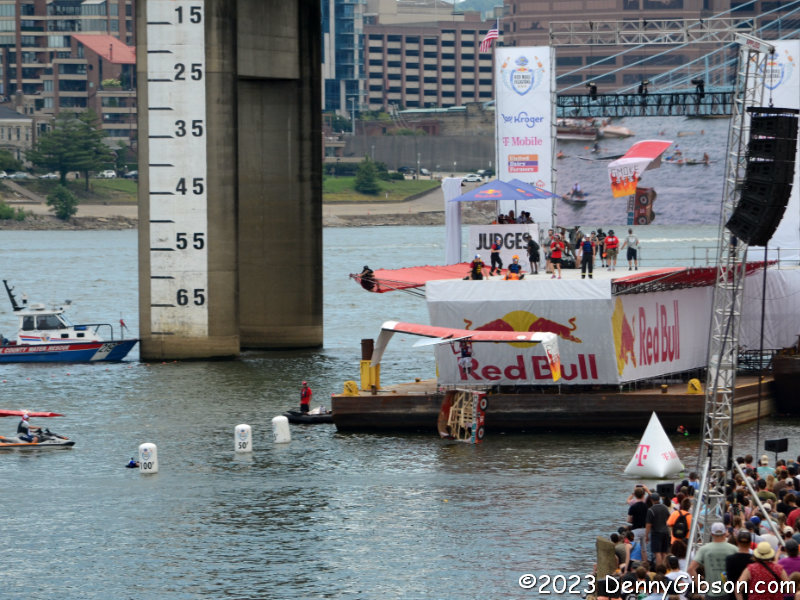
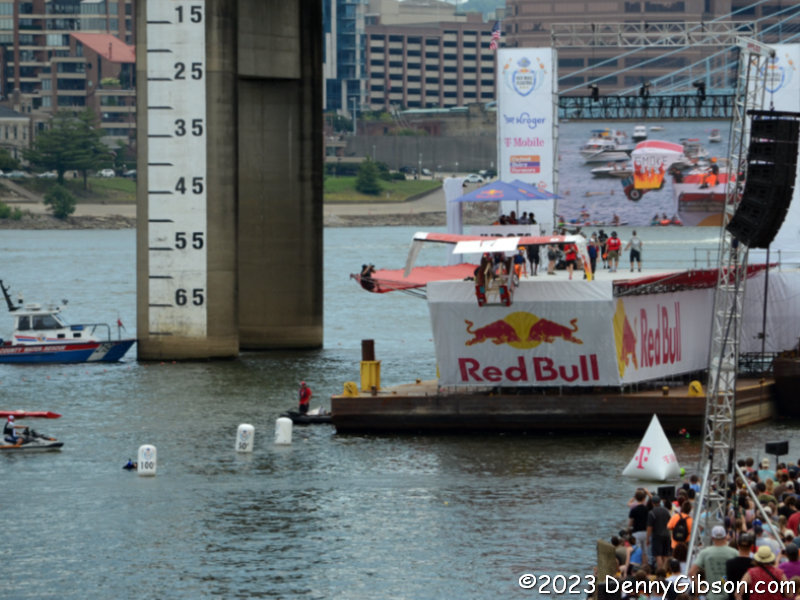
Redbull has been organizing Flugtags all over the world since 1992. Flugtag is German for Flying Day and the events feature homemade contraptions that generally do not fly as well as their creators expect. Yesterday they brought the event to this city where things not flying as well as expected is something of a tradition. On a cloudy but ultimately dry Saturday, thirty-nine participating teams and thousands of spectators gathered by the Ohio River for  Flugtag Cincinnati.

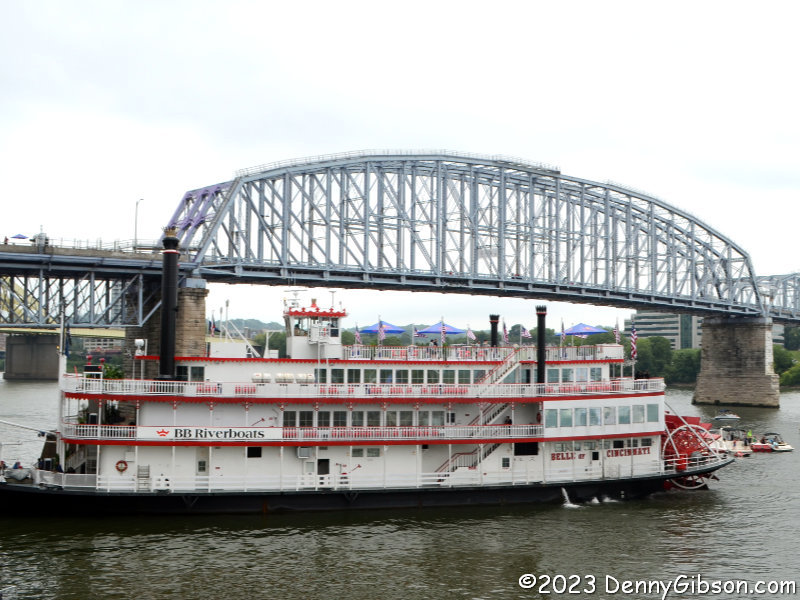
I reached Sawyer Point Park early enough to snag one of the last open spots on the street and avoid $20 and up parking fees. The event itself was free. The Belle of Cincinnati was moored near the Purple People Bridge for a true VIP experience. The launch deck was anchored at the west end of Serpentine Wall near the Taylor-Southgate Bridge. By launch time, both bridges would be lined with spectators.

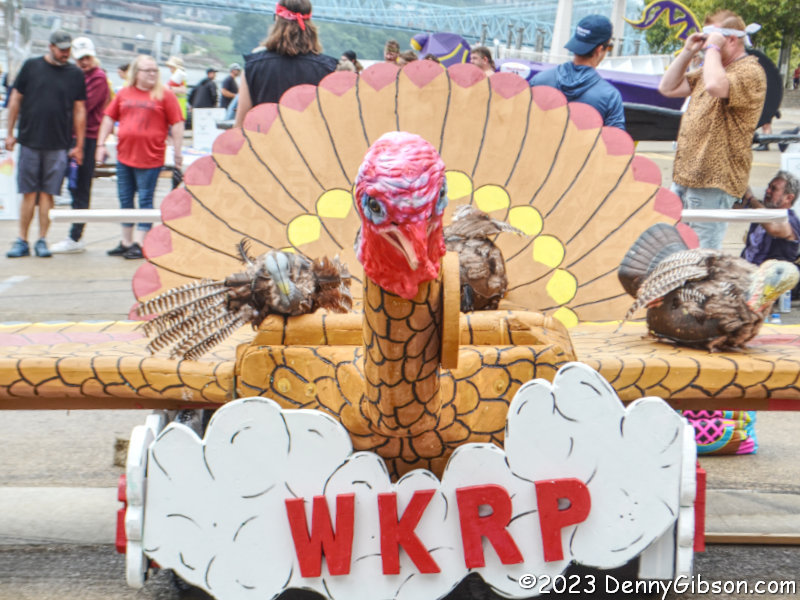
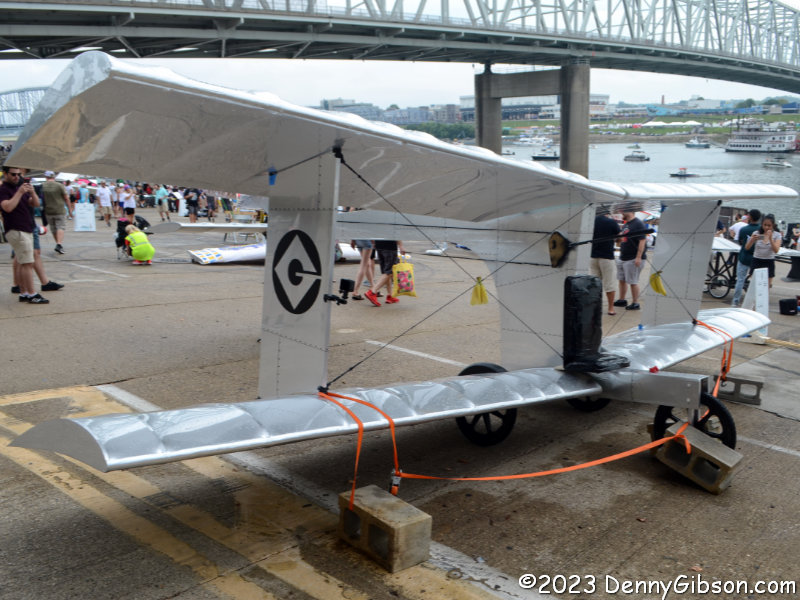
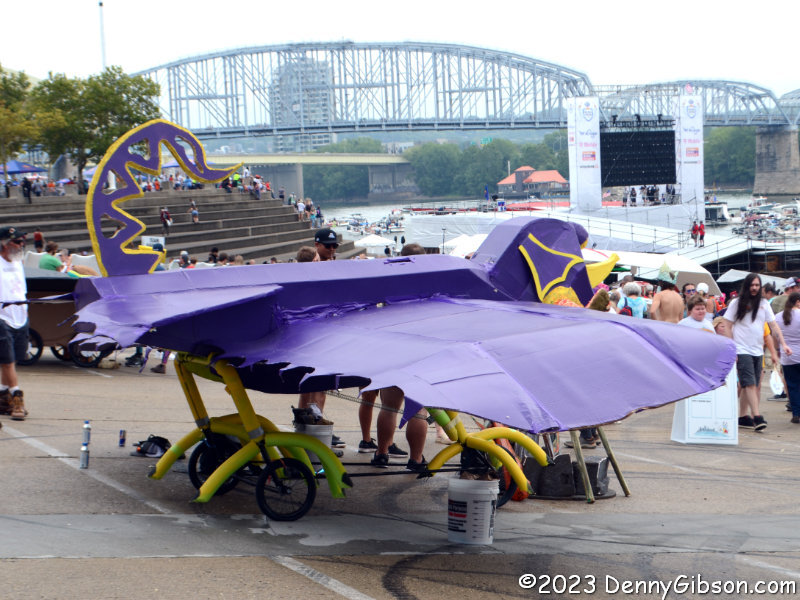
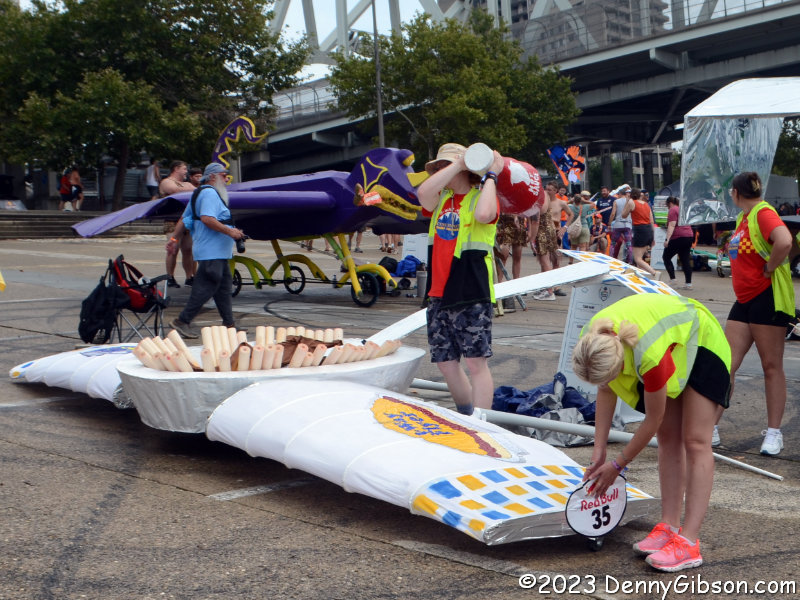
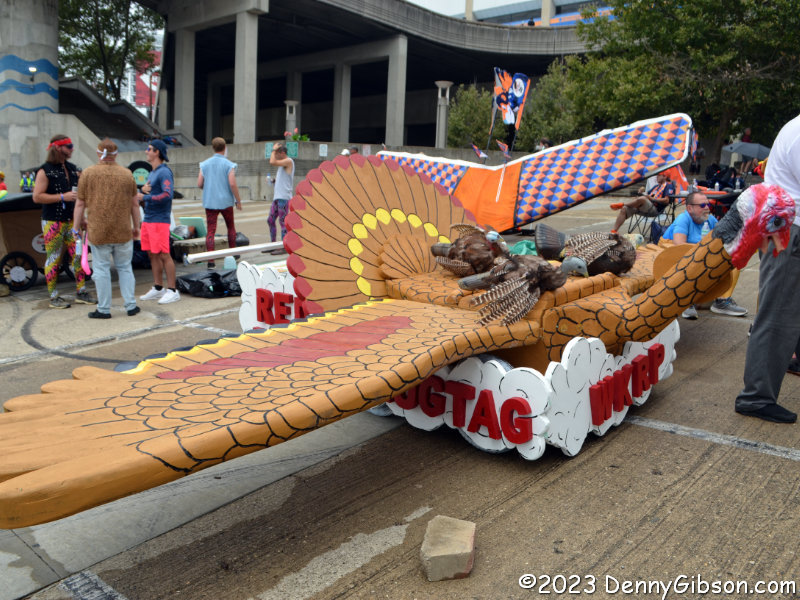
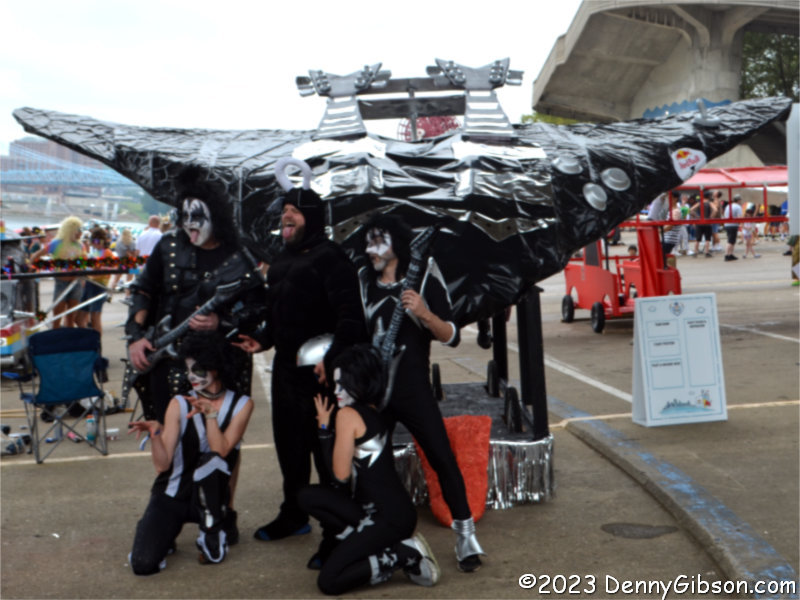
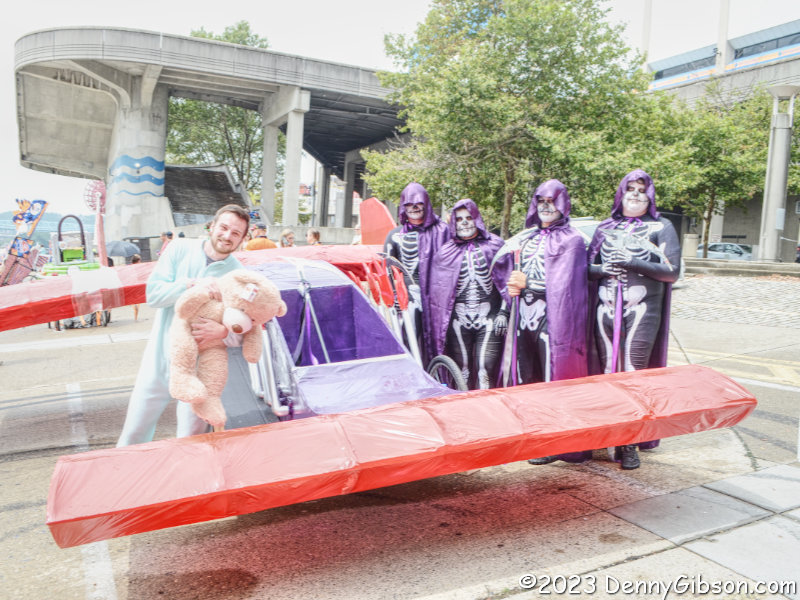
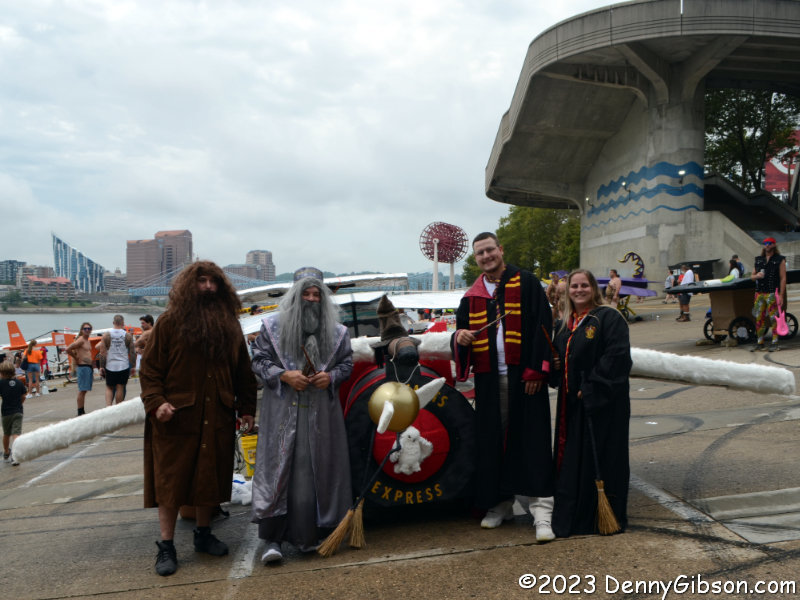
And I arrived late enough that the “hangar” area where the entries were being staged was open. Here’s a fuller view of the WKRP turkey in the opening picture plus some of the others that caught my eye. There are some, but not many, that even sort of look like they might fly.

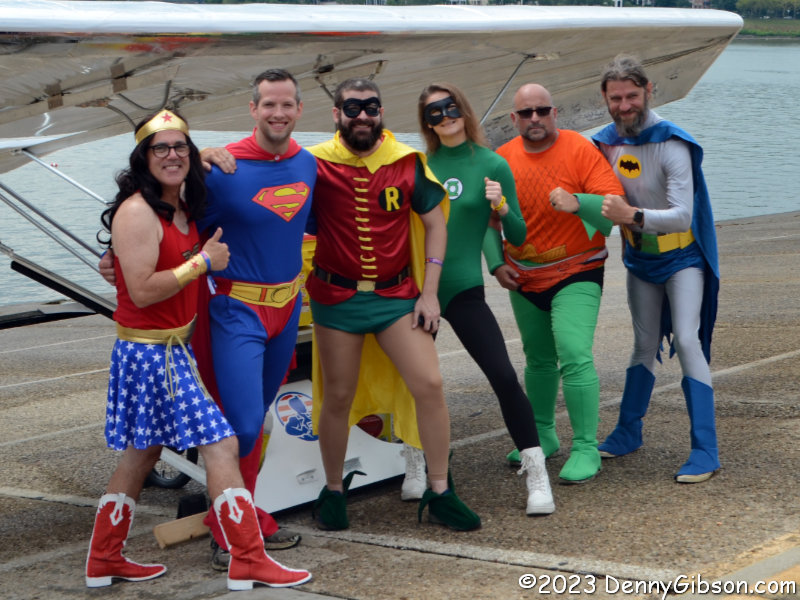
Of course, the crew is every bit as important as the vehicle.

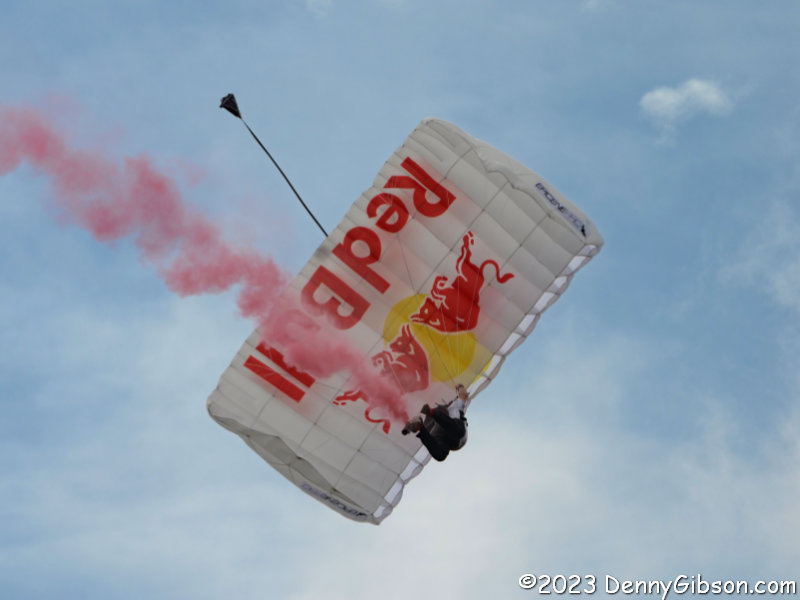
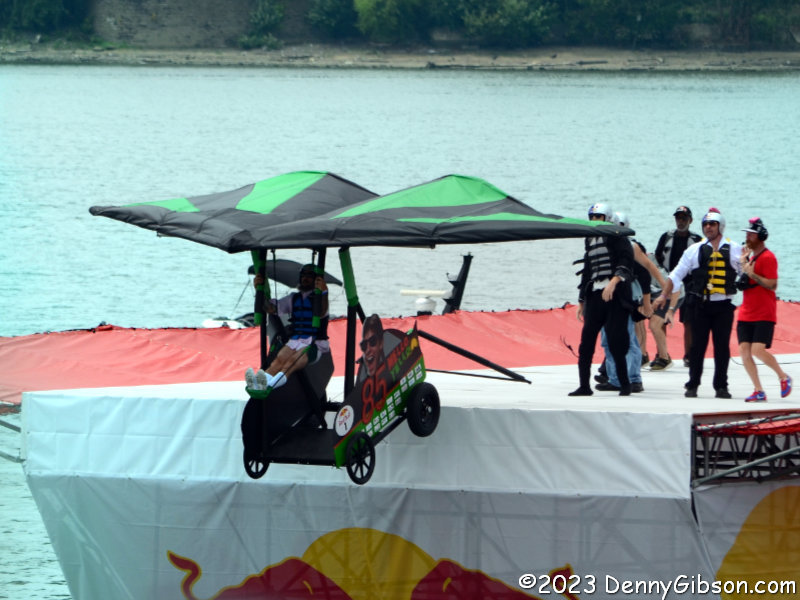
The Hangar had opened at noon with opening ceremonies scheduled for 1:00. As showtime approached, entrants began lining up on the ramp, rescue craft assumed their positions, and skydivers dropped onto the launch deck.

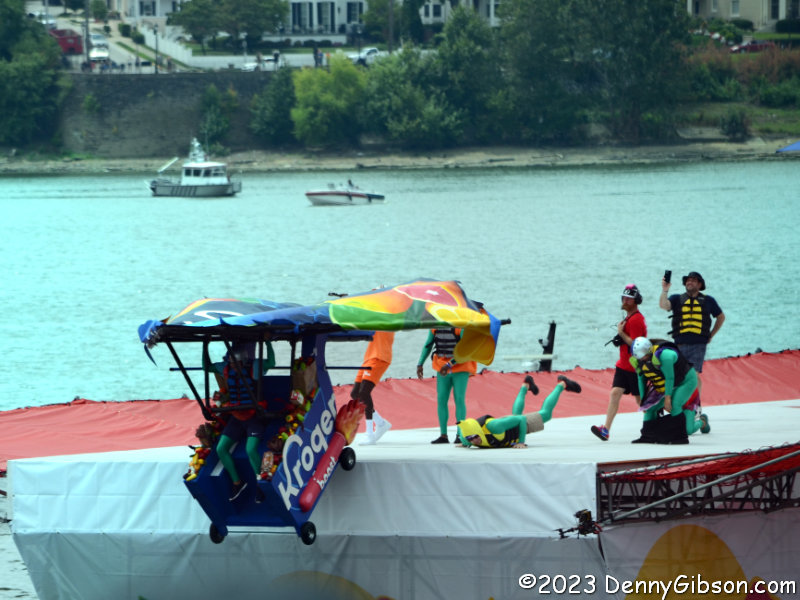
The first launch was an unjudged honorary entry from Kroger. Maximum speed is extremely important and that’s what the crew is for. Kudos to the Kroger crew member who clearly gave it his all. The first competitor followed as soon as the “landing” area was clear.

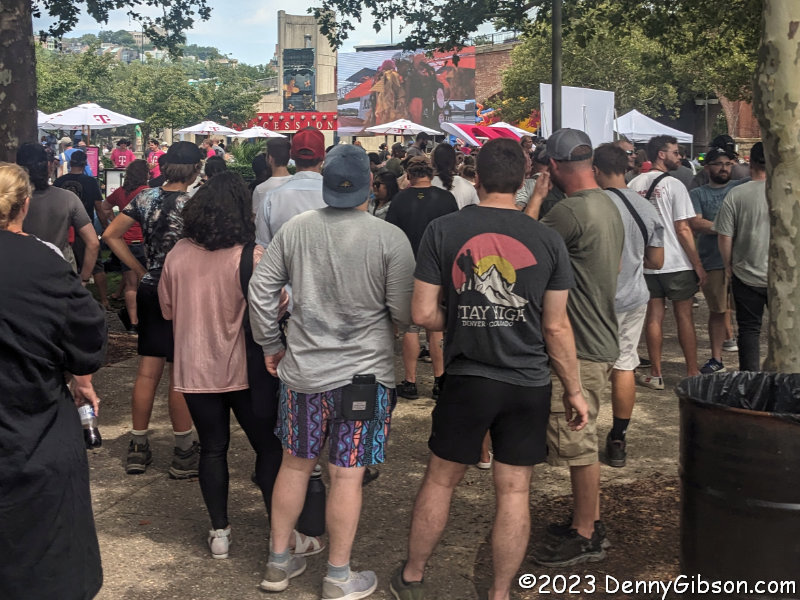
I had picked a spot with a pretty good view of the launch but my view of the flight (if any) and landing was blocked. I watched a few more launches then backed out of the crowd at riverside, treated myself to a four-dollar bottle of water, and watched some of the action on one of the big screens which naturally had their own crowds.

I eventually moved back toward the river but got a better view of the mayhem by keeping my distance from the launch deck.

I know there are videos out there that most will find much more entertaining than these still shots but here’s one more sequence anyway. If you are really interested and have access to ESPN2, the whole thing will reportedly be shown August 19 at 6:00 PM.


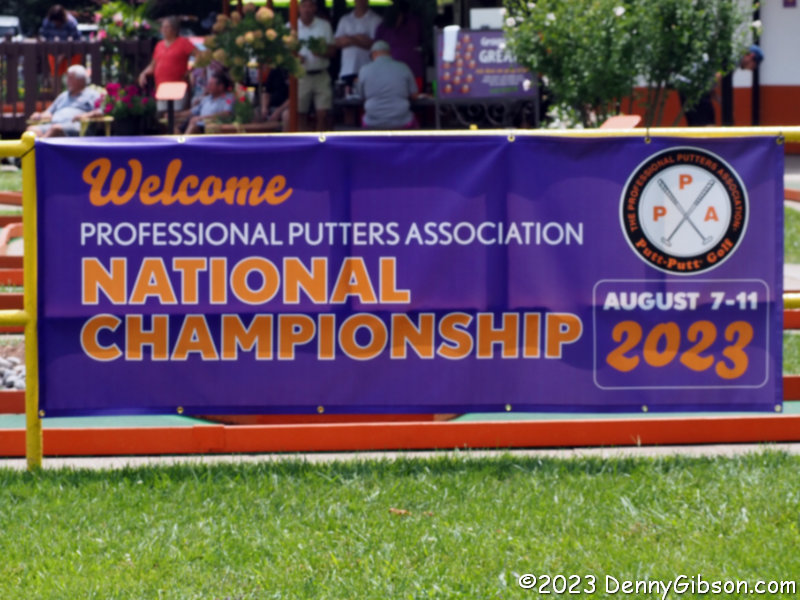
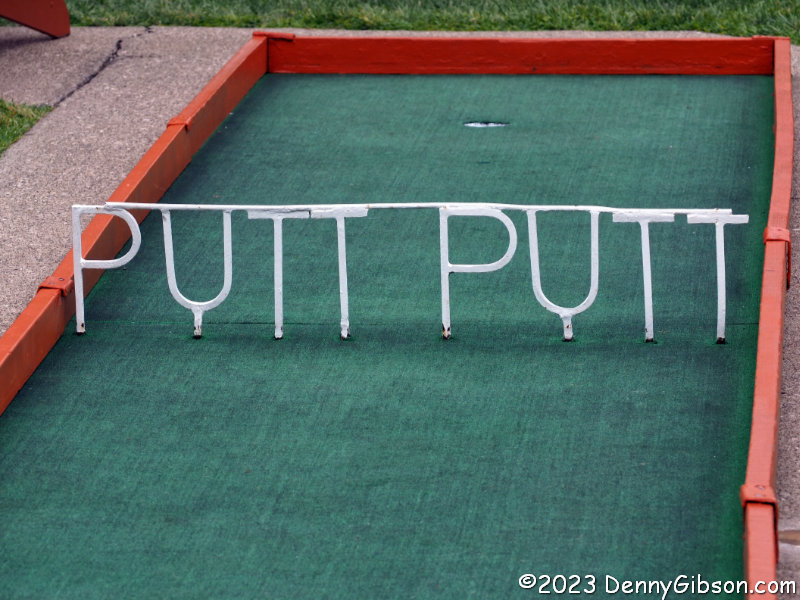
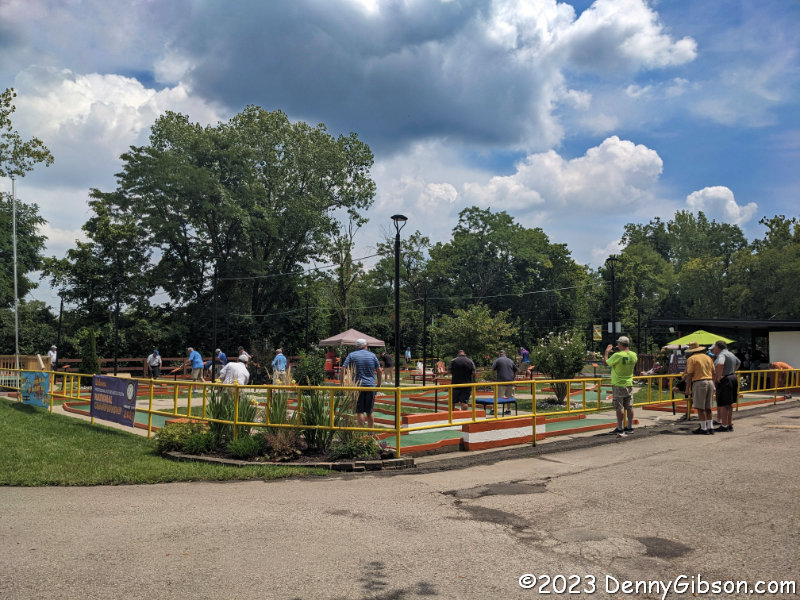
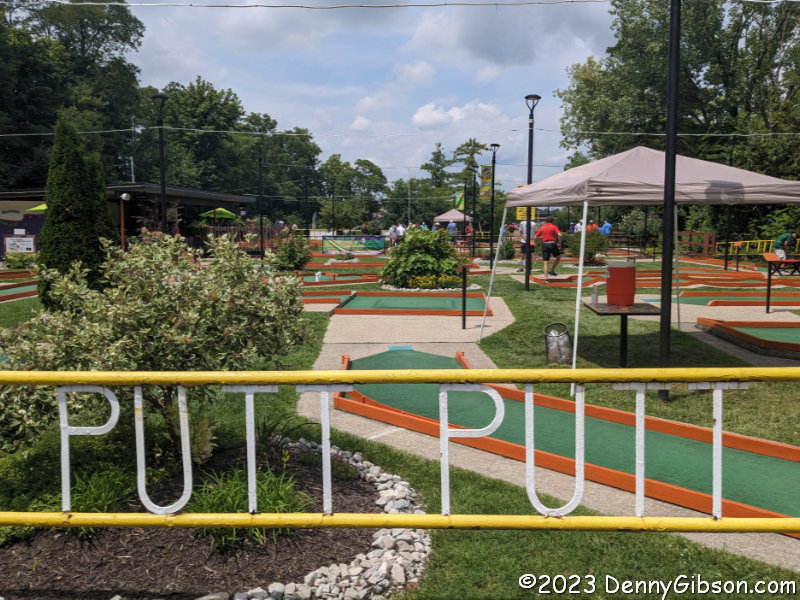
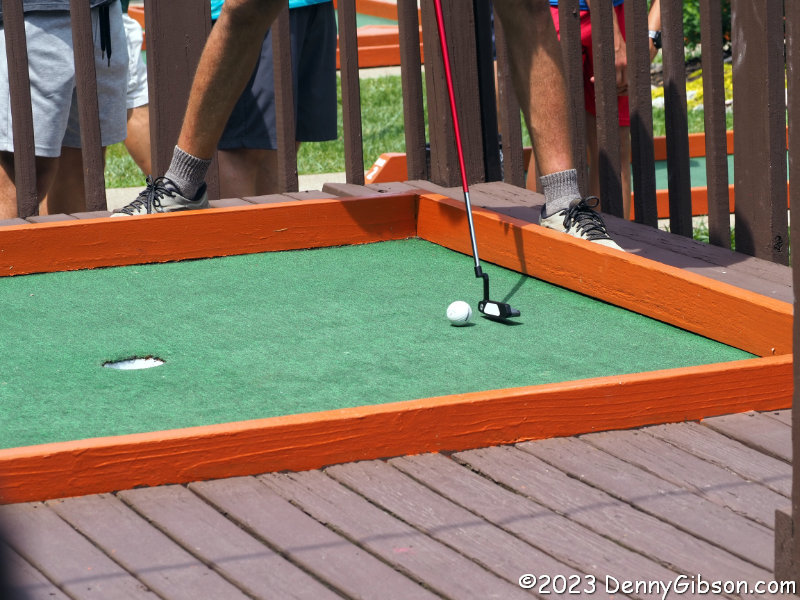
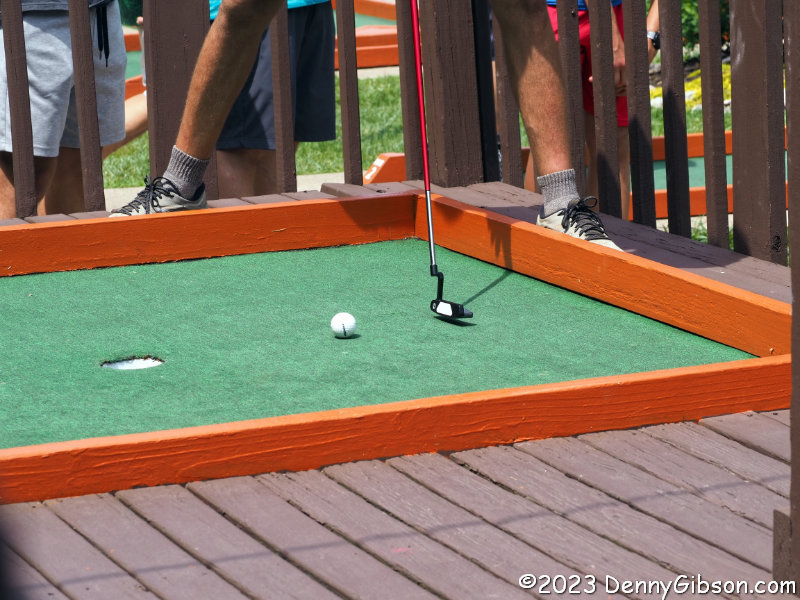
Flugtag wasn’t the only big-time competition happening in the area this week. Over in Erlanger, KY, at the country’s only remaining wooden railed Putt-Putt course, the Professional Putters Association National Championship took place. I stopped by Putt-Putt Golf of Erlanger on Friday to take a look.

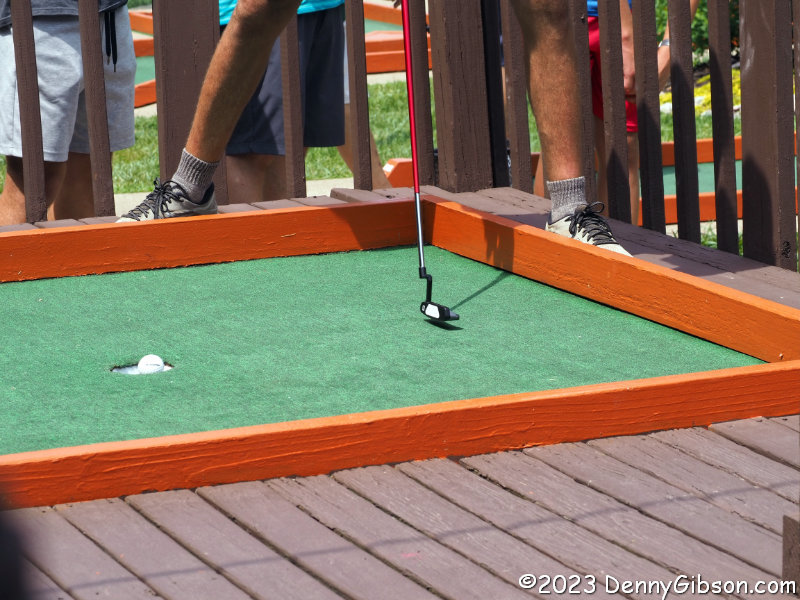
I had not seen a real Putt-Putt course in years. There are no windmills, dancing clowns, or other moving obstacles here.

Every hole is par 2 and this is a fairly rare par shot. I don’t know how many holes had been played but as the tournament neared its end, many players were more than 80 strokes under par.

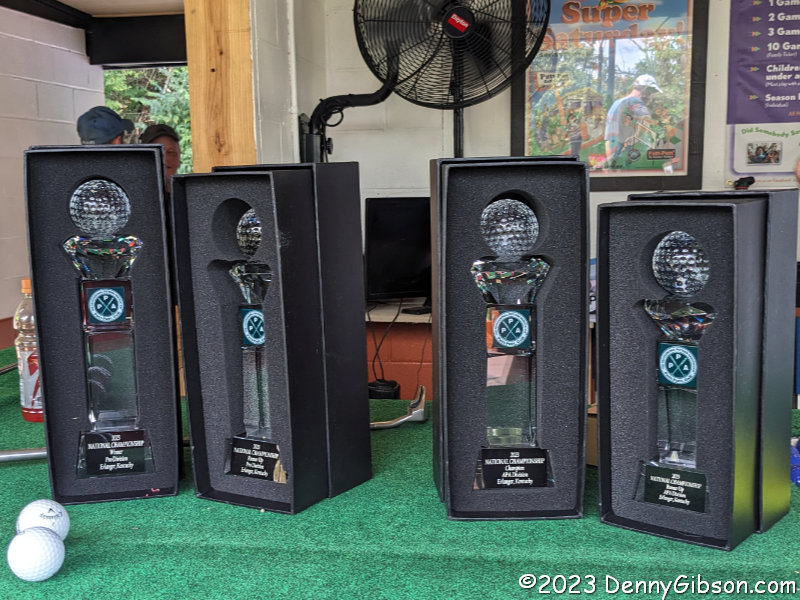
Some of those 80+ under-par players would be taking home a nice trophy and a few thousand dollars cash.

Musical Review
Utopia, Ohio
Hugo West Theatricals

Wednesday is this blog’s day for reviews. Although not every Wednesday gets one, reviews do sometimes appear two or more weeks in a row. In fact, reviews appeared on six consecutive Wednesdays earlier this year. But today is definitely the first time I have ever published back-to-back reviews of premieres of locally produced musicals about local history. In addition to their being musicals with local roots and having me in the audience of their inaugural runs, both Above the Sand (reviewed here) and Utopia, Ohio, the subject of this review, convincingly demonstrate the phenomenal amount of talent in this area. The similarities between the debuts of these two new musicals are striking but there are some pretty big differences between the musicals themselves.

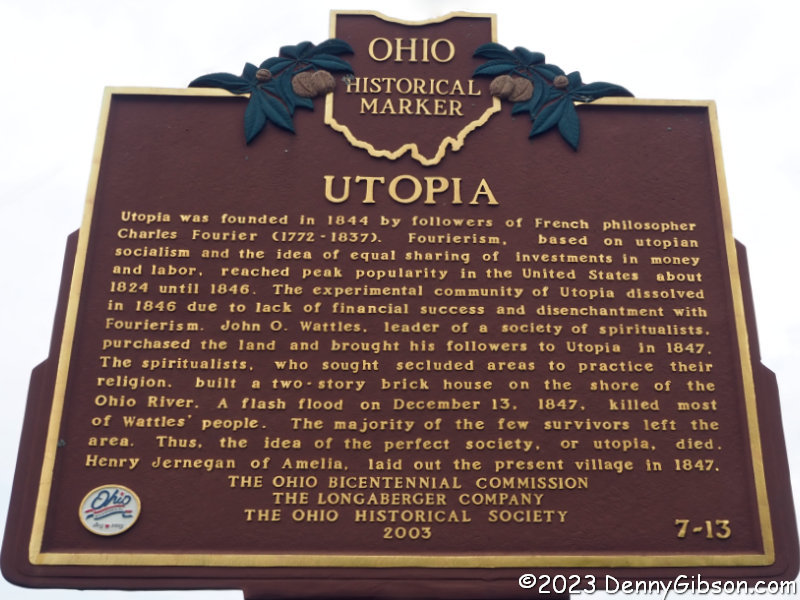
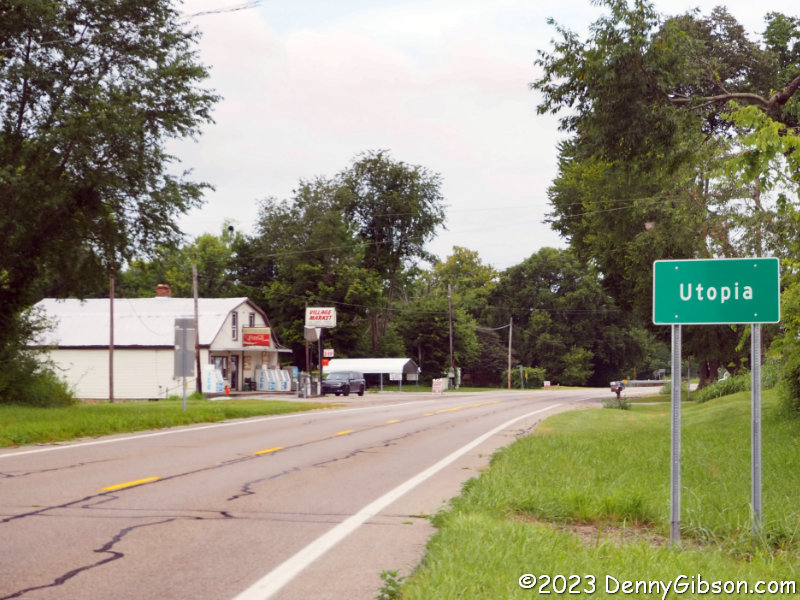
One difference of note is the public’s familiarity with the two subjects. Virtually everyone knows that the Wright brothers were the first humans to successfully fly a heavier-than-air machine, and many residents of southwest Ohio know a lot more of the story than that. But the story of Utopia, an unincorporated community near Cincinnati, is hardly known at all. My guess is that even people who live fairly close to the small cluster of buildings on the banks of the Ohio River know little or nothing beyond what is written on the historical marker in the opening photo and not many stop to read even that.

Utopia was actually the name of the third and final attempt at communal living at the location. The Clermont Phalanx was first. A “phalanx” was a group of followers of the writings of Charles Fourier. The Clermont Phalanx was formed in 1844 and failed in 1846. Within months of that failure, abolitionist and spiritualist John Wattles established the community of Excelsior on a portion of the phalanx property, and Josiah Warren, “America’s first anarchist”, established Utopia a short time later on another portion. A very good history of all three is available here. Joshua Steele, the writer of Utopia, Ohio, provided a nice summary in a Facebook post here.

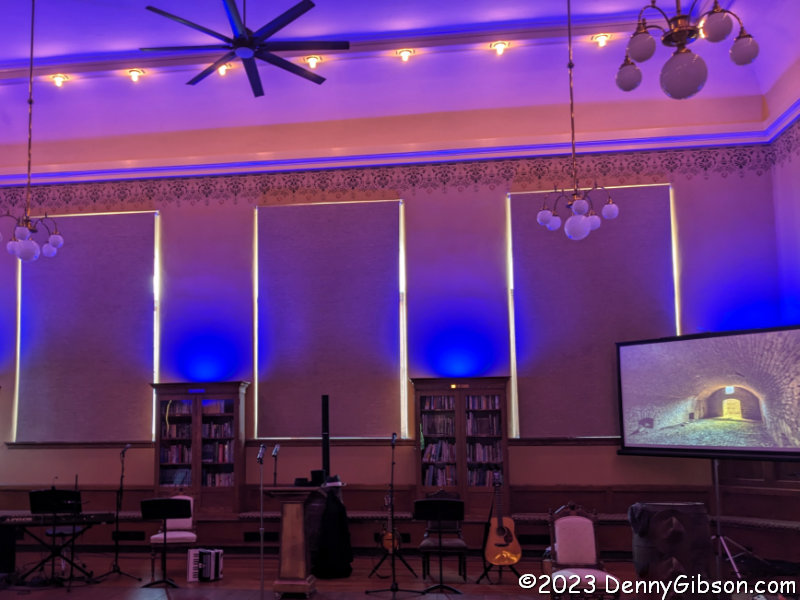
I’ve brought up all of this background stuff because I believe a decent knowledge of the history is necessary to understand the musical. Notice I said “understand” not “enjoy”. Enjoying the musical is easy because the music and performances are so good. In fact, knowing nothing at all about the history would not keep you from enjoying the music. You can appreciate the tunes the same way you appreciate a concert or a new album. All five cast members are talented vocalists. There is no orchestra. Every cast member plays at least one instrument and some play several. The full battery includes guitar, mandolin, piano, accordion, violin, and cajon. Coordinating instruments no doubt complicated the director’s and stage manager’s jobs but it was handled quite well.

Coordinating hats also added some complexity. With more roles than actors, hats were used effectively to distinguish specific roles. Linsey Rogers and. Brad Myers were particularly adept at this. At times, images projected at the side of the stage also helped know who was who.

Determining when was when was a different matter. You might be able to tell the players without a program but not the dates. The songs of Utopia, Ohio do not tell a story chronologically, at least not in the order they were performed on Thursday. That is why, I assume, there are dates in the program. It took me way too long to realize this. Once I did, I started taking in the performance more as a concert than a play despite having a pretty good sense of the history of the three failed communities. In the end, I decided that viewing it as a series of related but not ordered musical vignettes was best. Within each vignette, the cast skillfully brought music, lyrics, actions, and expressions together to tell the intended story and to entertain as well.

A very important difference between last week’s review and this one is the fact that Utopia, Ohio‘s first run is not already over. This is being published on the morning of the second of four scheduled performances so I do not feel the too-late-to-matter guilt I did last week. Maybe I will, though, as at least one of the three remaining performances is sold out. Check for tickets here. If you do snag one, my advice is to either pay close attention to the dates in the program and put the history together in your head or ignore them completely and just tap your toes to some fine music.

Paddlefest 2023

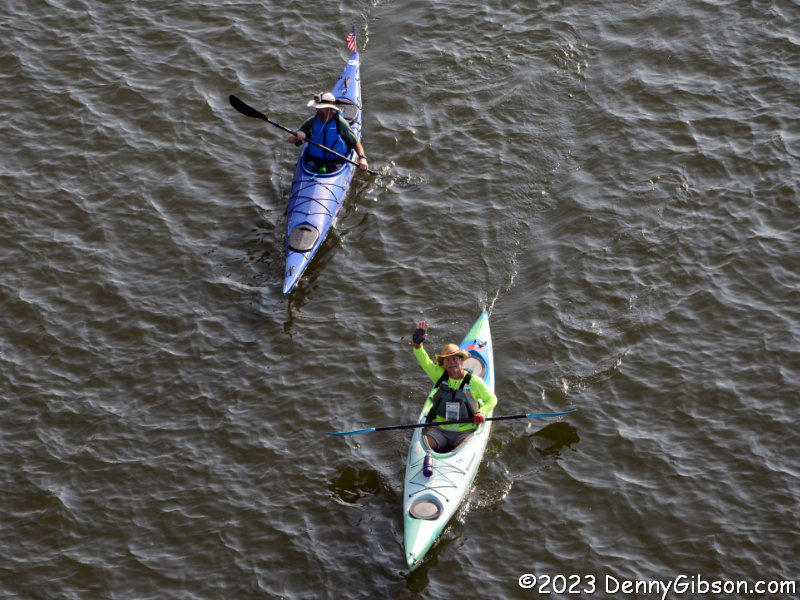
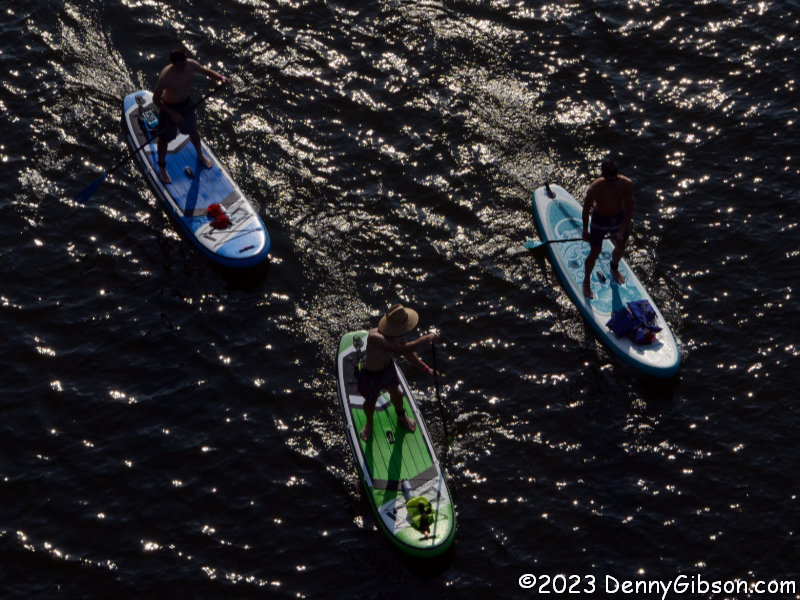
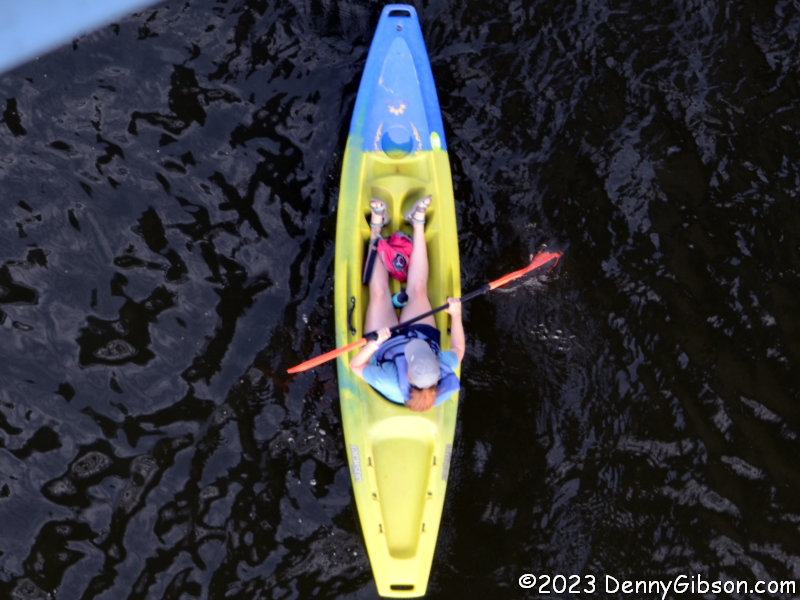
I’ve known of Ohio River Paddlefest for quite a while. I even planned to attend last year until severe weather convinced me — and everybody else — otherwise. Heavy storms led to the cancellation of several outdoor events including the 2022 Paddlefest. There wasn’t even a hint of foul weather this year and I finally made it to “the largest paddling event in the country” for the first time. I was not in position to see the launch of approximately 2000 participants into an Ohio River that was cleared of powered watercraft for the event but I did get to see many of them pass through Cincinnati’s riverfront.

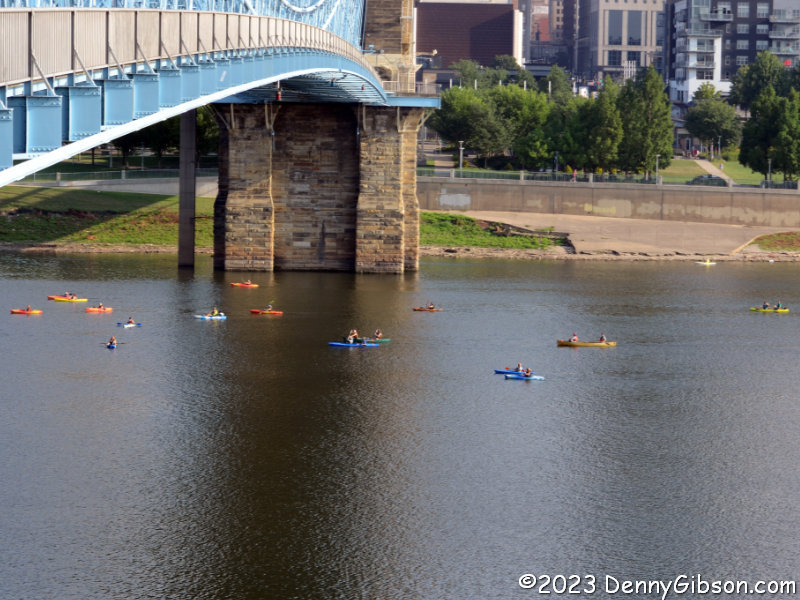
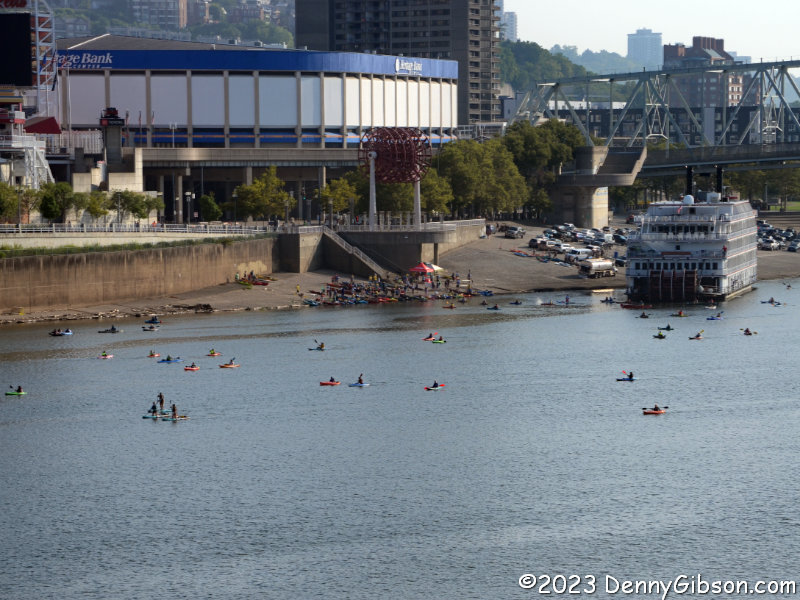
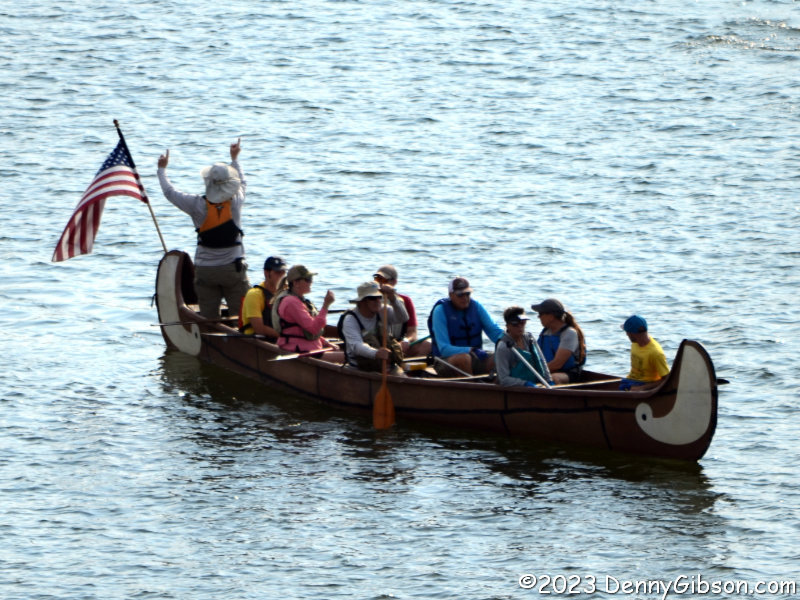
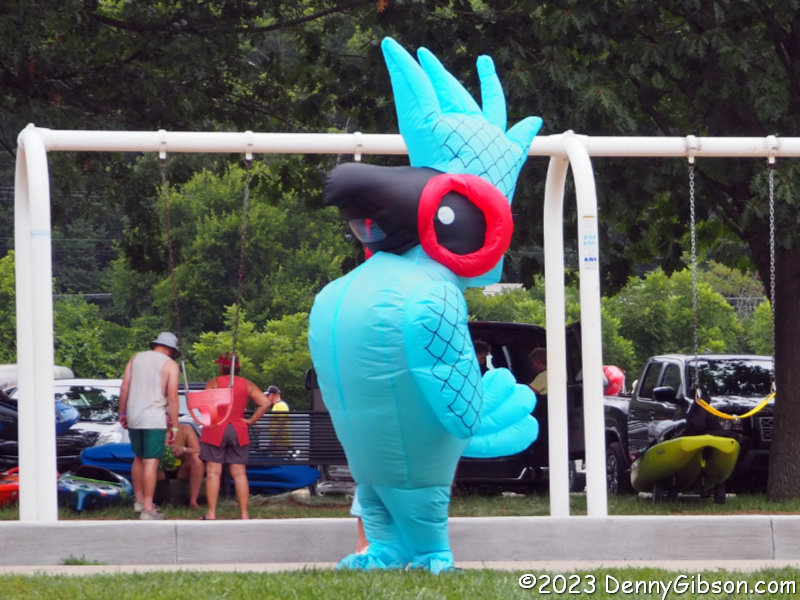
I decided to park in Kentucky and use the century-and-a-half-old Roebling Bridge as an observation deck. People can choose to paddle either 4.5 or 9 miles from the launch point at Schmidt Recreation Complex at the east edge of Cincinnati. The pullout point for the shorter trip is the public landing near the coliseum. The big paddle wheeler at the landing is the American Heritage on her way to Pittsburgh. I don’t know whether being in town for Paddlefest was intentional or something they just couldn’t avoid. Also in that photo, the three ladies in the opening photo can be seen well past the landing on their way to the Roebling and my camera.

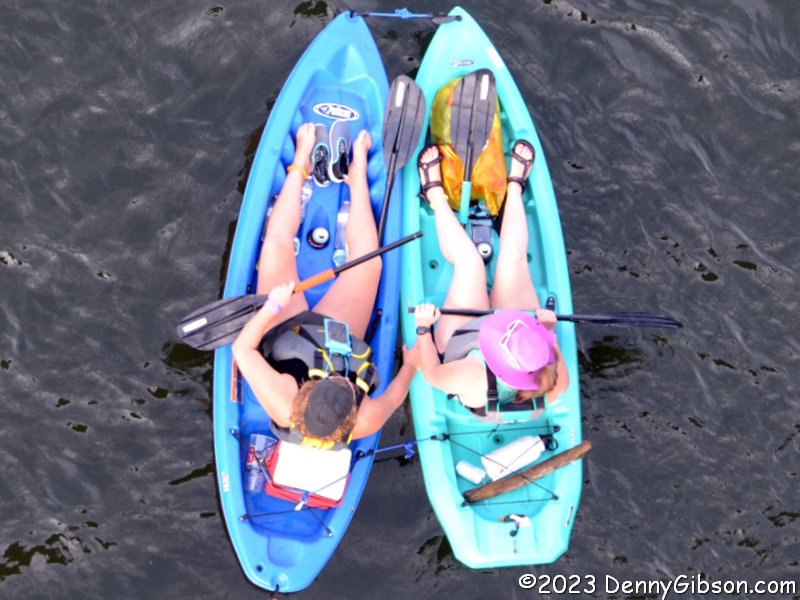
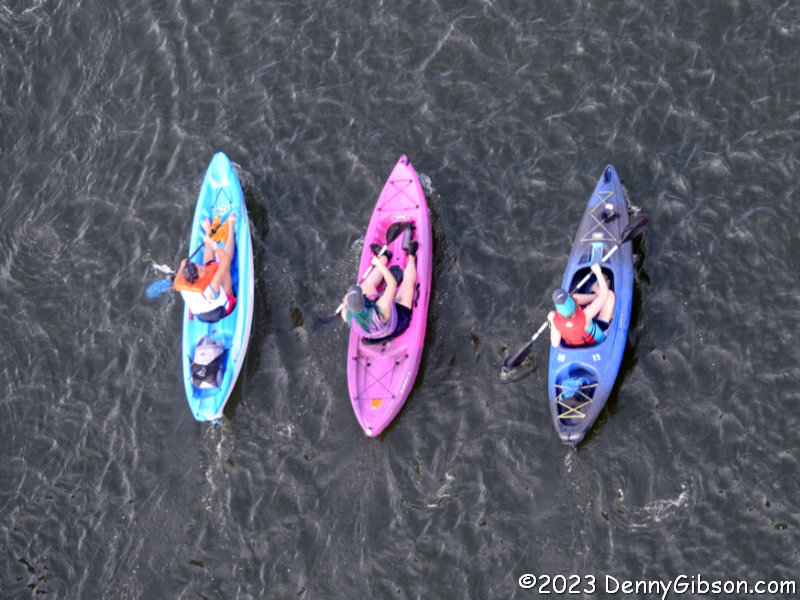
There was a race and I’m sure there was a winner but most participants seemed to be much more concerned with enjoying the float and maximizing rather than minimizing their time on the water. Some even took time to look up and wave or wrangle three boats together for a group selfie.

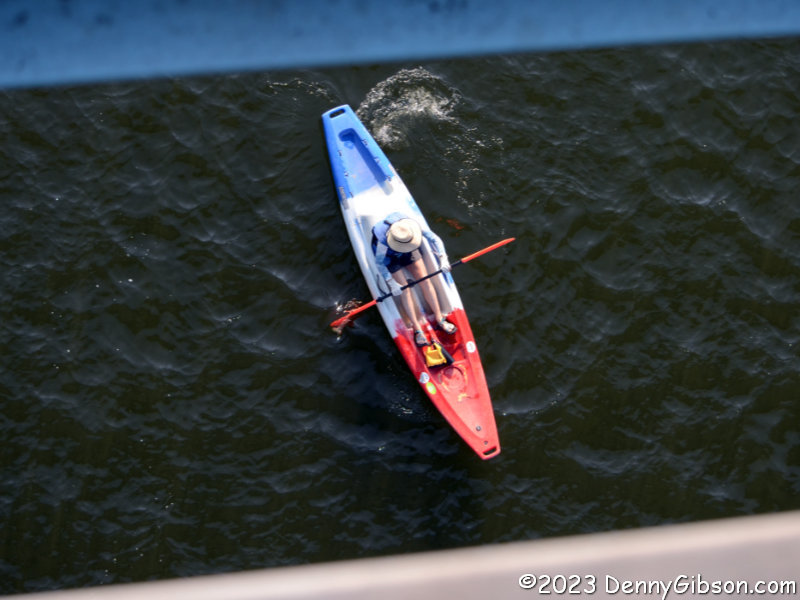
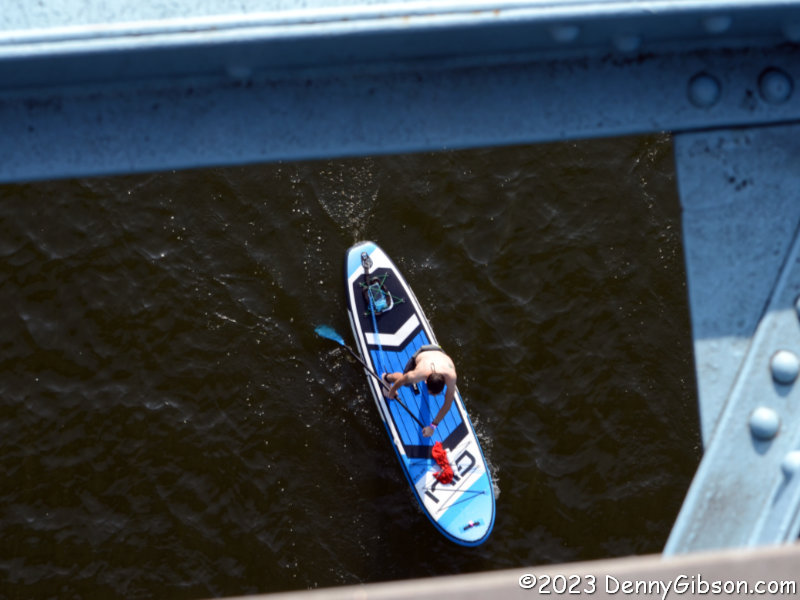
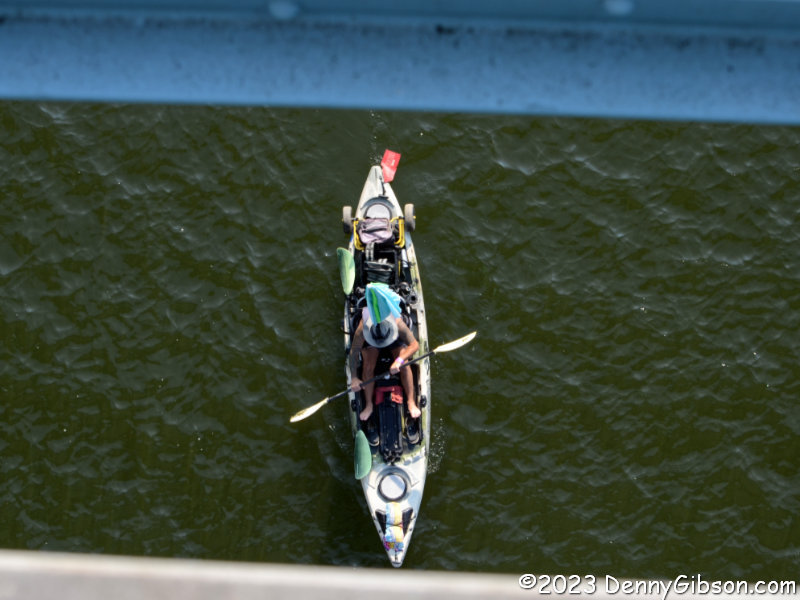
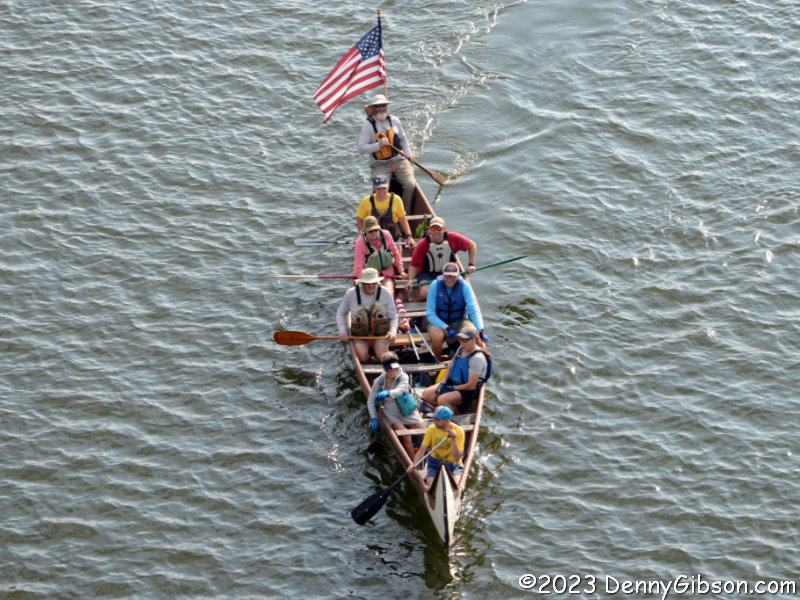
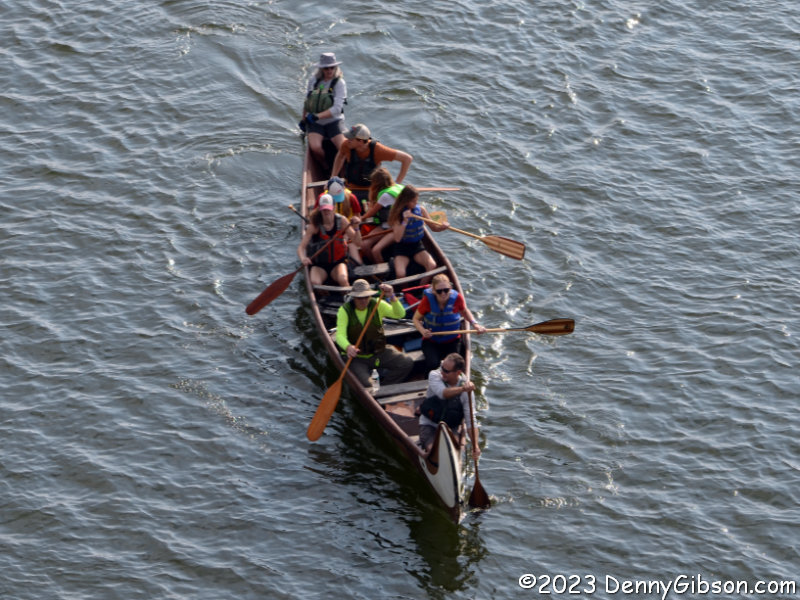
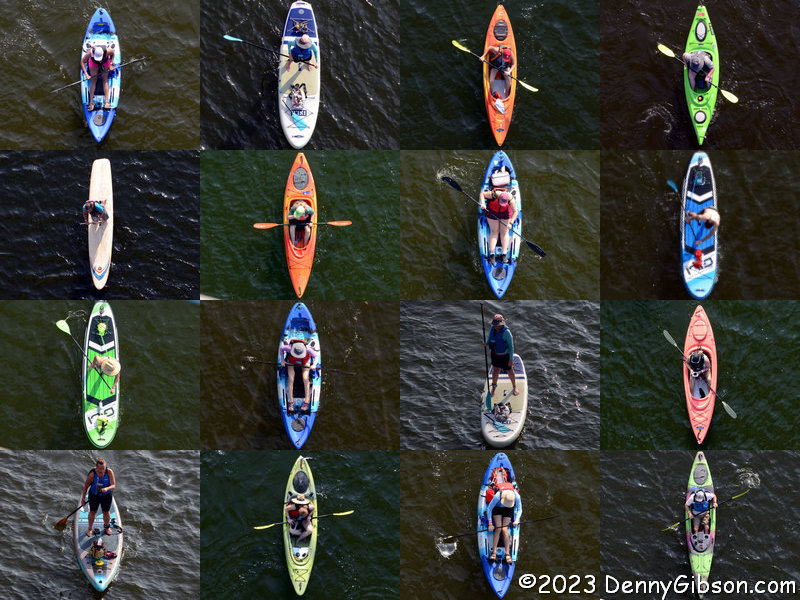
Shooting upriver at the approaching boats meant shooting into the sun but at some point, I realized that I could completely avoid any glare issues by shooting straight down. Snapping paddlers just before they disappeared under the bridge was actually quite addictive and I snapped a few more before I could pull myself away.

Not everything is ruined by shooting toward the sun. Some things actually look pretty good or so I convinced myself.

With the exception of some safety and patrol boats, these were probably the most powerful watercraft on the Ohio near Cincinnati throughout the morning. They did not flaunt it, however, and were well back in the pack.

Shortly after the big boats passed, I finished crossing the bridge and moved to the downstream side to return to Kentucky. Catching boats just as they popped out from under the bridge wasn’t nearly as easy as catching them just before they popped under it but I did catch one.

These are all a bit away from the bridge and moving slowly.

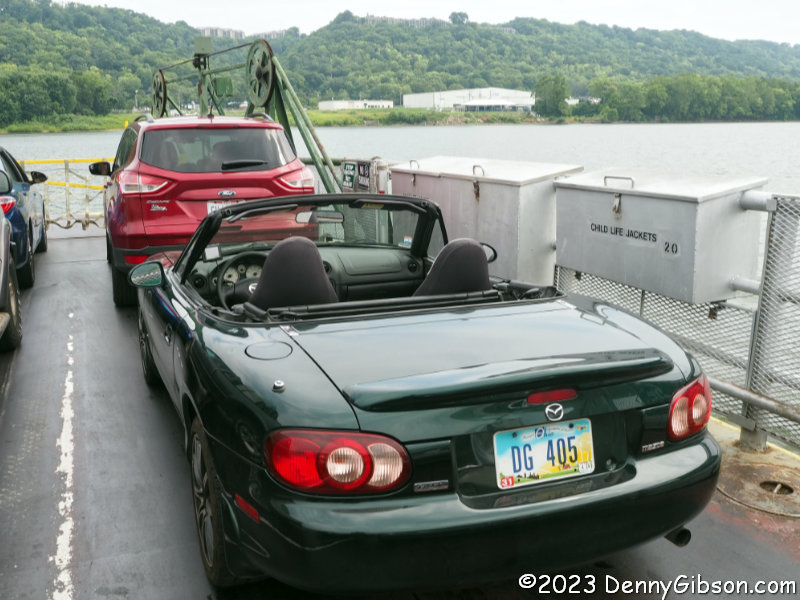
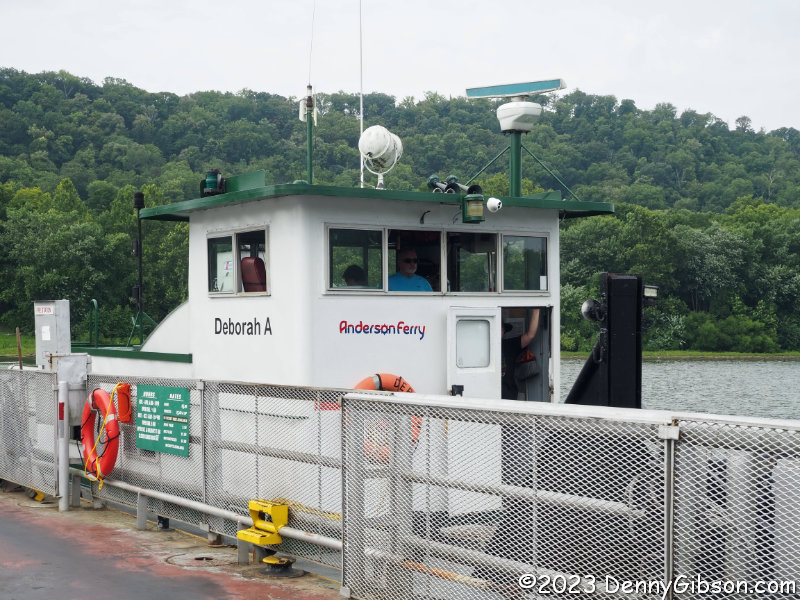
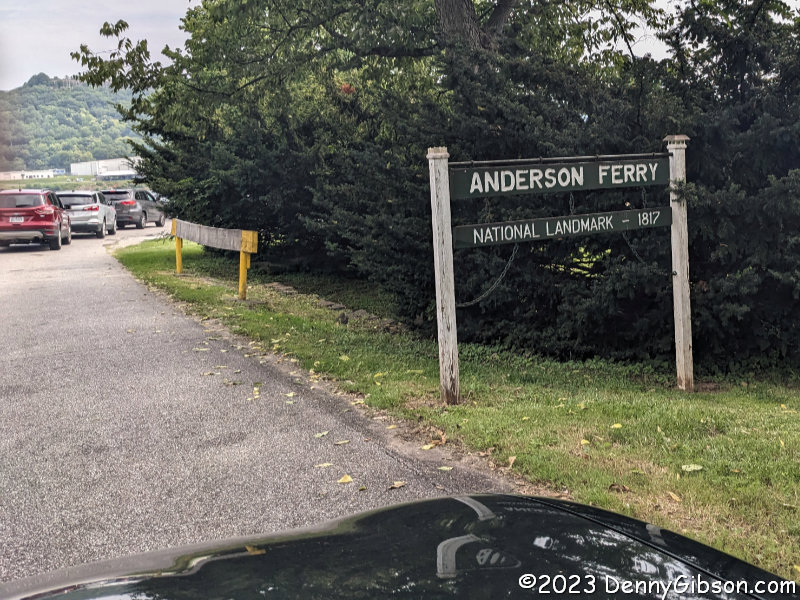
Back in Kentucky, I grabbed brunch and then headed to where the nine-mile paddle ended and where the wrap-up party was being held. For some reason, northbound I-71/75 was closed at the river. I didn’t figure that out until I was forced beyond it. I decided to just keep going and cross the river on the Anderson Ferry for a real break from the normal. The Miata got the first of two comments when the attendant collected my fare. “Nice change of pace. I have to reach up for every other car.”

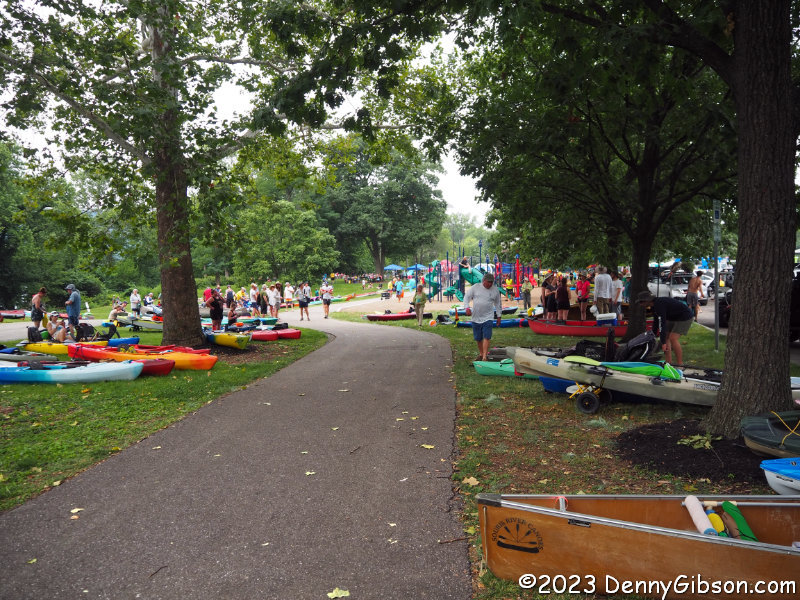
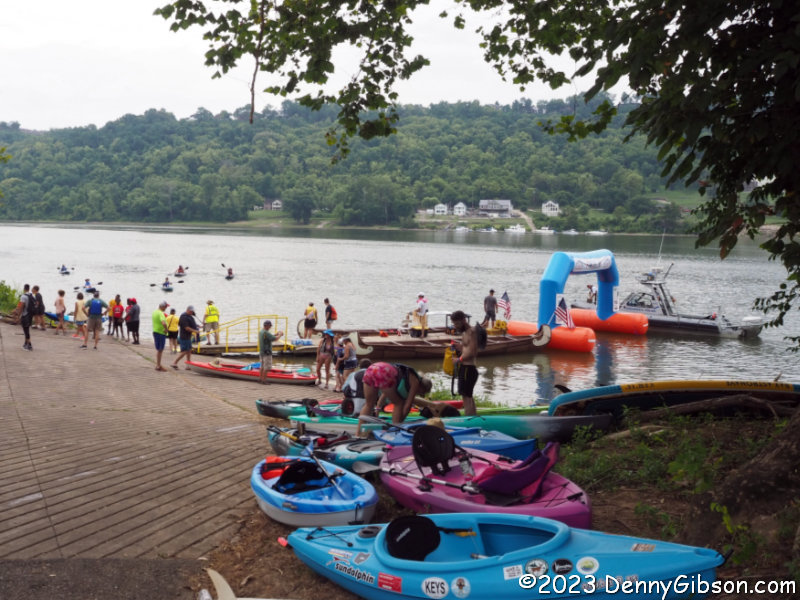
The second comment came from a fellow directing traffic at the Gilday Recreation Complex. With a mostly straight face, he asked if I was there to pick up a 17-foot canoe. Lots of canoes and kayaks had already departed and many more were in the process of being loaded. But there were still plenty waiting in the park and even a few still on the river. The finish line was still in place when I arrived but it would soon be gone.

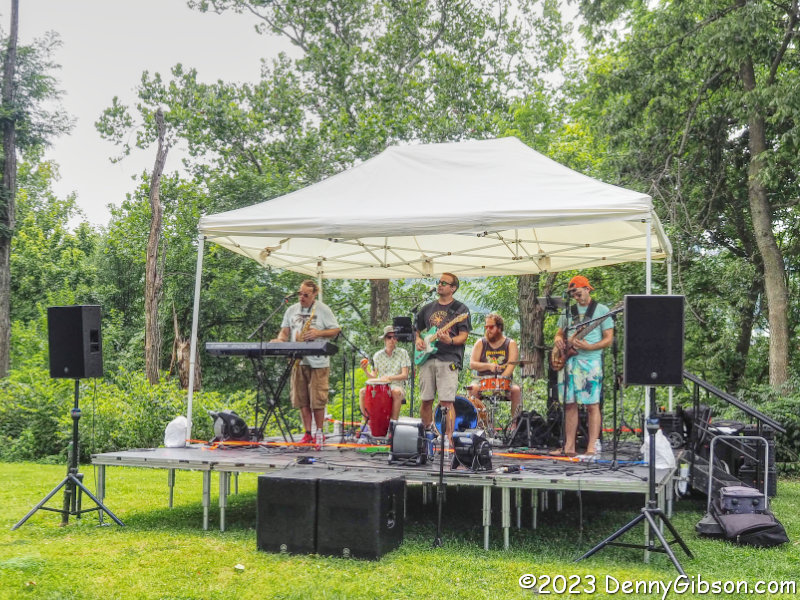
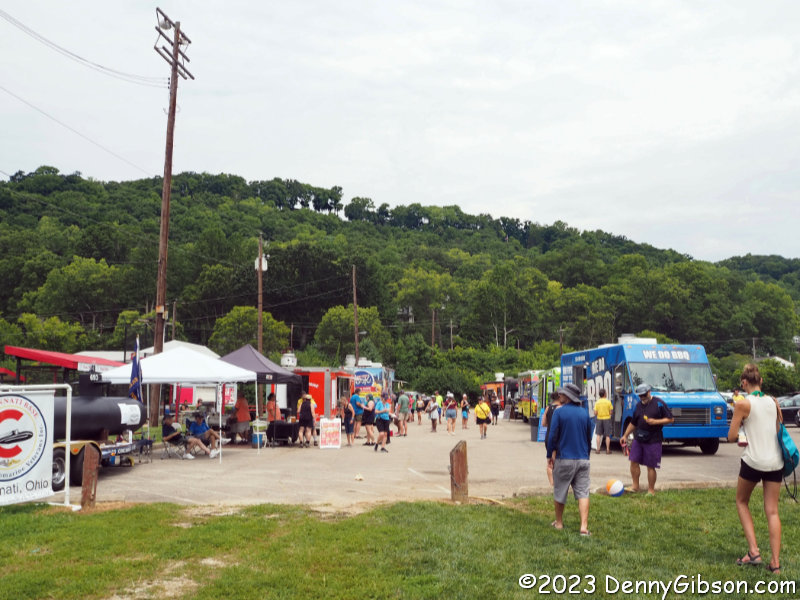
Madtree had a beer tent set up and there were several food trucks. The Sunburners provided some good Jimmy Buffet-style music and there were some Jimmy Buffet-style listeners too.

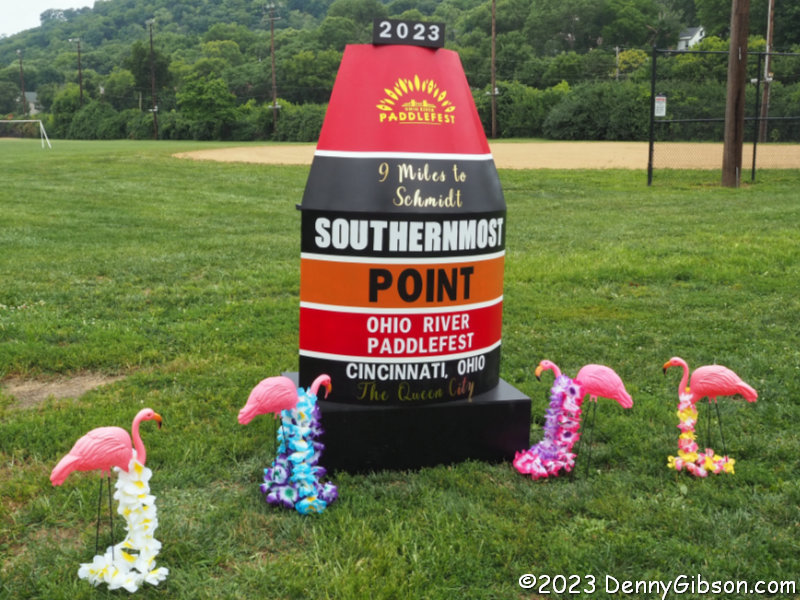
I had my doubts about the claims of this photo-op but a little research confirmed that the Gilday Complex really was the southernmost point of the Ohio River Paddlefest. And today it even felt kind of tropical.

At Speed in Cincy

History does repeat itself. In the early 1970s, I lived with my wife and two sons in a house with a driveway that sloped to a paved area in the back. That driveway was an ideal spot for the four-year-old to give his Big Wheel a workout. While I worked on something on a car behind the house, he repeatedly pushed the three-wheeler to the top of the hill so he could come rocketing down the hill, brace his feet on the pedals to stop the big front wheel, and throw the rear wheels into a perfect 180-degree slide. This was exactly what Big Wheels were designed for. After one of his countless slides, he looked up at me and made an incredibly insightful observation. “Dad”, he said, “I bet you wish you could do this.”
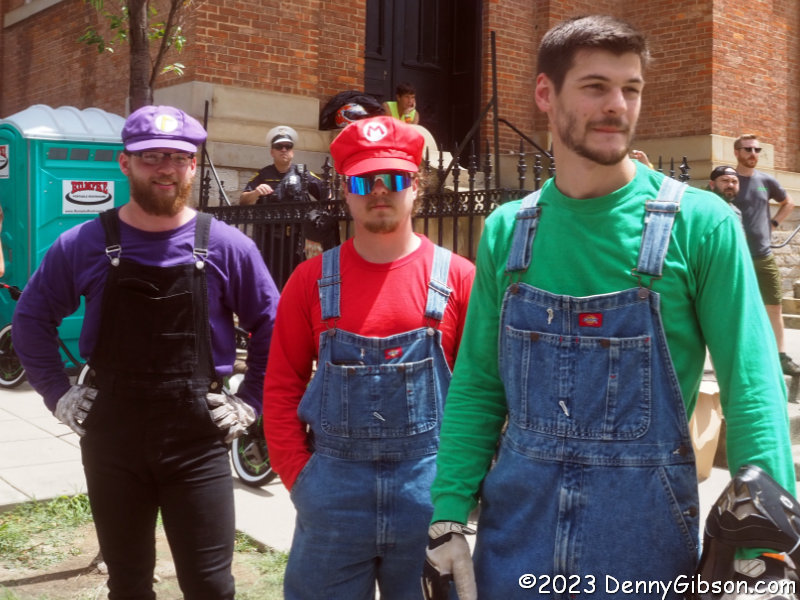
He was absolutely right. What he was doing looked like a fabulous amount of fun but I was too old. What I saw Saturday also looked like a fabulous amount of fun but I was once again too old. Fifty years ago, being too old meant being too big to fit into the seat. Yesterday it meant being too wheezy and too brittle.

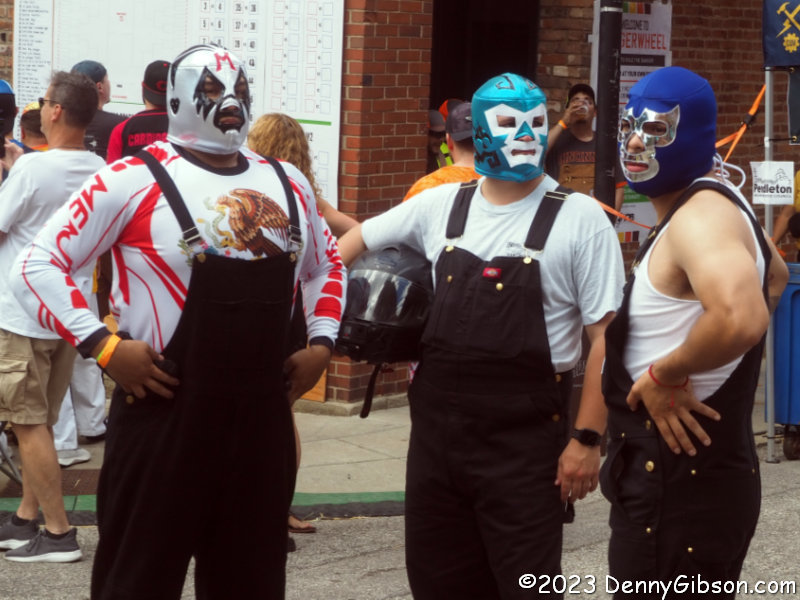
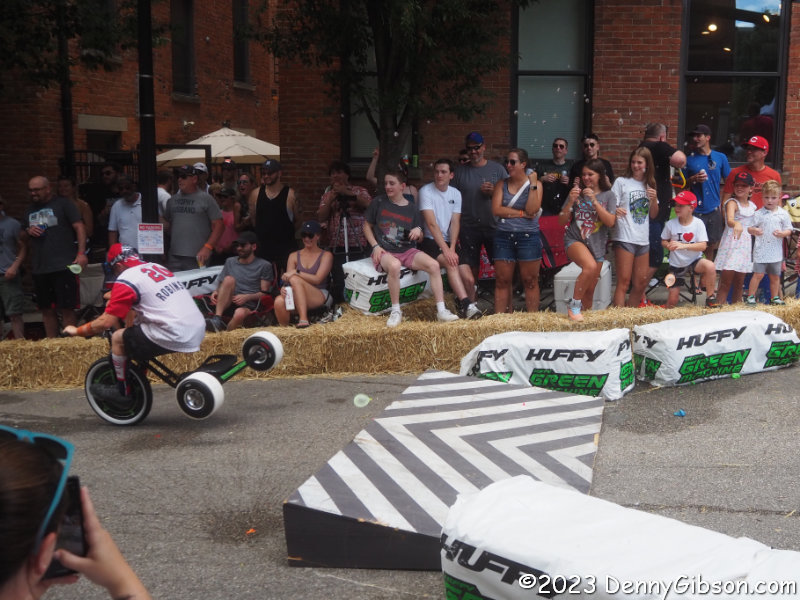
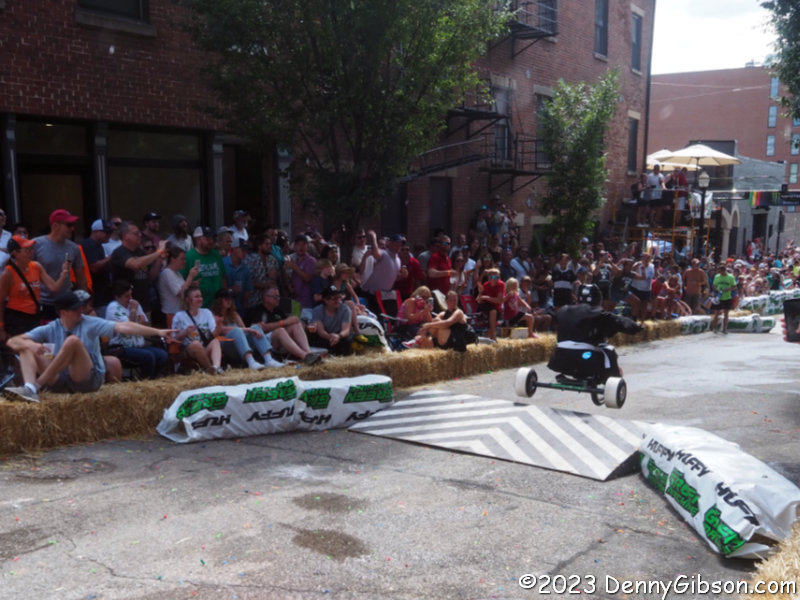
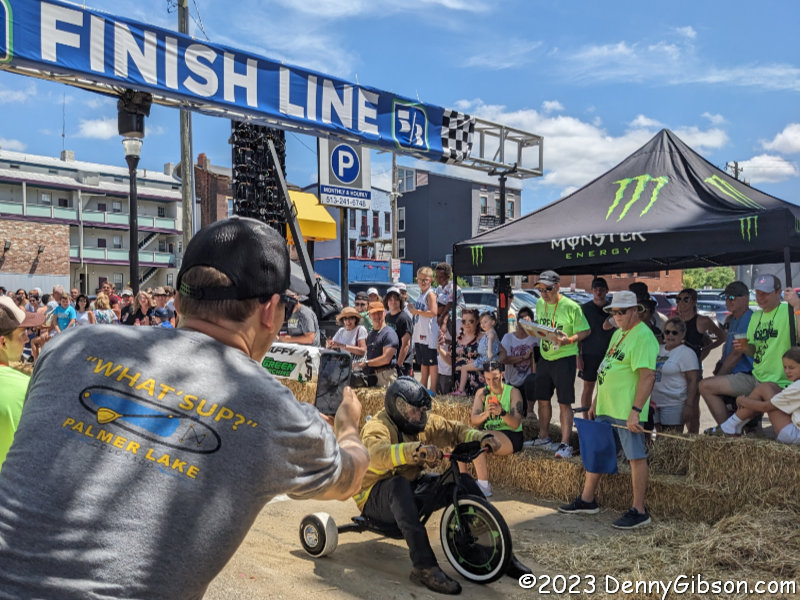
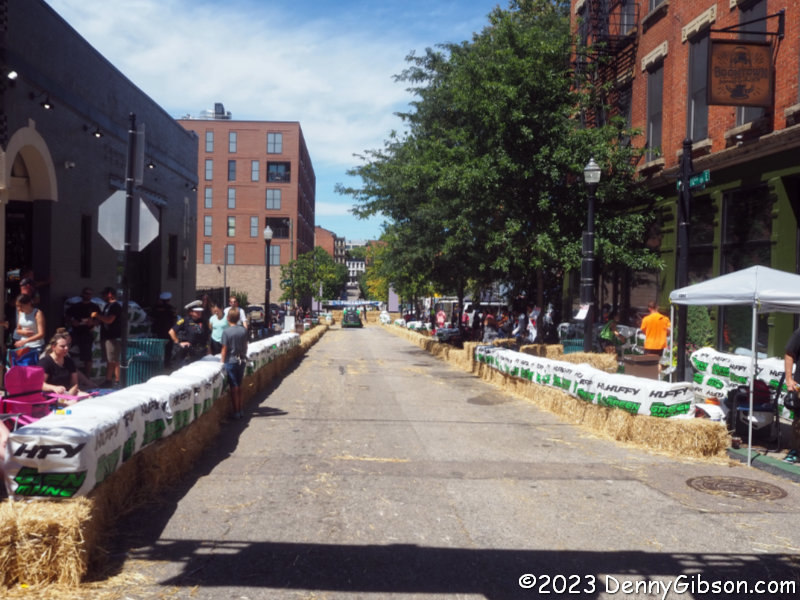
This is Danger Wheel‘s eighth year but it was somehow kept a secret from me until I saw Citybeat’s 7 Things To Do in Cincinnati This Weekend article last Thursday. Realizing almost instantly that this was something special, I made plans to attend and found myself near the midpoint of the course about two hours before race time. There is a starting line at the top of the hill and a finish line at the bottom just like the Soapbox Derby I attended last week (At Speed in Akron). More history repeating itself I suppose.

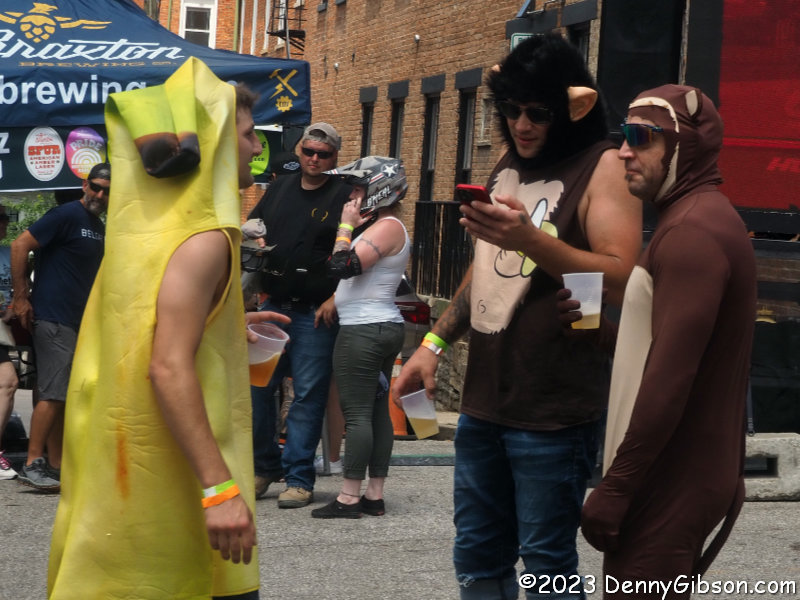
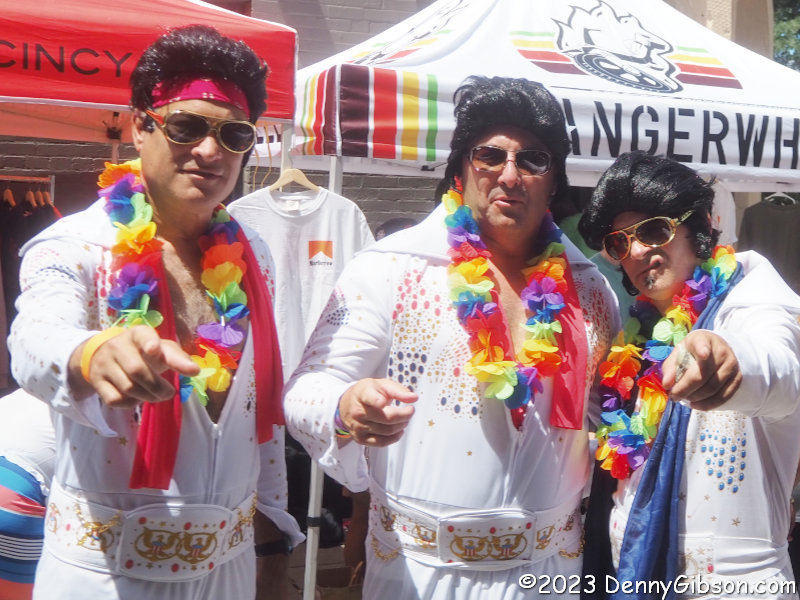
The race takes place in the Pendleton neighborhood of Cincinnati which has two breweries and several really good restaurants. Food trucks are brought in for the event along with tents from breweries outside the neighborhood. I had no trouble filling the time until the competition started. I even had time to check out some of the racing teams and vehicles.

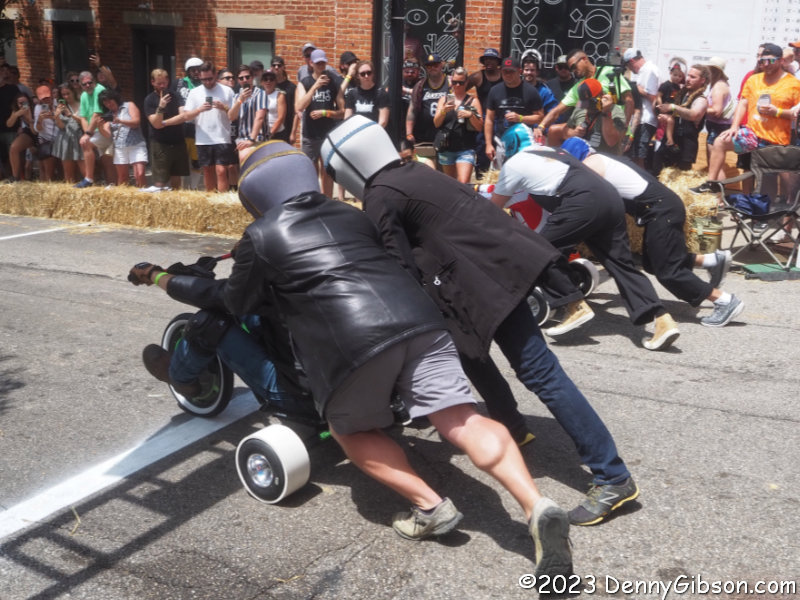
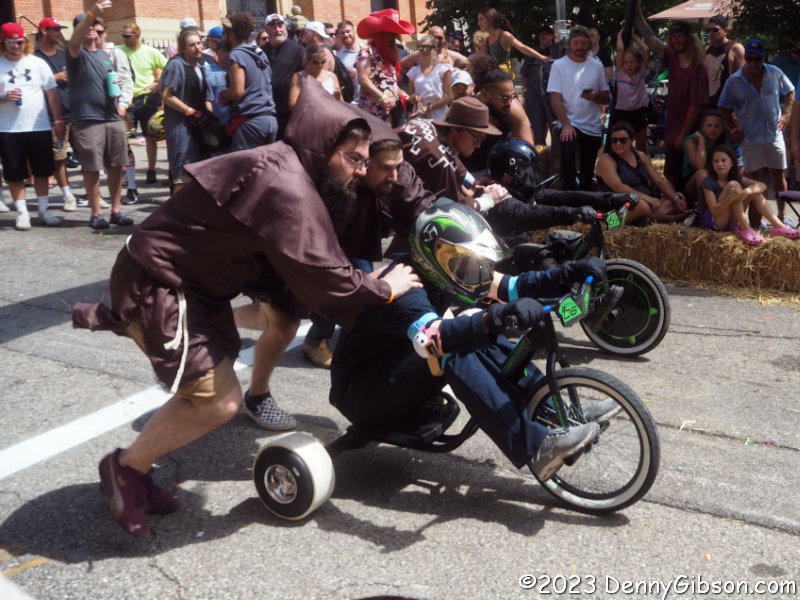
Of course, the two hours between my arrival and the first race also gave other spectators time to arrive and completely line the course. I did somehow manage to get close enough to the starting line to snap a picture of the launch of the first heat. When the starting horn sounds, two team members have ten feet to power the third member off the line.

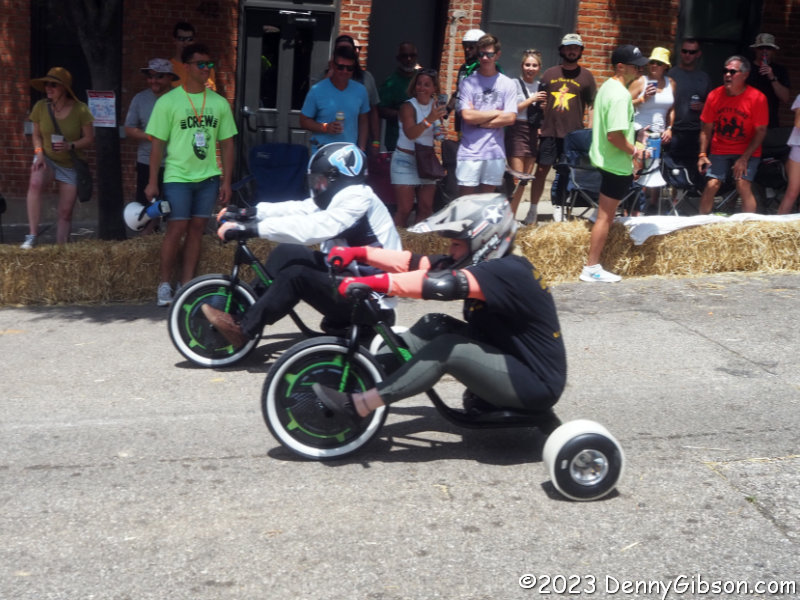
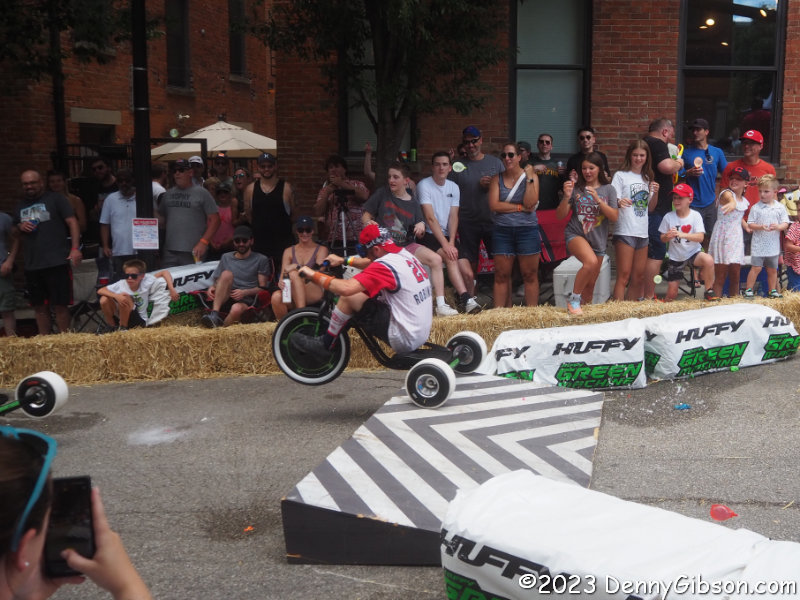
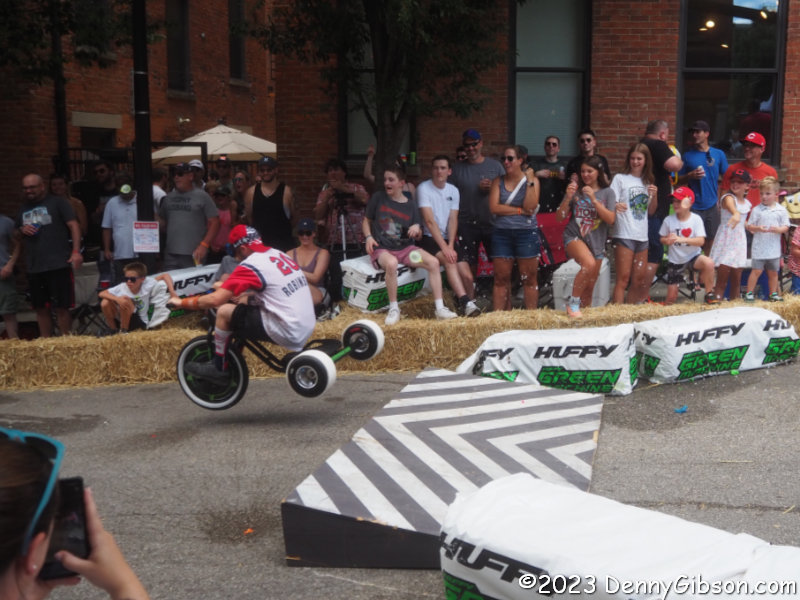
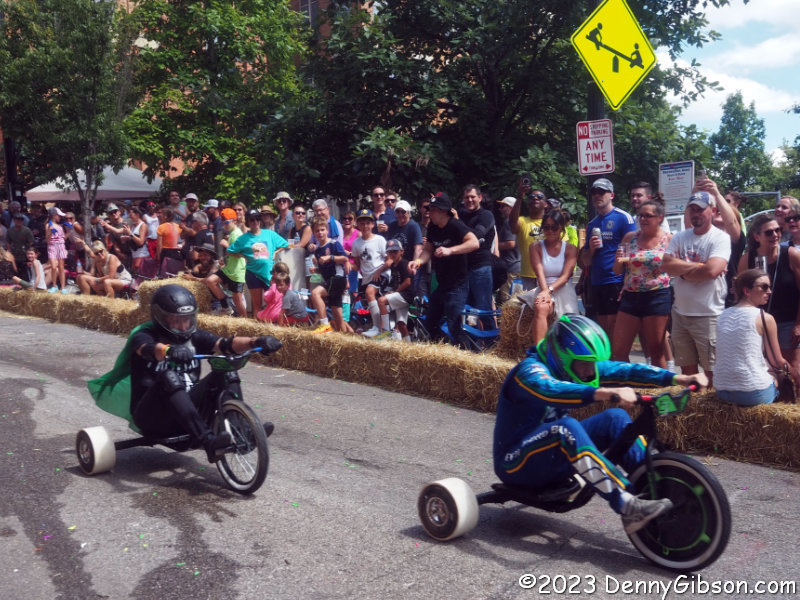
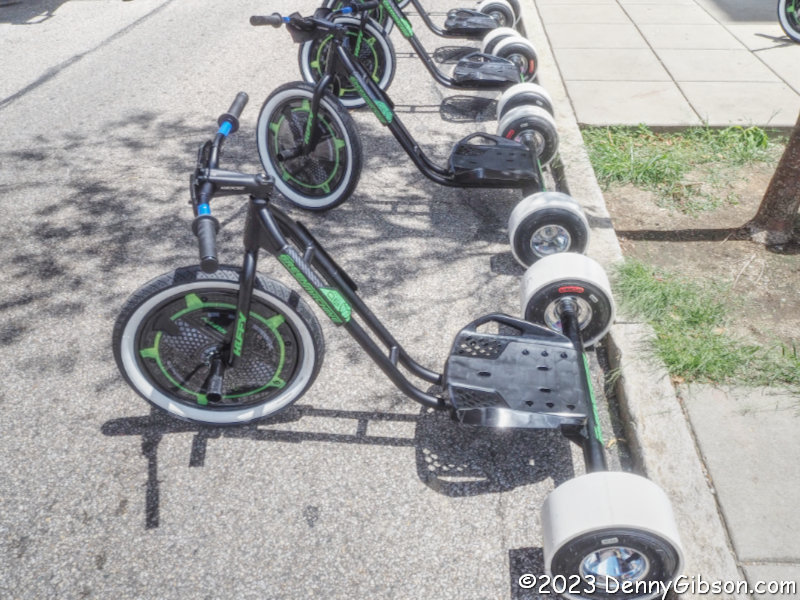
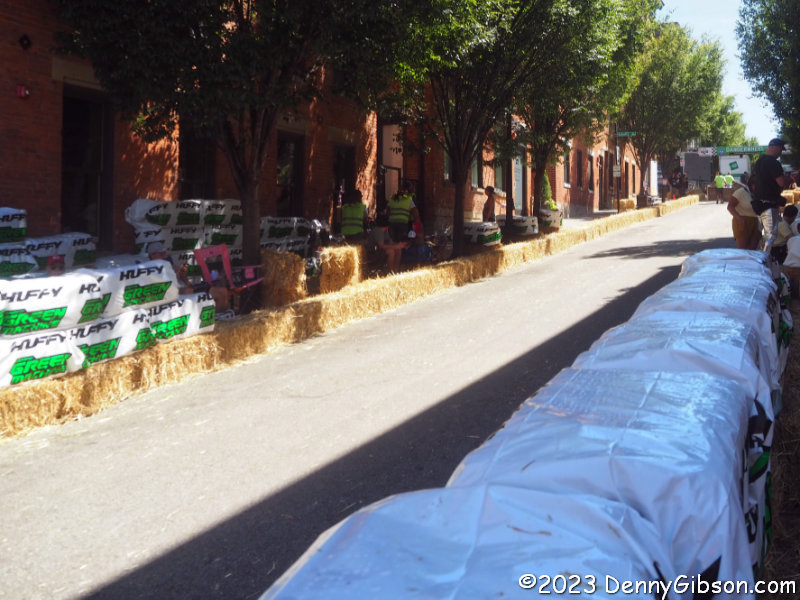
These special built Huffy Green Machines have no onboard means of propulsion so you might think that once the starting line pushing ends, the race is exactly like a Soapbox Derby heat with drivers dealing with nothing but steering until gravity takes them over the finish line. You might think that but you would be really really wrong.

While spectators were packing in trackside, race organizers had placed ramps and speed bumps along the clear street I’d seen when I arrived. In addition, pelting racers with water balloons was a legitimate and quite popular means of fan participation. I overheard the starter suggest to a rookie that he close his face shield all the way because “those water balloons hurt like hell”.

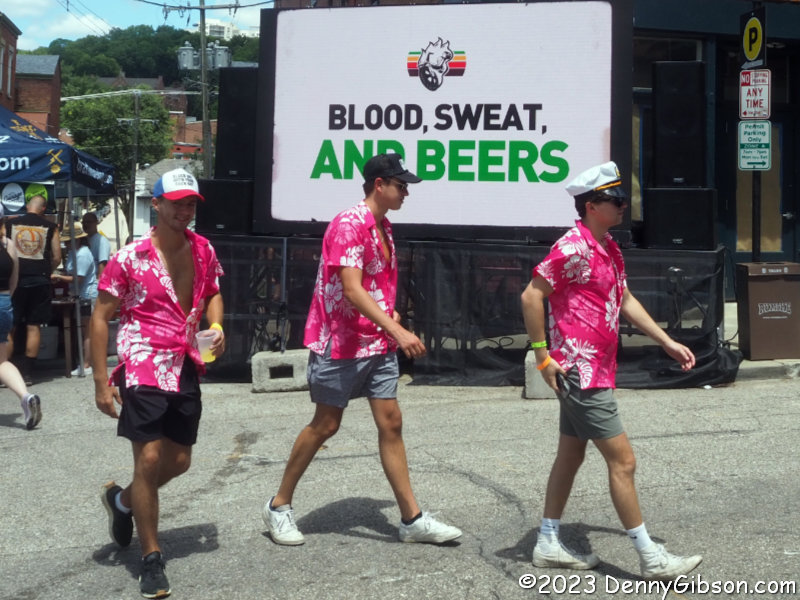
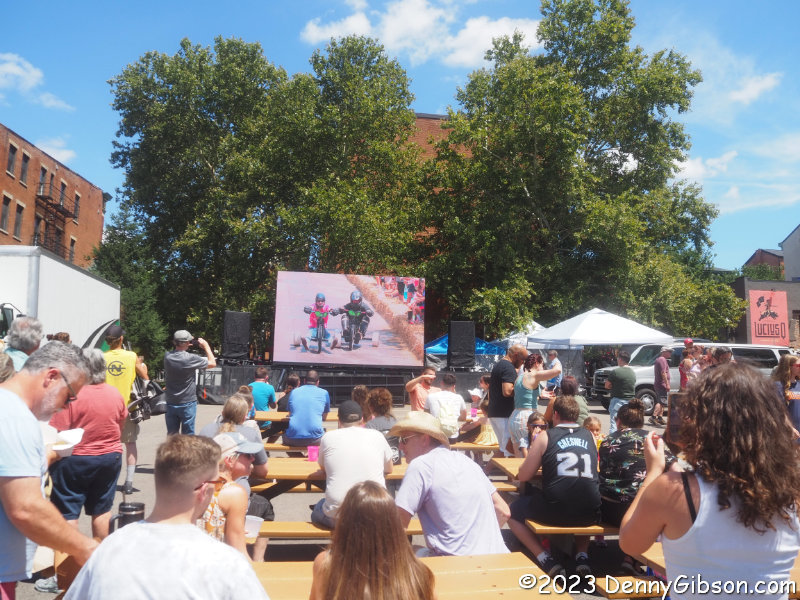
I didn’t feel like forcing my way to the front or staying in one place long enough to move up through attrition assuming that was even possible. I could see some of the action fairly well but had no clear shot for photos. The closest I came to capturing any of the mayhem was this fuzzy shot. The picture at right shows a large video screen in the parking lot where most of the food trucks were. Live racing was shown on this screen and on screens inside most of the businesses in the area. The longest stretch of racing that I actually watched was inside one of the breweries while also enjoying some cool air and cold liquid.

I did not stay until the champion was crowned. Just like last week at the Soapbox Derby, I had no one to root for. The winner of each heat was announced but the names were meaningless to me and I did not pursue standings.

But I still consider it one of the coolest events I have ever attended in Cincinnati. It was absolutely great fun to watch but, once I understood that the helmets and padding were not just for show, I lost any desire to participate. I do still wish I could have spun that low-slung speedster around in the driveway fifty years ago, however.

Lucky Cat Museum

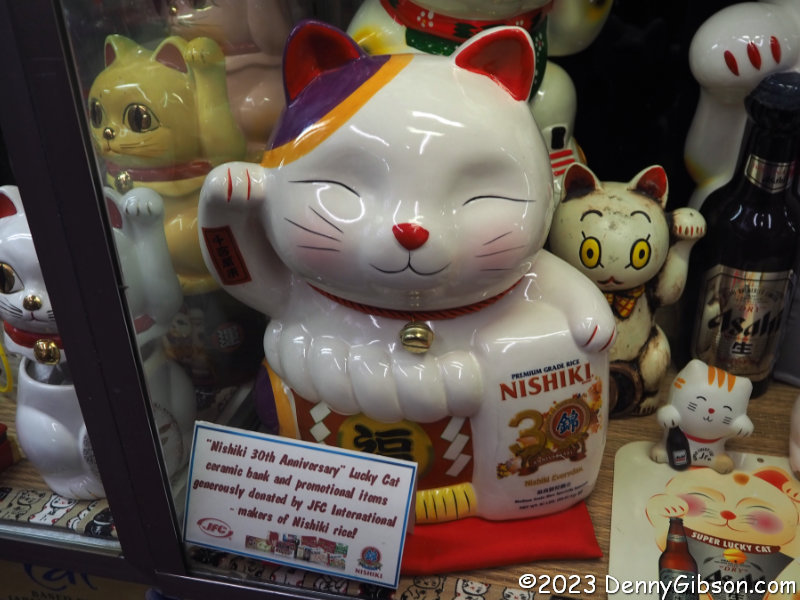
I am not a cat person but I am a museum person. I suppose those two facts have been quietly duking it out in my head since I first heard of the Lucky Cat Museum several years ago. The museum is in Cincinnati and it is unusual which are both strong come-ons for me but it had no regular hours. Visiting it was by appointment only which, combined with that “not a cat person” thing, kept me away. I am not at all an ailurophobe but my interest in seeing a collection of things is not at its highest when those things are cats. A recent Citybeat article brought it back to my attention and an online sign-up system for visits solved the appointment issue. I finally paid a visit to all the lucky cats and their keeper, Micha Robertson, and I am so glad I did.
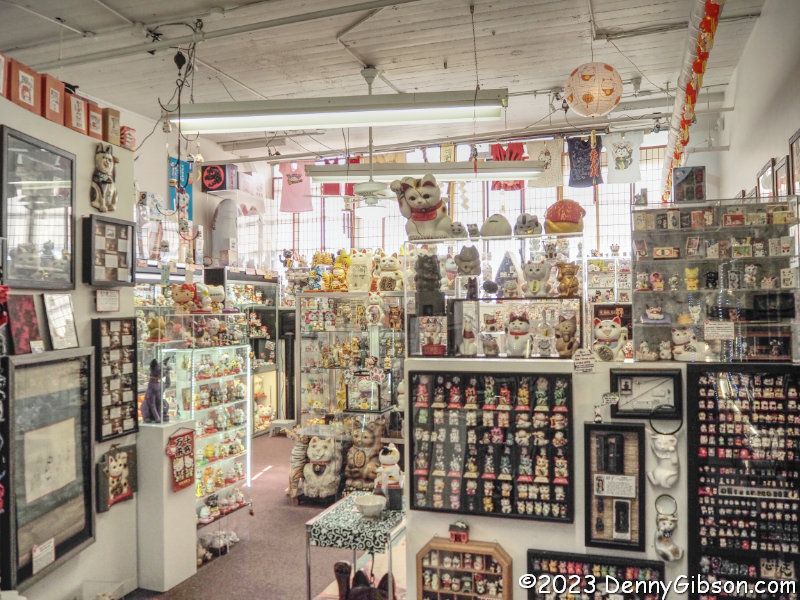
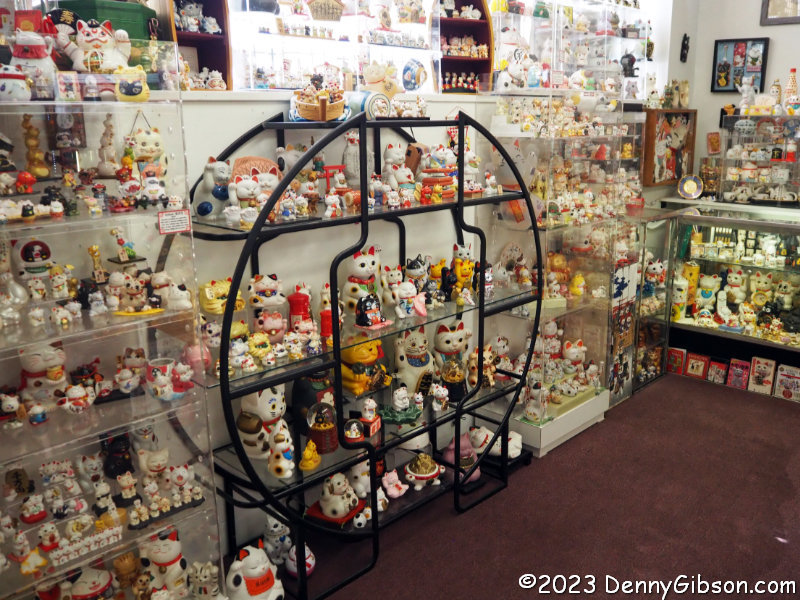
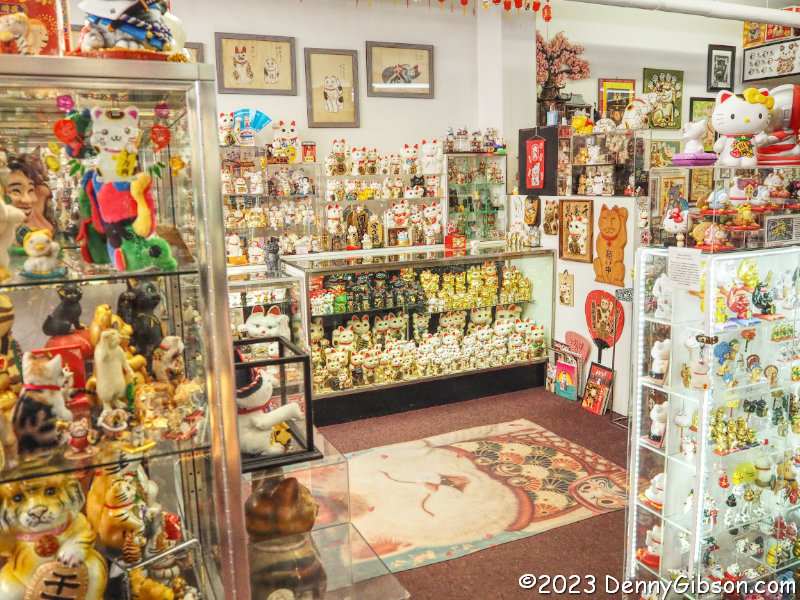
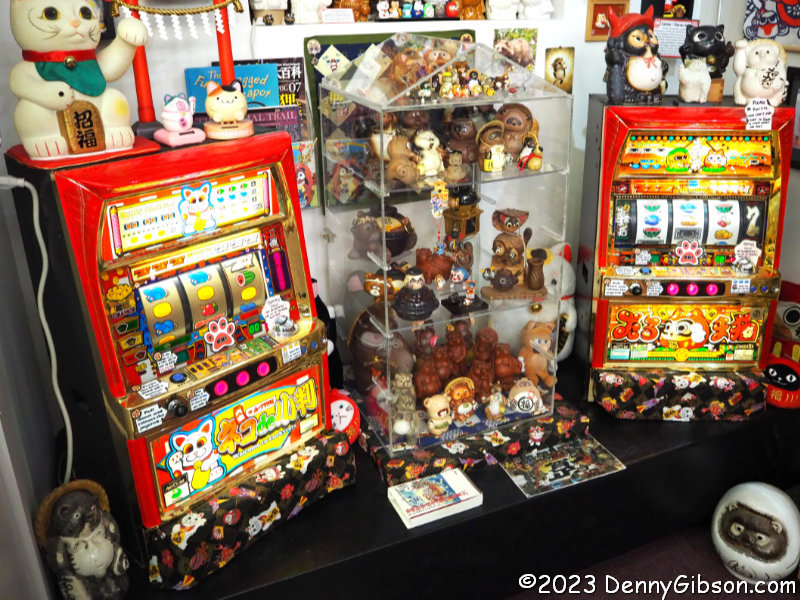
Before arriving at the museum, I read several online descriptions. The earliest talk of “over 700” cats. Some that are a bit more recent say “at least 1000”. The latest guess I found was from 2019 and that guess was “over 2000”. It doesn’t take much time inside the museum to realize just how ridiculously safe that estimate is. As with many large collections, there is a point following the initial exposure when you are struck by the sheer size of the display or the number of items it contains. That certainly happened with me and the Lucky Cat Museum. Not surprisingly, that is something I failed to capture with the camera but maybe these three photos will provide some sense of just how many items are on display.

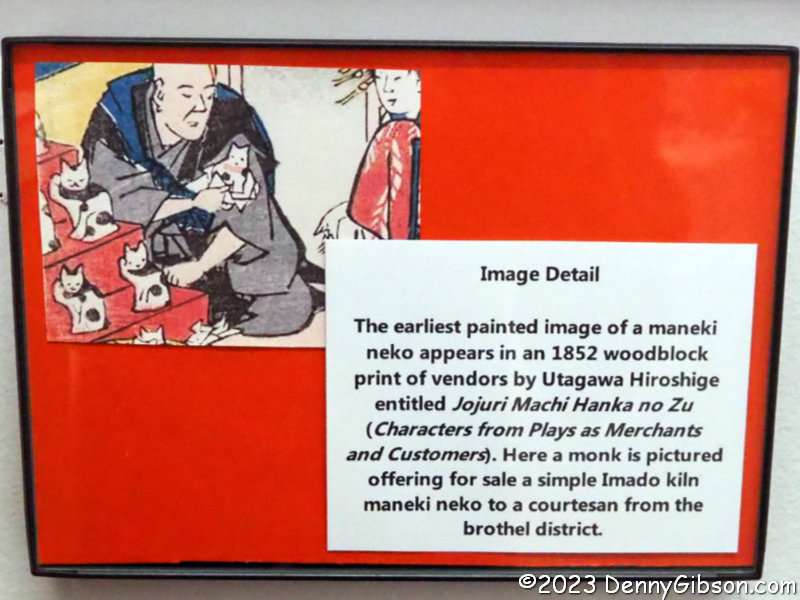
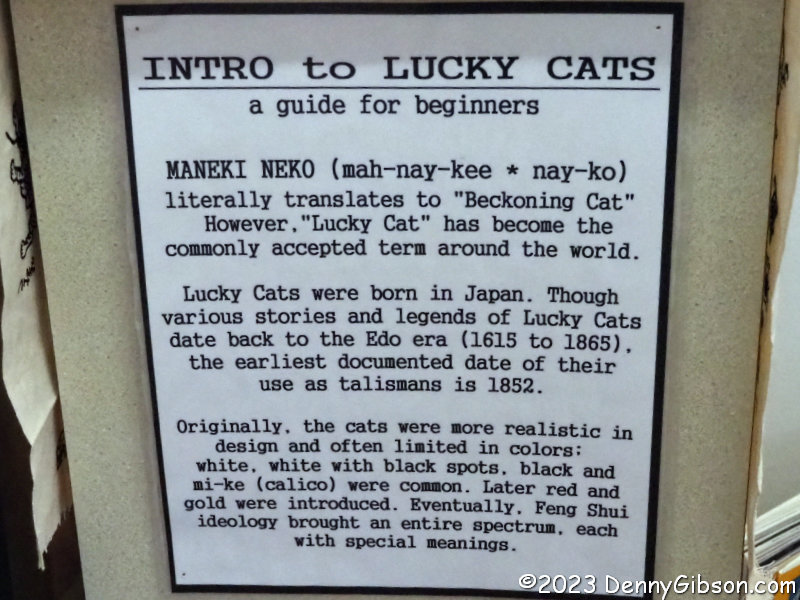
I’m always reluctant to call a number on a locked museum door or dive into “by appointment” arrangements partly because I’m uncomfortable having someone make any effort for the benefit of just one person. The online system for the Lucky Cat Museum allows just six participants in each tour and shows how many openings are in each slot. I had picked a slot with just two or three openings to avoid being the only person taking up Robertson’s time but it didn’t work out that way. All the others cancelled so I had the benefit of a one-on-one tour without any feelings of guilt. The tour began with some background information. Lucky Cats are more properly known as Beckoning Cats or Maneki Neko in Japanese. They have probably been around since the 1600s but first appeared in print in 1852.

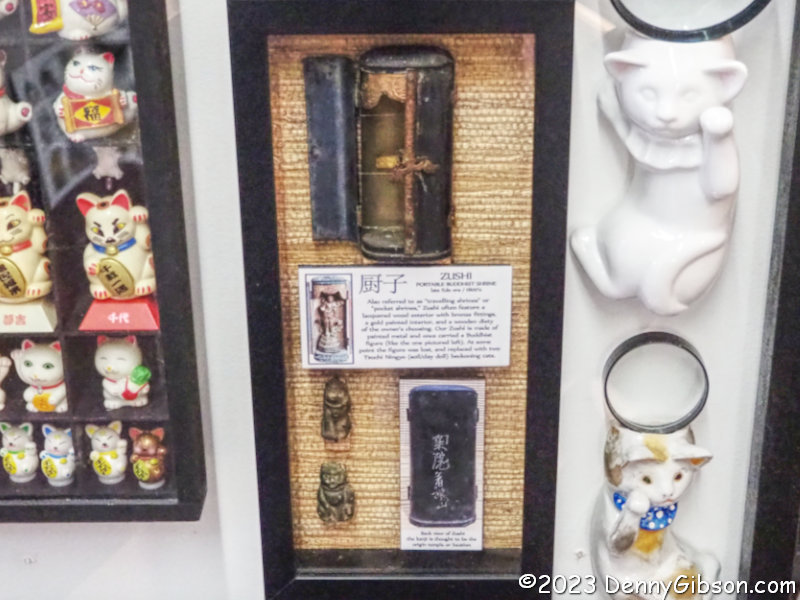
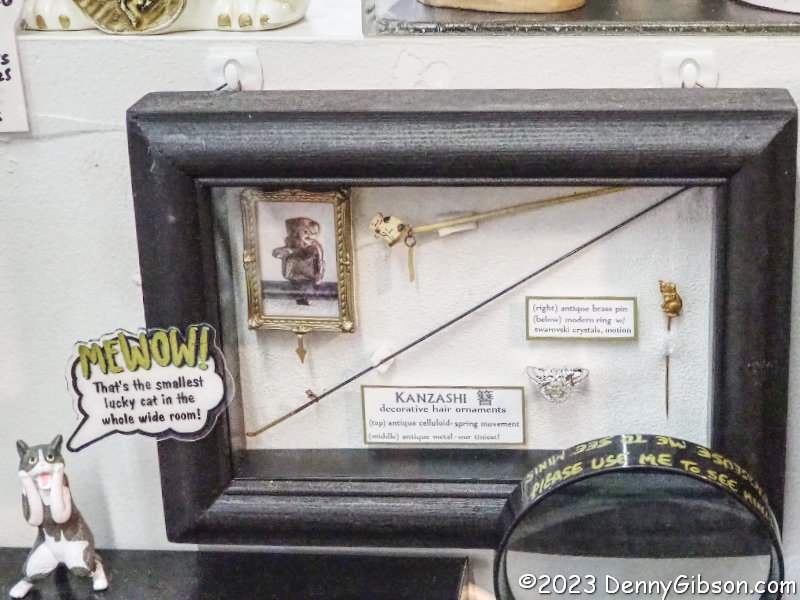
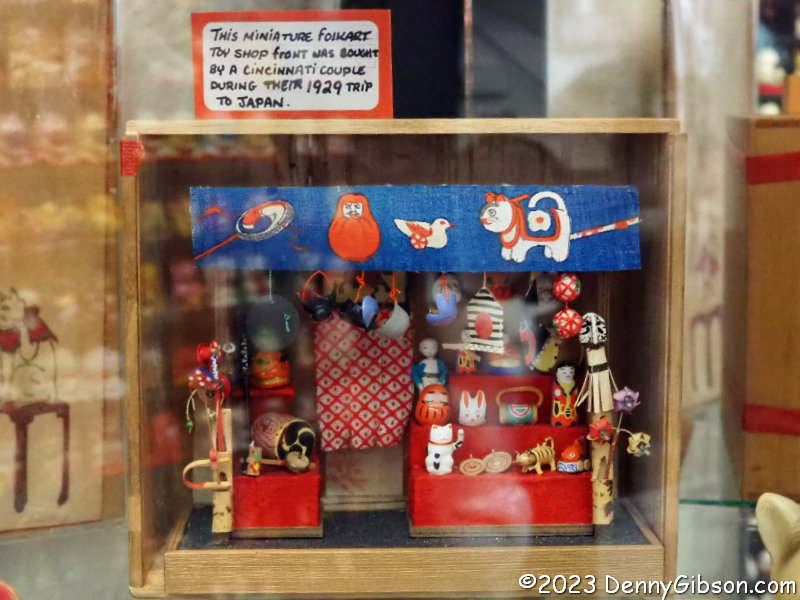
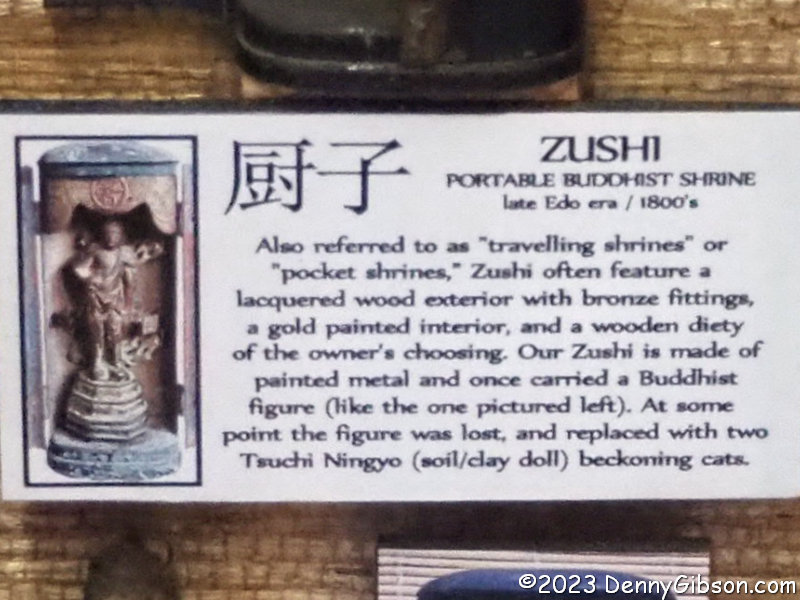
My attention was then directed to some of the “…est” items in the museum. The oldest is a long ago repurposed zushi from the 1800s. The smallest is the tiny kitten on a wire. The miniature toy shop is neither the oldest nor the smallest (although the tiny maneki neko it contains is pretty darned small) but it is probably the one most at home in a Cincinnati setting. It was purchased in 1929 by Cincinnatians visiting Japan.

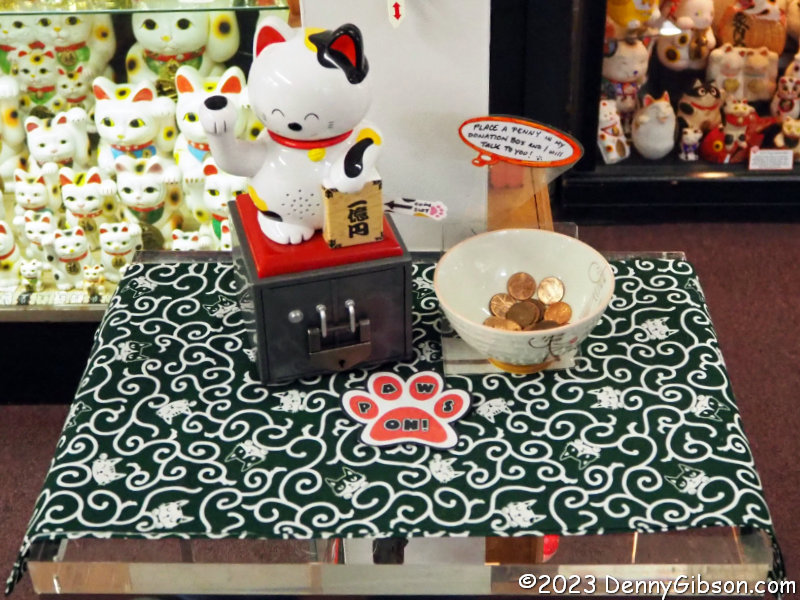
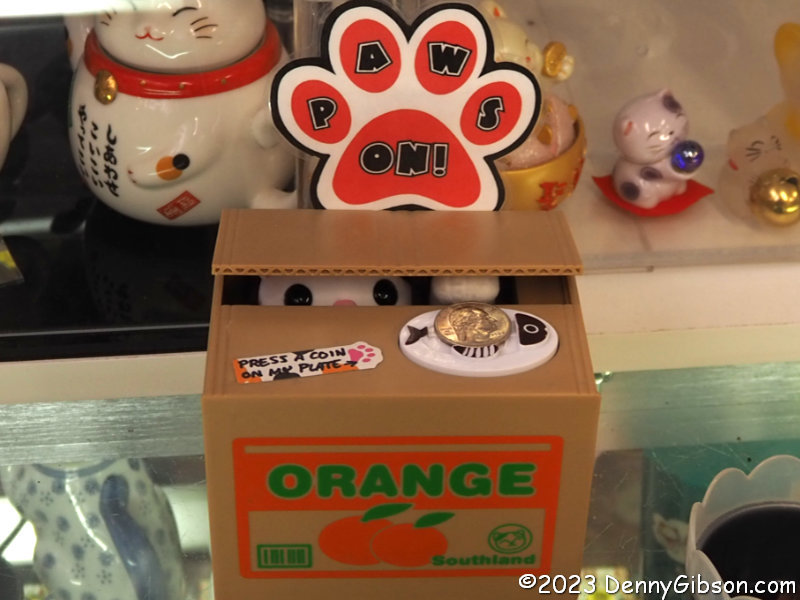
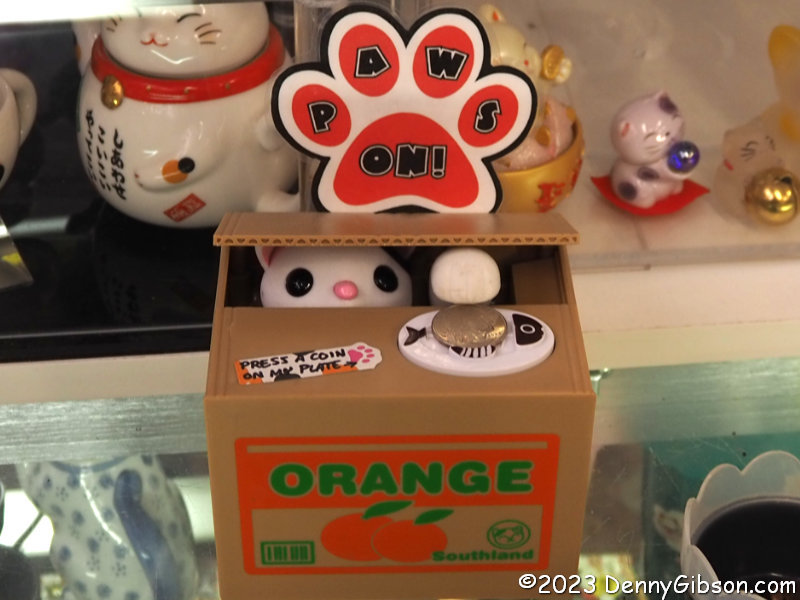
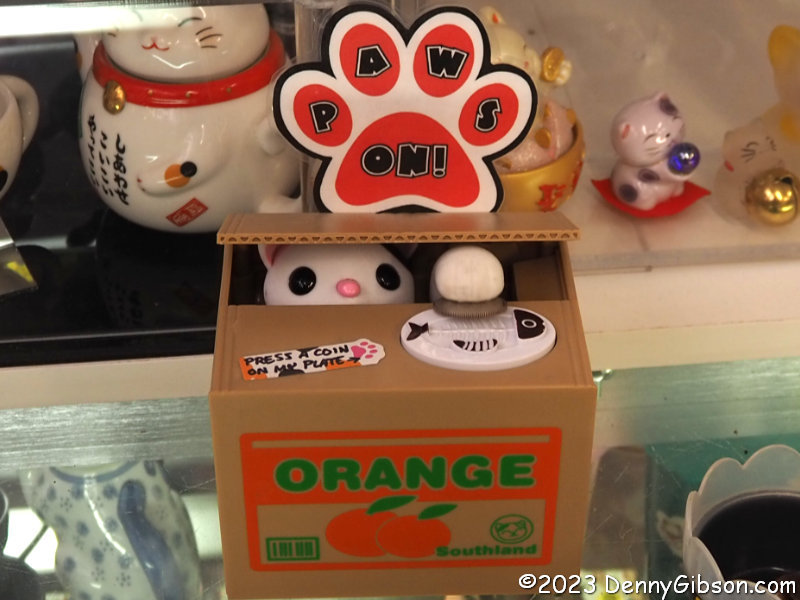
There are naturally plenty of “Don’t Touch” signs among the many rare and fragile items on display but there are several hands-on items as well. One is a coin-operated cat that meows (we think) in Japanese and says some other things too. The slot machines have been converted from coins to tokens as required after being retired from Japanese casinos.

This sneaky fellow and his identical twin did charm me out of a few coins and, yes, others have placed videos online if you care to look.

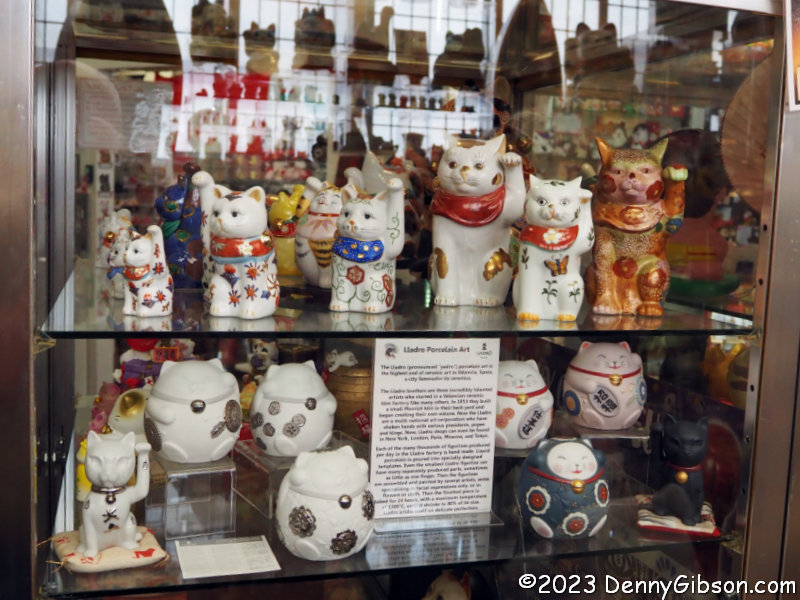
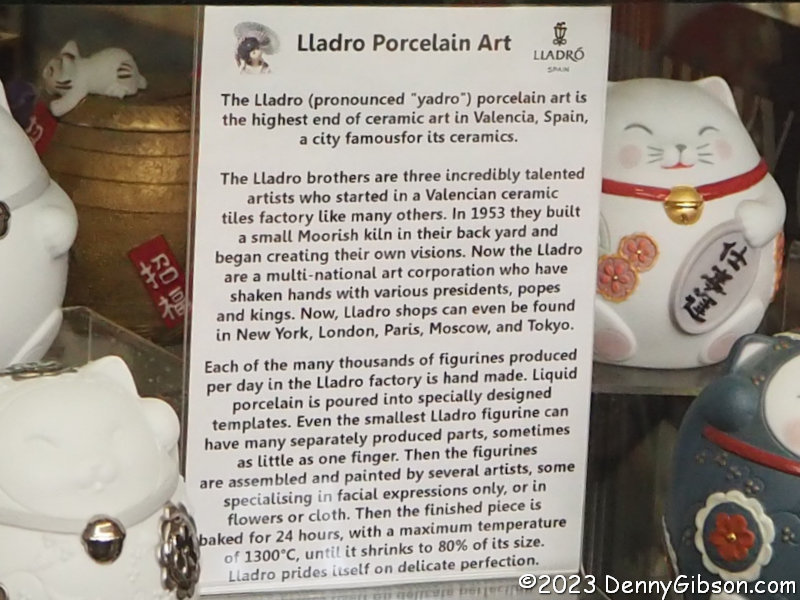
It should not come as a surprise that some of the cats have found work in advertising or that their manufacture has expanded beyond Japan or even China. All the cats in the second photo were made in Spain by Lladro.

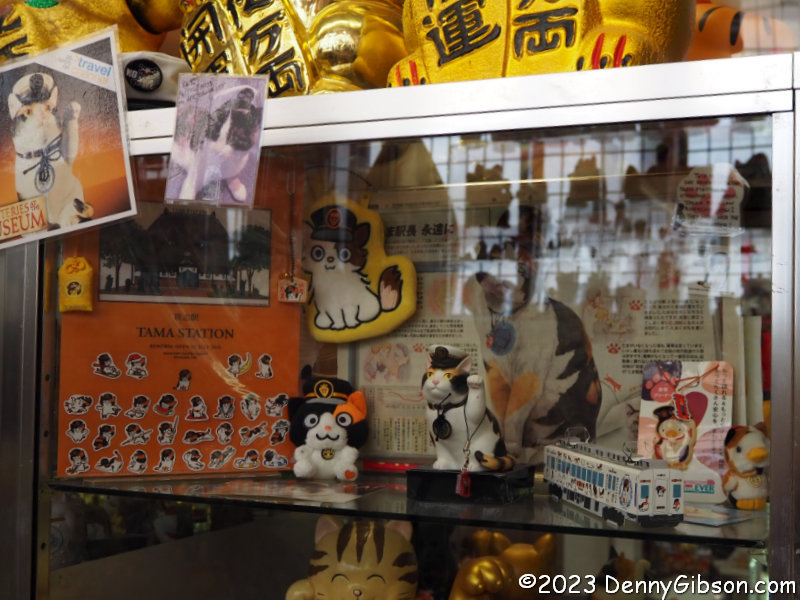
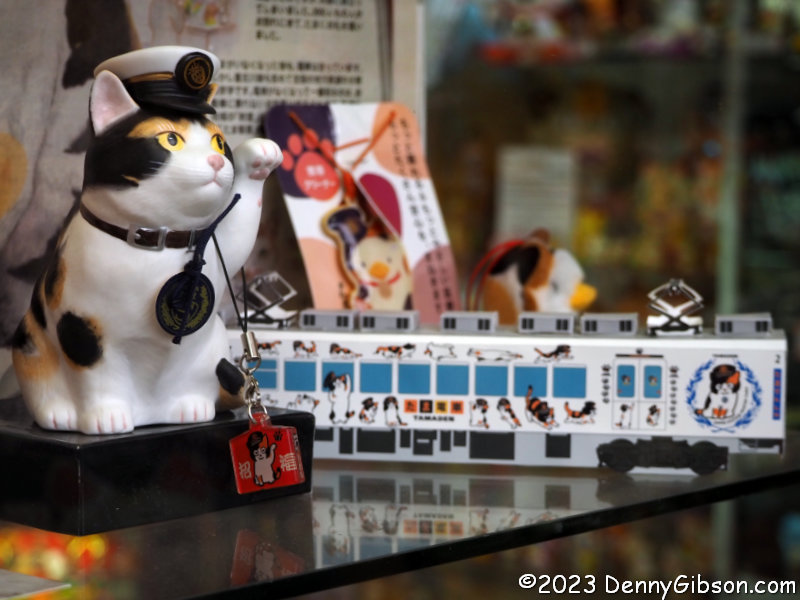
In my pre-visit poking around, I had seen references to “the cat that saved a train station” but had not pursued them. The claim turns out to be 100% true and the story well worth reading. Tama, the cat, was instrumental in keeping a Japanese train station open after it was scheduled to be shut down. With the official title of Station Master, she took her salary in cat food.

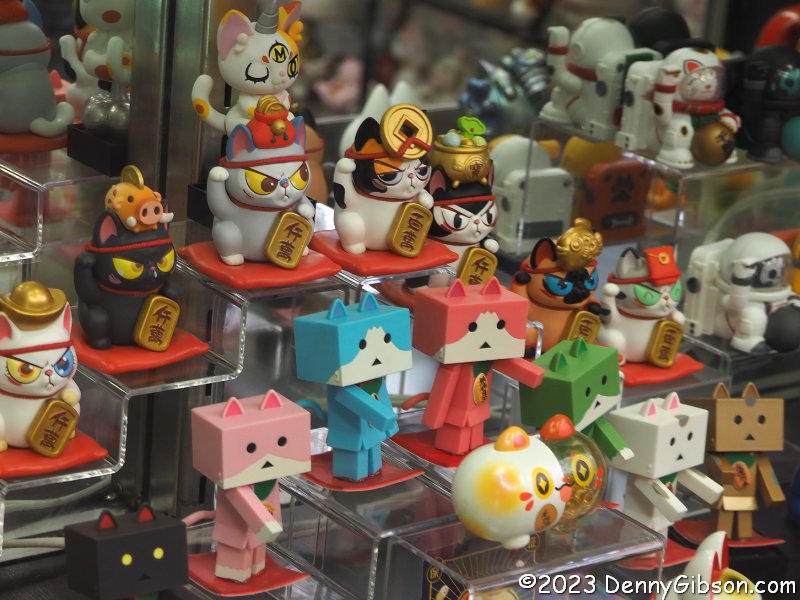
By this point, I was well aware that I was in the presence of someone with an encyclopedic knowledge of her subject but Robertson’s answer to a question about the box-headed cats drove it home. The tour was a combination of Robertson pointing out things of interest and me asking questions about random objects. In both cases, she provided in-depth details straight from her memory. The box-headed cats come from a Japanese cartoon that Robertson knew the name and history of. I just wish I could remember what she said. I had earlier been impressed by learning that she taught herself enough Japanese to survive in online auctions.

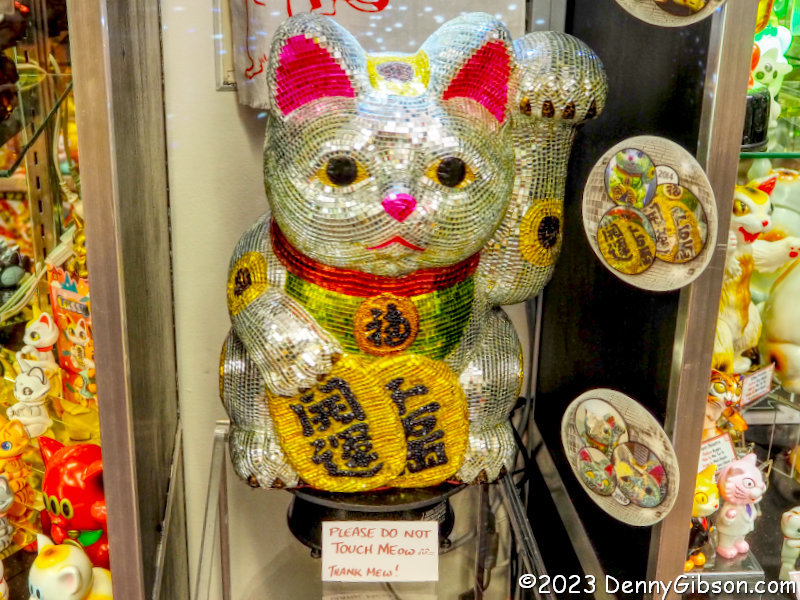
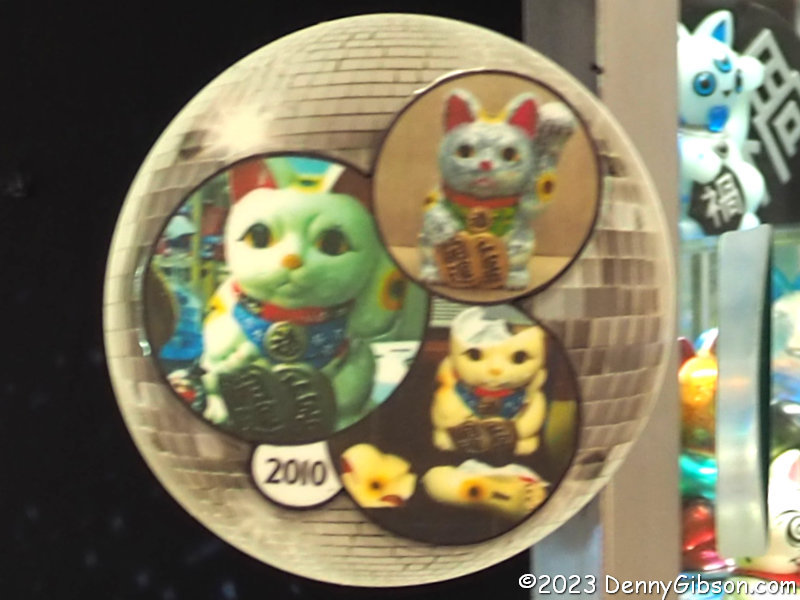
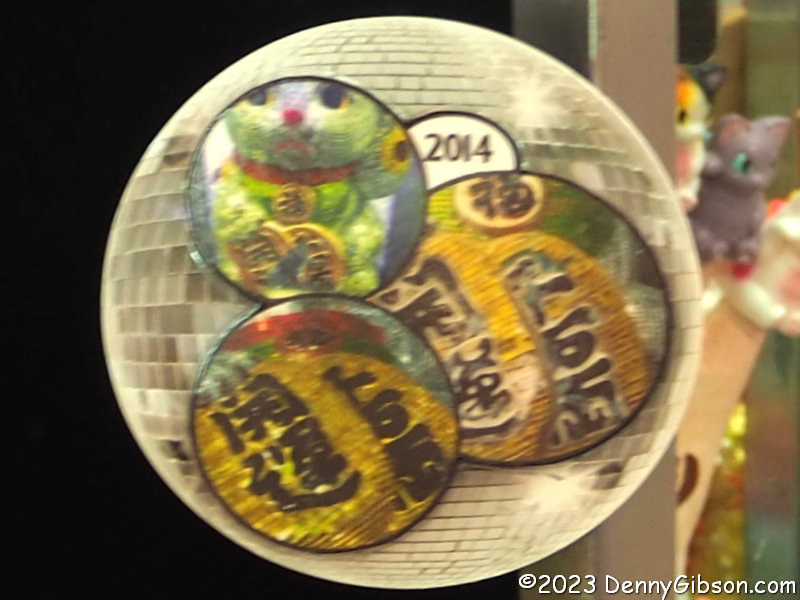
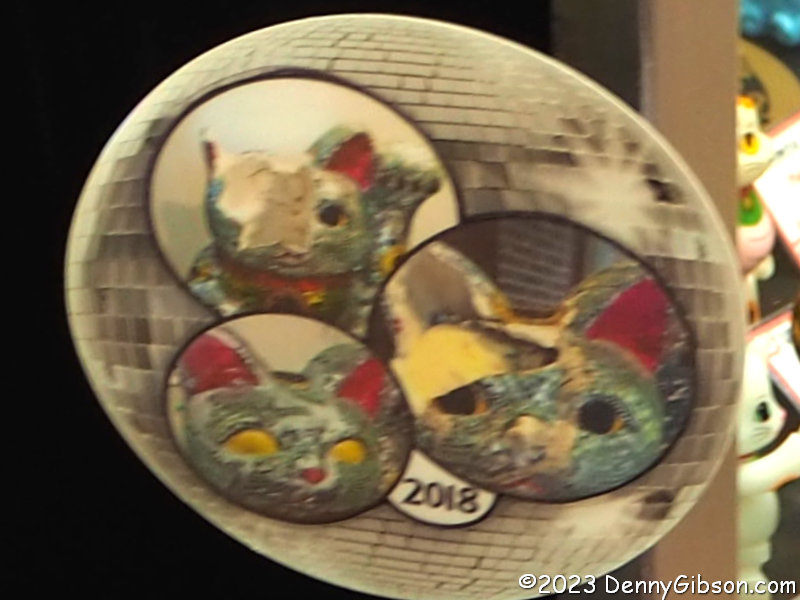
The cat in the opening picture wasn’t always glittering with a skin of mirrors. It has led a pretty rough life which is documented in the discs hanging next to it. In 2010, while on loan to the Krohn Conservatory for its Japanese butterfly exhibit, it was dropped in the last days of the exhibit. Damage also occurred in 2014 and 2018. On one occasion it was dropped by Micha’s husband but I don’t recall what the other accident was and I don’t remember which was which. Repairs were made every time with the mirrored surface apparently appearing in 2014. With that sort of history, I suppose some might question whether or not Disco Cat deserves a spot in a Lucky Cat Museum but I don’t. Sometimes Beckoning Cats bring luck to their owners and sometimes it’s the other way around. There is an awful lot of the latter going on here.