Now That’s Art

Joe Morgan WeekendCincinnati got a new statue Saturday. There was a big unveiling ceremony with an estimated 3,000 people in attendance. Most of those 3,000 people were standing directly in front of me. I’d heard of the planned unveiling some time ago and probably even considered attending some time ago. But it never really made it onto my agenda until Friday night.

The statue is of Joe Morgan, second baseman of the Big Red Machine. If you didn’t already know that, I’m not sure I even want you reading this, but maybe you just forgot, so here’s a little refresher. The Big Red Machine was the remarkable Cincinnati Reds team of the 1970s. Between 1970 and 1976, they won their division five times, their league four times, and the World Series twice. Those World Series wins were back to back in 1975 and 1976. In both of those years, Joe Morgan was the National League MVP. So seeing a statue of him unveiled would certainly be a cool thing, but on the other hand, I didn’t think it cool enough to fight a crowd to see something I could probably have all to myself on most afternoons in a month or so.

Then, on Friday, I’m out playing trivia with the Reds game on TV. It’s live trivia so the TV sound is off. It is the start of a Joe Morgan weekend, and there is a pregame ceremony. I’m watching it out of the corner of my eye and eventually realize that, one by one, Joe’s old teammates are trotting out on the field. Soon the entire Big Red Machine starting lineup is there. The most astonishing thing about this is that it includes Pete Rose who has been banned for life from participating in any aspect of Major League Baseball. He was being permitted on the field so that Joe’s celebration could be complete. Seeing the Great Eight, as that group was called, was cool enough to justify dealing with a crowd.

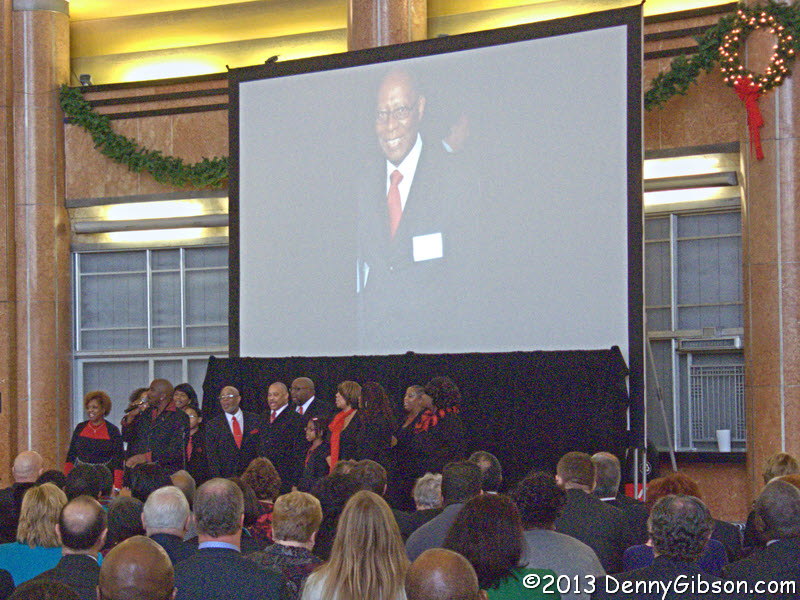
Joe Morgan WeekendJoe Morgan WeekendJoe Morgan WeekendSo I fought the crowd and the crowd won. My resolve to go wasn’t nearly as strong when I woke up as when I went to bed. I alternately talked myself into and out of going until it reached the now-or-never point. It once again sunk in that seeing the Great Eight together just might not ever happen again. I left home with just enough time to get there before the unveiling. The first picture is what I saw when I arrived. The second is what I saw after I had worked myself to the other side of the crowd. When things actually started, I realized that, not only were all those heads between me and the speakers, so was the tent. I had incorrectly assumed they would be in an open space to the left. I could, every once in a while, see one of the speakers under the tent covering and over the bobbing heads and I’ve included a picture of Joe to prove it.

Joe Morgan WeekendDrat! I had not actually seen the Great Eight. However, there would be another ceremony of some sort preceding the afternoon game with the Los Angeles Dodgers. The game was sold out but I got a ticket for a bad seat for a so so price from a scalper. I walked around the area and grabbed a sandwich. The crowd that initially hid the statue (shown at right) eventually thinned out so I could take the picture at the top of this article.

Joe Morgan Weekendjmwe07jmwe08I misjudged the time and the ceremony was already underway when I entered the stadium. I made it just in time to see Pete being introduced and Joe soon followed. The other six were already on the field. There was, of course, more to the Big Red Machine than these eight players but they were the heart of it. Of the 88 games that all of the Great Eight played in 1975 and 1976, they won 69 or nearly 80%.

Joe Morgan WeekendJoe Morgan WeekendThere were a few speeches and even the unveiling of a miniature of the life size statue outside the stadium. The ever classy Morgan talked much more about his teammates than about himself.

Joe Morgan WeekendJoe Morgan WeekendWhen it was time for the ceremonial first pitch, all eight players moved to their positions. The 69 year old Morgan had no trouble getting the ball to the plate and the 65 year old Johnny Bench had no trouble catching it. Then, as they walked toward each other, Bench flipped the ball back to Morgan who casually one-handed it. Then the Big Red Machine gathered for one more meeting by the pitcher’s mound.

Joe Morgan WeekendJoe Morgan WeekendAt the end of the day, when I looked through the pictures I had taken, I noticed that Bench’s star, in the line where the Great Eight had stood, was turned sideways. Had someone goofed when they laid them out? Had it been accidentally kicked around as the players waved to the crowd? Nope. A check of earlier photos revealed the truth. Bench had turned the star himself when the players moved to their chairs. Johnny is a joker.

Joe Morgan WeekendJoe Morgan WeekendThere is an awful lot of Cincinnati history in these two murals at Great American Ball Park. For one thing, the mosaics are reminiscent of those that once hung in Union Terminal and have since been moved to the airport. Sadly, those are once again in danger as the building they are in is slated for demolition. Secondly, there is the suspension bridge in the background. The bridge officially opened January 1, 1867. It’s still there and can be seen from the current ball park. One mural is of the 1869 Red Stockings, the world’s first fully professional baseball team. Note that the bridge is correctly shown without the steel trusses that were added in the 1890s. The other is of the Big Red Machine, the same eight men who were on the field today. The Red Stockings had a 65-0 record in 1969. In the seven seasons between 1970 and 1976, the Big Red Machine had a record of 683-443.

With the game tied 3-3, I left after eight innings. The Reds won in the tenth. That’s when the Reds latest speedster, Billy Hamilton, scored from second, which he had stolen, on a Todd Frazier single. Today was the thirty-ninth anniversary of another Reds win over the Dodgers. During the 1970s, the Reds-Dodgers rivalry was one of the biggest in baseball. Joe Morgan was playing with a sprained ankle on September 7, 1974 so wouldn’t be stealing any bases. Instead, he beat the Dodgers with a two-run eighth-inning homer.

My Wheels — Chapter 6
1959 Chevrolet

1959 Chevrolet adThe advertisement at right is the fourth one on my wall and for the first time I really am talking about exactly the car pictured in the ad. The twist this time is that it was only half mine. My sister is almost exactly two years younger than me so she was turning sixteen when I was graduating. Having a car wasn’t quite as important for girls as for boys but it was still a good thing and that was especially true for kids, like us, living outside of town. We had each come into a few hundred dollars and I convinced her that we should combine resources and get a really cool car. We’d share it for the rest of the summer then, when I headed off for college in the fall, it would be all hers except for the occasional weekend when I came home for a visit. We looked at quite a few cars, including 1958 and ’59 four-passenger Thunderbirds, before settling on a white 1959 Impala convertible. I have the number $750 stuck in my head and I imagine that’s what we each contributed. It would have sold for something over $3500 when it was new and $1500 for the six-year-old car sounds about right.

The 1959 Chevrolet is one of my all-time favorite automobiles and I really don’t believe it is because I once owned half of one. U.S. auto designers went crazy in the 1950s. Fins were in and they just kept getting taller until culminating in the towering blades on the 1959 Cadillac. Those ridiculous appendages are one of the most widely recognized automobile features ever and scream 1950s louder than almost anything else. The Chevy’s fins were no less extreme but, at least in my opinion, they had a lot more style. The Caddy was a fearsome projectile; The Chevy a graceful bird. Sorry. The prose is getting almost as silly as the fins but the truth is I like the smoothly arched fins that Chevrolet sported in 1959. The car looked like something an artist had created without constantly being told to get rid of these, add more of those, and straighten out that. The illusion was gone the next year. Horizontal wings were still around on the 1960 model but they were a crude caricature of those of ’59; Straight lines replaced the graceful arches and boring round lenses from the parts bin replaced the big red cat eye tail lights.

chev59Getting back to my, I mean our, Chevy, you don’t have to imagine anything different from the car in the photo. That’s not our car but it could be. White with red interior and black top. 283 V8 with Powerglide automatic transmission. As we had planned, the car stayed with my sister while I lived in an on campus dormitory in Cincinnati — mostly. I did take the car with me for the last few weeks of the school year and I no doubt felt like one really cool dude. I don’t recall specific issues but the joint ownership thing came to an end that summer. For one thing, I decided I wanted a car with me for the next school year. I’m sure I didn’t have the money to buy out my sister and going with something that got a little better gas mileage seemed like a good idea. My sister became sole owner of the Impala but not its sole driver. I never did know all the details but there was at least one wreck when someone else was driving. I don’t believe the car was actually totaled but there was enough damage that the car went off to a new home.

chev59_bkI’ve always liked this publicity picture. It emphasizes the car’s unique appearance and offers a hint at what it might be like in the front seat. I remember what it was like in the front seat. The hood was far from short — this was a full-size American cruiser — but it could seem that way by comparison with the rest of the car. With the top down, the view in the mirror was of a rear deck that reached to the horizon and extended all the way across it.

ADDENDUM 1-Mar-2020: When this was originally posted, I had no pictures of the actual car, but now, thanks to my nieces, I do. The picture at right shows most of the car and all of my sister along with an unidentified K-9 companion. When I first saw the picture and noticed the small hubcaps, I thought I might have misremembered the car being an Impala. However, a little research indicates that all 1959 and 1960 Chevrolet convertibles were Impalas and not all had fancy full wheel covers. 

Previous Wheels: Chapter 5 — 1952 Ford
Next Wheels: Chapter 7 — 1961 Renault 4CV

Battle of Lake Erie Bicentennial

I didn’t turn my attention to the Battle of Lake Erie Bicentennial in time to participate in the reenactment or even book passage on one of the cruises going out to watch it. That did not, however, stop me from going and seeing what I can see. By booking a day cruise to Put-in-Bay, I got to see some of the tall ships and I’ll get back for part of the festival. I think I’m going to see a little bit of Canada and the Dixie Highway, too.

The journal for the trip is here. This will be the only blog entry related to the trip and will serve to hold any and all comments.

I’ve Caught Up
(with a tiny piece of my world)

Feedly screen shotI subscribe to more than seventy blogs. Most are very quiet and some are probably dead. Only a half dozen or so actually publish much of anything on a regular basis. When I’m at home, leisurely sipping coffee, keeping up with them is simple and not a problem. When I’m traveling, it is simply not possible,

On a road trip where I’m maintaining a journal, my computer time is used for writing and editing photos not reading. I try to keep up with email and I do occasionally read a blog post but mostly they just pile up. When I got home from the recent Lincoln Highway trip, the unread pile contained nearly 800 items. I’ve been nibbling away at it and shortly before 7:00 on Thursday morning, I cleared the pile. I did it with my phone and captured the moment with the screen shot at right.

Using the phone helped and I suppose I should thank Google for that. I used to use a product called Google Reader for reading blogs. I actually used it for all RSS feeds but most of those come from blogs. A few months back, Google announced that they were dropping Reader on July 1, 2013. There was much alarm and a fair amount of anger but there were alternatives so things eventually settled down. Google giveth and Google taketh away.

I was alarmed and angry with everyone else but it didn’t last long. I tried a couple of the suggested alternatives and quickly settled on a product called Feedly. It was different and, of course, I didn’t like it being different but that didn’t last too long either. I accepted some things and Feedly, finding hordes of Google Reader refugees beating a path to their door, made some adjustments. I got all of my feeds switched over and even succeeded — eventually — in adding a few. Within a couple weeks of Google’s announcement, I was a happy Feedly user. Die, Google Reader, die. I care not a bit.

Then I made a wonderful discovery. I had Google Reader on my phone but almost never used it. There were problems. Sure, some of those problems may have been with the user but it never seemed to synchronize things quite right. An article read on the phone might show up as unread on the PC or vice versa and I swear that articles disappeared on their own now and then. That sort of thing did not happen without the phone app in the picture so I essentially quit using it.

Not surprisingly, after I’d installed Feedly on my PC, I was invited to put it on my phone and I did. I even used it a few time. Nothing bad happened. I used it some more and still nothing bad happened. Articles read on one platform showed up as read on the other and articles not read on either stayed unread on both. I was an even happier Feedly user and tried to convince myself that it was OK that Google Reader was allowed to live several more weeks.

I eat out frequently and I usually have a book or magazine next to my meal. With a back log of several hundred posts, I started reading my phone instead of a printed page. It took me thirty days to catch up after a thirty-five day trip. That means I was reading, or pretending to read, about twice as many articles per day as usual. I still read many at home on my PC but I probably read just as many on the phone. If I really did read half of the articles on the phone, then the phone was entirely responsible for the doubling and Google’s dropping of Google Reader is entirely responsible for me finding an application that allowed me to reliably read RSS feeds on my phone. Thanks Google. What’s next?

What a Regatta!

New Richmond River DaysSaturday’s cardboard boat race at New Richmond would have made a perfect topic for this week’s Sunday morning post except that the big tennis match already had the spot filled. But the mixture of creativity and calamity at the big race is too good to ignore so the blog gets two posts today. This year, for the first time ever, I made it in time for the parade.

New Richmond River DaysNew Richmond River DaysNew Richmond River DaysThere were quite a few “normal” classic cars but I really liked the old Jeep. Then there was a large number of decorated golf carts, several horses, the New Richmond Marching Lions, and miscellaneous.

New Richmond River DaysFollowing the parade, I strolled through town looking over some of this year’s racers. I did not get an entry count but there was clearly no shortage of people ready to go floating down the Ohio on various cardboard based contrivances for the Twenty-First International Cardboard Boat Regatta. For many, me included, this is the center piece of New Richmond’s River Days.

New Richmond River DaysNew Richmond River DaysNew Richmond River DaysI did, of course, intend to go down to the river’s edge at some point but these two beauties, which turned out to be the only entries in the “Mechanical Advantage” class really tugged on me. The business end of the “Row Man Chariot” looks like this.

New Richmond River DaysNew Richmond River DaysNew Richmond River DaysI’m hoping these pre-race photos provide some sense of the variety of watercraft taking part in the race. The picture of the “Moon Shiner’s Express” next to “R.R.2” illustrates that there are sometimes differing opinions as to how much effort should go into racer construction.

Some in-race photos:

New Richmond River DaysNew Richmond River DaysTo close things out, here’s a picture of the Log Ness Monster, which I captured in progress a couple of weeks ago, and a parting shot of the “Moon Shiner’s Express”.

My posts on the 2010 and 2011 Cardboard Boat Regattas might also be of interest. I was out of town in 2012.

Dennis at Tennis at Last

Western Southern Open 2013Cincinnati is home to “the oldest tennis tournament in the United States played in its original city”. What was once called the Cincinnati Masters began in 1899. Its current name is the Western & Southern Open. It’s a big deal with the world’s top ranked players, both men and women, competing. Despite that “original city” statement, the tournament site is no longer within the city limits of Cincinnati. It has moved several times in its 114 years and is now a little north of the big city near Kings Island Amusement Park and the smaller city of Mason. It has been there since 1979. During all of those thirty four years, I have lived no farther away than six miles and as near as three. This year I decided to see what was responsible for those annual traffic jams.

Play began this year with some qualifying matches on Saturday, August 10. Finals for both men and women take place today, August 18. I went Tuesday when things were interesting but not yet at fever pitch. The stadium behind the big TV screen in the picture at the top of this article, is Center Court. There are a total of sixteen courts at the Lindner Family Tennis Center including three smaller stadiums. All Center Court seating is reserved but a ticket there permits free run of all courts where most seating is open. One reason that Center Court is half empty in my pictures is that there is a lot going on and some people are watching matches on other courts. I suspect, though, that a bigger reason is that many with full series tickets simply skip the earlier matches.

Western Southern Open 2013Western Southern Open 2013Separate tickets are sold for day and evening sessions. My day session ticket entitled me to watch three matches at Center Court. The evening session would include two Center Court matches. I watched my first big time tennis match from beginning to end. It turned out to be the only one I would do that with. Through some mechanism that I never got around to investigating, the couple at the center of the first picture had won the right to do the pre-match coin flip. Lots of similar honors could be won such as as the on field seat occupied by a six year old boy during player warm-ups. The player on the couple’s left (viewer’s right) is Victoria Azarenka, the world’s number 2 ranked woman player. Her opponent is Vania King who won qualifying matches on Saturday and Sunday to get here. Azarenka easily took the first set but barely won the second in a tiebreak.

Western Southern Open 2013With the match over in two sets, I figured there would be a fair amount of time before the next one and left the stadium to look around. This is Hickory Robot, who I’d actually been hearing while inside the stadium and who I now could see as well as hear.

Western Southern Open 2013Western Southern Open 2013Western Southern Open 2013By the time I got back to my seat, the match between John Isner and Florian Mayer was in progress. Isner had been in the news recently and, although I did not remember his name, I did remember the news. Isner is the top ranked U.S. player and recently dropped from 20 to 22 resulting in there being no male from the USA in the top twenty for the first time since ATP rankings began in 1973. The current 22 did in the current 50 in two quick sets.

Western Southern Open 2013Western Southern Open 2013Western Southern Open 2013I took another break but before leaving the stadium, climbed to the last row of seats to take a look out over the complex. That’s the one-third scale Eiffel Tower at Kings Island in the background. Then I caught a little of the action between Mikhail Youzhny and Ernests Gulbis on the Grandstand Court and what was apparently a doubles match between shirts and skins on another court. In reality, I think that shirts and skins thing was just practice.

Western Southern Open 2013Western Southern Open 2013Western Southern Open 2013The third match at Center Court was pretty impressive. It took all three sets, including a tiebreak in the first set, for number 3 ranked David Ferrer to defeat number 102 Ryan Harrison. I knew Ferrer’s ranking from the schedule but had no idea what Harrison’s rank was. Had I realized the size of the disparity, I’d have been even more impressed with Harrison’s full court play and serves like this.

https://dennygibson.com/blog//////wp-content/uploads/2013/08/wso_hs.jpghttps://dennygibson.com/blog//////wp-content/uploads/2013/08/wso_hs.jpghttps://dennygibson.com/blog//////wp-content/uploads/2013/08/wso_hs.jpgI selected the session I attended purely on convenience and felt lucky is seeing the number 2 ranked female, number 3 ranked male, and highest ranked American male in my three matches. That might not be luck, though. It may be that the level of talent at this tournament almost guarantees seeing players of that caliber at every session. As I headed out, I paused briefly to listen to Kelly Thomas and the Pickups and watch a bit of the action at Court 3. The second picture was taken from Court 3 showing courts 5 and 6 and illustrating just how much tennis is going on here. The last picture is of the Moet & Chandon stand by Center Court. Moet & Chandon is the official champagne of the tournament. Up in my old neighborhood, Greenville, Ohio, has hosted the World Horseshoe Pitching Championships on several occasions, most recently in 1999. I am sure they will be back someday and do not believe they have yet selected an official champagne. There lies opportunity.

At this article’s Sunday morning publication, the matches I watched on Tuesday are ancient history but two of the three players I saw win are still playing. Victoria Azarenka, winner of the first professional tennis match I ever saw, won again on Thursday , Friday, and Saturday and will face number 1 ranked Serena Williams in the WTA finals this afternoon. The winner of that second match, John Isner, is also playing today. He is pitted against Rafael Nadal for the championship after a march to the finals that included a victory over number 1 ranked  Novak Djokovic. Win or lose, I’m guessing that the next top twenty released will once again include an American male. David Ferrer, the third winner I watched on Tuesday, was eliminated on Thursday.

1940s Flashback

Cincinnati Museum Center 1940 WeekendCincinnati Museum Center held its first “1940s Day” in 2011. It became “1940s Weekend” in 2012 and is again a two-day (Aug 10 & 11) event this year. The Museum Center occupies Union Terminal, which saw its heaviest use in the 1940s. It opened in 1933 with a capacity of 17,000 passengers per day; A number that not only seemed adequate but, with rail travel already on the decline, major overkill. It was World War II, of course, that changed that. The terminal became a hub for the movement of troops, and as many as 34,000 passengers, twice as many as it was designed for, passed through it daily.

Cincinnati Museum Center 1940 WeekendCincinnati Museum Center 1940 WeekendThough it doesn’t completely ignore them, “1940s Weekend” doesn’t focus on the horrors and hardships of the war years but on the bright spots they contained and the brighter years that followed. Music figured into many of the bright spots both then and now. The Jump ‘n’ Jive Show Band and several guest vocalists kept energetic attendees jumping, and the Sweet and Lows roamed the building with their wonderful harmonies. The picture shows an “on location” performance of The Trolley Song (a.k.a., Clang Clang Clang went the Trolley). The Sweet and Lows perform both days, but the Jump ‘n’ Jive Show Band gives way to the P & G Big Band on Sunday.

Cincinnati Museum Center 1940 WeekendCincinnati Museum Center 1940 WeekendCincinnati Museum Center 1940 WeekendThe rotunda was filled with vendors of, mostly, railroad memorabilia, and there were demonstrations of some of the grooming procedures of the day. The theater showed newsreels that were post-war or at least post-V-E Day. The picture I’ve posted is of General Eisenhower praising the rank and file members of every military branch for their war contributions. I also attended two live presentations in the theater.

Cincinnati Museum Center 1940 WeekendCincinnati Museum Center 1940 WeekendThe first was a recreation of an episode of the Seckatary Hawkins radio program. Seckatary Hawkins was the creation of Covington, Kentucky, native Robert Franc Schulkers. The mystery-solving character first appeared in 1918 in the Cincinnati Enquirer, then in novels and a radio program. Initially, the show was done in Cincinnati by Schulkers and friends and family, but it soon moved to Chicago, where professional actors filled the roles. Following the presentation of a little history, a volunteer cast was assembled and a fine performance delivered. The once huge Seckatary Hawkins Fair and Square club has been revived, and you can join for free. I did.

Cincinnati Museum Center 1940 WeekendThe second presentation stepped away from music and laughter. For the first time, each day of the weekend will feature a Holocaust survivor presenting their own story. Today’s speaker was Werner Coppel, who had been sent to Auschwitz-Buna as a teenager. He subsequently escaped during a death march. I have seen movies and read books and have had other personal Holocaust stories told to me directly, but none more insightful or delivered as articulately as what I heard today. Calling it a highlight may seem strange, but that’s what it was for me. There is a short video of a previous Werner Coppel talk here. Henry Fenichel will share his story on Sunday. He can be seen in a video here.

Trip Peek #10
Trip #72
Christmas on the Alafia

US 1 in Key WestThis picture is from the my 2008 Christmas on the Alafia road trip which was my third “Christmas Escape Run”. The Alafia is a river just south of Tampa, Florida, where my great-grandparents spent Christmas Eve in 1920. By sticking to expressways, I managed to get there on Christmas Eve 2008. I didn’t get to hang out on the river bank as they did but I did get to hang out with some of the wintering circus folk at the Showtown Bar in Gibsonton. I then drove the Tamiami Trail and a lot of Dixie Highway before reaching home on January 3. I slipped into Key West on the 27th but didn’t even spend the night. The END 1 sign was just about the last thing I saw before I started driving north looking for a vacant motel room I could afford. That didn’t happen until I reached Florida City back on the mainland.

Trip Pic Peek #9 — Trip #66 — 2008 Route 66 Festival


Trip Pic Peeks are short articles published when my world is too busy or too boring for a current events piece to be completed in time for the Sunday posting. In addition to a photo thumbnail from a completed road trip, each Peek includes a brief description of that photo plus links to the full sized photo and the trip journal it is from.

Book Review
The Lincoln Highway: Photos Through Time
Brian Butko

Lincoln Highway Pictures Through Time - coverI was hesitant to post a review of this book because some of those “Photos Through Time” are mine but I decided that it would be a bad thing only if I rave about how marvelous the book is. No harm in simply describing it, right? So here are the facts.

The Lincoln Highway: Photos Through Time was created for the Lincoln Highway Association as part of its centennial celebration. One of the most visible parts of that celebration was the pair of car tours traveling the Lincoln Highway from its two ends to a meeting in the middle. A copy of the book was part of the tour package and it is also available for sale exclusively through the Lincoln Highway Trading Post.

It’s a sampler. Its purpose is to give an overview of a century of Lincoln Highway. It is not a guide book or a scholarly history book. It does not contain pictures of every scenic spot along the road or every notable building or every key association member. It does, however, contain a whole bunch of each of those.

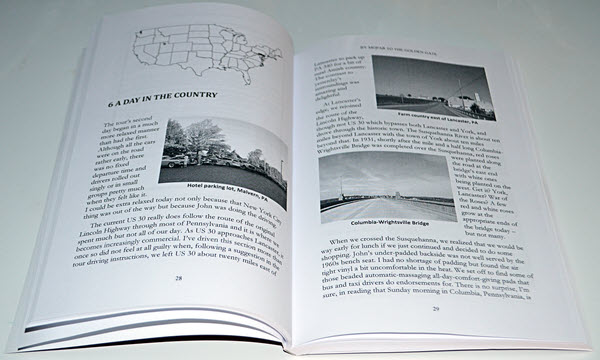
Lincoln Highway Pictures Through Time - sampleIt is organized neither geographically nor chronologically. The first section following the foreword is titled “History”. Here, among pictures of collectibles and artifacts, Butko gives a very brief history of the road’s birth and short life. It is enough to give someone who knows little or nothing about the Lincoln Highway a starting point and someone who knows everything a quick refresher on key dates and events. It is a stripped down but adequate introduction to the pictures that follow.

Lincoln Highway Pictures Through Time - sampleThose pictures are organized by their subjects. Butko identifies ten things that comprise the Lincoln Highway and gives each one a chapter. They are “People”, “Gas”, “Food”, “Lodging”, “Vehicles”, “Attractions”, “Signs”, “Markers”, “Bridges”, and “Roads”. The chapters are themselves samplers. Historic images from postcards and other sources are combined with modern photographs. Images of things along the road, which is every chapter other than “People”, are from locations spread over the road’s entire length.

The sources of the photos are pretty diverse, too. Butko lists more than fifty contributors. He supplied a large number of images himself and, at a presentation at the Centennial Celebration in Kearney, Nebraska, he singled out Russell Rein, Jeff Blair, and me as next in number of contributions. Many of the historic images came from Russell’s huge collection. Jeff and I are both amateurs who happened to be the the right place fairly often but our pictures get to appear alongside stuff from real pros like Michael Williamson, Drake Hokanson, Rick Pisio, Shellee Graham, and Jim Ross and Brian has made sure they all look as good as possible.

I described the “History” chapter of having value for two very different audiences. Maybe that’s true of the whole book. Most of its first recipients, members of those centennial tours, are probably somewhat familiar with almost everything in the book. For them and others like them, the book might be a memory booster or a chance to see an image of something they’ve only heard about. On the other hand, there is a large group of people who ask “What’s that?” when hearing of the Lincoln Highway. Flipping through the pages provides glimpses of what’s there today and some of what was there in times long past. Turn the pages slowly and read all the captions for an even better answer to the question.

The Lincoln Highway, Photos Through Time, Brian Butko, Lincoln Highway Association, 2013, paperback, 10 x 8 inches, 136 pages, ISBN 978-0989208000

Available at Lincoln Highway Trading Post.

The Annie Gathering

Greenville signsThere are big doings in Greenville, Ohio, this weekend. Some are associated with the Annie Oakley Festival and some are associated with the Gathering at Garst. The Festival includes a parade through downtown but essentially takes place at the Darke County Fairgrounds on the south side of town. The Gathering takes place on the grounds of the Garst Museum towards the north side of town. Since the museum houses something called the National Annie Oakley Center, you might think the Festival and the Gathering are just two aspects of a single event but that’s hardly the case.

Annie Oakley Days ParadeAnnie Oakley Days ParadeThe parade is completely the responsibility of the Annie Oakley Festival as is a shooting competition, using air rifles, whose winner earns the title Miss Annie Oakley. In the lingering drizzle, I failed to get a picture of this year’s winner, Courtney Osborne, but I did get a picture of the 1970 winner, Patty Nisonger Padula, who was this year’s Grand Marshall. I was watching the parade with my uncle in front of his store and he told me that Patty had been an employee when she won in 1970. He had been her driver in the parade in another black convertible, his 1962 Corvette. The parade included a couple of high school bands, several classic cars, many Shriner units, and much more. A most appropriate entry was the group of female horseback riders most of whom were riding on side saddles.

Gathering at GarstGathering at GarstThe rain had moved on and the sun was shining by the time I made it to the Gathering at Garst. The museum was surrounded by tents selling various craft items and small antiques and there were a number of food tents as well. A field across the street was filled with “living history”. It included some additional vendors and some big guns which were fired once in a while.

Annie Oakley FestivalAnnie Oakley FestivalI also stopped by the fairgrounds to check out the Annie Oakley Festival. There were vendors selling food and other items including some crafts. There was a small car show and bus tours, included in festival admission, depart from the fairgrounds to visit related sites such as Annie’s grave.

In the beginning (1963), the home of Annie Oakley Days, as the festival is commonly called, was the museum and its grounds. That lasted for thirty-some years until the festival moved to the fairgrounds for a number of reasons including more space and access to electricity. It had the last weekend in July all to itself until the first Gathering was held in 2011. A Bob Robinson article, written shortly after that inaugural Gathering, indicates that, while both were calling themselves successful, neither was completely comfortable with the other.

The Gathering is free but parking is $4. There is a fair amount of parking available on nearby streets so some (like me) avoid the charge by walking a bit. Parking is free at the Festival but admission is $3. Advance $2 passes were available from some area merchants. Both events offer various forms of entertainment including concerts.

I’m guessing that both can call themselves successful again this year. However, as someone who attended the first Gathering and several Festivals, I have little doubt that the Gathering is getting bigger and better attended while the Festival is shrinking along with its crowd. Only time will tell whether both can survive. I hope so. I like that living history stuff but I like even more the parade and the Miss Annie Oakley contest. Is “The Annie Oakley Gathering at the Garst and Darke County Fairgrounds” too long to fit on a tee-shirt?


Annie Oakley's BootsAnnie Oakley's BootsEven with its $8 admission fee, the museum gets a lot of traffic during the Gathering and Festival. I’m a member but had not been inside for awhile. In fact, it seems that I’d not been in the museum proper since sometime prior to attending an Annie Leibovitz exhibit in October. That exhibit included a photograph Annie L had taken of a pair of boots at the Garst Museum. I resolved to look at the boots, made for Annie O around 1915, a little closer on my next visit. I expected it to be sooner than this but doing it in the midst of the Gathering/Festival is more than alright. Taking a photo of Annie L’s photo was not permitted but I will admit it’s a wee bit better than mine. Hers was helped by getting the boots out from behind the glass but I think there might be a little more to it than that.