Movie Review
Ohio: Wild at Heart
MacGillivray Freeman

This just might be the ultimate selfie. It’s a big-screen movie ordered up by the Ohio Department of Natural Resources starring the natural resources of Ohio. Yeah, that selfie label is admittedly a real stretch — not only because it’s a 45-minute-long movie rather than an in-your-face snapshot, but also because it wasn’t the ODNR holding the camera. That was the talented folks at MacGillivray Freeman, makers of many outstanding features, including the subject of my first-ever movie review.

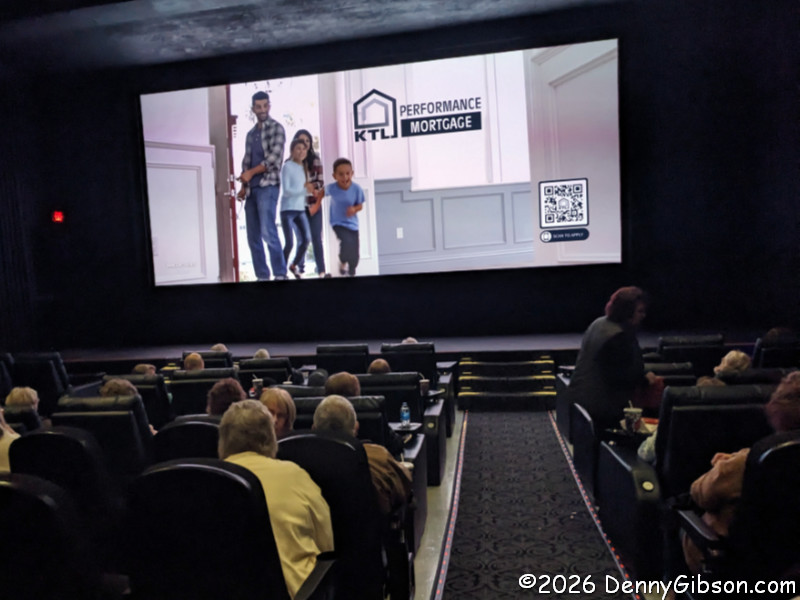
Of course, I watched Ohio: Wild at Heart at the Robert D. Lindner Family OMNIMAX® Theater in Cincinnati. I was there at its first screening on Friday. This is the third theater, after Toledo and Dayton, to add the movie to its schedule. It will soon be added by several others, as listed here.

The movie begins with the story of the recovery of the state’s bald eagle population from just four nesting pairs in 1979 to nearly 1000 nests today. The successful reintroduction of trumpeter swans to the state, with their removal from Ohio’s threatened species list just over a year ago, is a story told later in the movie. Other successful conservation projects, including major cleanups of the state’s waterways, are also documented. Governor DeWine, who was instrumental in getting the movie produced, emphasizes the word “education” when discussing it. He sees making Ohioans aware of what they have as an important mission. He has said, “If people love the rivers. If they love the lakes. If they love all the beauty of this state, they’re going to take care of it.”

MacGillivray Freeman does a wonderful job of capturing “all the beauty of this state” on the screen. There are gorgeous shots of swans on mirror-smooth lakes, and stunning aerial views of eagles in flight and in nests, of kayaks on rivers, and hikers, bikers, and dog sledders on trails. Yes, dog sledders! Before I saw this movie, this lifelong resident of the Buckeye state had no idea that dog sledding was a thing anywhere within its borders. That’s education.

There are people in the movie. Governor DeWine makes an appearance along with his wife Fran. There are enlightening conversations with folks enjoying all of the things I’ve mentioned, plus bird spotting, firefly watching, and much more. Narration is supplied by a true Ohio natural resource. Archie Griffin, the world’s only two-time Heisman Trophy winner, who was born in Ohio and played his high school, college, and professional football in the state, nails it.

The movie’s website highlights the quote “When we take care of nature, nature takes care of us.” I don’t know if I missed that exact line in the movie or if it’s a minor paraphrasing of a line I did hear and was impressed by enough to make a note of: “We make a commitment to restoring nature because nature restores us.” Both lines are insightful and worth repeating. I have no doubt that Ohio: Wild at Heart will do a fine job of making Ohioans aware of what we have, and I’ve a very strong hunch that it’s going to make a lot of other folks aware of it too.

Not Long Ago. Not Far Away.

On Saturday, October 18, “Auschwitz. Not long ago. Not far away.” opened at the Cincinnati Museum Center. I attended on Wednesday. The red shoe pictured at right is one of the first items visitors see when they enter the exhibit. Photos of the shoe, backed by the image of countless other empty shoes, have been used to promote the display. The wall-filling image boggles the mind as the realization that the owners of all those shoes walked into Auschwitz but never walked out slowly forms. The mind nearly breaks realizing that the photo contains just a fraction of such shoes.

Having seen pictures of that red shoe, and knowing that this was “the largest collection of artifacts from Auschwitz outside of Europe”, I probably could have predicted the question that formed as I moved into the exhibit and listened to the included audio guide. It’s a question that most of us ask ourselves anytime we give much thought to the Holocaust. “How could this have happened?” we wonder. The exhibit doesn’t really explain it, but it does tell some of the history. It describes and displays artifacts from the small Polish village that would become home to the largest of the Nazi concentration and extermination camps.

Establishing that the “other” was responsible for all of Germany’s problems was essential. The “other” was mostly, but not exclusively, Jews. Blacks, Roma, homosexuals, and people with disabilities were among those persecuted by the Nazis.

This is the desk of the camp commandant, Rudolf Höss. Photos of key Auschwitz personnel are displayed nearby with an identifying legend.

Roughly 80% of those arriving at Auschwitz were sent directly to the gas chambers. The other 20% became slaves, and not many survived the starvation, beatings, and forced labor. Many more than three people occupied the three-tiered bunks. The concrete post held barbed wire, as seen in the photo in the background.

Some of the prisoners were “rented” to various privately held companies, but many were assigned tasks in the camp, such as removing bodies from the gas chambers or moving them through the crematorium. The first photo contains items from gas chambers and crematoriums. There is a “shower head” in the lower right corner. The gas mask in the second photo was worn by a soldier who dropped the Zyklon B once the chamber was sealed.

Other prisoners were forced to sort through the few possessions that actually made it to the camp. Prisoners referred to the sorting sheds as Kanada.

There were several benches placed throughout the exhibit. Many were positioned in front of screens showing videos of scenes related to the camps. All had a box of tissues placed at their center. There was no lack of tear-inducing images, artifacts, and stories in the exhibit. Nearly all of the items on display are from the Auschwitz-Birkenau State Museum. The last picture is of a quote from the director of that museum about remembrance. I immediately thought of Eisenhower’s 1945 command, “Get it all on record now. Get the films, get the witnesses, because somewhere down the track of history some bastard will get up and say this never happened.” He was right, of course. That quote on the wall notes that today “…our efforts to build a more just and humane world are under threat.” Nearer the beginning of this article, there is a photo of a quote about  “…the disappearance of a number of quite harmless people…” It’s from 1938 Germany during the Nazi rise to power. As I read it, it occurred to me that it could have easily come from certain Central or South American countries a few decades ago. Or it could have come from somewhere not even that far away or that long ago.

Auschwitz. Not long ago. Not far away.” runs through April 12, 2026.


The Holocaust and Humanities Center helped bring the Auschwitz exhibit to Cincinnati. Although a separate operation, it is housed in the Cincinnati Museum Center and throughout the exhibit’s run is offering discounted adult admission of $7.50 to anyone presenting an “Auschwitz. Not long ago. Not far away.” ticket. This rate is available year-round to seniors and military.

Naturally, there is overlap between the Auschwitz displays and those in the Holocaust Museum. A notable example is this molded wall of abandoned shoes that echoes the red shoe and large photo from Auschwitz. But there are also a lot of differences. The museum has many interactive displays, and the story it tells is broader than the one with a specific concentration camp at its center. In particular, the museum continues the story well beyond the liberation of the prisoners with reporting on the post-war trials and tales of recovery.

When I spoke with a friend about the Auschwitz exhibit, I encouraged a follow-on visit to the Holocaust Museum, and it wasn’t just because of the broader story. The Holocaust is humanity at its worst. Studying it and acknowledging it is important and necessary, but it is hardly uplifting. The museum offsets that just a little by presenting recent examples of bigotry being defeated and human rights being defended. Your mood probably won’t be exactly celebratory when you leave, but it very well might be hopeful.

With every museum that exists, it is always possible to see something you’ve previously missed when you revisit. But sometimes that new discovery really is something new. That is the case with this recently installed interactive display featuring Albert Miller (1922-2023). Albert, who escaped Europe with his parents in 1940, then returned as a Nazi interrogator in 1943, tirelessly answers spoken questions about the life he lived.

I documented my first visit to the museum here

An Ohio Meeting

It has been a long time since I attended an Ohio Lincoln Highway League annual meeting. Longer, perhaps, than I realize, as I can find no evidence of attendance since 2014. There seems to almost always be a conflict in my schedule, but not this year. Canton, the meeting’s location, is a little too far away to make the round trip in a day. When I planned an overnight in a nearby town, I discovered that the path there passed quite close to a favorite brewery. With that, I thought my itinerary was set.

However, when I was ready to head out on Friday morning, I realized that there was no need to hurry on expressways, so I swapped I-71 for US-22. That allowed me to stop for breakfast at Kim’s Classic Diner in Sabina. I typically sit at the counter, but was in a booth today and was able to get a shot of an empty counter when the area was briefly empty. I stayed with US-22 to Zanesville, and that let me stop by Tom’s Ice Cream Bowl for some French Vanilla Cherry Chocolate Chunk, which disappeared before I could get a picture. I then headed to that favorite brewery, Wooly Pig Farm, on OH-93. OH-93 is quickly becoming one of my favorite wiggly roads.

President Scott Little presided over the meeting. The league is comprised of three chapters, each of which has more or less monthly meetings throughout the year. This yearly meeting is the only one involving the entire state. Scott is also president of the Western Ohio Chapter and delivered the report of that chapter’s activities for the year.

Mike McNaull, of the Mid-Ohio chapter, and Ed Cannane, of the Eastern Ohio Chapter, delivered reports of their chapter’s activities. All three chapters do some things for their members’ enjoyment and an awful lot to promote and maintain the Lincoln Highway in their areas.

A presentation by someone from the National First Ladies Library and Museum, followed by a visit to the museum, had been planned, but the government shutdown scuttled that. Jim Cassler’s presentation on this summer’s tour of the Lincoln Highway’s middle third was a fine substitution. A tour of the eastern third happened in 2022, and the trilogy will be completed in 2028 during the centennial of the final 1928 realignment and the setting of the concrete markers.

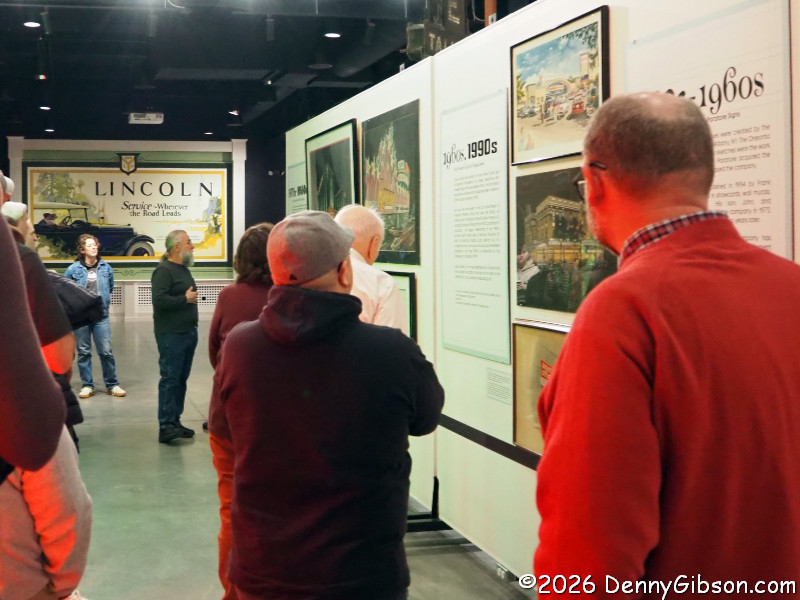
The Saxton McKinley House, home to the library portion of the not-to-be-visited-today National First Ladies Library and Museum, is directly across the street from the meeting site. A visit to the Canton Classic Car Museum, about a block away, would proceed as planned.

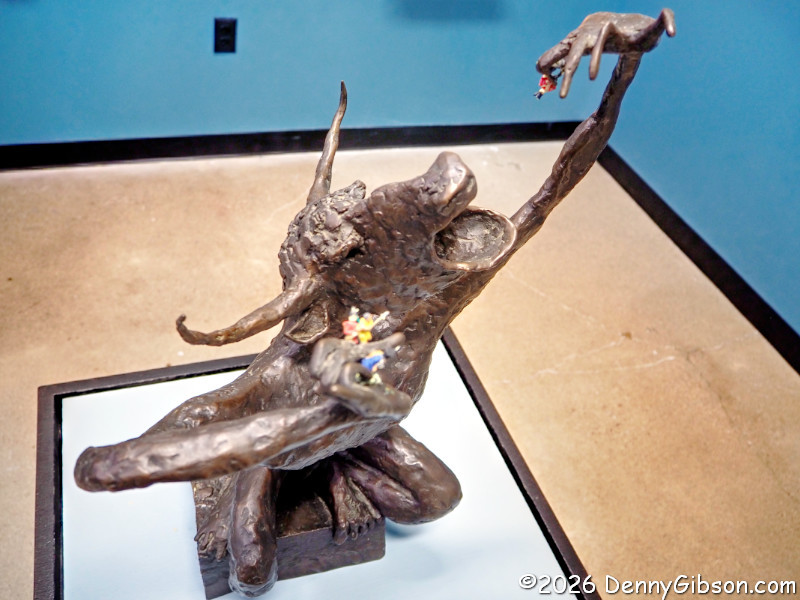
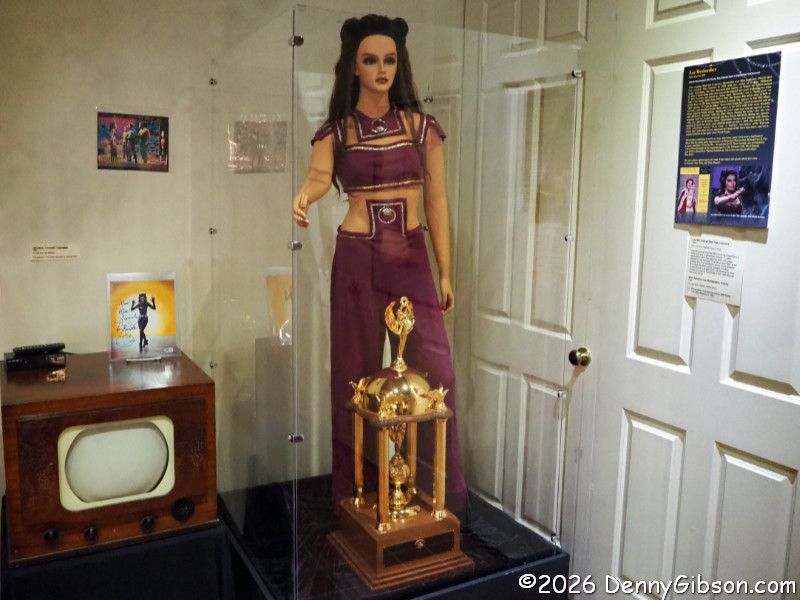
One of the museum’s prized possessions is a 1937 armored Studebaker. There are definitely plenty of really cool cars here, but there is more. If a fragile lamp with a single leg is a “major award”, what might this four-limbed illuminator be? 

Possibly one reason I failed to photograph my ice cream at Tom’s was the conversation I had with a couple beside me. They were headed home to Kentucky after a vacation that included a stop for ice cream in Canton, which is where they learned of Tom’s. I reversed the story and stopped in Canton for ice cream at a place I’d learned of at Tom’s. The wooden booths at Taggart’s Ice Cream looked inviting, but I enjoyed my Black Walnut outside.

I was a little disappointed when I realized that the meeting date was the same as the planned nationwide No Kings protests. I would not be able to attend one in my home territory, but was pleasantly surprised to learn that the one in Canton would be taking place later than most, and I could possibly make it. A sizable crowd was already in place when I arrived about half an hour ahead of the scheduled 5:00 start, and it was still growing when I left for home about 5:30. A fellow I spoke with said this was already a bigger turnout than last time.

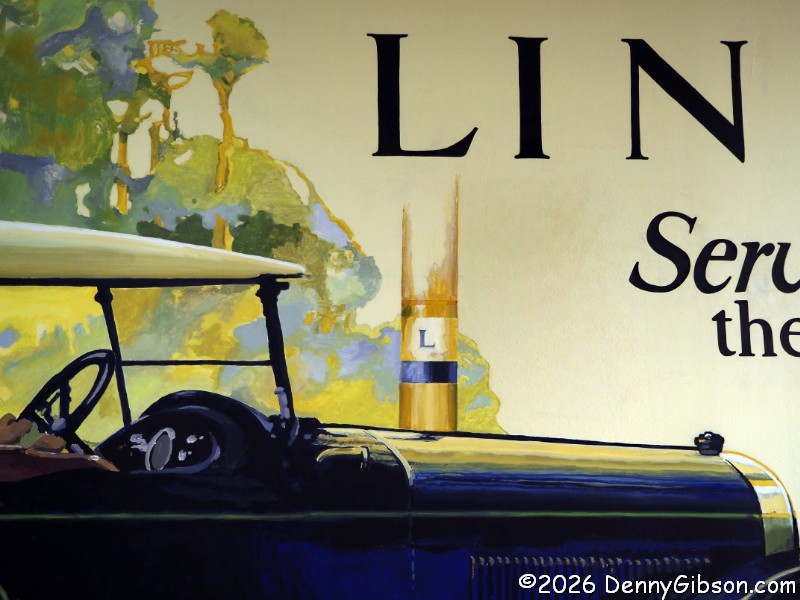
I’ll close with a reminder of why I was in Canton. I’m pretty sure Mr. Lincoln would be proud of the nation crossing highway with his name on it. I also think he would approve of the sentiments expressed in signs being held in demonstrations all across that same nation, though not necessarily of all of the language.

Trip Peek #149
Trip #167
Hiwassee Loop

This picture is from my 2022 Hiwassee Loop trip. Railroad loops allow elevation changes in less space than switchbacks and without the need to reverse direction. The Tennessee Valley Railroad‘s Hiwassee Loop was completed in 1890. Riding the train through the loop was the whole purpose of this trip, but I drove the Tail of the Dragon, the Cherohala Skyway, and a little Dixie Highway getting there, then some US-127 and more Dixie Highway getting home. It was a three-day trip with both overnights spent in historic digs.


Trip Peeks are short articles published when my world is too busy or too boring for a current events piece to be completed in time for the Sunday posting. In addition to a photo thumbnail from a completed road trip, each Peek includes a brief description of that photo plus links to the full-sized photo and the associated trip journal.

Route 66 Miles of Possibility 2025

I attended last year’s Miles of Possibility Conference in Edwardsville. It was my sixth documented trip of the year and was added to my schedule just days before it opened. This year is a little different. It’s my second trip of 2025, and I registered for the conference at the beginning of September. The tenth Miles of Possibility Conference is taking place in Joliet, IL, which is where the third one was held in 2017. The journal for the first day, which is basically the drive from home to Joliet, has been posted.
This entry lets blog-only subscribers know about the trip and provides a place for comments. The journal is here.

A River Roots Cruise (Lagniappe)

The American Roots Festival is not Tall Stacks. It’s similar but not matching. Tall Stacks was a festival that happened six times between 1988 and 2006 on the Ohio River at Cincinnati. Among the reasons given for not reusing the name is a desire to paint the event as something broader than a gathering of riverboats and to associate it with the nation’s upcoming 250th anniversary in 2026. Whether or not that painting and association were necessary and/or successful is not my concern. I definitely enjoyed some of the musical offerings at Tall Stacks, but for me, the boats were always the reason for its existence, and that is even more true for me and the Roots Festival. The fact that I was heading out of town when the festival officially began, but not before a day of “advance cruises” took place, has a lot to do with that. A Wednesday cruise on the Steamboat Natchez from New Orleans is my only personal contact with the American Roots Festival.

I arrived downtown well in advance of the scheduled boarding time and slipped across the river into Kentucky to snap a picture that includes five of the nine boats in town for the event. The boat I would shortly be cruising on is at the far right of that picture, plus I grabbed one of it alone.

Back in Ohio, I parked near the public landing and walked to the river for a closer view of the boats. The Belle of Louisville is at the west end of the line. On the way to the landing, I passed the National Steamboat Monument and was happy to hear the whistles blow as I walked through them. That’s not always, or even often, the case.

I actually took photos of all nine boats, and a couple even came out OK. However, with the low sun, most were atrocious, and I’m reserving them for my own entertainment. I spent the remaining shore time taking some close-ups of the Natchez. This trip is something of a homecoming for the calliope on the left. It was built in Cincinnati between 1900 and 1910 by Thomas J. Nichol for the Steamboat Sidney.

A wide variety of cruises is available during the festival. This was a 90-minute “Beignets & Coffee” cruise. During the half hour allotted between boarding and departure, I listened to the excellent onboard Dixieland trio and downed my beignet.

That left me free to roam around once we were underway.

Built in 1975, the Natchez is pretty new for an authentic sternwheeler. She’s not entirely new, however. For example, the engines were in service aboard the Steamboat Clairton from 1925 until 1962, which means they are celebrating their centennial this year.

With breakfast and onboard exploration out of the way, I used the turnaround point as an excuse for an early lunch of jambalaya and Abita Amber. That container was absolutely stuffed with quite tasty jambalaya, which I completely failed to finish before realizing that we were nearing Cincinnati. About half of it came home to nourish me as I wrote this.

Not too long after I capped the jambalaya and stuffed it into my jacket pocket, we passed under the Big Mac Bridge and were soon facing the Roebling Bridge with the Bengals’ and Reds’ stadiums off to our right. Several other visiting riverboats were in motion on the river as we turned around and pulled into the landing.

Back on shore, I paused at the top of the landing to gaze at the Natchez one more time before heading to my car. Cruising up and down the Ohio on a steam-powered sternwheeler can definitely play havoc with one’s sense of time. That’s no doubt why I didn’t question seeing Mr. Clemens heading toward the very river where he got his pilot training half as much as I might have otherwise.

This blog did not exist during the Tall Stacks period. There was, however, an Oddment section with entries not related to road trips. An entry was made for the final Tall Stacks event in 2006. It is here.


Because of my plans to leave town on Thursday, I finished writing this Wednesday for publication as the regular weekly post on Sunday. But it began to bother me that, although there would still be a day of the festival left at that point, at the moment nearly all of it remained. There was at least a small chance that it might be useful to someone if it appeared on Thursday instead of Sunday. So here it is: a blog post published on a normally silent day of the week. I’ll put up a canned post on Sunday, and this will be, as the folks in NOLA say, lagniappe.

Season of the Clown

Not everybody decorates for Halloween with store-bought skeletons and inflatable witches. Some people, like this guy in Delhi Township that I just learned of, do it with personal creativity. For the last ten years, Shaun Reynolds has filled his front yard with unique creations based on different themes. This year, it’s clowns.

“I’ve wanted to do this since I was a kid,” Reynolds told TV station WCPO. It was through their article and video that I learned of the seasonal attraction. Check it out here. I didn’t get to meet Reynolds when I visited on Thursday, but I have a feeling that he’s not quite finished with being a kid.

I did get to meet Teresa, a long-time neighbor. I was poised to ask what it was like having a big, spooky attraction in your neighborhood, but I didn’t really need to. Her smile when she greeted me let me know she was loving it. I had thought of counting the figures on display, but had not followed through. Theresa made that unnecessary, too. “38 or 39,” she said. She also tried to describe how great the place looks at night with the lights on, as well as just how crowded and fun it gets on Fridays and Saturdays.

Reynolds makes it very clear that he does this for fun and that sharing it and seeing others enjoy it is part of that fun. Of course, some folks have wanted to contribute something, so the Reynolds family has taken to accepting donations of food and money, which they pass on to the Delshire Elementary School food drive.

I’d sure like to see this place at night, and I’m going to try to make that happen. Maybe you can, too, but it is obviously pretty cool day or night. It’s on Assisiview Court.

One for Sun(flowers) in Ohio

Remember last month’s Two for Four in Ohio post, when one of the targeted museums was closed and the sunflowers were barely out of the ground? At the time, I noted that the projected date for Tecumseh Land Trust blooms was near the end of September. Well, the end of September is near, and the blooming sunflowers are here.

Thursday morning’s rain ended, and the forecast said it would not be back until evening. That wasn’t correct, but I did manage to get my visit in before the rain returned just past noon. This time, I was not alone. There were about half a dozen cars parked in the designated area next to the flowers, and some small winged beings hanging out right in their midst. Here’s a closer look at the bloom in the center of the opening photo.

The ground was wet but apparently not actually muddy, as a few of the humans from the parked cars ventured out into the field to take selfies surrounded by yellow flowers. Most, however, walked around the edge like I did. Just before I left, a group of women arrived with their young daughters wearing some very pretty dresses and posed the group at the field’s edge for photos. I worked at keeping all wingless creatures out of frame.

Even though none of the sunflowers said a word, I left with the impression that they were glad to see me.

Book Review
The Great American Retro Road Trip
Rolando Pujol

There’s no road trip here. The Great American Road Trip is not a travelogue. Nor is it a guide for traveling to or through a particular place. It is a well-done, very inclusive, nicely illustrated catalog of stuff that people like me drive around the country to see.

The subtitle is more accurate. This book is indeed A Celebration of Roadside Americana, and that’s a celebration I’m always ready to put on my party hat for. It’s a celebration that Rolando Pujol is extremely well qualified to host. He is an award-winning print and TV journalist, and is the man behind The Retrologist website. Surprisingly, this appears to be his first book.

Pujol identifies seven categories of stuff people like me/us drive around the country to see, and has divided the country we drive around in into eleven regions. The chapters are the regions: Northeast, New England, Mid-Atlantic, Southeast, South Central, Midwest, Heartland, Desert Southwest, Mountain West, Pacific Northwest, and California. Sections in each of those chapters are devoted to the categories: Roadside Quirks, Roadside Eats, Mainstays of Main Street, On with the Show, The Inn Crowd, Sweet Stops, and Cheers! I bet most of you can come up with an example of something in each of the categories, even without a precise definition. Sidebars appear here and there to expand on or drill down on selected topics.

The book is jam-packed with bright color photos that range in size from small thumbnails, measuring only an inch or so on a side, to double-page spreads at the front of each chapter. Many are integrated into the book’s text layout. I believe that all photos were taken by the author.

Every photo is identified in the text, and a few points of interest are described without an accompanying photo. Some attractions are covered in a single paragraph, but many get a lot more. The city and state are always provided, and more often than not, some interesting history about the building, the owners, or both is also included.

For the first time, I’m writing a book review without reading every word in the book. I did read every word from the beginning through the end of the Midwest chapter. That’s where my home is, and there are quite a few familiar items in that chapter. However, there is no storyline or itinerary to move the reader forward, and I found my page-turning motivation beginning to fade at that point. The pictures are great, and the nuggets are well-written and informative. I may finish it in some short spurts over the winter, and in all likelihood, I’ll give it a look when planning a trip to a specific area. I have not removed my bookmark.

This is a good quality hardback publication with glossy pages that properly present the photos. It is fully indexed for help in finding specific points of interest. I ordered this book when it was announced that Pujol would be featured in the Society for Commercial Archeology’s August Zoom presentation. I thought I might get in some advance reading, but that didn’t quite work out. That presentation was recorded and, like other SCA Zoom presentations, has been made available for anyone to view. Learn more about The Great American Retro Road Trip straight from the Retrologist’s mouth here.

The Great American Retro Road Trip: A Celebration of Roadside Americana, Rolando Pujol, Artisan (June 24, 2025), 7.2 x 9.25 inches, 320 pages, ISBN 978-1648293719
Available through Amazon.

A Thoroughly Modern Attic

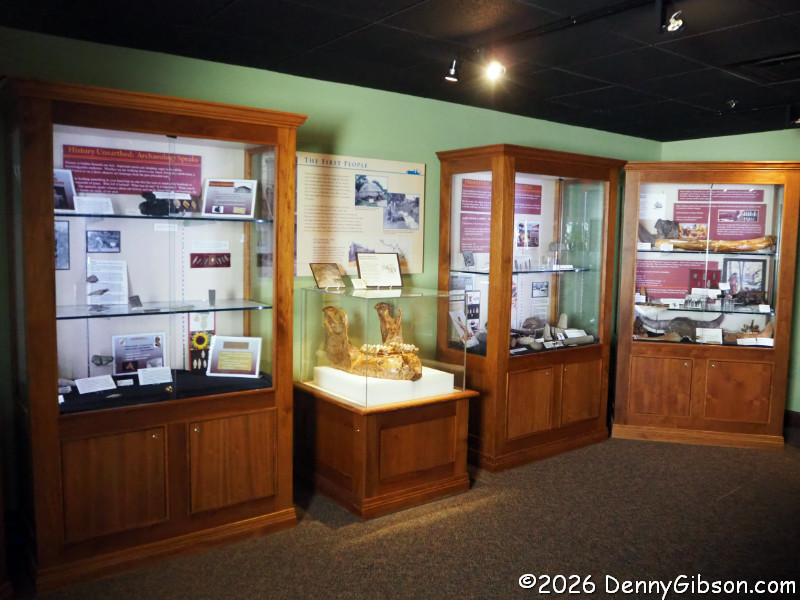
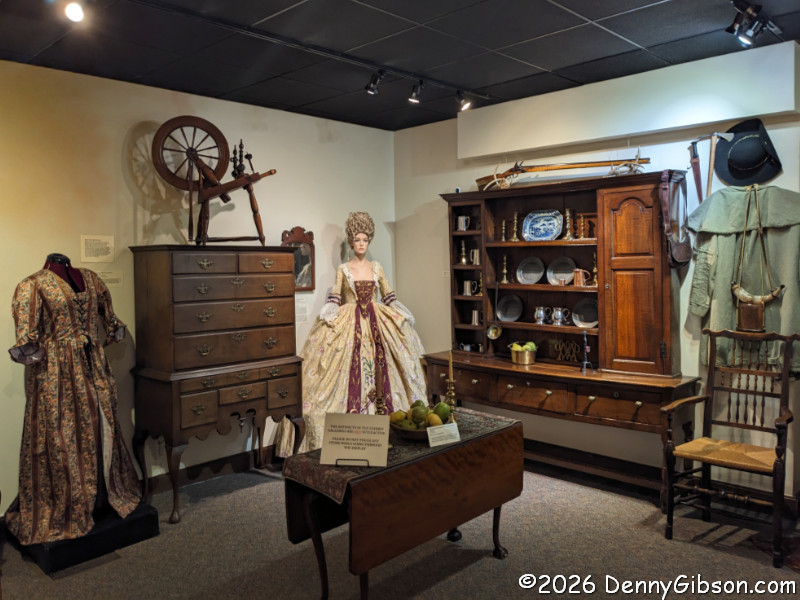
Museums in small towns are sometimes referred to as the village attic. Some of them really do resemble an old farmhouse attic with little filtering or organization of objects displayed. Most, however, display items in an organized manner that avoids looking overcrowded. Part of how this is accomplished is by being selective in what items are displayed and having only a portion — often a very small portion — of the museum’s collection on display at any one time. As the state’s attic, the Ohio History Connection is very organized, with a rather tiny fraction of its collection on display and the bulk stored elsewhere. Last year, it got a brand new “attic”, and on Thursday, I got to see it.

The occasion was an architectural tour preceded by a reception and presentation. I didn’t realize that food would be available, but I did realize that it was National Cheeseburger Day. I enjoyed the lemonade, but I skipped the food because I had just left Urban Gourmet, where I had celebrated the holiday.

The tour began with a presentation in the auditorium. Several people gave short presentations about different aspects of the project, which began several years ago with the Collection Care Center opening in June 2024. I happened to catch architect Carlos Lugo at the podium.

Following the presentation, we all went out to our cars and drove from the museum, past Ohio Village, to the Collection Care Center on the north side of the campus. At the door, the fifty or so attendees were split into smaller groups to tour the building.

The group I was in began our tour in the actual storage section. Among the wide range of things stored here are lots of fossils. Some are authentic, while others are cast copies. 

The bones of mastodon feet aren’t typically found intact in the wild. These are castings from assembled fragments. I thought a shelf filled with mastodon feet was pretty unusual, regardless of whether they were bone or plaster.

There is an enclosed loading dock at the other end of the building with offices, lab areas, and an extra-wide corridor in between.We paused in that corridor to learn about the building’s use of pre-formed concrete to speed construction and about other efficiency-focused aspects of the building. We then went outside to learn more about the climate control systems. I have the impression that the majority of attendees were architects. For many, hearing these details was as practical as it was entertaining. I was very impressed by the thoughtful answers to the building’s many unique requirements, but that was probably fueled as much by things I didn’t understand as by those I did.

Our last stop was just outside the front door after we passed back through the building. Here we learned about the landscaping. Native plants are used, and there is no mown lawn. There are some paved as well as gravel paths with a few benches along the way. Several glacial erratics encountered during excavation have been incorporated. The place has been incredibly well thought through, both inside and out.
For a much better overview of the project than I’ve provided, I suggest an article and video published by The Columbus Dispatch when the center opened. It is here