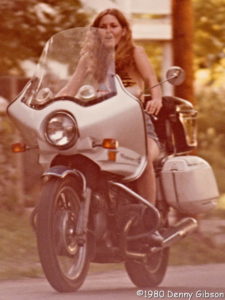
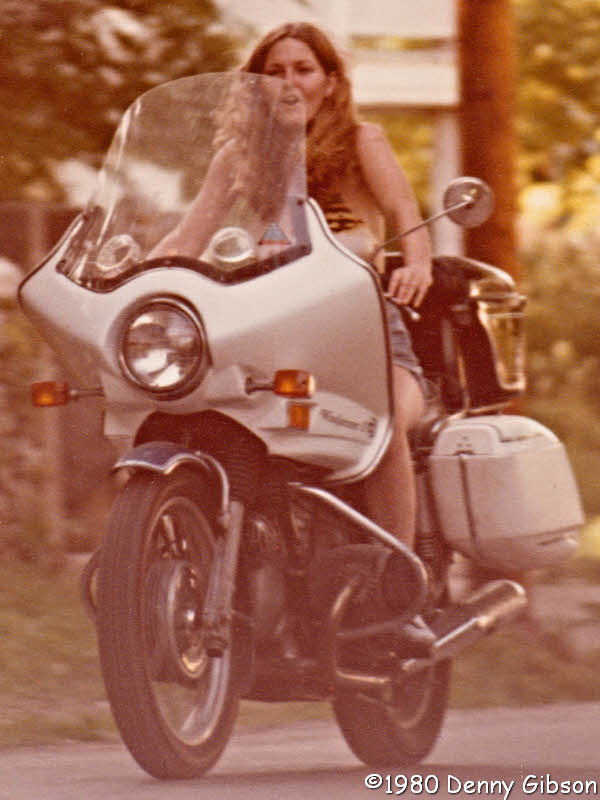
 For once I didn’t have to snag a picture from the internet to show what my vehicle looked like. Plus, unlike the previous My Wheels chapter, there’s no need for paid models to spice things up. The photo at right shows my future ex-wife riding my future ex-motorcycle.
I hadn’t been exactly eager to sell the Chevelle and I was less than comfortable with a truck being my only transportation. My ears perked up when I heard that a neighbor’s brother was selling his motorcycle. In some corner of my mind I’d always wanted a BMW. I started to make that seem more generic by saying I’d always wanted a touring bike but the truth is that a BMW is the touring bike I had in mind. I remember seeing my first Beemer when, as a high school junior or senior, I stepped outside the school as a shiny black one rolled past. I recall its windshield and teardrop saddlebags. The slightly futuristic looking bags might have been part of the attraction but I believe what impressed me the most was how purposeful it looked. That bike was made to go places. It may have been the first vehicle that produced the phrase “road trip” in my mind. I took one test ride on the proffered three-toned motorcycle then bought it.
The motorcycle itself was blue. The after market faring and saddlebags were white and the trunk was black. With all that luggage space and the “made to go places” thinking of the previous paragraph, you might reasonably expect me to spend the next summer touring the country on two wheels. If that’s what you expect you will be disappointed. I did and I was.
I had a nearly new van that functioned as a camper which made it a natural choice for overnight trips. It was also a good people hauler and was a popular vehicle for group outings. That left the BMW with only solo journey duty and, since I was heavily involved with the lady in the photo, there weren’t many of those of any length. I crossed the river into Kentucky several times and made it to Indiana once or twice but the BMW spent almost all of its time in Ohio where I often did take the long — sometimes really long — way home from work.
I laid it down once. I was off to visit a friend living on a gravel road. I moved slow in the ruts that previous travelers had made. It was dry and those ruts had been pretty much cleared of gravel. I let my speed creep up. By the time a gravel ridge did appear, I’d let it creep too much. I shoved the bike away from me as it went down. In my mind’s eye, it rose high in the air while spinning over and over waiting for me to slide under it and be crushed. In reality it was probably never more than a foot off of the ground and flipped exactly one and a half times. It was enough to snap off the windshield and leave scratches on both bike and rider. My scratches healed and the bike’s weren’t bad enough to worry about. A new windshield was purchased.
I also got one ticket. A small group of friends were spending the weekend at one of the group’s family cottage near Indian Lake. I was taking one of the wives on a tour when flashing lights appeared behind us. I stopped and was told I had failed to stop at a stop sign. I really believed that all forward motion had ceased for a second and the officer seemed to agree. “But your feet didn’t touch the ground”, he said. We weren’t far from the cottage so my rider simply walked back while I followed the officer to the unmanned station which he unlocked. I was able to pay the fine which means it couldn’t have been more than $25 or so. As he wrote out a receipt, I commented that if they stopped every motorcyclist whose feet didn’t touch the ground they were probably making a lot of money. He looked up with a smile that stopped just short of a grin and said, “We do alright.”
The last story is about a malfunction. The clutch cable broke on the way to visit a friend in Cincinnati. I don’t recall whether it snapped as I pulled up to the light or started to pull away and I don’t recall whether it was panicked braking or a panicked key removal that killed the engine. Whatever the specifics, I found myself without a clutch at the bottom of the last hill to my friend’s house.
Shifting a moving motorcycle is no big deal and neither is getting it into neutral for a stop. Getting a motorcycle moving without a clutch is significantly more difficult. One way is to start the engine then get things rolling enough to slip into some gear. It’s rather easy going down hill, kind of tricky on level ground, and essentially impossible going up hill. I had my choice of the latter two. There was an empty parking lot about a half block way where I could get the bike started and ride it abound in circles. The reason for the circles was to time my arrival at the the light with it being green. I failed at least once but made it on the second or third attempt.
There were a few more malfunctions and probably a minor adventure or two but nothing big. As I recall, there were some electrical issues with the bike when I changed residences. I left it in a storage area at the apartment complex I was moving from and other things in my life kept its retrieval a low priority. It eventually just disappeared.
My Previous Wheels: Chapter 22 — 1970 Chevelle
My Next Wheels: Chapter 24 — 1983 Renault Alliance

 It looks like Garmin BaseCamp first appeared in 2008. I don’t recall when I first downloaded it but I do recall that it sucked. I use Garmin hardware and Garmin software is required to communicate with it. BaseCamp was the intended replacement for their MapSource program and, while I was hardly a fan of MapSource, at least it didn’t crash or hangup too often. Early BaseCamp did both somewhat regularly and its user interface was no more intuitive to me than MapSource’s. I put off switching as long as I could but the day came when I was forced to replace a program I didn’t like at all with one I disliked even more.




 The trip count was down a little but one of them was a duesy. My 41 day 11,000 mile trip to Alaska broke all previous time and distance records and pretty much accounted for the jump in total days on the road all by itself. Pictures posted increased accordingly and posted road trip pictures topped 2000 for the first time. I did not break the 1000/trip mark however. My count for Alaska trip pics is 999. In addition to the 52 regular weekly blog posts, there were 8 reviews, 7 road trip links, and 2 miscellaneous asynchronous posts. After having three of 2015’s new blog posts among the year’s five most popular, this year saw no new posts in the top five but it was close. The most visited post in 2016 missed being published in 2016 by twenty-six days. I’ve no choice but to consider that close enough and declare it the top new post. On the other hand, after two years with none, a pair of newly minted entries appear in the the non-blog top five.