Book Review
Historic US Route 20
Bryan Farr

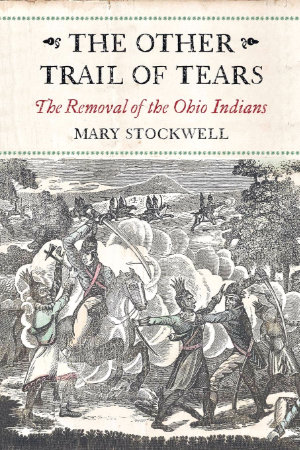
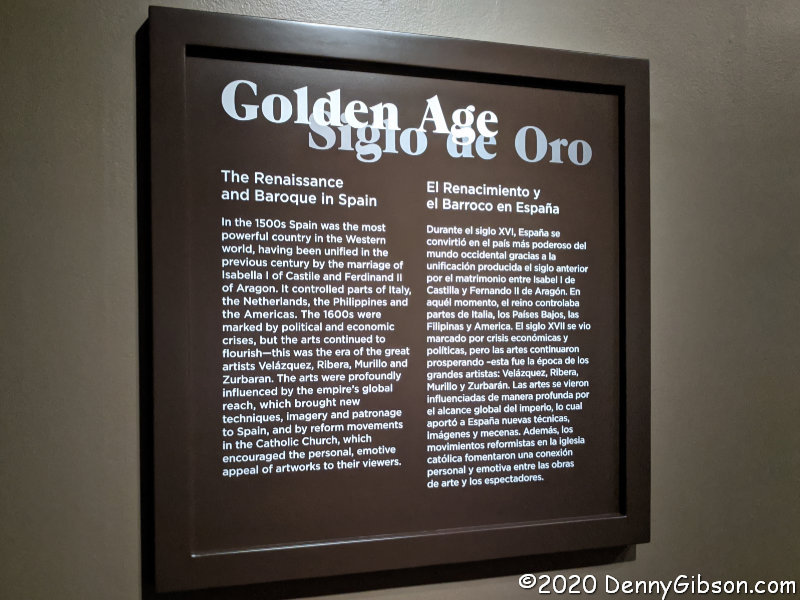
This book didn’t put US-20 on my to‑drive list, that happened long ago, but it did move it up quite a bit. At 3365 miles, Route 20 is currently the longest of the U.S. Numbered Highways so it’s quite naturally a road I’ve thought about driving. I have driven bits of it, of course, and crossed over it many times. It would be pretty hard to completely avoid a road that crosses the entire country as this one does. In Historic US Route 20: A Journey Across America’s Longest Highway, Bryan Farr documents an east to west drive over the entire length of the highway and the entire breadth of the nation with a couple hundred great color photos. There is something I’d like to see in just about every one of those photos.

A chapter on each of the twelve states crossed by US-20 follows an introduction and a brief history of the highway. Each chapter’s opening page contains a small map and some statistics such as length and highest and lowest elevation. A few pictures also appear on those opening pages but the best pictures form the chapter’s body. Many get a page all to themselves and few pages contain more than two. That means they are generally big enough to appreciate and the good print quality also helps.

Some images are of noted man made landmarks, such as the Wayside Inn in Sudbury, Massachusetts, and the Veterans Memorial Bridge in Cleveland, Ohio. Others capture the natural beauty of places like the Driftless Area near Elizabeth, Illinois, and Yellowstone Lake. Together they show off the wide range of experiences available along the highway as well as Farr’s photographic skills.

Although it’s certainly not overdone, the book is not without text. There is that one-page introduction and two-page history that open the book and virtually every picture gets some sort of description. Some get a one-line caption while others get a paragraph or two. Most descriptions that go beyond a sentence provide some history about the subject and all are interesting. There are essentially no travel directions. This is not a travel guide. It is a photographic trip journal and a very attractive one. Even without directions, it will certainly be an aid in planning my own trip. As I said, just about every one of those photos contains something I’d like to see and something likely included in any itinerary. Plus, just flipping through it randomly keeps my desire to drive “America’s Longest Highway” at least on simmer.

A Kindle version of the book is available through the Amazon link at the end of this article. New paperback copies are available directly from the publisher at Historic US Route 20.

Historic US Route 20, Bryan Farr, The Historic US Route 20 Association, Inc., February 16, 2015, 8.5 x 11 inches, 166 pages, ISBN 978-1628476880
Available through Amazon.

A Lesser Count of Counties

I was about to queue up a Trip Peek for today’s post when it occurred to me that a follow on to last week’s post on Hugh Donovan completing visits to all 3134 U.S. counties might be better. I had actually thought I might include something about my own county counting when I began writing about Hugh’s counting in An Awesome Travel Accomplishment but, in the end, I didn’t. The truth is that neither the counts nor the counting are all that similar. There are, you see, quite a few differences between a man on a mission and a guy just wandering into places.

For one, I am not an Extra Miler Club member. That’s not because I don’t think it is a good organization or because I don’t respect its goals. It’s because I do not see visiting every U.S. county as realistic for me personally. It might have been feasible if I’d started when I was 30 or 40 or, like Hugh’s grandson, 15, but not now. That doesn’t mean I don’t track the counties I visit. The map above is mine from Mob‑Rule.com (a.k.a., Why do you think they call them counties?) which anyone can use to track their travels free. There are 1731 counties marked on the map. That’s just over 55% of the total. Hugh’s count was a bit less than that when I first learned of his quest back in April, but that didn’t last long. My “live” map, which also contains numeric counts by state, is here

For another, I’ve never made a trip or plotted a route specifically to accumulate counties. On the other hand, if I see that an unvisited county is just a few miles away, I’ll quite happily make a jog or even drive straight there and back for the score. Again, that doesn’t mean a lack of respect for folks who plan their travels primarily or exclusively to reach different counties. After all, I’m a guy who will turn around to drive a missed bit of old alignment that looks exactly like the road I was already on.

If we weren’t all crazy, we would go insane.
    Changes in Latitudes, Changes in Attitudes,
    Jimmy Buffet, 1977

An Awesome Travel Accomplishment

There are 3142 counties in the United States of America and a surprising number of people have visited all of them. The Extra Miler Club is an organization for folks who have that as a goal. Prior to yesterday, its 100% Club had 61 members. Member number 62 is Hugh Donovan who completed the task by entering Clermont County, Ohio, at 1:50 PM, August 24, 2019.

Hugh’s accomplishment is different from and even more impressive than the others because of time. Those people took years or decades to visit every U.S. county or county-equivalent. Hugh’s stated goal, when he started counting on January first, was to do it within the year. He did it in 236 days, about 2/3 of a year, and that included marking time for several days so as not to get to the party too early.

I first heard of Operation 3142 sometime in April, about the time that Hugh reached the halfway point of his quest. Even then it was hardly a given that he would succeed. Ripping through multiple counties per day was one thing on the eastern mainland but quite another in other areas. In his favor was the fact that one of the big challenges, Hawaii, was already tallied. On the other hand, another big challenge, Alaska, remained and would be even tougher.

Impulsively I thought that Alaska might be the place for the big finish. Hugh and his team were much wiser. Getting the last county in some remote spot might be dramatic but it was also risky. If the end of the allotted year was approaching, reaching anywhere in the far north would be iffy. If December came with places like the Aleutians not yet visited, those visits just might have to wait until spring. There was another reason for not finishing in Alaska that I hadn’t considered at all. It would simply be more fun to celebrate victory where friends and family could join in. Maybe that’s why Hawaii, reachable and highly enjoyable in December, was knocked off early.

Even in summer, hitting all of Alaska had some hiccups and took more than two weeks but by mid-June it was done. Although the to-go count had been dropping rapidly, Hugh had resisted revising his target date. Things now seemed much more predictable and he announced that he now anticipated completion at the end of September. That would beat the original goal by three months and reality would be even better. There were still nearly 1000 counties to be reached but they were all grouped in the heart of the mainland, and for the first time I started thinking that the final county might be within some reasonable distance of my home.

But not only would this revised completion date be soundly beaten, the final county would be within an unbelievably reasonable distance of my home. The white area on his scoring map was steadily shrinking with its center moving to the east. On August 1 a revised — and quite precise –completion date was announced that trimmed more than a month from the end of September target. Hugh planned to enter his 3142nd county on August 24. That was barely three weeks away from the announcement date but astonishing me even more was the news that the final county would be one barely three miles away from my door. In addition to the county itself being ridiculously close, a planned celebration would be taking place nearby at a familiar brewery. Attending was an instant no-brainer.

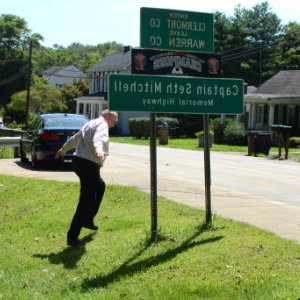
There was a small group gathered at the county line a little ahead of when Hugh planned to cross it. Fortunately, some in the crowd were more attentive than I and knew what to look for. My first glimpse of Hugh was after he had exited the car driven by his son and was beginning to walk the last 50 or so yards to the sign marking the country boundary. He stepped across to cheers and applause.

Several posed photos followed with many including family and friends who had assisted in planning and executing the numerous journeys. That’s the A team in the middle picture. Hugh is in the center with, left to right, his son, wife, daughter, and grandson. As you probably suspected, the third picture was not posed.

In time, things moved to the nearby Narrow Path Brewery where some fairly informal formalities took place. Extra Milers Club Vice President, Jonathan Riehl, was on hand to present Hugh with a plaque honoring his accomplishment. The club also awards certificates for hitting certain milestones like 500 or 1000 counties but Hugh blew through those so fast there was no time to mail them so Riehl just handed them over en masse. Then Hugh did a little talking but most of what he said was thanks. It was pretty clear that he considered the most impressive part of what he had accomplished to be the routing and other logistics management that others had contributed. He was proud of what he had done but seemed even more proud of what his son, daughter, wife, and grandson had done. Cool guy.

There may be a book coming out of this adventure. I certainly hope so. Until then, pieces of a most interesting story can be glimpsed by scrolling through the posts at Operation 3142. Nicely done Hugh. Congratulations. Thanks for wrapping things up in my neighborhood.

It Was Twenty Years Ago Today…

…that I got the first trip underway. This blog typically uses Wednesdays for reviews or nothing at all. Calling this post a review is a stretch. It does not evaluate a book or CD that you might consider buying or a movie or concert you might consider attending. It’s a look back at a road trip that not you, nor I, nor anyone else can ever recreate. Calling it a re-view (as in view again) allows me to publish it on a Wednesday without breaking any rules which means it appears on the twentieth anniversary of the first day of travel of the very first of my documented road trips.

4600 Miles to Bowling Green (a.k.a. Rt66in99) is how this website began. August 21, 1999, wasn’t the first date something had been posted to the site. Besides the trip’s cover page, some auxiliary pages had been created to provide a little background and context. To be entirely honest, the August 21st posting wasn’t even the first daily journal to appear. Circumstances kept the trip from starting on the 20th as scheduled but I called it Day 0 and still made a journal entry. In addition, there had been practice entries for Day -33 and Day-202. (The only way to reach these pages is to click “Prev” on Day 0.) But August 21, 1999, was the day I departed Cincinnati, drove to Chicago, and snapped a picture of the intersection of Adams and Michigan to appear in my first from-the-road journal entry.

A lot of things about the site have changed over the years but some things begun with that first trip have stuck. The concept of a page for each day with access to the next and previous day has been in place since the beginning as has a cover page with direct access to individual days. The idea of using the daily “Next’ and “Prev” button to (usually) represent the vehicle being used also goes back to that first trip. An animated GIF showing progress has been used on a few subsequent trips but it requires knowing the full route in advance and that’s often not the case. Besides, it’s a fair amount of work.

The organization of trip cover pages and of the site’s home page have changed over the years as features have come and gone and the number of completed trips has increased, but it’s still a clunky 1999 website. At my age and the site’s age, that isn’t likely to change. I’ve done some rework to accommodate things like small screen mobile devices and I’ve incorporated a few third-party tools to support a blog, mailing lists, and RSS feeds but the site is basically good ol’ HTML with the dated appearance and other characteristics that come with it.

Advancements in technology have brought improvements to the site but even more to the road trips documented here. A series of blog articles, My Gear, documents the various hardware used on the trips while another, My Apps, documents the software. The first three My Gear chapters describe the camera, computer, and GPS receiver used on the first trip. Of these, only the camera had a direct effect on the appearance of the website. That camera was a 350 kilopixel Agfa ePhoto 780c. It may be hard to believe there were once digital cameras with sub-megapixel resolution but easy to understand how a camera upgrade could really improve the website. The sluggish (by today’s standards) Toshiba Libretto and dial-up internet left no lasting marks on the website beyond limiting the amount of data uploadable during an overnight stop. The GPS provided some statistics I used on the site but otherwise had nothing to do with it. My Apps – Chapter 1 talks about the website and image editing software used on the first trip. Maybe better image software could have made those 1024×768 (extrapolated) images look better but I have serious doubts. FrontPage Express, the web editing software I initially used, did have lasting impact. The textured beige background that is used on almost all journal pages came from its built-in inventory. My Apps – Chapter 2 is about the software I used to produce printed route instructions which the GPS sort of helped me follow.

The pictures at right aren’t about advances in equipment but a comparison of equipment I had on that first trip. The picture on the left is one of the few unedited pictures I still have from the Agfa. I also carried a 35mm Nikon pocket camera which took the picture on the right. I have no idea what that proves but there it is.

The final cover page for that trip talks about it being temporary. As I said at the time, I expected it to go away because “I’ll need the space or retiring it will just seem right.” Web space became increasingly cheap and apparently retiring it never seemed right. Two decades later that first trip journal is still online and I’ve added 155 more. There is a clickable index of them all as well as a clickable collage. The collage, composed of one image from each of the trips, is a big favorite of mine. Visually skimming over it is a great reminder of what I’ve done with my gas money over the last twenty years. Pausing on any one of those images will always trigger a flood of memories which I can delve into deeper with just a click.

I’m spending this twentieth anniversary at home. I was on the road when the tenth anniversary rolled around. The 1999 trip consisted of following Historic Route 66 to Los Angeles to join a caravan to the Corvette Museum in Kentucky. The 2009 trip was quite similar with the westbound portion being the Lincoln Highway to San Francisco to again caravan to the museum. That was before this blog existed or I might have done a post similar to this one. Instead, I included a brief summary of the day ten years prior in the appropriate daily journals. I began those summaries with the first posting rather than the first day of travel so they begin on the latter trip’s sixth day, August 20, 2009. The summary of the final day of the first trip ended with these words: “It’s really hard for me to imagine a twentieth anniversary for this website but it’s no easier imagining an end. Watch this space.” I’m really happy that some of you are still watching.

Ludlow Garage 50th Reunion!

The Ludlow Garage is a sadly dim shadow in my personal reminisces. I blame that on being busy and broke. My first child was born about seven months before the Garage’s opening on September 19, 1969. Some months prior to that, my wife and I had moved from an apartment roughly half a mile from where the Ludlow Garage was about to appear to a house in a Cincinnati suburb some seven miles distant. Besides the new baby, I was working a full-time job and playing in a band, which meant there was little time. A mortgage and commuting to downtown — along with that new baby — meant there was little money. I visited the Garage a few times, but I missed biggies like the Allman Brothers and Pink Floyd. I almost saw Santana. A friend and I were in line when we convinced each other to go somewhere else. I may have seen Mother Earth since I distinctly recall seeing East Orange Express there, and their only appearance listed on the Ludlow Garage Archive is as a Mother Earth opener. Despite thin credentials, I attended the 25th reunion in 1994 and came back for the 50th. As Ludlow Garage owner Jim Tarbell delivered some opening remarks, Rob Fetters, the day’s opener, crept up behind him following Jim’s mention of his name. This might have been a great photo if I hadn’t been so close and chopped off Jim’s head. But it’s the thought — and the spirit — that counts. Right?

Jim managed to finish his remarks, and Rob got the show rolling. The January 1971 demise of the Ludlow Garage preceded the start of Rob’s impressive musical career, so he never got to play there. In the early 1980s, he fronted local legends The Raisins. The Psychodots, The Bears (featuring Adrian Belew), and lots of solo work have followed. Using recorded tracks lifted from albums combined with live guitar and vocals, he delivered a cool retrospective.

I don’t believe Sonny Moorman ever played at the Garage, either, but he has played just about everywhere else. A typical performance consists of lots of his own blues songs, but one of his side projects was an outstanding Allman Brothers tribute band, and he has been a super fan of Lonnie Mack since childhood. Grand Funk Railroad headlined that first Ludlow Garage with Lonnie Mack preceding them. I’ve often said that if a Lonnie Mack biopic is ever produced, it absolutely has to involve Sonny. He reinforced that today with a remarkable Lonnie Mack tribute set.

This guy definitely played the Ludlow Garage. Sandy Nassan opened the Garage’s second concert, which featured Spirit. I apologize for not catching the names of the folks providing harmonica and vocals. They were quite good and certainly added to the performance, but on the other hand, they might not have really been necessary for a guy who released the critically acclaimed Just Guitar within a year of that Ludlow Garage appearance.

Robin Lacy & DeZydeco recently celebrated their own 30th anniversary, but I missed it. In fact, it had been a while since I’d seen the band, and I’d almost forgotten how much fun they are. Robin and Joani Lacy live near the Ohio River town of New Richmond, where they often perform as a trio with DeZydeco guitarist Ricky Leighton. It’s a place I tend to end up in on semi-aimless drives now and then and I’ve enjoyed several summer afternoons listening to the three of them rotate song selections. As enjoyable as that is it just isn’t the same as a toe-tapping bead-tossing full-band outing. “If you ain’t having fun,” Robin’s been known to point out, “it’s your own damned fault.”

I’m pretty sure everybody did have fun, and that includes Mr. Tarbell. Here we see him catching a strand of thrown beads, struggling a bit to get them over his hat, then casually tossing off a few dance moves before continuing his walk to the opposite side of the stage.

The members of Haymarket Riot nearly exceeded the space available on the stage and the name apparently did exceed the space available on the behind stage screen. That screen, by the way, showed a recorded Ludlow Garage light show in addition to each performer’s name. The band was started in 1965 by the two guys in the second picture, G. Parker and Steve Helwig. They did play at the Ludlow Garage. Over the years, quite a few members have come and gone around Parker and Helwig, and one was in town to help them with a song today. Gary Griffin left Haymarket and Cincinnati in the late 1970s then spent the ’80s and ’90s recording and touring with the Beach Boys and Jan & Dean. He is currently touring with Brian Wilson but had some time off to help his former bandmates perform Good Vibrations.

The Warsaw Falcons arrived a little too late for the Ludlow Garage. Originally forming in 1981, the band has deformed, unformed, and reformed multiple times with the only constant being guitarist David Rhodes Brown. The current three-piece lineup came together in 2014 and has continued the legacy of solid live music with a tinge of rockabilly.

It’s possible that I saw Tracy Nelson at Ludlow Garage fronting Mother Earth. As mentioned earlier, that’s based on the fact that I recall seeing openers East Orange Express but I doubt that was the only time they played there. Today, she had wonderful backing from Cincinnati’s Bluebirds. Great voice and great performance.

As stated, Nelson’s backing band was the Bluebirds. There were a few members I didn’t recognize, but that wasn’t particularly unusual. The band has been around a long time, and I’ve lost count of the various lineups I’ve seen. The schedule called for the Bluebirds to perform their own set, including an Allman Brothers tribute, following Nelson’s set. I expected Nelson to just walk off and the band stay in place. Instead, a full onstage shuffle commenced and when it ended a more familiar lineup was on stage. Both groups were, of course, the legitimate Bluebirds. It’s kind of like whatever plane the President is on being Air Force 1. Whatever musicians accompany guitarist Marcos Sastre are the Bluebirds. And they’re always fantastic.

Although Jeffrey Seeman did not perform at the Ludlow Garage, his musical career is inextricably tied to the venue. Seeman was one of the neighborhood teenagers who helped create the place during the summer of 1969 and who worked there after it opened. Much about the experience made long-lasting impressions, but none like being the only person to witness the Allman Brothers rehearsal on the eve of their first Ludlow Garage appearance. The teenager was already playing guitar, but watching Duane Allman’s slide work inspired Seeman to master the technique, which he has done incredibly well. Today he performed on both acoustic and electric and had Skip Cason join on guitar and vocal for one song.

I’d been there when the music started at noon and sort of surprised myself by still being there when headliner Rick Derringer took the stage more than eight hours later. Rick played the Ludlow Garage in 1970 as a member of Johnny Winters’ band. I stayed for a few songs, including Hang on Sloopy, before starting the climb to my car. I saw Rick most recently back in his hometown when Sloopy was turning 50. The band had been a trio then, but now contained a keyboard player whose gear included a keytar. I was parked in the Art Museum lot, which isn’t all that far from the concert pavilion, but the museum completely blocked the music. Only when I pulled out and cleared the building could I hear what was being played. I exited Eden Park to the sound of Frankenstein as a keytarist presumably did his best Edgar Winter. Maybe I should have stayed for that.


Military Vehicle Centennial Convoy

Just months after the end of the First World War, a military convoy of about seventy vehicles spent sixty-two days crossing the United States. Setting out on July 7, 1919, it generally followed the young Lincoln Highway although there were several deviations. One of the most significant was that, rather than starting at the LH’s eastern terminus in New York, it began its westbound journey from a temporary marker near the White House in Washington, DC. A permanent Zero Milestone was erected there in 1923 with the intent that it would be the “POINT FOR THE MEASUREMENT OF DISTANCES FROM WASHINGTON ON HIGHWAYS OF THE UNITED STATES”. It hasn’t quite worked out that way.

For their observation of the 1919 convoy’s centennial, the Military Vehicle Preservation Association (MVPA) had originally planned on departing from that Zero Milestone but later decided to launch directly from their annual convention in York, PA. That happened on Monday, the 12th. On Wednesday, I caught up with them in East Palestine, Ohio, about a mile after they entered the state. East Palestine was a planned overnight stop and I had expected the convoy to already be in town and parked by the time I got there. It was delayed by an accident, however, and we ended up arriving almost simultaneously. Had I realized this and pulled over at the earliest opportunity, I could have photographed essentially the entire convoy. A few vehicles had already passed by the time I got stopped to grab the opening photo and photos of most of the vehicles following which included some pretty big gear.

A nearby park would be the convoy’s home for the night and I headed there to look over the vehicles. The trailered staff car is a 1918 Dodge. The Jeep is a 1943 model built by Ford. I imagine it’s a lot like the one my Dad drove around Belgium, France, and Germany in 1944-45. There’s a front view here and an interior shot here.

Before leaving, I asked one of the participants when they would be leaving in the morning. I was told between 6:30 and 7:00 but really thought that a bit ambitious. When I returned about 6:40 AM, I kind of expected to be killing time until everyone was awake and ready. Not so at all. The last vehicles were pulling into position when I arrived and the first Jeep rolled by at 6:47. The field was empty at 6:52. This is a military convoy.

That was the end of my planned contact with the convoy. I found an independent restaurant in East Palestine for breakfast (Heck’s, recommended) with thoughts of following it with a leisurely drive home. The path that the convoy was following is identified as an “Auxiliary route” on the online LHA map. Apparently, it was part of the 1913 Proclamation Route and the 1919 convoy likely followed it to dinner at Harvey Firestone’s place. I had never driven it before so decided it would be the first leg of that leisurely drive home. By the time I finished eating, I’d learned that the convoy was stopping along the route for breakfast at a place called Firestone Farms.

Their breakfast stop was considerably longer than mine which allowed me to catchup. Firestone Farms is a housing and shopping development on what was once Harvey Firestone’s farm. The original 1828 farmhouse was moved to Greenfield Village in 1983. This facade was built sometime later as part of the commercial development. During today’s stop, the screen on the right showed scenes from a movie of the 1919 convoy while the one on the left showed a movie about wartime manufacturing at Firestone. The tent beyond the clock tower contained displays of local history with an emphasis on Firestone.

The trailered Jeep was one of the vehicles involved in yesterday’s accident. Both drivers were taken to the hospital but are recovering. One of the participants told me that parts are on the way to repair one of the vehicles and the driver, though sore, expects to finish the trip in it. I’m thinking that this is the vehicle in question but do not know that for certain. The second picture shows how some convoy members proudly display Lincoln Highway signage.

When the convoy started getting ready to pull out, I headed to downtown Columbiana for one last encounter. I counted and snapped pictures of thirty-eight vehicles, including the three on trailers, as they passed through the roundabout. Here‘s a rear view of that Packard staff car I captured back at Firestone Farms.

I followed the auxiliary route to Canton and headed home from there. The convoy should be about ready to exit Ohio when this is published. The overnight for today (August 18) is South Bend, IN. A schedule has been posted to their Facebook page but I found it a little tricky to locate so have copied it to share here. Note that this is only a copy and more current information can be obtained through the Facebook page.

The Lincoln Highway Association has a separate centennial tour following the 1919 convoy route. That tour, described here, will be departing from Washington, DC, on August 31.

My Wheels — Chapter 38
2003 Mazda Miata

Driving a fifty-year-old convertible is great fun; Not so, at least for me, maintaining one. As reported in its own My Wheels chapter, the 1963 Valiant was sold not long after it completed its mission of carrying me over the full length of the Lincoln Highway. I’d already put some thought into what its replacement would be and did some looking as I waited for the Valiant to sell. I wanted something open and fun to drive like my most recent “play” cars but without the repair frequency of the Valiant or the repair expense of the Corvettes. A Mazda Miata seemed to fit my desires quite nicely.

By pure — and extremely lucky — coincidence, a friend and fellow Lincoln Highway fan was downsizing the family fleet and looking to sell his own “play” car. I met Mike and Nancy Hocker at the next Ohio Lincoln Highway gathering, test drove their 2003 Miata, and, after a couple of phone calls and a little negotiation, bought the car a few weeks later. Two owners had preceded the Hockers and apparently all three had used the car for short sunny summer day outings. At eleven years of age, its odometer registered just 37.500 miles; Barely 3,400 a year, 12,500 per owner. I would change that.

I bought the car in early May. The photo at the top of this article was taken on May 21 in the middle of its first trip. It was a three-day outing along the Wonderland Way across Indiana and into Illinois. The picture at left is from its second, somewhat more ambitious trip, a month later. The destination was a Route 66 festival in Kingman, AZ, which would have been a reasonably long drive by itself but I chose to enhance it a bit. I entered Kingman from the west after driving the full length of the Old Spanish Trail from Saint Augustine, FL, to San Diego, CA. The picture was taken near Milton, FL. That trip totaled nearly 7,000 miles which put the car’s miles-since-purchase at about 10,000. I was obviously screwing up its yearly average and the mile-per-owner average didn’t look very safe either. 

To date, the Miata has taken me on nine documented road trips. I still own it and the count will almost certainly increase. Both photos at right are from a 2015 trip to Maine. The first is outside my motel room in Littleton, NH. The second is outside my motel room in Ellsworth, ME. When I bought the car, it was wearing 18-inch wheels with 35 series tires. When it came time to replace the tires, I did the wheels too so they are now 16-inch with 45 series tires.

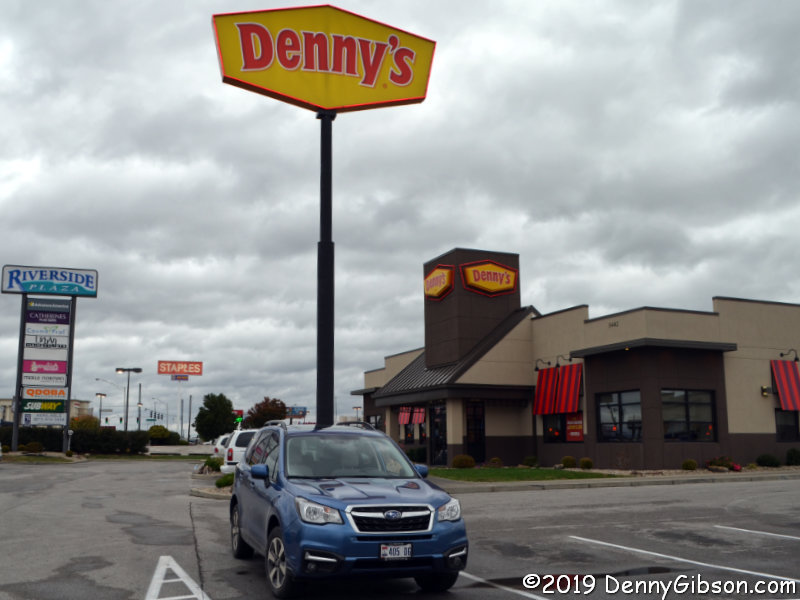
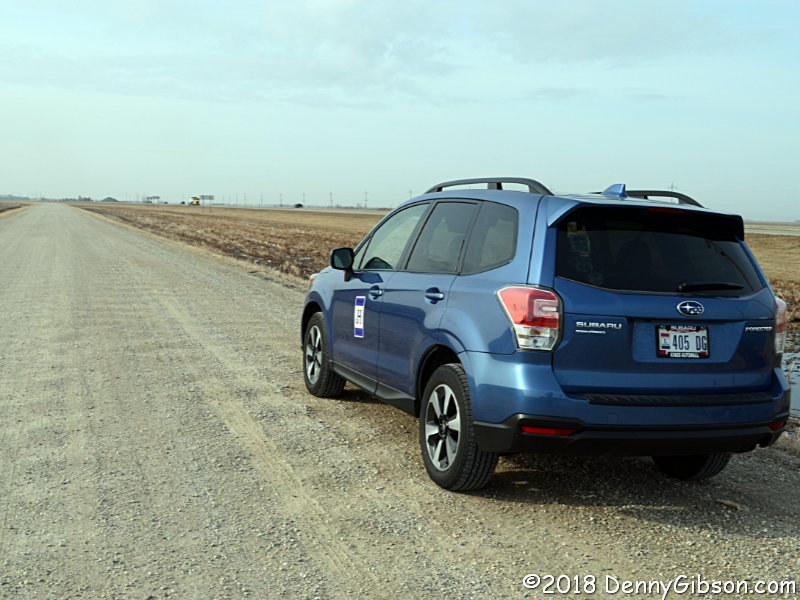
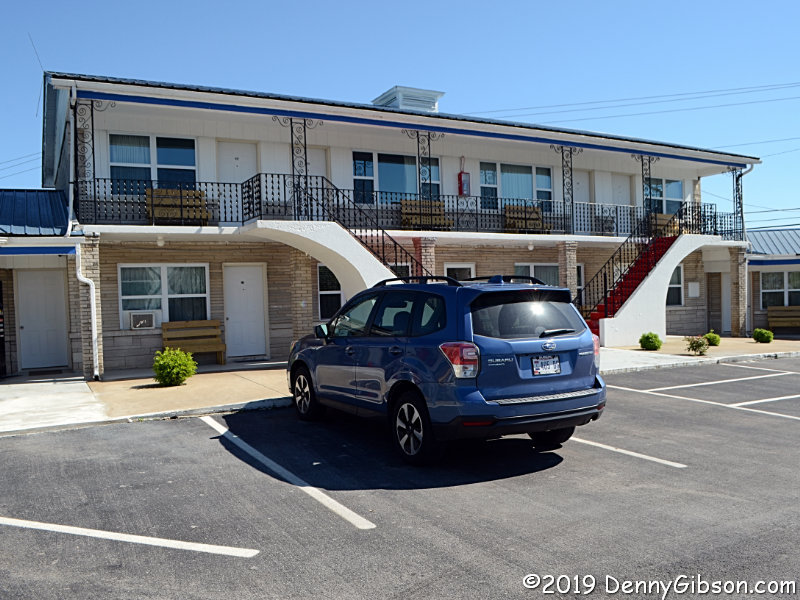
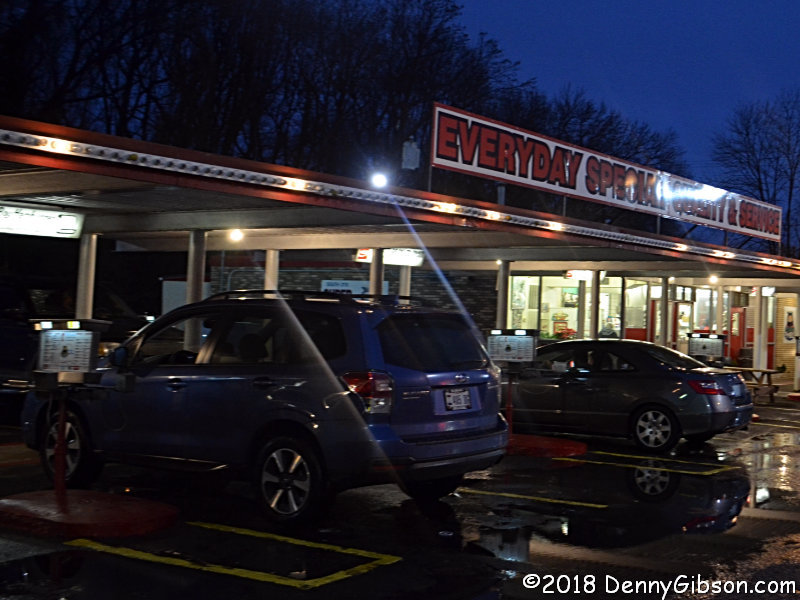
In the previous My Wheels chapter, I mentioned that I got estimates on repairs to its subject car from a body shop I had experience with. That experience was with this car. I had actually intended to take the Miata on the trip where the Forester got roughed up but it was still in the shop from its own encounter. I was about half a mile from home waiting on a light in the left turn lane. I was the third or fourth car in the line and the non-turn lane to the right was empty. The driver of the Jeep Grand Cherokee immediately in front of me decided that going straight was a better idea than turning left and moved to change lanes. I hit the horn as soon as I saw the backup lights come on so the impact was a slow one but a tow hook on the Jeep still poked a fair-sized hole in the Miata. The Jeep owner accepted responsibility without question and the shop did a nice job on repairs, but that little incident is why it was the Subaru that I took to get slapped around in Virginia.    

I’ve now owned the car for five years or nearly a third of its life. Its mileage has more than doubled to just over 80,000. Problems have been rare and costs have been reasonable. It handles like a go-kart and the 5-speed manual seems just right. The 142 HP is enough. I liken it to an Austin Healey that doesn’t leak oil and actually starts when it’s raining. It is a near perfect play car for an old man who knows that it’s a lot more fun to drive a slow car fast than a fast car slow.

My Previous Wheels: Chapter 37 — 2011 Subaru Forester
My Next Wheels: Chapter 39 — 2018 Subaru Forester

Butter and Beer, Buckeye Style

I’ve trimmed the time between visits to the Ohio State Fair to four years. That’s much less than the multiple decades that separated my 2015 visit from the one that preceded it. A conversation with a friend who goes every year planted the seed then reading about one particular exhibit got me to seriously thinking about it. Some altered plans and great looking weather turned those thoughts into action.

As I did four years ago, I took advantage of free parking for members at the Ohio History Connection and entered the fair through the nearby gate 3. That brought me right to the north end of the midway. The Sky Glider travels directly over the Food Highway where fried anything, including bubble gum, can be found.

This is the exhibit involved in my decision to head to this year’s fair. In recognition of the fiftieth anniversary of the first moon landing, a butter sculpture of the Apollo 11 crew joins the cow and calf that are fair regulars. The calf is just out of frame in that first picture but both buttery bovines are there. Ohio’s contribution to the crew, Neil Armstrong, makes a second appearance along with what I suspect is a rather slippery ladder.

The moon landing also gets some attention in the chalk drawings outside the Fine Arts Center as does another event celebrating a fifty year anniversary. The Woodstock Music Festival took place less than a month after Apollo 11 flight. The third photograph presents its subject with better perspective because 1) it was drawn with that in mind and 2) I had instructions.  

I caught the All-Ohio State Fair Band in a performance in an open space called Central Park. While the band delivered some high energy tunes, the fellow in the second picture kept up some very impressive twirling, tossing, catching, and, as you can see, acrobatics.

I don’t believe I’ve ever seen any actual turkey judging but I watched just a bit today. I really had no idea what was going on but I have been around turkeys before and the folks attempting to control them certainly had my sympathy. I also watched a little calf judging and passed by three adult dairy cows. The cows were displayed by the Ohio Veterinary Medical Association and each had a sign with their name (this one is Louise) and the phrase “I’m pregnant and due any day now.”

The Ohio Beer and Wine Pavilion is new this year. I was about to leave after my planned one beer stop when it was announced that North High Brewing’s brewmaster, Jason McKibben, was in the building and about to give a presentation. I decided to stick around and, after he started talking about the brewery’s collaboration with the Ohio Farm Bureau, have one more beer. Here‘s something you don’t see on a beer can every day.

I emptied my can of Cover Crop and was once again ready to leave when I was once again enticed to stay. This time it was the start of the Human Cannonball show across the way that pulled me in. I failed to get any photos of the Cannonball’s daughter doing some impressive aerial acrobatics but I did catch his buddy on the tightwire. The announcement leading to the cannon firing included the claim that only about 700 human cannonballs have ever existed since the occupation was created by 14-year-old Zazel in 1877. I haven’t found any independent support of that but it does seem reasonable and it made me wonder if I had ever actually seen one before. I’ve seen a few circuses and a human cannonball seems like something I should have seen but I don’t have any specific memories. In any case, I’ve never seen one this close and I’ve never taken a picture of one exiting the cannon barrel.

With the Human Cannonball’s successful landing, I was again ready to depart and this time I made it. The midway was significantly more active as I passed through it on the way out than it had been on my arrival but nothing tempted me. I’ve now pretty much outgrown the desire to be tossed around or turned upside down, and some of those rides looked quite capable of separating me from my recently consumed Farm Bureau approved beverage. 

200 Breweries

I like beer. I like beer well enough to be a Supreme Court justice, although my other qualifications are rather weak. I’ve had favorites from time to time. I was pretty much a Stroh’s guy in the 1960s and ’70s, then became a big fan of Christian Moerlein Select when Hudepohl introduced it in 1981. But I’ll confess to never being entirely faithful to a single brand. My roving taste buds would sometimes be led into temptation by an exotic label or a shapely bottle. Today, encouraged and aided by the craft beer explosion, I’m downright promiscuous. Several years ago, I began using Untappd, a phone app that allows me to track the various beers I’ve tried, and I’ve accumulated a decent score. I have, since January of 2014, consumed a measurable amount of 1202 different beers.

Yes, that’s decent, but it pales next to some others. Just within my small circle of Untappd cohorts, Brian is over 1600, Sara is pushing 1900 (and now only logs on special occasions), and Nick is well past 3000. I’ll never catch them, of course, and I’m OK with that. If nothing else, when someone accuses me of being too fickle in my drinking, I can point to Nick or Sara or Brian and say, “But not like them!”

Besides, as the title of this post indicates, I have other things to brag about. I enjoy logging different venues about as much as I like logging beers, and that goes double for breweries. In the beginning, I didn’t watch closely. I was almost halfway to the current count before it registered with me that logging breweries was something I was doing more than most. I completely missed the 100 brewery milestone but did note number 115 with a weak joke about Bob Dylan’s 115th Dream. I’ve been much more attentive as I approached completion of the second hundred, and my thoughts have been on Zappa rather than Dylan. It’s not only giving me an opportunity to brag but an opportunity to recount some of the breweries I’ve seen.

For starters, here are numbers 1 and 200. My first check-in of Lock 27 Brewing was on January 31, 2014. It was not, of course, the first brewery I ever visited. I have vague memories of being inside the recently departed Hudepohl brewery several decades ago, and I toured the oldest brewery in the US, Yuengling, back in 2005. A blog post from just about a year before I joined Untappd (Something’s Brewing in Cincy) describes visits to five breweries and mentions a couple more. And there were others. Lock 27 was simply the first brewery I visited after joining Untappd. My 200th brewery was the part-circus part-brewery Bircus. It’s in a converted movie theater just across the river in Kentucky and is more upfront about their tumbling and juggling than most breweries.

Dayton, Ohio, where Lock 27 Brewing is located, is also home to some truly unique producers of beer. Carillon Brewing Company (#24 12/8/14) is part of Carillon Historical Park and brews beer the old-fashioned way. I mean the 160-year-old-fashioned way. With the exception of piped-in water, the operation duplicates a brewery of the 1850s. I did a full blog post, History by the Pint, on my first visit. Pinups & Pints (#– 4/8/15) is a tiny 15-gallon operation that offers one choice of beer at a time. Unfortunately, Untappd had not yet identified it as a brewery when I was there, so it is not one of my 200 (It would have been #30). Even so, how could I not include “The World’s Only Strip Club – Brew Pub” in this post? And Untappd does now recognize it as a brewery. The third picture is of Ohio’s first and the nation’s second co-op brewpub shortly before it opened. Fifth Street Brewpub (#3 2/12/14) is the only brewery I currently “own” a tiny piece of (it’s a co-op!) and the one with the most Untappd check-ins. Here‘s a picture from the most recent of those check-ins.

I used the word ‘currently’ in the preceding paragraph because I once owned a few shares of the ahead-of-its-time Oldenberg Brewery in Fort Mitchell, Kentucky. Somewhere I have a beautiful and totally worthless stock certificate for the brewery that closed in 2001.

Two other visited breweries deserve shout-outs because of their locations. Silver Gulch Brewing (#79 6/29/16) and Kona Brewing (#123 4/7/17) are, respectively, the USA’s northernmost and southernmost breweries. I claim a bonus point for reaching these outposts within a year of each other. I have yet to reach the westernmost (Kauai Island) or easternmost (Lubec) breweries in the US.

Maybe I’ll make it to three or four hundred or beyond. I’ve started the second 200 like I started the first, with Lock 27. In 2017, a second location, which Untappd counts as a separate brewery, was opened just outside the Dayton Dragons ball field. The Dragons are an affiliate of the Cincinnati Reds, who are celebrating 150 years of professional baseball this year. A few months ago, Cincinnati.com published an article listing fifty-one breweries in the area, including fifteen I’ve yet to visit. There is also an unvisited-by-me brewery in the ten listed by the Dayton CVB. The Ohio Craft Brewers Association reports that there are now more than 300 breweries operating in the state, which means I could reach the next multiple of a hundred without crossing a state line — but I doubt I will.

Memories of the Eagle

My best guess of what I was doing exactly fifty years before the publication of this post is sleeping. I wouldn’t be sleeping much longer because it was Monday morning and I would have to wake up and go to work. And I would not have been asleep very long either. I would have stayed up way too long watching TV after a long drive home. Just having the possibility of watching TV late at night was unusual even at the very end of the 1960s. With the exception of Bob Shreve’s all-night movies on Saturday, all five Cincinnati channels went off the air around midnight. But the wee hours of July 21, 1969, were different. It was the day following the day when the Eagle had landed. There was news to be shared.

We — my wife, our son, and I — were visiting friends in Saint Louis over that weekend. Our plans were to be home at a decent hour but we were paying more attention to someone else’s travel plans than our own. While we were on our way to Saint Louis, Michael Collins, Buzz Aldrin, and Neil Armstrong were on their way to the moon. As we prepared to drive home, Buzz and Neil prepared to head for the Lunar surface. At 13:44 EDT on that Sunday afternoon, the pair separated from Michael and the command module Columbia and began their descent. At 16:17 EDT, Armstrong announced that “The Eagle has landed.”

The timestamps on my own recollections aren’t nearly as precise or reliable as NASA’s. Part of me thinks that we did not leave Saint Louis until after the Lunar Module was on the surface. Information currently available online says that a four hour rest period was planned between landing and exiting. If that was the information we had then and if we really did not depart until the Eagle landed, then I must have thought I could drive to Cincinnati in under four hours or maybe I was terribly confused by time zones. Or maybe we were counting on the astronauts sleeping for the full four hours then spending considerable time preparing to leave the lander. Whatever the reasons and reasoning, I know for certain that as we headed toward home, we believed we had a good shot at making it in time to watch man’s first step onto the moon.

There was no radio in the car. Not even AM. The vehicle’s entertainment system consisted entirely of an under-dash 8-track tape deck. That was normally not a problem since no one in their right mind would want to listen to news or the top 40 when all seven minutes of Light My Fire was available in stereo with the click of a cartridge. But this drive was not normal and we really did want to listen to news. As I recall, the Bairds, who we were visiting in Saint Louis, loaned us a portable transistor radio which we propped atop the dash and fiddled with almost constantly as signal strength ebbed and flowed.

The details were forgotten long ago, but I remember that somewhere along the way we heard that the rest period was going to be shortened and the astronauts would be stepping from the capsule earlier than once thought. Whether or not we ever actually had a legitimate chance of reaching home before that happened seems doubtful to me now. But, regardless of how likely or unlikely that had been, it now became clear that it was pretty much impossible. If we continued our drive, human beings were going to be walking on the moon while our only connection was a tiny radio with temperamental reception.

We were still somewhere west of Indianapolis when that realization struck. Like so many other details of that day, I cannot recall our thought processes as we left the expressway in search of a television. We did this near the airport and I know that at least part of the reason was that we knew there were motels in the area. There surely was no money for rented lodging in our family budget so it seems unlikely that we planned on spending the night. On the other hand, this was a truly major event so it’s possible that we were at least considering it. Checking prices may have even been on my mind when I stepped into the hotel lobby. If so, I’m sure it vanished when I saw the TV playing in the furnished lobby. I left and quickly returned with the family.

I think of it as a Holiday Inn but, in reality, it could have been any of the slightly upscale (to a 22-year-old father) motels of the time. Whatever the brand, it was upscale enough that flight crews from multiple airlines regularly overnighted there. My wife and I found seats on a sofa with 5-month-old Crispian parked in front of the TV in a little plastic carrier commonly referred to as a “pumpkin seat”. The three of us became lobby fixtures while others watched the TV for a bit on the way to their rooms.

Time moved slowly as we waited for the astronauts to step outside the capsule. Multiple flight crews arrived while we waited and each followed the same procedure. One member went to the desk to check in the entire crew while the others stood behind the sofa staring over our heads at the glowing screen. When the paperwork was completed, the unlucky person who had somehow been chosen to perform it, distributed keys and everyone rushed off to their individual accommodations and personal televisions.

At 22:56 EDT, Neil Armstrong stepped onto the Lunar surface. The picture at the top of this article shows his foot hanging from the Lunar Module’s ladder just before that happened. After Buzz joined him, Neil placed the camera on a tripod to provide a more panoramic view. The black and white images were dim and blurry and sometimes flickered away. And they were beautiful.

I halfway think we stayed in that hotel lobby during all of the approximately two and a half hours of Extravehicular Activity but I’m not at all certain. I am certain that Cris saw that first step because I checked to make sure his eyes were open. Of course, any memories he has of the event are almost certainly from repeatedly being told about it rather than from what he actually saw. My great grandfather had been dead just over eight years at the time of the moon landing but he had lived to see three humans (Gargarin, Shepard, Grissom) in space. He was born in 1875 and was almost exactly the same age as the kid in the pumpkin seat when Custer’s troops were annihilated at Little Big Horn. As my son watched dim images of men nearly 240,000 miles away and I watched him, I wondered what advances he would see in his lifetime. Fifty years in, the list is impressive and growing.


A ten-day 50th anniversary celebration in Wapakoneta, Ohio, Neil Armstrong’s hometown, wraps up today. The final event is a 7:00 Wink at the Moon concert featuring the Lima Area Concert Band. Other concerts and events have filled the ten days in downtown Wapakoneta and at the Armstrong Air & Space Museum at the edge of town. I visited Tuesday, the anniversary of the rocket launch that started Neil and his buddies on their way to the moon.

Two new statues of Armstrong had been unveiled at the museum on Sunday. It’s a bit disappointing that the white clouds and low light make the moon-like dome of the museum so hard to see. I photographed the statues before the crowd started to arrive but noted later that the statue of the young dreamer was — and I’m sure will be — a very popular place for families to pose their younger members for photos. A third statue, of Armstrong in his 1969 welcome home parade, was to be unveiled downtown on Thursday.

As 9:32 approached, attention was focused on a 22-inch replica of the Saturn 5 rocket that had lifted off in Florida at that time exactly fifty tears earlier. A recording of that half-century-old countdown was played to help coordinate the launch of the model. The model was a solid fuel-powered Estes much like the ones I helped build and launch even more than fifty years ago. When the count reached zero, I was quickly reminded that the acceleration characteristics of an Estes rocket are much closer to those of a bullet than to those of a 6.5 million pound 363 foot Saturn 5.

Following the countdown and launch, the museum was opened — and filled. I waited outside for the initial rush to pass although the place was still pretty busy when I did go in. The first picture is a reminder that Armstrong’s career did not begin with the moon landing. It’s the suit he wore on Gemini 8. His partner on that flight was David Scott who made it to the moon himself on Apollo 15. The second picture is of Armstrong’s backup suit for Apollo 11. On the day I took this photo, July 16, the Smithsonian returned the suit worn on Apollo 11 to display after being out of sight for some time being repaired.

Just beyond where this piece of the moon is displayed, is a movie that runs every half hour. Many other artifacts and information panels are in that room where I spent fifteen minutes or so waiting for the next showing. It was there that I was struck by the fact that I was one of the few people in that museum who actually remembered the Apollo expeditions. Many were adolescents born decades after the moon landings, but it was clear from overheard comments and answers to youthful questions that most of the parents and even grandparents weren’t around in 1969 or were too young to have solid memories. I’ve since learned that only four of the twelve men who walked on the moon between 1969 and 1972 are currently living. Yeah, I guess that really was a ways back.


On the anniversary of the actual landing, I watched a movie. Apollo 11: First Steps Edition is a version of Apollo 11 created for OMNIMAX style theaters. Yesterday’s showings are the only ones planned for the theater at the Cincinnati Museum Center but I believe this is the same movie being shown elsewhere including the Air Force Museum in Dayton. Made entirely of archival footage, it gave everyone in the sold-out theater a glimpse inside the historic mission and refreshed memories for a few of us. Sometimes the images are so big or there are so many of them that it’s hard to take it all in. It was that way the first time, too.


That concert that will be happening in Wapakoneta tonight gets its name from a statement that Neil Armstrong’s family issued at his death in 2012. “… the next time you walk outside on a clear night and see the moon smiling down at you, think of Neil Armstrong and give him a wink.” I did that last night shortly after the moon cleared the horizon. It was about the time when, fifty years earlier, Neil and Buzz’s time outside the capsule was a little more than half over. I thought of Neil and winked then winked two more times and thought of Buzz and Michael. Nicely done, fellows. Nicely done.