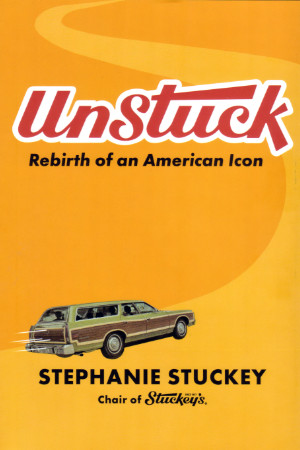
 I am more familiar with Stuckey’s signs than their products. As a kid, I probably didn’t even know the company existed since my family did not travel much. They were still going strong when I started doing some traveling on my own and I believe I bought gas at their stores a few times along with a pecan log roll or two but there was very little money in my travel budget for candy and none at all for rubber snakes. By the time my own fortunes had improved to the point that snacks were regularly permitted on road trips, Stuckey’s fortunes were headed in the other direction. The main reason that I am familiar with Stuckey’s signs is that I drove by a bunch of them. Many, maybe most, were for stores that were closed.
I first became aware of Stuckey’s rebirth when friends in Indiana became resellers of the company’s products. I made a point of stocking up on pecan goodness when a couple of road trips had me passing nearby. One of those trips was to a conference where Stephanie Stuckey was speaking and where I met her briefly. I have been looking forward to this book’s publication since then and thought I had a good idea of the story it would tell. It turns out that I had the basic outline down reasonably well but I was missing a ton of details and there were some genuine surprises. There was even a mystery of sorts.
The first part of the story is not particularly unique. An ambitious and creative man builds a very successful business through hard work and the help of friends and family. At the height of the company’s success, he sells it to collect his well-deserved rewards. Plopped into the world of faceless corporations, the company survives but becomes faceless itself. It is a fairly common tale that usually continues with more decline and eventual disappearance. That’s where this story becomes different. It’s where it becomes worth reading. UnStuck is a well-written telling of the uncommon story of a third-generation’s retrieval of the family business.
William S. Stuckey, Stephanie’s grandfather, founded the company in 1937 and sold it (actually merged with Pet Milk Co.) in 1964. It remained a significant presence on the American roadside into the 1970s but corporate shuffling led to the brand’s serious decline before the decade was over. William S. Stuckey, Jr., Stephanie’s father, stopped the downward slide when he repurchased the company in 1984. Stephanie took over in 2019. Those are the bullet points on a company timeline with lots of space in between. UnStuck fills in much of that space with an understandable focus on the post-2019 years.
 Stephanie’s father had great success in politics and served five terms in the U.S. Congress. She had her own success in politics with fourteen years in the Georgia state legislature. When Stephanie’s dad brought the company back to the family, he said it was based 80% on emotion and 20% on finances. There is little need to break Stephanie’s reasons for buying the company down by percentage. It was almost certainly 100% emotion. She had wonderful memories of her grandfather and road trips that included stops at stores bearing the family name. I have little doubt that a sizable percentage of the emotion behind the purchase was pure nostalgia.
Stephanie’s grandfather was known within the family as Bigdaddy. Six boxes of Bigdaddy’s papers play a very big role in Unstuck‘s story. How the new CEO studied spreadsheets and packed aging inventory into Mystery Boxes to return the company to profitability is interesting but it was what she learned from those papers that would let her move beyond that. They gave her some insight into how Bigdaddy viewed Stuckey’s, the company, and how he attacked problems. She cites his “two lessons in resilience — surviving World War II and the bypassing of his stores.”
 I and many other fans of old roads are conflicted about the interstate highways. We appreciate their ability to make travel faster and safer but regret the damage done to small businesses in the towns they bypassed. Stuckey’s was not exactly a small business at the time the interstates appeared but it did depend on traffic through those towns. Bigdaddy used the upheaval as an opportunity to redesign and relocate his stores and establish a partnership with Texaco that made those stores “a one-stop shop”. The papers in those boxes did not provide specific answers to any of the company’s problems but they did reveal and encourage a truly open-minded way of looking at them.
 That open-mindedness may or may not have figured into a board meeting described in UnStuck where “brand identity” was discussed. Thinking that Stuckey’s is “all about pecan snacks and candies” might seem natural but some serious reflection said otherwise. Stephanie had been visiting many of the surviving Stuckey’s stores and licensees and sharing some of the details on social media as a form of free advertising. That generated some responses almost none of which were about snacks or candies. 99% of the stories people shared with her were about road trips that just happened to involve Stuckey’s in some way. Most of Stephanie’s own childhood memories of Stuckey’s came from road trips. People may know that Stuckey’s sells pecans but they identify the company with road trips! Despite my limited experience, I do too.
I mentioned a mystery of sorts. Maybe not everyone reads dedications but I usually do. At the very front of UnStuck, I read that it is dedicated to John King. I had no idea who John King was and eventually learned that when she started writing this book Stephanie Stuckey didn’t either. Among other things, John King appears with Bigdaddy in a photo featured in the Stuckey’s company’s 25th-anniversary newsletter. John King is Black. After considerable effort, Stephanie learned that her grandfather and John spent a lot of time together during the company’s early days but not much else. In particular, she found no evidence that he was ever rewarded for what appears to have been significant contributions. That was not an unusual situation in the South in the early twentieth century which is also something Stephanie addresses in the dedication. On the other hand, there are several references in the book to the fact that Stuckey’s was never segregated which was sometimes possible only because the stores were outside the official limits of sundown towns. It is something that many people remember about the chain to this day.
The prologue imagines William Sylvester Stuckey thinking to himself after a pecan stand customer calls him crazy, “But that’s what it’s going to take to make it.” Stephanie finds herself thinking the exact same thing when she considers that people might think her crazy for buying what she had recently referred to as a “dumpster fire of a business”. The book does talk about pecans somewhat. It explains that the name comes from pacane, an Algonquian word meaning “nut that’s hard to crack”. Guess it runs in the family.
UnStuck: Rebirth of an American Icon, Stephanie Stuckey, Matt Holt (April 2, 2024), 6.25 x 9.31 inches, 240 pages, ISBN 978-1637744789
Available through Amazon.

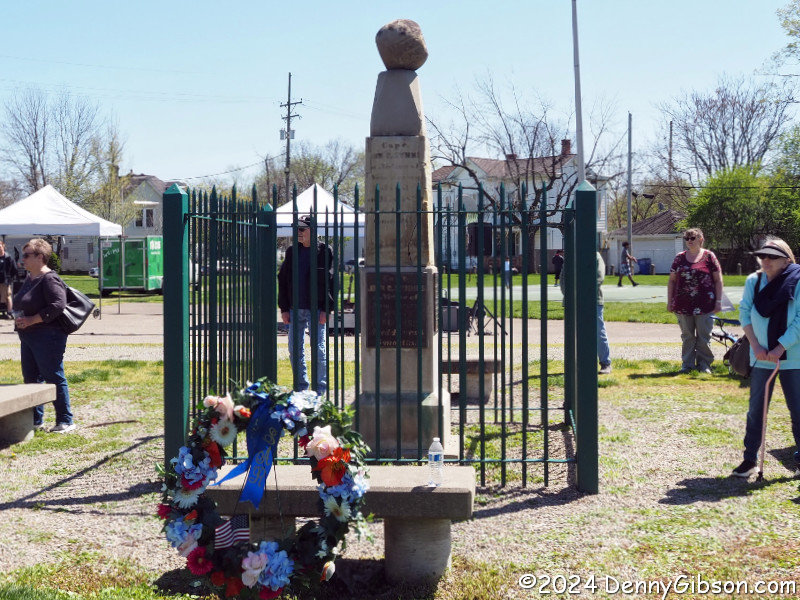
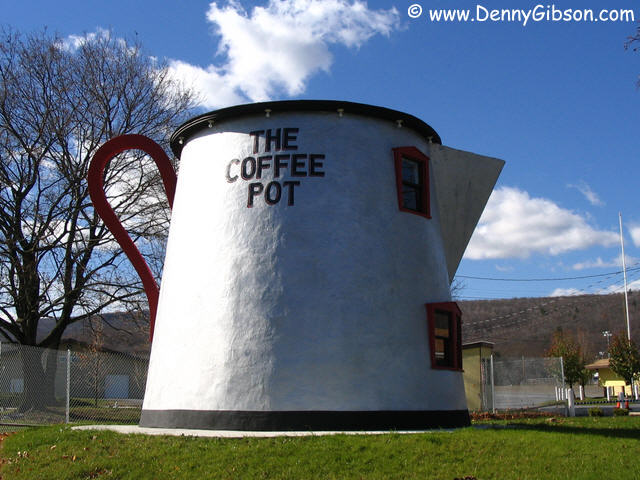 This picture is from my 2004 On the Lincoln Briefly trip. Basically a drive along the Lincoln Highway Heritage Corridor in Pennsylvania, it was my first documented trip on any portion of the Lincoln. I was still employed at the time and this was one of those trips where I tacked vacation days onto a business trip so most of the cost of transportation was covered by the company. The picture is of the coffee pot in Bedford, PA, and I also got my first look at the teapot in Chester, WV, on this trip. In the intervening twenty years, the two pots and several other Lincoln Highway icons have become fairly familiar but it was all brand new to me then. I went a little bit off course to visit the Gettysburg Battlefield and a little farther off course to visit the Flight 93 Memorial at Shanksville. There was not yet anything permanent at the crash site. Just a lot of flags and a few yards of chainlink fence stuffed with mementos. None of my subsequent visits with the engraved stone walls and informative displays have been as moving as that first time with those simple gifts from a mourning public.




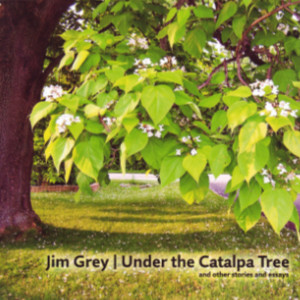 Like pictures? It’s got ’em. Like variety? Got that too. There are enough pictures to fill a deck of cards or a weekly calendar, which is not accidental. The premise for the book was writing an article to accompany a photograph every week for a year. That could very well be a student assignment in an overly long writing course and in a sense it is. Jim Grey assigned himself the exercise to, as he says, “strengthen this muscle”. He is referring to the writing muscle which can surely benefit from practice just as much as a musician’s skill or an athlete’s strength.
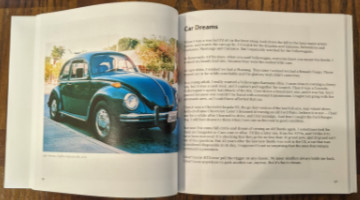 Even though photographs are at the heart of Under the Catalpa Tree, the book’s subtitle mentions only “stories and essays”. I’m guessing that is at least partially because only the stories and essays needed to be newly created for the book. The photos already existed from Grey’s many years of photographing the world around him. He doesn’t explain how the photos were selected. I am sure it was not completely random but there is tremendous variety. They range in quality from slightly fuzzy black-and-white snapshots taken years ago with a yardsale camera to crisp color images taken with high-end gear and well-developed skills. Some photos are digital but film is the source of many of the images since Grey collects — and heavily uses — film cameras. Among the subjects are family, friends, cars, houses, nature, and an abbey in Ireland.
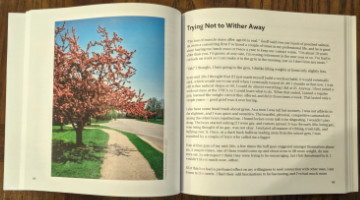 A detail I appreciate is laying out the book so that all images are alone on a left-hand page. That happens naturally when the text occupies a single page, which is common, or three pages, which is not. There are quite a few two-page essays where a blank is used to get things back in synch. Totally worth it, in my opinion. Those pages, by the way, utilize Amazon’s premium paper which has the photos looking their best.