
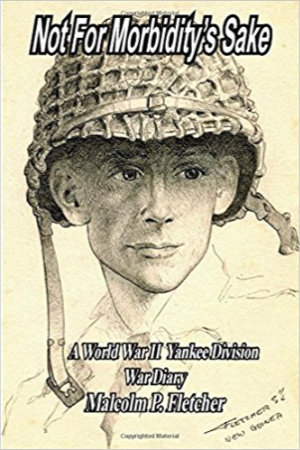
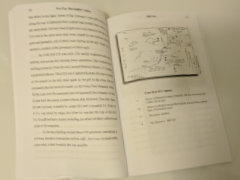
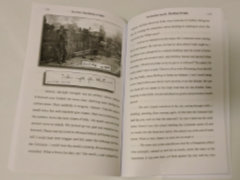
 It’s a familiar story I’d never heard before. In no way is use of the word “familiar” meant to be dismissive. It’s just my way of acknowledging that many aspects of Malcolm Fletcher’s story are to be found in the stories of thousands of other World War II soldiers. Of course, each of those stories is also unique in ways both small and large. Large happenings that make Fletcher’s story unique include the actions that earned him a bronze star and the day he watched his brother get shot and captured. Getting coffee and doughnuts from the Red Cross in February and washing clothes and shaving in May are among the not-so-large pieces of the story that make it real. Numerous photographs, maps, and drawings — many by Fletcher himself — really fill things out.
 It’s a great story and well told, but there’s no denying that the mere fact that it is being shared plays a big role in setting this story apart from most of the others. The majority of those soldiers never told their story to anyone. A relative few did write it down or record it but not many saw an audience beyond family, friends, or a veterans organization. That Malcolm Fletcher wanted to share his story is obvious. He expanded his wartime notes and produced a “diary”. The title is his. Not For Morbidity’s Sake came from the fact that, as his son Michael says in the foreword, “…he took no pleasure in telling most of this story”. Malcolm Fletcher died in 1994, and Michael, with help from his brother Mark, made publication of the diary a reality. To a large degree, this meant editing their father’s writings, but they also augmented the story with information gathered from other family members, friends, and even some of the men who served with Malcolm.
As mentioned, not many World War II veterans made any attempt to share their stories. In addition, not all who did were particularly good at it. Malcolm Fletcher was. At twenty-four, he was a little older than most of the enlistees he headed to Europe with in 1944. Maybe that made him a little more observant, or maybe that just came naturally. Either way, his observations fed some rather good sketches and some articulate writing.
 Those observations also fed some slightly philosophical thinking on the horrors of war and the brotherhood of man. He had personal experience with both. Whether the deeper of Fletcher’s thoughts came during his time in Europe or while he subsequently transcribed his notes in safety in the USA is unclear and unimportant. He was in the midst of battles where men destroyed each other with cannons, bombs, rifles, bayonets, and flame-throwers. He saw many and met a few French, Belgian, and German civilians whose world was ravaged beyond comprehension. And he was there at the end of the conflict, interacting with German and Russian soldiers to learn that “These Russies are just like us.”
He was there as a strange calmness came to a devastated Europe, and plans were being made to send him and lots of other men to tackle the Japanese. He was there when Hiroshima and Nagasaki were bombed, and the war ended without an invasion. He came home to a world that was damaged in its own way. He stumbled. He regained his balance. He wrote his story. The basic plot may be familiar, but the details are unique and personal, and the telling is something special.
Not For Morbidity’s Sake: A World War II Yankee Division War Diary, Malcolm P. Fletcher, CreateSpace Independent Publishing Platform (December 10, 2017), 6 x 9 inches, 226 pages, ISBN 978-1981114696
Available through Amazon.
I know Michael Fletcher through his work as a bassist with several local bands. I’ll admit that it’s rather unlikely I would have found this book on my own otherwise. But, if I had, there is no doubt that I would have enjoyed it. Knowing Mike or even knowing who Mike is is certainly not required to appreciate his father’s story. On the other hand, I probably enjoyed this book more than many, and it’s certain that the story is more familiar to me than most. Malcolm Fletcher’s time in the military more or less parallels that of my own father. Both probably crossed the Atlantic in the same convoy, although Dad landed in England rather than France. Both were at the Battle of the Bulge, and both were early crossers of the Siegfried Line.
But there were definitely big differences. Dad was a courier and spent most of his time driving a Jeep or truck. He was usually at or near the front but was not directly involved in the fighting in the way Malcolm Fletcher was. And he never talked about it the way Malcolm Fletcher did. I kind of wish he had. I’d certainly like to know more, but I think his “silence” was rather typical. There were occasional, seemingly spontaneous, reminisces that provided cherished glimpses but no long stories and no writing or recording.
Dad served with the 78th “Lightning” Division. Until about four years ago, there was an associated veterans group that published a quarterly newsletter called The Flash. Veterans’ memories were an important part of its makeup, and I read many of them. There are, naturally, similarities between the stories of every soldier in every war in every location, but I was thinking specifically of the stories I’d read in The Flash when I called Not For Morbidity’s Sake “..a familiar story I’d never heard before.” I wrote about the newsletter’s end in One Last Flash in 2013.
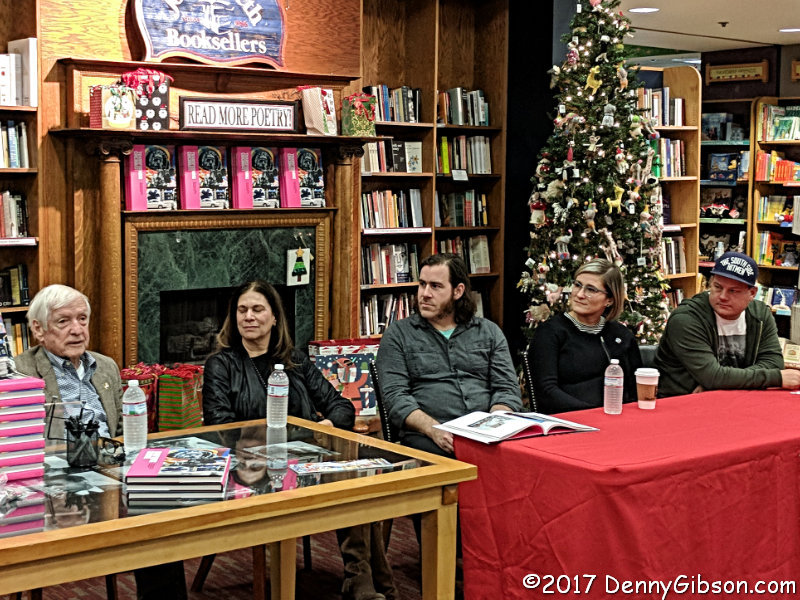
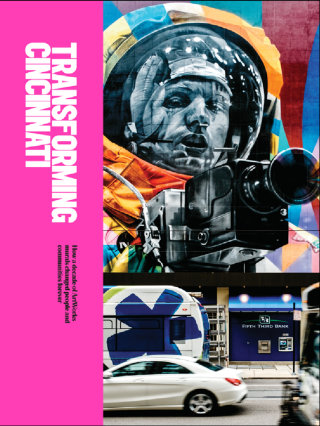 It would be nearly impossible to spend any time at all around Cincinnati and not notice that its mural population has been increasing. I’ve noticed but I didn’t understand. I didn’t understand that ArtWorks Cincinnati, a name I sometimes noticed being associated with a new mural, wasn’t just a company hired to paint some pictures on some walls. I started to understand that aspect of Cincinnati’s murals just a little when ads for Transforming Cincinnati started to appear that included pieces of the back story. At that point I thought I understood the book’s title but, as I learned when I attended the big premier nearly two weeks ago, that was probably what I understood the least. The official launch took place on November 18 at a “Book Premier & Artist Signing” hosted by Joseph-Beth Booksellers. I attended with the idea of getting a copy with a few autographs in it. I got so much more.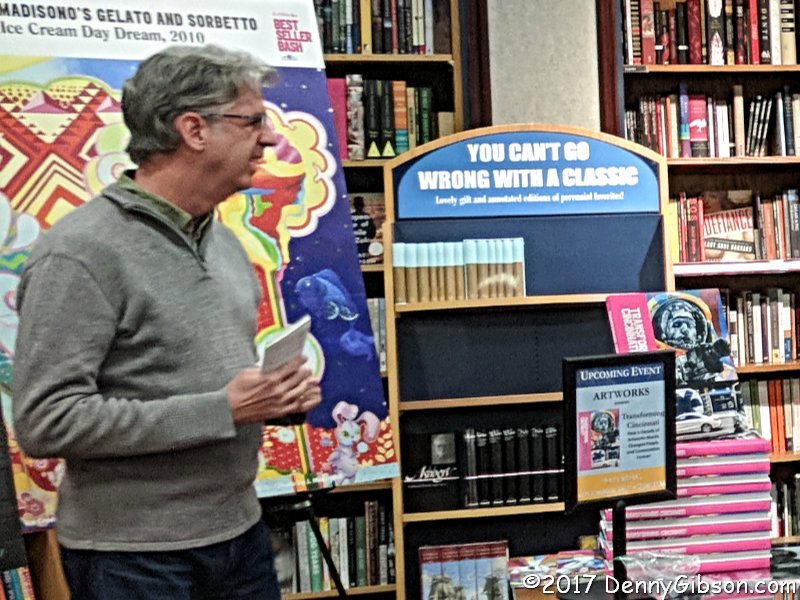
 Wow! This is one of the most captivating books I have ever held in my hands. It is the product of one of the most determined woman I have ever met on one of the most exciting adventures I can imagine. Claiming to have met Anna Grechishkina is actually something of a stretch. At the 2014 Route 66 Festival in Kingman, Arizona, she joined some festival attendees for dinner. Our “meeting” consisted of a second or so of eye contact and a group hello. But I learned of her dream and her plans to fulfill it and I have followed her journey from that point on.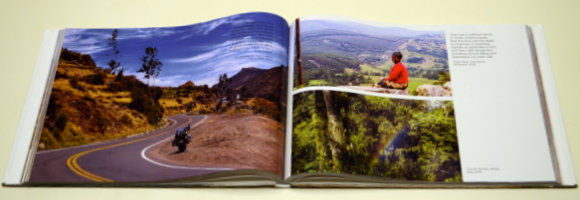
 This could be the charm associated with third attempts, or it could be the out associated with third strikes. Seriously, though, I doubt it is either. Neither of my first two books,
 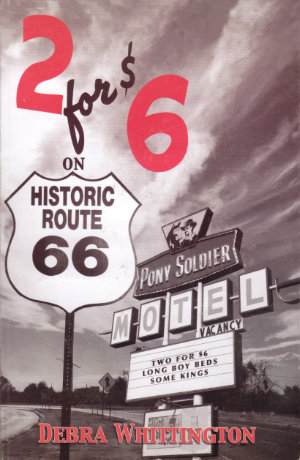 I wish I had $6 or even 6¢ for every time I’ve stood by an old motel or diner and wished that the aging walls could talk. There are no talking walls here but 2 for $6 on Route 66 does contain the memories of someone who spent a whole lot of time with some very interesting walls. Author Debra Whittington married into the motel business; The man she married was born into it.
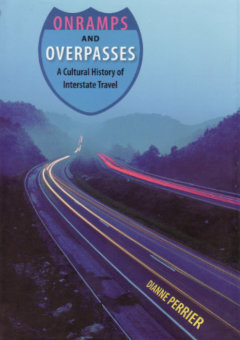 You can’t judge a book by looking at the cover. Or, sometimes, by reading the title. That was the case for me with Onramps and Overpasses and the impression I got from the title and cover pretty much explains why it stayed on the unread pile so long that I don’t remember where it came from or why I have it. The cover is a nicely done long exposure photo of cars on a divided four-lane highway passing through what looks to be a rather scenic area. The title reinforces the image of high-speed limited-access roadways. The subtitle, “A Cultural History of Interstate Travel” does a better job of describing what’s inside but the preconception created by the cover and title led me to overlook the word “cultural” and misinterpret the word “interstate”. In my opinion, Perrier goofed on the cover and even more so on the title. Those are, however, virtually the only mistakes she makes here.
 I’ve not read a lot of fiction lately. I used to. There was a time when I sucked down a fair amount of science fiction and historical fiction along with a smattering of aged classics. Sorry’s Run is none of those. It is, however, just about everything else. If pressed to place it under a single heading, I guess I’d call it a mystery. It’s a mystery where learning what was done is at least as much fun as learning who done it. Beneath the book’s central plot is an intriguing layer of occult, a tolerable touch of romance, and frequent and appreciative glimpses of the Ohio River and the country it flows through. It is set in the real world of today although it’s a world whose edges are not always crisply defined.
 The review of this book published in April 2017 has gone missing. Maybe I accidentally deleted it or maybe a slightly down level backup was restored and I didn’t notice. Whatever happened, I’m confident it was my fault. I’m not going to try to reproduce the whole review. I’m just trying to head off the “not found” errors — and encourage everyone to buy a copy.
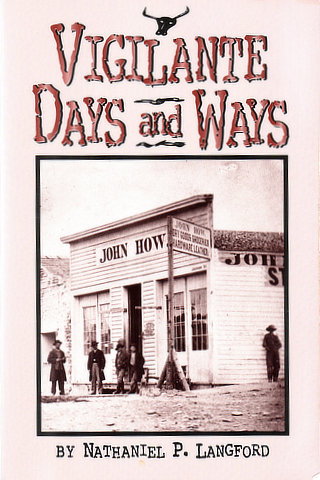 This book was first published in 1890. The link at the end of this article points to a version published barely a month ago. Despite it being well over a century old, some think it worth reading and someone considers it worth republishing. Why others consider the 127 year old writing worth reading I cannot say but I know why I enjoyed it. It’s filled with stories I’ve watched unfold on TV or in a movie theater or read as fiction. Those tales of frightened town folk, evil bullies, crooked sheriffs, and cowardly henchmen that thrilled me in my younger days were all legitimate. The basis of many plots played out in the numerous TV westerns of the 1950s and ’60s can be recognized in the real world events that Langford documents. This book is filled with characters very much like the assorted outlaws encountered by the horse riding heroes of my youth. Men similar to some of those heroes are also present although they don’t stand out quite as clearly. Few real world heroes wear a pair of pearl handled revolvers and a white hat.
 I’ve never met Jaimie Vernon but we’re friends. We’re the kind of friends that didn’t even exist a dozen years ago. Yes, we’re Facebook friends. It’s because of music. Vernon runs Bullseye Records which represented the band Klaatu through part of their career. I’m a Klaatu fan and stumbled onto a related online group in which Vernon played an active role. The e-group eventually became more or less dormant but we remained e-friends in the Facebook world. I’m sharing this, not because it has anything to do with the contents of this book, but to explain how I even know of the book’s existence. I am not in the habit of chasing down either cop books or cemetery stories.