This post first appeared last year. I’ve brought it back, with date appropriate updates, due to its uncommon concentration of useful historic facts.
 Two years ago I noted with surprise that Easter and my birthday have coincided only twice in my lifetime. But it has happened several times outside of my lifetime and that includes 1722 when Dutch sailor Jacob Roggeveen came upon a tiny South Pacific island which the residents may have called Rapa. Whether they did or didn’t mattered not a bit to Roggeveen who decided to call the island Paaseiland. Dutch Paaseiland translates to the English Easter Island. The island is now part of Spanish speaking Chili where it is known as Isla de Pascua. Its modern Polynesian name is Rapa Nui.
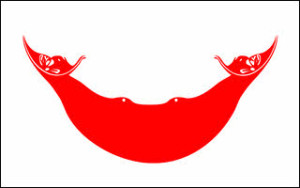
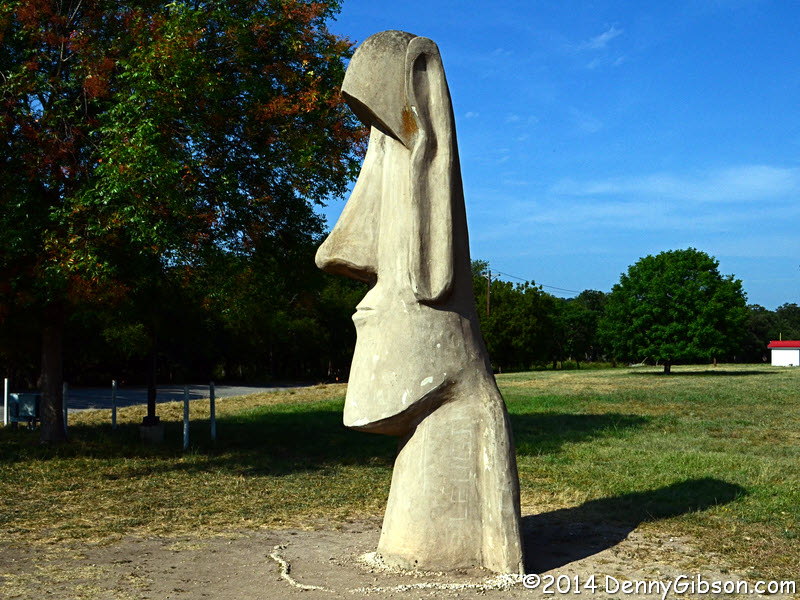 The opening image is the Isla de Pascua flag. The red figure represents a reimiro, an ornament worn by the native islanders. At left is an image more commonly associated with Easter Island. The island contains nearly 900 statues similar to the one in the picture. I’ve never been to Easter Island and have no pictures of my own although there are plenty to be found around the internet. This photo is one I took of an imitation at the Hill County Arts Foundation near Ingram, Texas.
The true significance of the statues, called moai, is not known but we do know that they once outnumbered inhabitants by roughly 8 to 1. The island is believed to have once held about 15,000 people. A number of factors reduced that to maybe 3,000 by the time Roggeveen came along. Contributing causes were deforestation, erosion, and the extinction of several bird species. The population probably remained around 3,000 until 1862 when Peruvian slavers began a series of raids that resulted in about half of that population being hauled away. The raiders were somehow forced to return many or perhaps most of those they had captured but they brought smallpox to the island when they did. Tuberculosis arrived just a few years later and disease, violent confrontations, and a major evacuation reduced the human population to just 111 by the late 1870s. There are currently 887 moai on the island. In the past there may have been more.
Today is the 296th Easter Sunday that Easter Island has been known by that name. The population has grown considerably and is now around 6000 which must make for a much happier island than when barely a hundred hung on. Of course the actual calendar date of the naming (and my birthday) passed more than a week ago. I hope everyone remembered to wish their friends and family a Happy Easter Island Anniversary.


 Friday’s date was eleven eleven. I spent the day at the 2016 Los Angeles Route 66 Festival where the ninetieth anniversary of Route 66 was celebrated. November 11, 1926, was when the United States Numbered Highway System was officially approved so US 66 did indeed come into being on that date but so did another 188 routes. I’ve always thought the big deal some folks make of Sixty-Six’s “birthday” to be somewhere between silly and chauvinistic. Sort of like New Hampshire celebrating its independence — and only its own independence — on the Fourth of July.
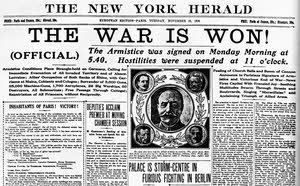 But November 11 was an actual national holiday well ahead of the creation of the United States Numbered Highway System and it marked something more meaningful than identifying one nation’s roads. When I started to school in 1953, November 11 was known as Armistice Day. During the next year, the name was officially changed to Veterans Day although people around me didn’t start using the new name immediately. Nor did they immediately embrace the new definition. Armistice Day marked the anniversary of the end of The Great War on November 11, 1918. It began in England but soon spread to virtually all the allied nations. Two minutes of silence — one minute to remember the 20 million who died in the war and a second minute to remember those left behind — at the eleventh hour of the eleventh day of the eleventh month was an important part of the day. Things started changing when the world had another “great war” and had to start numbering them. England and many other nations changed the name to Remembrance Day to include those lost in both conflicts and, as I mentioned, the United States changed the name to Veterans Day. This may be when we began observing a single minute of silence on the day or maybe it was always that way in the US. We observed one minute of silence at the festival.