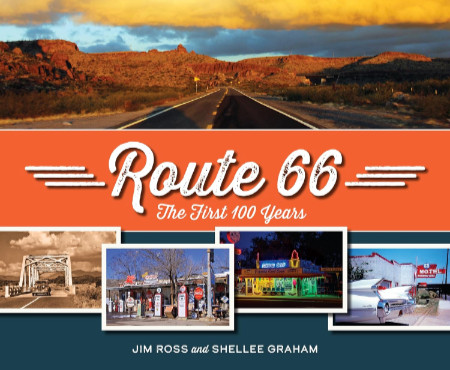
 It’s a beauty. That was my initial thought when I first held this book in my hands and flipped it open. I wasn’t surprised, of course. I’ve seen enough of Jim and Shellee’s work to make me expect great photography and writing, a top-tier knowledge of history, and a rock-solid commitment to quality. I’m not quite as familiar with Reedy Press, but what I have seen smacks of the quality targeted in that previously mentioned commitment. My instant declaration of beauty came from seeing great images accurately reproduced on thick glossy pages. Including the text in my appraisal took only a little more time.
Route 66: The First 100 Years differs from some of the authors’ previous books in that it does not rely almost exclusively on their own photography for the book’s images. It’s a history book, so naturally, historic images are used; however, contemporary pictures from other photographers are also included, with each being properly credited.
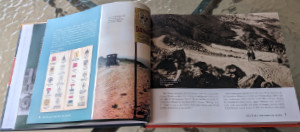 Unlike many other Route 66-related books, Route 66: The First 100 Years is not organized geographically. Nor is it organized chronologically as history books often are. There is a slight hint of chronology in discussing the roads that preceded US 66 in Chapter 1, “Revolutionizing Travel”, and covering “Renaissance” and “Preservation” in the last two chapters. In between, chapter subjects might be eras (e.g., “Hard Times”), collections of people (e.g., “Ladies of Legend”) and businesses (e.g., “Trading Posts and Tourist Traps”), or something else. Whatever the subject, a wide-ranging set of examples is included. But 100 years and 2400+ miles cover a lot of space and time, and anyone with more than a passing familiarity with Route 66 will probably come up with a personal favorite or two that didn’t get included. The selection process could not have been easy, but the selections are excellent.
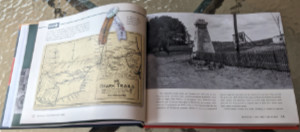 Every chapter, like the vast majority of real-life road trips, has a “Detour”. The book’s detours are deep dives into one of the chapter’s subjects, and not all of them are obvious. The detour for the “Revolutionizing Travel” chapter is “The Ozark Trails”. This was an early named auto trail, or actually a system of auto trails, that, in my experience, doesn’t seem to get enough recognition. The “Hard Times” chapter takes a detour into an area that has been overlooked far too often for far too long: “The Green Book and Threatt Filling Station”.
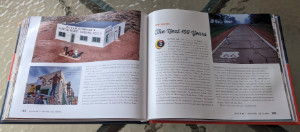 It’s probably not all that surprising that Route 66: The First 100 Years overflows its twelve numbered chapters. It starts with a full page of Acknowledgments, followed by a Forward written by Route 66’s storytelling king, Michael Wallis. Jim and Shellee follow that with a Preamble, then include an Epilogue, Road Facts, and a few other sections after Chapter 12. One of these sections, titled “Happy Trails”, is a collection of roadside photos taken over the Mother Road’s first 100 years. Many are of unidentified travelers, but there are some real celebrities in the mix. There’s Jack Rittenhouse standing beside a California U.S. 66 sign, Lillian Redman by an Arizona 66 sign, and Cynthia Troup gazing at a U.S. 66 sign in New Mexico. As I said earlier, 100 years and 2400+ miles cover a lot of space and time. Jim and Shellee have done an impressive job of capturing the big picture and quite a few of the small picture details, too.
While writing this, I took a look back at a post from this blog’s first few months of existence. My review of “Route 66 Sightings” by Jim and Shellee, along with their good friend Jerry McClanahan, was one of the first reviews published here. I was surprised to see that its last sentence starts with the exact same words that begin this review: “It’s a beauty”. Maybe I’m in a rut, but at least I’m being honest.
Route 66: The First 100 Years, Jim Ross and Shellee Graham, Reedy Press (May 22, 2025), 11 x 9 inches, 208 pages, ISBN 978-1681065823
Available through Amazon.


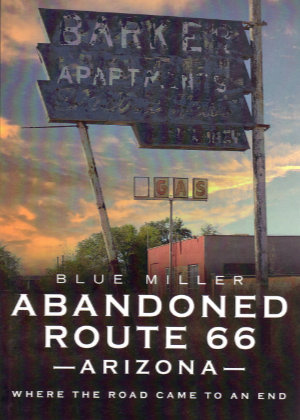 If I maintained a list of questions I frequently ask myself, “Why another Route 66 book?”, would be high on the list. I have never arrived at a reason that another one is actually needed; only justifications for ones at hand. Those justifications generally take the form of answers to two questions. They are, “What makes this book different from all others?”, and “Why should I buy it?” In practice, I ask them in the reverse order which means that, if I don’t have a good reason to buy a book, I’ll probably never get around to discovering what, if anything, makes it different.
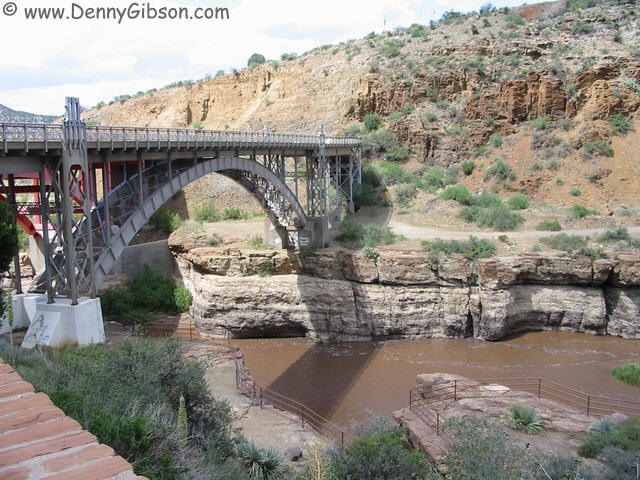
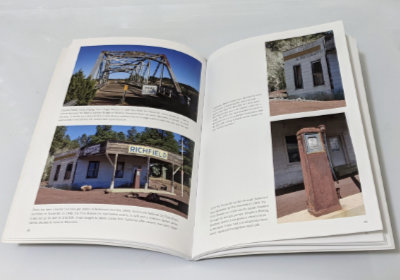 Although not of the coffee table variety, this is first and foremost a photo book. It contains upward of a hundred photographs, in color, printed on good quality semi-gloss paper. They are primarily documentary photos. That does not mean that they are boring, but it does mean that properly recording each subject is the main goal. The book is certainly not without its share of creative composition, but there are no abstract-light-patterns-on-pavement style pictures. There are usually two or more photos on a page for a max size somewhere around 5.5 by 3.5 inches. That might keep you from displaying it on your coffee table, but it is plenty big enough to show off bridges, buildings, and signs.
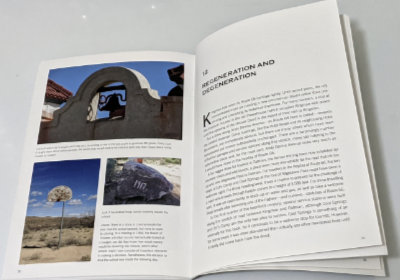 Yes, the pictures are cool and those of some fairly obscure places enlightening, but it is the words that made me happy with my purchase. The histories of most of the pictured buildings are told. Some are reasonably well known and available elsewhere, but Miller’s telling is both complete and concise. Others are not so well known, and I’ve little doubt that Miller’s aforementioned sleuthing ability brought out some details and possibly some entire stories. Maybe others knew all those details about the schools of Valentine, but I sure didn’t, and the story of the Ostermans and Peach Springs was all new to me. There are other examples of what I take to be sleuthing in the book, and all of them add to my appreciation of it.