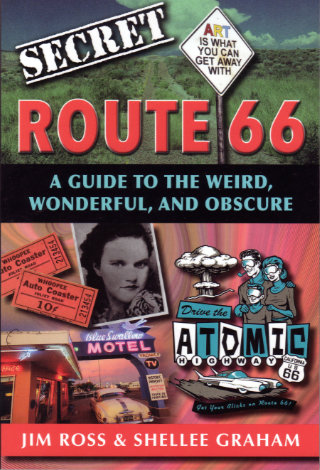
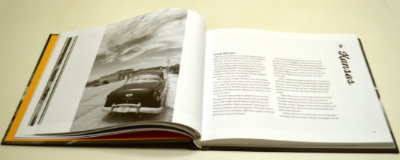
 At first glance, this probably looks like a perfect fit for my bookshelf. Like many of the other books there, its subject is a historic highway and its authors are people I know. In this case, the highway is Route 66 and the people are the husband-and-wife team of Jim Ross and Shellee Graham. Both are accomplished historians, photographers, and writers with Jim probably having a bit of an edge in the history department, Shellee having an equally small lead on the photography side, and their writing skills being too close to call. A second glance, however, just might turn up something about this book that is different from most of the others with which it now shares shelf space. It is the word “secret”.
I am not a fan of books with words like “haunted”, “mysterious”, “unsolved”, or “bloody” in their titles. I don’t know whether or not that puts me in a minority of road fans, but apparently it does in the larger world of readers in general. A writer friend’s publisher has pushed for a “haunted” book saying they are four times as popular as the other kind. To me, those words smack of exploitation. They seem to scream out the intent of emphasizing some sort of supernatural or scandalous connection for a topic that must be otherwise boring. I acknowledge that “secret” doesn’t sound quite as exploitative as “haunted” and that even “haunted” and the other words I’ve mentioned can be used as honest labels, but I still find them offputting.
Anyone who read my blog entry about visiting the recently reopened American Sign Museum will know when I bought this book and may even have some idea why. The ASM, like practically every other museum in the country, was hit hard by a COVID-19 related closing. As a member, I’d paid nothing for my visit, and wanted to show a little support with a purchase.
 So how is this book I didn’t exactly want? Surprisingly good. I’m not really all that surprised, of course. To my relief, the idea of revealing secrets doesn’t get much further than the title. I doubted that a pair of respected authorities would suddenly become conspiratorial sounding characters sharing dark secrets from the shadows but it was good to have that verified. To some extent, the subtitle also does that. Weird, wonderful, and obscure accurately describe the book’s contents.
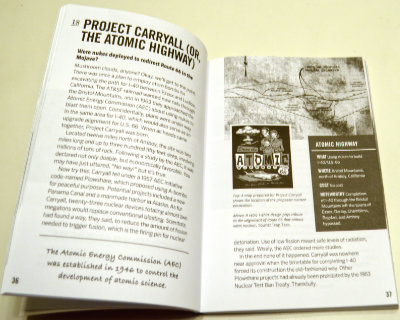
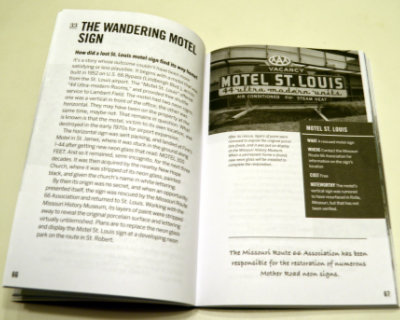 Almost everything in Secret Route 66: A Guide to the Weird, Wonderful, and Obscure is something that, while not actually a secret, is not likely to be found in mainstream guides. Even when the subject is something commonly known, Ross and Graham provide some detail or backstory not commonly known at all. Sometimes the subject isn’t a place or a thing but simply that uncommon detail or story. Among the things that struck me as weird is the true tale of a proposal to use atomic bombs for roadway excavation. Everyone has their own definition of wonderful but my definition is matched by the story of the Motel St. Louis sign that wandered off to help people find another motel (Finn’s in St. James) and then a church (New Hope) before being rescued and returned home. I thought learning about the annual reunion for the ghost town of Alanreed was kind of wonderful, too. Topping my personal list of obscure things is the chapter on several abandoned bridge abutments on the original route through Santa Fe.
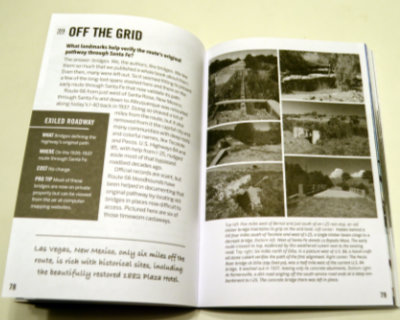 A pair of facing pages make up each of the ninety chapters so that everything about an item can be studied without flipping back and forth. A sidebar contains appropriate information, such as location. These pages are printed in black and white, but they are augmented by sixteen pages of color photographs (plus 2 b&w to make the positioning work) in the middle of the book. Some page flipping here is appropriate but the subject and associated page number are shown for each photo to make it easy. Images in the book are a mixture of historic and modern. Most of the modern photos are the work of the authors but not all. Other researchers and photographers are always credited with images provided.
I ended up liking this book that I didn’t exactly want. That really was to be expected with the Ross and Graham names on the cover. It’s a good reference to add to a Route 66 library although not to start one. Seeing obscure things is good. Seeing only obscure things not so much. You don’t want to come home from your first Route 66 trip and have to say “no” to every “Did you see?” your neighbors and relatives ask. You want to respond with, “Yes, and did you see the [put your favorite Route 66 ‘secret’ here]?”
Secret Route 66: A Guide to the Weird, Wonderful, and Obscure, Jim Ross and Shellee Graham, Reedy Press, LLC, October 15, 2017, 6 x 9 inches, 208 pages, ISBN 978-1681061078
Available through Amazon.

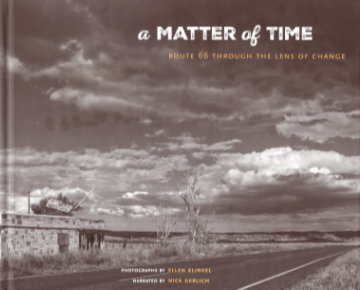 There’s not much point in counting the number of books published about Route 66; The likelihood that the count would increase before you were done is just too great. An Amazon search simply says “over 2,000”. So why review this one? What sets it apart from the others? The most obvious reason for reviewing it is a simple one: I know one of the people whose name is on the cover. The things that set it apart are not as obvious (or benignly biased). In fact, I’ve only found one thing about the book that I think is actually unique, and I’m not really sure about that. The book has no author; It has a narrator.
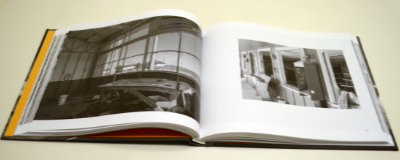 The photos are black and white, which is unusual but not unique. What may be unique is how they came to be at all. Klinkel tells that story in the book’s preface. It begins in 2013. She lives in Germany and was in the western U.S. with her husband for a four-week vacation which she describes as “the first time I ever had a serious camera in my hands”. Planned visits to several national parks fell victim to the sixteen-day government shutdown in October of that year and driving a portion of Route 66 was substituted. Klinkel credits this very first time on the historic highway coupled with the “serious camera” as having “instantly sparked my passion for photography”.
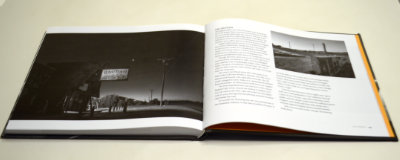 Most, but far from all, of the photos are of places I recognize from my own travels on Sixty-Six, and some of those nearly reproduce visions I’ve had myself. There are plenty of pictures of places I do not recognize. Sometimes that’s because they are from a location where I’ve never stopped or maybe even passed, but sometimes it’s because Klinkel sees and shares a vision that never occurred to me even though I’ve stood at or near the very spot she did. I don’t mean to imply that I expected anything else. It’s great to be shown something you’ve never seen, but it can be even better to be shown something known in a new way. Although it is a place I instantly recognized, a favorite example of being shown something in a new way is the early morning shot of the Bagdad Cafe with the coming sun just a tiny but significant twinkle. Another is the low-level shot of a protective wall of tires at a long-abandoned gas station at Texas Exit 0 of I-40.
 However, something clicked on a rereading of that preface that hadn’t quite registered on the first pass. Klinkel explains the title quite clearly:
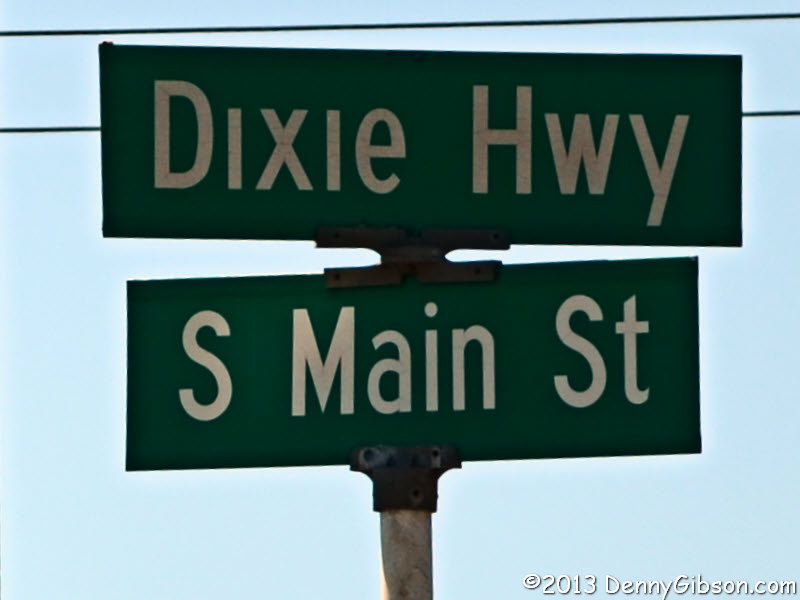
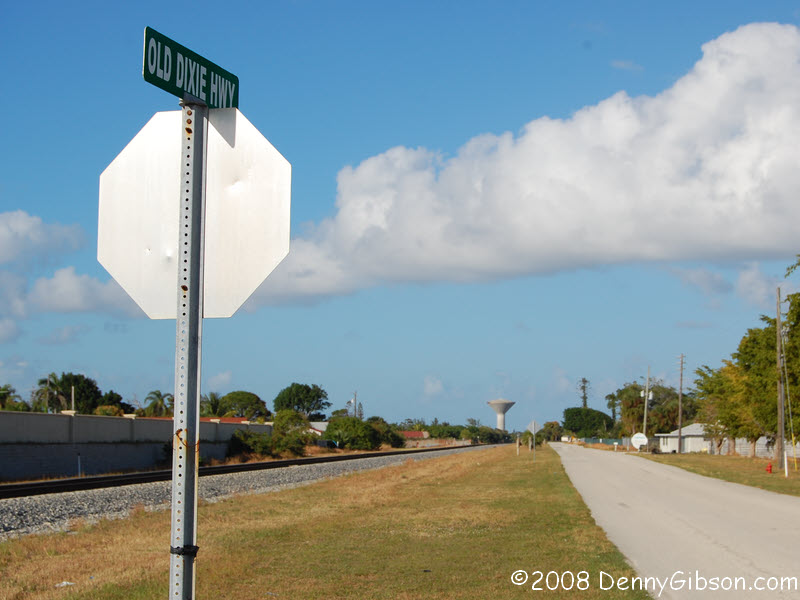
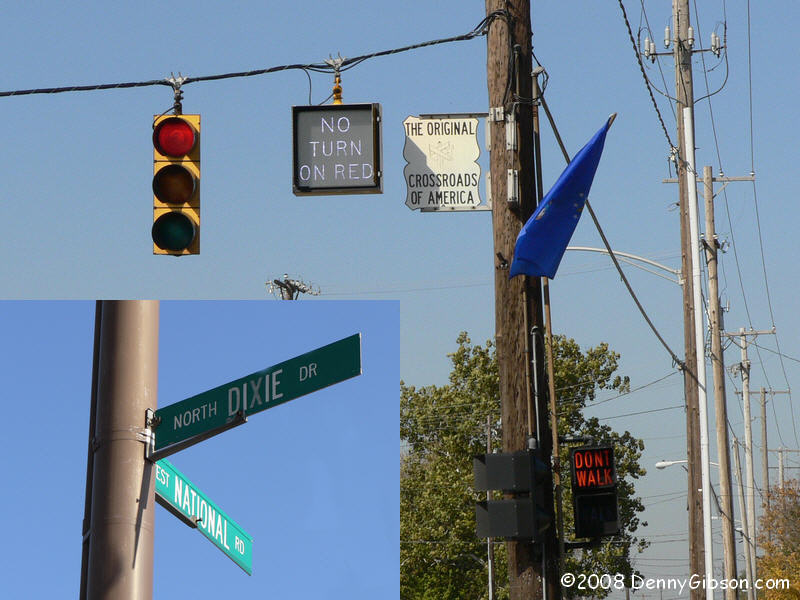
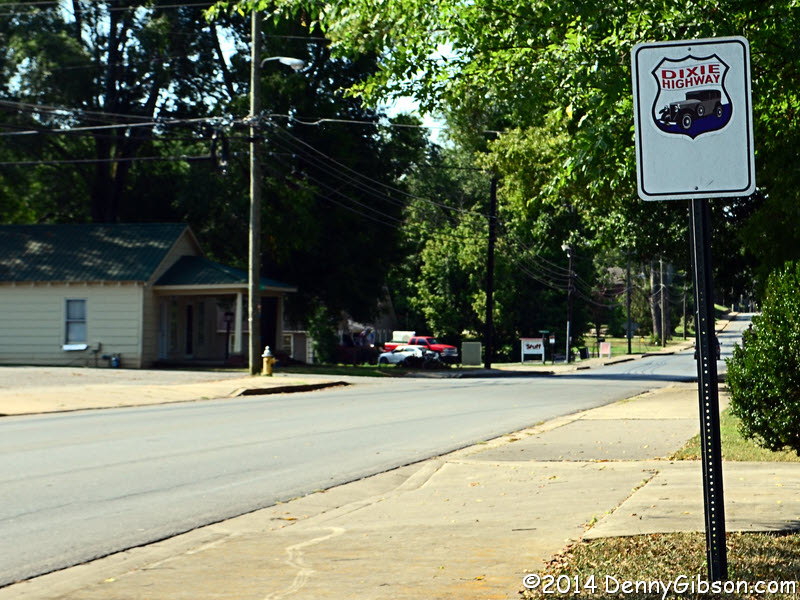
 If something called a dixie existed, I have little doubt that we could refer to it differently without changing its aroma, but the word “dixie” doesn’t really identify anything. It is not, in other words, a common noun. As a proper noun — with a capital ‘D’ — it is used as both a surname and a given name and to identify a wide variety of things including a region of our country. People with a first, last, or nickname of Dixie surely outnumber things bearing the name but there are certainly plenty of those. It has been used to identify buildings, songs, currency, music groups, towns, counties, movies, beer, boats, ships, taverns, race tracks, waterways, restaurants, mountain ranges, athletic conferences, grocery stores, airports, schools, universities, and much more. With an ‘X’ made of a stylized flower, Dixie is a registered trademark of Georgia-Pacific for a brand of paper products.

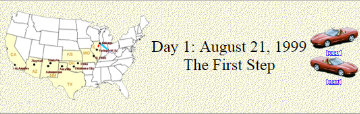 A lot of things about the site have changed over the years but some things begun with that first trip have stuck. The concept of a page for each day with access to the next and previous day has been in place since the beginning as has a cover page with direct access to individual days. The idea of using the daily “Next’ and “Prev” button to (usually) represent the vehicle being used also goes back to that first trip. An animated GIF showing progress has been used on a few subsequent trips but it requires knowing the full route in advance and that’s often not the case. Besides, it’s a fair amount of work.
 The final cover page for that trip talks about it being temporary. As I said at the time, I expected it to go away because “I’ll need the space or retiring it will just seem right.” Web space became increasingly cheap and apparently retiring it never seemed right. Two decades later that first trip journal is still online and I’ve added 155 more. There is a